Asymco

Asymmetric Intelligence

Research

  1. Tele Vision

    Research · 115 comments

    Every few months rumors emerge of another technology company attempting to create a new product centered around the TV. Apple's name comes up, of course, but so does Google. And Microsoft has been experimenting with no lesser degrees of vigor than the others. They all seem to be trying to make TV smarter, somehow.

    But I would argue that these efforts are misguided. Television is more than the TV set or a set-top box, or any box. It's more than channels or broadcasters or producers or aggregators or distributors. It's all of these things; plus more. It's a value network of great breadth and complexity. It's a highly modularized industry with well-defined business model boundaries and inter-dependencies. I would argue that its very breadth is what has kept it rigid and immune from disruptive change.

    If you look at each technological experiment to move to a new business model, they can all be reduced to the offer of an additional or substitutive module. There is no assumption made that the content being served will change. To put it in the context of mobile computing, it's like trying to introduce a smartphone in a world without data networks--where the only service to be served is person-to-person calling. Unlike the Smartphone which could only have emerged to leverage the Internet, TV has no "smart content" to leverage. The "smartness" has to be not in the box but in the programming.

    Of course, I don't mean there's a lack of good programming. What I mean is that there is no innovation in what a program is--the job it's hired to do. The way it and its distribution fits into a person's life. TV programs have not changed for half a century. They feature the same genres, the same duration, the same business model, the same series, format and scheduling and the same value chains as when "I Love Lucy" premiered in 1951. They assume people watch TV during the same time each day (while doing nothing else.) They also assume people are equally influenced by brand advertising and that audiences are largely homogeneous.

    Contrast that with other media. The song, the book, the game, the newspaper even the movie have gone through consumption changes which have been supported by disruptive innovations. The portable music player, the ebook reader, the console and the mobile phone and the internet in general have all allowed consumption to conform to new usage patterns. The jobs that music is hired to do has changed dramatically. These re-definitions of what media is used for caused dramatic changes in both the production and distribution and hence the way value is captured in media.

    TV, it seems, stands alone and immune.

    So it's not hard to understand why technology solutions have largely failed. Every attempt to make a change in a part of the value network has affected another part, which has led to resistance and reversal. Even Hulu, an innovative distribution method for content, owned by a group of incumbents, has had to scale back ambitions as the incumbents throttled it. Apple TV faces a stone wall of restrictions on distribution due to the inter-locking contracts content is bound by. Google TV has been largely shut out for the same reasons.

    And I won't delve deeply into the fact that TV is intensely parochial. There are few if any global brands, programs or regulations. Every country, region, city and town feels a need to localize its content and offer obstacles to external sourcing. Governments engaged with the industry so long ago that they've become co-dependent.

    Only one experiment is entirely independent of the current network: YouTube. YouTube does not rely on current programming. It has allowed a new set of producers and new form factors to emerge. It's still very rough and incomplete as a solution but it may get better. The growth is phenomenal and the business model is sustainable[2].

    It's hard to provide an illustration of how important this separate network effect becomes, and how long the time frame can be. The only proxy I can draw on is the story of how Voice over IP has grown in comparison to voice traffic over the switched network. The following chart shows how three types of traffic have grown in the US between 1997 and 2015 (est.): Interstate and Intrastate Voice (left column) vs. Internet traffic (right column) with IP voice inset inside Internet Traffic (areas represent relative traffic measured in Terabytes/month)[1].
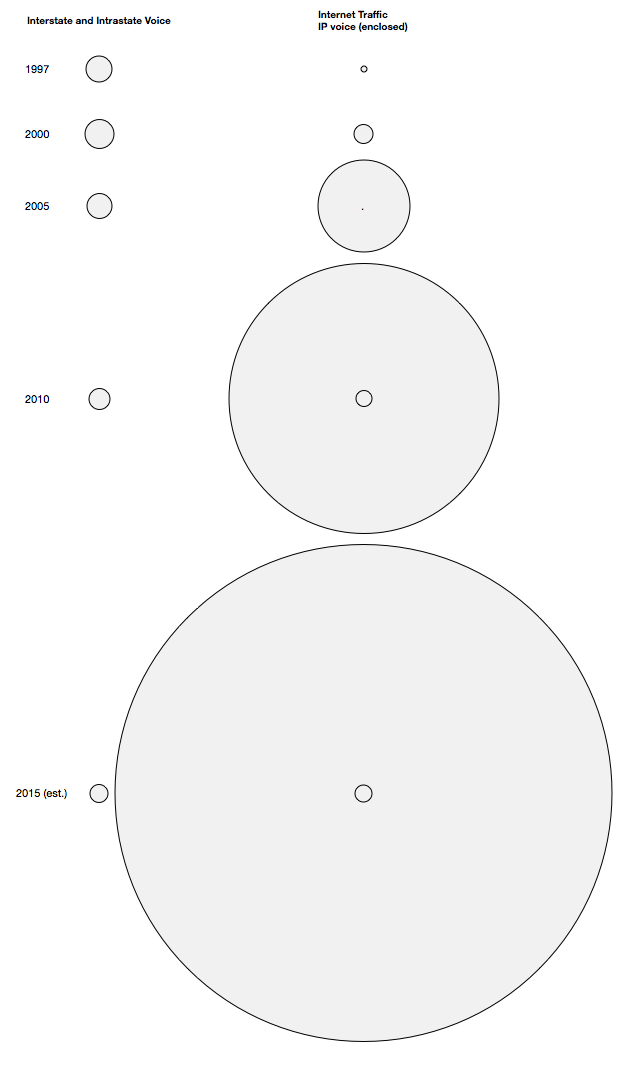
    The estimate for 2015 shows that Voice over IP will reach 23,000 terabytes/mo. while PSTN voice will consume only 26,000 TB/mo. A negligible difference and one which will likely be in favor of IP over a global scale. The tail indeed does wag the dog.

    The only numerate conclusion that can be drawn is that the growth of internet consumption is so vast that it swamps other forms of media, even if within the internet, media itself is a minor component.

    So as far as having a vision of tele-vision, the answer is not to graft technology onto an archaic value network, but to build a new value network around new technology.

    ---

    Notes:

    1. Source: Lampert, O'Connor & Johnston, P.C. June 16, 2011 Ex Parte via ... The Tail Wagging the Dog--A comparison of PSTN and IP traffic from 1997 to 2015.
    2. I note with some dismay that Google feels it needs to dabble in the current value networks. Nurturing YouTube is a far better use of its resources.
  2. Apple and comparables P/E ratios: Is punishment for growth being dispensed equally?

    Research · 72 comments

    Apple's valuation has been discussed several times on Asymco. Apple’s relative valuation in terms of P/E ratio has not improved since the recession despite an acceleration in financial performance. As Apple seems to be getting punished for growth, we have to also ask if it is the only one.

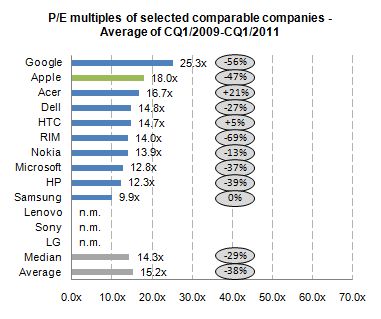
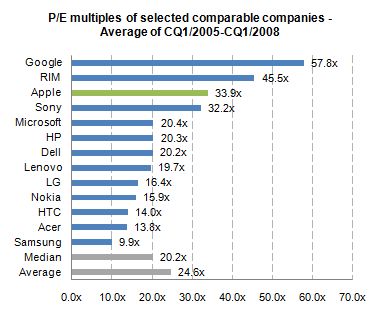
    When looking at valuation from an institutional investor or financial analyst point of view, the most common methodologies are discounted cash flow (DCF) as well as comparable company multiples. Most often, a DCF valuation is performed and cross-checked with comparable multiples. The justification for using comparable companies is the exposure to the same market dynamics including, for instance, market growth and profitability. So to understand this perspective, let us focus on a peer group valuation by looking at the average P/E multiples[1] for the calendar quarters 1/2005 to 1/2008[2].


    We can see that before the financial crisis Apple has been valued above the peer group average with a P/E ratio of 33.9x.

    During the financial crisis stock prices declined across industries. For the selected companies share prices declined on average more than 80%. One would assume that with the improved industry outlook and worldwide recovery since 2009, peer group multiples should return to pre-crisis levels. By looking at the average P/E multiples for the calendar quarters 1/2009 to 1/2011, we can derive the change in relative valuation levels.


    The data shows that, on average, all companies are continuously trading almost 40% lower for a two year period after the financial crisis. Despite Apple’s higher-than-average discount of 47% to pre-crisis valuation level, Apple is valued above the peer group average and on top of the mobile phone and PC vendor group.

    By using the comparable company valuation approach, we are able to see how institutional investors analyze and value Apple. The analysis points to a valuation paradigm shift affecting not only Apple, but many comparable companies post financial crisis. In addition, there was a premium on Apple’s valuation before crisis and there is a premium after the crisis.

    The notion that Apple has been single-handedly punished by the market does not hold in the context of comparable companies.

    The next step will be to determine if the P/E premium for Apple is consistent with its growth premium.

    ---

    Notes:

    1. Share prices as of end of quarter, earnings include last twelve months
    2. Charts excluding negative multiples and outliers (turn-around multiples)


  3. Welcome Dirk Schmidt, Asymco Contributing Author

    Research · 15 comments

    Asymco has reached nearly 19,000 comments from nearly 5,200 contributors. I value every comment and read them all. The process of contribution leads to peer review and encourages differing points of view. It's essential to finding errors, testing assumptions and, ultimately, learning.

    Since starting this blog, I've thought about how to increase the participation of the audience and how to offer it as a platform for others. There is a fundamental limit to how much one person can contribute and "move the ball forward." In that spirit, the method I'm initiating today is to allow comment writers to also write as contributor authors.

    Dirk Schmidt is the first such author. Dirk is a resident of Finland but is a native of Germany. He worked in corporate finance for six years. Prior to that, Dirk was an intern at Nokia and practiced management consulting.

    Dirk has an MSc from the Leipzig Graduate School of Management. He is on Twitter as @disc1979. Initially Dirk will write on topics related to financial markets and financial analysis.

    As Asymco expands, it should be understood as a resource that has many individuals behind it. I look forward to welcoming many more contributors.

  4. Is LG about to exit the phone market?

    Research · 74 comments

    LG's market position seems precarious. I first noted LG's predicament about a year ago: LG dreams of smartphones [Updated] | asymco

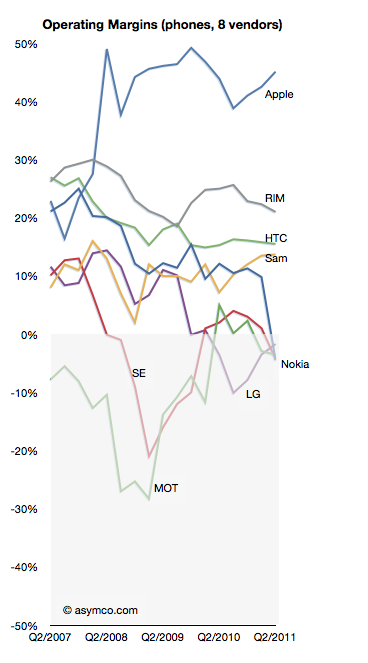
    LG lost profitability in Q3 2009 and has not recovered it yet nor can it say when it might.

    In a recent article on analyst reactions the prospect of LG's exit from handset sales is raised:

    LG's handset division is the company's biggest capital sinkhole and the shares have more than halved this year, making it the worst performer even when compared to HTC and Nokia.

    "Selling the loss-making business is probably what investors want," said Harrison Cho, an analyst at KB Investment & Securities. "But even with that option, LG wouldn't get much from the sale. They should have sold it long ago before the overall landscape got tougher."

    "They simply missed the boat," said Cho.

    The dire business outlook had already pushed LG shares below their book value to a record-low multiple of 0.9 times its book value, much cheaper than Research In Motion's 1.6 times, Nokia's 1.1 and HTC's 8.2.

    That's a huge discount for a company that is also a global brand in television and home appliances.

    Analysis: LG faces tough choices for mobile phone division - Yahoo! Finance

    As I like to point out it's unlikely that management failure is the sole cause for this problem LG finds itself in. If it were, then why did Nokia, Sony Ericsson and Motorola find themselves in trouble at the same time?

    But putting aside the causes, the prospect of another tier one vendor becoming a victim in a booming market speaks volumes. Only Samsung remains largely unscathed, though I believe they are not immune. The shift in profit capture that I have been documenting is plain proof that the industry is undergoing permanent structural changes.

    As the chart to the left illustrates, the plunge into negative margins is difficult to reverse. The only advice for LG today (besides breaking itself up) is:

    "What LG can do at this point is keep doing what it can do best; keep upgrading its hardware offering, differentiate them and then diversify away from Android to Microsoft's Windows phones," said Jung Kyun-sik, a fund manager at Eugene Asset Management in Seoul.

    I suspect however that diversifying into multiple platforms will not be particularly differentiating as every other vendor will do the same.

  5. Polymath

    Research · 87 comments

    In a rare reflective moment Steve Jobs, after the launch of the iPad, mentioned Apple's DNA. He said:

    "Technology alone is not enough. It's technology married with the liberal arts, married with the humanities, that yields the results that makes our hearts sing.

    Nowhere is that more true than in these post-PC devices...that need to be even easier to use than a PC, that need to be even more intuitive than a PC; and where the software and the hardware and the applications need to intertwine in an even more seamless way than they do on a PC.

    We think we are on the right track with this. We think we have the right architecture not just in silicon but in the organization to build these kinds of products."

    Steve Jobs' legacy in product development has been clearly established and celebrated. What remains now is to determine his legacy in company development. If indeed Apple has the "right architecture in the organization" to serially build disruptive products. The collection of evidence begins today.

    If Apple has indeed become Jobsian then it will have been a grand achievement. John Gruber is already convinced. He points out

    Jobs’s greatest creation isn’t any Apple product. It is Apple itself.

    If indeed he has built Apple sufficiently well to last then he has built an admirable process and not just a product. But this would not be a unique achievement. There have been other companies which preserved their founders' cultural imprints, at least for significant periods beyond their departure. Consider that Disney, Ford and even HP and IBM remained successful for many years after the departure of their founders operating much the same way. They were infused with an indelible culture and preserved it for some time.

    But a leader should aspire to do more. A leader should claim to have left a legacy not just on their company but on all companies.

    Is it not more worthy to have changed civilization than the fortunes of a few?

    I believe that Steve Jobs has actually sought just that. He put it as "making a ding in the universe." This can be interpreted as developing products that "change everything". But if the thing that Steve Jobs should be most proud of is the creation of Apple Inc. then how exactly could an Apple Inc. benefit the world?

    This is where Jobs' quote above strikes me as valuable. The lesson the world should take from Apple is that a company needs to become multi-dimensional. It needs to mix the core business with the disruptive innovation. It needs to combine the intellectual with the artistic. It needs to maintain within it the rational and the lunatic.

    Apple's violent success should serve as a powerful beacon that others should follow. Rather than copying its products other companies should copy Apple's processes--its way of thinking. They should copy how Apple harbors the creative process and the technology processes under the same roof.

    If they do heed this call then we should look forward to the the post-Jobs era as that time when large companies gained the ability to intertwine multiple core competencies. A time when humanism balanced corporatism. A time when we came to reconcile the rational and spiritual.

    --

    This post has be re-published in The Harvard Business Review Blog as: Steve Jobs's Ultimate Lesson for Companies - Horace Dediu - Harvard Business Review

  6. Estimates for Apple's fourth fiscal quarter: Entering the post-P/E era

    Research · 91 comments

    I'm late with posting my estimates for Apple's current (fourth fiscal) quarter. Normally I post my estimates a few days after the previous quarter's earnings are announced. This quarter however there was a lot to think about.

    As pointed out in my analysis of the previous quarter, the iPhone sold at a far faster rate than I thought. I had expected it would be a "lame duck" in the quarter but the expanding distribution allowed it to continue at a triple-digit growth rate (142% in fact, the highest quarterly growth rate since 2009).

    So the question for this quarter is, as always, what's the iPhone growth? The problem for me is that I have to choose between two assumptions:

    1. Due to distribution and dual product strategy (n-1 variant) production has now become more consistent.
    2. This quarter is the actual transition quarter when iPhone 4 production is throttled down in favor of the new model.

    The first assumption would put the iPhone growth at 100%+ while the second would place it in the 60% to 80% range. I decided to dial in a figure somewhere in between at 90% but I'm not very confident in this until we see more evidence that a new pattern has emerged.

    So here are my "mid" quarter forecasts:

    • iPhone units: 26.8 million (90%)
    • Macs: 4.8 million (23%)
    • iPads: 10.5 million (150%)
    • iPods: 7.0 million (-22%)
    • Music (incl. app) rev. growth: 30%
    • Peripherals rev. growth: 23%
    • Software rev. growth: 32%
    • Total revenues: $33.2 billion (growth: 63%)
    • GM: 41.8%
    • EPS: $9.05 (95%)

    Three years ago the company's share price was trading at a P/E ratio of about 35. The above estimate and today's price implies that's it's trading at the same multiple but the Earnings is measured over one quarter not one year.

    As @Patricklgoe noted on Twitter: the post-PC era for Apple means it's the post-P/E era as well.

  7. Nokia vs. Android

    Research · 82 comments

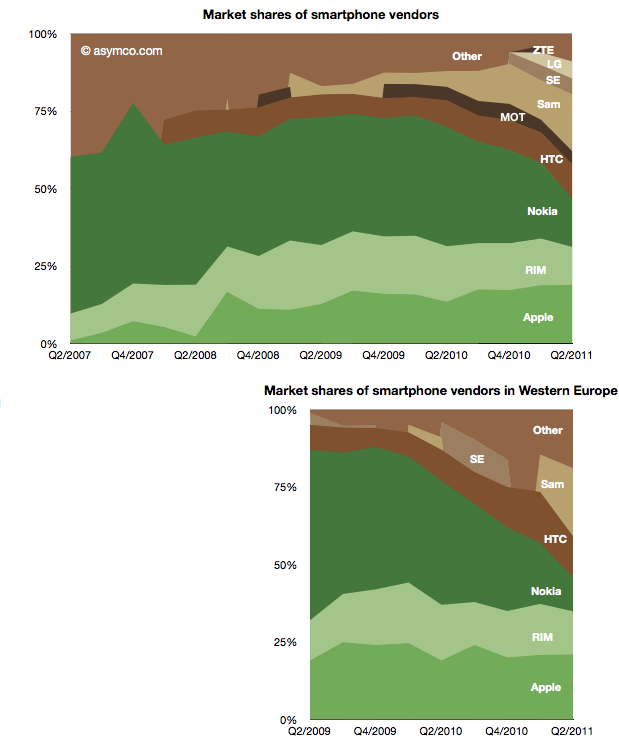
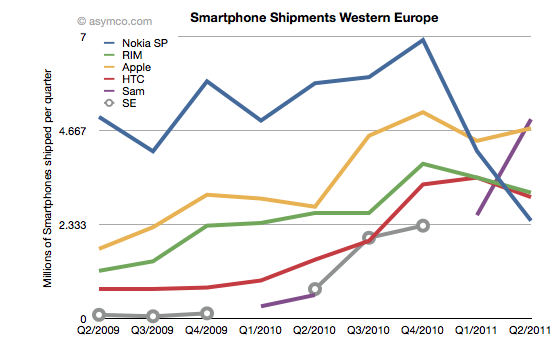
    Two years ago Nokia sold 30% of its smartphones in Western Europe. Today it sells 15% in that market. Its unit shipments went from 5 million to about half that and its market share went from 55% to 11%. Its rank in the market went from first to fifth.

    The fall is exceptional and dramatic. The two charts below show smartphone market shares. The top chart shows global share and the second shows Western European smartphone shares (European share data sourced from IDC).

    The other perspective is shown the the following chart which shows actual units shipped.

    One striking thing is how volumes collapsed into Q1 and Q2 this year, coinciding with the public decision in February to deprecate Symbian. The other interpretation I would make is that within the two year time frame Nokia's share has been completely absorbed by Android, not Apple. Whereas most commentary shows Nokia suffering at the mercy of Apple, it's Android that took share in Europe.

    Can a Windows Phone portfolio turn Nokia's fortunes around? The first problem is that such a portfolio will not be available until next year. The second problem is that the competition will not be standing still. The third problem is that the market itself may not be growing as fast as expected.

    It's becoming increasingly difficult to see how Nokia can weather this turbulence and odds are against it.

  8. HP's decade-long departure

    Research · 221 comments

    HP's sudden departure from a business model that has sustained the company since inception is symptomatic of the passing of an era. Yesterday HP announced that it would exit the PC and tablet computer business, focusing on higher-margin "strategic priorities of cloud, solutions and software with an emphasis on enterprise, commercial and government markets." In other words, HP is fleeing upmarket, away from a core that it will abandon to device makers.

    HP management conceded that the disruptive impact of the iPad forced their hand but that hand was already quite weak from a decade of over-serving the market. The last decade offered plenty of opportunities for incumbent PC companies to adjust to the realities of mobility. However only one computer maker made the transition.

    Why is that?

    Consider how HP and Apple faced the changes in the PC market almost exactly a decade ago.

    • On September 3, 2001, HP announced that they would acquire Compaq.
    • On October 23, 2001, Apple announced the iPod.

    The rest, as they say, is history.

    But what would any reasonable person have done? The PC industry was no longer young but still thriving, why not consolidate? Consolidation is a natural and well-reasoned practice for maturing industries. You get rid of over-capacity, you consolidate overhead, "leverage synergies" and boost margins.

    And it's not like they were ignoring innovation. Compaq had a growing line of PDAs, so there were plenty of diversification opportunities. Microsoft was offering Pocket PC and the Phone edition was on the roadmap. HP was clearly watching mobility carefully.

    Contrast that with Apple's predicament. Which aspiring manager would want to deal with the disaster that was Apple at the time? Apple was struggling with a declining Mac business and had just re-booted it with OS X but it seemed a quixotic effort. Moving to music players seemed desperate (and late). Margins were low, commodity vendors were lining up, record labels offered resistance, they did not have any IP or any DRM and nothing but Mac users as target audience.

    As it turns out, the path of sustaining and the path of disruption diverged that moment in time a decade ago. Companies like HTC, Apple and RIM were embryonic in their device businesses vs. Goliaths like Microsoft, HP and Dell. But they grew, at first slowly, but at all times profitably.

    By the time their success was worth noticing, in 2004, HP and Dell decided to dabble in devices. But all their efforts were half-hearted. They did not crave profits but growth and share. HP's PDAs and phones never received management attention. How do I know? Because they relied on off-the-shelf components for everything including software. It indicated that the value to be offered was in "leveraging" (there's that word again) their brand and distribution. The value of HP was not to build something great--something that required blood, sweat and tears.

    The result was a set of mediocre experiences while the (now incumbent) Apple was iterating rapidly into new directions. By the time the future was self-evident, it was too late to build foundations. HP did the right thing to acquire Palm, but they did it far too late. In 2010 the game was over.

    How cruel.

    But that's the nature of unforeseeable growth: you cannot foresee what will happen and plans never work out. Data and planning don't help. The lesson is that you need to plan for that which cannot be planned. When you are at your peak you must assume failure is imminent and when you are at the trough you must assume success is inevitable.

    All failures of strategy are rooted in the assumption that outcomes are predictable.

    This is why I expect Apple is now working on shaping the post-iPhone world.

    --

    Update: This article has also been published in the Harvard Business Review blog: HP's Decade-Long Departure - Horace Dediu - Harvard Business Review

  9. The perils of licensing to your competitors

    Research · 177 comments

    Google's acquisition of Motorola is clearly designed to be an acquisition of Intellectual Property rather than an entry of Google into the phone business, but the impact on the business will be felt in many ways.

    It is surely going to send some Android vendors scrambling. The situation is not without precedent however. The history of governance and ownership of Symbian shows how the licensing of platforms by licensor competitors leads to unintended consequences.

    Symbian was formed to be governed in a way very similar to the original Android via the Open Handset Alliance. The company was owned by a consortium of phone vendors.[1] The shares were not equally distributed however with Nokia holding a larger share (though not a majority).

    Although nominally involved in decision making, the smaller shareholders never felt entirely comfortable with the arrangement and over time some sold their shares and left the group even though they continued to license the OS.

    Eventually Nokia ended up acquiring the company outright and open sourced the code. However, by then the product was obsolete and the only licensee was Nokia itself.

    The lesson (and warning) was that a licensor that is also a licensee makes other licensees uncomfortable. The supplier is also a competitor. This is classic channel conflict and never ends well.

    Open or not, with or without equity, these arrangements are always unworkable.

    So Google's promise that

    "This acquisition will not change our commitment to run Android as an open platform. Motorola will remain a licensee of Android and Android will remain open. We will run Motorola as a separate business. Many hardware partners have contributed to Android’s success and we look forward to continuing to work with all of them to deliver outstanding user experiences."

    seems naive at best.

    --

    Notes:

    1. Before its outright purchase by Nokia in December 2008, Symbian Ltd. was owned by Nokia (56.3%), Ericsson (15.6%), Sony Ericsson (13.1%), Matsushita (10.5%), and Samsung (4.5%). The company's founder shareholders were Psion, Nokia, Ericsson, Panasonic/ Matsushita and Motorola. Motorola sold its stake in the company to Psion and Nokia in September 2003. Psion's stake was bought by Nokia, Matsushita, Siemens AG and Sony Ericsson in July 2004.
  10. A motion chart for the mobile phone market

    Research · 17 comments

    The charts published here typically show data across two dimensions, (X-axis and Y-axis). Since many times we have to look at data over these dimensions and through time, there are no easy ways to do it without some iteration of the same chart.

    As an alternative a "Motion Chart" let you look at data across up to five dimensions (X-axis, Y-axis, Color, Size and Time). This is a dynamic flash-based chart that allows you to explore several industry/vendor indicators over time. You can:

    • Select x-axis from seven options
    • Select y-axis from five options
    • Select type of chart (tabs in the upper right of chart: bubble, bar, line)
    • Set color from several variables
    • Set bubble size from several variables
    • Select to track individual companies (and enable tracks or trails that trace the patch of individual bubbles)
    • Play through time (and change playback speed)
    • Scrub through time manually over any time range
    • Mouse-over any data point for the actual values it represents in all dimensions (mouse-over and click to select to track that vendor)

    This data and chart are updated and available at higher resolution at the following (permanent) location: https://asymco.com/hire-me/vendor-bubbles/
    [hang2column foo="bar"]
    [/hang2column]