So the SEC is investigating analysts who peddle "channel checks" for violation of securities laws. Former SEC chairman Paul Atkins summarizes the law as follows:
"Insider trading basically comes down to where you know or ought to know that the person from whom you're getting this information has a duty to someone else to keep it confidential. If you go in and pay the mail clerk to give you special information, that's not proper."
This is perhaps newsworthy. But the real news is that information that comes from sources that cannot be verified should not be trusted and certainly not valued.
Here's why: if someone holds information that is non-public they automatically treat it as more valuable. It's more valuable because it's not something everyone has. It's not valuable because it's accurate. By definition, that accuracy cannot be proven so the assumption of its value is based entirely on exclusivity. So valuable perhaps that you can even sell it, and surely many do.
However, simply not being public makes is no more likely to be accurate. You have a situation where people ascribe more value to something that is equally (and sometimes even more) inaccurate as background noise.
Beware of anyone offering non-public information to a larger audience. The data and the person's ethics are both suspect.
The proof comes every quarter: those who rely on inside info are no better and often worse in predicting fundamental performance.
I've noticed that there is a lot of speculation on the prospects for iPad use "in the enterprise". Business users could sure benefit from the device and anecdotal evidence does point to many cases of use in business.
But anecdotes are not conclusive evidence. How can one make a better guess? Based on reader input, I thought I'd test this hypothesis directly on my own stats.
As pointed out a recent posting on my stats, the iPad has been a popular device in accessing this site. 102k out of 1.06m views came from iPad users. A statistically interesting number.
One way to check enterprise use is to measure the ratio of use of the product during weekends vs. use during weekdays. The logic being that weekend use is almost strictly consumer use and weekday use is mixed. Any normalized significant difference between the two measures should indicate a bias toward consumer use or vice versa.
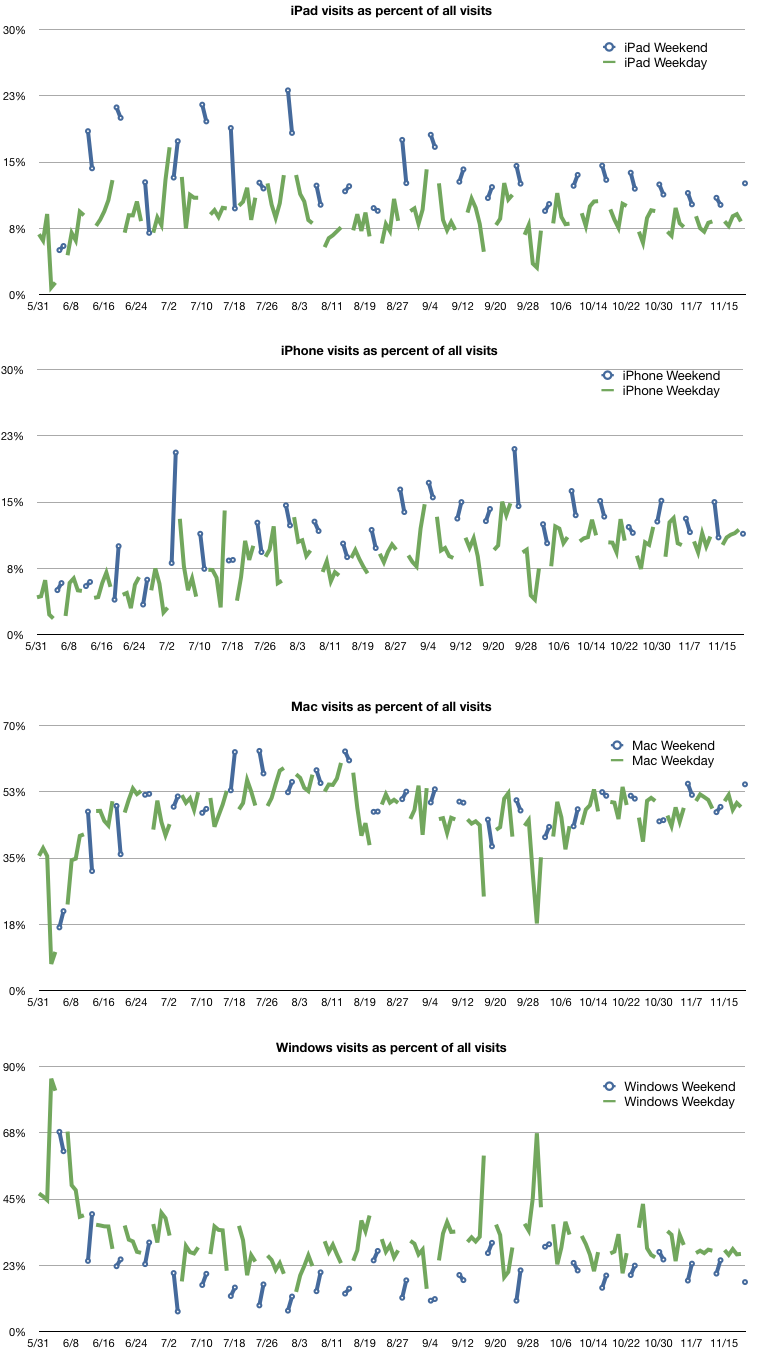
The following charts show the percent of each platform's use with weekends separated from weekdays.
The larger the delta the more likely the more the bias one way or the other. To that end I measured the average percent of visits from iPad (as a total of all visits) for weekends and weekdays and measured the delta between the two. On the weekend the iPad was accounting for 13.3% of visits. On weekdays it was 8.8%. A difference of about 4.5% in favor of weekend use.
To calibrate that figure I did the same for iPhone, Mac and Windows use.
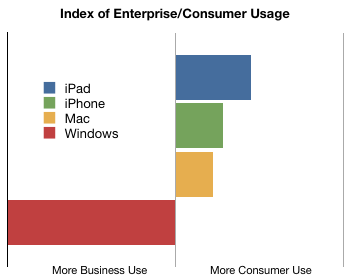
The following chart shows this ad-hoc index of "enterprise use".
Essentially the data is inline with assumptions. The iPad is the most likely to be hired by consumers. The iPhone is more than the Mac and they're all far more likely to be consumerized than Windows.
The average consumption of Asymco.com through Windows was 32% of during weekdays but only 22% during weekends.
In order to make this measure more meaningful, the evolution over time of these figures should be tracked. If the Blue bar above moves more toward the center then the chances are that iPad will be more adapted by business users, or at least more in use at work.
Does this seem like a valid method for measuring relative enterprise use?
When I wrote my opinion on the future of publishing (Citizen Publisher), I focused my lens on books and magazines. Published works that have relatively low time-sensitivity and hence relatively long shelf life are quite different from newspapers which package material with very brief temporal relevance.
The print-based news industry has suffered much more than print-based books and magazines. The primary cause is that "print" plays a far larger role in newsprint-based newspapers than in books.
To give you an idea of how important the printing plant is, consider that a huge proportion of a newspaper's assets are tied up in its printing plant. That plant is so large and so demanding that it ends up causing the whole business to revolve around it: Print runs are done at night to make sure the product is delivered in the morning. That puts a hard deadline on the writers to submit stories before the product is "frozen" into a final edition. Writers and editors and advertisers need to march in lock-step to the cycle time of a big manufacturing operation.
There are 19 presses and 17 printing plants that print the two million copies of the U.S. edition of The Wall Street Journal. To make changes to the plant require large amounts of capital investment and that capital's depreciation is an integral part of the financial balance of the company. So much so that one wit remarked that a newspaper is nothing more than an instrument that permits the depreciation of a printing plant.
Costs of manufacturing have been slightly offset by better technology and distributed printing but newsprint itself has soared in price so the dependence on physical product has made the economics worse over time.
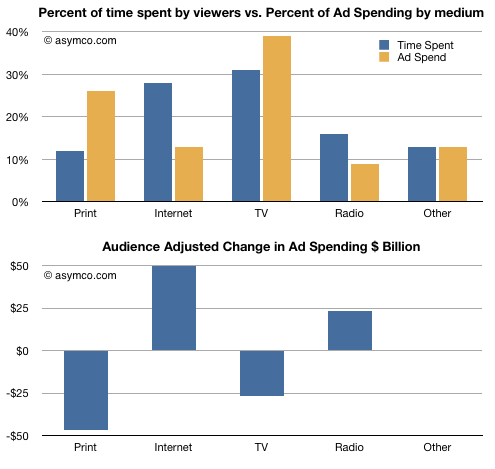
That's the cost side. But if you keep following the money from the revenue side, you realize that the situation is critical. In the US, a large part of the local paper's revenue base was wiped out by Craig's list. Classifieds are a fading memory. With respect to regular ads, the story is almost as bad. 26% of ad spend in 2009 was allocated to print, while only 12% of time spent consuming media was spent on it. In contrast, Internet use is at 28% of time where only 13% of ad dollars are allocated.
Source: Morgan Stanley Internet Trends Presentation.pdf
It's inevitable that advertisers will shift their budgets to follow where the attention is going. Potentially that's a $50 billion shift into Internet advertising. The number nearly matches the $47 billion loss from print.
This future is not far off. In fact, it's already happening. in recent years the number of newspapers slated for closure, bankruptcy or severe cutbacks has risen—especially in the United States, where the industry has shed a fifth of its journalists since 2001.
Once the printing plant is taken out of the equation, the raison d'être of the package itself ends. For this reason, the newspaper product cannot survive on-line. Reading news is still very popular, but newspapers aren't.
So will the iPad save this medium?
As in Citizen Publisher, I argue that for that to happen, the medium needs its Orson Welles. Furthermore, to have him emerge, the business must be architected as an integrated approach to solve a new job to be done.
The latest story from The Guardian suggests that Rupert Murdoch is working on just such an approach. In another interview Murdoch explained the project in more detail:
What is the biggest thing on your mind now?
...There are so many disruptive technologies coming all the time! [This in almost a whoop of excitement.] Pretty. Damn. Interesting! Just trying to stay ahead of the technology. I'm starting a paper in six weeks. A brand new paper. It will be a bit like the New York Post . But it will be national. Have that sort of humour and attitude like the Post . It will only be seen on tablets. It will only employ journalists - and maybe eight to 10 technicians.
What sort of circulation will you need?
At the price we are talking about, that's $1 a week - not a day, a week - we need 800,000. By the end of next year there will be 30 to 40 million iPads. I believe every single person will eventually have one, even children.
What's more, it's suggested that an unreformed disruptor is mysteriously involved. One can only speculate, but the hints of autonomy, dedicated (and incentivized) creative professionals involved in a new (not re-purposed) publication with a low-cost structure bodes well.
I began writing in February of 2010 but I moved to my own domain in June. More than 95% of my traffic came after June 1st (during which time 284 articles were written.)
Since then 270,036 visitors came to visit 592,351 times and saw 1,063,355 pages. 65,331 stopped by more than once. 337,270 of the visits came because someone told them about Asymco. 27,113 visits came because a search engine sent them. 1,548 of those who came had something to say and they said 5,273 things. Over 2,500 asked to keep in touch.
Here is the less lyrical breakdown of that traffic as reported by Google Analytics:
James Allworth, a Fellow at the Forum for Growth and Innovation at Harvard Business School writes:
Baidu,... has taken an even bolder approach. It's reportedly in negotiations with a number of smartphone manufacturers to remove all references to Google, and replace them with Baidu.
... Microsoft recently negotiated with Verizon that some of the Android phones that ship to Verizon customers will have Microsoft's Bing, not Google, as the default search engine. And the manufacturers are getting in on the act too: Motorola recently released a new phone, the Citrus, based on Android, but shipping with Bing.
Yes, it's Google's operating system. In both these instances, it counts as a "win" in the handset volume war against Apple, Microsoft, Nokia and RIM. But Google will not make a cent on this handset, despite having enabled its creation with Android. All the search revenue will flow to Microsoft.
Readers of this blog might find these arguments familiar.
Since February this year, I wrote four articles under the headline "Google vs. Android" documenting these contradictions in Google's strategy. There have been numerous other opinion pieces that described how Google's approach was not consistent with an innovation-based disruption.
I've also argued that there is strategic incoherence in building systems software and hardware while selling web services.
Android is powerful, but as Google is finding out, power can be very dangerous without control.
When the iPhone vs. Android rhetorical war heats up, both sides bring up the history of Macs vs. Windows PCs. The commonly held thesis is that Windows triumphed as the PC was commoditized (and modularized). This triumph was at the expense of the over-serving and over-priced Mac.
This is a largely accurate view of what happened during the 90s. But the problem with this thesis is that (1) the PC's job has been slowly changing in the last decade (2) the Mac keeps growing faster than the PC and (3) Apple keeps capturing a vast portion of the profits in the PC industry.
These anomalies or contradictions to the thesis imply that something changed. What changed and can these changes turn the tables on the market and create an opportunity for a new computing disruption?
The PC of the 90s was hired first by companies as a productivity boosting tool and second by consumers as a way to duplicate their work productivity and communications in their personal lives.
However something changed with PCs when the laptop became "good enough". With portable computing, the job the PC was hired to do evolved. It was more important that the product be well designed (for aesthetic value, usability and reliability) than just fast and spacious. The microprocessors were plenty fast but what mattered more was low power consumption, a low profile and tighter integration with software.
The product was also purchased in a different way. A desktop could be purchased on specs alone, sight unseen, from a catalog. But a laptop had to be touched, hefted and the screen had to be observed and the whole design contemplated before a purchase decision was made. The product had an integrated keyboard, display, touchpad and storage. It was not easily serviced by end users. It was, in a word, re-integrated.
You can see how portability changed the job and therefore everything else as well. Consumer tastes became important, retail distribution became necessary and R&D resources had to be applied to solve what was no longer good enough: the whole package.
Vendors which did not prioritize design, retail and R&D were left flat-footed.
At the same time, systems software became more commoditized and productivity software became portable. The old measures of performance were being over-shot while the new measures of performance were under-served.
While this shift was underway on the hardware side, Microsoft continued to improve their product to serve more demanding business productivity jobs. Their software was not getting optimized for this new portable consumer job. They left the new market open to disruption.
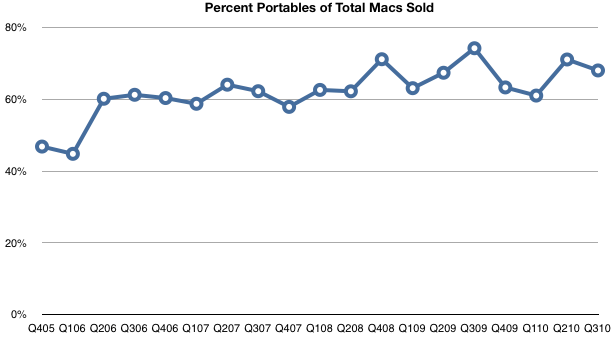
In stepped the MacBook with good enough (and improving) office productivity. With excellent appeal along the dimensions of performance consumers demand most of all. It was priced higher than other laptops but the price points were affordable and, inflation-adjusted, lower than they'd ever been. It should not be a surprise that Apple was one of the first vendors to see its portables line become bigger than its desktop lines. The market evolved to the point where what Apple had was what the buyers needed.
The shift to portability is a compelling story for Apple as disruptor in the PC market. It may not result in a complete reversal of the PC hegemony but it allows Apple to grow a product line at triple the growth rate of the market. A market that was considered completely dominated by entrenched incumbents with an unbreakable profit formula.
But with the iPad Apple is clearly also aiming at disrupting the Mac (and, transitively, the PC as a whole.) The iPad can be seen as an evolution toward seamless portability; the mobile computing paradigm shift.
Apple has been contemplating a SIM card that would make carrier switching a lot easier. Sounds great, doesn't it?
"Apple is relenting," said Rodman Renshaw analyst Ashok Kumar. "They are now completely backing away from their plan to take the carrier out of the equation," said Kumar,.
This brings to mind a recent article I wrote that any talk of mobile dominance by platform vendors is bunk.
... no single platform can win a disproportionate share because it would threaten the balance of control the operators require. So talk of “dominance” of one platform or another is hyperbole. The most likely scenario is an even distribution of share between 4 or 5 competitors.
The power of distributors in the mobile phone value chain cannot be ignored. It's not fair, it's not convenient and it's not consumer friendly, but as long as networks are not good enough for mobile computing, mobile computers cannot commoditize the network.
The consequence (for those of us who try to foresee the platform game) is that operators will continue to play platforms off against each other leading to the scenario I suggest above.
Garriques will leave Dell at the end of January after nearly four years on the job. Prior to Dell, Garriques had been the mobile device chief at Motorola until early 2007.
Here is how Ed Zander (the former CEO of Motorola) described Garriques soon after he left the company.
...Zander didn't have a lot of good to say about the former team running Motorola's cell-phone business. "The management in mobile devices made calls that were dead wrong," he said, referring not so much to massive price slashing on the popular Razr as to the slow-footed move into so-called 3G (for third-generation) multimedia phones. That particular slam was directed at a young guy named Ron Garriques, who headed that division, which is most of Motorola's business today, before high-tailing it out of Motorola just before the you-know-what hit the fan. Garriques today is part of the crack team turning around Dell.
His move to Dell caused quite a lot of speculation that Dell was going to be a serious contender in the mobile device space (despite their previous failures).
Apparently the launch of the Android-powered Streak was not enough to cement his future at Dell.
More than 400 000 new developers in past 12 months; 92 developers each top 1 million download mark; 1.5 million downloads of Qt software development toolkits
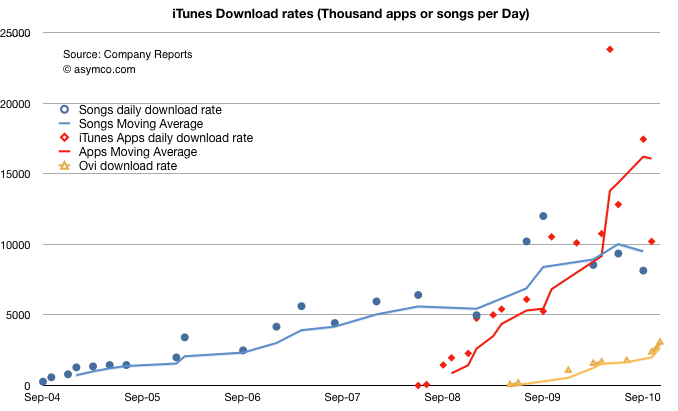
See the following chart comparing Ovi with iTunes Music and iTunes Apps download rates.
The last data point we have for iTunes App downloads was from October 18th when 7 billion total downloads were announced. The last update was around Sept 1st when 6.5 billion were announced. That comes out to about 10.6 million downloads per day. The previous interval suggested about 17.6 million/day.
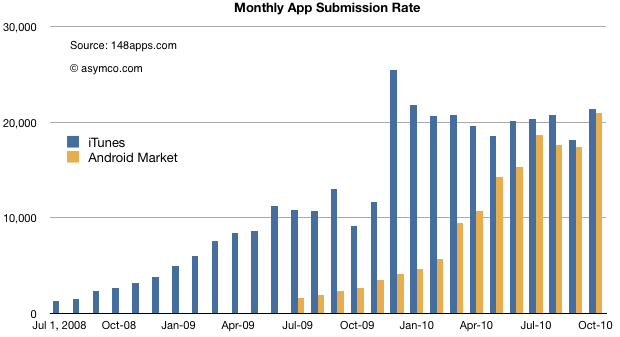
Thanks to 148apps.biz we know how many apps are being submitted to the App Store.
For the year so far the average has been almost exactly 20k apps per month. Toward the last half of last year, 10k/mo was the norm.
The total number of apps available is about to cross 300k though over 350k have been "seen" on the store at any one time. Almost 61k apps have been removed from the store.
There are about 61k unique app publishers.
Books has been the most popular category for some time (51k titles). This does not include books available through iBooks.
The Android Market is growing at approximately the same rate with androlib.com estimating 21k being apps added in October.
The UPhone will run on a “totally new” operating system that Unicom developed based on Linux, Zhang Zhijiang, who heads the company’s technology department, said in an interview today at the Mobile Asia Congress in Hong Kong. The phone is being developed with Okwap, Huawei Technologies Co. and ZTE Corp., he said.