Asymco

Asymmetric Intelligence

Latest from Asymco

  1. The Mac App Store: can it change the software business?

    Research · 36 comments

    What is it that makes the iTunes App Store so compelling? Will the value the App store added to the iPhone be added by the Mac App Store to the Mac?

    Here are the characteristics I think make the App Stores valuable:

    1. They redefine software as content. The pricing, marketing, discovery and buying process is identical to that for content like music or video.
    2. They redefine the skill required to create a relationship with customers. They allow a new class of less-skilled and less-capitalized developers participate in selling software directly to the buyer. By "skill" I don't mean engineering skill but marketing skill. A developer can create a product that can reach millions without having to acquire with channels and distribution skills.
    3. From a consumer's point of view, they simplify purchasing and lower the price of software.

    These three characteristics of app stores make them disruptive. The disrupted companies are the traditional software publishers. The response from game publishers to the App store were predictable: they condemned it for destroying value, "cheapening" their product, and creating a race to the bottom. They also predicted that it would all end badly as nobody would make any money.

    The truth is that they were disrupted by different cost structures. The entrants did not need to spend on market development, and focused on innovating on the essential novelty of the user interface.

    So the Mac App Store could be disruptive to traditional software vendors. A large new population of software developers could emerge targeting the Cocoa environment and they may bring new apps that move the jobs that the computer is hired for to appeal to new users.

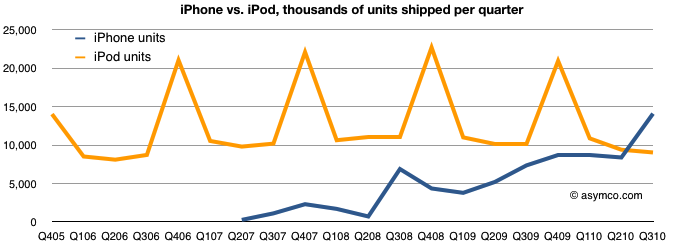
    However there is a problem. The Mac is a small target market relative to iOS. Apple announced that there are 50 million Mac users. This compares badly to the 130 million (or so) iOS users. It won't be long before 50 million iOS users will be added every three months.

    So the first thing that Apple needs to do is grow the Mac installed base. Perhaps the new Air and following updated to the MacBooks will do just that. But the growth rate needs to be an order of magnitude faster. And I suspect price is an obstacle to this growth.

    Regardless of this obstacle, the Mac App Store has the potential to change the appeal of the Mac. As the first personal computer with an App Store, new uses may emerge and create the same app-platform effect.
  2. Subscribe to Asymco One for full access to our research.

  3. Subscribe to Asymco One for full access to our research.

  4. Nokia's moderate-intelligence-phone performance

    Research · 60 comments

    A complete market overview will follow when all the top tier vendors report the last quarter, but in the mean-time here are some data that are available:

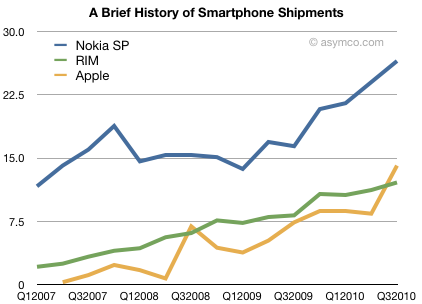
    Smartphone volumes for Nokia, Apple and RIM:

    Whereas Nokia is often criticized for being weak in smartphones, the fact is that they have grown at a decent rate over the last two years. In fact, they've opened a gap with RIM. Apple has increased share but it will take quite a while to overtake Nokia.

    So why is Nokia's smartphone performance so under-valued? Partly it's because ASPs have been dropping. A lower price and lower margin is sometimes seen as a sign of weakness. But Nokia has had a strategy of expanding into more price brackets in their core markets (i.e. outside the US). Half of Nokia's smarpthones are sold through distributors not operators and probably end up being sold unlocked and unsubsidized. Price matters in those markets.

    The other problem that Nokia takes a beating over is that their products don't get used as smartphones. Many are sold without data plans at all which makes one wonder what exactly makes their phones "smart". So many of these 100+ million/yr.  smartphones are really hired to do a feature phone job. They're "overqualified" and thus underutilized. The statistics in terms of app downloads, browser and ad impressions all lag as a result. The ecosystem suffers.

    Lastly, they are all but absent from the US. Due to accidents of history (CDMA) and various mistakes, Nokia never got a foothold in what turned out to be the most important mindshare market. A decade ago the US was a mobile data backwater, with lower data ARPU than Nigeria. It was not a market Nokia felt particularly deserving of investment. In hindsight, this was a big mistake.

    But these knocks against Nokia still should not detract from the fact that they do sell a lot of Symbian phones. Distribution still matters as does having 600 operator customers. And in many parts of the world, Nokia is synonymous with mobile phone. Many of those buyers will migrate to future Symbian devices.

    My mobile platform thesis has been that as long as penetration is not 80% and as long as operators are still in the value chain, mobile platforms will remain fragmented and split shares. The graph above shows exactly how that has evolved among the top three smartphone vendors.

  5. Subscribe to Asymco One for full access to our research.

  6. The new king of Apple analysts - Apple 2.0 - Fortune Tech

    Research · 28 comments

    The new king of Apple analysts - Apple 2.0 - Fortune Tech.

    My thanks to Philip Elmer-DeWitt but I think he is not right in proclaiming a King. Credit is due to all the other blogger analysts who inspire and push analysis forward.

    The  lines were nothing but a commercial advertisement, but they very well describe this group that opened the eyes of the world:

    Here's to the crazy ones,

    the misfits,
    the rebels,
    the troublemakers.
    The round pegs in the square holes.
    The ones who see things differently.

    They're not fond of rules
    and they have no respect for the status quo.

    You can quote them,
    disagree with them,
    glorify or vilify them.
    About the only thing you can't do
    is ignore them,
    because they change things.
    They push the human race forward.

    And while some may see them as the crazy ones, we see genius.

    Because the people who are crazy enough to think they can change the world
    are the ones who do.

    "Crazy Ones", directed by Chiat/Day's Jennifer Golub who also shared the art director credit with Jessica Schulman and Yvonne Smith. The familiar voiceover was by Richard Dreyfuss. See the video here.

  7. Subscribe to Asymco One for full access to our research.

  8. Visualizing iPad vs Mac

    Research · 23 comments

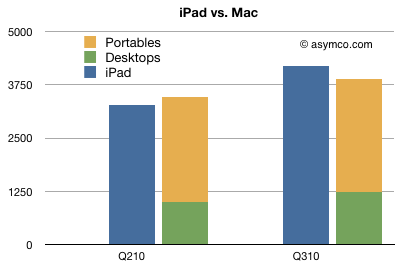
    The iPad outsold the Mac after two quarters in the market. It's important to understand the effect the iPad is having on PCs. Data is trickling in that potential notebook buyers are "postponing" purchases due to the iPad. The netbook market has witnessed a significant slowing which has trickled down to the performance of everybody in the value chain, from Microsoft, to PC vendors, Intel, AMD and retailers.

    So naturally we need to ask how it has affected the Mac.

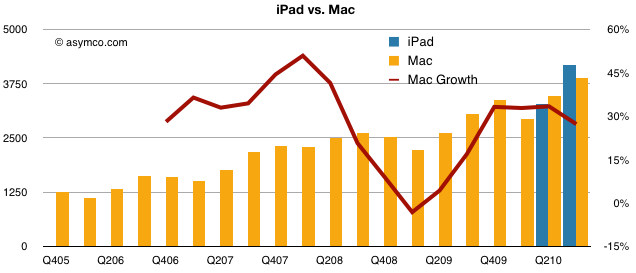
    The following chart shows how the iPad has outsold the Mac the past quarter. The iPad was on the market for six months while the Mac has been for sale for 322 months--a shocking achievement.

    But the Mac has not slowed down. It grew faster than the overall PC market (units grew at 27.3% and revenues grew at 22%) as it has grown for most of the past 18 quarters.

    The performance is also highlighted in the following chart showing the history of the Mac units by quarter over nearly five years. The Mac had a slowdown during the recession but the dip in growth in the last quarter does not seem significant.

  9. Subscribe to Asymco One for full access to our research.

  10. Estimates for Apple's first quarter earnings (January)

    Research · 38 comments

    Oppenheimer on the concall:

    We expect revenue to be about $23 billion compared to $15.7 billion in the December quarter last year. We expect gross margins to be about 36%. We expect OpEx to be about $2.325 billion.

    We expect OI&E to be about $65 million. And we expect the tax rate to be about 25.5%. We're targeting EPS of about $4.80.

    Here are my expectations:

    • iPhone units:  16.2 million (85% growth)
    • Macs: 4.3 million (27% growth)
    • iPads: 6 million
    • iPods: 18.9 million (-10% growth)
    • Music growth: 20%
    • Peripherals growth: 28%
    • Software growth: 11%
    • Total sales: $25.5 billion (63%y/y growth)
    • GM: 37.5%
    • EPS: $5.86 (60% y/y growth)
  11. Subscribe to Asymco One for full access to our research.

  12. 63 percent of iPhones were sold outside the US in Q3

    Research · 7 comments

    [AT&T] activated 5.2 million iPhones in the wake of the iPhone 4 launch, or about a 62.5 percent leap over an already record spring

    via AT&T blows past records, activates 5.2m iPhones in summer | Electronista.

    This means 63% of iPhones sold outside the US last quarter.  This is down from about 70% earlier this year. As it was a launch quarter and distribution was much more constrained outside the US, the lower figure is not surprising.

    It's still important to note however that sales outside the US are far larger than in the US but penetration and share is far less.

  13. Subscribe to Asymco One for full access to our research.

  14. Analysts predict iPad sales (part IV)

    Research · 8 comments

    So far Apple has sold 7.458 million iPads and there is still a quarter remaining in the calendar year. The highest forecast immediately after the launch of the product was 7 million.

    For the record, in January I forecast 6 million units for calendar 2010 (and 10 million in first 12 months of sales).

    All analysts polled grossly underestimated the iPad. My impression is that competitors are still in denial.

    How many iPads will Apple sell? - Apple 2.0 - Fortune Tech.

    Unit sales 2010 (millions)2011
    Brian Marshall, Broadpoint AmTech7.013.0Calendar
    David Bailey, Goldman Sachs6.210.1Calendar
    Kathryn Huberty, Morgan Stanley6.09.0Calendar
    Shaw Wu, Kauffman Bros.5.010.012 mos.
    Gene Munster, Piper Jaffray3.58.0Calendar
    Ben Reitzes, Barclay's Capital2.97.3Fiscal
    Keith Bachman, BMO Capital2.55.5Fiscal
    Jeff Fidacaro, Susquehanna2.13.8Calendar
    Chris Whitmore, Deutsche Bank2.04.0Calendar
    Bill Shope, Credit Suisse1.87.4Fiscal
    Scott Craig, Merrill Lynch1.23.7Fiscal
    Peter Misek, Canaccord Adams1.23.5Fiscal
    Doug Reid, Thomas Weisel1.16.8Fiscal
    Yair Reiner, Oppenheimer1.14.0Fiscal
  15. Subscribe to Asymco One for full access to our research.

  16. Deagol: Fiscal 4Q '10 actual results vs. estimates

    Research · 9 comments

    Comprehensive and thoughtful review of the performance of the analyst cohorts in predicting Apple's quarter:

    Deagol's AAPL Model: Fiscal 4Q '10 actual results vs. estimates.

    By Daniel Tello's ranking I was first in Q2 but 8th (out of 38) in Q3. Overall, bloggers beat Pros but by a lower margin than in the past.

    I have been ok at estimating product line performance and top line sales but not so good in guessing margins. Last quarter I went for a high iPhone number (13 million vs 14.1 actual and 11.39 Pro/12.07 Blogger consensus) and middle-of-pack on iPads (5 million vs. 4.2 actual and 4.79 Pro/5.52 Blogger consensus). The total iOS units I forecast was 18 million and Apple sold 18.3 so I was fine on units and pricing.

    My guess on the cause of my estimate failure on margins was iPhone 4 rollout ramp. I had to take iPhone margin down to below 50% (about 49%) to make the reported total GM. iPhone has been, on average, running at 52% over the life of the product.

    PED's rankings are here.

  17. Subscribe to Asymco One for full access to our research.

  18. Subscribe to Asymco One for full access to our research.

  19. AT&T does not pay a higher price for iPhone exclusivity

    Research · 6 comments

    In last year's third calendar quarter earnings call (October 20, 2009) Tim Cook was asked:

    “So when you go from exclusive to multiple, you don’t change the charge to the carrier?”

    Cook answered: “Correct.”

    In this year's third calendar quarter earnings call (October 18, 2010) Tim Cook was asked again whether the future iPhone non-exclusive subsidy will affect the iPhone revenues and again Tim Cook repeated that it won't.

    Chris Whitmore - Deutsche Bank

    And what is your experience then when you've gone non-exclusive from a subsidy and margin standpoint on the phone, have you had to give anything up in the past?

    Tim Cook

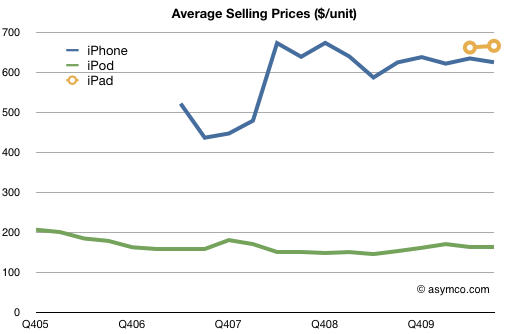
    We don't give specific information out on the margins. But I think you can look at our ASPs and see that they've generally stayed above $600, and that's despite opening up several markets from an exclusive market to a non-exclusive market.

    The recurring assumption that the loss of AT&T exclusivity will cause iPhone price erosion is wrong and has been evident in the sales data for over a year now. Not only did Cook state clearly that there is one price for iPhone to the channel regardless of exclusivity but the price data shows that as Apple moved to non-exclusives in many regions of the world, the ASP remained fairly constant:

    Over the period when the blue line has been flat, Apple moved a number of markets from exclusive to non-exclusive.  There are three main countries where iPhones have a contractual exclusive relationship. That is the United States, Germany and Spain. (China and Japan are exclusive due to network technologies). All these markets will go to non-exclusive next year. I don't expect any change in the ASP as a result.

    The final data point comes from AT&T themselves when they revealed the price they paid for the iPhone was roughly the same as the ASP shown above.