Asymco

Asymmetric Intelligence

Latest from Asymco

  1. One billion sold

    Research · 12 comments

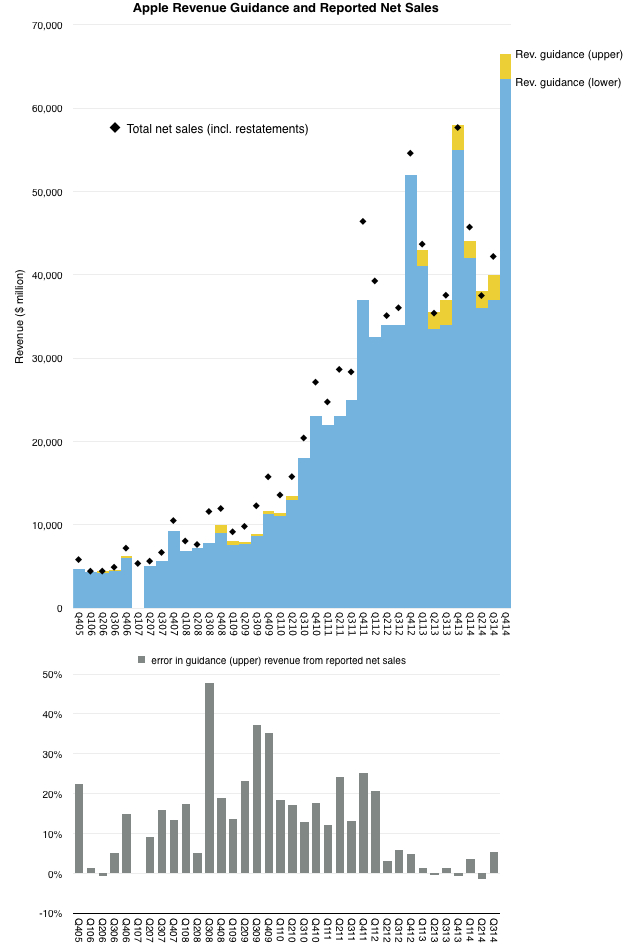
    In Q3 2014 Apple's revenues were 5.3% higher than the upper end of their guidance. This is the highest error in guidance since the new range-bound  reporting regime started two years ago.

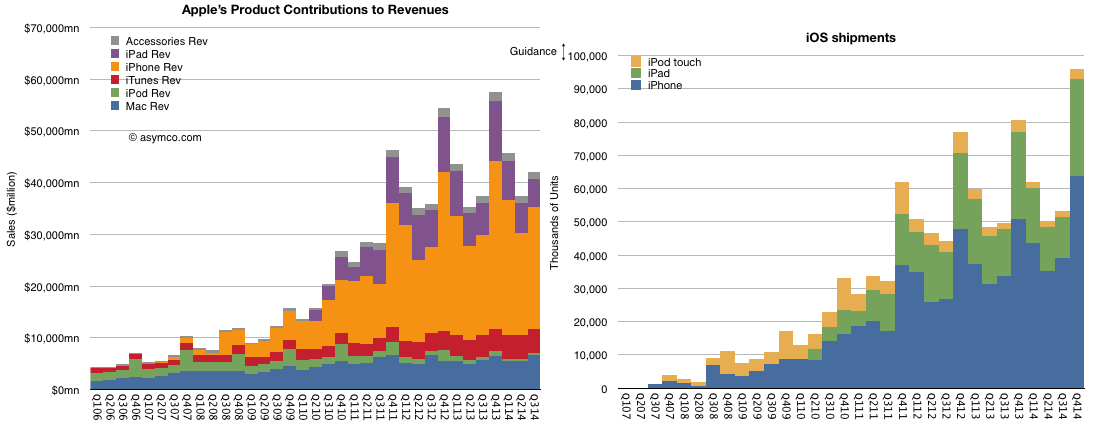
    The following graph shows the guidances given since 2005 and the actual revenues. The error (as a percent of upper guidance) is given in the second graph.

    Screen Shot 2014-10-23 at 10-23-10.44.28 AM

    Note how since the newer, presumably more accurate method was introduced in 2012, the errors have decreased on average. As a result, for these two years, forecasting performance for Apple was no longer challenging. The only questions for the analyst were how to allocate the revenues among products and to guess how many shares would be retired.

    Is this about to change? Could forecasting make a comeback as sport and leisure?

    Assuming no error in Q4 yields the following shipment forecast:

    Screen Shot 2014-10-23 at 10-23-11.11.17 AM

    That's about 95.5 million iOS devices in the quarter. That also means that the one billionth iOS device will have been sold sometime in the next few weeks. ((McDonalds took 23 years to serve its first billion hamburgers)) ((Over 650 million iPhones, 115 million iPods touch, 265 million iPads))

  2. The new iPad. Is it better?

    Research · 62 comments

    The problem with getting better is that if you're more than good enough you're actually getting worse. Improving beyond the point where your improvements can be absorbed is not only wasteful but it's also dangerous. It opens the door to competitors who compete asymmetrically.

    This is the perverse and pervasive threat hanging over all system vendors. The temptation to "get better" is not coming from incentives and human nature. It's  always there as Moore's Law offers an exponential increase in power. People don't naturally have exponentially increasing needs. For them to absorb this new power, it has to be couched in new uses.

    What has permitted the absorption of improvements in semiconductor performance (and production) have been other aspects of the system: the software, communications and services innovations have been positioned on more demanding jobs to be done which, once hired for those jobs, saturate the available processing and storage.

    This is most easily evident in how digital photography has advanced. The constraints on sensors meant that quality was initially poor and as cameras were unconnected, they were relatively under-utilized. But once software and communications were added (by inclusion in smartphones) digital photo creation exploded. This, in turn, led to more storage needs both on the device and the servers. In a virtuous cycle, more processing power meant video was possible, then high definition video, then slow motion high definition video. The previous storage limits on mobile devices were quickly overwhelmed. Megabytes of storage became gigabytes and then hundreds of gigabytes. Video editing meant processing power was suddenly in demand again. Cores multiplied.

    Third party media (music and videos) storage and playback used to be the main job that storage was hired to do ((Which was far more demanding than office-like documents)) but as cameras got better, user-generated content suddenly bellied up to the bar.

    That is now the story for phones, which are gobbling up all the storage and bandwidth we can throw at them. But what about the larger form factors? Are iPads (and laptops) growing in their demands? Paradoxically, it would seem that the smaller devices are hungrier than their larger cousins.

    The answer lies with the jobs to be done. If highly portable devices are more usable, they will be used more. Large devices are left behind, literally, because their jobs are not as pervasive in place and time. For a large screen like the iPad to increase its attractiveness, it has to be the stage for a set of jobs that only it can perform.

    The new iPad has the horsepower. It has more portability (thinner, lighter) and it has the touch ID convenience. It even has a better camera. But for it to succeed it needs to be hired for a set of jobs as expansive in usage as the user-generated photo/video jobs that the iPhone has been called to do.

    I hire my iPad for one such job: to persuade audiences small and large. I use it across a dining table and across an auditorium to appeal with a visual language. I use Perspective to create stories that have to be seen to be believed and once seen, create belief.

    The tool is demanding however. As the stories are fed by data and the visualizations are rendered algorithmically and not as stored images it is hungry for processing power. I also need it to record performances which taxes storage. I need to transmit those performances both in real-time and as recordings, tasking the WiFi and cellular bandwidth. I need as much screen as I can get to be able to interact with the elements on screen, of which there may be hundreds. I need to export video versions of performances and thus I need a video studio with all its extravagance. I need it to run for all-day workshops connected to a projector, sometimes through AirPlay, under stage lights, which pushes the battery.

    Consider my last padcast. It was recorded in one take lasting 18 minutes. I then exported the results to a video that was uploaded to Vimeo and viewed by thousands. However it took over one hour to render it and due to that constraint I did not have the luxury of editing it. I could not easily add, subtract or annotate the video production. This was done on an iPad Air and I was happy to get it done at all.

    But if I had an iPad Air 2, not only would production time be shrunk ((To about half the time)) the things I could attempt to do with a presentation suddenly expand. It's not just about more efficiency but an expansion of scope. More power means more work I choose to do.

    So is the new iPad better? As far as the jobs I hire it do do, the new iPad is better. It is in fact not good enough. Which is the best thing to be.
  3. Next Airshow: Seattle, Nov 8

    Conference

    We will be conducting the 11th Airshow event in Seattle on Saturday, 8 November 2014.

    Airshow

    The purpose of Airshow is to:

    • Understand how data can be used to persuade through an appeal to logic as well as through empathy.
    • Understand the basics of "data cinematicism" including the techniques analogous to cinematography and direction.
    • Understand story development techniques including how to facilitate the audience's entry into the story.
    • Learn how to build a cinematic presentation.

    The method we devised borrows heavily from the techniques of cinematography and screenwriting to impart meaning to the audience beyond the literal words spoken or images shown on screen. These techniques are demonstrated with "feature presentations" and then deconstructed in interactive lectures. Throughout we also weave Aristotelian rhetorical tips and present from the Asymco repertoire of stories.

    Given the cinematic nature of the event, we thought it would be fitting to use a screening room, so we have reserved the the Auditorium at Fry Art Museum. See Airshow Seattle event page for more information. Discounted registrations for readers of this site are available. Students and teachers may register with an academic discounts.

    Fry Art Museum Auditorium

    Frye Art Museum Auditorium

  4. What next, Samsung?

    Research · 200 comments

    I received a few questions from Shirley Siluk of NewsFactor as a follow-up to my post on the trajectory of successful companies.

    1. Do you foresee any hope for a turnaround for Samsung? If so, where do its best opportunities lie?

    Screen Shot 2014-10-13 at 1.44.54 PM

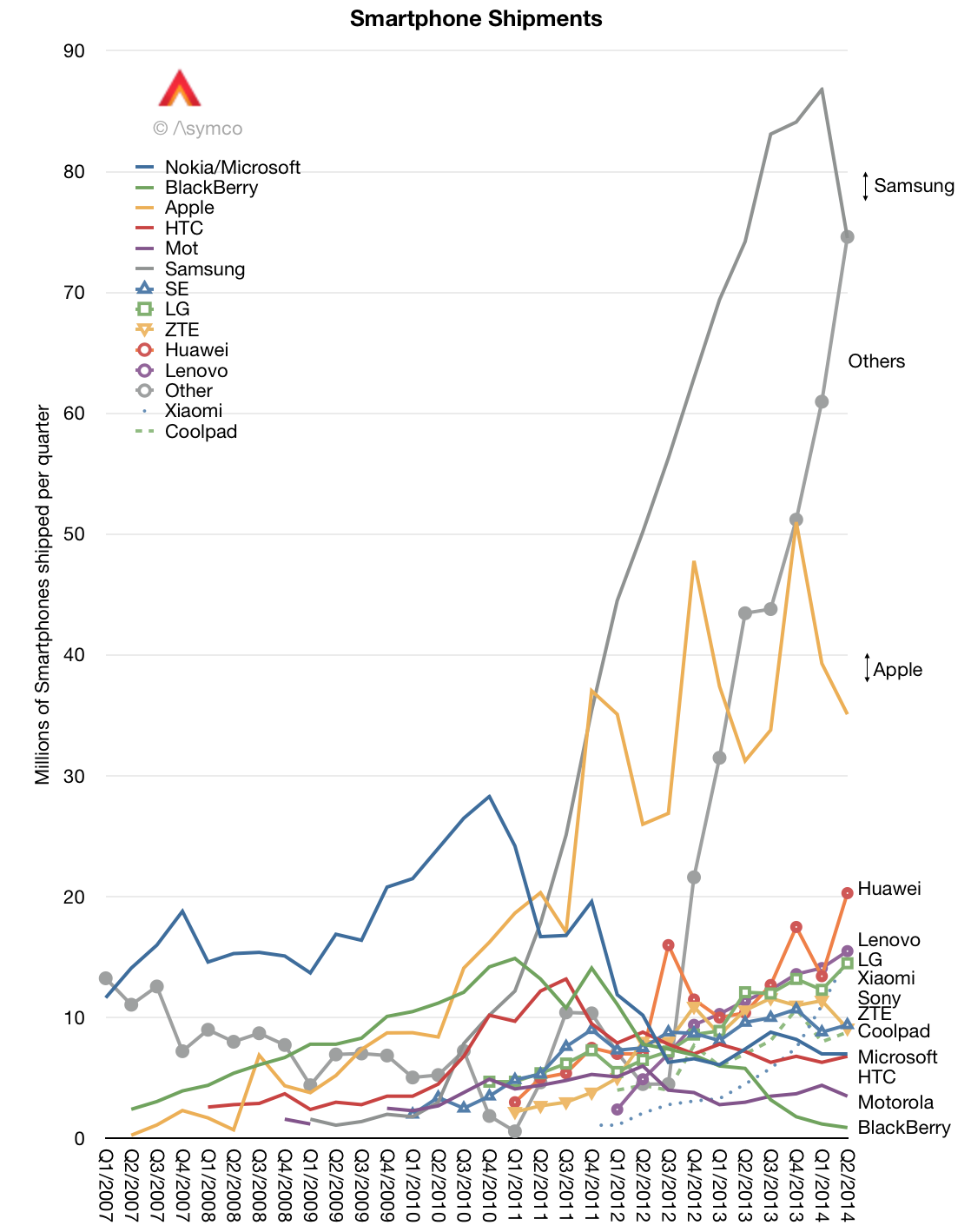
    The smartphone business was a huge opportunity for Samsung and they took full advantage of it. Unfortunately, it’s a difficult business to stay on top of. The list of victims in that industry is quite long and there have been no long-term winners. Samsung’s operating model seems to be to invest as a ‘fast follower’ filling in the market after it’s established while leveraging capital intensive components synergies. That has also worked for them in consumer electronics (at the expense of Sony and other Japanese vendors). If the modus operandi does not change then their turnaround will depend on the creation of new opportunities/categories. Wearables may be such an opportunity but it may not be as big as the phone business. ((The graph shows estimates of smartphone shipments for a select number of vendors.))

    2. What has contributed most to Samsung's decline? Which competitors are posing the greatest threat?

    The fast follower strategy belies its own limitations: it implies a transience or impermanence in strategy. In a fast follower strategy it’s only a matter of time before late followers eat into the business, similar to the way that the fast follower ate into the innovator. Chinese vendors are poised to take more share. The way I said it in 2011 was that I saw in Huawei ((I did not anticipate the Xiaomi and Lenovo entrants which are also doing very well.)) what Samsung was five years earlier. It’s easier for the low-end providers to move up-market and not at all easy (in terms of loss of margin) for the higher end to move down.

    3. You mentioned the pattern of commoditization in all of Samsung's markets -- what would be the best way around this?

    Commoditization is largely unavoidable. The way to survive as a business is to ensure you create new businesses or solve new problems. One hope that springs eternal is that through a “brand” a maker can ensure long-term margin survival. That did not help Nokia, Sony, or Microsoft. Brand is only valuable if it carries meaning and often that meaning becomes a fading product. So the short answer is that Samsung needs to create new categories or businesses. The challenge for them is that they need to control the platform and service infrastructure. These are currently out of their control and I’m not quite sure how they can regain that control.

    I was wondering if you had any followup comments you could offer about Samsung in light of the announcement today that it's developed a faster 60 GHz wifi technology -- do you think this kind of technology, if it's everything Samsung says it is, could provide the kind of corporate turnaround momentum Samsung needs?

    Certainly not. This is a sustaining improvement in a technology. What Samsung needs is a disruptive improvement. A disruptive improvement implies a new business model. Put another way, it means that Samsung needs to invent a new way of making money.

    --

    Postscript: One problem with this prescription is that it's considered impossible to execute and those who try to operate as repeatable innovation companies are punished with deep discounts and condemned as being "hits driven" rather than annuities. Woe befalls the manager who seeks this route.

  5. On the trajectory of successful companies

    Research · 159 comments

    Samsung Electronics warned Tuesday that its third-quarter earnings would fall below market expectations. It did not cite a decrease in shipments but an increase in marketing expenses coupled with an unfavorable mix (i.e. more low-end units and fewer high-end units).

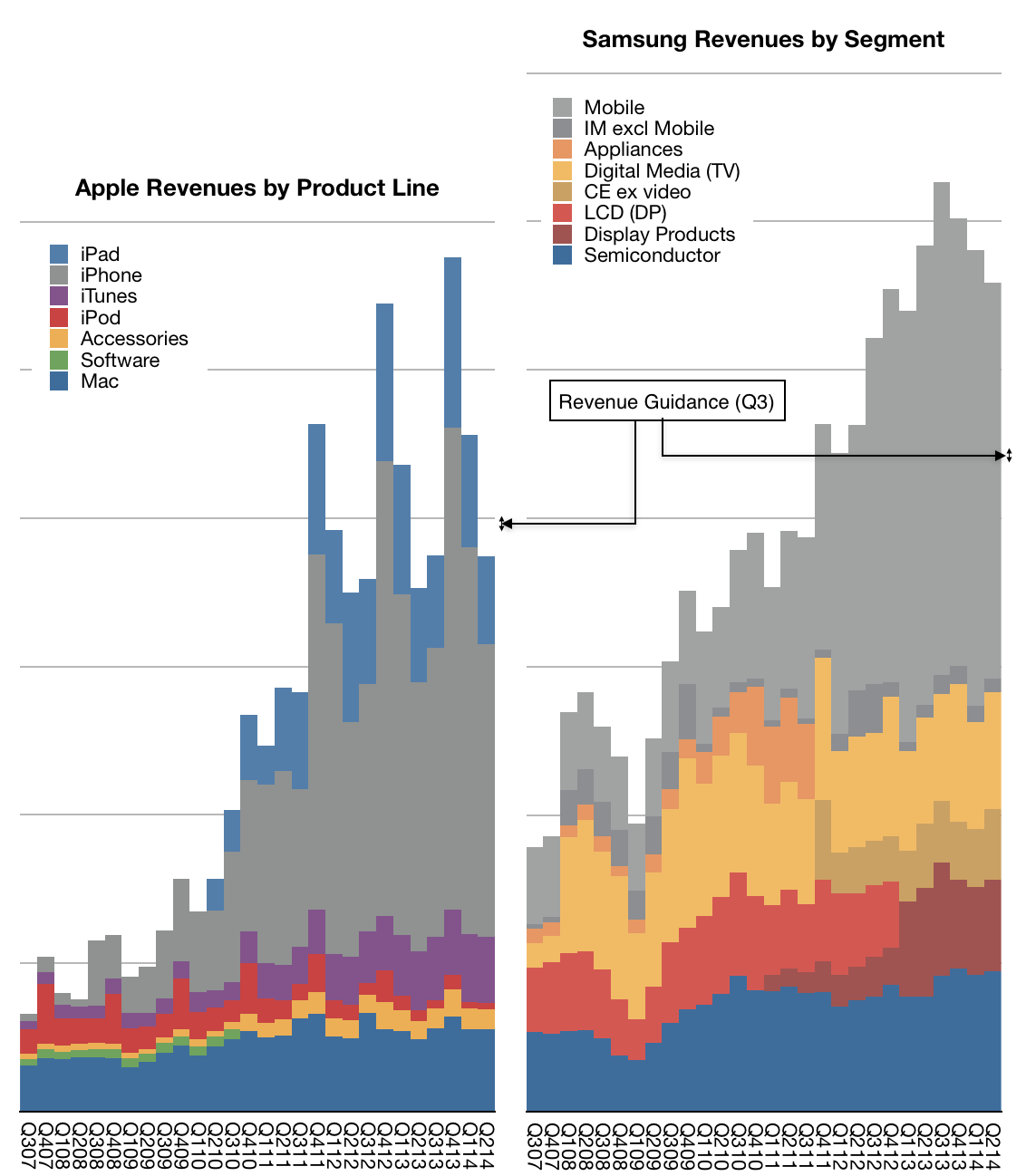
    The headlines reporting the news emphasized the 60% forecast drop in operating income but the company also provided sales figures. Adjusting for exchange rates, the forecast revenues are shown in the following diagram:


    Screen Shot 2014-10-07 at 8.51.05 AM

    Note that I also included Apple's revenue history and forecast. Samsung's revenues are shown on the right and Apple's on the left using the same scale (each horizontal gridline represents $10 billion/quarter.

    The explicit cause for the drop is a decline in prices and "increased competition". ((Though one can't be sure when there was ever decreased competition in its markets.)) However a few more questions need to be answered regarding long-term success in the markets Samsung competes in.

    Namely:

    • The absence of a software platform fully within its control
    • The absence of control over an ecosystem of content and apps
    • The absence of services
    • The lack of integration of software, services and hardware
    • The absence of differentiation vis-a-vis other vendors
    • The indefensibility of its low end offerings from low end disruptors
    • The pattern of commoditization in all its markets

    Samsung is a very big company but many very big companies came to become small companies. They all followed similar roads.

  6. The Critical Path #124: Big in Japan

    Podcast · 3 comments

    Horace and Anders discuss Opening Weekend Sales of iPhone 6, Accurate Timekeeping Device, the 3rd tentpole of Apple Watch, leading to a brief history of wristwatches, a study of Job-to-be-done for the watch and what it signals about Apple's future.

    Horace also announces his new role at the Clay Christensen Institute, and the resumption of Airshow World Tour starting with Airshow Seattle on Nov 8.

    via 5by5 | The Critical Path #124: Big in Japan.