Asymco

Asymmetric Intelligence

Latest from Asymco

  1. The Critical Path #106: Can Bitcoin Be Money?

    Podcast · 5 comments

    This the the first of hopefully a series of talks on Bitcoin. The hope is to assess it as a disruption but first we need to understand the differences between a store of wealth, a currency and money. Then we need to understand what jobs each of these is hired to do and whether Bitcoin is better or worse than the incumbents and whether it has "headroom" to get better in those cases where it's not good enough.

    via 5by5 | The Critical Path #106: Can Bitcoin Be Money?.

  2. Airshow 2014 World Tour: Coming to a City Near You

    Conference · 3 comments

    Screen Shot 2013-12-19 at 12-19-3.48.45 PM

    In a world where everyone needs to present, few know the power that lies under their fingertips.

    Whether one-on-one or in front of millions on TV, presentations are the primary means of persuasion in business.

    Have you ever cringed at text-only slides or puzzled over graphs that made no sense? Steve Jobs saw "PowerPoints" as "rambling and nonsensical" and had them banned internally. But he used visuals for all his keynotes. What made them tolerable, even persuasive?

    The problem is that most people receive no training in how to compose the most crucial images they project to an audience and the tools available do not take advantage of motion, touch, processing power, mobility and high resolutions.

    • Airshow teaches principles of visual persuasion using techniques of cinematography and visual storytelling.
    • Airshow shows how tablets create a new stage for your performance.
    • Airshow applies Aristotelian rhetoric, Cinematographic theory and Cinematic storytelling as well as Tufte design principles into a new medium.

    You’ll learn how to:

    • Persuade with logic, empathy and credibility.
    • Present rich data as compelling and emotionally engaging
    • Get hands-on experience with modern tools of persuasion including tablets and interactive, touch-based interfaces.

    You have the data. You have the audience. All you need is a story and a screenplay. How do you build them?

    There are techniques which are proven to work. They’ve been used by writers, performers and playwrights for centuries. Professional presentation coaches will teach you far less and at greater expense.

    • Airshow is better and less expensive, especially in terms of time.
    • Airshow is an intimate experience. Audience size is limited.
    • All the tools and techniques needed in one day of intense, inspirational and engaging training.

    Airshow could be coming to a town near you but to make it happen you need to act now.

    Here's how it works: For every month in 2014 an Airshow event will be hosted. The location for that month will be locked-in when the first 20 registrations for that city will be recorded. Any registrations that take place before the location is locked-in will be half-price.

    In other words, early registration means you get half off! ((If your registration is not part of a quorum (fewer than 20 total) then it's automatically re-issued for the following month. You may also request a refund.))

    Now is the time to learn presentation skills for the post-PC era. Just like there is no writing which does a movie justice, I can't write here how it's done, you have to see it live.

    Register now.

    HERE'S WHAT PEOPLE SAY ABOUT AIRSHOW

    “Airshow was amazing. Business stories with cinematic impact made easy with perspective”
    — Paul Brody, Global Business Leader, IBM

    “Airshow has fundamentally changed how I give client and industry presentations. It is an important tool in my toolbox which allows me to showcase my data and my story in ways that help audiences gain deeper insight and perspective.”
    — Ben Bajarin, TIME, TabTimes, Techpinions

    “Nobody brings numbers to life like Horace Dediu does.”
    —Philip Elmer-DeWitt, Fortune/CNN

    “The unhurried nature of Airshow is just terrific and in contrast to many other events. Anyone who goes will gain their own purposes.”
    —Steve Crandall

    “Airshow is a treat [...] showing how to make the audience wonder.”
    —Bertram Gugel

    “Airshow is surpassing my expectations. Very interesting deep content.”
    —Ryan Singer, 37signals.

  3. Moonshot

    Research · 63 comments

    When describing the process of disruptive innovation, Clay Christensen set about to also describe the process by which a technology is developed by visionaries in a commercially unsuccessful way. He called it cramming.

    Cramming is a process of trying to make a not-yet-good-enough technology great without allowing it to be bad. In other words, it's taking an ambitious goal and aiming at it with vast resources of time and money without allowing the mundane trial and error experimentation in business models.

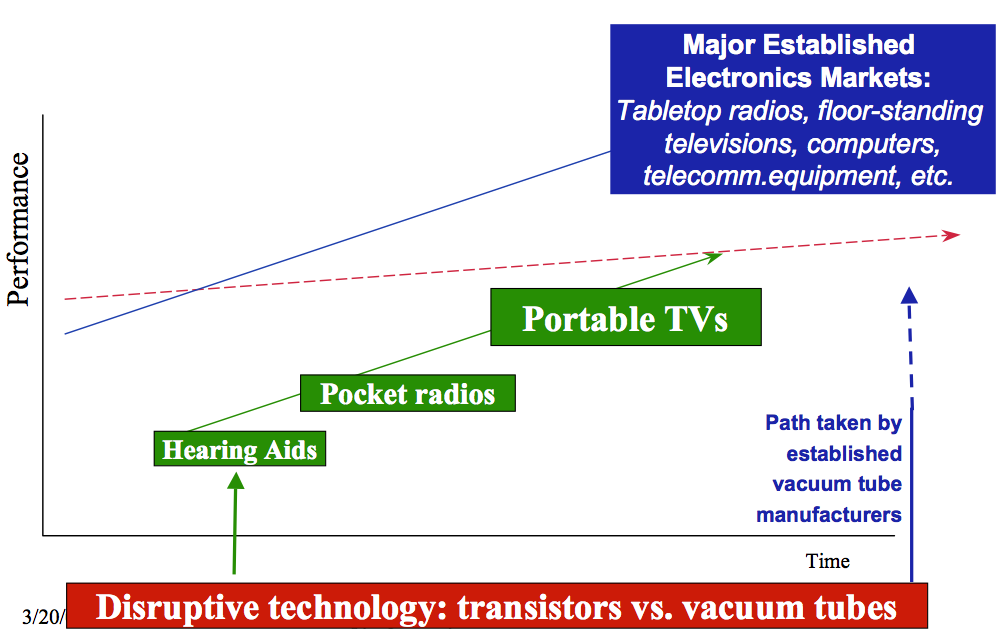
    To illustrate cramming I borrowed his story of how the transistor was embraced by incumbents in the US vs. entrants in Japan and how that led to the downfall of the US consumer electronics industry.

    Small upstarts were able to take the invention, wrap a new business model around it that motivated the current players to ignore or flee their entry. They thus successfully displaced the entrenched incumbents even though the incumbents were investing heavily in the technology and the entrants weren’t.

    In the image below, the blue "path taken by established vacuum tube manufacturers" is the cramming approach vs. the green entry by outsiders who worked on minor new products which could make use of the rough state of transistors at their early stages of development.

    Screen Shot 2013-12-17 at 12-17-3.04.59 PM

    The history of investment in transistor-based electronics shows how following the money (i.e. R&D) did not lead to value creation, quite the opposite. There are many such examples: The billions spent on R&D by Microsoft did not help them build a mobile future and the billions spent on R&D by Nokia did not help them build a computing future.

    There are other white elephant stories such as IBM's investment in speech recognition to replace word processing, the Japanese government spending on "Fifth Generation Computing" and almost all research into machine translation and learning from the 1960s to the present.

    But today we hear about initiatives such as package delivery drones and driverless cars and robots and Hyperloops and are hopeful. Perhaps under the guiding vision of the wisest, most benevolent business wizards, breakthrough technologies and new infrastructures can finally be realized and we can gain the growth and wealth that we deserve but are so sorely lacking.

    But the failure of crammed technologies isn't rooted in a lack of wisdom. It was the wisest of minds which foresaw machine learning, advanced computing, mobility and convergence coming decades before they came. It was their wisdom which convinced others that resources should be spent on these initiatives. And it was the concentrated mind power of thousands of scientists which spent hundreds of billions in academic and government research.

    What failed wasn't the vision but the timing and the absence of a refinement process. Technologies which succeed commercially are not "moonshots." ((It could be said that the space and nuclear weapons programs during the Cold War were the original "moonshots" and they succeeded. But although successful in their goals, those goals were not commercial value creation and we are left with little to show for it. See also Concorde.)) They come from a grinding, laborious process of iteration and discovery long after the technology is invented.

    The technology is one part of the problem to be solved, the other is how to get people to use it. And that problem is rooted in understanding the jobs people have to get done and how the technology can be used defensibly. That's where the rub is. An unused technology is a tragic failure. Not just because it has no value but because the resources (those beautiful minds) used in making it could have been applied elsewhere.

    Building usage means imparting and retrieving learning through a conversation with the customer. That conversation is best spoken with a vocabulary of sales and profits. Without profits the value is unclear. Nothing is proven. Without economic performance data, the decision of resource allocation becomes a battle of egos. ((This is how most research is allocated today.)) The decision may be right but going by past history the odds are low.

    Incidentally, timing is the other element that is key to success. It might seem that timing really is a matter of luck. But timing can be informed by the same conversation with the customer. As you observe adoption you can also measure how long it take for a technology to be adopted. You can do A/B tests and see what is faster.

    The most reliable method of breakthrough creation is not the moonshot but a learning process that involves steady iteration. Small but profitable wins.  A driver-less car might be achieved but first a driver-assisting car might teach the right lessons. An electric car might be achieved but first a hybrid car might teach the lessons needed. A delivery drone might be achieved but first a programmable UPS truck might be a better way to learn.

    And finally, Android (née Linux) in 2005 might have been foreseen as the future of mobile operating systems but it took the learning from iOS to shape it into a consumer-friendly product. Even when you see a moonshot work, you realize that a lot of learning had to have taken place. It's like the story of an overnight success that took a lifetime of perseverance.

  4. Bundling and Pricing Innovation

    Research · 84 comments

    This was initially posted on LinkedIn December 16, 2013.

    Innovation comes in many forms. Many times innovation is thought of as technological improvement or as invention. We can all cite examples of inventions which turned into industries which re-defined civilization. The steam engine comes to mind but there were many others before and after. Inventing something is certainly a way to create value but it's not as common or as reliable a method as it might seem. Creating Intellectual Property is one thing, finding a defensible market and business model is quite another.

    More often companies innovate in terms of processes or the "algorithms" which are used to deploy existing resources. Wal*Mart was immensely innovative in the way it organized itself and laid out a low-cost business model. More recently Amazon has innovated in distribution and fulfillment based on the ability to dispense with showrooms for products and sell directly online. There is little in terms of technology which Amazon "invented". Rather, it deployed off-the-shelf technology in a novel way.

    But what I want to address is a more mundane sort of innovation: marketing innovation, specifically pricing. Few would consider a price model to be an innovation but in fact it's a core lynchpin to many breakthrough innovations. It was pricing which permitted Henry Ford to build an industrial empire. He could have built cars for those who could afford them as cars were defined in 1907 but he chose to build a car around a price point which was around the median of the population. A car "so low in price that no man making a good salary will be unable to own one." His business logic began with a price and the product and process followed.

    Another aspect of pricing innovation is "bundling" where products which might sell poorly independent of each other sell very well when coupled with complements. Consider the original Microsoft Office. When introduced vis-a-vis Lotus 1-2-3 and WordPerfect as separate products, it handily won the market for spreadsheets and word processors. Bundling is also the way TV is sold. Cable companies don't offer channels a-la-carte. It even took root in the car business. Automakers are now selling upgrades as "equipment packages", a method proving far more popular (and profitable) than the menu system of old.

    But there are cases where bundling has been rejected by users. iTunes broke the bundle of the "Album" where the only way you could get a single was to buy a dozen other songs. Once broken, the album bundle shows no signs of a come-back. Many are questioning whether TV channel bundling is also ripe for such a break-up.

    And there is yet another looming bundle question. For as long as the market existed, mobile carriers sold their service bundled with a device. This harks back to the days when AT&T (known then as the Bell Network) did not permit users to own their own landline phone. They argued that the device is a part of the network and choice in the matter would compromise security and safety of a crucial infrastructure. The argument played well with regulators for decades.

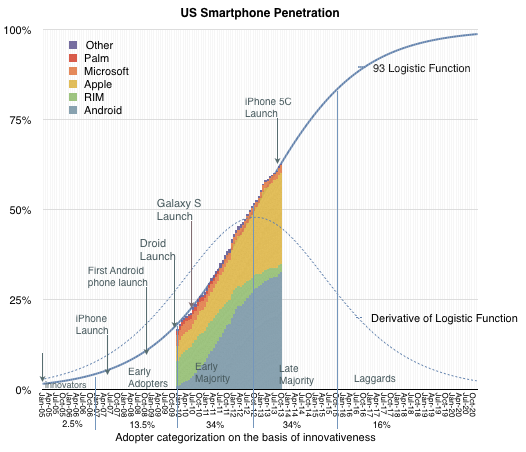
    This tie between the device and the service persists today but the connection has been preserved not though regulatory fiat but through incentives in pricing. Arguably, the low price of devices, and hence cost of entry, has meant that penetration skyrocketed. Cellular service now reached saturation in the US in near-record time. The upgrading to smartphones is now about 60% complete and looks to saturate a mere 8 years after reaching 10% of the population.

    So in a way, the "innovation" of the carriers has been in bundling and creating a package that was irresistible to consumers. They went from not consuming mobile networks to consuming them universally. The amount being spent by consumers on mobile services is above $1.3 trillion world-wide--a market that did not even exist 20 years ago.

    So now the question being asked, even within the industry, is whether this bundling can long last. The way I would answer the question is by following the logic from the consumer's point of view. If the bundle is valuable, then it's likely it will be tolerated, even preferred. In the case of software and car options the model works. Even in the case of TV the model is still preferred as few consumers are defecting to the IP-based unbundled alternatives. In the case of music, the consumers prefer the unbundling because there were things in the bundle which they did not need or want. They wanted a song, not a song and others which they might like.

    But in the case of network service and device, the split is more subtle. A service is useless without a device and a device is useless without a service. The bundle makes sense from the point of view of co-dependency of modules. The broader question is one of choice. The premise of unbundling might be that users can choose service and devices separately and change them arbitrarily.

    There is a fundamental problem with this however. A service that can be switched on or off easily by consumers is economically challenging for network operators. The economics of networks are such that financing them requires steady cash flow and every operator desires stability. So incentives will be put in place for consumers to stick around, and these incentives (read innovations) work. But isn't the device itself such an incentive?

    We end up back where we started. The business model and economics of operators world-wide is such that the device is a critical part of the incentive structure which preserves the network's economic balance.

    It may be an illusion, but a cheap phone (with a long-term contract) is a fundamental innovation devised by telco operators even before the phone became mobile. Operators have come to love it and no matter how many technology generations go by; how many family plans, bucket plans, weekend minutes, rollovers, and data packages; no matter how many tweaks and re-brands the model gets, it will persist. There simply isn't sufficient win-win value in alternatives.

  5. The EcoV

    Research · 1 comment

    In this episode we move beyond just talking about our pet theories of automotive disruption and interview someone who is doing something about it.

    Asymcar 8: The EcoV | Asymcar.

    If you want to know more about Toyota's secret sauce, why GM could not make an electric vehicle and how decisions are made in the auto industry then you should listen.

  6. How many Americans will be using an iPhone when the US smartphone market saturates?

    Research · 200 comments

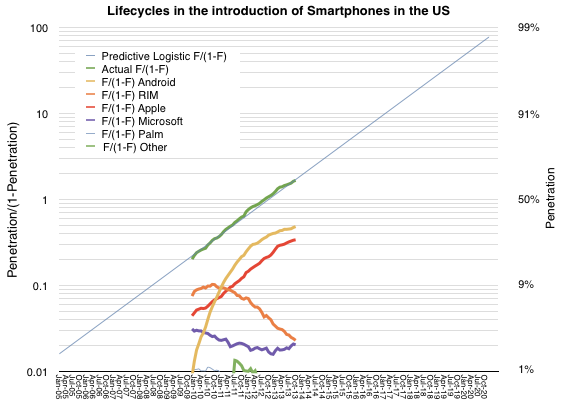
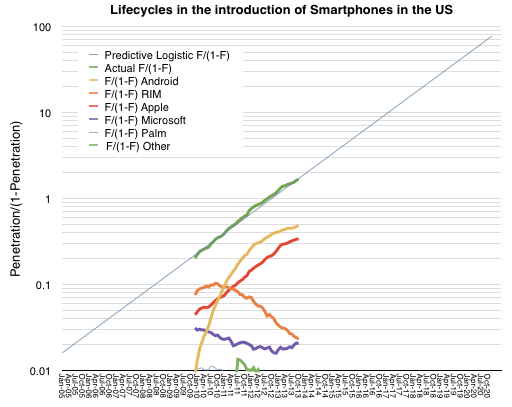
    As previously noted, the US smartphone market has followed an almost perfectly logistic growth. The measured data (via comScore, in green below) follows a predictive logistic function (thin blue whose formula is discussed here).

    Screen Shot 2013-12-13 at 12-13-11.30.54 AM

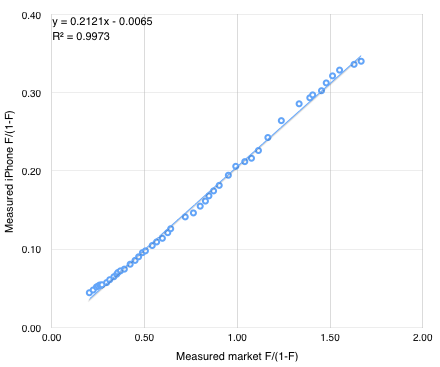
    The other notable market observation is how closely the iPhone follows the same pattern as the market. The red line representing the iPhone above is almost perfectly parallel to the green and blue lines which represent the overall market. The reason for this seems to be that consumers are absorbing the product in similar way to how they are absorbing the technology. ((Note that this pattern of adoption has happened even though the product has been at least partially unavailable to the entire market until quite recently.)) The "learning model" which underpins logistic models could offer clues as to the cause. It suggests that there is a direct communication that happens between the product and the consumer.

    Incidentally, the reason other platforms do not follow this pattern is that they are not communicating value with the consumer but with manufacturers or distributors of the product. These alternative communications could create faster or slower growth than the overall market as they are not subject to the same large population imitation/learning models.

    If we believe that the iPhone can be modeled behaviorally then it may be possible to forecast its growth. One can simply draw a line extending the existing red segment above and read the F/(1-F) figure at any point in time. Solving for F results in a measure of penetration and hence number of users (if population is known.)

    An alternative is to use the following formula derived from the linear interpolation of the two measured market shares. iPhone market share is y/(1+y) where y=0.21x and x = F/(1-F) and F is the expected market penetration of smartphones.

    Screen Shot 2013-12-13 at 12-13-11.29.59 AM

    So if F = 91%, x = 10, y = 2.11 and therefore the iPhone market share =  68%.

    We also know from the plot of the market that F = .91 is reached around February 2017. So we can suggest that at 90% penetration (approximately saturation) the iPhone will have 68% market share of users in the US. Forecasting the addressable market (US population aged older than 13) at about 266 million that implies 180 million US users of the iPhone by early 2017.

  7. Updated US Smartphone Saturation Forecast

    Research · 37 comments

    The latest comScore US smartphone survey showing three months' ending October data has been released and there were no surprises. Smartphone penetration grew to 62.5% representing 149.2 million users. I made a slight adjustment to the predictive logistic function parameters (p1 = 93, p2 = 22.5).

    Logistic

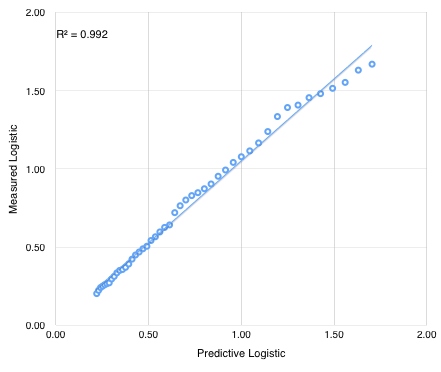
    The correlation between predictive and actual logistic function (P/(1-P)) is shown below.

    Screen Shot 2013-12-10 at 12-10-10.31.29 AM

    90% penetration (P/(1-P) = 9.23) is now expected by December 2016 when about 230 million users will be using smartphones in the US.

    Screen Shot 2013-12-10 at 12-10-10.32.13 AM


    Individual platforms adoption curves are shown as colored areas above and as lines on a logistic plot below:

    Screen Shot 2013-12-10 at 12-10-10.34.45 AM


    The parallel behavior of iPhone and the overall market remains unchanged.