Asymco

Asymmetric Intelligence

Latest from Asymco

  1. AMP Index update

    Research · 50 comments

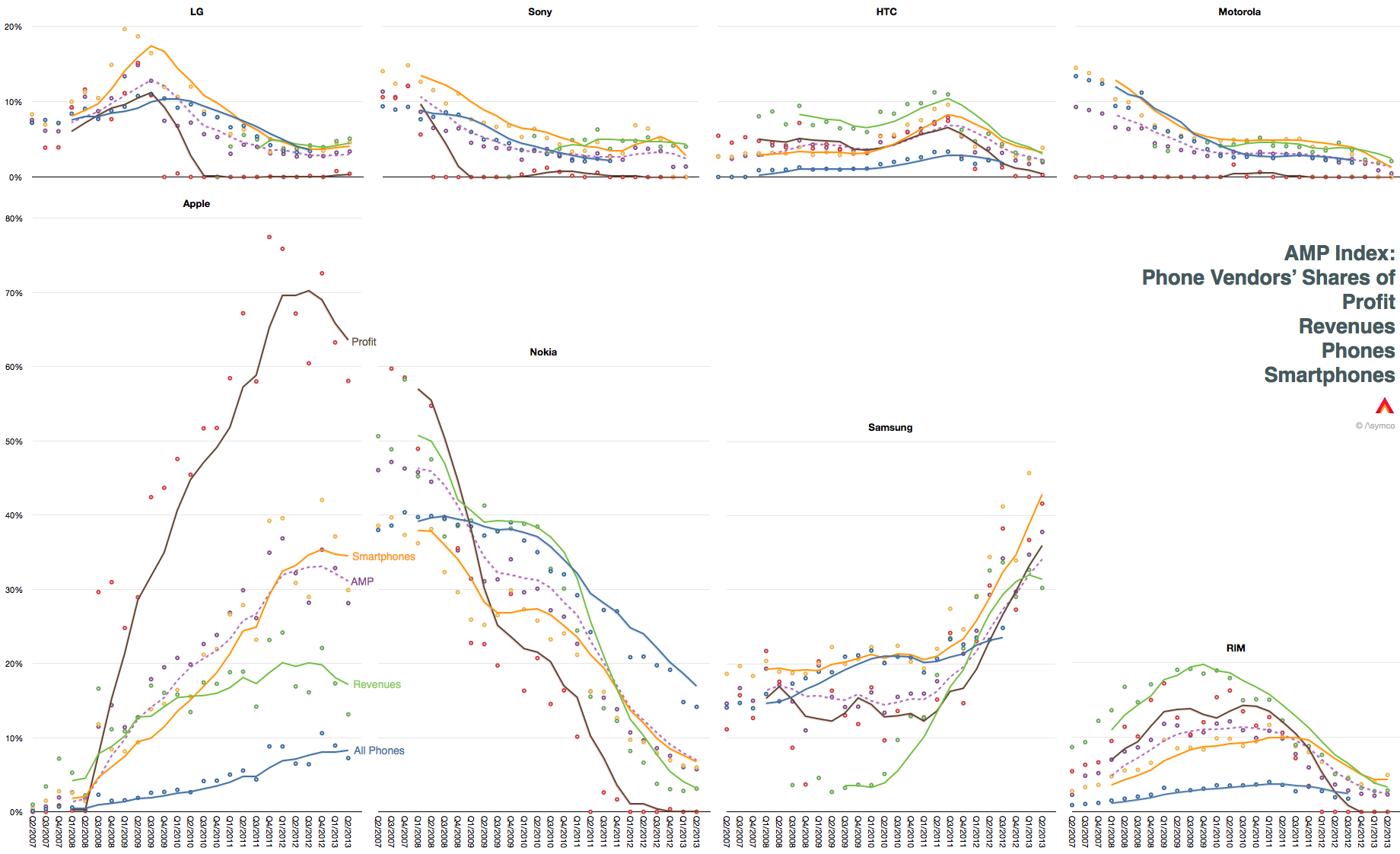
    The following graphs show the most visible global phone brands and the approximate percent of value they captured since 2007.

    Screen Shot 2013-08-21 at 8-21-6.17.19 PM

    The graphs each show trailing four quarter average of shares of units shipped, revenues, operating profits and smartphones shipped. I also averaged the four shares into a single share number called the AMP index (Asymco Mobile Performance).

    Note that this data ignores those "other" vendors whose financials are not available.

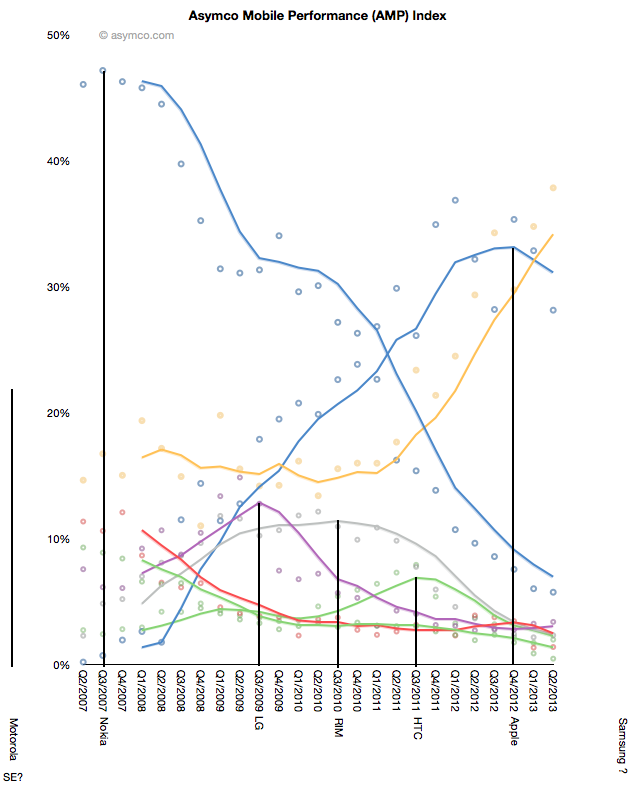
    I placed all AMP indexes on the same graph and looked for some patterns. The result is shown below.

    Screen Shot 2013-08-21 at 8-21-6.58.01 PM

    It's not much to go on, but there seems to a pattern where each vendor reaches a peak share, though that peak varies greatly in value. If the pattern holds, we could perhaps anticipate a peak for Samsung in one year or so.

    I'm searching for some hypothesis of what is happening and what is causing this pattern, if it is a pattern. The instability of the market is certainly a pattern. (Many markets would show horizontal lines for many years rather than what we see here.)

    But the constant turnover and the periodicity of success and failure is a characteristic of either a market where there is a hidden hand (operators? regulation? etc.) or one where disruptive change is extremely consistent and rapid.

  2. The last frontier

    Research · 51 comments

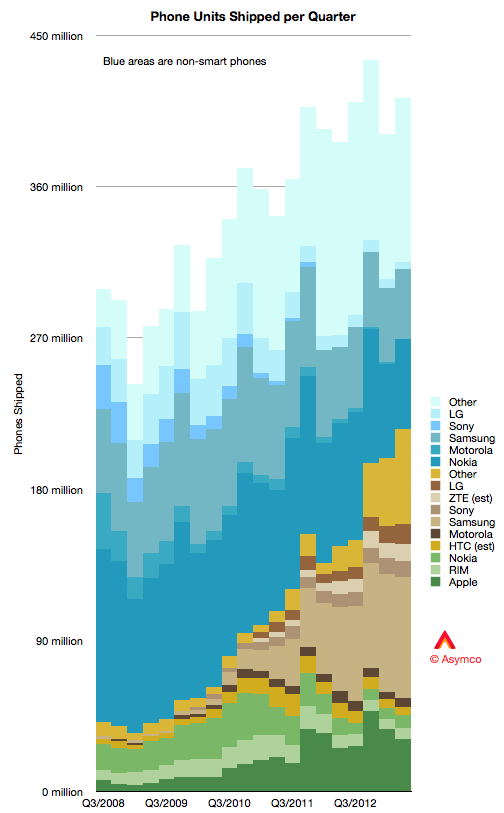
    Tracking the mobile phone market hasn't been getting any easier. The lack of published data from many incumbents (including the largest) is compounded by the lack of visibility into entrants. It's not just ZTE and Huawei which are up-and-coming, but companies such as Lenovo, Xiaomi and Yulong make up an increasingly large part of the overall market. (Not to mention BBK, Meizu, OPPO and TCL).

    Canalys suggests that China's top five vendors make up 20% of the world's smartphone shipments. This is mostly due to the rapid rise of the category in China and the advantages local vendors have in that market. Absent this large segment, a complete picture of the market is simply not possible. Nevertheless a fuzzy picture of the entire market can be still be painted.

    Screen Shot 2013-08-20 at 8-20-12.44.02 PM

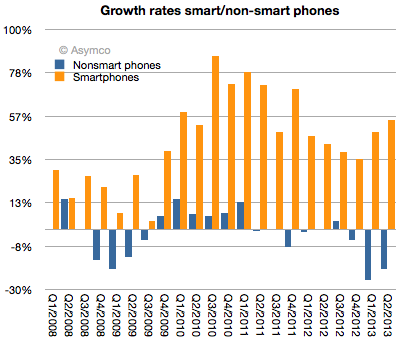
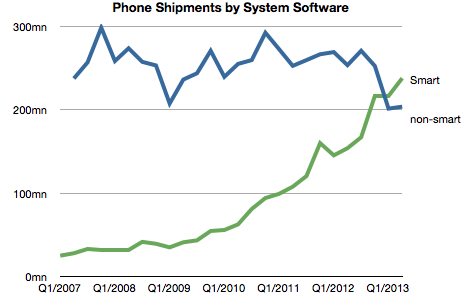
    What I see in this graph is that competition with smartphone non-consumption is still fierce. Non-smart phones are still shipping at the rate of about 200 million per quarter. Not as many as the smartphone units, which are nearly 225 million, but their numbers have not so much plummeted as not risen. Smartphones meanwhile have expanded greatly.

    Screen Shot 2013-08-20 at 8-20-1.55.15 PM
    Screen Shot 2013-08-20 at 8-20-1.05.38 PM

    The other observation is that these non-smart units are increasingly being made by no-name brands and sell in emerging markets through grey markets. Nokia's non-smart business is contracting and Samsung, the only other branded vendor with any material non-smart volumes is fleeing upmarket.

    Consider that India, a market of 700 million users purchased barely 9 million smartphones last quarter. Contrast that with the Chinese market where 1.1 billion users purchased 88 million. The preference in India is for super low cost products of dubious progeny.

    In other words, the preference in India is about what it used to be in China two years ago.

    Will India follow China out of non-consumption? It's hard to say. There are many factors beyond market forces at work. Although that's true in most phone markets, India is particularly byzantine. Not only is distribution different (retail only and very fragmented and multi-level distributed) but there are few 3G users and networks are notoriously difficult to scale. For a vendor trying to apply a global strategy in India the odds are very poor indeed. And there are few vendors more uniform in their approach than Apple.

    The Indian market is not yet "cracked" as Tim Cook would say.  One wonders if it ever will be.

  3. The Meanings of Appleiness

    Research · 212 comments

    I've never worked at Apple and know very few people who did. Nevertheless, I read Adam Lashinsky's book and enough Folklore.org that I think I can get away with replying to the Meaning of Googliness with the following:

    Googliness meansAppleiness means
    Doing the right thingDoing the best thing
    Striving for excellenceStriving for greatness
    Keeping an eye on the goalsKeeping both eyes on your task
    Being proactiveBeing obsessive
    Going the extra mileGoing to the moon
    Doing something nice for others, with no strings attachedDoing everything for the user
    Being friendly and approachableKeeping your mouth shut
    Valuing users and colleaguesValuing functions other than your own
    Rewarding great performancePunishing failure
    Being humble, and letting go of the egoKeeping your mouth shut
    Being transparent, honest, and fairKeeping your mouth shut
    Having a sense of humorNever writing a post on what Appleiness means
  4. Airshow coming to New York

    Conference · 2 comments

    I'm delighted to once again have the sponsorship of IBM for the presentation of Airshow. This time it's in New York City on Wednesday, 25 September at the IBM Building, 590 Madison Ave. My thanks again to Paul Brody for being so gracious and earnest in his support.

    Seating is limited but there are still 25 20 3 available.

    This will be the third Airshow, having started in June in San Francisco and rolling into Chicago in July. The event keeps getting better with a plan to introduce a hands-on module allowing participants to build cinematic data-driven presentation during the afternoon.

    Airshow is intended as both an exhibition of technique and as an explication of   the methods for creating persuasive presentation enabled by new technologies.

    Without revealing too much, the gist of the theory espoused is that presentations can benefit from:

    • The use of directly manipulated visuals
    • Cinematic effects honed by cinematographers over a century
    • Aristotelian presentation principles

    Together, these techniques solve the "job to be done" of persuasion—a job universally in demand but deeply underserved by current tools and techniques.

    The participant should come away from the event with the ability to:

    • Use the iPad as their primary presentation tool, with or without a projector to large and small audiences
    • Use a cinematic technique of presentation where a layer of implicit yet easily sensed meaning is overlaid upon the words spoken and images viewed
    • Appeal with empathy, logic and credibility to all audiences.

    You can register for Airshow New York here.

    See also: The end of the projector.


  5. It's a wonder

    Research · 3 comments

    My responses to questions from Juliette Garside of The Guardian newspaper:

    Q: Will noise from Icahn distract the Cook from focussing on product?

    A: Investors may think that they can influence management but they do so only when companies are in distress. It’s only then that shareholders can affect some change with their votes as they have a common purpose. The voice of investors carries little weight or distraction when a company is successful. At first glance it seems that Icahn thinks he can unlock value in Apple by getting management to accelerate share buybacks. That’s a modest goal and not one which needs to distract managers.

    Q: What will do most for the share price – a buyback or a blockbuster new device?

    A: Neither. What will do most for the share price is a change in the perception that Apple is not going to survive as a going concern. At this point of time, as at all other points of time in the past, no activity by Apple has been seen as sufficient for its survival. Apple has always been priced as a company that is in a perpetual state of free-fall. It’s a consequence of being dependent on breakthrough products for its survival. No matter how many breakthroughs it makes, the assumption is (and has always been) that there will never be another. When Apple was the Apple II company, its end was imminent because the Apple II had an easily foreseen demise. When Apple was a Mac company its end was imminent because the Mac was predictably going to decline. Repeat for iPod, iPhone and iPad. It’s a wonder that the company is worth anything at all.

  6. How will iPhones 5S and 5C be priced?

    Research · 175 comments

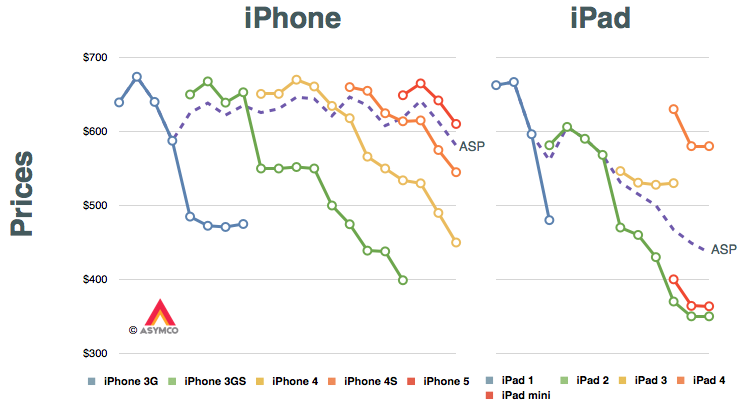
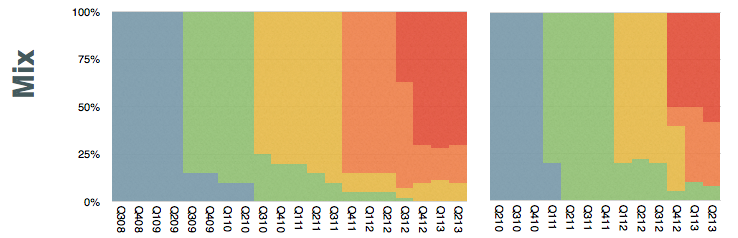
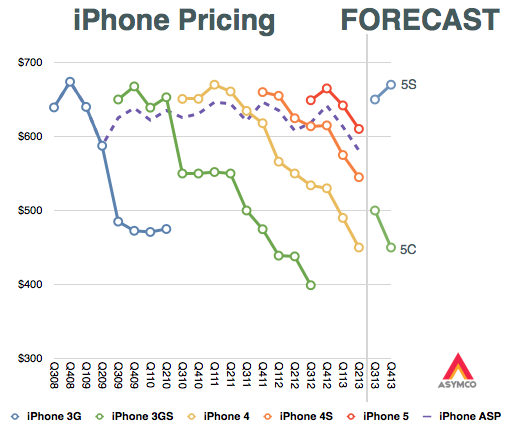
    The answer may lie in the way the iPad mini has been marketed. The pattern for iPhone pricing is pretty regular but that for the iPad shows a marked difference. The reason is, of course, that the iPad has already gone through a portfolio broadening. The following graphs tell the story.

    Screen Shot 2013-08-12 at 8-12-11.30.09 AM
    Screen Shot 2013-08-12 at 8-12-11.49.19 AM

    The only data in these graphs that is provided by Apple are the dashed purple lines. They represent the average selling prices (ASP[*]) for the two product lines. I added assumptions about product mix (shown in the lower set of graphs) and thus generated prices for each product variant at a given point in time shown as  line graphs.

    If you look at the iPad, ignoring the legacy iPad 2 (which I presume sells mostly to educational institutions) the replacement of the iPad 3 was with a "bracketed" portfolio of the higher-priced iPad 4 and the lower-priced iPad mini. Note also that the mini reflects similar pricing to the legacy iPad 2.

    My second assumption is therefore that the 5S and 5C will form a similar bracket as the new iPads did. I also assume that the iPhones 4 and 4S will be retired. This means that the 5C will take up the trajectory of the 4S while the 5S will take up the upper bracket around $650.

    Screen Shot 2013-08-12 at 8-12-11.44.05 AM

    The average pricing for the entire portfolio will depend on the mix. This is still highly speculative since we can't predict how the end-user (operator) pricing will be set for the 5C. Aggressive promotion and new market growth might skew the 5C considerably. On the other hand, upgrade promotions might move the 5S in existing markets.

    ---

    Notes:

    • These prices reflect blended average prices of all SKUs to the channel and do not necessarily reflect prices offered to end-users.
  7. Signs of US Android net user decline

    Research · 255 comments

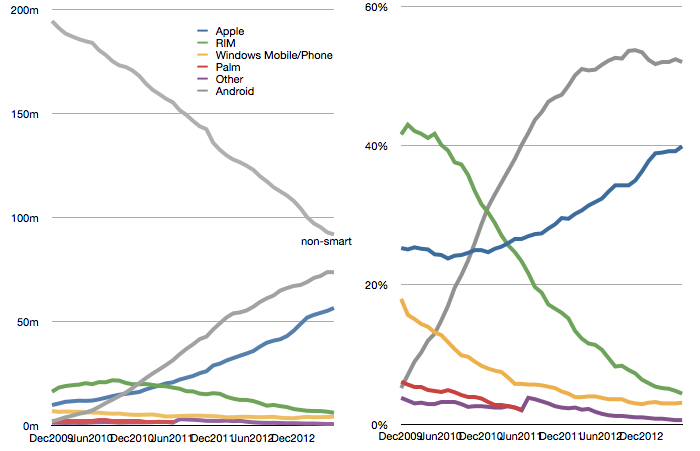
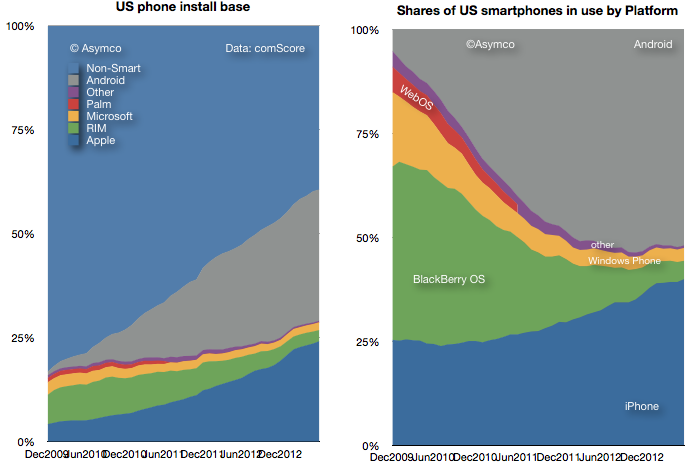
    ComScore's latest survey  for US smartphone users showed that Android had 52% share of about 142 million users. That amounts to 73.84 million Android devices in use.

    ComScore's previous such survey showed that Android had 52.4% of about 141 million users. This amounts to 73.88 million Android devices in use. It also means that Android usage in the US went down for the first time.

    Screen Shot 2013-08-08 at 8-8-10.10.39 AM

    The difference is surely within a margin of error so it's not something to declare definitively, but the pattern of Android "peaking" has been evident for some time.

    Screen Shot 2013-08-08 at 8-8-10.11.44 AM

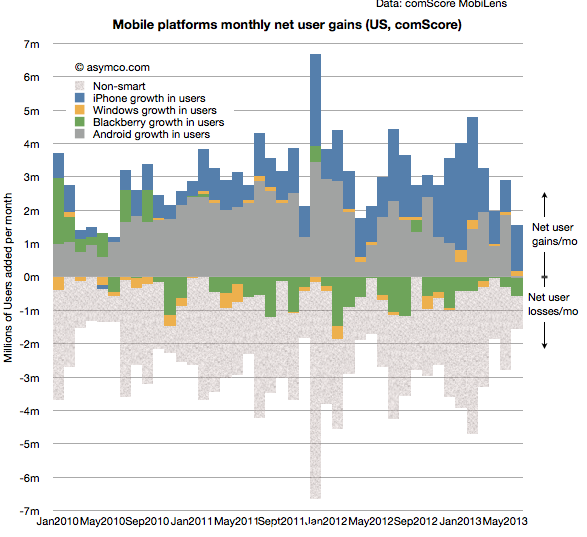
    Even though share stopped growing about a year ago, Android continued to gain users as overall smartphone consumption increased. The last few months however have shown a slowing of new smartphone users and therefore we have this first instance of Android appearing to lose usage.

    Screen Shot 2013-08-08 at 8-8-10.12.35 AM

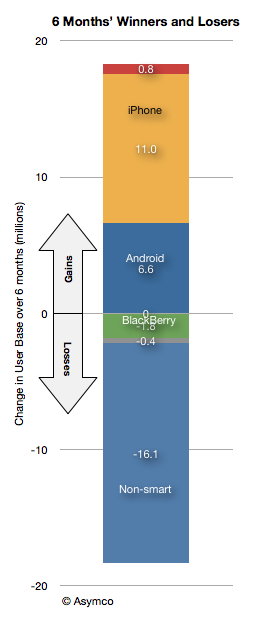
    Note that this has not been the case for iPhone as usage over the last six months is up by 11 million users vs. 6.6 million for Android.

    Screen Shot 2013-08-08 at 8-8-10.13.07 AM

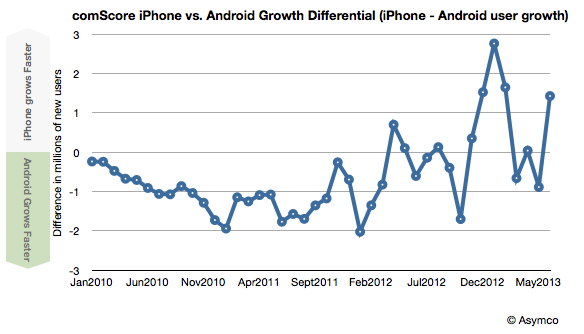
    Indeed, iPhone gained more users than Android for the last 6 out of 8 months.

    Screen Shot 2013-08-08 at 8-8-10.16.36 AM
  8. The Anti-Apple

    Research · 268 comments

    Building a successful business is hard. Many try, few succeed and those that do tend not to thrive for long. So success in business it should be respected. Especially in highly competitive industries like technology. The fragility of success however should also give one pause to think about how delicate a business model is.

    The presumption that companies can shift business models at will is usually false. Businesses are balanced on a knife's edge of dependency on multiple variables. Almost all resources are expended on preserving this balance.

    This being my observation, I take issue with assumptions that large companies can "pivot" on a dime or that they can change their business models "when conditions are right". Consider Microsoft's dilemma. They have all the resources in the world and yet they could not pivot to take advantage of a change so mundane as a low power microprocessor (which enabled a mobile computer and hence a new ecosystem and profit model for software.)

    Or consider the dilemma of Apple which after building a successful computer business which included system software, could not pivot to license that system software so others could build computers with it.

    Or consider the dilemma of Nokia which had an early and large leadership in smartphones including having its own OS and platform and large volumes and users bases. It could not pivot to allow into an ecosystem and had all its advantages disappear.

    Each company thought they could manage change but none of them actually did.

    It's with this thinking about inertial navigation that came to consider the idea that Amazon has a flexible business model which, though unprofitable today, will be profitable some day.

    The premise that Amazon can, on a whim, change its business model from selling other people's products at a razor thin margin while investing in capital-intensive distribution to selling other people's products at a large margin while not investing in capital-intesive distribution is not credible.

    I would argue that Amazon's existing business model is a direct consequence of the market it's in: that it could not be anything else given the circumstances it finds itself in. Enlightenment may be an illusion.[*]

    That's not to say that there is no wisdom in the management of Amazon. Quite the contrary; recall the respect that's called for in creating a great business. Managing the business to this point was a work of decades of vision and creativity.

    What I take issue with is the premise that Amazon is the "anti-Apple" in its hunger for growth and patience for profits. Apple has its own "Amazon-like-business": iTunes has been growing at a steady 25% or more and it also has its ancillary zero-profit hardware analogue to the Kindle called Apple TV.  iTunes is a great business in the Amazon vein, harvesting hundreds of millions of users (and their credit cards.) Presumably iTunes could also some day "flip the switch" and become profitable, but something magical needs to happen. Something like becoming a payments processor or retailer of other things. Analyst beware however. There might be conditions that make such switch flipping extremely difficult.

    At an even deeper level, Apple and Amazon are much more alike than they are different. They are both hired for similar jobs (convenience, ease of use and a controlled, predictable environment for average users interacting with technology). They both focus on delighting customers and controlling all the variables which come into contact with that delight. They both have long-term views and are driven by vision rather than competition.

    Where they differ is in others' perception of sustainability. Whereas Apple is perpetually given an expected lifespan of less than a decade, Amazon is expected to have an indefinite lifespan. This is because Amazon is seen as having no competition and Apple is seen as having infinite competition. In other words, Amazon is perceived as a monopoly and Apple is perceived as the  innovator that is in a permanent state of being disrupted by the low end.

    I disagree with both assumptions. I've always thought Apple fragile but dedicated to moving into new markets as older markets are disrupted. It's a tough strategy and one which (literally) nobody believes possible. But I've also thought Amazon's monopoly status fragile. This too is not a popular idea but the company depends on many variables.

    Retail is hard and it is being disrupted by technology wielded well by Amazon. But it's also subject to further disruption. Amazon's job to be done can be done by alternatives. Buyers are typically hiring Amazon for convenience, not just price and ease of use is where the value is. But again, new information technology which makes shopping, discovery and delivery of products directly from the vendor, bypassing the aggregator (i.e. retailer) could shift value along the value chain yet again.

    By the time Amazon reaches some point of monopoly in distribution it could be too late to make the switch to profit generation.

    I don't want to suggest that failure is inevitable, but I want to point out that success is not certain by any means. Disruption happens.

    --

    * It's possible that Enlightenment is also an illusion at Apple. Even if they once had it, there are forces which act on companies that make them lose their wisdom.
  9. iTunes Update

    Research · 29 comments

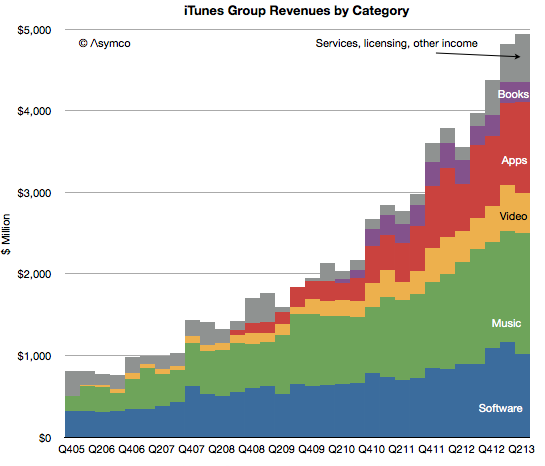
    In the latest quarter the iTunes group top line grew by 25%.

    Additional newly reported items:

    • Quarterly revenues dipped slightly to $4 billion (second highest after $4.1 billion last quarter).
    • iTunes Stores billings (i.e. gross content revenues) were $4.3 billion
    • Reached the best month and best week ever for App Store billings at the end of the quarter.
    • iTunes billings translated to quarterly revenue of $2.4 billion, up 29% from the year ago but flat q/q. Company reports “strong growth in revenue in both content and apps.”
    • New content added includes HBO GO and WatchESPN available on Apple TV. Apple TV catalog now includes over 60,000 movies and over 230,000 TV episodes.
    • Users have downloaded more than 1 billion TV episodes and 390 million movies from iTunes to-date. They are purchasing over 800,000 TV episodes and over 350,000 movies per day.
    • iOS developers have now created more than 900,000 iOS apps including 375,000 apps made for iPad. Apps created grew by 50,000 overall and 25,000 iPad apps.
    • Cumulative app downloads have surpassed 50 billion.
    • App developers are being paid at the rate of $1 billion per quarter.
    • App developers have been paid over $11 billion for their sales through the App Store (half of which was earned in the last four quarters.)
    • There are now over 320 million iCloud accounts
    • There are 240 million Game Center accounts
    • Almost 900 billion iMessages have been sent
    • Over a 125 billion photos have been uploaded and over 8 trillion notifications were sent.

    Some observations and estimates:

    • Music revenue growth remains at around 15% while video revenue growth remains around 25%
    • Apps continue to accelerate with a near doubling of revenues
    • Book revenues are contracting as pricing pressure is being felt
    • The software group grew moderately at 15% as Apple’s apps are reaching saturation within the iOS user base and as Mac sales stagnate.

    As a reminder, you can order the iTunes Business Review from the Asymco Store.


    Screen Shot 2013-08-05 at 8-5-4.21.54 PM
  10. Asymcar 2: Is Tesla Disruptive? Also Segway, Multiair, Winglet, Organ Donors & Regulation

    Podcast · 5 comments

    Podcast 2: Is Tesla Disruptive? Also Segway, Multiair, Winglet, Organ Donors & Regulation Über Alles | Asymcar.

    Horace Dediu and Jim Zellmer discuss the odds of disrupting the present automotive club via Tesla. We further dive into the regulatory and cultural environment that sustains the current players, while reflecting a bit on Segway, Toyota’s Winglet, organ donors and the Fiat “multiair” engine. Finally, we preview a larger discussion on apps in and around the car. [24MB 57 minute mp3]