Asymco

Asymmetric Intelligence

Industry

  1. Making rain

    Podcast · 72 comments

    The following is a slightly edited transcript of a portion of the Critical Path podcast #79. I am reproducing it here for the sake of brevity and focus of discussion.

    ---

    I'm going to try to put together an analogy together here that maybe will help us think through the Facebook Home and the Google Fiber issue.

    I've been thinking a lot about how to illustrate Google's business model. The problem is that discussion has been polarized: Two camps have formed. One camp suggests that Google is a benevolent entity that does great things and only asks that we indulge their hobby of a business model called advertising. Fundamentally they are about pushing the envelope on technology, making wonderful things happen.

    That is one camp. I call them the utopians. It may not be a nice thing to call them but I frame it as being exceedingly idealistic.

    The anti-utopian camp is one that suggests that Google is an advertising company primarily, and fundamentally and overwhelmingly. And anything they do technologically is in support of that. The implication is that Google is sinister and manipulative, bent on getting away with as much privacy extraction as possible.

    I believe that the anti-utopians dismissing Google as an advertising company sounds a bit incomplete. It's not incorrect. It's not erroneous. It's just not a complete story.

    And also the utopian view that they do everything for us out of the goodness of their hearts and that advertising is something that they are reluctant to do, saying in effect, "We only do it because it earns us enough money so that we can do good deeds." That too is not an accurate picture. Google is a business and its business management team is hard nosed and knows what they're doing and they are not purely idealistic in that sense.

    And so the question could be where across this spectrum does Google lie? Possibly it moves around between these points. Where they are becomes a question of motivation and what they want to become.

    But this is only one dimension. It does not help us answer the question of Home, or Fiber or Reader or Blink. Their actions seem contradictory. Holistic or selfless in one case, greedy and capricious in another.

    Let's step out of this spectrum and try to think of different ways which can describe the situation.

    I propose a way to think about it as: Google tries to make a business succeed through having a huge amount of _flow_ in terms of data, traffic, queries and information that is indexed. So think about this idea of them tapping into a vast stream. The more volume that is flowing through the system the more revenue they generate.

    As so given this very rough analogy I try to sharpen it up by saying: imagine it more as a river. And even more than a river, as a watershed, a river basin. Perhaps a giant basin the size of a continent. The business is, let's say, capturing fish at the mouth of the biggest river, before it exits into the ocean at its delta.

    And so your job (as Google) is to catch fish mostly at one point. It's the most efficient way to catch fish because you have the most flow of water at that point and building nets is not trivial.

    But in order for you to improve your business, to create more opportunity, presumably, you want to essentially have more water flowing.

    And so how would you do that? Think of the Mississippi river. If you've got a net down at the bottom of the river, the question is how would you engineer, through civil engineering, or shaping the earth itself, a way of catching more fish.

    The answer I think, in terms of the way Google might be thinking, is that they want to create more sources of water. So they would look to connect tributaries and lakes. "How about having another river join our river?" Let's make sure that we have "everything east of the Rockies" flow into our river system.

    Now, think of it this way: After you've gotten all the tributaries, what are the remaining sources?

    First, you'll want to make sure that no-one can dam or stop the flow of water into your main channels. And so you become extremely anxious about people building dams. That's the number one concern.

    So your strategy becomes one of "how do we avoid dam building"?

    That's one part of your strategy.

    The other thing you could do to improve your business would be to make it rain more. So there's the question in your mind of: If we had more rainfall, then everything will flow more rapidly and we'll get many more tiny rivers forming and joining together into our main river.

    Android and the Fiber business and even Facebook fit into this analogy rather well. In this context more rainfall means more people using the Internet. If you have more people you'll have more rivers and you'll have more water and hopefully more fish. Fiber means the water will flow more rapidly: you're essentially dredging the riverbed.

    But the two are very disconnected (rain, dredging and fish). So your strategy amounts to not really worrying about the ratio. You don't create incentives to people who make rain in the form of fish catch quotas next quarter.

    In other words, your performance as a manager of cloud seeding efforts should not be measured in fish.

    Leadership should instead simply put out the mandate of "Go out and make it rain".

    So that's the notion of Google going out on these projects and doing all these "great things" for us. They make it rain. The Internet expands. There is minimal censorship.

    By the way, censorship is a dam. Being blocked out of a country is a huge dam. It's actually more like building a mountain range that diverts water flow away from your watershed.

    And so they have these notions of how to prevent these things from happening.

    So it sounds like they are doing good things. It sounds like asking for it to rain; they want to make sure that people don't divert resources; they want to make sure that there are no barriers between the raindrop and getting access to the channel to the ocean.

    So it sounds like they're doing all the good things like a good civil engineer. Like the US Army Corps of Engineers who developed the irrigation, flood control, energy generation and waterway transportation of the United States.

    Google seems to be the world's "internet civil engineer". They are building all these things to make sure that we have good water (i.e internet) supply. That we have plenty of navigable channels. That's the analogy.

    But let's not forget that the only reasons those things are happening is because they are catching fish at some point down the Mississippi.

    From that point of view you have to ask yourself: do they deserve this concession? Because they are ultimately affecting the environment to such a degree; and the environment is the internet; and the whole scope is how the world operates.

    That is where people have to step back and ask themselves: Even a group of civil engineers that have all the best intentions may realize that they didn't think of all the consequences of their actions. A lot of the criticisms may come decades later. From people who'll note an effect on the environment. Dams get silted, a lack of floods reduces nutrients to crops which then need fertilizer, which has a whole other set of problems.

    That is when you have to reflect more deeply on what is right and what is wrong. So saying, as the City Council of Austin might: thank you for coming and paying for installing broadband for us. Fine, but we just don't know what the unintended consequences might be. It all _sounds_ good but we don't know if it _is_ good.

    And similarly, in the case of Facebook, there is a subtle hijacking going on where Android creates more rain, and Facebook and Amazon are essentially putting down nets and catching fish upstream. They're not damming the tributaries. They're not putting up mountain ranges and saying they'll make sure the water flows away from the Mississippi. But rather they are putting nets and saying "Thanks for the rain". They took advantage of what amounts to a public resource. Here the failure of anticipating consequences falls on Google. But they could not have possibly foreseen all that? Or could they?

    Then there is the question of measuring success. It's complicated and hard to measure performance. Even Google's own performance. We don't really know if the cloud projects work. We don't get to run this as an experiment that can be tweaked as data comes in.

    Google does not report performance. When they go off on these rain making projects, it's natural to ask how many fish were caught as a result. Is that incremental new rainfall causing more fish to get caught. And Google won't say anything about the profitability of rain making. They will never give you a profit and loss statement for all these projects: the dam eradication project, the project dredge a channel, the project to seed clouds. They will say that these are projects that will result in only one thing, which we do measure, which is the number of fish we catch in the delta of the Mississippi down by New Orleans. But so far although rainfall seems to be increasing exponentially there are not that many new fish.

    So that's where we struggle as analysts: is rainmaking good? Is the dam destruction process working? We can't answer these question. And we don't even know if Google themselves can. They might think of it as a strategic thing: it's always better to have more rain than less and more water flowing. End of discussion.

    To borrow a phrase from Zuckerberg, it's above my pay grade to know what all the consequences are. I have opinions as environmentalists have opinions and sometimes they have some data to back up those opinions. For instance whether a dam project is a good thing on balance. But they are bound to have partial answers because the cost/benefit analysis is definitely missing a lot of the costs and missing a lot of the benefits as well. You can't put a number on a lot of these things.

    That's where we are today. Google and Android are forces which are are very powerful but which are, to a large degree, uncontrolled, even by their own managers.
     

  2. Samsung vs. Google: an Interview with Rafael Barbosa Barifouse of Redacao Epoca

    Research · 59 comments

    On Mar 18, 2013, Rafael Barbosa Barifouse - Redacao Epoca - Editora Globo asked (and I answered):

    Q: Why is Samsung creating Tizen?

    A: I believe they are collaborating on Tizen development because they want an alternative to Android and because Bada was not good enough to meet that goal. Tizen's roots include contributions from Intel, Nokia and several Japanese companies so it's not Samsung's OS per se. Historically it was the "open" alternative operating system for embedded and mobile systems. See https://github.com/kumadasu/tizen-history/blob/master/tizen-history.pdf for a historic perspective.

    In some ways Tizen seems to be a blend of several pieces of code including proprietary Samsung user interfaces. Samsung is presumably interested in having a unique, differentiated experience. This is something every device maker seeks. Put another way, if they did not seek this then it's unlikely that they would be profitable which would also imply that they would not invest in marketing and development of products. As Samsung invests both in marketing and development it can be concluded that they seek to offer a unique value proposition and, in today's market, that means a unique experience.

    Does it make sense to create a new mobile OS when it has had so much success with Android?

    Samsung would argue that the success it's had is not due to Android but to its products. Arguably they are right because if Android were the valuable component in a phone then buyers would buy the absolute cheapest device that runs Android regardless of brand. That is not the case. People still seek out a particular brand of phone because of the promise it offers. Consumers have been buying more Galaxies than no-name Android phones.

    Why is Samsung the most successful company between the Android devices makers?

    In my opinion it's due to three reasons:

    1. Distribution. Success in the phone business depends in having a relationship with a large number of operators. Samsung had these relationships prior to becoming a smartphone vendor [because it sold all other kinds of phones]. Few alternative Android vendors have the level of distribution Samsung has. For comparison Apple has less than half the distribution level of Samsung and most other vendors have less than Apple.
    2. Marketing and promotion. Samsung Electronics spent nearly $12 billion in 2012 on marketing expenses of which $4 billion (est.) was on advertising. Few Android vendors (or any other company) has the resources to match this level of marketing. For comparison, Apple's 2012 advertising spending was one quarter of Samsung's.
    3. Supply chain. Samsung can supply the market in large quantities. This is partly due to having their own semiconductor production facilities. Those facilities were in a large part built using Apple contract revenues over the years they supplied iPhone, iPad and iPod components. No Android competitors (except for LG perhaps) had either the capacity to produce components or the signal well in advance to enter the market in volume as Samsung did by being an iPhone supplier.

    Tizen was being treated as an OS for low and mid level devices, but recently Samsung said that it will launch a high-end device with Tizen on Q3, an area where it's very successful with Android. What has changed? What does this announcement mean?

    Planning for these product launches is done a few years prior to launch. I believe alternatives to the Android line (i.e. Galaxy) have been planned for a long time. Note that Samsung also has a line of Windows Phones and historically has supported Bada, Windows Mobile, Symbian, PalmOS and LiMo smartphone platforms. Samsung's involvement with Android is only about three years old, and arguably only enjoyed two years of prominent growth. That's less than one product launch cycle and far less than a platform or OS development cycle.

    I believe the company has a long term perspective and that includes a time span beyond the likely lifetime of Android [Note that platforms do have finite lives]. Keep in mind that phones last less than two years. If users are not loyal to a platform then they will very quickly move on. The "stickyness" of a platform depends on media or software consumption by the user. That level of consumption is not particularly high for most Android users. The same phenomenon happened with Symbian and BlackBerry and Windows Mobile users. Hundreds of millions switched or will switch out of those platforms. This happens far less with iOS, Mac OS X and Windows because of the significant investments users make in the ecosystems above the OS.

    Is Google dependent on Samsung's sucess with Android? Or Samsung is more dependent on Android since its the most popular mobile OS nowadays?

    Google is not dependent on Samsung because it's not dependent on Android. Samsung is not dependent on Google because Samsung is not dependent on Android. Android is valuable in theory but in practice its value is hard to identify. Historically it was planned as a defense against the hegemony of Windows, BlackBerry and iOS. In that respect it has succeeded. But playing defense is not enough to win a game. For Google to truly succeed in mobile it needs to define a better business model.

    So far its profitability from mobile is very weak and has not shown up in the bottom line. Furthermore, it's probable that Google has 'control' over only about 40% of Android devices in use. Control here means a guarantee that users will use those devices for the benefit of Google, and, more importantly, not for the benefit of its competitors.

    You can also think of it this way: If they "divorced" there would be minimal to no impact to their fortunes in the foreseeable future. Buyers of Samsung phones will still buy Samsung phones because they will look and feel very similar and Google services will still be available through browsers or apps (e.g. Google maps on iOS). Conversely, users of Google services will continue to use them because they will be available on Samsung devices, no matter what OS is running. The services Google offers are independent of Android and are cross-platform. They will make sure they are available on all major platforms (as they were before and during Android). Google is far more loyal to Search and Maps and Gmail and YouTube than they are to Android.

    Do you think Google is going to merge Android with Chrome OS?

    Google's chairman said they would so I assume they will.

    If so, how this could make an impact on Samsung?

    It depends on how the new OS would enforce licensing terms. If the result would be a restriction on Samsung services like S Pen, AdHub, Samsung Wallet, SmartTV, ChatON etc. then Samsung might reject the OS and either fork Android or move to Tizen more broadly.

  3. The cost of building Galaxies (and iPhones)

    Research · 33 comments

    Although Samsung and Apple are acclaimed as the leaders in profit capture for smart (and otherwise) phones, what is not lauded is how much they spend on capital equipment used in the making of these phones.

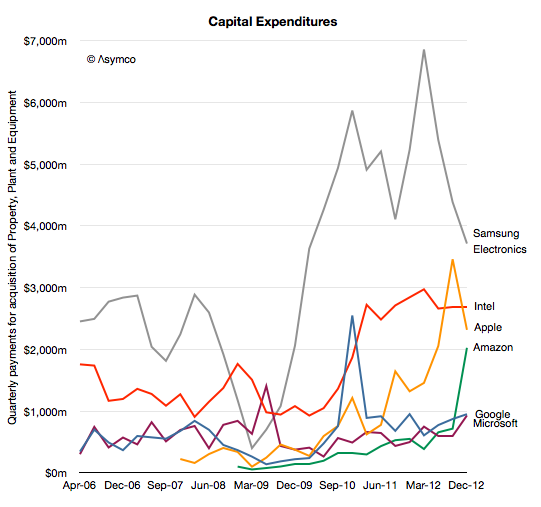
    In 2012 Samsung spent around $20 billion while Apple spent about $10 billion (excluding leasehold improvements or Apple stores but including real estate).

    Compare these figures with Intel at $11 billion, Google at $3.2 billion, Microsoft about $2.8 billion and Amazon $3.8 billion (including presumably new distribution centers.)

    Screen Shot 2013-04-04 at 4-4-5.51.15 PM

    What each company spends on differs depending on its business model, but as the graph above shows it's easy to see that there is a class of "big spenders" who spend so much that it makes it hard to imagine just what $10 billion/yr could actually buy.

    To get an idea of just how big that figure is consider that a Nimitz class aircraft carrier costs about $4.5 billion to build and it takes several years to do it. Or consider that the largest data center in the world probably costs about $1 billion or that the largest office building will cost between $4 and $5 billion. Either of these infrastructure projects are massive multi-year projects. Apple, Intel and Samsung spend well more than this every six months.

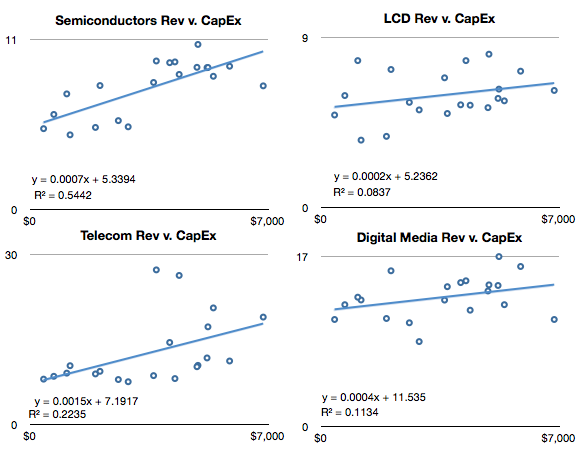
    So it's a special class of equipment which falls in the multi-billion dollar range: semiconductor process equipment.

    Whereas in the case of Intel it's the obvious target for the funds, how can we assume it's the case for Apple and Samsung.

    We don't have proof but there is a remarkable correlation between CapEx and Semiconductors in Samsung's divisional financial reports:

    Screen Shot 2013-04-04 at 4-4-5.58.22 PM

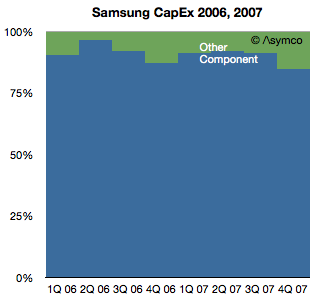
    We also have the historically reported allocation of CapEx as reported prior to 2008:

    Screen Shot 2013-04-04 at 4-4-6.00.26 PM


    Therefore I consider it safe to assume that the bulk of Samsung's Capital Expenditures are in support of semiconductor production (note that this does not include display panels).

    Note however that in the first graph, Samsung's expenditures seem to be declining. Measured in Won, the level in Q4 '12 was about the same as that in Q1 2010 and down 30% y/y. Apple's spending also dropped sequentially in Q4 but was up 75% y/y. It's also nearly ten times higher than what Apple spent in Q1 2010.

    So the question I would ask is whether Samsung's reduction CapEx (which is safely assumed to be supporting semiconductor production, and which, in turn, is, to a large degree, supporting Apple) is being picked up by Apple.

    If so then then this would be evidence of the re-alignment of role and control in the value chain of a terribly important industry.

  4. Apple retail vs. Amazon retail

    Research · 55 comments

    As part of a continuing series on the iTunes economy I described how iTunes fits within Apple's overall revenue and cost structure. The operation is a modest contributor accounting for single-digits percent of revenue and operating margins.

    One additional question is how does iTunes compare with other non-Apple retail businesses. The obvious comparable businesses are Google Play and Amazon's digital content businesses. Unfortunately we can't compare iTunes with Google Play because Google does not reveal any details about Play revenues (or units sold/downloaded or payments to developers or any other data.)

    Also unfortunately, we can't compare iTunes with Amazon digital sales because Amazon does not provide that detail either.

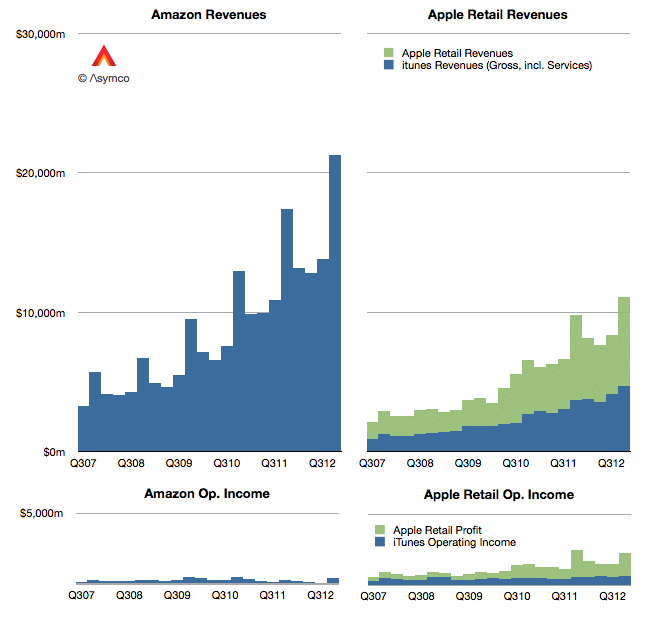
    What we do have is Amazon's overall revenues (and operating margin.) So that's what I have compared:

    Screen Shot 2013-03-27 at 3-27-2.09.30 PM

    Since we have Amazon's overall retail revenues it seemed fitting to also add Apple's physical store retail data on top of iTunes for additional perspective.

    Here are some observations:

    1. Since 2008, Amazon's sales grew by a factor of 2.18. Apple's combined iTunes+Retail grew by 2.14x.
    2. Apple's gross retail revenue was $11.1 billion in Q4, 52% of Amazon's overall revenues.
    3. Apple's operating income from retail in 2012 was $6.8 billion, over ten times Amazon's $676 million.

    Although Apple's overall retail operations are only about half of Amazon's they are far more profitable on an operating level. They are also growing at a similar pace. Amazon as an equity is priced at approximately twice sales. By that ratio, Apple's retail business would be worth $70 billion. Of course, that valuation presumes that, as with Amazon, operating profits are disposable.

  5. Interview with Anouch Seydtaghia of Le Temps regarding the Galaxy S4

    Research · 78 comments

    This interview took place on the eve of the launch of the Galaxy S4. Anouch Seydtaghia is Deputy Head of the Economic & Finance Section chez Le Temps Geneva, Switzerland.

    ---

    Q: How can you explain that Samsung organizes such a huge event in NY for the S4?

    A: The S4 is a very important product as it's probably the second most profitable mobile phone in the world. Samsung is trying to position it as a premium product and is using every means available to do so.

    What are your thoughts about the huge marketing budget of Samsung?

    Samsung's marketing budget has been a constant percent of their sales (approximately). As sales have risen, the budget has risen. This is not considered a normal situation if sales grow very rapidly but Samsung seems to consider x% of sales to be appropriate spending level. Note that Apple's marketing has fallen as a percent of sales while its sales have grown dramatically.

    If we read the media, we see a lot of speculation about the features of the future S4. Can we now compare that to the expectations before a new iPhone?

    There are speculations about all phones, from Nokia to HTC and BlackBerry. I don't see the speculation to be different between all the major companies.

    Can Apple regain the lead in the smartphone market? If yes, how?

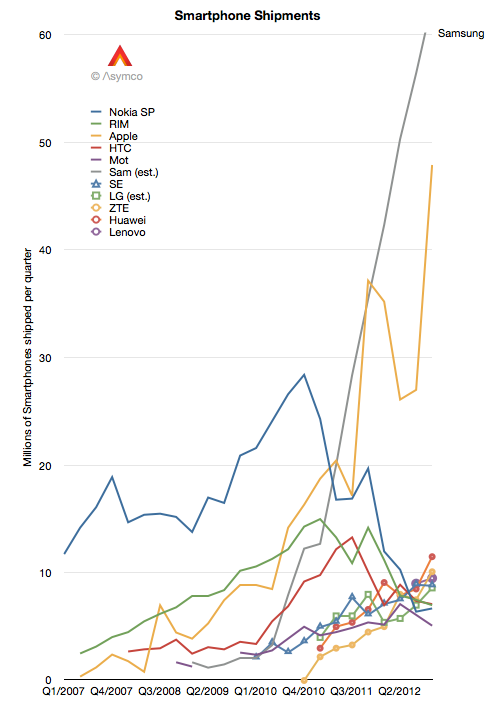
    Apple had leadership in the phone market for two quarters (see graphic below.)

    Screen Shot 2013-03-14 at 3-14-6.09.03 PM

    It's a myth to think that Apple was dominant for any extended period of time. The top spot is very difficult to obtain unless a company has a large portfolio of products which are sold in all markets. Apple has less than half the operator distribution of Samsung and keeps only one new product in the market each year.

    Apple also has a very high price due to the distribution model it uses for the iPhone. The primary buyers are operators who made large volume purchase commitments a few years ago. The iPhone strategy can be summarized as "skimming" where they pick the most profitable customers rather than "penetration" where there is a focus on market share. It's therefore very surprising that Apple was able to ship as many phones as it did.

    Is there a difference between what Samsung and Apple invest in R&D?

    Of course, but we don't have details. Samsung Electronics has to develop semiconductor processes and build large fabrication plants. Apple has a vast software engineering operation. Apple has iTunes and web services while Samsung has appliances and TVs. The two R&D efforts are vastly different.

    What could be the new features in the next smartphone?

    The most important innovation in smartphones will be a product that is not a smartphone. The category will be eliminated through a disruptive approach just like all other technologies that have come before it. My expectation is that when it comes it won't be recognized as important or relevant.

    As a follow-up:

    - Thank you very much! So do you mean that for Apple, marketing is just 1% of sales?

    It's difficult to compare the two exactly.

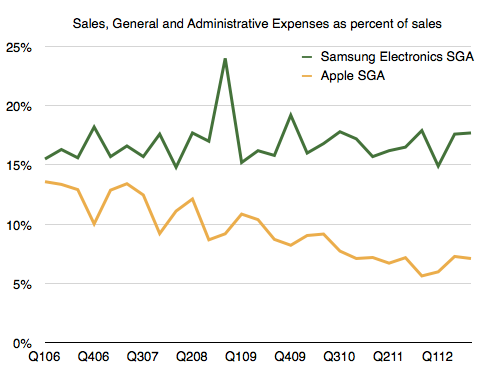
    We don't have specific data on Apple's marketing. We have either Advertising or SG&A (which includes marketing.) Samsung reports “Marketing Expenses” every quarter but these figures appear to be the sum of Ad spending, Sales Promotions, Public Relations and a portion of “other” expenses as a part of SG&A.

    You can see a comparison here:

    What seems to be happening is that Samsung increases its spending in proportion to sales while Apple grows marketing a bit more slowly.

    Basically, Samsung is treating SG&A as a "variable" expense which is tied to sales whereas Apple is managing it as organic growth.

    The difference might be that Marketing at Apple is mostly an internal effort and thus depending on headcount while Samsung might be spending mostly externally. If costs are internal then it would be hard to pare them down if sales slow whereas if they are external then they can easily be made variable.

    I've received comments suggesting that Samsung's approach is unorthodox and that the quality of marketing cannot be maintained if it grows as quickly as Samsung has grown it. This is a matter of speculation however.

  6. LG's new Tele-vision

    Research · 17 comments

    LG Electronics has acquired HP's WebOS for an undisclosed amount. When last it changed hands WebOS was part of Palm which was purchased for $1.2 billion in 2010.

    Palm has thus been effectively divided into several smaller pieces distributed as follows:

    HP will own:

    • Support of existing Palm users
    • Palm back-end assets including source code, infrastructure and talent
    • webOS patents

    LG will own:

    • Stewardship of the Open WebOS and Enyo open-source projects where the source code resides
    • Associated talent
    • WebOS websites
    • License for IP related to webOS

    LG announced that it plans to offer an "intuitive user experience an Internet services across a range of consumer electronics devices." In an interview, the CTO of LG said that given the current situation with Android, LG does not plan on making smartphones running webOS but will use it in televisions and other devices such as cars, signage and appliances where there are no embedded OS's. "We'd like to secure a software platform across all devices."

    Most commentary regarding the deal focused on the use of the platform for TVs but management seems to consider all devices, perhaps even phones, at some future date, to be webOS targets.

    The TV however seems to be low hanging fruit today. The TV as an app platform will be the new ecosystem war and no platform today has a lock on the developers or users. The way this rivalry will shape up will not mirror other device classes for the same reason that current device classes are platform silos.

    PCs, music players, tablets and phones all have different super-majority platform leaders. The association of a platform with a device class depends first on the distribution model, which favors a specific business model which favors a specific vendor which favors a specific platform. As each device is distributed differently, a different platform takes precedence.

    Consider that the PC has historically been purchased by IT departments which led to a monoculture of Windows which led to a persistent leadership for Microsoft.

    The music player created dominance around iTunes mostly because the distribution model for music labels was baked-in. With network effects, the iPod quickly gained and perpetually retained market share leadership.

    The smartphone business initially favored Symbian and BlackBerry because they had the market access through operators. After the touch UI became dominant (and incumbents failed to respond in a timely manner), Apple and Google took leadership as soon as they accepted the operator distribution model. Android in particular is especially resonant with operators and has been developed with their requirements in mind.

    The tablet business is more like the PC business but without enterprise requirements or patterns of purchase. This has meant that app/content ecosystems and retail distribution were the key gating factors. The story is still unfolding but so far Microsoft has not found a foothold while iOS and Android and Amazon have.

    That leads to the question of how will smart TVs be sold and which business model (or go-to-market strategy) will succeed. Steve Jobs pointed out the difficulty in trying to deliver innovation into a value chain dominated by cable companies which can effectively block it. A TV which is an application execution device rather than a content terminal will require a re-definition of the category. That will require a re-positioining of this product. Few companies are able to do that. [See also my post Tele Vision from mid-2011].

    Which brings us back to the question of webOS. As long as LG sells TVs as content terminals they might not obtain much value from webOS. If, on the other hand, LG were to use webOS to re-define their televisions to be something else entirely, namely software execution devices, sold differently and hired to do a different job than a TV, then webOS becomes not only necessary but potentially a source of great prosperity.

  7. The iTunes Value Structure

    Research · 19 comments

    The International Federation of the Phonographic Industry (IFPI) reported that global digital revenues were $5.6 billion in 2012. This represented about 9% growth from 2011 and accounted for 34% of total industry revenues[1].

    Apple regularly reports iTunes as a separate revenue item and occasionally it also reports payments data for developers and app download rates. By interpolating the data published and combining it with some assumptions it's possible to estimate the mix of revenues (and costs) associated with iTunes.

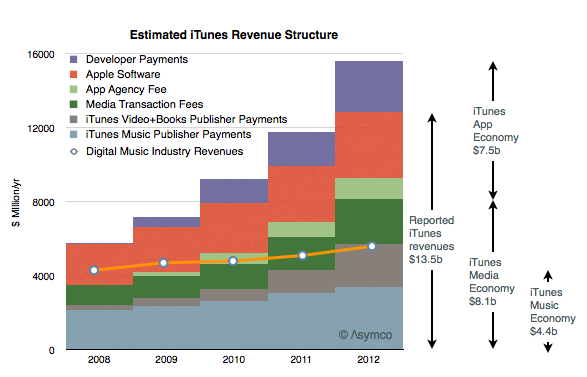
    My yearly estimates are summarized below.

    Screen Shot 2013-02-26 at 2-26-6.04.23 PM

    Note that I also included historic digital music industry revenues (as a line). I also included the following summary items:

    1. iTunes reported revenues were $13.5 billion (including Apple's own software sales)
    2. iTunes gross revenues were about $15.6 billion (including payments to developers)
    3. The iOS and OSX "App Economy" was about $7.5 billion while the iTunes "Media Economy" was about $8.1 billion (both figures include transaction costs.)
    4. The iTunes Music economy was $4.3 billion of which $3.4b was paid to music labels.[2]

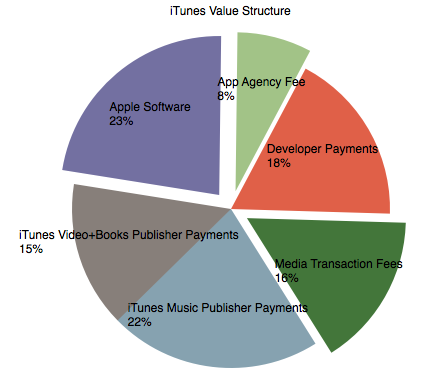
    In terms of percent of total value the components are:

    Screen Shot 2013-02-26 at 2-26-6.09.12 PM

    Looking at growth, these estimates imply that App revenues are growing at about 50% while iTunes Music is at 10% and Video+other at 90%.

    Looking at profitability, there is potential for operating margin in Apple Software and App Agency Fees and perhaps some of the Media Transaction Fees (exploded wedges above). Historically, Apple suggested that their App and Media stores ran at break-even but that may no longer be the case. Operating margins from Software may be significant.

    ---

    Notes:

    1. These revenues were from recorded music and don't include live performance
    2. My estimate for the iTunes Music payments to publishers is equivalent to about 60% of total industry revenues.
  8. Apple's International Retail Strategy

    Research · 56 comments

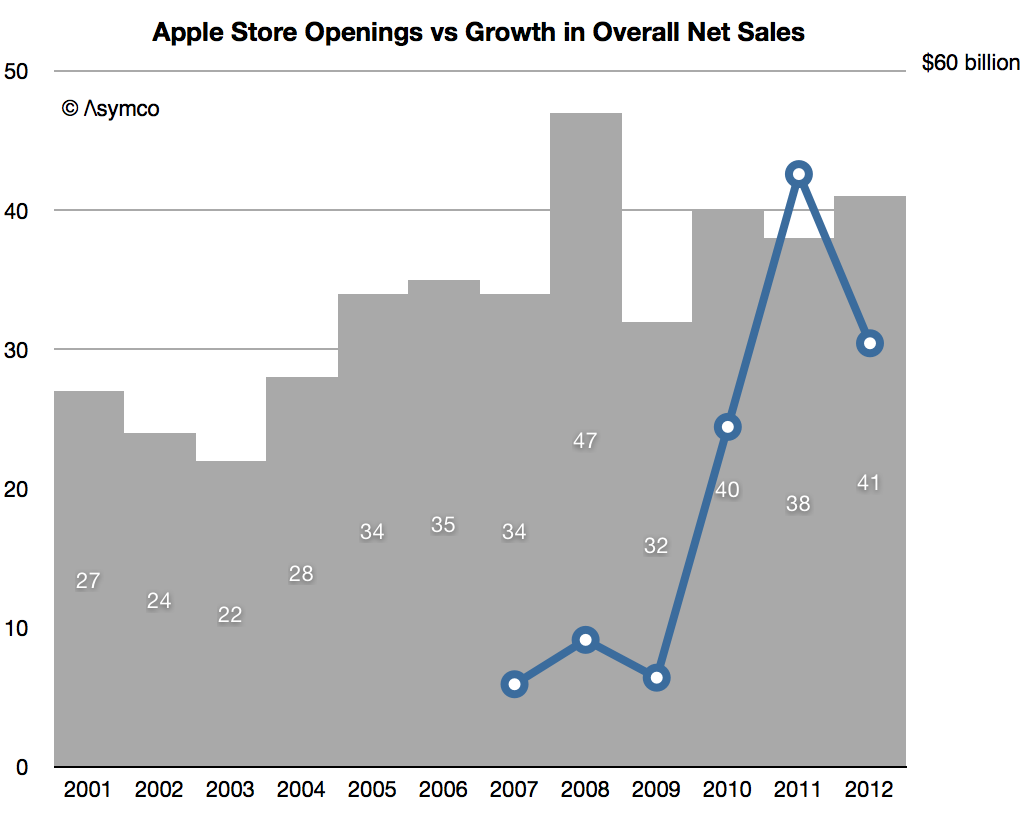
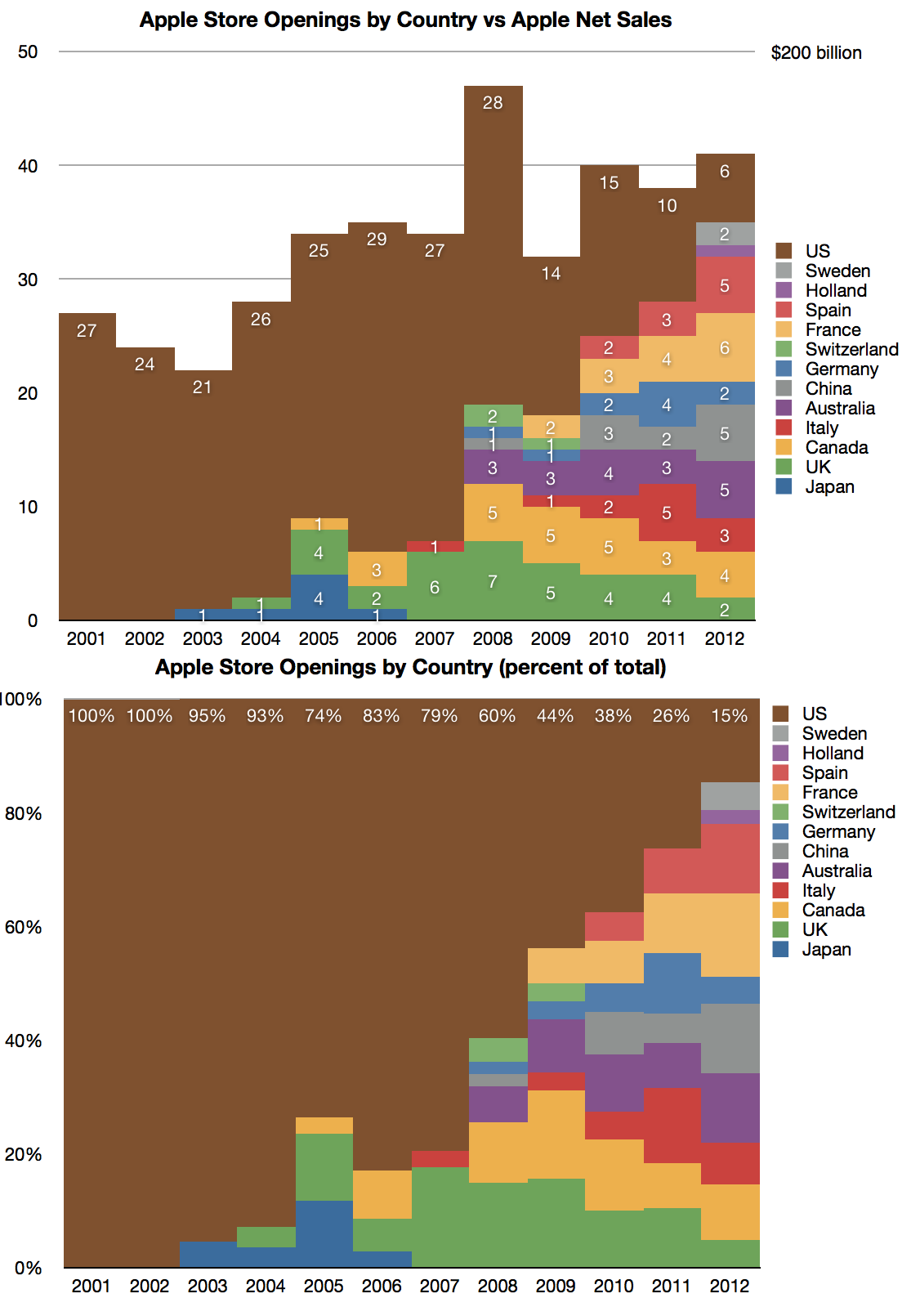
    In 2012 Apple opened 41 stores. The total is the second highest yearly opening rate since the stores first began operating. The highest total was in 2008 when 47 stores opened.

    Although it is a healthy total, the surprising story about retail is that stores are not being opened as quickly as Apple's sales and reach are growing. The following graph shows the yearly opening rate.

    Screen Shot 2013-02-25 at 2-25-6.28.22 PM

    The line in the graph above shows the change net sales since 2006 (right scale).

    The store opening rate has been around 40/yr. during the last five years, up from 30/yr. during first seven but a 33% growth rate it's still a frustratingly slow rate of growth. Consider that during 2007 when Apple opened 34 stores, Apple's net sales were growing at the rate of $7 billion/yr and that in 2012 when it opened 41 stores sales grew about $37 billion or more than 5 times faster.

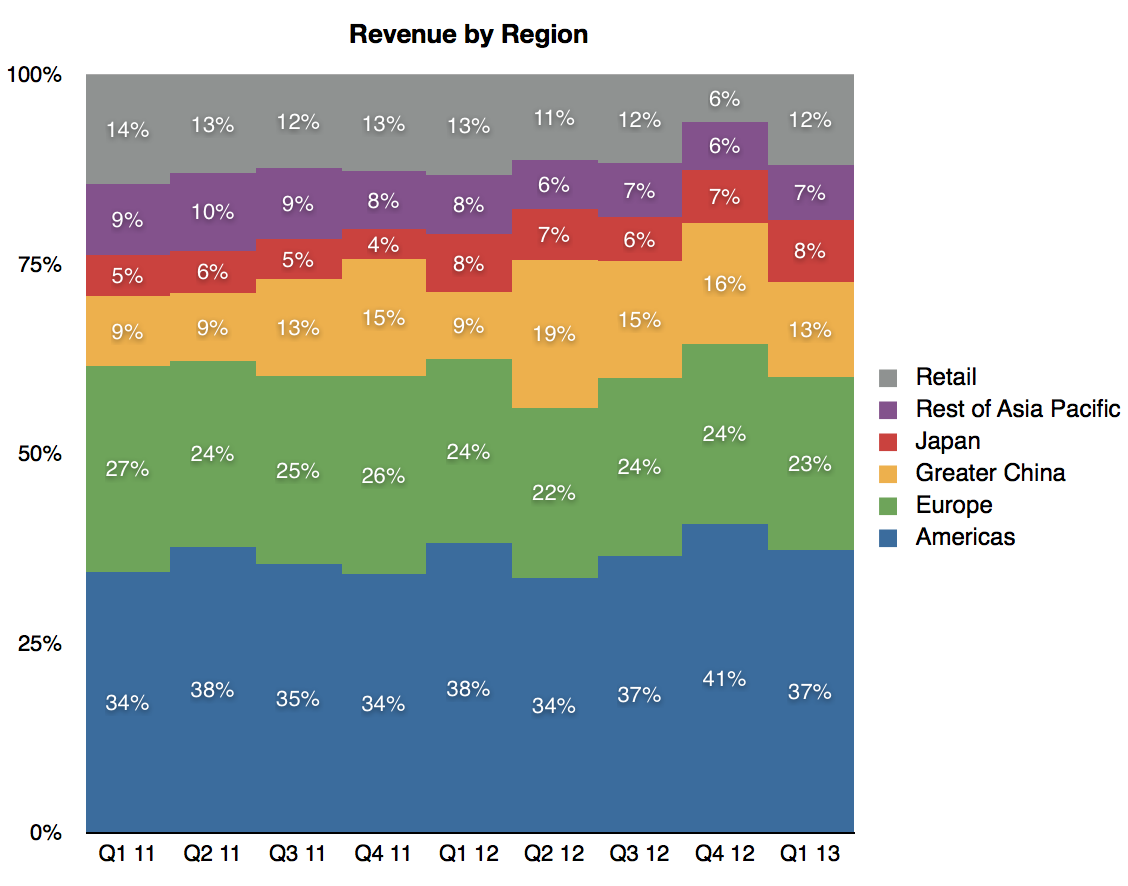
    Although performance for the stores has improved (i.e. the sales per store went up), sales outside of their own retail channel are now a far higher portion of total. 2007 retail revenues were $4.7 billion or 17% while 2012 were $19.1 billion or 12%. You can see the mix by region in the following graph:

    Screen Shot 2013-02-25 at 2-25-4.32.22 PM

    Note that these are quarterly figures.  Now consider the split of stores currently open in each region:

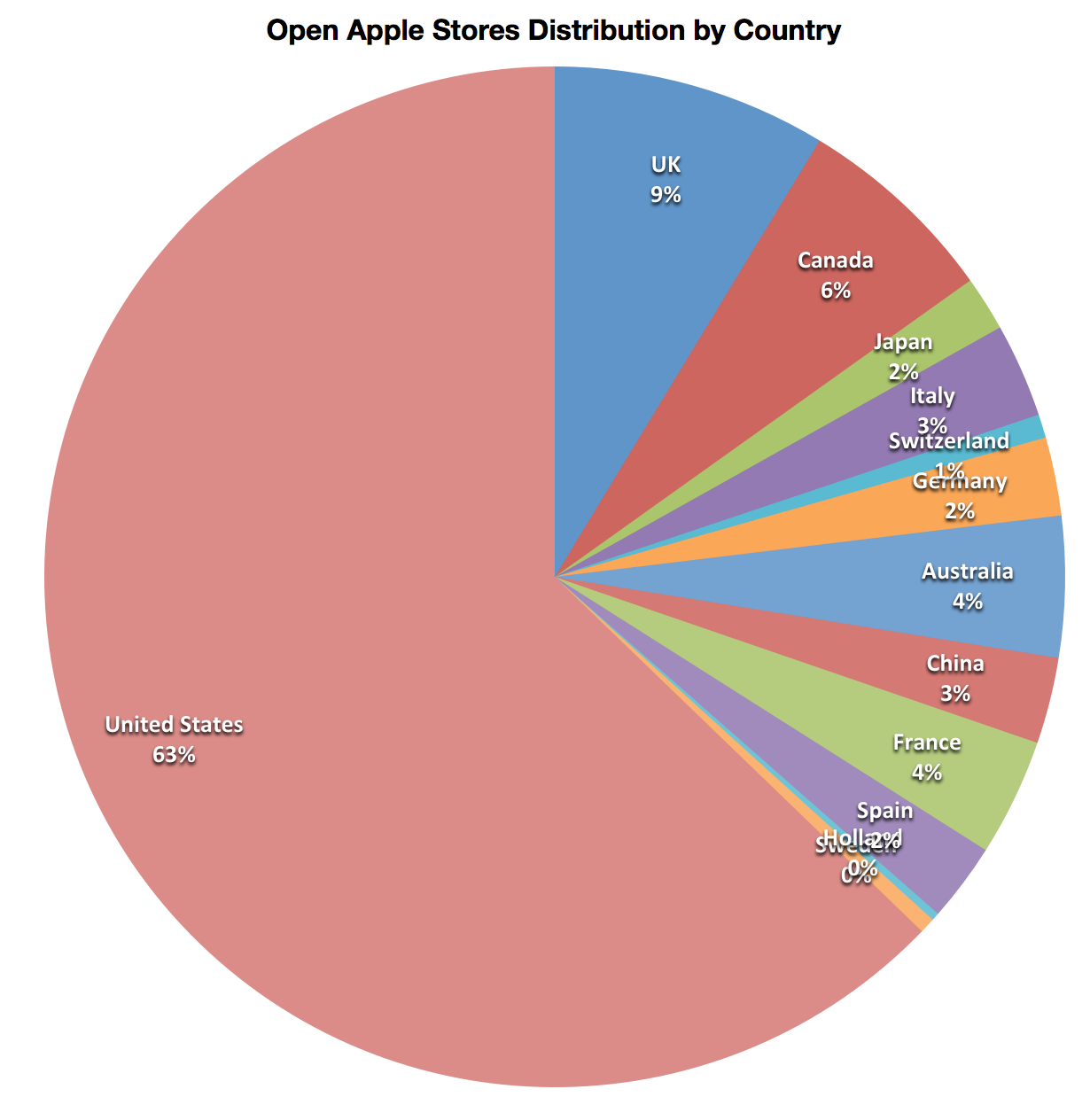
    Screen Shot 2013-02-13 at 2-13-4.11.22 PM

    We can then conclude that for sales outside of the retail channel, the split of sales and stores is as follows:

    • Americas: 37% of sales 69% of stores (63% in US, 6% in Canada)
    • Europe: 23% of sales 22% of stores
    • Japan: 8% of sales,  2% of stores
    • China: 13% of sales, 3% of stores
    • Rest of Asia: 7% of sales, 4.5% of stores (all in Australia)

    This explains the current mix of store openings, shown below:

    Screen Shot 2013-02-25 at 2-25-4.38.09 PM

    In 2012 only about 15% of store openings were in the US. It would seem reasonable therefore to expect that the priority for most, if not all, future openings should be outside the US to address the current sales/retail presence imbalance and to accommodate the bulk of future growth.

  9. Are the ecosystem wars won on the factory floor?

    Research · 13 comments

    I'll be speaking at the Harvard Business School Technology and Operations Management Digital Seminar Series on "The evolution of value chains in a computing markets measured in the billions of units per year."

    ​Abstract

    2013 will see two billion phones shipped into a market of over 6 billion points of network connectivity for over 4 billion consumers. In addition to phones, there will be a few hundred million more tablets and mobile computers shipped. It's very likely that the majority of these devices will be "smart", meaning designed to be a part of an ecosystem of software, content and services. Contrary to the common assumption that larger markets sustain more competitors, this immense and rapidly growing market has become profitable for only two device vendors. The reason is that the windows for competitive advantage are fairly narrow and although production can be ramped more quickly than ever, the resources needed are available to few.  The frequency and amplitude of market flux benefits only those who can operate at scale and punishes those who can't. Close observation of the investments of these "superpower" competitors shows an extraordinary level of capital purchases of manufacturing equipment, regardless of their nominal position in the value chain. These capital expenses have been growing in proportion to in the frequency of product launches. I present data showing a correlation between manufacturing equipment CapEx and ecosystem success and put forward a hypothesis that this relationship is causal. I also discuss the implications for ecosystems owners with regard to the processes, resources and priorities necessary to succeed in this evolved value chain.​


    The event is open to the public and taking place March 7th, 3:00PM to 4:30PM in the Cotting Conference Room.

  10. A short interview with Jasna Sykorova

    Research · 22 comments

    A short interview for iCon where I'll be presenting tomorrow. The interview originally took place on January 9th, 2013.

    Jasna Sykorova: You have focused on mobile devices for some time now. What made you to start to give a special attention to Apple related data?

    I began to look at Apple in 2005; long before they were in the phone market. I had an iPod and liked the Mac but I did not have particular reason to think about the company. You might find it strange that it was the launch of two very peculiar products that caused me to change my perception of the company. They were the iPod Shuffle and the Mac mini.

    These are not seen as important today nor were they back then.  But they signaled to me that something dramatic was happening: the company was shedding its "premium" image. This and the earlier move of iTunes to Windows signaled [to me] that Apple was serious about the mass market and the minimum price that a person would need to pay to become an Apple owner.

    This was pivotal to me also from the point of view of disruption theory. If a company takes the fight to the low end it means it protects itself from a low end disruptor and may even enter new markets. So if the thinking is that Apple would disrupt then it would have to get into new categories. I then asked myself what it would target. I told myself (again, in 2005) that Apple will do three things:

    1. build a phone
    2. disrupt the PC market
    3. enter the living room.

    1 and 2 are well understood to have happened and 3 is nearly here with Apple TV.

    Each of these were tremendous opportunities and it's been fun watching it happen over the last 7 years.

    By the way, my expectations were right not because of any insight into the company. I had not studied Apple much at the time. All my expectations came from understanding the psychology of a disruptor. Nor does it mean that what Apple did was deliberately planned. It's possible to predict what people will do even if they don't know what they will do themselves.

    Can data tell stories? Can you judge just by data?

    Data tells amazing stories but not without an interpreter. Having data without a storyteller is like the tree falling in the forest and nobody being there to hear it. If the data's story is not interpreted then does the story actually exist? Did the data "make a noise"? It's a question for philosophers.

    Practically, it's important not to base decision making on data alone. Data only exists about the past. Clay Christensen blames God for making us suffer in this cruel way. The past sometimes reveals patterns that help us predict the future, but it's hard to see some patterns. You may need to look at long time frames and there's never enough data. What is more helpful is to have a theory.

    Science works this way. Data helps build a model and the model helps build a theory and that theory is tested over time and adjusted. Unfortunately, we don't have very good theories about how businesses should be run. I used to say that if Business Management was a science it would be like medicine in the Middle Ages: mostly superstition and faith in the powers of individuals. [We need to move forward from this.] That's what I'm doing with my work: trying to build and test management theories. The data is just the first step on that road.

    What is the difference between Apple in the time of Steve Jobs and Apple now?

    Steve Jobs was a very important influence in the DNA of Apple. I think his influence was so deep that it existed even when he was not there in the 90s and I think it exists to this day. The influence is in the priorities, values and culture of the company. These influences exist in all companies and are very hard to change. They are almost never put in writing or even discussed. They are dogma, constitutions or doctrine by other names.

    Processes and assets may change however. I think decision processes will change at Apple. I suspect there will be more discipline in that regard and more rational ways of doing things. That could be good or that could be bad. But the passion to be great will not change. That's what the brand speaks to each employee. They are there because they want to be part of that greatness.

    You will speak about Apple's strategy for enterprises at the iCon. Do you consider it a “new wave” of activities of Apple? What chance does it have against the strong corporate players like Dell? And what benefit can iPad have for a company, if any?

    If you look at my list from 2005 you don't see Enterprise on there. I think it might have joined the list since then. But it's not obvious yet. The thing is that Apple's approach to Enterprise will not be typical. It will be disruptive. It will be subtle and "easily ignored". This is what I want to discuss. The incumbents are not noticing Apple even as they are losing significant value to Apple in their core markets.

    Analysts (and consultants) find all kinds of reasons to downplay Apple's efforts and comfort the organizations who hire them [which is why the approach is generally unfelt]. Also IT is changing in the jobs it's hired to do. These are all good signs that something is happening. Something that will become very quickly a fait accompli.

  11. What's up with text messaging?

    Research · 21 comments

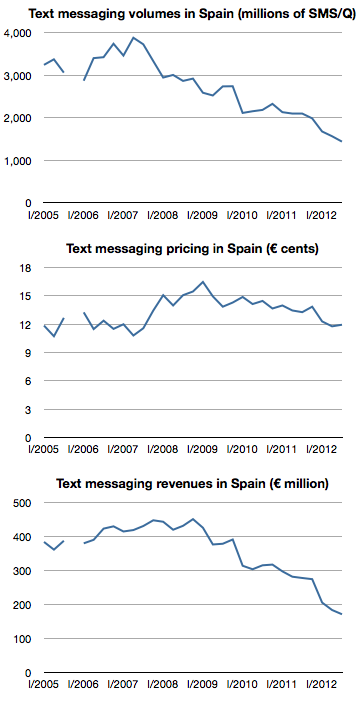
    The following graphs show text messaging volumes, pricing and revenues for SMS in Spain.

    Screen Shot 2013-01-18 at 1-18-2.40.39 PM

    After peaking at the end of 2008 at about €450/quarter, revenues have fallen by 60% to about €171 million in the third quarter of 2012. These figures represent almost 100% operating profit for operators so the impact is felt directly in the bottom line.

    The culprit is IP-based messaging. Services like Whatsapp, iMessage and even Facebook offer "free" messaging to users who have a smartphone and a data plan. I've been told that 97% of Spanish smartphone users have Whatsapp installed. In some markets this "free" messaging is offered via BlackBerry Messaging.

    The decline in SMS is coupled with a vast increase in IP-based mobile messaging. Whatsapp reported that it set a record of 18 billion messages processed over New Year's Eve. In October Apple announced that iMessage had delivered 300 billion messages during the preceding 12 months.

    Globally SMS traffic is still rising. It's expected to reach 9.6 trillion in 2012, but at least one analyst forecasts  that SMS’s share of global mobile messaging traffic will fall from 64% in 2011, to 42% in 2016.

    The data from Spain suggests that the drop may happen more quickly than anticipated.