Asymco

Asymmetric Intelligence

Industry

  1. What's a Post-PC device?

    Research · 86 comments

    Microsoft's Steve Ballmer argues that the tablet computers (aka slates, media tablets or iPads) are PCs. Steve Jobs argues that they are post-PC devices. There are analogies to trucks, cars and various metaphors for what these new devices symbolize. Some argue that because the iPad needs a PC, it's not a post-PC device.

    But how to define a new generation of computing? Since the PC is not the beginning of computing, it may make sense to look to the eras of computing that preceded it.

    The first post-mainframe computers worked alongside mainframes and were typically used by engineering departments (vs. the finance and accounting departmental role occupied by mainframes.) They did not require a dedicated (often external) mainframe service team and could be administered by in-department system administrators. Input was not through dedicated data entry personnel and output was not a ream of folded paper. Users could use a CRT terminal to interact with the computer directly. Digital Equipment Corporation, Control Data, HP, Honeywell, Prime, et. al. grew up in the shadow of IBM but thrived. Their products were cheaper and simpler to operate. Initially, the products were not more powerful.

    The first post-minicomputer microcomputers (also known as PCs) were used alongside mainframes and mini-computers. They were typically used for 2-dimensional spreadsheets analysis by individuals in many departments and were easier to justify cost-wise than the time-sharing cost structure of the incumbent computers. Many microcomputers were able to access mini-computers and mainframes through terminal emulation software (and sometimes special hardware boards) so they were still able to work with existing business processes. They did not require dedicated personnel for administration but had a shared support department. Input and data storage were on the "desktop" as was printing. Compaq, Dell, HP, Apple and IBM embraced this new form factor. Their products were cheaper and simpler to operate than the previous generation of computers. Initially, the products were not more powerful.

    The first post-microcomputer tablets are used alongside microcomputers for tasks such as presentations and entertainment. They have software available that allows access to desktop computers and services dependent on PC-architectured servers. They depend on PCs for data backup and software updates. They do not require IT support. They do not require a keyboard or a desk. Apple and many mobile phone vendors are embracing the new technology. They are cheaper and simpler to operate. The new products are not more powerful.

    To define a new generation of computing by its isolation and exclusion of the previous generation is not sustained by the history of computing.

    I would suggest that the definition of a new generation of computing is that the new products rely on new input / output methods and allow a new population of non-expert users to use the product more cheaply and simply.

    I might add that the consequences of each generational shift are:

    1. Consumption increases
    2. Skill required decreases
    3. Support required decreases
    4. There are new applications and use cases
    5. The economics are not favorable for incumbents
    6. The economics are favorable for new entrants
    7. The older generation slowly fades through diminished growth but never disappears
  2. On Android [Updated]

    Research · 43 comments

    Demonstrating the value of openness and broad support from partners:

    In terms of openness and broad support we've done very well... Literally available on over 150 different handsets. It's available from over one hundred different mobile operators around the world. We will probably license about 20 million devices this year which is really quite dramatic at least among smartphone systems. So we have great momentum. We've brought [a new version] to market. We're driving forward on our future releases. We'll have to see what [the competition] does. Right now they have a press release [...] We have many many millions of customers, great software, many hardware devices and they're welcome in our world.

    Inspired by a tweet from Charles Arthur.

    [Update]

    The quote is Steve Ballmer speaking in 2007 soon after the announcement of Android and in response to a question of what he thought about Android. The source video is here.

  3. iTunes App Store generated $3 billion in sales

    Research · 33 comments

    The announcement of $2 billion total for App store payments to developers did not come as a surprise. On January 22nd Apple reached 10 billion total apps downloaded. From that figure and an earlier derivation of the average selling price, I estimated $2 billion was paid out around the same time frame.

    We don't know exactly how many apps have been sold at exactly the moment when $2 billion was paid out so we don't have the means to update the ASP of apps (currently estimated at 29c).

    We do know for certain however that the app store generated $2.86 billion in sales if $2 billion was paid out.

    The new data affirms existing estimates.

  4. Android vs. Windows Phone: Which vendors benefit?

    Research · 32 comments

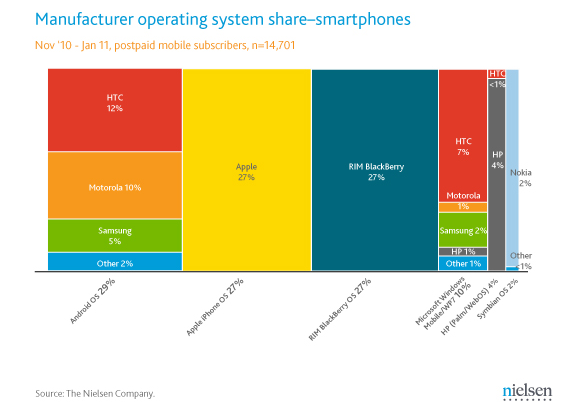
    Who is Winning the U.S. Smartphone Battle? | Nielsen Wire.

    This is a great chart from Nielsen showing the split in manufacturer share by OS in US installed base. What I consider significant is how the modular software platforms Windows Mobile and Android worked out for the licensees.

    Whereas in the case of Windows Mobile HTC took a significant, nearly dominant share, the Android ecosystem was more balanced between HTC and Motorola. However, HP and Motorola left the Microsoft camps, Motorola going exclusively for Android and HP buying Palm. That leaves Microsoft with HTC, Samsung and Other (mainly LG I presume).

    The question of how Windows Phone will shape up vs. Windows Mobile and Android remains. Motorola has signaled they are not interested in WP7 for the time being and so it's likely that they will stick with Android. Samsung is always hedging its bets so it will probably balance its portfolio. One could conceive of Nokia stepping into the US with significant WP volumes, but there are many hurdles on the way.

    One can see the challenge individual modular vendors have to edge the overall volumes of the integrated vendors. As Nielsen points out:

    But an analysis by manufacturer shows RIM and Apple to be the winners compared to other device makers since they are the only ones creating and selling smartphones with their respective operating systems

    Not only are the volumes higher, but so are the margins and hence profit share.

  5. Lookout ZTE and Huawei: Here come NEC, Sharp and Kyocera

    Research · 29 comments

    Sony Ericsson, NEC and Kyocera are among the other Japanese handset makers also betting on Android as their path to international sales.

    via Japanese Phone Makers Look to Ride Android’s Surge - NYTimes.com.

    The Japanese positioning is based on the notion that current Android phones are not good enough and that they can bring "great hardware, great R&D and great engineers" to solve the existing problems with Android portfolio phones.

    That's an interesting observation by Google's own director of Android Global Partnerships. The idea that the market can still reward hardware innovation would also imply that Apple could benefit from that demand.

    So is the message that there is still room for device innovation?

    Perhaps not. Perhaps Android's pursuit of Japanese vendors (and vice-versa) is just evidence of the rush into smartphones by those possessing excess hardware R&D and manufacturing capacity and a deficit of software assets.

    It's still striking that there are hundreds of hardware vendors and supposedly "only two" platforms.

  6. Nokia: We depend on uninformed customers, deception preserves brand value and uncompetitive software will keep us competitive

    Research · 99 comments

    In a previous post I asked whether Nokia's strategy is dependent on a "built-in assumption that end users are inherently stupid."

    Nokia confirmed that this is indeed the case.

    “Millions of consumers are oblivious to the announcements that we have made,” she said. Those consumers value Nokia’s brand, she said, and will continue to buy devices provided the company keeps making competitive products.

    via Nokia's Jo Harlow on the Move To Windows Phone, the Future of Symbian and More | Ina Fried | Mobilized | AllThingsD

    There are three statements being made:

    1. Nokia is counting on uninformed customers, not just end users but the shops and operators which will keep stocking the end-of-life product lines. There needs to be a conspiracy of stupidity for this plan to work.
    2. Nokia's brand will survive even after customers are deceived into buying lame duck products. The idea that buyers value a brand that is offering products that the company does not believe have a future is cynical.
    3. The absurd implication that Nokia's products will be "competitive" even though management asserted clearly and emphatically that the software they run--the very basis of competition for any smartphone--isn't. If a smartphone is expected to be competitive even though its software isn't then it's not competing on the basis of software. If it isn't then how smart is this smartphone?

    One gets the sense that Nokia is undergoing significant ethical decay.

    [UPDATE]

    To paraphrase the ethical dilemma:

    "We want a three horse race. We're not there yet. In the meantime we have a sturdy donkey that can still walk. We expect 150 million people to bet on it."

    [UPDATE 2]

    I take issue with the ethics of jumping off a burning platform while selling tickets to tourists to come visit.

  7. Why operators will find it hard to sell tablets

    Research · 107 comments

    On the eve of iPad 2.0, it's time to think again about this curious new computer. My intuition tells me that this product category will behave very differently from the iPhone and will not be subject to the same sales ramp.

    The iPad has been on the market for less than a year but it's still a puzzle for many. It's a product that's often seen as an iPhone product line extension. From a hardware point of view, it certainly seems to be. It has an almost identical internal architecture and uses almost the same software. An engineer would look at it and reasonably say it's the same thing.

    However, from the way it's used and the way it's sold, it has very little in common with its smaller cousin. There are plenty of experts who can detail how the products are used differently, but I would highlight the portability of the iPhone makes it suitable for a completely different set of tasks than the less portable but more immersive iPad.

    But what I want to dwell on here is how differently the products are sold.

    I'll build the case from evidence that Apple provides. The most important observation is that the iPad is an unlocked product. Although you can hire an operator to provide you with data services for it, the product is designed not to rely on that. As a result the product is effectively "divorced" from the operator channel. This means it does not typically benefit (or suffer) from subsidy.

    This may seem an interesting side-note to the iPad story, but I think this is a central pillar of the market strategy. The iPhone was designed around a high-ARPU data plan. I've even suggested that the iPhone is nothing more than a data plan wrapped in glass and polished metal. Because it was designed to enable migration of cellular voice users to data plans, it's priced to skim profits from the migration. At some future point in time when a skimming strategy is no longer optimal, the iPhone might be re-positioned for penetration, but that time is not now.

    As part of a skimming strategy, the iPhone has a limited distribution channel. It's only sold through special agreement with selected operators. Again, timing is crucial. That channel is expanding, but for nearly four years the product has not been positioned for sale through any channel other than Apple retail and Operator retail.

    On the other hand, the iPad is marketed for penetration. It had a low price and an unlimited distribution strategy. It could be sold through any consumer electronics product point of sale. And then some. It could conceivably be sold through as many if not more points of sale as the iPod (i.e. tens of thousands.)

    It can be sold in any country, can be distributed through middlemen and can be priced arbitrarily [1]. It can be bought in bulk by companies or schools or hospitals. It can be re-sold in a secondary market. It is essentially a perfectly liquid commodity.

    Now we can step back and ask why and what are the implications for competitors.

    The reason the iPad was positioned asymmetrically to the iPhone is, I believe, because it could be. I believe that the iPhone is sold the way it is (through operators) because that's the only way it could be sold effectively. Cellular products have always come with lots of fine print, footnotes and asterisks rooted in the regulatory environment that underlies the industry.

    The iPad is a product built and sold along the lines of the Mac and the iPod--unrestricted by orifices and aligned with the unregulated environment that computers have always enjoyed. Essentially, for the iPhone, Apple chose to go along with the telecom industry's rules but as soon as it had a product that did not need to comply to those rules, it ran back to its comfort zone: control.

    If we take this to be the cause, the implications for competitors become clearer. Apple is more in its element selling the iPad than it is in selling the iPhone. Other tablet contenders however are in an opposite strategic stance. Almost all the credible tablet alternatives rely on the telecom channel for distribution. The rush to build iPad alternatives is as predictable as the derision that was poured on the product when it was launched.

    But the alternative products are positioned in different ways. They are positioned as big phones.

    Which brings me to my final point: selling big phones is hard.

    These products are not compliant with what users expect from an operator: a service plan. As a result they are also not competitively priced with the iPad. Apple engineered a price for the iPad that makes comparisons extremely favorable. Buyers know the thing they are buying is not a phone so they look at the price carefully.

    But the most crucial weakness of alternative vendors is the fact that operators don't know how to sell tablets. Tablets are small computers. They are bought in the same way that buyers buy laptops: in-store testing. Notice that except for the iPhone operators only provide phone mockups in their stores. This is because they want buyers to discuss their purchase with a sales rep. This is not the way laptop hunters shop. Another tell-tale sign of a disconnect between operators and tablets is that operator shops are physically tiny. PCs (and tablets) need large tables for users to look, touch, heft and fondle. Just on square feet alone, operators and tablets are not a good match.

    If you need any more evidence, consider the plight of operator-subsidized netbooks.


    ---

    Notes:

    1. I realize that this is not currently true and the distribution is limited but that's only a matter of supply constraints. There is no theoretical positioning limitation.


  8. The platform as a promise

    Research · 39 comments

    In a recent answer on quora, I wrote that I did not believe developers are tempted primarily by economic incentives when choosing which platforms to work on. I suggested that they hire platforms because of their star-making potential and that star-making value is not a something that money can buy. Using Hollywood as an example I suggested that subsidies decrease the perceived value of a talent-oriented platform.

    The notion that a platform signals meaning to developers led me to think about how mobile platforms signal meaning to consumers. I have a hypothesis that platforms can and should be treated as brands. This point of view allows platform orchestrators to develop a comprehensive market-driven strategy for platforms that transcends technical debate.

    First a word about what a brand is.

    Brands are vaguely defined. They are identities, names, symbols or attitudes or all of the above. Marketers struggle to define brand value because they are trying to encapsulate what they sell into a single symbolism. The problem is that there are vast varieties of things being sold. Every product or service has different meaning to buyers and it cannot be captured the same way. Because I cannot rely on a single definition I have to create a specific definition of brand to the context of mobile platforms.

    I choose to define brand in this context of platforms as the "promise of the platform". A platform is a promise that the products will function in ways beyond what's "written on the box"; that the product is extensible and has value provided by an ecosystem bigger than the original vendor.

    For example, although the iPhone is based on iOS platform, iOS is not the brand. "iPhone" encompasses the platform brand and it's a promise to users that they can expect apps and content and an extended flow of innovation to continue well beyond the initial purchase of the device. This brand value is attached to iPod touch and iPad even though it's not communicated as a unified platform. In other words, consumers don't look for "iOS inside" but the implicit value of "there's an app for that" covers all the products.

    When looking at platforms as promises or brands, we can observe how some are more powerful than others.

    Symbian or Series 60 was never marketed as a brand and Nokia users are generally unaware of what OS or platform their phone runs. Does Symbian make a promise of an "extended flow of innovation to the device" after the time of purchase? It's hard to make that promise when you can't communicate clearly anything but device specs.[1]

    Conversely, Android has become a strong brand. The Android label (and mascot) is frequently used by device vendors to signal platform brand value.

    How did Google achieve in a year this value with Android while Nokia continued to squander any brand goodwill around Symbian for a decade? The answer lies in marketing decisions. Nokia wanted to focus on the hardware as value (and the Nokia brand as the way that value is encapsulated). Google and Android OEMs wanted to lift their own device brands into becoming smartphone brands and attached the value of Android branding to them.

    Which brings me to the question of how to design platforms as powerful brands. Creating awareness of extensible value is the way to signal to developers and all members of an ecosystem that a platform is valuable. Apple did this very well with their iPhone ads which focused on the app value of the product. They showed the product in use and did not rely on metaphors. Developers saw other specific apps being advertised by Apple and it engendered huge star value in the platform. Every developer wanted a shot at being featured in an iPhone ad. The iPhone could and did make stars.

    But you can't make the great promise of the platform without the ensuring consistency, reliability and longevity. Fragmentation, malware, copyright infringement and arbitrary termination amount to the confiscation of platform value by the orchestrator. Poor custodianship results in the destruction of both ecosystem and end user value.

    --

    Notes:

    1. The lack of platform promise for Symbian may also explain why Nokia believes they can sell 150 million Symbian devices which have a deprecated platform. Those devices could be sold as feature phones, not platform products. The challenge for them will be to get a smartphone price for a feature phone product.
  9. Nokia's Burning Ships strategy

    Research · 84 comments

    In the recent series of exposés on Nokia's new strategy I sought to paint a background for what caused such a dramatic decision:

    This gives a backdrop to the decision, but it does not explain the most crucial part of the decision: why did Stephen Elop decide to maintain an exclusive platform for Nokia rather than a multi-platform approach as chosen by successful competitors such as HTC, Samsung and Sony Ericsson.

    Going from backing one "burning" platform exclusively to backing another "ice cold" alternative without bothering with a hedging alternative is very risky. This may be the biggest puzzle and mystery for outside observers.

    Here I put forward a few reasons why exclusivity attracted Nokia:

    1. The lessons of product focus (see why focusing on a few products is hard).
    2. The costs associated with Symbian and Meego were unreasonably high. (see Nokia employs as many people to develop its smartphone software as Apple does to develop all its products).
    3. The psychology of change management.

    This last one may be the most crucial of all.

    What has to be appreciated is how bloated Nokia has become. It has 140 thousand employees. It's been organized and re-organized countless times and is completely intractable even to insiders. Cutting headcount can only accomplish so much. It deals with costs, but not with motivation. What management needs to do is also incentivize the survivors.

    This is where exclusivity comes in as a motivational tool.

    To explain we need to dip into a new metaphor. Conquistador Hernan Cortés landed in Mexico with the intention to conquer it. Legend has it that as soon as he landed, he burned his ships to prevent his men from retreating and motivating them that conquest their only option.[1]

    Leaders motivating their followers by removing the means to surrender or retreat is not uncommon. It's harsh and brutal. It's not a natural thing do do: destroying perfectly useful options is value destructive and generates outrage, even mutiny.

    In Nokia's case, institutional inertia with a vestigial Symbian effort would compel the organization to maintain the current platform while treating the new alternative as a pathogen.

    Counter-distruption theory states that the response to a disruption requires a focused approach through an autonomous challenger protected from corporate antibodies by the CEO herself. In this case, the autonomous organization is outside the company (Microsoft). Protecting the new effort was not possible with a Chinese wall. The only alternative was to simply get rid of the old and start with a clean slate.

    While there are times it makes sense to burn ships to eliminate any ideas of retreat, there are other times when doing so is reckless. You can do the calculation on the basis of cost of being wrong and levels of uncertainty [2], but even when armed with all the data linked above, this decision can hardly become something that can be quantified.

    It's a gut-level decision.

    I would say that Nokia's new CEO did not just jump off a "burning platform" but that once he jumped he made sure it kept burning so that nobody thought of going back on board.

    ---

    Notes:

    1. There is a Microsoft precedent to this story. See Amazon.com: Burning the Ships: Transforming Your Company's Culture Through Intellectual Property Strategy (9780470432150): Marshall Phelps, David Kline: Books Burning the Ships recounts the decision that forced Microsoft to face its own 'succeed or die' moment. It's a lesson in strategy and survival that speaks about the courage required to embrace radical business transformation.
    2. See also: Burning Ships
  10. The lives and deaths of mobile platforms

    Research · 68 comments

    When Stephen Elop said that Nokia and Microsoft sought to create a "three horse race" he implied that there were only two viable mobile ecosystems today. With that statement he sought to deprecate or declare "end of life" two platforms: Symbian and MeeGo, implying that Nokia's efforts at being the third way failed.

    However, he also implicitly declared irrelevant a larger set of market participants. In fact, the market is awash with platforms. Far more than the three or five that Stephen considered.

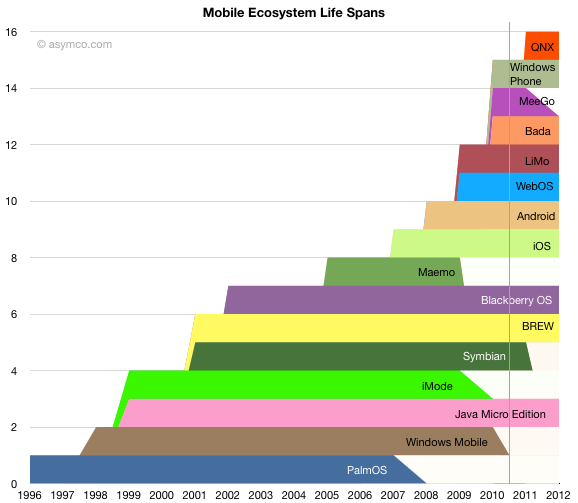
    To illustrate I built the following chart showing the history of all major mobile platforms. The are ranked by launch date (earliest at the bottom). A vertical line marks the present. End dates are approximate and based on declarations of end of life rather than end of usage.

    There have been 16 total mobile platforms[1], 10 of which are still (or soon will be) on the market. Of the six that were terminated, three had replacements built by the same orchestrating company (Windows Mobile begat Windows Phone; Maemo begat MeeGo, and PalmOS eventually led to WebOS.) Only three reached end of life with no known descendant (iMode, MeeGo[2] and Symbian).

    Operating systems that were launched in the 1990s or early 2000s have mostly been withdrawn/replaced with the exception of Java and BREW.  "Modern" operating systems all emerged after 2007 (following iOS). A total of eight such new OSs were introduced in four years[3].

    What I find noteworthy is that there is an implied peculiar fatalism about the market when only two platforms are considered viable, neither of which are more than 3 years old. While visiting the Mobile World Congress, I sensed this jumping to conclusions about platforms was eerily similar to that of a few years ago when new entrants like Apple and Google were declared dead on arrival.

    I can only conclude that there is a great deal of groupthink going on in the industry. A perfect setting for a disruptive entrant to change everything, all over again.

    ---

    Notes:

    1. I excluded some platforms like Motorola's Linux, SavaJe and perhaps some others (Openmoko, Qtopia) which did not gain significant traction. I also excluded any embedded OSs which did not have native APIs.
    2. The end of MeeGo is speculative. Intel is still defending it and may continue developing it.
    3. Android variants like Tapas could be considered new platforms, but I maintain them as part of one OS for the time being.
  11. Where is the Windows Phone Tablet?

    Research · 78 comments

    The Windows Phone platform currently has hardware specifications that imply a cellular phone device. What is interesting in light of the new WebOS TouchPad, the newly announced Android tablets, the RIM Playbook and the iPad is that this supposed "third horse" of Windows Phone has no hint of present or future presence in the tablet form factor.

    That might have something to do with the plans to move Windows to the tablet form factor. Perhaps Microsoft thinks that pocket size devices deserve a separate operating system, platform and ecosystem than portable mobile computers. Perhaps Microsoft plans to have two separate interfaces for these tablets (slates vs. tablets?) Then again, Ballmer held up a Windows Phone and said "This is Windows too."

    It gets confusing.

    The bottom line is that without a tablet implementation, Windows Phone developers and content providers will find that the WP ecosystem will have a limited addressable market and will not be suitable for all forms of media or apps. Tablets are currently expected to grow even more rapidly than smartphones did and so there will be significant numerical advantages to those platforms that support multiple screen sizes and form factors.

    Now that Nokia has anointed the Windows Phone platform as its exclusive conveyance to the device market, the question in the headline becomes: Where is the Nokia tablet?