Asymco

Asymmetric Intelligence

Industry

  1. The price of Windows Phone: Nokia's evaporating smartphone share

    Research · 61 comments

    In the last quarter Nokia sold 28.3 million Symbian phones. The average selling price was €156 or approximately $210. That price was down 17% year-on-year.

    According to the company,

    The 17% year-on-year decline in our converged mobile devices ASPs was mainly driven by general price erosion and an increase in the proportion of lower-priced converged mobile devices sales.

    ASP erosion has been a fact of life across all of Nokia's products for quite some time, checked only by the increasing mix of smartphones. However the smartphones it sells have been consistently positioned for lower price points. This is consistent with Nokia's long-term goal of serving "billions" of users.

    The trouble with the new strategy is that the Windows Phone product lines currently in the market are not likely to be priced in the $200 range. The reason is that the minimum specifications for Windows Phone 7 are:

    • Capacitive, 4-point multi-touch screen with WVGA (480x800) resolution
    • 1 GHz ARM v7 "Cortex/Scorpion" or better processor
    • DirectX9 rendering-capable GPU
    • 256 MB of RAM with at least 8 GB of Flash memory
    • Accelerometer with compass, ambient light sensor, proximity sensor and Assisted GPS
    • 5-megapixel camera with an LED flash

    These don't add up to a product that can be sold profitably at $200. The bill of materials is likely to be in that range (and one has to add $15 for Microsoft).

    So there are two possible implications for Nokia's new smartphone strategy.

    1. Windows Phone will be ported to lower spec/cost hardware to allow the traditional Nokian market growth model to continue and perhaps combat Android proliferation
    2. Nokia's smartphone portfolio will consist of high-priced products, and exclude mid-to-low price products.

    Option 1 is difficult to imagine. The user experience that Microsoft is putting forward as its differentiation depends on significant hardware which is unlikely to become very cheap very soon. It is an interesting exercise to think through however. What would we have to believe for this option to become real?

    Option 2 is more likely as Nokia conforms to this a new definition of smartphone as "high-end" only. This seems to be the default option given what is visible to observers today.

    If Option 2 is in fact the outcome of the new strategy, then it leaves Nokia very vulnerable to a low-end disruption (after it's succumbed to a new market disruption.) The $50 smartphone will be reality this year.

    Option 2 also most certainly guarantees that Nokia's current market share of 30% in smartphones is likely to be lost and never regained.

    Some might argue that's no great loss. After all, Apple does very well with low share and high prices. However, Nokia is almost religious about market share. The reason being that scale offers significant purchasing power and logistical leverage. It sustains a cost structure, distribution network and a business model that is central to the company's core competency. It's also presumably the reason Microsoft partnered with Nokia in the first place: volumes and wide distribution.

    So we're back to the old question: how does the new deal lead to a thriving ecosystem? Does it depend on vendors other than Nokia? If so how does Nokia benefit from the sale of Samsung phones?
  2. In memoriam: Microsoft's previous strategic mobile partners

    Research · 223 comments

    Microsoft's new "strategic partnership" with Nokia is not its first. For a decade the software company has courted and consummated relationships with a variety of companies in mobile and telecom. Here are the ones I can remember:

    • LG. In February 2009 Microsoft Corp. signed a multiyear agreement for Windows Mobile to be included on devices from LG Electronics Inc. LG would use Windows Mobile as its "primary platform" for smartphones and produce about 50 models running the software.

    What happened? LG made a few Windows Mobile devices but with WinMo uncompetitive, they abandoned the platform and moved to Android losing years of market presence and all their profits.

    • Motorola. In September 2003, Motorola  and Microsoft announced an alliance. "Starting with the introduction of the new Motorola MPx200 mobile phone with Microsoft Windows Mobile software, the companies will collaborate on a series of Smartphone and Pocket PC wireless devices designed to create a virtual "remote control" for the Web-centric, work-centric, always-on-the-go mobile professional." In addition, the alliance includes cooperation on joint marketing and wireless developer programs.

    What happened? Motorola launched a series of Windows Mobile phones culminating in the Motorola Q "Blackberry killer". As Motorola hit the rocks in profitability new management reached for the Android liferaft. The company now relies exclusively on the Droid franchise.

    • Palm. In September 2005 Palm and Microsoft announced a strategic alliance to "accelerate the Smartphone market segment with a new device for mobile professionals and businesses. Palm has licensed the Microsoft Windows Mobile operating system for an expanded line of Treo Smartphones, the first of which will be available on Verizon Wireless’ national wireless broadband network."

    What happened? Palm shipped a few Windows Mobile, famously dismissing Apple's potential entry as something "PC guys" could never achieve. A new CEO, a private placement and an acquisition later the company is a division of HP making its own operating system.

    • Nortel. When Steve Ballmer was famously laughing at the iPhone and saying that he likes the Windows Mobile strategy "a lot" he was sitting next to the then-CEO of Nortel (Mike Zafirovski formerly of Motorola) with whom the company had just closed a strategic deal.  "an alliance between Microsoft and Nortel announced in July 2006 ...  includes three new joint solutions to dramatically improve business communications by breaking down the barriers between voice, e-mail, instant messaging, multimedia conferencing and other forms of communication".

    What happened? Nortel declared bankruptcy two years later.

    • Verizon. In January 2009 "Verizon Wireless has selected Microsoft Corp. to provide portal, local and Internet search as well as mobile advertising services to customers on its devices. The five-year agreement will go into effect in the first half of 2009 when Microsoft Live Search is targeted to be available on new Verizon Wireless feature phones and smartphones." The deal would ensure Bing distribution to all of Verizon's smartphone customers.

    What happened? Bing did ship on some devices but in October 2009 Droid came to Verizon.

    • Ericsson. In September 2000, "Ericsson and Microsoft Corp. today launched Ericsson Microsoft Mobile Venture AB. This previously announced joint company will drive the mobile Internet by developing and marketing mobile e-mail solutions for operators. The first solutions are expected to be on the market by the end of the year. The company is part of a broader strategic alliance between Ericsson and Microsoft"

    What happened? Ericsson divested itself of the mobile division forming a joint venture which would go on and make more strategic alliances with Microsoft over Windows Mobile culminating in a loss of profits and eventual flight to Android.

    • Sendo. In February 2001, Microsoft announced a partnership, in which Microsoft bought $12m of Sendo shares and a seat on the board. Sendo was to be Microsoft's "go to market partner" for the Stinger smartphone platform that would become Smartphone 2002.

    What happened? Sendo after litigating IP issues with Microsoft went bankrupt in 2005.

    And finally,

    • Nokia. No, not this OS deal, but in August 2009 "The worldwide leader in software and the world’s largest smartphone manufacturer have entered into an alliance that is set to deliver a groundbreaking, enterprise-grade solution for mobile productivity. Today, Microsoft Business Division President Stephen Elop and Nokia’s Executive Vice President for Devices Kai Öistämö announced the agreement, outlining a shared vision for the future of mobile productivity. This is the first time that either company has embarked on an alliance of this scope and nature."

    The plan was to bring "Microsoft Office Mobile and Microsoft business communications, collaboration and device management software to Nokia’s Symbian devices."

    What happened? One and a half years later the same Stephen Elop announced that Symbian will be deprecated.

  3. Two turkeys don't make an eagle, but no penguin will ever soar.

    Research · 155 comments

    Vic Gundotra of Google tipped off the world two days in advance that on Feb 11 Android would play no part in Nokia's strategy. To be sure, Elop said that Nokia didn't choose Android because of "differentiation challenges and commoditization risk" (begging the question of how these challenges and risks are mitigated by licensing another openly available OS).

    But I won't weigh the merits of one module vs. another. Rather, the more pertinent discussion should be on why license instead of build. Clearly, Nokia threw in the towel. Not because they could not build, but because their building processes could not create greatness.

    But can greatness ever come from modularity? I've argued that it can't. I'll maintain that argument as long as what is being built is not good enough. In other words, as long as innovation remains relevant, improvements will be absorbed and rewarded. Once innovation exceeds what can be absorbed, the basis of competition will shift to convenience and price which are best served with a modular business architecture.

    Android is a fast follower. The first Android prototypes looked like Blackberries because that was the input paradigm of 2006. When capacitive touch was shown to be a better input method, Android reacted swiftly. When app stores created a new medium Android reacted swiftly. When the iPad demonstrated that computing can be done in new settings, Android reacted. At such time when there will be nothing to follow Android will be the king of the last commoditized innovation, but as long as there is something worth inventing Android will be there to reproduce it.

    This is not a judgement, but an observation: Nokia and Microsoft may not make an Apple but neither will Android ever create the future.

  4. Changing places: Microsoft trades HP for Nokia

    Research · 56 comments

    The juxtaposition of HP's strategy of increased independence and Nokia's new strategy of increased dependence can't be more striking.

    HP is probably Microsoft's biggest customer. As the largest licensee of Windows it probably generated more revenue for Microsoft than any other company. The fact that HP invested in a new operating system for its mobile efforts shows a level of discomfort with the lack of strategic leverage.

    Nokia, on the other hand, has been resolutely independent in its software strategy. For over a decade it held out against licensing any OS, especially one from Microsoft. The pantomime theatrics that took place over that decade will make a great case study some day.

    But now we have a complete reversal of roles: The abandonment of platform independence by a mobile giant at precisely the same time as the acquisition of platform resolve by an IT giant.

    It seems almost poetic. And that should be a clue. Whenever you see poetry, you need not look far for some truth.

    These chess moves are taking place in the context of a greater game: the collision and disruption of IT and Telecom. It's not surprising that massive market forces are causing incumbents to react. HP, Microsoft and Nokia are in the throes of fundamental disruption. Even if these moves may not be all in the same direction, they each react in ways that make sense to them.

    It's also very likely that all the moves are for naught. Incumbents rarely win with reactions. Let's not forget that the entrants came with different business models. Apple and Google are not making money in the ways of Nokia and HP (who are channel dependent) or Microsoft (who is license dependent). The reaction must itself be asymmetric. So far it's not clear where the asymmetry lies.

    Read more:

    HP/Palm’s Rubinstein believes in integration

    WebOS: HP, and HP Only. QNX: RIM and RIM Only

    HP’s PC group spends 0.7% of sales on R&D

    The reason Robbie Bach was fired

  5. Android and iPhone: Conquistadors or pioneers?

    Research · 93 comments

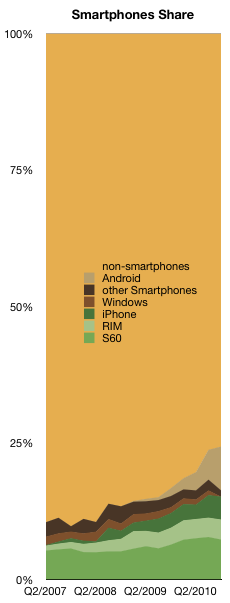
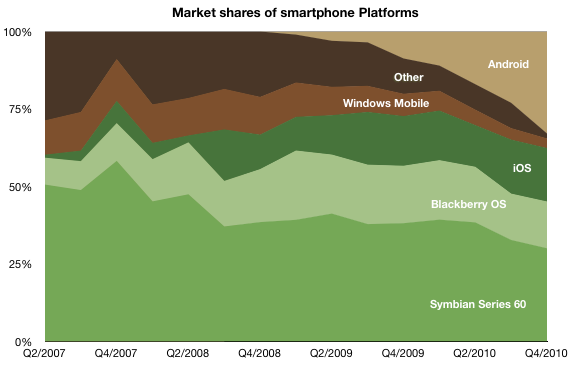
    Picking up the discussion of vendor share, I used Canalys estimates of platform shares to visualize the effect of Android on the smartphone market:

    Not wishing to belabor the point, but Android and iOS are less than 2 years old as platforms. In that time frame these two johnny-come-latelys have taken 50.2% of the most competitive technology market on the planet.

    Here is the share data:

    Since the market is not a zero-sum game, I prefer the first chart, but this second view stresses the transition away from incumbent "others" / Windows Mobile toward Android in the licensed OS market.

    The final chart shows the competition against smartphone non-consumption. I like this chart best of all as it shows the effect of Android in growing the entire pie for smartphones.

    What would have happened without Android is anyone's guess but my bet is that the market would not have grown as quickly. Apple is producing iPhones at capacity and RIM is growing into new markets. Symbian's strongest markets also do not overlap (much) with Android.

    However, the trend seems to be for consolidation of platforms (fragmentation within platforms notwithstanding). This trend, however, is over a very short time span. The smartphone industry started a decade ago and the time frame shown in these charts is a mere 3.5 years.

    The question remains whether the headroom visible in this chart still allows for new entrants or whether the platforms we see today are the last we'll ever see in mobile computing.

    I'm still willing to bet that there is room for innovation and for new platforms. Just like the two newcomers that came to conquer half the market emerged seven years after its inception, new contenders like Windows Phone, Bada, MeeGo, WebOS can still make an impact.

    The conquerors came with new business models and a focus on computing not telephony. Can factor innovation and the ubiquity of mobile broadband keep this market open to newcomers?

  6. Comparing Share of Growth: Integrated smartphone vendors held their own in Q4

    Research · 24 comments

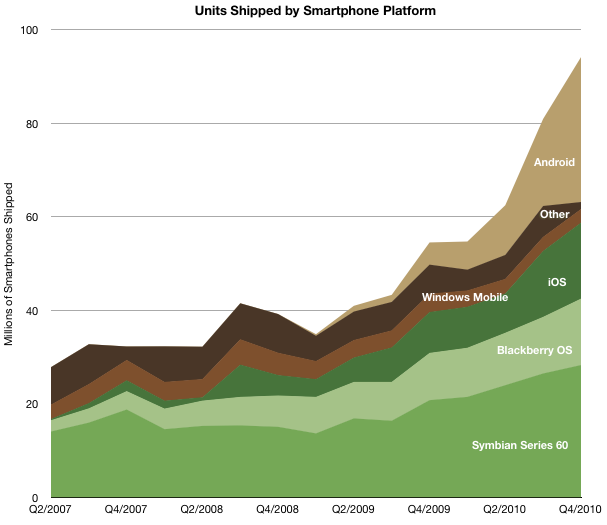
    The smartphone market grew to about 100 million units last quarter. That's nearly double what it was a year earlier and triple what it was three years earlier, the year the iPhone made its debut.

    Few markets grow this quickly, especially as this tripling happened during one of the worst recessions for a century. 100 million units a quarter is not a small number. The rate at which smartphones are growing makes clear the trajectory of where all phones are going.

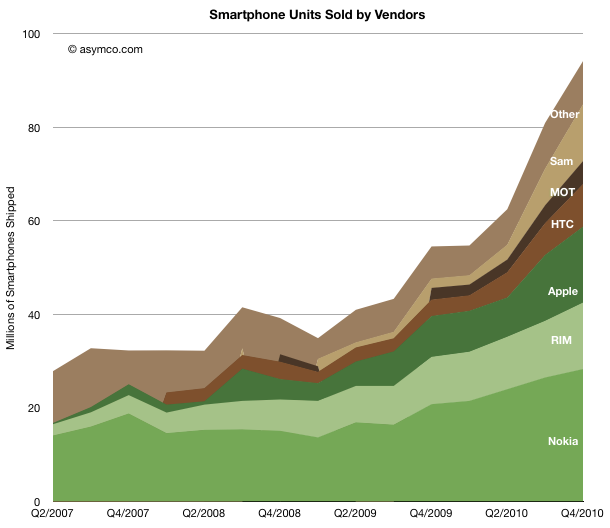
    As I've shown in profitability charts, vendors have been benefiting to differing degrees. The overall smartphone market with individual vendors is shown below:

    I've used the color coding of shades of green for vendors which use their own operating systems and shades of brown for vendors which use a licensed operating system (licensees).

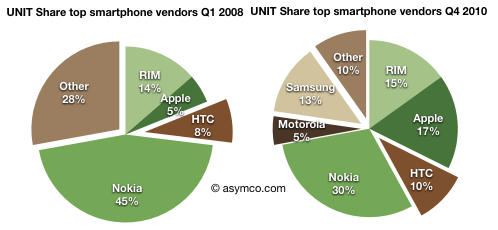
    What remains interesting is how the share of licensed OS products has changed since 2007. I selected two snapshots in time: Q1 2008 and Q4 2010 and compared the shares that licensees were able to obtain.

    The shares of licensees was then 36%, and is now 38%. Not a huge increase, but an increase nevertheless. In the last such analysis in Q3, the share of these vendors (which I also call "Modular") was actually lower than in early 2008.

    RIM has held steady in terms of share. HTC has added a few points of share. Apple seems to have gained a healthy share which Nokia seems to have lost. Samsung and Motorola have certainly made a bigger mark in the last few quarters.

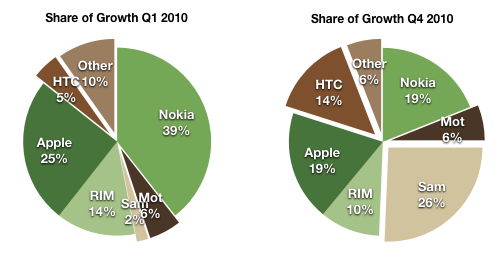
    But I would caution that share comparisons when the market is growing at nearly 100% are not very meaningful. All vendors are increasing their sales, though a different rates. What would be more meaningful would be a "share of growth" measure where each vendor's increase in units is divided by the overall market's increase.

    That analysis gives us the following chart. (I added Q1 2010 for comparison).

    Samsung did very well, but surprisingly perhaps, so did Nokia, tying Apple for second place.

    The licensees (whose pie slices have been exploded) added up to 52% of total growth (y/y) and the integrated vendors had 48%. A pretty even split.

  7. Nokia employs as many people to develop its smartphone software as Apple does to develop all its products

    Research · 106 comments

    In a recent post I pointed out that Apple's R&D was about 2.2% of sales in the last quarter. Bernstein took a look at the R&D for Nokia and presented a chart showing the difference between the mobile industry players in terms of total expenditure on R&D.

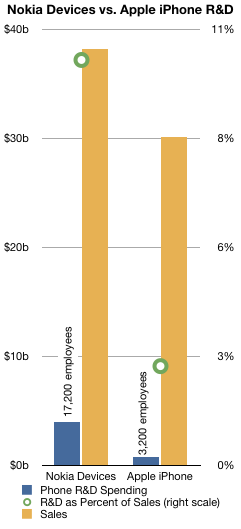
    I took inspiration from that to plot the Devices R&D for both Nokia and Apple over the entire 2010 period. I also compared that with sales and computed the ratio between R&D and sales.

    The result is shown in the chart on the left.

    Bottom line: Nokia spent 10.2% of phone sales in 2010 on phone R&D while Apple spent 2.5%.

    Bernstein goes on to argue that at least for Devices,

    Nokia spent $3.9bn in R&D in 2010, almost 3x the average of its peers, 31% of the industry's R&D total spending, for an output that we can qualify as visibly disappointing.

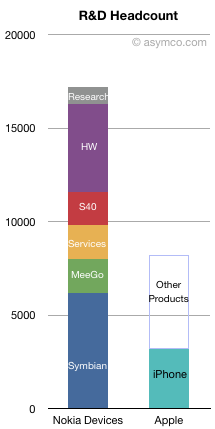
    To relate the $3.9 billion for Devices into head count, they estimate that Symbian projects employ 6,200 people; MeeGo and Qt 1,800; Services 1,800; and S40 1,800. Hardware headcount is assumed to be 4,700 and 900 more for fundamental research.

    So Nokia's total software headcount adds up to 11,600 people. Nokia smartphone headcount adds up to about 8,000.

    Applying a similar formula ($240k/employee[1]) to Apple's estimated iPhone R&D (from Bernstein's chart) yields a headcount of about 3,200 and a total Apple company R&D headcount of 8,200.

    So Nokia employs about the same number of engineers[2] for its smartphone software platforms as Apple does for all its product lines[3].

    In fact, Symbian alone may cost twice as much to develop than the iPhone (including the hardware).

    ---

    Notes:

    1. The cost per employee is obviously different between the companies as they operate in different countries. However there are enough sources of error in these estimates that they probably overwhelm the cost of living/tax differentials.
    2. I know that engineers are not all that R&D headcount covers, but let's assume that the mix of overhead is similar for the two companies.
    3. The total for Symbian + MeeGo is 8000 and the total for Apple overall is 8,200, however one can comfortably allocate 200 out of 900 researchers out of Nokia research to their mobile software effort.
  8. Calling the end of innovation in mobile computers

    Research · 72 comments

    People are lining up to call the market for mobile phones. Analysts and amateurs alike are connecting points on charts and predicting with confidence the future of mobile platforms. Consensus is forming that there is no future but a quiescent state. By the acclamation of pundits, the survivors are declared to be iOS and Android. They are also predictably arranged in a way similar to OS X and Windows. End of story.

    Except for one thing.

    3.5 years ago neither of these platforms existed.  In fact, it was only two and a half years ago, in mid 2008, that one of the finalists even became a platform with the launch of an app store. The other "winner" only launched in a handset later that year and had no significant volumes until a year ago. In other words, these suddenly predictable platforms have been in existence for less than the life span of one device that runs them.

    To point out how extraordinary this claim is, if we look back to the history of computing, could we have declared the PC industry future cut and dried in 1978, two years after the founding of Apple? What about 1983, two years after the emergence of the IBM PC? What about 1986, two years after the Mac? Or maybe 1990, after Windows was born? Maybe the writing was on the wall in 1997, two years after Windows 95 caught up with the Mac's UX. That would be 21 years after Apple's founding. Some would argue that even today the story of desktop or portable computing is far from over.

    Sure, times have changed. Things move much faster now. But markets are also much bigger and take a long time to penetrate. Mobile channels are bounded by provincialism and parochialism.

    What's more, it's not like there haven't been platforms before these two upstarts came along. I've seen 9 mobile platforms in 9 years (PalmOS, Windows Mobile, Symbian, Java, WebOS, Windows Phone, iOS, Android, RIM Blackberry). New platforms are still emerging and evolving (e.g. MeeGo, Bada, LiMo, QNX and Tapas).

    So the existential question is this: If you were to draw a time line, would a mark in early 2011 signify the end of mobile platform history? The point in time when unforeseeable change will cease to happen?

    Let me offer a hint as to why not: every major platform battle has been sparked by an innovation built around a new input method. The keyboard integrated into a personal computer in the 1970s, the mouse in the 1980s, the stylus in the 1990s and the fingertip in the 2000s. Each of these input methods created new platforms (DOS/Apple ][, MacOS/Windows, PalmOS/Windows CE, iOS/Android), new ecosystems, new industries, new competitors and new platform battles designed to enrich forecasting pundits. I won't even try to go back to the changed in the half century of computing prior to the PC.

    So here's my challenge to the prognosticators: If you are willing to draw a line in the calendar now and say that no input methods will ever emerge in mobile computing after this point in time I'll buy the thesis that it's over and we can count our chips.

    If you think that out of the hundreds of user experience patents being filed, and hundreds of prototypes being slaved over in labs throughout the world, not a single new product will emerge with a new way of interacting with a computing device, then it's time to move on to something other than what can be declared a commodity market.

    But if you believe that, as happened four years ago, a new input method, previously only in the realm of mockups and movie magic, suddenly was shown, in a working product, on stage, then this business still has a chance of staying interesting.

  9. The remarkable stability of pricing

    Research · 27 comments

    Prices provide accurate, independent signals about where, when, and how to create and deploy value-creating innovations. The mechanism of free markets signals what should be rewarded and what shouldn't. When comparing competitors, prices are the best indicators of differentiable positioning.

    However, prices are sometimes anomalous and subject to transient market conditions. It's therefore important to observe pricing over a long time frame.

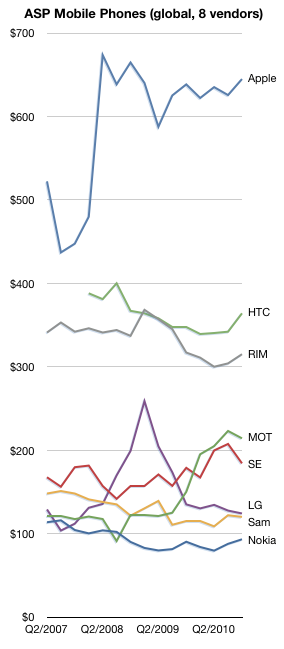
    This chart shows the average selling prices for all phones sold by the eight publicly traded phone vendors (covering approximately 70% of the market) since mid-2007.

    There is remarkable stability in the pricing of the competitors. One could argue that only Motorola and LG saw significant swings in price. (Apple's instability in 2007 was due to the revenue sharing deal for the 2G iPhone on AT&T).

    Motorola pared down its portfolio (and its market share) and as a result has seen a doubling in ASP. LG had a rapid rise and rapid fall as its feature phone business boomed and busted.

    But otherwise, pricing trends are subtle: down from Nokia and Samsung. Slight decrease for RIM and HTC and stable for Apple. In a future post I'll dive into the relationship between pricing power and share.

  10. Making it up in volume: How profit and volumes traded-off in the fourth quarter

    Research · 24 comments

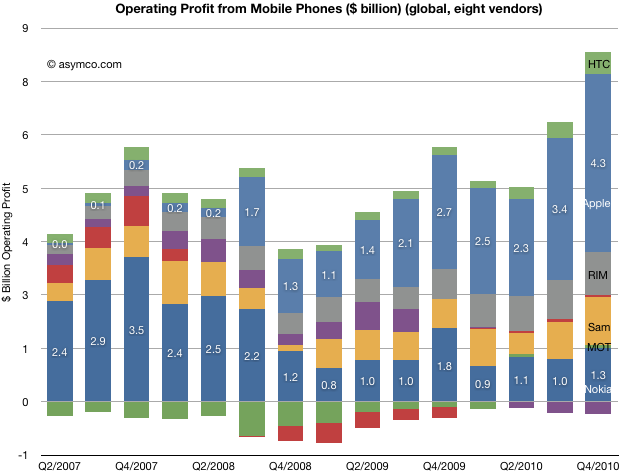
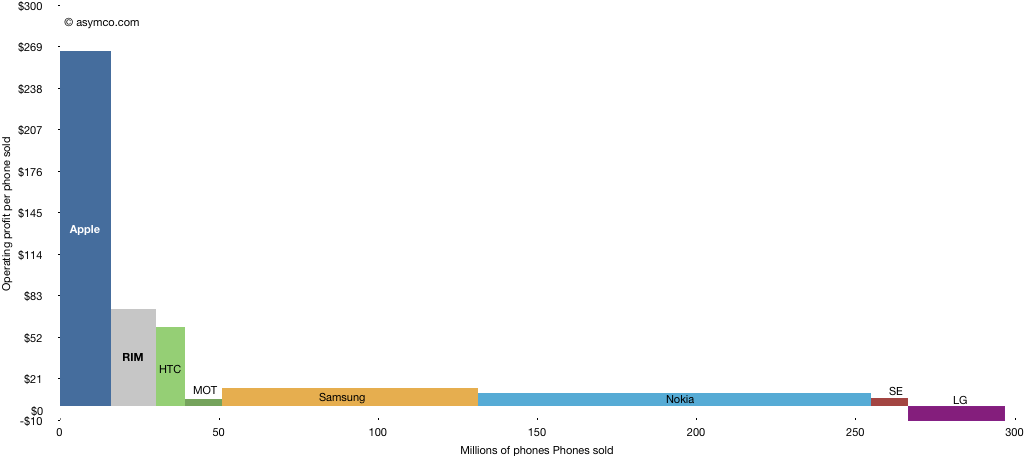
    Today's charts show the amount of profit captured by the top eight public mobile phone companies in two different ways.

    The first, as a bar chart:

    The second shows the way they captured it by taking into consideration the number of devices sold.

    Please click on the image for a full size view (1024 pixels wide).

    Generally speaking, vendors which are focused on smartphones have higher pricing and higher profitability (pricing discussion will follow at a later time). However, some, like Motorola and Sony Ericsson are still trying to recover from the collapse of their non-smartphone business and have higher prices but not very high margins overall. LG does not seem far behind.

    Samsung and Nokia profit per device is quite small but they "make it up in volume".

    The areas above represent operating profits and are comparable. One wonders how the ratios between horizontal and vertical dimensions for these boxes will change over time.

    Since the overall market will expand, the sum of all horizontal dimensions will increase. As the first chart shows, there is no law for the conservation of profits in the industry, so it's possible that the sum of all these areas will increase, but it's still hard to imagine it increasing by an order of magnitude.

    Will the industry remain clustered into a tall-and-narrow group and a short-but-wide group? That's a question with many strategic implications..

  11. Google as Android "Vendor"

    Research · 113 comments

    In a recent tally of mobile OS market share estimates from Canalys, the market was organized by OS vendors. The number of devices sold by operating system vendor includes as many OS's as each vendor may supply.

    For example, Microsoft licensed two different OS's during the period: Windows Mobile 6.5 and Windows Phone 7. Nokia also offered multiple versions of Symbian, which have varying degrees of inter-operability.

    Google's offerings include (as per footnote) OMS and Tapas platforms in addition to Android.

    Fragmentation is not a new subject as OS licensing models have been ripe with it for as long as they existed.

    What I want to draw attention to is the concept of Google as "vendor."

    A vendor in the traditional supply chain model is a supplier that sells to an up-stream value-adding stage of the value chain. The word itself has as its root the word "vend" which means to sell.

    But we know Google does not sell Android. And it's not just that Google builds a product and ships it for free.

    There are no contracts associated with the transaction of downloading the Android source. No contract means no obligations, no warranties, no terms and no conditions. The product is not indemnified against litigation. There are no licenses, no support, no copyrights and no patent license granted.

    The contract-less nature of Android makes it easy to distribute. It's one of the key reasons why distribution can grow at 600% a year--there is no distribution in the classic sense. The real disruptive advantage for Android lies in the removal of distribution costs (not just development costs). Google themselves admit that they have no idea who implements the software and how it's used.

    Which makes the classification of Google as a "vendor" a misnomer. The notion of 'vending' something implies a contract. What Google does is write code and place it on an FTP server.

    It's a wonderful way to save on SG&A (there is no sales, general or administrative expense.) But as everyone knows, there is no such thing as a free lunch.

    By avoiding any contractual engagement with the authors of the source code, implementors are subject to independent litigation for IP violations. This is why HTC and Motorola are targets for Apple and not Google.  Google is no more liable for writing Android than the author of a book on bomb making is liable for the bombs put into use [1].

    Patent violation rests with implementation, not the writing of the idea itself.

    Furthermore, Google cannot ensure Android users have any specific experience. They can't encourage upgrades, service models or any form of common UI. The experience, like the protection of property is the responsibility of the implementor.

    Can Google change this approach with Android? Not as long as Android is open source. Can Google change Android from being open source? No, they don't own the source to Android. Nobody does.

    ---

    Notes:

    1. If the bomb making book was a copy of another, then the author is liable, which is the case being made by Oracle.