Asymco

Asymmetric Intelligence

Industry

  1. Dell's devices head resigns

    Research · 8 comments

    Garriques will leave Dell at the end of January after nearly four years on the job. Prior to Dell, Garriques had been the mobile device chief at Motorola until early 2007.

    via Dell's Device Plan Reboots, Exec is Out - TheStreet.

    Here is how Ed Zander (the former CEO of Motorola) described Garriques soon after he left the company.

    ...Zander didn't have a lot of good to say about the former team running Motorola's cell-phone business. "The management in mobile devices made calls that were dead wrong," he said, referring not so much to massive price slashing on the popular Razr as to the slow-footed move into so-called 3G (for third-generation) multimedia phones. That particular slam was directed at a young guy named Ron Garriques, who headed that division, which is most of Motorola's business today, before high-tailing it out of Motorola just before the you-know-what hit the fan. Garriques today is part of the crack team turning around Dell.

    His move to Dell caused quite a lot of speculation that Dell was going to be a serious contender in the mobile device space (despite their previous failures).

    Apparently the launch of the Android-powered Streak was not enough to cement his future at Dell.
  2. China Unicom Says It Will Introduce own smartphone OS by Year-End

    Research · 7 comments

    The UPhone will run on a “totally new” operating system that Unicom developed based on Linux, Zhang Zhijiang, who heads the company’s technology department, said in an interview today at the Mobile Asia Congress in Hong Kong. The phone is being developed with Okwap, Huawei Technologies Co. and ZTE Corp., he said.

    via China Unicom Says It Will Introduce Self-Developed Smartphone by Year-End - Bloomberg.

    Operators are still considering bespoke operating systems.

    See also: European Operators contemplate own OS. Why not just fork Android?

  3. Warner Music waits for Godot

    Research · 19 comments

    You really can’t stress this point enough: We’re a decade past Napster, but the music industry still runs on CD sales. In Warner’s case, digital now accounts for 25 percent of overall revenue.

    via Warner Music Renews Spotify's European Deal, Waits for Google | Peter Kafka | MediaMemo | AllThingsD.

    What's even more amazing is that after ten years not a single industry participant has found a new job for which its product can be hired by consumers.

    The music companies wait for Apple, Google, Spotify to  "invent" some new consumption model from which they can extract a rent.

  4. Operators' last stand: payment platforms.

    Research · 13 comments

    Operators “had high hopes until 2007 or 2008,” said Patrik Karrberg, a researcher in the London School of Economics’ Department of Management. The hopes dimmed after the emergence of iPhones and improved data speeds that made the Internet directly accessible on handsets.

    “They gave up the idea of controlling the entry point,” Karrberg said. “That was the death of the portal.”

    via Vodafone, France Telecom Push to Regain App Edge From Apple - Bloomberg.

    It looks like a payment platform may be one of only a few opportunities remaining.

  5. Is Android fragmented by design?

    Research · 99 comments

    When I wrote about the absence of copyright enforcement on the Android marketplace, I was trying to point out that Google did not have the interests of copyright owners at heart. This attitutde is also apparent in many ways from the absence of desktop sync for Android (and hence the absence of discovery or acquisition of commercial media) to the absence of protection for the app developer.

    Moreover, recently Google TV was blocked from all major US TV content and Google faced litigation from copyright holders in print publications and before that for YouTube infringements and before that from newspaper publishers for Google News' unlicensed reuse of their content.

    Therefore it should not come as a surprise the following revelation that Android lacks any common DRM framework.

    The hurdle has been the lack of a generic and complete platform security and content protection mechanism available for Android. The same security issues that have led to piracy concerns on the Android platform have made it difficult for us to secure a common Digital Rights Management (DRM) system on these devices.

    Setting aside the debate around the value of content protection and DRM, they are requirements we must fulfill in order to obtain content from major studios for our subscribers to enjoy. Although we don’t have a common platform security mechanism and DRM, we are able to work with individual handset manufacturers to add content protection to their devices.

    Unfortunately, this is a much slower approach and leads to a fragmented experience on Android, in which some handsets will have access to Netflix and others won’t.

    via Netflix blog.

    But the absence is not just oversight. DRM is, by its nature, proprietary and, by necessity, "closed". DRM ultimately includes "secrets" which would always be revealed in open source. If Android is to be open source, then it cannot include a DRM framework.

    This leaves the problem of content protection up to the device vendors who must license schemes from various third parties.

    The upshot is more fragmentation.

    As John Gruber points out,

    More and more, I’m convinced that Android isn’t a single platform. It’s a meta-platform upon which handset makers build their own platforms.

    In other words, Android fragmentation seems to be not only impossible to rein in, but it may actually be by design. Google is doing nothing to stop the centrifugal force that is building up in its ecosystem. They have neither the means nor the incentives to control the spiraling.

  6. Google Nexus S

    Research · 52 comments

    Google Nexus S is real, gets leaked by Best Buy [U] | Electronista.

    Can you imagine Microsoft launching a Microsoft branded phone to compete with its Windows Phone licensees? When Microsoft launched the Zune, their licensing model (PlaysForSure) was quietly folded up.

    A Google phone makes little sense, but then again Google does not seem to care much about its ecosystem or relationships with Android device vendors. They even claim that they have no idea how many phones are being built using Android and, except for activations, have no way of measuring the number sold.

    From their point of view, if Motorola feels it's unfair to have to compete with a Google branded Samsung (or HTC) designed phone then too bad. There's lots of white label vendors lined up to make these with or without anyone's blessing.

    In fact, the biggest opportunity for Android growth seems to be the large unlicensed (and illegal) grey market which seems to be rapidly expanding.

  7. Visualizing smartphone platform growth

    Research · 55 comments

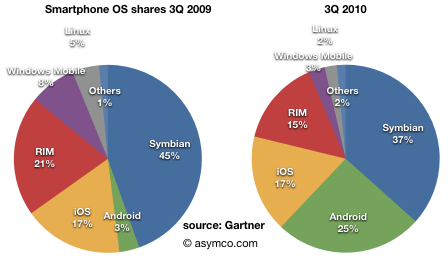
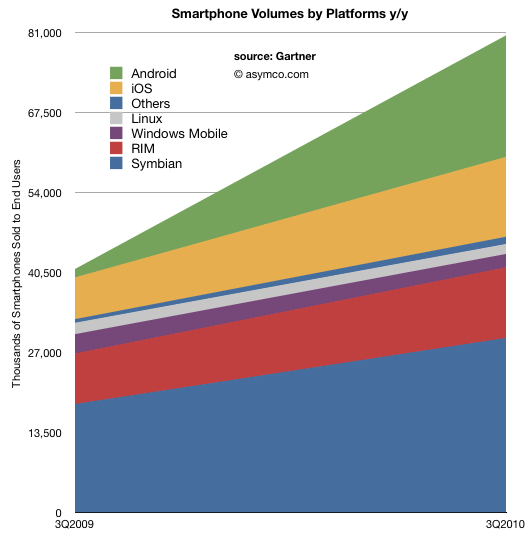
    None of this should come as major surprises, but Gartner's data allows for a bit more granular detail in the overall view of the market. Here are new points derived from Gartner's sell-through data:

    • The smartphone market is growing at nearly 100% (96%).
    • The overall market is growing at 35%.
    • The non-smartphone market is growing at 25%.
    • Android grew at 1,340% y/y. iOS grew at 92%, Symbian at 61% and RIM at 40%.
    • Platform market shares (below) shows a more even distribution of platform volumes between four main platforms:
    • Non-branded mobile phones grew to 33% of the market, with 141% unit growth. This is an alarming figure for the low-end of the market. The unbranded market excludes ZTE and Hauwei which grew below the overall market growth (9.8%, 27% respectively). The implications were most dire for Motorola (-36% units growth), Sony Ericsson (-23%) and LG (-14%). Nokia grew but, at 3.5%, well below market growth.
    • In 3Q 2009 41 million smartphones were sold. In 3Q 2010 80.5 million were sold. If we were to split the growth among platforms, nearly half the growth was Android. 27% of the additions were Symbian and 16% were iOS. Only 8.3% of the growth was RIM devices.
    • Windows Mobile and Linux were the only smartphone platforms to shrink volumes. However, even though the platform is deprecated, 2.2 million Windows Mobile devices were still sold last quarter -- more than Android sold a year earlier.
  8. The largest Android vendors

    Research · 8 comments

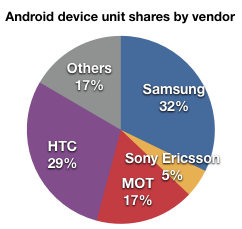
    Gartner released sell-through data for the handset market. In the release appears an estimate of total Android 3Q Smartphone sales (20.5 million). Combining this with what some of the vendors have reported in terms of units sold, we can estimate the share of Android by vendors.

    Note that this is a rough estimate. We don't have data on Sony Ericsson's smartphone units sold and we don't know the mix of HTC's Windows Mobile vs. Android.  I'm also assuming LG as part of Others. The data from Gartner is claimed to be sell-through whereas vendors report sell-in so there is more roughness about each vendor.

    Regardless of these potential sources of error, it's a very safe bet that Samsung and HTC are the largest Android vendors by a fairly large margin.

    It's perhaps noteworthy that both are also committed Windows Phone vendors. According to pdadb.net here is the count of Windows Phone SKUs by vendor:

    • HTC 12
    • LG 5
    • Samsung 2
    • Dell 2
    • Toshiba 1

    Motorola is keeping its Windows Phone options open, leaving "Others" as the only likely exclusive Android vendors.

  9. Were Nokia and Symbian always inter-dependent?

    Research · 8 comments

    Several readers pointed out that in my discussion on the market share of modular vs. inter-dependent market shares for smartphones, Nokia was incorrectly classified as having an inter-dependent software architecture since the Symbian platform is/was a modular component.

    The problem is that the relationship between Symbian and Nokia is not that of independent modules. Nominally, the two are independent and mutually exclusive, but, in practice, Symbian has always been so heavily dependent and influenced by Nokia that it's never been possible to declare its governance fully independent.

    I won't describe the full history since there are many other sources (good example here.) But I will point out that since Nokia licensed Symbian exclusively and Symbian obtained the vast bulk of license fees from Nokia, the relationship was one similar to a bilateral monopoly.

    Nokia's bargaining power over Symbian was always high enough to affect its operations. "Ownership" does not only infer a formal control over equity, and many would agree that Nokia "owned" Symbian even when it held less than 50% of the equity. The relationship was so tight, that even though there were other members of the consortium with board seats, the licensing by Nokia's competitors was always very limited. The only significant non-Nokia revenue for Symbian came from Japan where Nokia did not have a presence.

    After Symbian was effectively acquired by Nokia, the ownership became both de jure and de facto. The open sourcing of the Symbian code made it no less a Nokia operation than the open sourcing of Android makes it no less a Google operation.

    So for all intents and purposes, the relationship between Symbian and Nokia makes Nokia's smartphone hardware inter-dependent on Symbian's software.

    Now, given that the way the products are built in practice may be far from integrated, it would seem that Nokia's management captured the worst of both worlds: Modular implementation of an inter-dependent business. Nokia captured all the downside of modularity (poor integration and polish) without any of the benefits (e.g. flexible supply chain or lower R&D.)

  10. Android remains the only mobile OS still patterned after Microsoft's 2002 vision of the mobile value chain

    Research · 52 comments

    Belfiore wasn’t shy about criticizing Google’s Android OS. Even though Google currently dominates the mobile OS market, its strategy of licensing the Android OS to manufacturers is similar to Microsoft’s previous approach with Windows Mobile: It’s open-ended, and there are few restrictions on how manufacturers can use or modify the OS.

    As a result, Android is suffering from some of the same issues as Windows Mobile did: Android works better on some phones than others, manufacturers are shipping different versions of the OS on different phones, some Android phones are shipping with bloatware made by carriers, and some app developers complain that it’s difficult to make software because of the hardware and OS fragmentation.

    via How Microsoft Hit CTRL+ALT+DEL on Windows Phone | Gadget Lab | Wired.com.

    Android was initially an attempt to commoditize Windows Mobile with a symmetric but "free" alternative. The idea was to conform to OEMs and operator business models. This was directly copied from Microsoft's early 2000's playbook for entry into mobile.

    Trouble is that Microsoft realized their purely modular, operator and OEM centric approach was failing to be competitive on the user experience and decided to move into a more integrated approach, closer to Apple's integrated model.

    But while Microsoft dropped their vision, Android was still patterned after their approach.

  11. HTC to re-bone Android?

    Research · 10 comments

    Peter Chou, chief executive of HTC, had previously said he saw “little value” in HTC running its own application store. But he has also said that it was no longer enough for HTC to simply customise the standard Android user interface with its own “skin”: “It is not enough to be skin-deep. We need to go bone-deep.”

    via FT.com / Technology - HTC to target online app store.

    HTC was the world's biggest Windows Mobile vendor, at one time claiming to have sold over 80% of all WinMo phones ever made.

    I always considered them to be the natural leaders in the Android licensing cohort. First, because they are the most agile and second because they had the operator relationships that allowed white-label operator phones.

    HTC aspired to differentiate itself by "skinning" Windows Mobile and have carried their Sense UI over to Android offering a brand image distinct from competitors.  However, HTC's branded strategy may have upset their operator partnerships (no evidence of this, just hypothesis). In the event, HTC, though prosperous, is not the largest single Android vendor.

    Now the comment above from Peter Chou indicates that HTC is going to integrate the experience further. Building its own APIs, store and perhaps more. Not satisfied with "re-skinning" perhaps it will "re-bone" as well.

    Going "bone-deep" sounds a lot more integrated and inter-dependent than modular to me.