12.1 million phones shipped, 11 million sold through (estimated iPhones for this Q range from 11 to 13 million)
Net subscriber account additions were 4.5 million which was lower than anticipated (41% of units sold through were to new subscribers which implies nearly 60% were to existing users)
Revenue grew 31% over the same quarter last year and GAAP earnings grew 76%.
The BlackBerry subscriber account base grew 56% year-over-year to over 50 million
RIM has shipped approximately 115 million handhelds to date. (note: 120 million iOS to date)
BlackBerries are available through over 565 carrier and distribution partners in approximately 175 countries and international markets (vs. 150 carriers and 88 countries for the iPhone)
Approximately 52% of revenue in the quarter was generated outside the United States and over 45% of BlackBerry subscriber account base is outside of North America. (70% of iPhones were sold outside the US through the first half of this year)
Torch was launched with one carrier but will expand to 75 next quarter
To date over 35 million BlackBerry Smartphones have downloaded App World at an average of over 1.5 million Apps are being downloaded every day which is up 40% sequentially (iOS apps are running at 17 million downloads per day)
Average selling price for RIM devices was $304 (vs. $600 for the iPhone)
Gross margin was 44.5% (upward of 50% for the iPhone)
Management changes are usually made at the end of the year but the change, which takes effect from October 1, reflected an urgency to overhaul the struggling mobile unit.
"We made the decision to give an incoming chief executive enough time to prepare for next year," LG Group said in a statement.
LG follows Sony Ericsson, Motorola, Palm and Nokia in replacing CEOs because of trouble with their smartphone efforts. Microsoft also let go Robbie Bach, head of the Mobile division.
It's an interesting pattern at a time when the industry is facing unprecedented growth.
France Telecom-Orange CEO Stephane Richard has invited the heads of Vodafone, Telefonica and Deutsche Telekom (T-Mobile) to Paris on 8 October to discuss the development of a common operating system for mobile devices. He told Le Figaro that mobile operating systems were the Trojan horse used by Google and Apple to establish relationships with mobile customers. The four operators have nearly 1 billion customers combined and the capacity to influce industry. The initiative could take several forms including a joint venture or a common apps development unit. He added that the operators aim to retake the reigns of innovation, rather than be followers.
In the interview Richard also stated that carriers have decided not to advertise the iPhone any more.
This attempt at operator cooperation in software has been tried before, but it predictably failed (does anyone remember Savaje?) Symbian itself was an attempt at mobile phone vendor cooperation on systems software. There are various consortiums for "open mobile OS" based on Linux (e.g. LiMO which started as a Japanese effort). Even the Open Software Alliance is a rubber stamp body rather than an attempt at development.
Although one can safely dismiss the potential of this effort on the basis of a lack of competence, the arrogance reminds one of the rigidity in response to the disruption under way. The fact that high-speed data networks allow operator disintermediation cannot be changed by "innovation" on systems software.
But the odd thing is why even bother. The solution to taking control over the user experience and services platform is straight-forward: each operator could fork a version of Android as their own and hire a team to integrate white label services. It's much more straight-forward than coordinating a joint effort. China Mobile have already done their own non-Google Android.
With Verizon shaping Android into its image, you can read AT&T's embrace of Microsoft as the deeply-held belief by operators that they need multi-platform balance in their portfolio.
The idea that operators will tolerate "dominance" of a platform is looking less and less tenable.
But one area where IBM won't compete with HP is personal computers. In 2005, IBM sold its PC business to China's Lenovo Group for $1.75 billion. The PC era, Mr. Palmisano said Tuesday, ended three or four years ago.
"We wanted to get out before it was obvious to everyone," said Mr. Palmisano. "I couldn't give it away today," said Mr. Palmisano of the PC business. HP is the world's biggest PC maker.
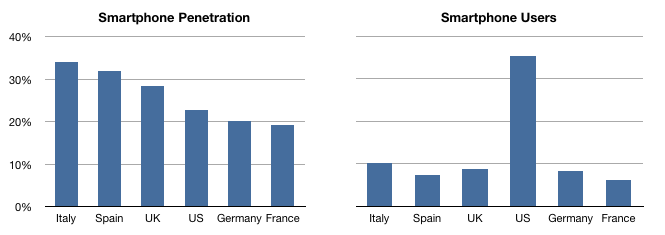
Following up on survey data showing that up to 25 percent of Americans have moved to smartphones, here is another survey (Comscore) which shows that US smartphone users are at about 23 percent.
Comscore also surveyed European countries, and we can compare the popularity of smartphones vs. the US.
I also indexed the share to population to show the relative populations of smartphone users across these countries.
It may come as a surprise to some that smartphones are more popular in the UK, Spain and Italy than in the US. Considering that these are countries with lower levels of disposable income, and that in Italy and Spain pre-paid plans are overwhelmingly more popular. Buyers in those countries are much more likely to pay full, unsubsidized prices plus 20% or more VAT. Overall the price differential for an Italian buying a smartphone vs. an American is likely to be a factor of 5. It gets even more peculiar when you consider that many Italians have more than one phone, with overall phone line penetration above 100%.
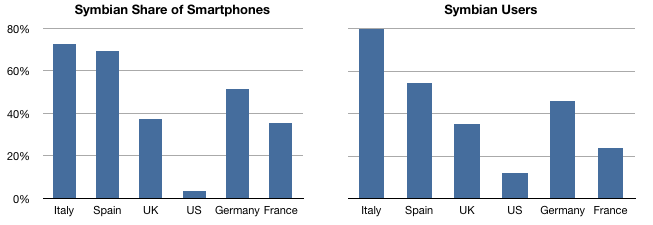
The explanation for this remarkable appetite for smartphone goodness is the early lead that Symbian had in Europe. Buyers who entered the phone market ten years ago became accustomed to upgrading their Nokia phones. Symbian phones were aspirationally positioned as feature-rich camera and messaging devices. Many were also purchased without data plans and were thus used as high-end feature phones. In other words, consumers in those countries were comfortable paying full price for unlocked Nokia devices and using them with multiple SIM cards.
This can be seen in the share of Symbian in these charts:
The data points to how normative behavior evolved and how different that can be even among culturally aligned Western nations. When looking at Asia and South America, it gets even more interesting.
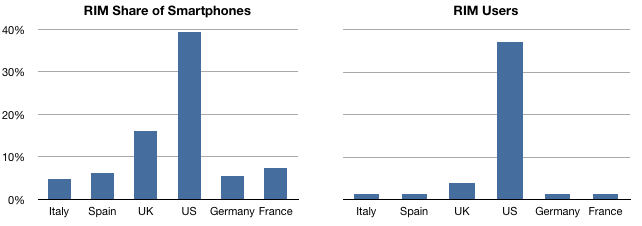
Whereas in Europe it was Symbian, in the US RIM got the ball rolling.
The contribution of these platforms in shaping expectations, not to mention pricing, for the iPhone and Android should be noted.
“The N8 is certainly a step in the right direction, it’s much more multimedia,” Per Lindberg, an independent technology analyst at MF Global in London, told Marayam Nemazee on Bloomberg Television’s “Countdown.” “But whether it will move Nokia’s market share upwards is more debatable,” he said adding that Android phones are becoming an “formidable force.”
This is the same Per Lindberg who, in January of this year, reiterated his February 2009 Sell rating on Apple and the entire smartphone industry:
"There is no doubt, in my mind, that the whole sector is hugely overstretched," says the London-based physics PhD and MBA graduate who joined MF Global Ltd. in 2008 after 10 years at investment bank Dresdner Kleinwort.
"The whole sector is priced as if the average player would sustain 25 per cent margin in eternity," he adds.
"It's bordering on absurdity. This will end in tears."
He is willing to use the b-word: "Many stock bubbles are generated by sell-side analysts generating enthusiasm for the companies they cover."
To date however, it's Mr. Lindberg's call that's been the costly one for investors. He has maintained his sell rating on Apple since early February of last year, causing investors who followed his advice to miss out on a more than 110-per-cent surge in the share price.
This is potentially a positive development for Nokia as the "fightback" as Vanjoki defined it was certain to fail. His departure might allow a new team to accelerate the response to the disruption using an asymmetric approach. The odds are massively stacked against Nokia but the more turnover is seen at high levels of the organization the better their chances.
Lots of people apparently think it’s a big deal that Gartner is predicting Android will surpass iOS for second place. But why is that necessarily a good thing, given that they’re predicting Symbian will remain in first place? Who thinks Symbian is actually doing well? Nokia’s board sure doesn’t.
I also noted with amusement that by 2014 "other" is slated to sell 85 million units or nearly 10% share, up from 6.1% in 2009. These "others" will be selling more than twice what Apple is expected to sell this year. Is "other" WebOS, Bada, MeeGo, LiMO? If so they're in for a healthy future.
But dwelling on details like these is missing the point. To see how improbable this prediction is, let's go back to 2006 and ask what Gartner was forecasting would happen now.
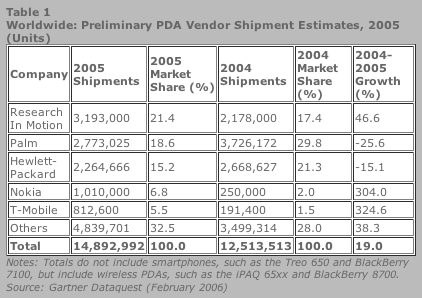
First thing to note is that in 2006 Gartner was busy tracking PDA sales. You might wonder why this is relevant. The reason is because a significant proportion of RIM's Blackberries counted as wireless PDAs and were therefore considered to compete with Palm's Treos, HP's iPaq and Dell's famous Axim. Nokia was in the running with its Communicators. Here is how Gartner characterized the equivalent market in early 2006:
So I'll just come out and say it: In 2006 Gartner did not have a clue what a smartphone was. By their admission:
Gartner defines a PDA as a data-centric handheld computer weighing less than one pound that is primarily designed for use with both hands. These devices use an open market operating system supported by third-party applications that can be added into the device by end users. They offer instant on/off capability and synchronization of files with a PC. A PDA may offer WAN support for voice, but these are data-first, voice-second devices.
In other words, in 2006 Gartner was splitting phones with operating systems into two separate markets: data-oriented wireless PDAs and voice-oriented smartphones. The split was mostly based on the judgement of the analyst on whether a device was "voice" or "data" oriented. I suppose they used the primary input method as a proxy: numeric keypads meant the device was one-handed and therefore voice-oriented. If the device had a full keyboard and/or a stylus-actuated touch screen then it was a two-handed data-oriented device. But even this proxy was not quite enough, sometimes devices were classified whimsically.
To make it more complicated, they bundled non-cellular but Wi-Fi enabled PDAs with wireless PDAs. This made some sense from a corporate IT point of view (their primary customer base) as these data-oriented devices would be used either on a LAN or a WAN (Wide Area Networks: what Gartner anachronistically called cellular networks.)
The presence or absence of a cellular radio did not enter into their view of these devices. So if you asked Gartner in 2006 to forecast smartphones (as we know them now) in 2010, I suppose you'd get what they forecast for "data-centric" devices.
So assuming that today's smartphones are mostly "data-centric" we would have to look back on their view of that market and not the voice market which was seen as an entirely different thing. Their answer should have had something to do with the market leaders and participants in 2006. As the table above shows Gartner showed that RIM, Palm and HP led in 2005 with Nokia and T-Mobile[1] pulling up the rear.
However, from a platform point of view, at the beginning of 2006
Microsoft Windows CE was the No. 1 PDA operating system (OS) in 2005 as 7.05 million PDAs were loaded with the OS, up 33 percent from 2004 shipments of 5.28 million units. Palm OS PDA shipments declined 34 percent to 2.96 million units in 2005.
In late 2006, Gartner made further predictions for the year:
In 2006, Gartner expects the PDA market to increase by 6.3 percent to 16 million units. The market will continue to be driven by broader availability of cellular-enabled PDAs from wireless carriers. Gartner estimates that 53 percent of all PDAs shipped in the first half of 2006 featured integrated cellular capability, up from 46 percent during the same period in 2005. “The share of PDAs purchased by enterprises will continue to increase; it accounted for 49 percent of all PDA shipments in the second quarter of 2006 and Gartner expects that the enterprise market will account for 52 percent of all PDA shipments in 2006,” said Todd Kort.
At this time I have not yet dug up a Gartner "Wireless PDA OS" four year forecast from the year 2006 but I suspect it would not show devices running Google's Android operating system or any running something called iOS.
[1] T-mobile is in the list because it was common practice in 2006 for operators to market Pocket PC Phone Edition devices made by HTC under their own name. Orange, Vodafone and Verizon also had own-brand HTC Windows touch-based devices. Now what does that strategy remind me of?
He said that the technology world was facing a "moment of fundamental disruption" thanks to the advent of the smartphone, social media such as Facebook, and "cloud computing" which uses the internet to increase the capabilities of home computers.
It's encouraging when an incumbent realizes when they are being disrupted. The textbook says however that it usually happens too late to reverse the damage done.
With a new CEO, Nokia may cut one year off from their response cycle but it's not a certainty that it will happen.
Just noticed that the Apple online store now says it takes 1-2 weeks to ship an iPhone 3GS. I think this just changed from 5-7 days shipping.
Is Apple having supply problems again with the 3GS model? Or perhaps Apple is saving supply for a China launch? Or using production capacity to make iPod touches?
The news today that Foxconn can only produce iPhones at the rate of about 4 million per month shows how constrained Apple's production is. Demand is far, far higher.
The discussion about iPhone vs. Android share is usually framed around questions of demand or distribution, but may really be a question of production capacity right now.