Asymco

Asymmetric Intelligence

Industry

  1. Why OPK was fired

    Research · 27 comments

    Under Kallasvuo Nokia embarked on the most dramatic shift in its business since entering the mobile phone business in the early 90s.

    The shift was not into mobile software which began in 2001 under his predecessor. It was not into enterprise solutions which also preceded his tenure. OPK's main contribution was the move into mobile services.

    The concept of mobile services may be an unfamiliar one for casual observers because it has not become a visible business for operators and certainly not for handset vendors. It's also a complicated business model that requires some deeper understanding of the way the telecom industry is structured.

    What Nokia had in mind was to offer various value-added, billable services to operators which would be enabled by Nokia handsets. The types of services included music subscriptions (Comes With Music), email (several acquisitions), photo sharing, and navigation.

    The idea was that since many operators would not be capable of rolling out own brand services and could not do the heavy back-end lifting or the integration with handsets, someone could step in and roll out white labeled solutions world-wide. Third parties would also find it impossible to integrate and would lack the relationships Nokia had with operators world-wide.

    For example, Nokia could enable a South American operator to offer email services to all their customers (with or without smartphones) and that service could be offered at a certain incremental price over the basic voice plan. The client implementation could be device independent but Nokia devices would probably work better. This would lead to higher ARPU which could be shared with Nokia.

    Anyone can see that this is a complicated business plan and is therefore unlikely to be successful. But what makes it a complete failure is the realization that most buyers will resist the idea of paying for individual services separately. $1/mo for email, $2/mo for music, $3/mo for maps, etc. is repulsive. Users stampeded instead to unlimited data plans and smartphones which offered all these services and hundreds more for free or at prices negotiated with third party providers, rather than the untrusted network operators.

    And therein lies the entire cause of Nokia's strategic failure: an operator centric point of view. It led to poisoned devices and irrational business plans.

    Which leads to the question in the headline. Is this mistake recognized and is it big enough to cause such a disruptive CEO dismissal?

    I argue yes. Strategic errors are forgivable, but the they become a capital offense when they turn into a derailment of the core business. Instead of being enhanced with value-added services, the core business collapsed under the disruptive attack of unlimited data.

    But it gets worse. Like the capital offense that Robbie Bach was guilty of at Microsoft, there has to be some direct accountability. To add insult to injury, OPK single-handedly pushed through the biggest and stupidest acquisition in Nokia's history. To support this flawed vision of mobile services OPK bought Navteq for $8.1 billion in October 2007.

    Intended as a service that could be rolled out on all phones and monetized through operator billing, Nokia maps is a free service that will never return anything to shareholders.

    Missing where the puck was going is one thing but burning precious capital is another. This, in my humble opinion, is why OPK was fired.

    Speaking of pucks, here's hoping fresh Canadian eyes will see where it's going.
  2. Google vs. Android Part IV

    Research · 35 comments

    Verizon, unfortunately, is also what ruins the phone. Or, rather, what it’s forced Samsung to do to the phone, which you could sum up in a word: Bing. Bing is the default—and only—search engine on the Fascinate. A Google Android phone. In the search widget, in the browser, when you press the search button. Bing. No, you can’t change it. There’s no setting for it, and the Google Search widget that you can snag from the Market is blocked (or at least very carefully hidden). Being unwittingly forced into Verizon and Bing’s conjugal relationship is infuriating on its own, but the implementation also feels like the sloppy hack that it is.

    via Daring Fireball Linked List: Matt Buchanan on Verizon's Samsung Fascinate Lightning.

    John Gruber astutely adds:

    Android is “open”, but who it’s open for, primarily, are the carriers. (Somehow I doubt we’ll see any Windows Phone 7 devices where Google is the one and only search option.)

    The primary defense of Google's Android strategy is that it's beneficial in driving traffic to Google's services/properties. This is by no means a certainty. To the contrary, it seems likely that the Android experience will be defined by operator back-room deals.

    See also: asymco | Android vs. Google Part II

    Coupling a lack of control over the platform, the revenue streams, the user experience, the potential banishment of AdMob from iOS and an attack on Google's brand, Android is currently winning the war with Google.

    However, my money long term remains with Google. They can and will eventually beat Android. Perhaps with Chrome.

    [Footnote: if anyone wonders why Verizon, Google's best friend in mobile, is gutting Android, you need to remember an exclusive five-year deal Microsoft struck with the carrier to provide search and advertising services on the phone. Microsoft was rumored to pay $500 million for the opportunity.]

  3. Smartphone market growing faster than expected

    Research · 9 comments

    IDC raised its 2010 smartphone sales growth forecast to 55 percent from 44 percent earlier. Citing booming smartphone demand it also lifted its forecast for overall cellphone market growth to 14.1 percent from 12.6 percent.

    via Cellphone market growing faster than expected -IDC | Reuters.

    Keep in mind the 55% growth figure when reviewing analyst forecasts for iPhone growth. If their forecast is less than that then it implies market share loss. When I suggested 50% compounded annual growth rate (CAGR) for iPhone going forward 3 years, there was a lot of skepticism but this market is growing faster than most people expected.

    I still believe that Apple can grow the iPhone at least as fast as the market.

    Here are the quarterly y/y growth rates for iPhone units since sales began:

    159% 516% 88% 90% 644% 7% 100% 131% 61%

    On a yearly basis:

    2007: 3.7 million

    2008: 13.7

    2009: 25.1

    2010 first half: 17.15

    2010 (my estimate): 44.4

  4. Will Apple need to cut margins on the iPhone?

    Research · 39 comments

    Many comments on and off this blog raise the specter of the inevitable decline in Apple's margins due to two forces:

    1. The iPhone begins to reach into more markets or points of distribution without exclusivity.
    2. The Android surge will apply competitive pressure forcing Apple's pricing and hence margins.

    The first claim can be countered by observing that Apple has not cut margins when switching from exclusive to non-exclusive distribution in several markets. In fact, Apple made this information public: When Tim Cook was asked in October 2009 earnings concall “So when you go from exclusive to multiple, you don’t change the charge to the carrier?” Cook answered, “Correct.”

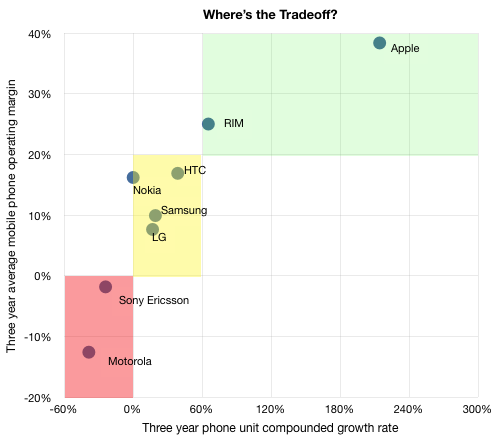
    The second claim can be countered by observing that innovation trumps pricing every time. When looking back at the three years' history of the industry there is a clear but counter-intuitive demonstration of the power of innovation in the market.

    Whereas one would expect that in a highly competitive market torrid growth would only be possible with lower pricing and hence margins, the opposite is observed in the phone market during the last three years:

    [HTC data is over a two year period]

    The graph shows that companies that grew the fastest had the highest margins, and the companies that grew the slowest had the lowest margins. The trend line in the graph above is precisely orthogonal to what would be expected in a commodity market.

    The orthogonality of growth vs. margin points to the effect of innovation in this market. In a non-commoditized market (i.e. one where usable improvements in a product are quickly absorbed and highly valued) high growth and high margins are correlated.

    In a commodity market (i.e. one where improvements in a product are neither absorbed nor valued) growth can only come at the expense of margins.

    Being able to spot when a market tips from innovation-driven disruption to price-driven commodity sales is an essential skill for both investors and managers. It requires a comprehensive and integrated analysis of technology, finance, consumer behavior, competitive forces and a lot of faith in theory to make the right call.

    As a keen observer I think the market still has a long way to go before it reaches this tipping point. I don't see it happening in the next three years (which is just 2 product cycles--the most an outside observer can hope to roadmap).

  5. Nokia's fifth last chance

    Research · 26 comments

    The cellphone maker will unveil its new flagship model E7, which comes with a large touchscreen and full keyboard, at the show in London, two sources with direct knowledge of Nokia's plans told Reuters.

    via PREVIEW-Nokia bets on new smartphones for recovery | Reuters.

    Analysts have been saying that Nokia has one last chance to fix (software, UI, strategy, etc.) for some time now.

    Nokia sold 24 million smartphone units sold in Q2 which represented significant growth. Sales and Profits however were both down but to say that Nokia is facing imminent demise is misguided.

    How is Nokia able to sell so many units when its portfolio elicits so much pathos?

    The reason Nokia can still coast with poor products is that they have a vast distribution network. I don't know the exact distribution but let's assume that half their phones go through carriers and half through distributors who resell unlocked phones world-wide. Carriers will continue to carry the phones because they slot into well-established portfolio slots and distributors will continue to distribute because the product is competitive in markets where there are no other unlocked smartphones at the same price.

    So predicting imminent failure without taking into account distribution inertia is showing a lack of understanding of the market. The same insensitivity to distribution is why so many predictions of Microsoft's "death" or RIM's "death" fail.

    The less sensational but more accurate description of Nokia's predicament is that their strength in distribution prevents them from reforming their business model in order to benefit from the disruption that mobile broadband is bringing to mobile telecommunications.

    That's a mouthful.

  6. Smartphones will outsell PCs next year

    Research · 12 comments

    If we add Apple's 230k "activations", Android's 200k, Symbian's 300k and estimating 130k for RIM adds up to 860k per day.

    It won't be long before we'll see smart mobile devices selling at the rate of 1 million per day (I'd bet by the holidays this year.)

    Gartner is estimating the global PC market to total of 367 million units this year (though it may need downward revision based on recent data).

    If the 1 million/day benchmark holds, and all indications are that it will, then the total smartphone/iPad/touch market will be greater than the total PC market next year.

  7. Sony wavering on recognizing iPad market

    Research · 9 comments

    Sony in May:

    Sony is “not convinced there is a large enough market to justify bringing out a tablet,”

    Sony would say No to Walkman today
    Sony in September:

    Sony Corp., said yesterday it hasn’t decided yet whether to offer its own tablet computer. It needs to be a “very appealing product that is going to be widely accepted, as opposed to a me-too product,” said Kazuo Hirai, president of Tokyo-based Sony’s Networked Products & Services Group.

    Hirai said 23 companies are planning to bring tablet computers to market, making a price war inevitable.

    via Samsung, Toshiba `Me-Too' Tablets Use Price to Fight IPad - Bloomberg

    I'd bet that Sony will soon join the stampede to make iPad knockoffs. They probably did not read today's Appleinsider piece on Apple's plans to increase iPad production to 3 million units per month.

  8. iPod touch made up 37.7 percent of all iOS devices sold so far

    Research · 13 comments

    On September 1st, Apple announced that 120 million iOS devices were sold to date.

    We know that there were 59.6 million iPhones sold through June (from SEC filings)

    We also know that 3.2 million iPads were sold.

    If we assume about 8 million iPhones and 4 million iPads were sold during August and July, the total number of iPod touch sold is 45.2 million.

    That is 37.7% of total units.

    In April I wrote that 41% of all iOS units sold were iPod touch to date.

    The expansion of iPhone distribution plus the addition of iPad as reduced the platform footprint for the iPod, but it's still a sizable chunk. More than one in three iOS units in use are non-cellular devices. As the iPad rolls that number could move toward 50%.

  9. LG says WP7 will outperform Android

    Research · 1 comment

    LG has reportedly told Korean sources that “it expects WP7 to outperform the two rival smartphone operating systems” – one of these platforms is definitely Android (I’m not sure about the other platform LG is referring to; Symbian? iOS? BlackBerry?).

    via LG to bank heavily on Windows Phone 7, says WP7 will outperform Android » Unwired View.

    While Samsung believes WP7 is doomed, LG believes it will RULE!

    This might go some way to explain why LG is in such dire straits when it comes to smartphone share.

  10. Nokia says: "My activations are bigger than your activations"

    Research · 6 comments

    While Jobs and Schmidt were having a contest over their mobile platform activation numbers...

    Pshaw to all that, says Symbian. The company points out that according to Canalys' research, there's 300,000 Symbian devices activated on a daily basis, which equals 109.5 million phones activated annually.

    via Sad Nokia Wants You To Know It's Activating 300,000 Smartphones Daily.

    I long for the good old days when we used to just measure units sold per quarter.