Asymco

Asymmetric Intelligence

Industry

  1. Correlating Innovation and Share Prices

    Research · 12 comments

    In the last article on the P/E ratio vs. Growth for some of the largest companies, the question of PEG came up. PEG is the P/E over Growth and it's a good way to index valuation relative to growth. Usually Growth is measured as the forward twelve months consensus and a PEG of 1 is, as a rule of thumb, considered "fair value". However, forward growth is based on possibly inaccurate analyst consensus. If we instead look at historic growth, we have some actual performance to evaluate. Let's call this PEhG for P/E over historic Growth.

    The following chart shows 30 large cap technology companies[1] and their five-year compound EPS growth vs. their current P/E multiples. If we draw a line at the PEhG of 1, i.e. when the P/E ratio is equal to the historic growth rate and split the pack into PEhG > 1 (overvalued)[2] and PehG < 1 (undervalued), we have the following split:
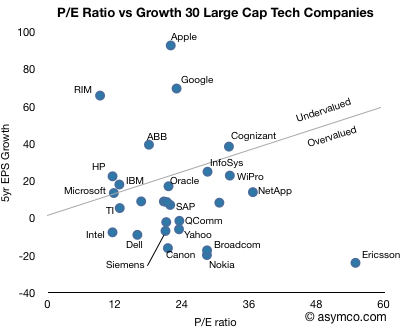
    The chart makes for an interesting point of view over what the best positioned companies in the sector are doing and how business model innovation shows up as investment opportunity[2].

    Apple, RIM, Google stand out for their business model innovation. Ericsson, Nokia, Yahoo and Dell show poor value for their lack of innovation. Microsoft, IBM, HP, TI and Oracle show in-line value for in-line or sustaining innovation.

    [1] I omitted Baidu from the chart as it's off the scale: Growth is 151, P/E is 108. It would classify as undervalued. These are also not a complete set of all large caps. It's meant to be indicative.
    [2] Notions of value are completely subjective. This does not constitute financial advice.
  2. WebOS: HP, and HP Only. QNX: RIM and RIM Only

    Research · 14 comments

    WebOS: HP, and HP Only.

    With the launch of RIM's tablet computer based on QNX and HP's confirmation that WebOS will not be licensed, we have

    • Apple the largest tablet and music player company,
    • HP the largest PC company,
    • RIM the largest smartphone company in the US, and
    • Nokia largest smartphone company in the world

    avoiding Android.

    These are the companies which today are profitable and enjoy large market shares. Why did they choose integrated (aka "closed") software with their hardware vs. the modular (aka "open") approach offered by Google and Microsoft?

    See also: asymco | Android’s Pursuit of the Biggest Losers

  3. Morgan Stanley analyst predicts Microsoft will buy its way to triple smartphone market share in 2 years

    Research · 13 comments

    "You could buy your way in, if you are Microsoft," he said. "This is a market where a deep balance sheet will help Microsoft determine where they want to go."

    He notes a good marketing campaign can do wonders for adoption, with Ehud predicting Microsoft will hit 15% market share in 2012 (about the same as the iPhone’s share now)

    "With [Microsoft's] resources, I think they can sustain double-digit market share," he said.

    He notes Microsoft, with $36.8 billion in the bank, could win market share in multiple other ways, including subsidizing phone costs.

    He still however predicts Android will lead the pack with 30%, Apple next with 25%, and RIM, Nokia and Microsoft all having 15% of the market.

    via Morgan Stanley analyst predicts Microsoft will triple smartphone market share in 2 years.

    There you have it: users are so easily persuaded that a platform purchasing decision can be acquired via small outlays of cash for ads and subsidies for vendors and operators.

  4. The Symbian open source experiment has failed

    Research · 17 comments

    ZDNet reports Sony Ericsson are abandoning Symbian for Android, and Samsung headed down the Android and Bada road a while back. There are precious few device manufacturers remaining as foundation members, e.g. ZTE, Sharp and Compal, none of whom are exactly trend-setting industry leaders.

    via The Symbian open source experiment has failed [Gartner].

    I was going to ask what happened to 'Open always wins?' but decided against it.

    What I will say is that open sourcing Symbian was not a new beginning for the platform but the beginning of the end. I don't think anybody seriously considered it a viable multi-vendor platform, least of all Nokia.

  5. Will Nokia build Windows phones?

    Research · 11 comments

    Will Nokia build Windows phones? | VentureBeat.

    The chances are extremely small. There are three scenarios where this would make sense:

    1. If there was a specific market that required it. It would also need to be a large opportunity since developing a new platform and diluting existing platforms need significant upside. The only such market is the US, but there are better options available, namely Android that have better potential and Android is treated as a toxin by Nokia (see metaphor).
    2. Specific users. Windows Mobile used to be justified for business users, but Windows Phone is not targeting business users.
    3. The last option would be "strategic" i.e. Microsoft paying Nokia for using the OS (directly or indirectly through marketing co-spend or other symbolisms). I don't think Nokia is desperate enough yet.

    Although it's never prudent to say never, I just don't see any logic for Nokia to add to its bill of materials for phones while facing price pressure.

  6. Hewlett-Packard is bundling a tablet with a $399 printer

    Research · 17 comments

    The bottom line: HP's decision to bundle a tablet computer with its new $399 printer could make trouble for competitors.

    HP's New Tablet Could Be an iPad Spoiler - BusinessWeek

    HP took the control panel display from a printer and made it detachable. The idea, according to the manager in charge, is that this will encourage printing. Printing is a good business for HP because they manage to charge $7500 per gallon of ink.

    I suppose there can be some sense to this idea but I don't use inkjet printers so I can't judge how popular this can be. But the headline suggestion that the new display panel cum web pad is "an iPad Spoiler" calls into question the author's motivations. Maybe he did it for a bet.

    But the real gem is a quote from Richard Shim an IDC PC analyst who says "Everyone is trying to figure out the opportunity for these types of devices, how to position media tablets in a way that they don't cannibalize other businesses."

    That's an interesting comment coming from a PC analyst. It says that the vendors in the industry are already feeling that the iPad is substituting regular PCs (and hence the need for a response that is sustaining not disruptive).

    This acknowledgment means it's only a matter of time before the idea of iPad as PC morphs from crazy talk to conventional wisdom.

  7. Android vs. Windows Phone: Extending the urination metaphor

    Research · 29 comments

    CE-Oh no he didn't!: Anssi Vanjoki says using Android is like peeing in your pants for warmth -- Engadget.

    A quick follow-up on Anssi Vanjoki's observation on Android. When he suggested that Android would be just a short-term solution for phone providers the metaphor he used was that it was equivalent to peeing in your pants for warmth in winter.

    I wanted to point out that strategically, using Windows Phone is the same thing, except that vendors have to pay for the urine.

  8. Can Android change the distribution of profit among phone vendors?

    Research · 97 comments

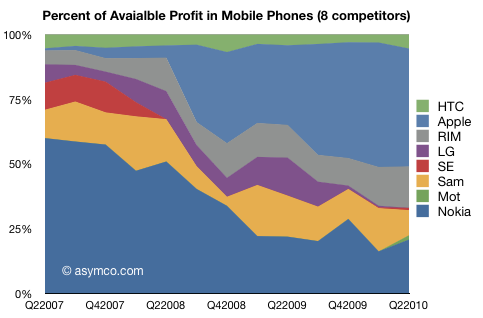
    A quick update on the analysis of mobile phone profits. If the available profit[1] (i.e. excluding losses) were summed and each vendor's profit were measured as a percent of this total, this chart would tell the story of the last three years:

    Note that profit share has mostly shifted from Nokia to Apple, though Sony Ericsson and LG were also casualties and Motorola has not had anything to lose.

    Some assume that the future belongs to the Koreans but we see that the relatively small amount of profit that Samsung has (less than RIM actually) has not changed much. HTC is also shown to be a steady performer but not having displaced much from competitors.

    Will Android change this picture? As I've argued before, Android is most attractive to the unprofitable and the strategically constrained. Can having undifferentiated new products change this? As Nokia is unlikely to license Android, and RIM seems very unlikely and Apple is out of the picture, the only possible contenders are Samsung, LG, HTC, Motorola and Sony Ericsson.

    Motorola and Sony Ericsson have both returned to profitability but with a very small volume Android strategy. However the incumbents fielding Android are really facing a far more sinister threat: the smaller local brands in China (e.g. ZTE) and emerging markets.

    On profitability, the smaller challengers are unlikely to make a large impact, but they will constrain the profits of other licensees. The distribution of phones on a global scale is challenging without a brand, and brands are very expensive to build. It's still possible over a longer timer frame that a small brand like HTC can emerge on a global stage. But in terms of profit capture, challengers will mostly "steal" from the already constrained big brands running with Android.

    --

    [1] Profit is not the only measure of success and can sometimes be a deceptive indicator. For this reason I look at a longer time frame so that anomalies, seasonality and business cycles are smoothed over. As flawed as it is as a measure, the most important reason to pay attention to profit is that it's the only fuel for growth in the long term. Companies that are consistently unprofitable (e.g. Motorola) face diminishing degrees of strategic freedom further lubricating a downward slope toward financial distress.

  9. Is a Facebook phone destined to be a Vanity smartphone?

    Research · 4 comments

    What do Palm, Kin, Nexus One, and the Simon have in common?

    Beside being market failures, it's the fact that they were efforts by large companies that had no business in smartphones. What's more important is that the motivation for participation was not well thought out.

    HP, Microsoft, Google and IBM tried (or are still trying) to capture a piece of the hardware revenues from smartphones, but their results were dismally poor. It turns out that with the exception of RIM, HTC and Apple, there have been no smartphone entrants which have succeeded against the incumbent voice phone makers.[1] Furthermore, Apple is the only large technology company to succeed. Studying the efforts that the successful entrants undertook shows that (1) it takes a very dedicated effort, led from the top, and (2) it takes a lot of capital or a lot of time. Those who tried and failed were not dedicated to the concept at a high enough level and were not patient enough for growth.

    I think the real motivation to enter the market is rooted in vanity: appealing to the need management to feel a part of something new and important. If you are an ambitious internal champion skilled in political maneuvering, it's fairly easy to appeal to this vanity in order to secure funding for these efforts.

    This string of vanity-induced failures is not likely to end anytime soon. No doubt Dell will keep trying with the Aero, and we might see the PC companies rush in again as they did with PDAs.

    We also hear today of the evolution of INQ's product (INQ Social Mobile) into some sort of Facebook phone. However, is the Facebook phone project a vanity phone? Maybe, but the counterpoint is that this is not likely to be a smartphone. It's more likely to be a feature phone and, as such, it's not attempting to be something so grand or vain.

    The real comparison might be to the Kindle. A specific, purpose-product built by the most motivated and best-positioned service provider. The Kindle has had some (unspecified) amount of success because it was developed to light specs and with a well-established distribution channel (amazon.com).

    So although the motivation might be more sound, the challenge for Facebook will be the same as for Google: distribution. At the end of the day, without operator support the product will still remain a niche.

    [1] I note here that Android and Windows Mobile are not phones but platforms and this article deals specifically with hardware.

  10. US Population by Phone Operating System

    Research · 36 comments

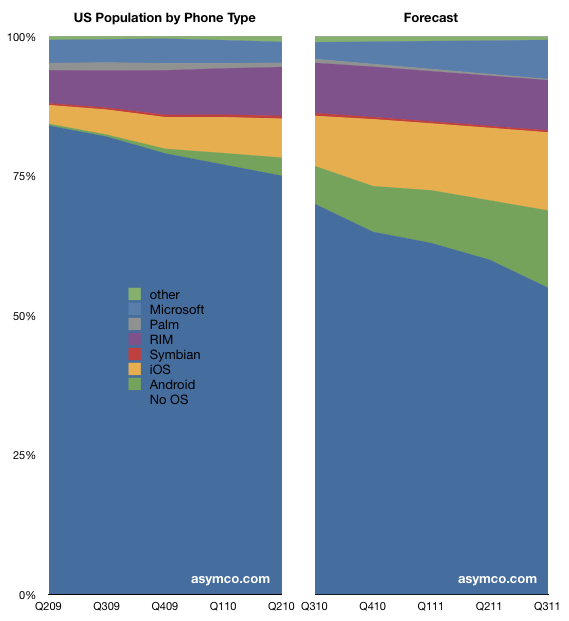
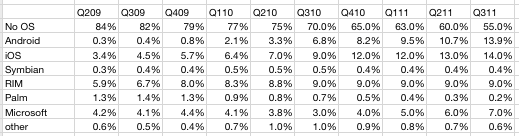
    Since wireless subscriptions in the US are running at about 100% penetration, it's possible to classify the wireless subscribers as representative of the entire population. So it's safe to categorize the population of the US by the phone OS they carry.

    The left part of the chart shows data from Nielsen that breaks up the population by the OS to date. The right part of the chart shows my estimate for how the platform shares will evolve by this time next year. The non-OS share will still be above 50% but it looks like it might shrink even more rapidly after reaching a tipping point of half the market. (Note these charts do not show quarterly sales but installed base of each OS).

    My hypothesis remains that smartphone user bases will be balanced (or fragmented, depending on your point of view) by operator portfolio decisions and chronic constraints on distribution.