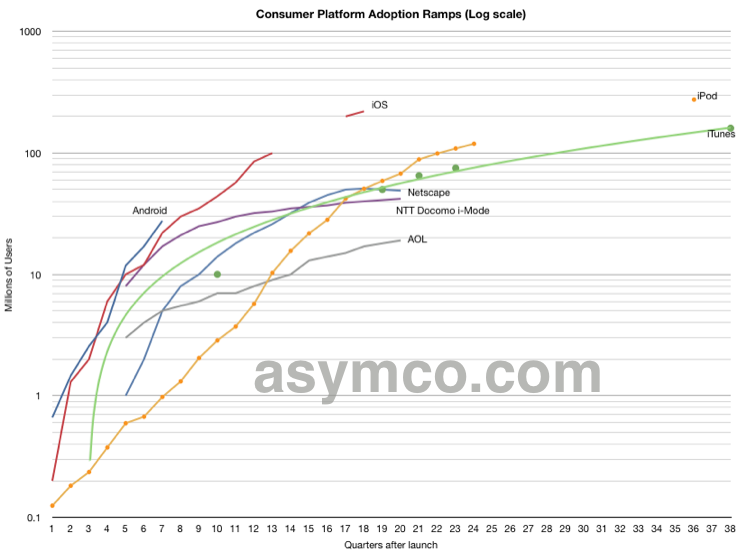
To make it more readable (but conceptually more complicated) I put the data on a log chart.
Discussion
The time span covered is nine and a half years. The top of the graph marks the one billion threshold. Reaching one billion in less than 10 years is an interesting challenge for any platform and, at first glance, it seems that both iOS and Android have a shot at it. This does not seem likely for any of the other platforms.
The challenge is that as penetration grows, it's natural for the slope for the lines to become shallower. Some platforms are simply not able to address one billion users:
i-Mode, AOL and other technologies with localized value networks are clearly limited to populations in their home countries.
iTunes is limited by the use of a PC, which has a small footprint in under-developed countries (dependency by iOS on iTunes should throw up a red flag here).
The iPod was embraced and extended by more ubiquitous mobile phones.
In contrast, mobile phones in general and smartphone platforms in particular have potential to reach a billion users (per platform.)
To wit, note that iOS and Android have similar curves to date and are both likely to overtake iPod and any other contender.
So for the obligatory theological question: Will Android follow the curve of iOS or will it diverge and continue on a steeper trajectory? Does it matter?
On June 7th, 2010, at WWDC, Apple announced that they will have sold 100 million iOS devices some time during June 2010. Today, September 1st, Apple announced that 120 million iOS devices have been sold.
Assuming that 100 million was crossed half-way through June, then the additional 20 million units must have been sold during half of June, and all of July and August. That's approximately 20 million over 75 days or 267k units per day.
Apple also announced that there are 230k new iOS activations per day which seems consistent given that they classify these as "new" activations.
There is one huge implication of this figure: Forecasts for iPhone, iPad and iPods may be too low. I had forecast 20 million units for the entire quarter (12.1 million iPhones, 4 million iPads and about 4 million iPod touch). The iPhone figure assumed 65% y/y growth at that looks way too low. There is still another month in the quarter meaning that the total could be 30% too low.
$50 billion in cash and Apple execs bawling that they can't ship enough product.
"iPhone 4 demand remains very robust and despite efforts to close the supply-demand imbalance and the continued supply ramp, Apple still cannot meet iPhone demand,"
Taiwanese operators Chunghwa Telecom and Taiwan Mobile have reported much interest in iPhone 4 pre-orders. Both operators announced at 9pm on 26 August they would open pre-ordering at 10am on 27 August and both operators saw their websites crash, the China Post reports. By noon, some 10,000 users had signed up with Chunghwa Telecom and by 11am Taiwan Mobile had sold out all of its 3,000 iPhone 4 handsets available for pre-ordering. Rival Far EasTone said between 30,000 and 40,000 people signed up for a phone on its website and the operator will notify people that will be able to get the handset.
Microsoft executives told Goldberg during a recent visit to company headquarters that the company, carriers, and manufacturing partners, would spend "billions" of dollars in the first year on marketing and development of Windows Phone 7. Another source estimated a $1 billion price tag for the launch, with half of it going to marketing.
Note the scale of spending here. The number quoted is twice Apple's yearly ad budget, for all its products.
$500 million is roughly the equivalent of Apple's entire advertising budget for its 2009 fiscal year. In its 2009 Form 10-K filing to the SEC, the Cupertino, Calif., company listed $501 million in advertising expenses. Microsoft's fiscal 2009 advertising budget was $1.4 billion.
But beside the unrepentant destruction of Microsoft's shareholder wealth, one other thing jumps out at me: why are the operators and vendors going along with this?
Fragmentation increases the cost of development, marketing, operations and hinders the creation of cohesive ecosystems.
Most companies are very aggressive in consolidating around internal platforms and standards. Supporting R&D teams and marketing teams around each platform is costly and dilutive to one's brand.
With hundreds of Android devices and RIM and Apple increasing distribution, why would operators be willing to spend hundreds on a venture to promote a new platform? This decision is even more puzzling when realizing that the vendor of the new platform left nothing but business model carcasses behind the last time they got involved in the industry.
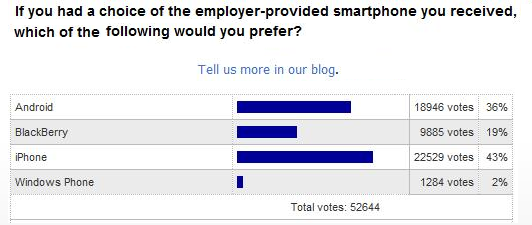
In addition the positioning of this product is suspiciously awkward. One could argue that as a vendor or operator, having an unaddressed or underserved market (say, business users) might mean this platform could expand the distribution of your product or service. But Windows Phone is being positioned as a consumer brand and that's a crowded space where every other platform is also targeted. See the survey data below (unconfirmed source: US Army)
So again, why would operators and licensees spend hundreds of millions to introduce yet another platform in the market?
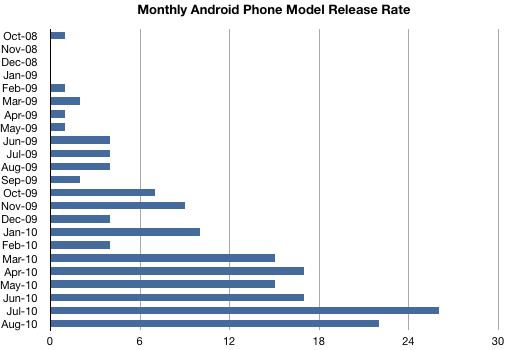
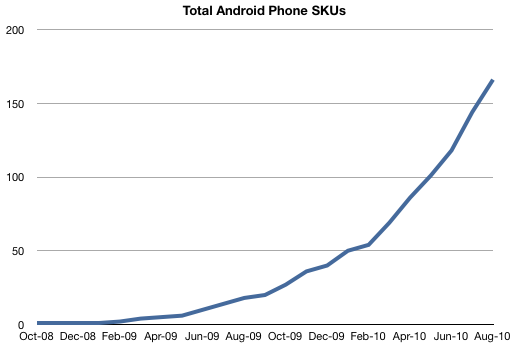
Next month will be the 24th since the first Android device launched in October 2008. The G1 was followed by another HTC device in February of 2010 and a few others in the spring. The summer of '09 showed a steady release of up to four new phones every month. Since then the number of Android phone stock keeping units (SKUs, uniquely identifiable stockable products) increased dramatically, with the release rate increasing to 26 per month during July of this year (source: pdadb.net).
Altogether, there are have been 166 Android phone SKUs in the market with another probable 25 or so ready to launch in the next few months.
Now this may seem like a large number of different phone models in a short time, and it is, but Windows Mobile was even more proliferated as a licensed OS. At its peak over 50 new devices were released every month. The total now is over 1700 and it's still growing.
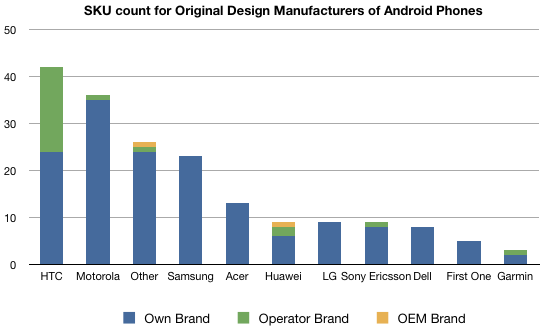
The 183 known Android devices are distributed among 10 principal vendors with another 18 minor vendors. The 18 "other" vendors (see footnote 1) have either one or two devices in the market.
The vendors or original design manufacturers list ranked by most devices follows:
I broke out the devices also by the number of operator branded devices designed by the same manufacturer (green) and any devices designed and built by one vendor but sold under a different vendor's brand (orange). It shows how, excluding "other", HTC is the most prolific Android builder (and seller) but also how it still depends a lot on Operator branding.
The proliferation of Android devices is indeed striking, but as I've pointed out before, the licensing model for Android is symmetric with that for Windows Mobile with the exception that Android is both open source and cost-free to license. This should make it highly disruptive to the paid-license model that Microsoft worked so hard to implement. It should be no surprise then that the adoption dynamics for the platform are very similar, with the same licensees that took Windows Mobile a few years ago embracing Android today.
The proliferation still has a while to go. There is production capacity for over 2000 SKUs among all the vendors in the market (especially the "other" category) and it's only been two years since a stable version of the OS has been available. So it would not be surprising if the total number of licensed Android products will overtake the 1700 or so Windows Mobile SKUs.
So what's the paradox?
The question that should jump out from this data is what's the value to the participants in this, or any mobile OS licensing model? When I analyzed the Windows Mobile field in 2007 or so, it was pretty evident that very few vendors other than HTC shipped enough volumes to make a product profitable. In fact, I coined the phrase Pocket PC Paradox to describe the situation where hundreds of vendors would line up to make undifferentiated products competing for a shrinking pie. This went on first with Pocket PC PDAs, then repeated with Windows Mobile and is now repeating with Android. Nobody ever made money except for HTC, not even Microsoft.
It's still a mystery to me why any manager would decide to make the (n+1)th Android/WinMo phone. It must be difficult to make market projections that justify the cost of developing and marketing this new product.
But here's some help: The total number of Android phones sold through the end of last quarter was about 23 million units. The total number of SKUs launched to date then was about 118. That means that the average Android phone SKU sold 200k units (2).
Now this may seem comically low, but I will again bring up history and point out that while the WinMo bubble was in its zenith, the average Windows Mobile SKU had 50k units sold. With the SKU count increasing more rapidly than the sales rate (40% more SKUs since June) it's very likely that the average units per SKU is dropping. So by my reckoning there's plenty more in the Android bubble to go.
-----
(1) The "other" category includes the following vendors:
Lenovo
Gigabyte
Highscreen
Notion Ink
WayteQ
Forsa Posh
Inventec
Kyocera
Pantech
TechFaith
Saygus
Sharp
Ziss
Alcatel
General Mobile
(2) I'm fully aware that the distribution of sales over the products is not even and very likely exponential, but there is no way to predict whether a given new product will be a "hero" or DOA. The dream for every manager must be that his product will be a star, but the odds get worse and worse over time and the average units sold has to be considered as including these odds.
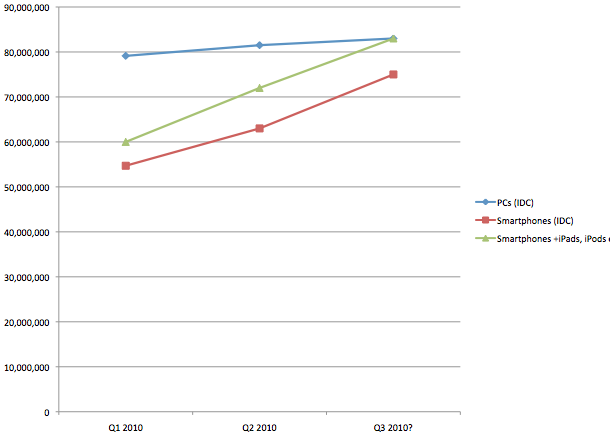
Smartphones, or Mobile devices, will soon become the dominant computing platform for humanity and supplant the PC which has reigned since Apple ignited the Personal Computer revolution in the late 1970's.
I guess Gartner didn't get the memo. By keeping the two categories separate, it implies no overlap in consumption and hence no need to worry if you're in the PC business.
I installed HTC's leaked version of 2.2 on my incredible last month. It has been noticeably faster, has better battery life, and the extra features are nice. As expected, Verizon put a lock down on the wifi tethering feature, and if I want to use it I have to pay an ADDITIONAL $25/month, which is completely ridiculous. Luckily, my phone has been rooted (it was the only way to get froyo on there) and I can use a number of FREE wifi tethering applications that don't cost anything extra per month either.
It's pretty sad that the only way to enjoy an android phone is to hack the crap out of it, and doing so requires relative technical expertise.
Reminds me of Windows Mobile in another way: the only real fans were those who could play with cooked ROMs. Conversely, imagine if the only iPhone fans were those who jailbroke/unlocked iPhones.
The OS market in the mobile space is dominated by other players. Is that a cause of worry?
I think it’s a temporary issue. I don’t put a lot of face and snapshot and time into what is going on. On a global basis, I see what is growing and what is shrinking. Text messaging is the fastest-growing on simple phones part of the mobile market. That’s where growth is. The smart phone part of the market, or the premium market, is in the downward part of the market. It will not be there for a long time in the future.
People want something that’s simple. The design goal for the Windows Phone 7 is that with rich experience you get simple stuff easily. Great keyboard or touch or both – so you can have that. It is too early to talk about dominating, but I’m excited about it. Android coming into the market says there is room for more innovation and we see ourselves playing a role in that space. People talked about the iPhone and thought that was the end of the world for OS. Windows Phone 7 will prove there is more room for innovation.
In other words, Android's entry in the market and remarkable growth, there is room for Windows Phone. And because Windows Phone is easy to use and has a keyboard and touch it will have a chance at dominating.
Microsoft's enthusiasm for yet another mobile platform joining the fray (along with iOS, Android, RIM, Symbian, Windows Mobile, Meego, various sundry Linux and Bada) is not just delusion. I'm sure that they gathered positive feedback from operators. By this time next year there will be dozens of Windows Phone devices on the market. After all, Windows Mobile attracted 1700 licenses.