Asymco

Asymmetric Intelligence

Market

  1. The next 100 million iPads

    Research · 56 comments

    Having reached 100 million iPads shipped in 2.5 years the natural question is how long will it take for the next 100 million iPads?

    The ramp of cumulative units shipped is shown below.
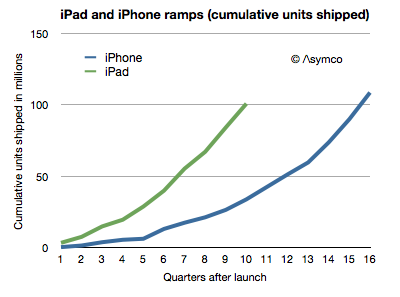
     

    I also added the equivalent ramp for the iPhone. [The last data point for the iPad is based on an estimate of 16.5 million units in Q3 which may need revision depending on company reporting.]

    The next 100 million will depend to a large degree on the success of the new iPad mini. To make an estimate we have to realize that there are several aspects of the tablet market which differ from the phone market and that therefore the predictive power for previous data is weak.

    First, the channels are different. Tablets are sold as media consumption or "computing" products. They are not sold as communication devices. Therefore operators have few incentives to promote and subsidize them. They do participate in the distribution but not with the same level of commitment. That means less "push" and opportunity for discovery. Apple has an advantage in this case with their stores and brand value. The lack of operator engagement and lack of points of sale might be one reason why Android tablets have not ramped as quickly.

    Second, for some competitors, the tablet itself is a loss leader and acts more as a terminal into an ecosystem rather than a product in itself. In cases where tablets are given away it's possible that consumers might own one for each platform or ecosystem. This is similar to the game console model where the cost of the console is not a barrier to many avid gamers. This means that penetration of tablets can reach above 100% of users in some markets. Although network connections (i.e. SIM cards) can and do reach well above 100%, the number of phones in use by one person simultaneously is bounded.

    Third, the lifetime of the product is as yet undetermined. Phones tend to last 2 years. This is due to evolving standards as well as high wear and tear and breakage or losses. Tablets are not as "mobile" and are less likely to be used and the basic functionality does not evolve as rapidly. It's possible that replacement rates for tablets will follow more that of notebook computers than phones. Perhaps between 2 and 4 years. I suspect most iPads purchased are still in use today, including the first version. There will be some obsolescence from system upgrades, but the older systems will keep going.

    Some of these aspects of the product could lead to slower growth and some to faster growth. That and the fact that it's a completely new category with business and consumer and educational and vertical applications makes it a difficult product to forecast.

    Having said that, the product is extremely resonant with buyers. The growth to 100 million is testament to that. The liquidity of the product, with no carrier locking and no pricing illusions means that it reaches all parts of the world quickly. So there is no obvious upper bound on the size of population who might buy it. The new price points and form factor may lead to a wave of new adoption, similar to the impact the iPod mini had on the iPod line.

    There are still many factors that can slow growth, especially production capacity, but I believe that the iPad could growth between 50% and 80% which would mean 100 million more iPads could be sold by the end of 2013.
  2. Nokia's price for exclusivity

    Research · 47 comments

    Days after Nokia announced the end of life for the Symbian platform I wrote a post titled Who will buy the next 150 million Symbian smartphones? The reference was to claim by management that before there would be a complete transition to Windows Phone, 150 million legacy Symbian phones would be sold, keeping the company financially stable before the new ecosystem took root.

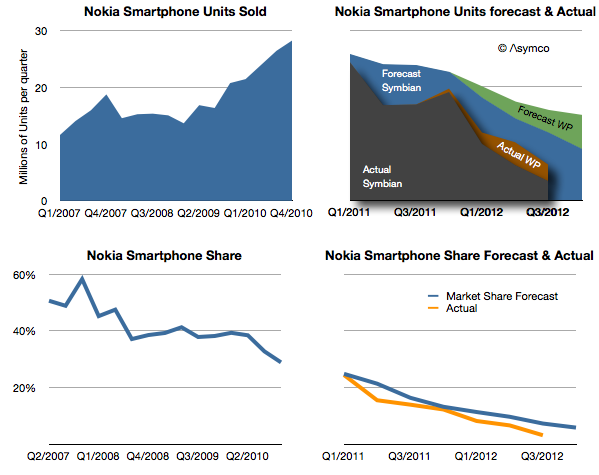
    I reproduce the original forecast I made below with the addition of what actually happened.

    [Note that the Actual stack area chart is independent of the forecast area chart as indicated by shading.]

    My forecast in early 2011 was based on the 150 million Symbian phones being sold over a two year transition period. The implication with the forecast for Windows Phone was that this would still lead to a difficult contraction of volumes.

    As it turns out, only 96 million Symbian devices have been sold in the 7 quarters since the platform was deprecated. It's unlikely that there will be ever by 150 million units sold as last quarter only 3.4 million shipped. In any case, management has already retracted that claim.

    What about the Windows Phone forecast? It turns out that by this point in time (Q3 2012) I had expected Lumia shipments to total 9 million. Actual shipments reached about 9.5 million, so not bad. However, the market grew faster than I had expected and overall Nokia smartphone market share turned out to be slightly lower (6.3% in Q2 vs. 10% estimated.)

    The just ended quarter shares are not yet available but it's quite possible that overall Nokia smartphones could be well below 5%, and may slip to 3% during the transition period.

    My warning in February 2012 was that 150 million Symbian units would not ship since I expected there would be a stigma associated with the products among distributors, even if consumers were fine with them (which they weren't).

    The public execution of Symbian (and any other alternative being developed inside Nokia) will probably be a classic case study in disruption management. To wit: even if a platform needs to be led out to pasture, there are ways of managing decline other than suicide. Nokia's failure is not so much having chosen the wrong alternative to Symbian, but having chosen exclusively.

    However, there's a twist. The company did not accept exclusivity of one supplier without a concession: In exchange for exclusivity, Nokia negotiated $250 million every quarter in the form of "platform support payments" from Microsoft. Nokia has to date received over $1 billion in such payments. (For the last quarter that amounts to $86 for each Lumia phone shipped.)

    The tragedy comes from this $1 billion/yr not being enough. The foregone revenues from Symbian (assuming they had been able to maintain the decline to the level of 150 million units that they had originally forecast) would be about $9 billion. This means that had Nokia not knifed Symbian and had sold the shortfall units at an average price of $200 they would have received an additional $9 billion in sales. Furthermore, assuming a margin of 33% for those units, Nokia received from Microsoft one third from of what she gave up for exclusivity.

    In other words, the net cost of the Microsoft exclusive relationship is at least $2 billion in operating profit.

    This turns out to be the difference between being profitable and being distressed.

    We will never know if this scenario would have ever happened, but the forecast management made 21 months ago suggests that at least they thought this was what they were going to get out of the bargain.

    This reminds me of another article posted around the same time.

  3. Why are tablets and smartphones insulated from tough economic conditions?

    Research · 46 comments

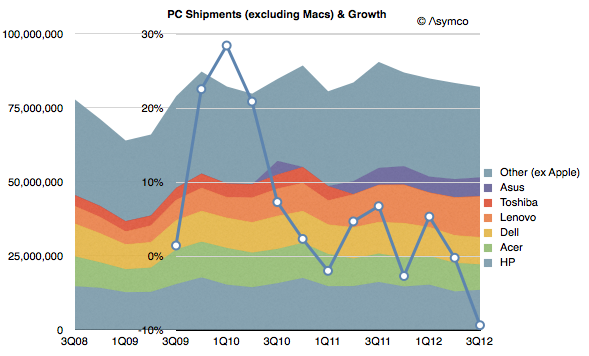
    The iPad launched in April (i.e. Q2) 2010. Since then the PC industry (excluding Macs) has seen a decline in growth. The following graph illustrates global shipments as reported by Gartner:

    Note that the growth rate has been negative for 4 out of the eight quarters since. The latest data shows a decline in shipments of over 9% bringing yearly growth to negative territory for the first time since the recession of 11 years ago.

    There's not much I can say that hasn't been said every quarter since 2010. The industry analysis as provided by Gartner suggests a different cause for the decline, becoming more creative each quarter. This time it's "challenging economic environment" and "lack of appeal and innovation", "delays due to tax incentives", "lack of new models", "conservatism", "clearing out inventory" and "softness".

    The primary challenge to these ascribed causes has to be that all these factors also affect the tablet industry and yet it's growing at phenomenal rates. The rate of new product introductions is not faster for the iPad than for PC vendors. The public and private sector buying conditions are the same. The "conservatism" on the part of institutional buyers should affect the newcomer more than the established.

    The notion that an outside challenger with a new platform, an unproven set of features and missing "security" should grow in the face of difficult macro conditions that are slowing the established platform makes no sense.

    My hypothesis is that the new products are solving new jobs for the users and those new solutions are trumping any "softness" in demand. In other words, an upgrade to an over-serving product will be deferred at the slightest excuse while an installation of an under-serving product that attacks an unsolved problem will be rationalized no matter the circumstances.

    One product will be met with "Why should we buy it?" and the other by "Why shouldn't we buy it?"

    These are the decisions made by millions every day and yet it seems that some analysts don't see any pattern forming. Such is the dilemma of disruption.

  4. Why iPhone 5? | LinkedIn

    Research · 9 comments

    On October 5th, 2011 I asked Why is there no iPhone 5? The question was prompted by the pervasive media surprise that the 2011 iPhone launch was the "4S" and not a completely new design.

    I answered this question with the conclusion that an iPhone "5" in 2011 would over-serve the market by offering more than most buyers would be looking for. That was because there could only be three groups of users the iPhone 4S would need to target: existing iPhone users, smartphone non-consumers and non-iPhone smartphone users. The majority of iPhone users in late 2011 who would be willing to upgrade were iPhone 3 or 3GS users and for them the 4S would be a huge improvement. Non-consumers would find the 4S attractive, as they would any iPhone; and existing smartphone users (mainly Android) would still be in their first contract and not likely to be looking to upgrade. Given the conditions at the time, the 4S was an adequate fit with customer expectations.

    I wrote "The question will be very different a year from now when most early Android buyers will be looking for a new phone and when most iPhone 4 users (all 70 million of them) will be looking for a new iPhone. That would seem like a good time to introduce a new iPhone '5'."

    It is now a year hence and we can consider how these same three targeted user groups see the new iPhone:

    Read the rest of the post here: Why iPhone 5? | LinkedIn.

    (Note: you can also follow me on LinkedIn now).

  5. Measuring iPhone demand

    Research · 109 comments

    When Apple announced five million iPhone 5 were sold to end users over its launch weekend, I was surprised. Not because my guess had been around 6 million, but because the company had set expectations by announcing a doubling of pre-orders from the year-ago 4S launch.

    Instead of doubling its performance for the launch weekend the company only sold 25% more units. How can there be this discrepancy? Is this a sign that demand is not growing at the rate we've become accustomed to? Is it a sign that there are shortages of components or labor or other production problems?

    No, probably none of the above.

    What we saw in the 5 million figure is what the company was able to deliver in the hands of buyers. It's possible that there were people who did not get a phone when they wanted it, and at the same time it's possible that some phones were available for sale and did not get bought.

    This is because Apple offers the product through multiple channels. Some channels like Apple Stores may have gotten too many units while other channels like their on-line store, operator stores or retail partners did not get enough.

    In other words, we have a situation of over- and under-supply (or over- and under-demand) simultaneously because the product is misallocated.

    Can this really happen?

    The fact that pre-orders were twice as fast indicates that online purchasing was much more popular. The company's press release suggested that only "a majority" of online orders shipped so far and we know that day one delivery of units was only offered to online buyers for 40 minutes.[1] At the same time some stores seemed to have plenty of stock.

    This is easily explained. It's possible that this year a larger group of consumers decided that braving long lines is not their cup of tea. Instead, this larger proportion could have chosen to bravely endure waiting for a package at home rather than the companionship of their fellow man. Maybe the population of buyers is broader this year as one would expect from such a large base, and there are fewer who have the time or inclination to queue for a device.

    If the shift to online from in-store was unforeseen, the company could easily have allocated too many units to retail and not enough to online resulting in weeks-long waits for orders placed online and relatively short waits in queues.

    It's easy to fault the company for making this error. However, we can only calibrate our expectations on what we've seen before. If the company measured demand in its stores and on-line for three years and saw a pattern, it would make sense to allocate the limited supply according to the same pattern of demand[2].

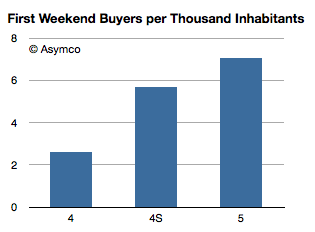
    But overall, the performance of the product is relatively solid. The iPhone 4S launched into seven countries in 2011 with a total combined population of 704 million and sold 4 million units in three days. The iPhone 5 launched into nine countries in 2012 with a total combined population of 721 million and sold 5 million in the same amount of time.

    That means that 0.57% of the addressable market bought an iPhone 4S in three days and 0.69% bought an iPhone 5.  A handier measure might be that 7 out of 1000 inhabitants in the launch countries bought an iPhone 5 in the first three days.

    The pattern for the last three phones is shown below:

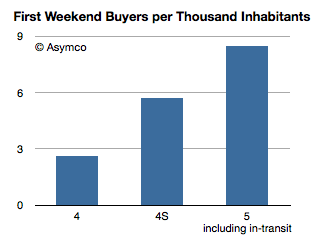
    The growth from 4S to 5 is subdued, but it fails to account for the in-transit inventory.  Assuming that due to the misallocation of stock, unfilled online orders number one million then the growth would look as follows:

    For the markets iPhone launched in, this would be a fairly healthy take-up rate. Anecdotal evidence I've seen suggests that 1% penetration on day one is not uncommon.

    ---

    Notes:

    1. The fact that more than those initial promises were met means that the company quickly re-allocated stock and production to online after they sensed there was a problem.
    2. Demand estimates are also driving the allocation of production capacity and capital expenditures for process equipment and pre-purchase agreements for components. All indications are that these allocations are running at the usual growth rate.
  6. An interview with Matteo Fumagalli

    Research · 12 comments

    Matteo Fumagalli is a student of economics at University of Insubria, Italy. He is writing a thesis for a bachelor's degree analyzing the smartphone industry.

    He asked me to answer the following questions:

    -First question is about you. Why did you found Asymco?

    I founded the company to develop software, mainly apps. I began writing the blog as a way to drive traffic to the site. I would have preferred to build a blog only but did not think it was possible to earn any money doing that so I treated it as a hobby. Even after the site became more visible I changed from development to consulting and did not expect that writing in itself could be self-sustaining. It took about two years before I felt comfortable with the idea that I could do writing and speaking exclusively. I am still exploring additional business models however.

    -You worked 8 years as analyst and business development manager at Nokia and you anticipated their current crisis with your first post on Asymco. Do you think Nokia will have the chance to recuperate, and eventually what will be the role of Windows Phone?

    Nokia may recover or remain independent, at least. But it will be far smaller. The idea of a return to dominance or 40% share seems very unlikely. As I pointed out in the first post, the organization cannot cope with the new marketplace. Large organizations require extreme stress and damage to change. It's a phenomenon at all levels of society that success results in rigidity. From the individual to the nation to the civilization, success makes change very, very difficult.

    Windows Phone is an attempt to create a third ecosystem. I am concerned that the logic of having a third alternative is not solving a consumer need but an operator need. In other words, consumers are not asking for a third option and when they are presented with a third option they are not excited by it. The consumer does not think in terms of increasing their options. They decide once every two years which phone to buy and that is the end of their thinking on the subject. By focusing on the operator's needs the platform is fundamentally mis-positioned.

    What Windows Phone needs to be positioned as is either as fundamentally different, solving a different job for the consumer. Or fundamentally better along a new dimension like price or convenience. These are some of the claims it makes but they are very weak claims right now.

    -What about RIM, other company which is going through difficult times? What do you think about their decision not to move to Android and stake everything on their closed OS?

    The decision to remain with their own platform may sound risky but it's a simple decision about retaining their business model. RIM is not a general-purpose manufacturer. They have always made an incremental margin on services, messaging and email. For them to use a third party OS would force them to build within the constraints of that OS or platform. That would result in a difficult competitive environment and not one where the company could sustain margins vs. larger competitors. In other words, the company faced two risky alternatives. They chose the risk they were more familiar with or the one that they already had an operating company organized for.

    -Recently Apple lost market share in Europe and China favoring Android. What will be the impact of iPhone5 on this situation? As expert of Apple strategy, do you think Apple has done something wrong in these last months?

    Apple lost market share when considering the smartphone market. I agree with management (and I've argued this before they did) that the market for the iPhone is all phones, not just smartphones. In that context, Apple is increasing its share consistently. Since Apple has only one product in the market (with some residual older versions as well), it's very seasonal. It would be natural to see variance in share through the year. What should be watched is a four period average performance. Overall, Apple is growing its iPhone business faster than the overall phone market so it follows that its share is increasing. I see a long-term potential for the iPhone having 20% share of all phones. That would give it an installed base of over 1 billion users.

    -Smartphone penetration is reaching 60% and we probably talk about saturation in next 2 years. What will be for you the future role of tablets and phablets, they will be threaths of substitution for smartphone or maybe an opportunity to offer complementary products?

    The evidence so far is that buyers don't mind having more than one device. It makes sense if each device is hired for a different job and it cannot be general purpose enough. We've seen this phenomenon with mobile phones where penetration in many markets is above 100%. That implies that even a basic feature like a phone number cannot serve all the needs on one person. To me it seems likely that one person will have more than one device and more than one form factor.

    -What do you think about legal battle between Apple and Samsung? There will be consequences also for Google and Android?

    I defer to my blog post Deus Ex Machina. Legal battles are not strategy.

    -What will be the role of the possible entry of Amazon in the smartphone industry? It's too late for them?

    Amazon is a retailer. I find it hard seeing a retailer becoming a platform provider. Not only is retail a difficult to expand business model internationally, but it's hard to imagine partners being comfortable building an ecosystem on top of retail. Retail is not sufficiently flexible as a business model.

  7. Is the iPhone good enough?

    Research · 172 comments

    We don't want to just make a new phone. We want to make a much better phone.

    - Jony Ive, video at iPhone 5 launch event

    Disruption theory has taught us that the greatest danger facing a company is making a product better than it needs to be. There are numerous incentives for making products better but few incentives to re-directing improvements away from the prevailing basis of competition.

    This danger is more acute for technology companies. Coupling incentives with the speed of improvement in various technologies (aka Moore's law) means that over-service can come suddenly and more quickly than warnings from the marketplace. A product can tip from under- to over-shooting the market within one product cycle. One year the product is under-performing and trying to catch up to the competition and the next it's superfluous and commoditized. The dilemma is compounded by the cycle time of development which can span multiple product cycles.

    Therefore, how to tell whether a product is over-serving a market is one of the most important and frequently asked questions I get asked. It's easy to see over-service in the rear view mirror when looking at a multi-year pattern. The trouble is that by the time you see the data, it's too late. How do you tell you're on the cusp of good enough, subject to imminent disruption before you get there?

    I consider measuring a product's absorbability to be a marketing problem. The marketer's job is to read the signals from the market[1]. Determining absorbability comes down to reading two market signals, both of which must be met before green-lighting an improvement:  (a) a product's improvements must be used and (b) a product's improvements must be valued.

    If a product's improvements are not used and the buyer will not pay more for them then they are not being absorbed and the effort to develop the improvements should be redirected.

    Now the problem becomes one of measurement. Of the two, utilization is easier. Data can be gathered on whether a feature is being used. Research methods exist to tell if a feature would be used even if it's not available[2]

    The more difficult assessment is that of the value of a feature. You can usually only tell value by trying to price it and watching what happens. For example, you add more speed/memory/capacity and try charging more (or the same) for the product. The acceptance will be measured by sales growth and will give you an indication of whether these improvements are valuable.

    If you have to add features and drop prices at the same time then it's likely that the market does not value the improvement.

    But this is extremely risky. You need to wait through a sales cycle and iterate through a development cycle before you have an answer. In a space where competitors are placing opposite bets, the experiment fails even if you get the data.

    How can you structure a value measurement experiment without wasting an opportunity?

    Rather than dealing with hypotheticals, let's use the iPhone as a test case. As Jony Ive states, the focus for the latest iPhone was to make it better. Is this improvement absorbable? What happens if Apple's bet on being better is wrong?

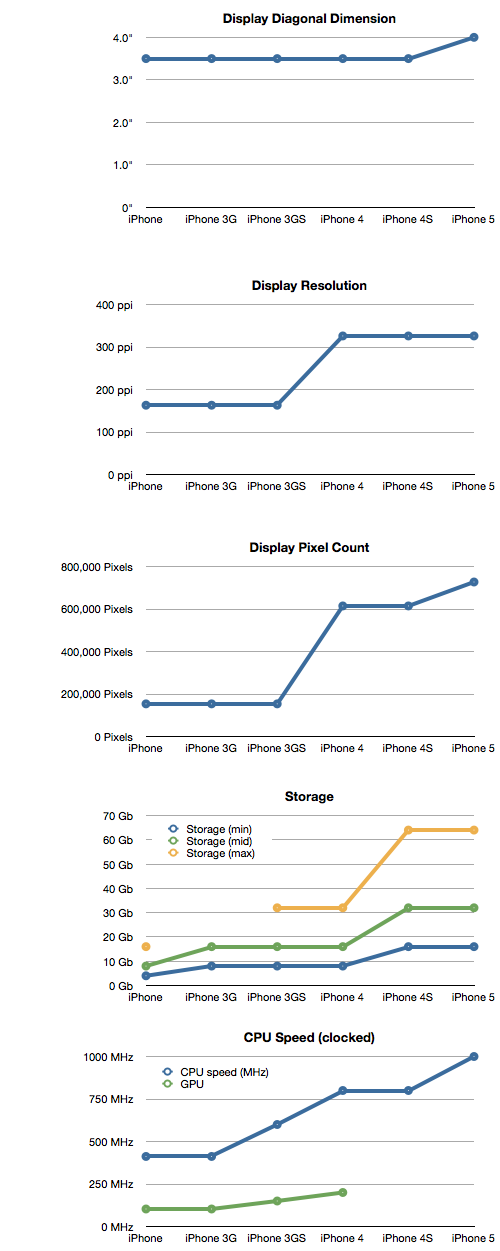
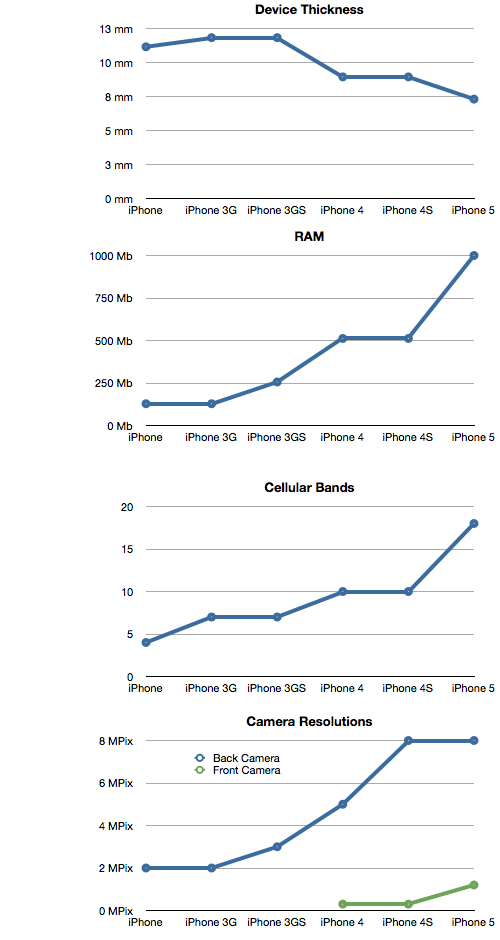
    First, we can confirm that the iPhone has been on a trajectory of getting better and that those improvements have been absorbed so far. We can measure the history of performance of the product (roughly doubling every year) and we can also measure proxies for performance as I have in the following charts:

    As the product has been improved along these dimensions, sales have increased and prices have held steady (even rising occasionally.)

    The question is about the future: what about the latest "5" variant?

    The clue to this experiment is the presence of a control group.  We could test the question of absorbability by keeping a version of the product which did not improve (or got cheaper) and measuring whether it performs better vs. the "improved" version.

    Of course, this is exactly what Apple does with the n-1 generation products. By ranging products which are older and at lower price points it can measure whether the improvements are valued.

    If sales of the n-1 variant were to increase relative to the new version then they can understand when they are at the point of good enough. The experiment is brilliant because the margin on the older products is maintained even at the lower price point.

    We don't have public data on the performance of the old vs. the new but some studies show that, at least in some markets, the older variants have, so far, been a minor part of the sales mix. The CIRP study from early this year showed that about 90% of holiday iPhone sales in the US we for the latest (4S) variant. If this pattern persists globally and for the 5 then the improvements can be said to be valued.

    If the new features (as represented by the metrics charted above) also get broad engagement--data which Apple can easily obtain--then the iPhone 5 can be declared not good enough. The company can then comfortably work on improving it further.

    ---

    1. Note that the marketer's job is to listen not to talk.
    2. e.g. contextual inquiry.
  8. Projecting iOS devices sales through iTunes account growth

    Research · 16 comments

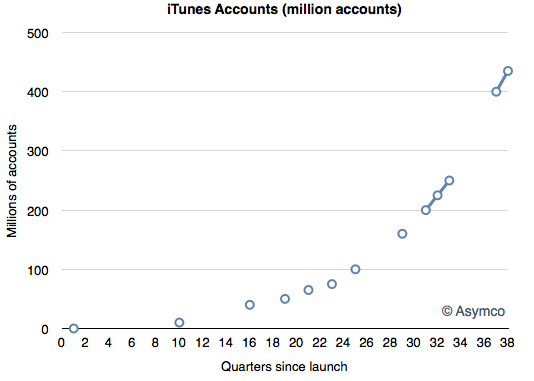
    During the iPhone 5 launch event, Apple announced 435 million iTunes accounts (with credit card numbers) with one click shopping.

    The account total is updated occasionally by Apple and the history of these updates is shown below:

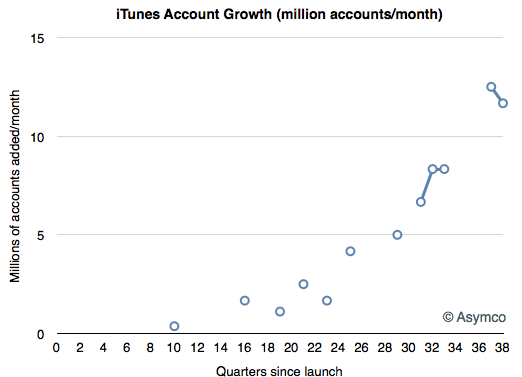
    Measuring the growth in accounts shows steady acceleration.

    The current rate is approximately 12 million new accounts per month.

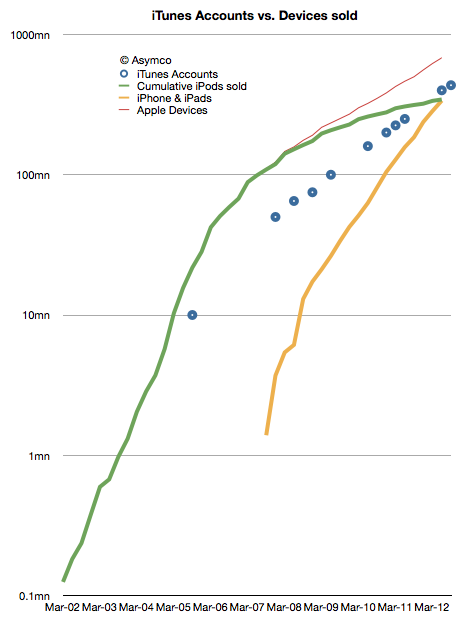
    The growth in iTunes accounts mirrors the growth in iOS usage as shown the following chart:

    The alignment between the circles and the red line should offer an alternative method of projecting the platform's growth.

    Projecting the growth forward would imply one billion accounts in another two years. As iPhone and iPads growth increasingly converges with iTunes (of which there are 400 million units sold), the same time frame could apply to iOS cumulative sales.

    This is not a very precise forecast, but late 2014 to early 2015 could see one iOS billion units sold.

  9. Are iPhone Average Sales Prices Increasing?

    Research · 64 comments

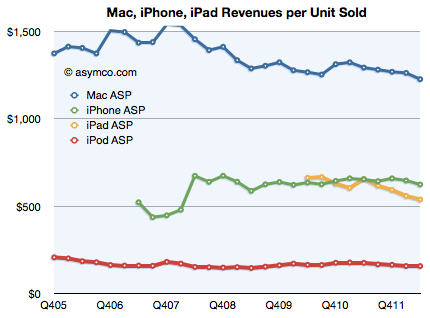
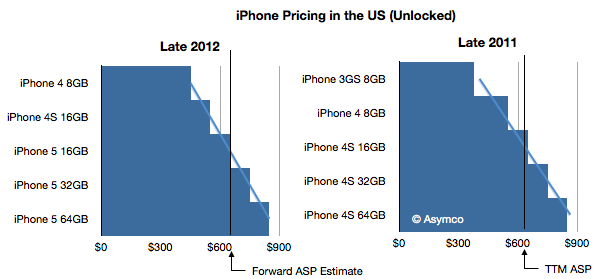
    The most remarkable thing about the iPhone as a technology product is that it has been able to maintain pricing stability for over five years. As the following chart shows, the revenues per unit sold for the iPhone (as reported by the company) have held even as volumes grew exponentially.

    The latest version of the product should see no significant change in this pattern. I show below the price spectrum of the iPhone as available unlocked in the US (therefore assuming no sales taxes or VAT and no subsidy). I also highlighted the average revenue per unit from the latest four quarters.


    The only difference between 2011 and 2012 is that the lowest priced variant is now $450 vs. $375 a year ago.

    Without knowing the split between products, it's hard to tell how much impact this price increase will have. Note that the average price was very nearly the same as the 16GB variant ($643 ASP vs. $649 16G pricing). Assuming equal volumes for each variant, the average pricing for 2011 would have been $634. Therefore the actual ASP was only $9 higher than average pricing.

    If we assume the same for this year (equal split between variants + $10) then the average price could rise to about $660. That would be a slight increase but it would be multiplied by many more phones sold.

    In fact, going from $634 to $649 and selling 200 million units would imply an additional $3.4 billion in revenue.

  10. How many iPhone 5's will sell in the opening weekend?

    Research · 56 comments

    The iPhone 4S sold about 4 million units in the first three days of availability last year. The iPhone 4 sold about 1.7 million and iPhone 3GS about 1 million.

    The main driver to growth for the initial weekend is usually upgrades for existing customers. There might be first time buyers, but the dedication required to ensure being first to have it usually means buyers are keen on the brand and are repeat customers.

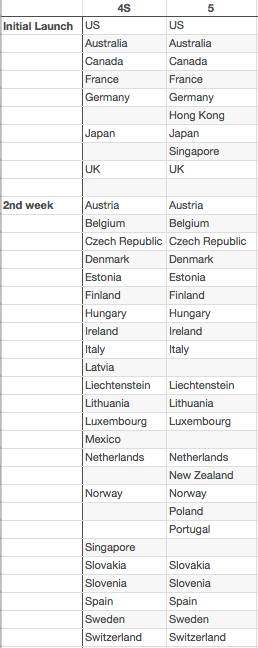
    The other factor is the number of countries where the phone is available. The 4 was initially available in 5 countries. The 4S in seven and now the 5 will be in nine countries. I made a list of the differences in launch countries for the 4S and the 5 below:

    I've also listed the second week launch countries for completeness and shown which countries have changed.[1]

    The performance of the 5 in the first weekend should be better on a volume basis simply because there are more existing customers who wish to upgrade and because there are more initial and significant launch countries.

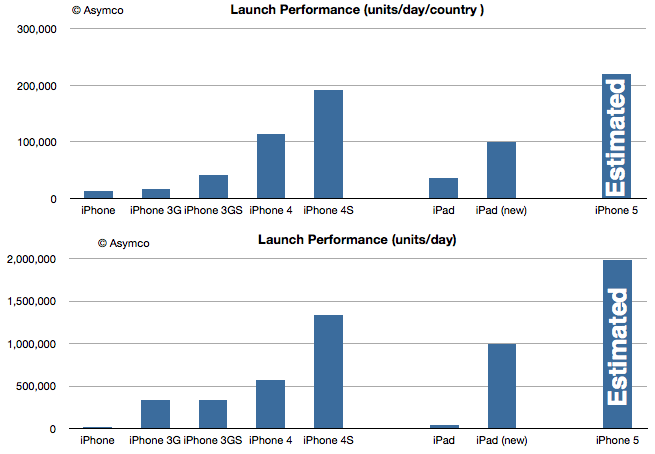
    The 4S launched with an average of 1.3 million units per day but 191k units/day/country. The 4 launched with 113k units/day/country. If we assume that the 5 can capture 220k units/day/country we reach 2 million units/day for this launch footprint and a total of about 6 million units for the launch weekend.

    These estimates are shown below relative the the other iPhone and the iPad launches.

    The additional shipments to fulfill orders for the second week may see the iPhone 5 sell over 10 million units before the quarter is over.

    ---

    Notes:

    1. Hong Kong and Singapore are noteworthy initial launch additions, Poland a noteworthy second week addition and Mexico a noteworthy second week omission.


  11. Positioning Lumia

    Research · 17 comments

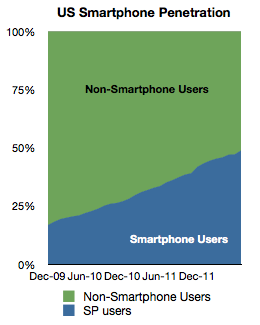
    The US has reached 50% smartphone penetration.

    comScore data shows July penetration at 48.8% and a monthly growth in penetration of nearly 2 percentage points. Given the rate of growth, it's nearly certain that we've crossed 50% in August.

    The historic growth is shown below:

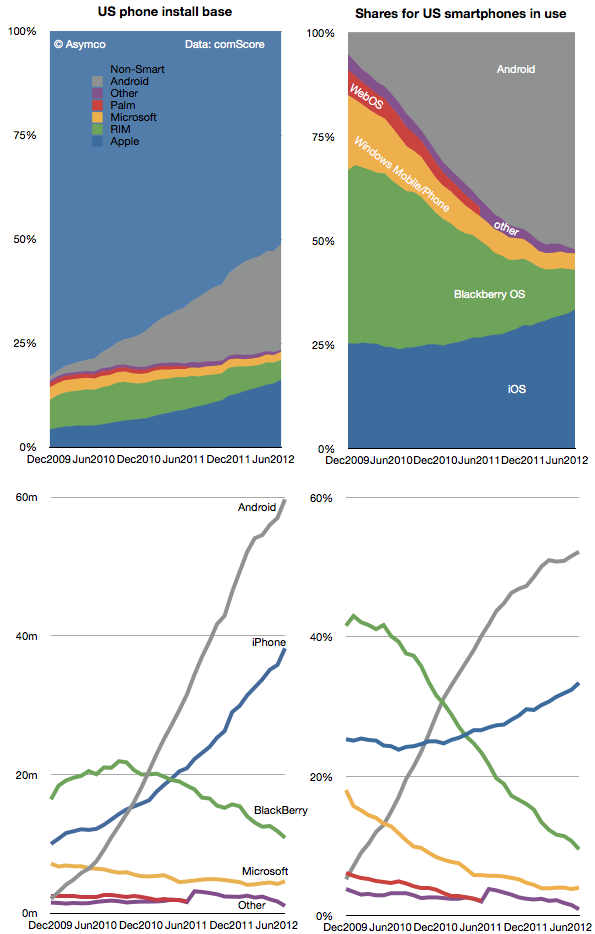
    The platforms making up the smartphone market in the US have seen unequal shares of this new population of users. The following diagrams show how the install bases have changed in absolute and share terms.


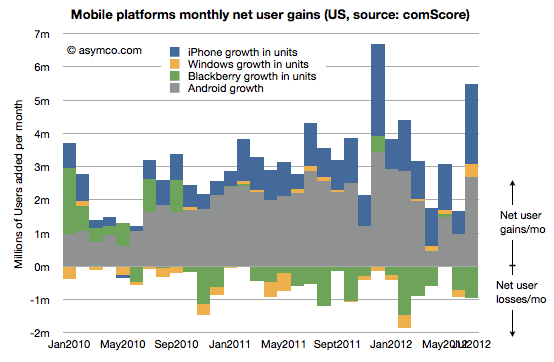
    To round out the analysis, here is the net user gains for the platforms showing the net addition or loss of users since early 2010.

    What I look for in this data are signs of slowing adoption (so far there aren't many), subtle shifts in platform performance (as seen in RIM's move from consistent net gains to consistent net losses) and signs of churn or the transfer of users from one platform to another (rather than from non-consumers to consumers.)

    The story in the latest data seems to be that Windows Phone has turned in a first significant gain in users (378k new users). Its share seems to have stabilized at around 4%. This is in contrast to BlackBerry whose hemorrhage continues (a net of 7 million users defected from the platform in the last 12 months.)

    On this occasion of reaching what I've called the tipping point, it's worth reflecting on just how far we've come. In December 2009 the total number of smartphone users in the US was 39 million whereas now it's about 115 million. That's a total of 75 million new users in a bit more than two and a half years, quite a story there.

    And yet, half of the phone users still remain to be converted. It's possible that the growth in adoption will remain steady but it's also possible that it might slow down and follow the "S-curve" adoption rate that new consumer products typically follow, perhaps reaching saturation at some point below 100%.

    If growth slows immediately then there will be more churn between platforms. If rapid growth can be maintained then there will be more competition with non-consumption rather than between rivals for some time still.

    The changing character of competition will need to be reflected in product strategies. Non-consumption is typically an easier competitor to beat with features. Switching users from a comparable product is harder and may require pricing pressure. To solve this in a time of transition, new products will have to split into a set offered to new users and another set offered to switch users.

    You can see the pressure of this on the Windows Phone platform most of all. As a late comer, does the Lumia range from Nokia fit the bill as targeting non-consumers or switchers?

    In other words, has the brand been positioned as a "better" smartphone or as a "good enough" smartphone? It matters because the "good enough" position has been held by Android overall while the "better" position has been held by iPhone. However, not exclusively. We've seen "better" positioning from Samsung's Galaxy S and Verizon's Droid brand and "good enough" positioning from the older variants of iPhones.

    So it's quite difficult to see where Lumia fits in the US. There is no obvious opening. The next 75 million first time US smartphone users may be attractive to Microsoft and Nokia but it's not clear why, having waited so long, those buyers will be persuaded by the new brand. Perhaps subsidies will help. As indicated with the first US Lumia launch, the product was priced at a discount to the prevailing price point for a premium smartphone. Perhaps that's the "good enough at a good price" strategy.

    If so, it has not been a home run. Perhaps there is still time for this strategy to play out in 2013 but what if Lumia is not actually being marketed this way?

    At launch Nokia has tried to promote the brand as something "better". Better camera, better charging, better maps, better screen, etc. They have promoted on Twitter with the #switchtolumia hashtag. Microsoft has had the "Smoked by Windows Phone" campaign targeting specifically existing smartphones.

    I don't want to suggest that one positioning is more appropriate or more likely to succeed than another. That's a tough call. Either could be the right choice. What I would suggest however is that there needs to be clarity of thought and communication on the matter.

    Perhaps the launch of the new Lumias (920, 820) is part of a clear positioning toward the high end. But the absence of pricing and distribution and how the operators will be engaged leaves the question open. The strongest criticism of the effort so far is this lack of clarity about how the product is intended to be perceived by the buyer.

    A lack of clarity in positioning is symptomatic of a lack of clarity, or maturity in strategy.