Asymco

Asymmetric Intelligence

Market

  1. 20% of American subs have a smartphone with 1.2 million switching every month

    Research

    According to The State of Mobile Apps | Nielsen Wire 21% of American wireless subscribers have a smartphone at Q4 2009, up from 19% in the previous quarter and significantly higher than the 14% at the end of 2008.

    A previous Comscore survey showed US smartphone penetration at about 17%.

    If we were to blend the data to a rough estimate, I would say it's fair to assume 20% penetration.  The total number of subscribers in the US is about 234 million, which makes for 46.8 million smartphone users.

    This still leaves 80% or 187.2 million non-smartphone users.

    The share gain of 6%/yr. means another 1.2 million Americans are switching into a smartphone every month.  Another decade and the non-smartphone market will simply be gone.

    With AT&T lowering the barriers of entry with data plan pricing and with other operators matching, don't be surprised if it happens sooner.

    As saturation begins around 50% to 60% penetration, price competition will intensify.  That takes the tipping point to about 2013.

  2. Nokia bullish on N900: sales substantially above expectations

    Research

    A spokesman for Nokia, the world's top cellphone maker, declined to comment on the sales number, saying the company was pleased with sales, but an executive was more bullish.

    "Sales have substantially exceeded expectations," Alberto Torres, head of Nokia's solutions business, told the Open Mobile Summit trade conference in London this week.

    via Nokia top model N900 sales below 100,000: Gartner | Reuters.

    If Alberto Torres' expectation for a flagship product is substantially less than 100k for a launch quarter, I wonder what disappoints him.

  3. Analysts predict iPad sales (part II)

    Research · 6 comments

    After 12 million units sold in 28 60 days, it’s time to review the analysts’ predictions:

    First year iPad unit forecasts (sourced from TMO Finance Board)

    • Brian Marshall, Broadpoint AmTech 7.0
    • David Bailey, Goldman Sachs 6.2
    • Kathryn Huberty, Morgan Stanley 6.0
    • Shaw Wu, Kauffman Bros. 5.0
    • Mike Abramsky, RBC Capital Markets 5.0
    • Gene Munster, Piper Jaffray 3.5
    • Ben Reitzes, Barclays Capital 2.9
    • Keith Bachman, BMO Capital 2.5
    • Jeff Fidacaro, Susquehanna 2.1
    • Chris Whitmore, Deutsche Bank 2.0
    • Scott Craig, Merrill Lynch 1.2
    • Peter Misek, Canaccord Adams 1.2
    • Doug Reid, Thomas Weisel 1.1
    • Yair Reiner, Oppenheimer 1.1

    Looks like at least half two thirds of these guys have already blown it.

    For the record, in January I forecast 6 million units for calendar 2010 (and 10 million in first year).  It looks like I'll be facing the iPad dunce corner as well.

    See: Analysts predict iPad sales

  4. IDC: I Dream of Claim Chowder

    Research · 3 comments

    A few eyebrows were raised when Microsoft presented a slide at a French event where they made the claim that 30 Million Windows Phone devices would be sold by the end of 2011.  Given that the first Windows Phone won't ship until October 2010 at the earliest, or, according to Mr. Ballmer, "by Christmas," count me among the skeptics.

    However, the claim was later retracted by Microsoft stating that they mis-quoted IDC, the original source for the forecast.  The correction was perhaps meant to put an end to the credibility crisis.

    However, the actual forecast from IDC was even more preposterous. Apparently IDC makes the forecast that 32 million "Windows Mobile" devices will sell during all of 2011--a combination of both Windows Mobile and Windows Phone devices.

    Instead, the research company forecast 2011 sales of 32 million devices running all Windows Mobile operating systems. This includes expected sales of devices with Windows Mobile 6.5, which is already on the market. IDC has not given any sales estimate for Windows Phone 7, which Microsoft has said will be available in the fourth quarter.

    Their report showed about 16 million Windows Mobile devices shipped in 2009, with a forecast of 22 million this year and 32 million next year.

    Windows Mobile shipped a total of 3.7 million phones in 1Q10, so in order to reach 22 million this year they need to ship 18.3 million for the rest of the year or, on average, 6.1 million phones a quarter.  That's a higher number than what Android shipped in Q1 with BOGO promotions (5.2m units). That's almost as high as the launch quarter for the iPhone 3G.  And all this (mostly) with WinMo 6.5!

    Alternatively perhaps IDC foresees a huge launch for Windows Phone. Assuming an erosion of the WM6.5 to 2.7 m this quarter, 2 million in Q3 and 2 million in Q4, then Windows Phone would somehow need to ship 12 million units during the last quarter.  This number is higher than what iPhone sold in its highest ever quarter.

    This sounds sillier than 30 million Windows Phones in 2011.  By claiming that Microsoft's combination of deprecated Windows Mobile (6.5) and unreleased Windows Phone 7 will continue to sell at a growth of 38% this year, they are actually suggesting an acceleration in sales going into the second half at a rate higher than what the market is likely to grow at.

    In other words, they are suggesting that Microsoft will gain share during the rest of this year. Share gains for a platform that has declined in share in Q1 from 10.2% to 6.8% with 3.7 million units sold on the back of further share losses the quarter prior. Share gains against Android that competes with a free license. Share gains with a new platform that has no clear differentiation vs. the iPhone.
  5. At 135 devices, the Android army marches on but what happened to the Windows Mobile legions?

    Research · 2 comments

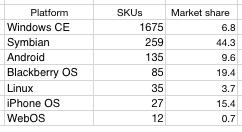
    The number of Android devices is rising steadily; it's already up to 135.  Android devotees should rightly rejoice.  However, Android is not the first mobile platform with an open licensing strategy. A quick visit to pdadb.net lets us count the number of devices that shipped for every mobile platform in history.  We can also see the current market shares as listed by Gartner for these platforms.

    The numbers of SKUs (stock keeping units) that have shipped historically vs. the market shares of the mobile phones running those platforms are (see Footnote below for some caveats):

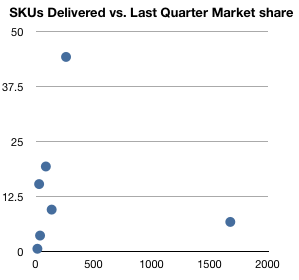
    The same data in a scatter plot:

    (SKUs on the x-axis and share on the y-axis)

    The thing that jumps out is how uncorrelated the two quantities are.  The Windows Mobile/CE number is such an outlier that it breaks any attempt to link the two variables.

    What's likely to happen is that since the licensing of Android is even less problematic than it was for WinCE (i.e. it's both free as in beer and free as in speech) the number of Android SKUs is likely to overtake WinCE.  In other words, we're very likely to see Android grow from hundreds to thousands SKUs.

    However, the real question for the Android platform isn't whether it will have licensees. WinCE proved that there is vast demand from many companies to build cloned and undifferentiated devices. The real challenge is whether Android can achieve significant volumes without fragmentation to keep the platform/network effect going.

    The WinCE platform was actually less fragmented through its life than Android is today. This is understandable since the source code was decidedly not open and thus not modifiable and new versions were released far less frequently. And even with a high price tag, it was wildly popular with licensees. Nevertheless, the volumes never came and Microsoft was forced to abandoned the whole strategy.  The next version of Windows Mobile (Windows Phone 7) will follow an "iPhone lite" model of highly restricted configurations and device and ecosystem specification.

    So will Android follow the fate of Windows Mobile with an even more fragmented, bazaar-like licensing model? Or will thousands of undifferentiated Android devices swamp their integrated competitors?

    Footnote: The total SKU number includes non-cellular devices whereas the market share number includes only cellular devices. Omitting non-cellular devices will not detract from the pattern or change the correlation meaningfully.  The argument can also be made that the "platform" value lies in both cellular and non-cellular devices (e.g. iPad) and they should both be counted.  Unfortunately there are no market share statistics that blend both device types into one market.

  6. The black ships from Cupertino

    Research

    Softbank stopped accepting reservations for the iPad after only three days.

    In one Twitter exchange, Mitsuru Yoshii sent a message to Softbank Chief Executive Masayoshi Son saying that the iPad was the "21st century's black ships."

    In response to the historical reference to the U.S. Naval fleet that opened up Japan to the West in 1853, Mr. Son wrote back: "Indeed!"

    via Japan's iPad Frenzy Signals a Sea Change - WSJ.com.

    In Japan the term "Black Ships" has come to symbolise a threat imposed by Western technology but also the opening of Japan to the West and the awakening of imperial ambitions that lasted for a century.

  7. Instant messaging: AFK

    Research · 4 comments

    In 2007, 14% of Britons' online time was spent on IM, according to the UK Online Measurement company - but that has fallen to just 5%, the firm says, basing its findings on the habits of a panel of 40,000 computer users.

    The study was released shortly after AOL sold its ICQ instant messaging service $187.5m (£124m) - less than half what the company paid for it in 1998.

    And in September 2009, a survey of internet use by the New York-based Online Publishers Association found that the amount of time spent by surfers on traditional communications tools, including IM and e-mail, had declined by 8% since 2003.

    via BBC News - Instant messaging: This conversation is terminated.

    In other news today Yahoo and Nokia announced a worldwide partnership. Yahoo will provide e-mail and chat services on Nokia phones. The services will be co-branded.

    OMG LOL.

  8. Does iPhone really have 72% of Japanese smartphone market?

    Research

    MM Research does not count Symbian as a smartphone platform. This makes them inconsistent with any other analyst for counting smartphones.  So shouldn't Symbian be included?

    In a comment to iPhone has 72% of Japanese smartphone market | Asymco it's been pointed out that 12 million Symbian sold in the same time frame as Apple sold 1.7 million phones in Japan.

    It would seem then that the correct market share for iPhone would be 12%, with Symbian having 83% and "others" having less than 5%.

    However...

    Symbian in Japan is not the same thing as Symbian elsewhere.  Symbian in Japan is used as a low level OS by Fujitsu, Sony Ericsson Japan, Mitsubishi, Sharp and others to provide devices running the MOAP(Symbian) software platform.  MOAP (Mobile Oriented Applications Platform) is the software platform for NTT DoCoMo's FOMA (Freedom of Mobile Multimedia Access) service.

    Unlike Series 60 and UIQ MOAP(Symbian) is not a open development platform.

    MOAP is also supported by Linux with Panasonic and NEC using it in something called MOAP(Linux).

    MOAP(Linux) is also not an open development platform.

    So the "72% share for iPhone" in Japan must be stated with this important caveat: that Symbian and Linux are not included because, due to not having exposed APIs, they are classified as feature phone platforms.

  9. iPad outsells iPhone (part II)

    Research

    “Checks indicate that US iPad sales remain strong post-launch, driven by rising consumer visibility to iPad’s user experience, sustained PR/word-of-mouth marketing, 3G iPad launch, and broadening iPad apps/content,” Abramsky wrote in a note to clients this morning. “We believe Apple is now selling >200k iPads/week, greater than US Macs (est. 110k Macs/week) and just below US iPhone 3GS first quart (246k/week).”

    Retail checks in mid-May showing widespread iPad stockouts at Apple stores and Best Buy. The 3G iPad is sold out at many Apple stores and about 25 percent of them now have only selected Wi-Fi iPads available. Waiting lists are not uncommon.

    ... Abramsky raised his global iPad outlook for 2010 from 5 million to 8 million.

    via Apple Selling More iPads Than Macs | John Paczkowski | Digital Daily | AllThingsD.

    iPad is not only outselling iPhone version 1, but, soon, iPhone version 3.