Asymco

Asymmetric Intelligence

Nokia

  1. Nokia vs. Apple phones business comparison shows comfortable lead for Apple

    Research

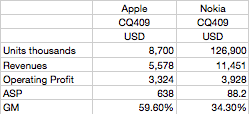
    Nokia reported 21.5 million converged devices sold in Q1.  The units, share, ASP, Revenues and Operating Profits are compared in the following table.

    It's once again evident that Apple captured more profits from the iPhone than Nokia did from all its devices and services operations.

    With respect to converged devices, Apple also generated more sales and had nearly triple the ASP.  Unit shares remained almost the same sequentially. Nokia did suffer more from ASP erosion sequentially as the converged ASP dropped by 24% vs. a 2.5% drop for Apple.

    What is interesting from a growth perspective is that Apple's #1 position in the share of profits from mobile phones was acquired with such a low market share.  Analyst Brian Marshall said the most interesting part of Apple's story is the international growth of the iPhone. He believes that Apple has only acquired about 1.5 percent of its international carrier partners' total postpaid subscription base of 525 million. For comparison, its penetration in the U.S. peaked in Sept. 2009 on AT&T with 5 percent.

    Sources:
    Nokia - Investors- News Release

    Apple - Investor Relations

  2. Nokia Tablet?

    Research

    "Getting a strong Intel backing here could be an important advantage," says MKM Partners analyst Tero Kuittinen, who sees the Nokia tablet as part of an array of mobile computers.

    via Nokia Aims a Tablet at Apple: Exclusive | Technology | Financial Articles & Investing News | TheStreet.com.

    No doubt Nokia's tablet plans preceded the launch of the iPad--product cycles being what they are.  And the relationship with Intel is certainly a big part of this push (vs. on the handset side where Intel has no cards to play).

    However, the elephant in the room is what software will run on this Tablet.  Any discussion on competitive potential of iPad competitors must include a view on the software/platform and ecosystem that tablet will rest on.

    This is not a hardware business.  In fact, the hardware is designed to get out of the way.

    The hardware is so understated — it’s just a screen, really — and because you manipulate objects and interface elements so smoothly and directly on the screen, the fact that you’re using an iPad falls away. You’re using the app, whatever it may be, and while you’re doing so, the iPad is that app. Switch to another app and the iPad becomes that app. If that’s not magic, I don’t know what is.

    source: http://db.tidbits.com/article/11152

  3. The Below Average CEO: Olli-Pekka Kallasvuo

    Research

    I vehemently disagree with this premise:

    Nokia did not take advantage of any of the opportunities that it had by being in first place. It failed to leverage its partnerships with carriers, manufacturers, software developers, and content companies.

    link: The Below Average CEO: Olli-Pekka Kallasvuo Of Nokia (NOK) – 24/7 Wall St.

    When disrupted, large incumbents invariably fail to respond adequately to the threat.

    You can only blame management if the threat is symmetric and they fail to take up the challenge. This failure almost never happens.

    Asymmetric competition is intractable in almost all instances. This failure always happens. A response in kind by management is usually worthy of dismissal "for cause".

  4. Microsoft and Nokia agree: Apple is hindering Innovation in Mobile market

    Research

    From the GSMA Mobile World Congress 2009 (one year ago):

    Kallasvuo used Apple and its "closed" ecosystem as an example of what could limit innovation in the mobile market in the future. He said Apple's vertically integrated model, where its hardware and software are tightly controlled by the company, further fragmented the market. And he added that what is truly needed is more openness in developing applications.

    Yes, prior to the iPhone innovation was zipping along rapidly, but now it's stuck because the iPhone is closed. The iPhone is hindering innovation because it's highly integrated.

    Ballmer argued that device openness was important to give customers more choices. And he pointed to the number of choices that Windows Mobile customers have when choosing a device.

    We'd all have more choices if we'd all choose Windows Mobile.

    Fast-forward one year and Microsoft decides to offer more choice by adding a new operating system (in parallel to its existing OS) and Nokia decides to solve fragmentation by launching a new platform called MeeGo (in parallel to Symbian).

  5. Platform Bonanza! Three new Platforms in one Day

    Research

    Delivering precisely what the world needs today:

    • Samsung launched Bada
    • Microsoft launched Windows Phone “7 Series”
    • Nokia and Intel jointly announced MeeGo.

    Three new ambitious platforms starting with zero installed bases and no applications are going up against the following:

    • Symbian with more than 200 million users and 20k apps
    • WebOS with less than 3 million users and about 1k apps
    • Windows Mobile with 30 million users and about 2k apps
    • iPhone OS, about 75 million users and 150k apps
    • Android with 3 to 5 million users and approx. 20k apps
    • Blackberry OS with more than 50 million users and a few thousand apps.

    It should be noted that Microsoft’s new Windows Phone “7 Series” will compete with Microsoft’s Windows Mobile 6.5 which will continue as a product line.

    MeeGo will also compete with Nokia’s existing Symbian OS for developers, replacing Maemo.

    Most of these new platforms will not have products shipping for at least 6 months during which time another 50 million (at least) new users will join existing ecosystems.

    There are now nine smartphone platforms, but who’s counting? I’ve been hearing predictions of consolidation for years and although platforms have come and gone (PalmOS, SavaJe), the total number continues to increase.

    If nothing else, this seems to indicate that the industry is not in any state of maturity or point of “over-service” where commoditization takes place.

  6. Calibrating iPhone Growth

    Research

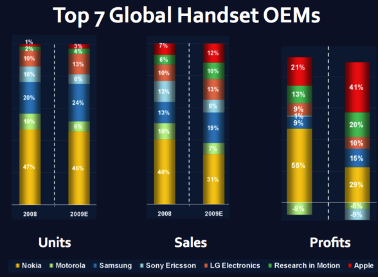
    I calibrate my growth rates on the assumption that Apple will overtake the combined share of the two money-losing handset vendors.

    Sony Ericsson and Motorola are the weakest competitors in terms of portfolio and competence with software. Their sales, units and profits shares for 2008/2009 are shown in the graph above (source: Morgan Stanley).

    Therefore, my thesis is that Apple could beat these two weakest competitors in 3 more years.

    Here is the basic top-down view:

    In 2009 174 million smartphones were sold out of a total of 1.13 billion phones (IDC, Strategy Analytics). Using a 10% CAGR on this figure gives 1.65 billion phones in 2013

    Apple obtained 2.1% share in 2009 and about 1.5% share in 2008. My forecast share for Apple:

    2010: 3%

    2011: 4.1%

    2012: 5.5%

    2013: 7.5%

    During the last quarter, Sony Ericsson held 4.5% share and Motorola 3.7% therefore my 2013 target for Apple is a little less than the sum of what these two hold today.

    This results in unit sales for Apple of 125 million units for 2013 and a compound annual growth rate of 50% a year.

  7. Nokia back on top

    Research

    Nokia regained top spot in operating profit. I'll leave net profit assumptions aside this time, but Apple is sure to have beat by having far lower R&D as percent of sales.

    Nokia Smartphones had a good quarter due to new launches. I show also share and ASP comparisons for smartphones in both companies.

  8. Nokia shutters U.S. flagship stores

    Research · 1 comment

    In other news:

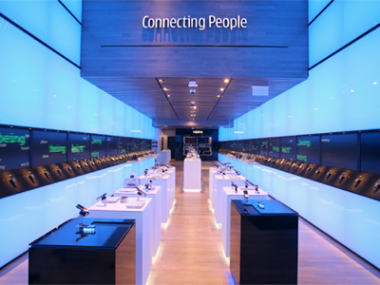
    • Nokia shutters flagship Regent Street store in face of Apple retail’s domination - December 08, 2009
    • Nokia sees flat market share as Apple gains - December 02, 2009
    • Nokia Chief Strategist: Apple will remain a niche player in smartphones, just like in computers - November 30, 2009
    • Nokia to cut another 330 R&D jobs - November 20, 2009
    • To understand market share vs. profits, look no further than Nokia vs. Apple - November 11, 2009
    • How Apple passed Nokia to become the world’s most profitable handset vendor - November 11, 2009
    • Strategy Analytics: Apple passes Nokia to become world’s most profitable handset vendor - November 10, 2009
    • Nokia sues Apple claiming iPhone infringement of Nokia GSM, UMTS and WLAN patents - October 22, 2009
    • Nokia posts loss of 559 million euros on weaker smartphone sales - October 15, 2009
    • Nokia’s earnings plummet 66 percent - July 17, 2009
    • Jim Cramer: The problem with Dell and Nokia is that no one wants their products; Buy Apple - July 17, 2009
    • Nokia’s failures vs. Apple’s vibrant iPhone platform puts market share at risk - June 24, 2009
    • Nokia Ovi Store launch a complete disaster - May 26, 2009
    • Nokia ships 19% fewer phones in Q1, bleeds more share - April 16, 2009
    • Nokia axes 1700 jobs worldwide - March 17, 2009
    • Nokia halts sale of iPhone killer; 5800 handset plagued with major problems - March 02, 2009
    • Nokia hops on bandwagon, unveils knockoffs of Apple’s iTunes Store, App Store - February 16, 2009
    • Nokia profit collapses 69% in fourth quarter 2008 - January 22, 2009
    • Nokia’s profits plummet 30 percent - October 16, 2008
    • Nokia’s fatally flawed ‘Comes With Music’ service no Apple ‘iTunes Store killer’ - October 03, 2008
    • Nokia fumbles iPhone lookalike-not-workalike launch in U.S. and Europe - October 02, 2008
    • Nokia sputters that iPhone ‘not worthy of discussion’ - August 13, 2008
    • Apple takes top spot from Nokia on AMR Research’s 2008 Supply Chain Top 25 list - May 30, 2008
    • Nokia shares slammed in wake of miss; Nokia CEO calls Apple iPhone ‘niche product’ - April 17, 2008
    • The knockoff parade continues: Nokia exec shows Apple iPhone lookalike ‘Tube’; dismisses Apple - April 08, 2008
    • Nokia previews blatant Apple iPhone knock-off (with video) - August 29, 2007
    • Nokia CEO challenges Apple over iPhone - February 13, 2007

    http://www.macdailynews.com/index.php/weblog/comments/nokia_shutters_us_flagship_stores_as_floundering_cellphone_maker_fails/

  9. Version Arithmetic

    Research

    Remember when I laid out the timeline for Nokia's response to the iPhone? Still checking off the milestones: http://www.thestreet.com/_yahoo/story/10636833/1/nokia-outlook-another-year-in-limbo.html?cm_ven=YAHOO&cm_cat=FREE&cm_ite=NA

    Let's also do some version arithmetic:

    Nokia is already on the 5th version of Maemo, a platform which by any measure is non-functional but already 5 years in the making. After this investment, only one product is shipping and it's something of a science experiment--a pre-beta product. Nokia is also on the 9th version of Symbian, a functional but outdated platform stuck in the 90s. Promising big things in the 10th version to be re-branded Symbian ^2--I guess double digit version numbers are not confidence inspiring.

    Microsoft meanwhile is working hard on the 7th major version of Windows Mobile. World waiting with bated breath.

  10. Maemo

    Research

    Insipid and irrational politics are symptomatic to a company trapped by rigidity of response to asymmetric attack (and you can quote me on that.)

    Nokia, the world's leader in total mobile phone sales seems to be having new problems deciding on its OS strategy. There were some murmurings about embracing Android last summer, but Nokia seems to have decided against it. Stefan Constantinescu had this to say about the results of Nokia World 2009:

    "The [new] software, Maemo 5, is a pain in the ass for developers since Nokia has admitted in public that Maemo 6 will come out in a year and it will break compatibility due to a switch from the GNOME environment to Qt. The browser, built on top of Mozilla technology, the same code that powers Firefox, is a step away from WebKit, the browser engine that powers Safari in the iPhone, the browser in Symbian, the browser in Nokia’s dumbphone OS known as S40, the browser in Android and soon the browser in RIM BlackBerry devices. Why is Nokia supporting something contrary to what the industry has already accepted as best in class? What’s the strategy?"

    Technical mistakes and internal politics can sink a company in an intense competitive environment. Mr. Constantinescu didn't perceive a coherent strategy. There may not be one.

    http://www.macobserver.com/tmo/article/iphone_competitor_forecast_stormy_with_a_chance_of_fail/