Asymco

Asymmetric Intelligence

Theory

  1. Invulnerable

    Podcast · 182 comments

    On a recent podcast I noted that Google was perceived as invulnerable. In contrast, Apple is seen as temporarily enjoying a stay of execution. ((The list of Apple Achilles' Heels is so long and creatively composed that it would take ages to compile, but here are just a few: the Mac (vs. Windows), Digital Rights Management (which kept the iPod alive), dozens of lawsuits (including from The Beatles), the Mac (when it ran Windows), PlaysForSure, Music Labels retaliation, the Zune, Android and clones, the Kindle and Amazon in general, more Mac, iTunes, iPod and iPhone and iPad killers than can be counted; Steve Jobs is ill, Jony Ive will quit, Tony Fadell quit, Rubinstein quit, Forstall was fired, etc. Feel free to add more through comments. See also Apple Death Knell Counter.)) This is not necessarily a bad thing for Apple. The more gushing the loathing or scorn, the more likely it's a reaction to love and attraction. A brand dies not from hate but from apathy.

    But nor is it necessarily a good thing for Google be be seen as invulnerable. There might be no "Google death knell counter". There might not be a "Google is doomed" trope. If an executive from Google quits or is fired there is no investor panic. If a product is withdrawn there is no mourning. There are no journalists pursuing Pulitzer prizes by describing some seamy underside of Google. But there are no overt displays of affection either. Google is seen, on balance, as benevolent and hopeful. The discussion on business robustness is simply missing.

    I suspect the absence of scrutiny comes from Google being seen as an analogy of the Internet itself. We don't question the survival of the Internet so we don't question the survival of Google -- its backbone, its index, and its pervasive ads which, somehow, keep the lights on. We believe Google is infrastructure. We don't dwell on whether electric grids are vulnerable, or supplies of fuel, or the weather(!)

    Too complex, too pervasive. These are systems, not things. And people are not designed to contemplate systems. We leave that to experts, or better yet, computers.

    The reason Apple is contemplated at all is that it's not seen as a system. Even the suggestion that Apple is a system is implicitly treated as an impossibility. Because it's not a system it's fragile. It's a person, or an idea, or a product or a singular "key" to something. It is, ultimately, mortal. The only debate is when it will die and points are earned for calling it sooner rather than later.

    But what if Apple were a system? And what if Google were a person (or three?)


  2. But Apple does not pursue profits either!

    Research · 36 comments

    In my essay on Google's absence of profit (or income or business) motives questions were raised on the stated absence of hunger for profits from Apple and what difference there might be from Google's philosophy.

    Indeed, Jony Ive stated:

    "Our goal isn't to make money. Our goal absolutely at Apple is not to make money. It may sound a little flippant, but it's the truth." ((at the British Embassy's Creative Summing in July 2012)).

    He was probably repeating what Jobs had previously stated:

    "I remember very clearly Steve announcing that our goal is not just to make money but to make great products" ((Walter Isaacson's Steve Jobs))

    However, note that both quotes are qualified. In the case of Jobs, he said "not just to make money". Jobs clearly stated that great products lead to money. That great products are causal to money and therefore that if you make great products you make money. One leads to the other.

    Ive also continued in this reasoning:

    "Our goal, and what gets us excited, is to try to make great products. We trust that if we are successful people will like them. And if we are operationally competent we will make revenue. But we are very clear about our goal."

    I would paraphrase the Apple logic as "Great products are the means by which we sustain our business. By focusing on the product, the customer is satisfied and through that satisfaction we create the free cash flows which can be used to fund more products."

    There is a difference between Apple's "indifference to money" and the "indifference to business models" that Google exhibits.

    Google steps even further away from cash flows. Its goals are to build great things guided by their vision and patterns in the data they collect. The value is in the data itself rather than in any transaction.

    As long as the source of money is unfettered, its provenance is uninteresting. A business model is a profit algorithm. It could be linked to the data but it need not be. Markets are messy and imperfect. Data provides much clearer views into value. You could conclude that value itself cannot be trusted to the judgement of the public. Value is to be determined through the recognition of patterns on data privately collected.

    So when I say that Google has disdain for market mechanisms I mean that they believe they can do better. Apple still values the user as the ultimate adjudicator of its actions. Google looks past the user and interprets their intentions.

    Google sees markets as ultimately obsolete.

  3. Google's three Ps

    Research · 185 comments

    A company is nothing more (and nothing less) than three things: people, processes and purposes. In the language of the software engineer these would be inputs, algorithms and specifications. In the language of classical business analysis they are assets (or resources), organization structures and business models. In military theory, these are logistics, tactics and strategy.

    This is the trinity which allows for an understanding of a complex system: the physical, the operational and the guiding principle. The what, the how and the why.

    When approaching any analysis problem, these questions form the foundation of causal inference. What is it, how does it work and why does it exist?

    When analyzing nature the sciences often help with the what and the how but rarely address the why. ((Religion attempts to answer the whys which science leaves as unanswerable.)) In contrast, man-made systems (e.g. systems of law, religion and commerce) require an answer to the why as there is a presumption of a will in their creation and preservation. The why allows ultimate judgement on the merit of an enterprise. The why may escape us but it's assumed to always be there. For instance, in criminal law the motive is often a crucial piece of evidence but it's not always found. In business, the motive for action or for organization is a crucial piece of the puzzle which often explains the what, who and how, but here the ultimate why is usually profit. This the characteristic of a for-profit business, the purpose is explicit.

    Some companies try to define their purposes beyond profit but they are often too vague or merely speak of values represent a quality not causality.

    This is the case with Google. The problem isn't only that "don't be evil" isn't a priority or a purpose, but also that its resources are not applied to cohesive goals. In fact, there seems to be no interest in pursuing a direction aligned with generating income.

    This is not in itself a bad thing. The notion of operating as a learning (vs. a deliberate) organization, informed but not driven by a goal, is the best approach when seeking new markets or discovering new needs and new business models. The difference with Google is that there seems to be no expectation of business model discovery. In other words, that the learning is not for any purpose other than learning itself.

    This might be noble but learning for its own sake has not been attempted by public, for-profit organizations ((The Bell Labs story in an interesting possible exception but on deeper inspection it was the by-product of a  government sanctioned monopoly and hence a ward of the state)) since there is an implicit fiduciary responsibility to generate profit and unrestricted experimentation, unguided by profit, is unlikely to ever learn the needs of markets.


    The evidence I note supporting this is in the persona the company maintains, both internally and externally. There is no representation of themselves as a "business seeking profit" or even as a commercial entity. It's not simply because their business model is embarrassing. It's because all business models are embarrassing.

    The representation is one of a research laboratory succeeding against difficult problems. Very similar to a successful academic or industrial laboratory sustained by grants from a benevolent (but messy) organization. Google becomes the embodiment of "big science" and "the world's laboratory" unfettered by politics and unsoiled by commercial interests.

    There is a business in Google but it's a very obscure topic. The "business side" of the organization is only mentioned briefly in analyst conference calls and the conversation is not conducted with the same team that faces the public. Even then, analysts who should investigate the link between the business and its persona seem swept away by utopian dreams and look where the company suggests they should be looking (mainly the future.)

    There are almost no discussions of cost structures (e.g. cost of sales, cost of distribution, operations and research), operating models (divisional, functional or otherwise) or of business models. In fact, the company operates only one business model which was an acquisition, reluctantly adopted.

    It's as if the management is not only uninterested in its own profit model but deeply scornful of it. For all the technology innovations the company can claim, it has not had one internally sourced business model innovation.

    But is this wrong? Again, we need to ask if Google breaks with convention then maybe convention needs to be broken. This is the radical bet underlying the Google thesis: are business models necessary? This is in fact a bet many VCs are implicitly placing within the current start-up culture. The notion of making a profit or even having an interest in doing so seems passé. This notion is directly traceable to the Google ethos as it acts as the source of acquisition funding and is driving the agenda of VCs and entrepreneurs. This is leadership by example and the example is one of blissful ignorance of market constraints.

    But we have to go back to the profit model, even if analysts, observers and the company itself sweep it under a rug. The reason is that this laboratory runs only as long as the grant money keeps coming. No bucks, no Buck Rogers. So far the money rains down from heaven, but that rain is not infinite nor permanent. The answer seems to be diversification, even the creation of a conglomerate. In other words, the answer seems to be that if enough great technology is developed or acquired, then a business model will appear (think about it as a probability problem) and the vulnerability of revenue sources is managed. Clever? Convenient? We'll see.

    But that's not the only problem. The deeper problem is in us knowing their intentions. The absence of a purpose rooted in profit makes Google resistant to analysis. There might be a purpose, known only to the founders ((or not known at all)), but it's one that is potentially naive, amoral or too abstract to be useful. Shareholders are aware of this and have agreed to entrust control to only three individuals. The purpose of the organization is in their hands alone and reflects their priorities. Bearing in mind that the road to hell is paved with good intentions, they must be brave indeed.

    This would not be too troubling if the effect would be restricted to the company stakeholders. The trouble lies in that organization also having de-facto control over the online (and hence increasingly offline) lives of more than one billion people. Users, but not customers, of a company whose purpose is undefined. The absence of oversight is one thing, the absence of an understanding of the will of the leadership is quite another. The company becomes an object of faith alone.  Do we believe?
  4. Moonshot

    Research · 63 comments

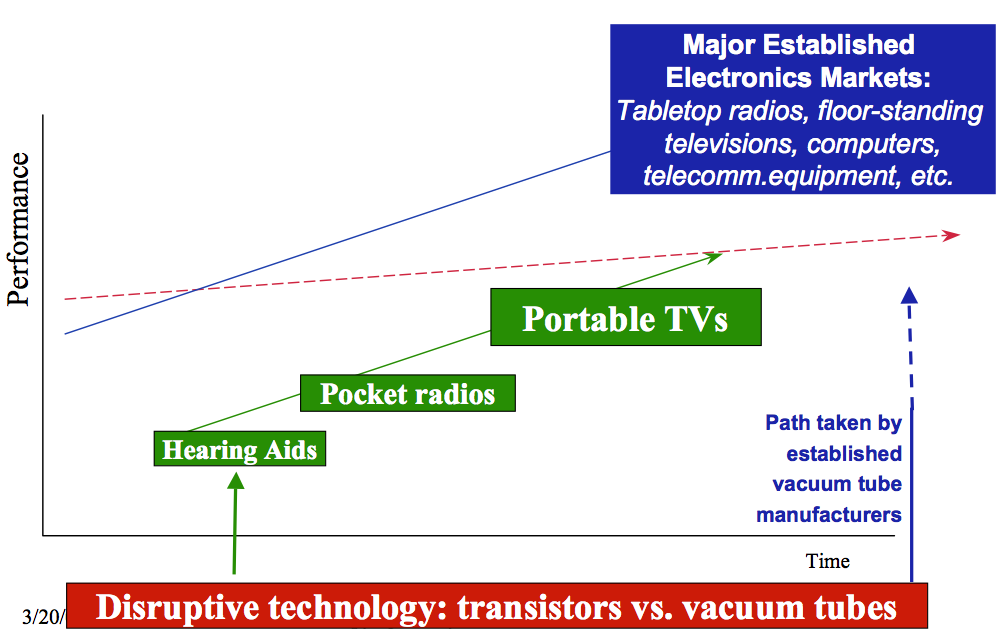
    When describing the process of disruptive innovation, Clay Christensen set about to also describe the process by which a technology is developed by visionaries in a commercially unsuccessful way. He called it cramming.

    Cramming is a process of trying to make a not-yet-good-enough technology great without allowing it to be bad. In other words, it's taking an ambitious goal and aiming at it with vast resources of time and money without allowing the mundane trial and error experimentation in business models.

    To illustrate cramming I borrowed his story of how the transistor was embraced by incumbents in the US vs. entrants in Japan and how that led to the downfall of the US consumer electronics industry.

    Small upstarts were able to take the invention, wrap a new business model around it that motivated the current players to ignore or flee their entry. They thus successfully displaced the entrenched incumbents even though the incumbents were investing heavily in the technology and the entrants weren’t.

    In the image below, the blue "path taken by established vacuum tube manufacturers" is the cramming approach vs. the green entry by outsiders who worked on minor new products which could make use of the rough state of transistors at their early stages of development.

    Screen Shot 2013-12-17 at 12-17-3.04.59 PM

    The history of investment in transistor-based electronics shows how following the money (i.e. R&D) did not lead to value creation, quite the opposite. There are many such examples: The billions spent on R&D by Microsoft did not help them build a mobile future and the billions spent on R&D by Nokia did not help them build a computing future.

    There are other white elephant stories such as IBM's investment in speech recognition to replace word processing, the Japanese government spending on "Fifth Generation Computing" and almost all research into machine translation and learning from the 1960s to the present.

    But today we hear about initiatives such as package delivery drones and driverless cars and robots and Hyperloops and are hopeful. Perhaps under the guiding vision of the wisest, most benevolent business wizards, breakthrough technologies and new infrastructures can finally be realized and we can gain the growth and wealth that we deserve but are so sorely lacking.

    But the failure of crammed technologies isn't rooted in a lack of wisdom. It was the wisest of minds which foresaw machine learning, advanced computing, mobility and convergence coming decades before they came. It was their wisdom which convinced others that resources should be spent on these initiatives. And it was the concentrated mind power of thousands of scientists which spent hundreds of billions in academic and government research.

    What failed wasn't the vision but the timing and the absence of a refinement process. Technologies which succeed commercially are not "moonshots." ((It could be said that the space and nuclear weapons programs during the Cold War were the original "moonshots" and they succeeded. But although successful in their goals, those goals were not commercial value creation and we are left with little to show for it. See also Concorde.)) They come from a grinding, laborious process of iteration and discovery long after the technology is invented.

    The technology is one part of the problem to be solved, the other is how to get people to use it. And that problem is rooted in understanding the jobs people have to get done and how the technology can be used defensibly. That's where the rub is. An unused technology is a tragic failure. Not just because it has no value but because the resources (those beautiful minds) used in making it could have been applied elsewhere.

    Building usage means imparting and retrieving learning through a conversation with the customer. That conversation is best spoken with a vocabulary of sales and profits. Without profits the value is unclear. Nothing is proven. Without economic performance data, the decision of resource allocation becomes a battle of egos. ((This is how most research is allocated today.)) The decision may be right but going by past history the odds are low.

    Incidentally, timing is the other element that is key to success. It might seem that timing really is a matter of luck. But timing can be informed by the same conversation with the customer. As you observe adoption you can also measure how long it take for a technology to be adopted. You can do A/B tests and see what is faster.

    The most reliable method of breakthrough creation is not the moonshot but a learning process that involves steady iteration. Small but profitable wins.  A driver-less car might be achieved but first a driver-assisting car might teach the right lessons. An electric car might be achieved but first a hybrid car might teach the lessons needed. A delivery drone might be achieved but first a programmable UPS truck might be a better way to learn.

    And finally, Android (née Linux) in 2005 might have been foreseen as the future of mobile operating systems but it took the learning from iOS to shape it into a consumer-friendly product. Even when you see a moonshot work, you realize that a lot of learning had to have taken place. It's like the story of an overnight success that took a lifetime of perseverance.

  5. Bundling and Pricing Innovation

    Research · 84 comments

    This was initially posted on LinkedIn December 16, 2013.

    Innovation comes in many forms. Many times innovation is thought of as technological improvement or as invention. We can all cite examples of inventions which turned into industries which re-defined civilization. The steam engine comes to mind but there were many others before and after. Inventing something is certainly a way to create value but it's not as common or as reliable a method as it might seem. Creating Intellectual Property is one thing, finding a defensible market and business model is quite another.

    More often companies innovate in terms of processes or the "algorithms" which are used to deploy existing resources. Wal*Mart was immensely innovative in the way it organized itself and laid out a low-cost business model. More recently Amazon has innovated in distribution and fulfillment based on the ability to dispense with showrooms for products and sell directly online. There is little in terms of technology which Amazon "invented". Rather, it deployed off-the-shelf technology in a novel way.

    But what I want to address is a more mundane sort of innovation: marketing innovation, specifically pricing. Few would consider a price model to be an innovation but in fact it's a core lynchpin to many breakthrough innovations. It was pricing which permitted Henry Ford to build an industrial empire. He could have built cars for those who could afford them as cars were defined in 1907 but he chose to build a car around a price point which was around the median of the population. A car "so low in price that no man making a good salary will be unable to own one." His business logic began with a price and the product and process followed.

    Another aspect of pricing innovation is "bundling" where products which might sell poorly independent of each other sell very well when coupled with complements. Consider the original Microsoft Office. When introduced vis-a-vis Lotus 1-2-3 and WordPerfect as separate products, it handily won the market for spreadsheets and word processors. Bundling is also the way TV is sold. Cable companies don't offer channels a-la-carte. It even took root in the car business. Automakers are now selling upgrades as "equipment packages", a method proving far more popular (and profitable) than the menu system of old.

    But there are cases where bundling has been rejected by users. iTunes broke the bundle of the "Album" where the only way you could get a single was to buy a dozen other songs. Once broken, the album bundle shows no signs of a come-back. Many are questioning whether TV channel bundling is also ripe for such a break-up.

    And there is yet another looming bundle question. For as long as the market existed, mobile carriers sold their service bundled with a device. This harks back to the days when AT&T (known then as the Bell Network) did not permit users to own their own landline phone. They argued that the device is a part of the network and choice in the matter would compromise security and safety of a crucial infrastructure. The argument played well with regulators for decades.

    This tie between the device and the service persists today but the connection has been preserved not though regulatory fiat but through incentives in pricing. Arguably, the low price of devices, and hence cost of entry, has meant that penetration skyrocketed. Cellular service now reached saturation in the US in near-record time. The upgrading to smartphones is now about 60% complete and looks to saturate a mere 8 years after reaching 10% of the population.

    So in a way, the "innovation" of the carriers has been in bundling and creating a package that was irresistible to consumers. They went from not consuming mobile networks to consuming them universally. The amount being spent by consumers on mobile services is above $1.3 trillion world-wide--a market that did not even exist 20 years ago.

    So now the question being asked, even within the industry, is whether this bundling can long last. The way I would answer the question is by following the logic from the consumer's point of view. If the bundle is valuable, then it's likely it will be tolerated, even preferred. In the case of software and car options the model works. Even in the case of TV the model is still preferred as few consumers are defecting to the IP-based unbundled alternatives. In the case of music, the consumers prefer the unbundling because there were things in the bundle which they did not need or want. They wanted a song, not a song and others which they might like.

    But in the case of network service and device, the split is more subtle. A service is useless without a device and a device is useless without a service. The bundle makes sense from the point of view of co-dependency of modules. The broader question is one of choice. The premise of unbundling might be that users can choose service and devices separately and change them arbitrarily.

    There is a fundamental problem with this however. A service that can be switched on or off easily by consumers is economically challenging for network operators. The economics of networks are such that financing them requires steady cash flow and every operator desires stability. So incentives will be put in place for consumers to stick around, and these incentives (read innovations) work. But isn't the device itself such an incentive?

    We end up back where we started. The business model and economics of operators world-wide is such that the device is a critical part of the incentive structure which preserves the network's economic balance.

    It may be an illusion, but a cheap phone (with a long-term contract) is a fundamental innovation devised by telco operators even before the phone became mobile. Operators have come to love it and no matter how many technology generations go by; how many family plans, bucket plans, weekend minutes, rollovers, and data packages; no matter how many tweaks and re-brands the model gets, it will persist. There simply isn't sufficient win-win value in alternatives.

  6. How many Americans will be using an iPhone when the US smartphone market saturates?

    Research · 200 comments

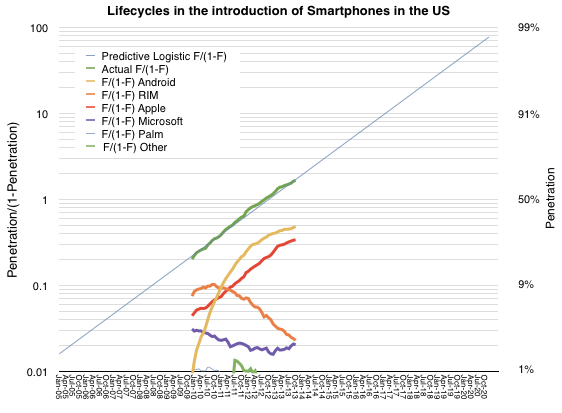
    As previously noted, the US smartphone market has followed an almost perfectly logistic growth. The measured data (via comScore, in green below) follows a predictive logistic function (thin blue whose formula is discussed here).

    Screen Shot 2013-12-13 at 12-13-11.30.54 AM

    The other notable market observation is how closely the iPhone follows the same pattern as the market. The red line representing the iPhone above is almost perfectly parallel to the green and blue lines which represent the overall market. The reason for this seems to be that consumers are absorbing the product in similar way to how they are absorbing the technology. ((Note that this pattern of adoption has happened even though the product has been at least partially unavailable to the entire market until quite recently.)) The "learning model" which underpins logistic models could offer clues as to the cause. It suggests that there is a direct communication that happens between the product and the consumer.

    Incidentally, the reason other platforms do not follow this pattern is that they are not communicating value with the consumer but with manufacturers or distributors of the product. These alternative communications could create faster or slower growth than the overall market as they are not subject to the same large population imitation/learning models.

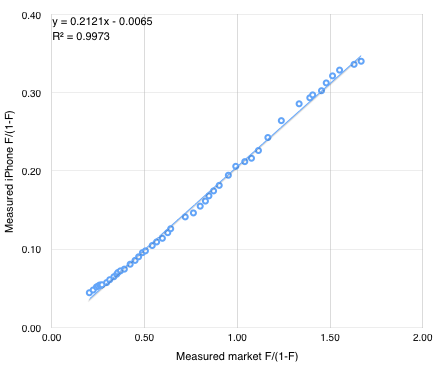
    If we believe that the iPhone can be modeled behaviorally then it may be possible to forecast its growth. One can simply draw a line extending the existing red segment above and read the F/(1-F) figure at any point in time. Solving for F results in a measure of penetration and hence number of users (if population is known.)

    An alternative is to use the following formula derived from the linear interpolation of the two measured market shares. iPhone market share is y/(1+y) where y=0.21x and x = F/(1-F) and F is the expected market penetration of smartphones.

    Screen Shot 2013-12-13 at 12-13-11.29.59 AM

    So if F = 91%, x = 10, y = 2.11 and therefore the iPhone market share =  68%.

    We also know from the plot of the market that F = .91 is reached around February 2017. So we can suggest that at 90% penetration (approximately saturation) the iPhone will have 68% market share of users in the US. Forecasting the addressable market (US population aged older than 13) at about 266 million that implies 180 million US users of the iPhone by early 2017.

  7. When will there be one billion iOS devices in use?

    Research · 94 comments

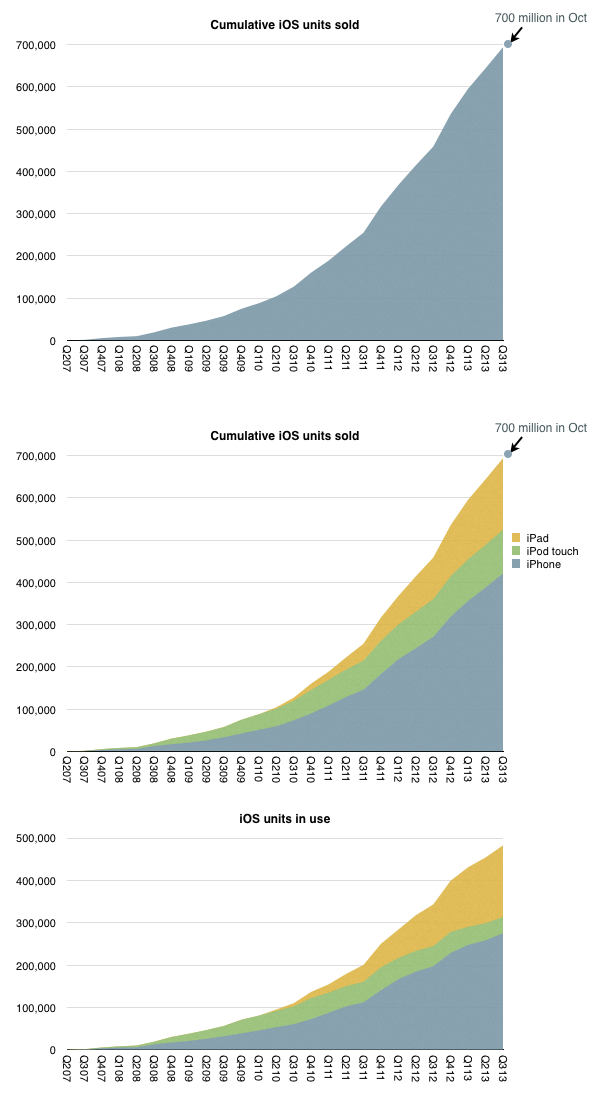
    iOS unit sales crossed over 700 million units last month. That is a significant milestone but the total number of units in use is likely to be lower. My estimate based on device replacement assumptions is that about 500 million are still in use.

    The estimated break-down of units sold and in use by device type is shown below:

    Screen Shot 2013-11-25 at 11-25-2.59.59 PM

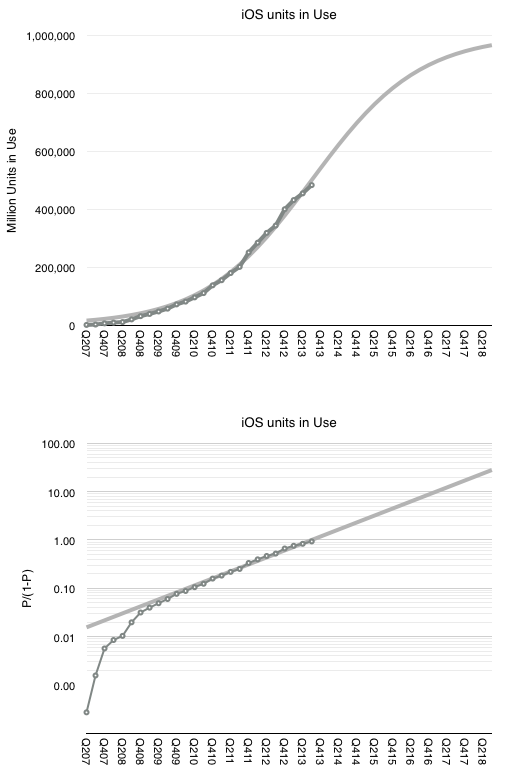
    When I looked at the penetration of iPhones in the US (as a part of smartphones in total) the surprising pattern was that it followed a logistic curve (while other platforms didn't.) If this is indicative of a particular learning process to be observed in the market, then can we extend the logistic growth pattern to iOS overall?

    I tried it with the assumption that at 500 million, iOS is at the half-way point in its growth. This assumption comes from growth being near an inflection point. It could be that iOS might accelerate further in which case peak penetration could be higher than 1 billion, but might take longer to reach.

    The 500 million as 50% penetration point assumption fits the model as shown below.


    Screen Shot 2013-11-25 at 11-25-3.23.10 PM


    The fit is pretty good for the period after the iPhone 3G launched. This assumption would therefore imply (nearly) one billion iOS devices in use by the end of 2018.

    Note that this does not mean one billion iOS users. The attach rate for iOS devices per user could well reach 2 by then placing total user base at 500 million. Note that this size of audience is very nearly the existing total Apple audience already (counting iTunes/iCloud accounts).

    This means that we already have "existence proof" that Apple can reach half-a-billion users. Apple does not need to discover a large new set of non-consumers. The idea of 1 billion iOS devices is simply the projection that each current user could some day use two devices.

  8. Dark Matter

    Research · 84 comments

    Benedict Evans explains well the problem with measuring Android tablets. There are no reliable data collected because many of the devices are invisible through the regular, measurable channels:

    • There are no firms which report their shipments
    • They are not sold through retail chains which normally are sampled in the US and Europe (NPD and GfK respectively.)
    • They don't show up in browsing or ad transaction data
    • Google Play statistics are missing most of the activations since they are not sold as bona fide Google-sanctioned Android.

    The only measured statistic happens to be component shipments. Items such as screens, CPUs or perhaps memory might be visible to market analysts. It's therefore tempting to add up tires manufactured to determine what's getting sold in auto dealerships.

    But it's also hugely problematic.

    Before we go into that rat's hole, I want to re-visit my original criticism for market analysis based on device attributes. When the iPad was new it was famously labeled a "media tablet" by Gartner and excluded from being counted (and hence compared) with PCs. This created an implicit signal to the analyst's clients to ignore the entrant as irrelevant.

    That actually accelerated their demise (and the revenue prospects for the analyst).

    In contrast to that exclusion--of a clear and present danger based on an arbitrary definition of form factor--the analyst who defines categories of products purely on the definition of their components is guilty of the same sin.

    Snowing the audience with irrelevant comparisons is just as bad as withholding relevant comparisons. This is explicitly asked of witnesses: to tell the truth, the whole truth and nothing but the truth. The "nothing but the truth" means the exclusion of irrelevance.

    The correct approach is to identify which devices are comparable (and thus in the same category) based on the jobs they're hired to do. If a tablet overlaps considerably in the work it does with a PC (e.g. browsing, email, media play, and other applications) then they should be considered comparable. If a tablet does nothing that a PC does or nothing that an iPad does (e.g. no browsing, email, apps or ecosystem activity other than piracy) then they should not be considered comparable.

    Which brings me back to the question of what these dark matter "Android tablets" actually do.

    To answer I want to recall another "dark matter" technology that seems to have gone largely unnoticed but was exceptionally popular. This was the VCD or Video CD. It was an alternative to the DVD without the licensing and DRM overhead it entailed. It was extremely popular in Asia as a way of not only buying but also sharing video content. The cost of content was a fraction of sanctioned versions, essentially taking the role that mass-copied VHS had in previous years.

    The "job to be done" was to enjoy video content cheaply and conveniently for the equivalent of pennies a day. A job very similar to what we think of as cable TV today.

    These devices and discs were largely invisible mainly because they did not exist in economies which adopted protected DVDs and because the content consumed did not hit against any databases that tracked consumption. Nevertheless there might have been hundreds of millions of these devices sold and billions of discs viewed.

    Now we are in a situation where devices whose primary purpose is to watch video content (cheaply and conveniently) are being counted. By their counting, their implicit competitiveness is asserted. But it means nothing if they are not hired for the same jobs. In fact it misdirects attention.

    Sometimes these "low end" devices do grow up to swamp the higher-powered alternatives with good enough functionality. That is the innovator's dilemma for low end disruption. But in some cases they don't because other factors are at work. Because ecosystems have complex multi-sided markets and because regulations and channels and consumer behavior conflict with the technical specification.

    For this reason the VCD did not "disrupt" DVD or grow up into a Blu-Ray equivalent that caused Hollywood to crumble. It faded away as an anomaly.

    Whether the dark matter Video-only Android device will come to swamp the iPad will depend not on just volume shipments in select geographies. It will depend largely on the ecosystems built around it. The ecosystems of VCD were largely unsustainable because there was no value placed on the content itself. The value chain did not strive to sustain the technology. When something better came along, it got dropped.

    In contrast, content-based value chains sustain technologies which keep the revenues coming. And we can measure this revenue.

    You don't need to look too hard for that in tablets. Apple states it quite frequently: total payments to developers.

  9. A way to measure one's life

    Research · 20 comments

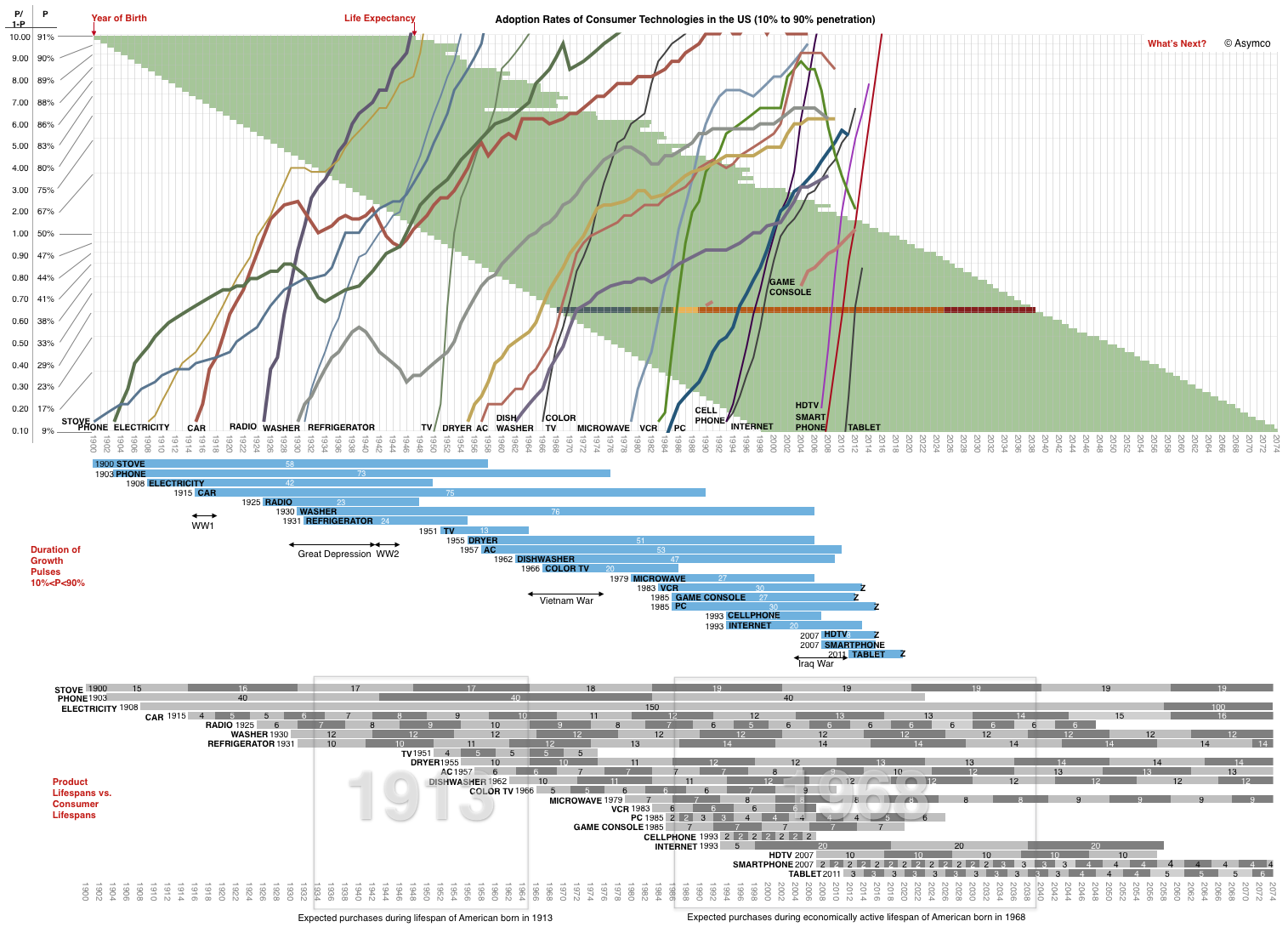
    In the post Seeing What's Next, I showed how the rate of change of adoption of technology varies with time and asked what might be experienced by present and future generations.

    It turns out that knowing how what innovations become universal and the speed at which these technologies are replaced can give us an idea of what individuals might experience in their lifetimes.

    Here's how to think about it:

    Screen Shot 2013-11-19 at 11-19-8.04.42 PM

    You can use the model above to visualize a lifespan, given a year of birth. Follow the line for your year of birth and measure an expected life (the life expectancy in green is a guide). You can skip over childhood years and decide when you might have reached an age when you start buying and using certain products as well as when you think you might stop.

    Trace a rectangle over the grey areas in the bottom graph spanning the years you will start to consume and when you might expect to stop.

    The area within the rectangle will include known products and their expected lifespans (marked in alternating shades of grey with a figure for the longevity of service life.) The total number of segments represents your expected consumption.

    I marked the areas for a person born in 1913 and one born in 1968 ((Corresponding to my grandmother and myself though we were not born in the US.)) What the analysis shows is that I would be expected to own:

    • Three stoves (I've owned one so far.)
    • One regular landline phone service. Mine was discontinued in the late 90s.
    • One electricity subscription. (It seems banal to give electricity a product lifespan but will make more sense if the electric grid is re-achitected.)
    • Five cars (for my household). I've owned more than five but mostly due to vanity.
    • 8 Radios/Stereos. I owned about 5 "sound systems" so far
    • 4 Washers. My household has owned 3 so far.
    • 4 Refrigerators. I've owned three so far.
    • 4 Dryers. Three so far.
    • 7 Air conditioning systems. I've only owned about 3 but I lived in cooler climates.
    • 5 dishwashers. I've owned 3 so far.
    • 4 CRT Color TVs and three HDTV. I've had 4 CRT TVs and one HDTV so far.
    • 4 VCRs. I've owned 4.
    • 11 PCs. I lost track but I think more than that so far.
    • 5 Game consoles. I've owned none. To be fair, consoles are not an universal technology as they have not reached saturation.
    • 7 voice-oriented cell phones. I've had a few more but it's close
    • Three internet service contracts. (This assumes dial-up as first.)
    • 15 Smartphones. 6 so far (excluding company purchases).
    • 10 Tablets. 4 so far.

    A couple of caveats:

    1. My life is not yet over, so there is still time to fulfill my consumption quota.
    2. There will be additional things to count within my life span.
    3. There are many technologies not counted but few of those I can imagine are universal, or saturated. This means that there is little certainty this model can be used reliably.
    4. Some people are early adopters and some are late adopters. Depending on which, it might add or subtract certain product cycles but as adoption rates increase and product lifespans decrease.

    I did the same tally for my grandmother and it matches prettily closely her consumption with the caveats that she did not reside in the US and that she lived almost twice the expected lifespan.

    The obvious next step is to multiply the model by population forecasts.


  10. Seeing What's Next

    Research · 62 comments

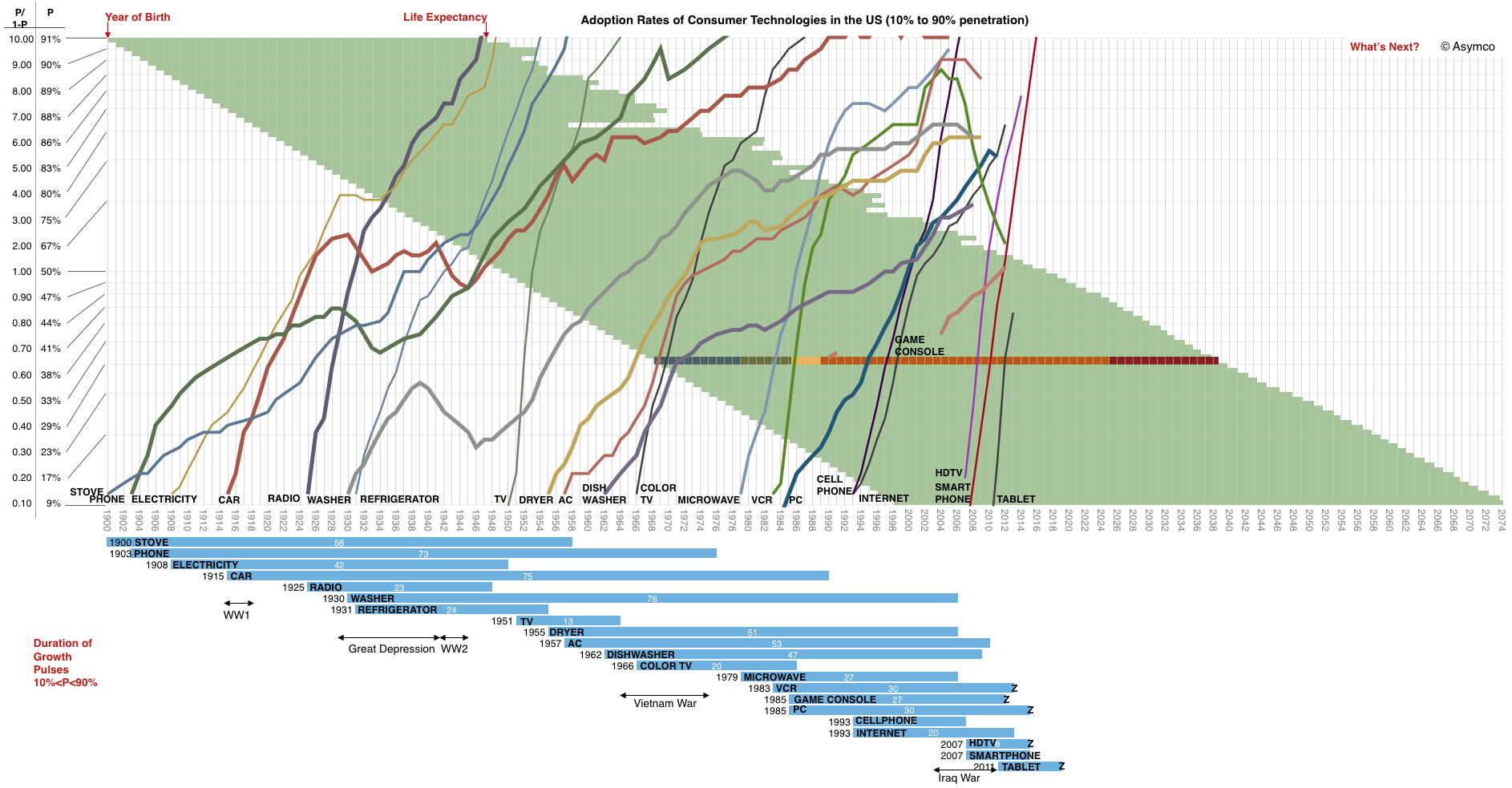
    The adoption of smartphones in the US is on track for reaching 90% of the available audience by August 2016. This is a mere eight years after smartphones reached 10% penetration. As far as technologies go, that's pretty fast. To get an idea of how rapid, I plotted a few other technologies and the time they took to grow within the US market.

    Adoption Rates of Consumer Technologies

    A few things to note:

    1. The time scale has a yearly resolution spanning 1900 to 2074
    2. The penetration scale is logarithmic and shows the ratio of Penetration/(1-Penetration) allowing a linear view of logistic growth.
    3. The blue bars summarize the growth pulses and give a starting year and duration in years.
    4. Note some traumatic events are marked on the time frame. They partly explain innovation gaps or decreases in adoption.
    5. The life expectancy of Americans born from 1900 to 1998 is also shown as green bars. This allows the reader to trace which technologies emerged during the lifetimes of people they might have living memories of. I overlaid one specific lifetime beginning in 1968 and color coded with Childhood, Adolescence, Higher Education, Work live and Retirement as a guide. You can note how the PC emerged when that person would have been in college.
    6. Some technologies have not yet saturated and may never do so. They are marked with a "Z" on the bar graph. It might be instructive to understand why.

    You'll also note that the time frame does not end today but that the technology curves do. The time frame includes the expected lifespan of someone born in 1998.

    What will they see?

    There is a lack of visibility or certainty among observers that anything worthy of inclusion on this graph will ever emerge.

    And yet, when glancing at this graph, it would seem that the addressable market, the rate of introduction of new technologies and the speed of adoption have all increased. The area to the right of 2013 looks inviting to a plot of many lines.

    Indeed, for the canvas to remain blank would be the riskiest of bets.

    What would you put upon it?

  11. How many mobile platforms can a market sustain?

    Research · 83 comments

    Using logistic curves to measure diffusion of innovations is a powerful method of analysis. However there are limits to what can be learned. The methodology helps in understanding how quickly a pervasive technology is adopted. It assumes that the technology "fills all available space" within a market. It therefore also assumes that whatever problems the technology solves are universal problems.

    Put another way, if a technology is not universally useful, it tends to peak before a market saturates. This "universality" condition is in evidence when observing that pervasive technologies are adopted not only by all members of one national market but also all nations and through all means of government and regulation. In other words that the jobs that the technologies are hired to do are so important that they bulldoze any and all obstacles placed in the path of adoption.

    The only difference is one of timing. Some regions are quicker than others. Institutionalized obstacles essentially defer rather than deter adoption. They impede rather than block.

    And I am pretty sure that smartphones solve universal needs and their adoption will be nearly 100%. They also have fairly low impedance given the speed of adoption (50% penetration in most large markets seems to come in less than 5 years.)

    That's the story for the technology, but how value is captured is another story.

    Who captures and how it's captured are questions of commerce not economics. They are informed by competitive advantage and business models. The puzzle seems to be that individual companies don't capture value in the patterns of Logistic curves. Or at least I don't think they do.

    Consider the graph below.

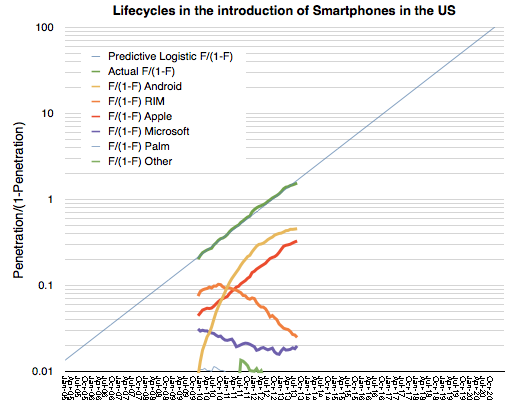
    Screen Shot 2013-10-22 at 10-22-1.25.54 PM

    It shows the transformation of a logistic curve into a linear representation. It's a log-scale graph of fractional shares of smartphones in general (Blue/green Lines) and individual platforms in the US.

    The individual platforms are shown as (Platform x share of all phones/share of all others). This is a "logistic substitution trajectory". ((Fisher and Pry, 1971, proposed a similar model to study the replacement of old by new technologies. The basic assumptions of the Fisher-Pry model are: (1) The substitution process is competitive. (2) Once substitution by the new technology has progressed as far as a few percent (i.e., "lock-in"), it will proceed until a complete takeover occurs. (3) the rate of fractional substitution F1 is proportional to the remaining substitution 1- F1 possible. Source: Grübler, The Rise and Fall of Infrastructures Physica-Verlag 1990.))

    The problem is that whereas the overall category (smartphones) reaches saturation, it's not at all clear that any individual platform does. At least from the data we have so far, there is far too much volatility in platforms to see a clear pattern of monopoly emerging.

    I'm not sure if this is "proof" enough to convince anyone that this market supports any number of platforms, but it certainly disproves that there will be only one. ((The odd pattern here seems to be Apple's consistent (i.e. parallel) adoption. One hypothesis could be that Apple is different in solving the prevailing job to be done while rivals jockey for positional advantage.)) We're too far along for churn to convert existing users before saturation sets in.