Asymco

Asymmetric Intelligence

active device

  1. John Ternus has left big shoes to fill

    Research · 4 comments

    April 21, 2040

    It's been 15 years but John Ternus has finally stepped down as Apple CEO. Analysts described the transition as expected rather than disruptive, noting that investors had long anticipated Ternus' eventual departure. Nevertheless, he leaves with many questions still unanswered about Apple's long term strategy. Apple incoming CEO faces a defining challenge: Fixing the company’s Services dependence.
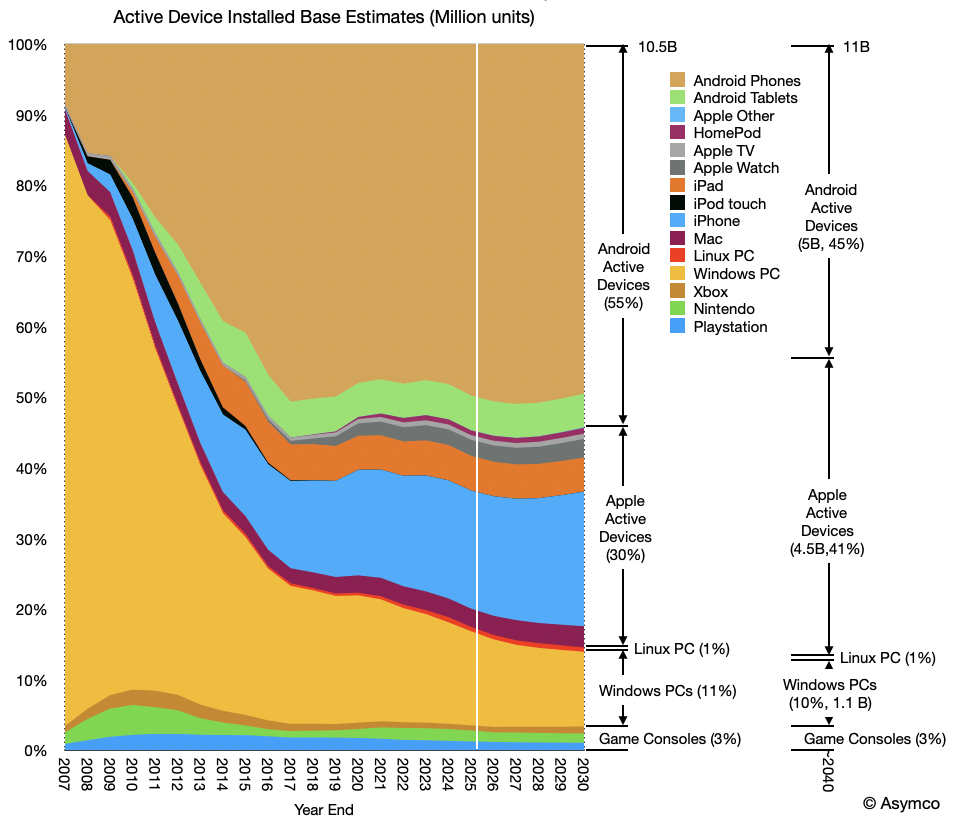
    It's been a tumultuous tenure for Ternus but he is leaving with significant accomplishments:

    • John grew Apple devices to 4.5 billion from 2.5 billion when he took over in 2026. Many have pointed out that he has been building on Tim Cook's success and that John has only added 2 billion devices in 15 years, averaging 110 million per year. The reality is that most of those have been switchers from Android rather than first-time users. Because of this, Android's 5 billion active devices means Android users still outnumber Apple users. Apple's users do have attach rates of over 2.5 devices per user including passive AI wearables but the competition is not standing still. The new CEO will face the challenge of trying to wrest majority market share in a saturated 12 billion active device market.
    • With over 2 billion customers, Apple is capturing over 40% of all AI revenues. Critics point out that the company has not grown beyond its core: high net worth and high income households. Much of that foundation was laid by his predecessor and arguably all that John has done is maintain a base that grew organically as global income has risen. Over a billion middle/high income individuals have joined the world economy as Apple users but that is hardly attributable to Ternus. His engineering acumen did not give him the insight into marketing to low income countries where most of the users are shunning Apple products.
    • John has had to navigate a challenging geopolitical situation with the rise of India as the world power and the decline of China. Critics pointed out that Apple's dependence on India is an Achilles' heel and that his transition of production and market growth from China to India has been rough and challenges remain with regulation and labor unrest. The Indian middle class has been the growth engine for a decade but, as all eyes are on Africa and South America, Apple has been on its back foot.
    • Apple grew the AI business but now depends too much on in. Growth since 2038 has slowed from mid teens to low teens and analysts are pointing out that Apple is too dependent on Services as its biggest source of revenue. Apple's P/E ratio is now below the average of the Fab Five reflecting investor skepticism that it can capitalize on submersible data centers in international waters. Its insistence on local sovereignty for data storage goes against the bathospheric consensus.
    • Competition has been kept at bay, so far. Apple has seen off challenges by Anthropic, Netflix and SpaceX but there are hundreds of startups looking to build the next Services killer. Billions of satisfied customers are not the moat they used to be.

    Apple has made it this far, recently celebrating its 65 anniversary but there is no guarantee that it can continue its run as the world's most valuable company. The next CEO has to steer the ship Ternus just managed to helm through stormy seas.
  2. iPhone vs Android Switching Rates

    Nota Bene · 3 comments

    Bitchin' ain't Switching

    SellCell’s Smartphone Loyalty Survey 2026 shows iPhone and Android loyalty at record highs, but Android users still switch more.

    Key findings

    iPhone loyalty stands at 96.4%, up from 91.9% in 2021

    iPhone switching stands at 3.6%

    Android loyalty stands at 86.4%, with switching at 13.6%

    Android users are nearly four times more likely to switch than iPhone users

    Samsung loyalty stands at 90.1%, up from 74% in 2021

    Samsung switching stands at 9.9%

    Google loyalty stands at 86.8%, up from 65.2% in 2021

    Google switching stands at 13.2%

    The loyalty gap between iPhone and Android now stands at 10 percentage points

    Price and value are the biggest drivers of switching

    Technology is the second biggest driver

    Overall, loyalty has increased across all major brands since 2021

    Source: SellCell.com Blog

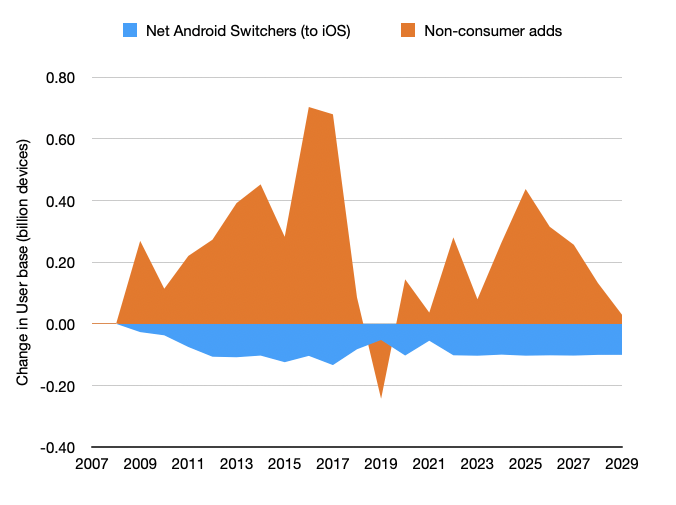
    NB: I did a deep dive into the data and came up with graph above. The original report shows intention numbers which seem quite high. For instance, the net switching rate between iOS and Android is 10% in favor of Apple. This would imply that the entire user base would flip in 10 years. It would also imply...

    As time goes on and saturation is reached (near 5 billion active smartphones) then the churn will imply that Android will eventually become a net user loser.

    That probably won't happen before 2030. When saturation does happen however, I will be watching to see if Apple chooses a different strategy to accelerate switching similar to what it is doing with the MacBook Neo at a time of PC market saturation.

    The lesson here is that switching intention surveys showing a net 10% churn rate don't mean that the actual switching rate is net 10%. The intention to switch is a sentiment but actual switching is often more difficult than a wish to do so.

    I think actual net churn is 1.7% of the base each year. That's still 100 million a year. For now it seems Apple is happy to maintain that rate.

  3. How many Apple users are in China?

    Research · 2 comments

    Greater China.

    As previously reported, China represented 18% of net sales for Apple in the fourth quarter of 2025. This was up from 15% the year before and the third largest reporting segment. The segment grew by 37.9% year-on-year.

    It's time to understand precisely how big this market is in terms of users, iPhone install base and device install base, with an eye toward understanding the history and potential for growth.

    First, it's important to note that Apple refers to "Greater China" (GC) not just China. That means within this reporting segment are Mainland China, Taiwan, Hong Kong and Macao. The populations are approximately, 1.4 billion, 23.2 million, 7.5 million and 700k respectively.

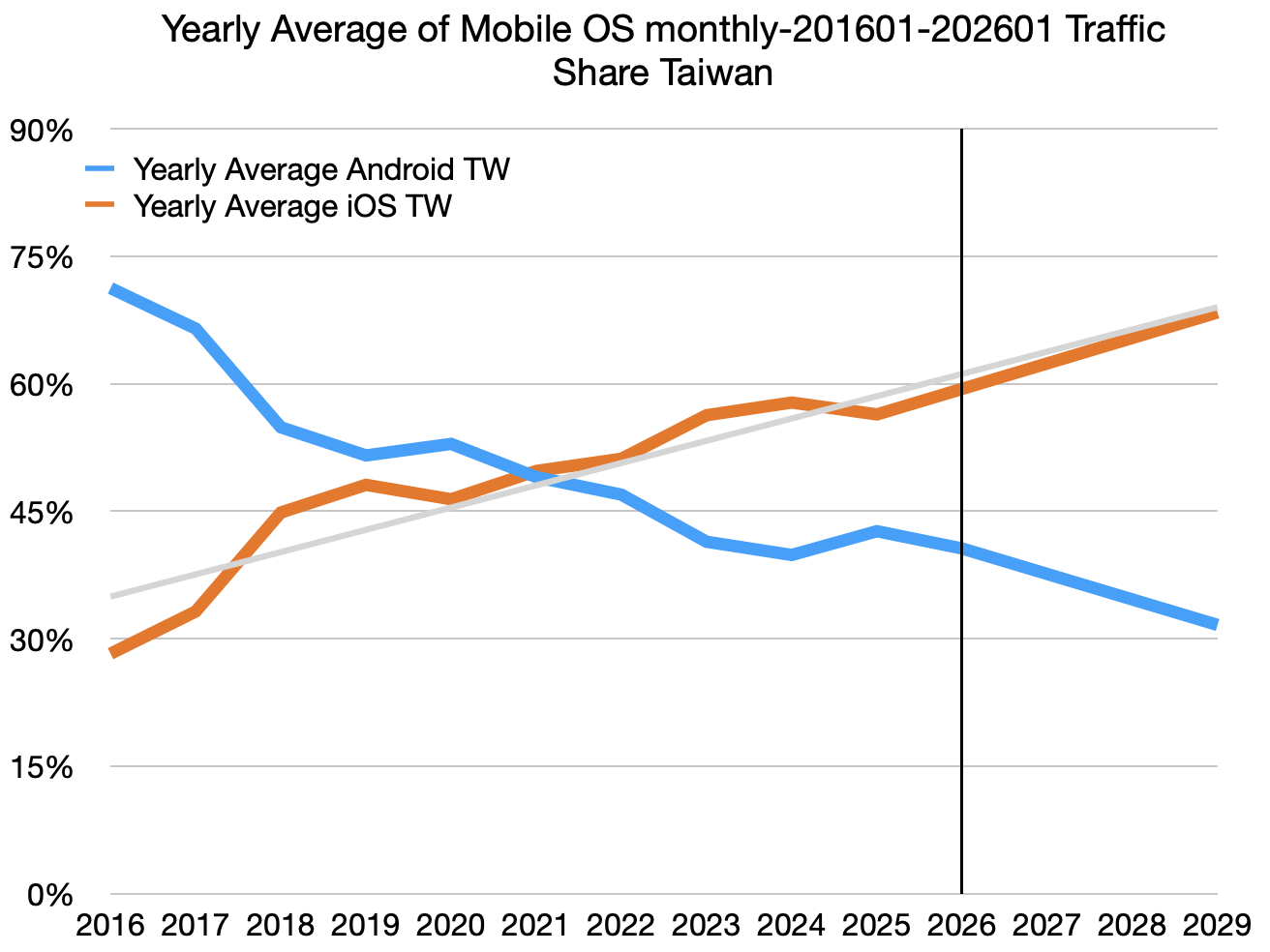
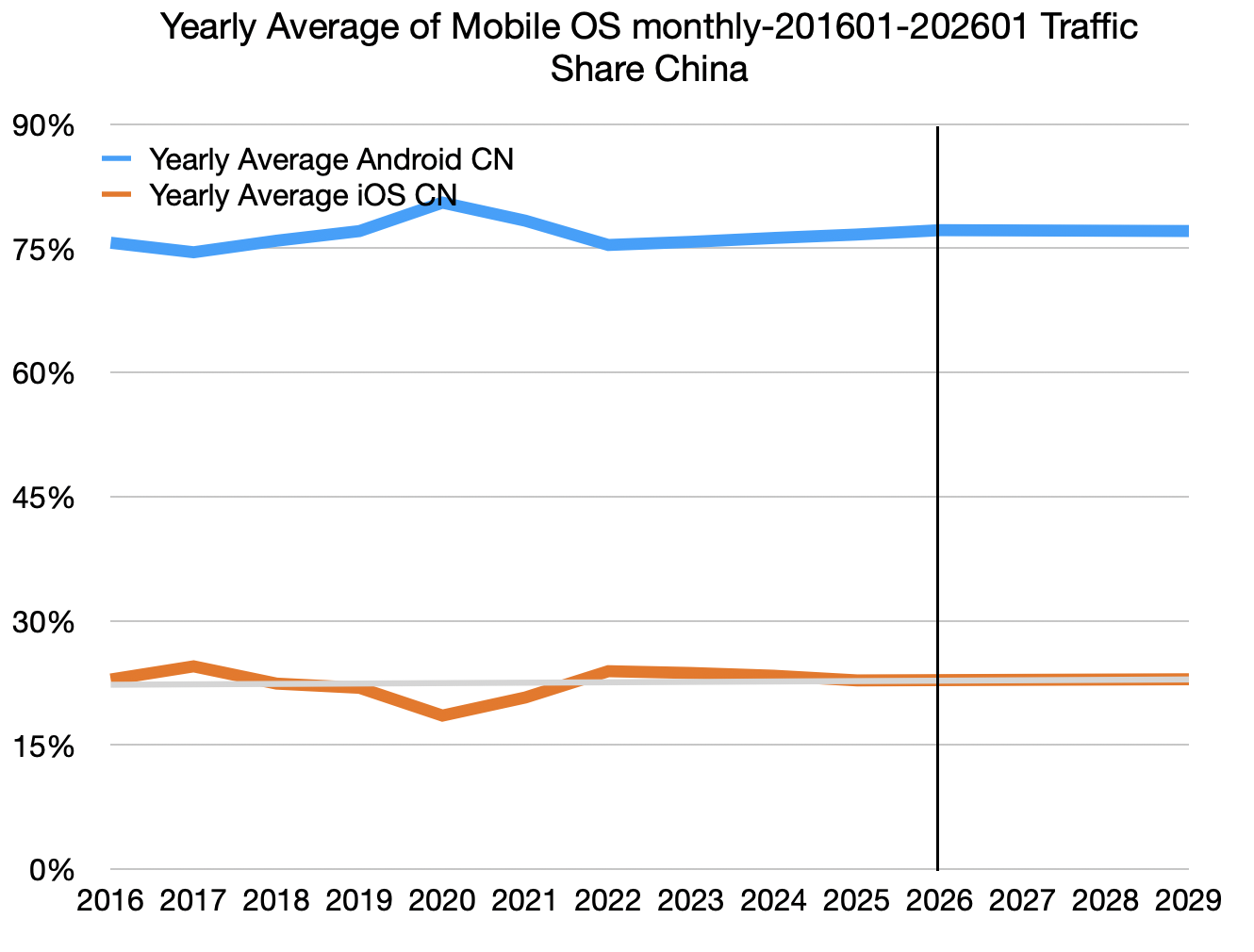
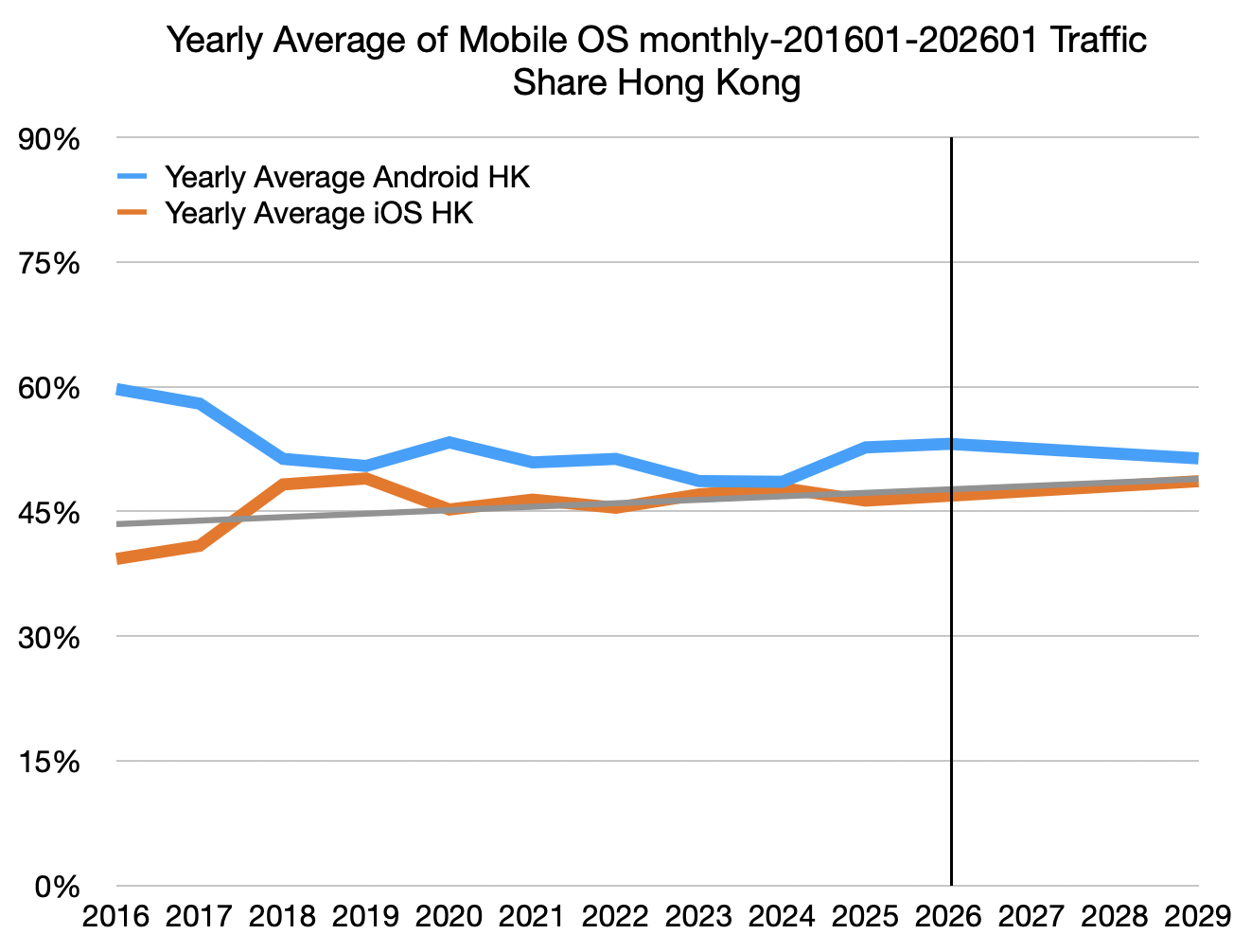
    Second, the population of smartphone users has been growing dramatically. In 2016 there were about 690 million (GC) and in 2025 the number is about 997 million. The forecast for 2029 is 1.08 billion.

    Third, the share of iOS has been rising but at different rates in the three regions (Macao is excluded because of small relative size, but Apple is holding iOS share steady at about 60%.)

    These graphs represent the trends in Mobile OS share as collected by Statcounter and trendlines for iOS are shown with projections to 2029.

    Multiplying the share numbers by the user numbers, including projections gives the following iOS users summary.

  4. Asymco Bulletin 001 / 22 Feb 2026

    Bulletin

    Asymco Bulletin is a digest of all the work we have published for the week ending Feb 22, 2026.

    Research

    Teen Survey Update: What happens when teens grow up?

    Latest data indicates 88% of teens own and intend to purchase iPhones, marking a decade-long trend of increasing adoption. This phenomenon transcends mere functionality; the iPhone has become a cultural icon, symbolizing status and identity.

    Unlike other Apple products, such as Apple TV+ or Apple Music, which struggle for traction among teens, the iPhone's appeal is deeply woven into the social fabric, partly due to generational continuity—the children of early iPhone adopters are now loyal users themselves.

    In contrast, social media platforms illustrate the fickle nature of tech usage among younger demographics. While Facebook remains prevalent among older millennials, Gen Z gravitates towards Instagram and TikTok, reflecting shifts in cultural preferences and digital behaviors.

    For Apple, success in services like Music and TV+ hinges on leveraging existing family dynamics through bundling.

    Read More →→→

    Apple in Europe: How many iPhone switchers are addressable in the near term?

    On the Q4 call, Tim Cook highlighted Greater China’s 38% year-over-year revenue growth, fueled by record iPhone sales, strong upgrade activity, and double-digit retail traffic gains.

    Europe, however, drew little attention—despite generating more revenue for Apple than China. This is peculiar.

    Europe’s smartphone market shows steady structural gains for iOS. Since 2018, share has risen from 24% to 39%, while Android has fallen from 74% to 60%—a 15-point swing equal to roughly 70 million additional users. With an installed base near 459 million users versus about 300 million in the U.S., Europe combines scale with affluence.

    In sum, the pattern for Apple in Europe is not saturation but share transfer, signaling durable competitive strength in a mature market and an inkling of how all markets will eventually behave in maturity.

    Read More →→→

    Estimating 2035 iPhone Users

    In the last quarter Apple reported 2.5 billion active devices. Of those, I estimate 1.6 billion are iPhones.

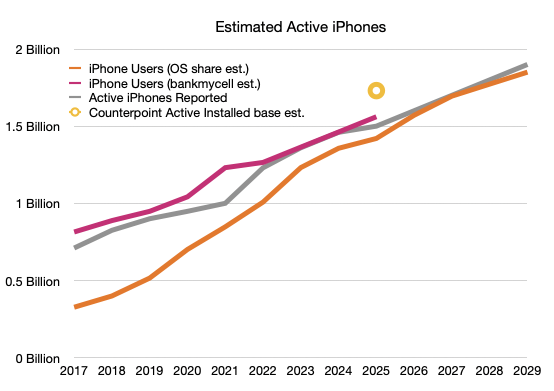
    Using this as a base, I've created an iPhone installed base estimate looking forward to 2030, integrating Statcounter’s market share data, Ericsson’s global smartphone user forecasts, and BankMyCell’s smartphone install base.

    The sources broadly align through 2025, though Statcounter’s historical iOS share (2017–2023) diverges somewhat, possibly reflecting Android’s heavier web traffic footprint due to usage patterns and bot activity rather.

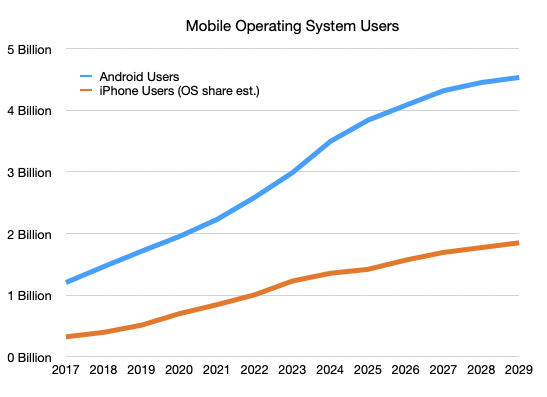
    Taken together, the data points to iPhone nearing 2 billion active devices by 2030, consistent with overall smartphone adoption. Android’s projected rise toward 4.5 billion users signals continuing headroom.

    If switching dynamics and monetization trends persist, Apple’s ecosystem could expand to 2.5–3 billion users by 2035, with growth thereafter driven by switching and increased engagement depth and value extraction per user.

    Read More →→→


    Nota Bene

    Apple Announces Special Event in New York, London, and Shanghai on March 4 → Apple is hosting intimate, global "Special Apple Experience" events on March 4, 2026, likely unveiling new products like the iPhone 17e and M5-powered MacBooks, marking a fresh twist on traditional live-streamed launches.

    Apple adds video experience to Apple Podcasts → The "pod" in podcasts originated from Apple's iPod, with the company popularizing the medium by integrating podcasting into iTunes in 2005, and continuing to innovate with features like video podcast support and dynamic ad insertion.

    Why not maroon? The Macalope ponders the power of color → Apple's upcoming lineup, featuring color-excited anticipation for the iPhone 17e and modest updates to iPads, promises subtle yet intriguing tech advancements.

    Dan Ives Says Apple’s AI Alone Could Be Worth $1.5 Trillion → Apple's unparalleled distribution through its vast user base offers a significant competitive edge for rapidly monetizing AI innovations, potentially adding $1.5 trillion in value.

    While big tech burns cash on AI, Apple waits → As foundation models commoditize, Apple strategically curates top AI tech into its ecosystem, prioritizing user experience over engine development.

    Secure the chips, absorb the costs, and grab more market share → Apple faces memory cost inflation potentially raising iPhone prices, yet its strong ecosystem and execution provide resilience, whereas competitors like Samsung may struggle more due to lesser volume leverage.

    iPhone Emergency SOS via Satellite Helped Six Skiers Survive Tahoe Avalanche → Six skiers survived a deadly Lake Tahoe avalanche by using iPhone's Emergency SOS via satellite, highlighting its transition from luxury to essential. This feature enabled crucial communication with rescuers in remote areas lacking cellular service. The evolution mirrors mobile phones but faces slower adoption due to satellite bandwidth constraints.

    The US Supreme Court has ruled against US President Donald Trump’s decision to impose a raft of global tariffs → Apple and other affected companies may soon seek refunds for tariffs paid, following the Supreme Court's decision to invalidate Trump's tariffs, though the exact timeline and amount remain uncertain.

    Bankers complain that Apple has a tight grip on mobile payments → Canadian banks struggled to compete in the mobile wallet market, dominated by tech giants like Apple and Google, due to their risk-averse nature clashing with tech's innovation-driven approach.


    The all new Asymco One

    Introducing Asymco One Early Bird Pricing. → Asymco celebrates 17 years of insightful Apple analysis, launching Asymco One to guide stakeholders through Apple's evolving era with comprehensive content and community engagement. →

    Introducing: Asymco One Office Hours → Join Asymco One's monthly Office Hours with Horace to get live insights on Apple's business and financials, with special editions during key events.

    All Asymco Podcasts. All in One: Asymco One. → Exciting news: All Asymco Podcasts now under Asymco One subscription with remastered classics and new episodes.


    Asymco One gives you full access to our research, analysis, and commentary. Subscribe with code BULLETIN for a discount.

    Feedback: Have questions or comments? Reach out to us at contact@asymco.com. We’d love to hear from you.

  5. Estimating 2035 iPhone Users

    Research

    Surveying multiple sources

    We have a firm hold on the number of active devices as well as the number of iPhones in use. This is due to Apple reporting the data. The latest active device count was 2.5 billion and the estimate for active iPhones is 1.6 billion.

    This patters also allows us to forecast the active base pretty accurately as the growth is predicted by the tight fitting linear approximation.

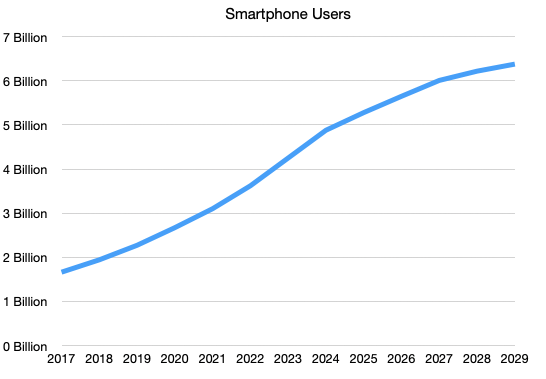
    For more confidence it would be useful to confirm these predictions with different estimates. For this I turned to two additional sources: the Statcounter GlobalStats measure of Mobile Operating System Market Shares Worldwide coupled with Number of Smartphone Users Worldwide (forecast by Ericsson) and the Number of of iPhone Users from Bankmycell.

    The total Smartphone Users history and forecast is shown below:

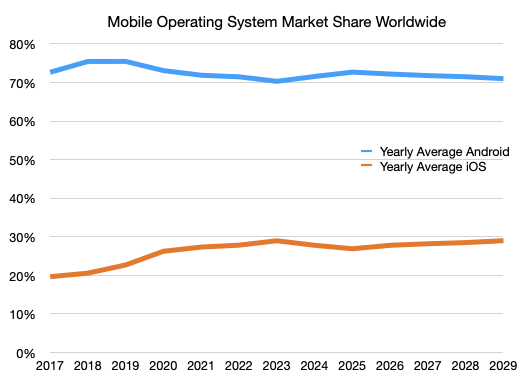
    The Mobile Operating System Market Share Worldwide is shown below:

    Multiplying these two yields the Mobile Operating System Users

    The iOS users (orange line) can now be compared to Apple's own reported active device total (grey line) and the Bankmycell estimate as well as a derived estimate from Counterpoint (24% share of install base)

    The graph includes forecasts from 2025 to 2029.

    Discussion:

    That, coupled with value captured per customer will determine the value of the firm.

  6. Introducing Asymco One Early Bird Pricing

    Invitation

    The all-in-one on Apple

    In July this of this year Asymco turns 17. In April of this year Apple turns 50. 

    This means that Asymco has been following Apple for one third of its life. I regret that it has not been for longer but oh, what a third it has been.

    • During 2009, Apple Net Sales were $46.7 billion.  17 years later revenues should comfortably top $500 billion. 
    • Earnings per share (split-adjusted) in 2009 were 37c. This year EPS will be around $9.5. 
    • Most importantly, at the end of 2009 Apple had about 107 million active devices (43 million Macs, 33 million iPhones and 30 million iPods!) Today it has 2.5 billion. 

    The increases in multiples:

    • 23x Active devices, or a compounded annual growth (CAGR) of 20%
    • 11x Revenues, CAGR of 15%
    • 26x Earnings, CAGR of 21%
    • Apart from the customer love affair these numbers reveal, investors were awakened.
      36x increase in Apple share price, from $7.5 to about $270. That’s 17 years of 23.5% growth. 

    The appreciation of the share price faster than the other underlying metrics reflects the undervaluation that existed for most of the last 17 years. Its value grew a lot more because it was too cheap to begin with. 

    That was perhaps my most important observation. A recurring undervaluation reflecting a perceived fragility. The more I studied and came to learn how the company operates the more I realized that the perception was wrong. It was in fact the opposite of reality.

    When I started my “Apple model” in 2009 I did it out of indignation. I had access to a few analyst reports covering the company and, when looking at their forecasts and assumptions, I was shocked to read that they treated Apple as a computer company. Two years had passed since the iPhone launched and I had made the radical assumption that the future of the company would be determined by the dynamics of phones--later to be broadened into “devices.” This did not appear radical to me because five years earlier Apple had created the market for music players. A market it came to dominate. It seemed very rational to me that with the iPod (and iTunes), Apple had demonstrated that it was more than a computer company. Or perhaps more accurately, it was so profoundly different as a computer company that it redefined what computers were. Nonetheless, observers seemed stuck with the perception that once a PC maker, always a PC maker.  

    So here is my prediction today: Apple at 50 is no less capable than Apple at 20. Indeed, it is more so.  This is because, even if it has not yet completed its quest, the company has sought self knowledge.  A knowledge which I have sought to gain as a distant observer.

    And so here I am, inviting you to come along with me on this journey. 

    Asymco is being re-launched. Apple at 50 is entering a new era. It has transitioned from Apple ][ to Mac to iPod, iPhone, iPad, Watch and Spatial Computing. But it has always been the company that brought computers to people and people to computers. The new era of computers that appear more like people is dawning and the connection between the two needs to be built. Only Apple is capable of creating this connection. And only Asymco is able to tell the asymmetric story of how it will happen.

    Let’s learn together. 

    To make this research possible we’re launching Asymco One. 

    Asymco One is the analysis you need for understanding everything in the world of Apple. It’s a bundle of seven categories of content:

    1. Curated news and commentary with Nota Bene. 
    2. Reconsider your assumptions with Research. 
    3. Save time with the weekly summary in the Bulletin. 
    4. Supercharge your narrative with Asymetric podcasts. 
    5. Get your questions answered during Office Hours. 
    6. Attend in-person or online the full-day Conference.
    7. Search over 1800 posts, 60,000 comments, 400 podcasts and thousands of graphs since July 2009 in the Archives.

    All while connecting with the most knowledgeable community of thinkers and investors in Apple.

    Asymco One is a bundle which will offer over one thousand updates per year providing the ultimate intuition on Apple for stakeholders and connoisseurs of the most important phenomenon of our time.

    It’s available as a subscription for $1000/yr, about the price of an adequately configured iPhone. 

    For early adopters we are offering a discount of $150 with the code INNOVATE.

    I hope to see you in the Comments, the Office Hours, the only Conference and in person. 

    Yours,

    Horace Dediu

    –
    Asymco One: About | Subscribe
    Use code PIONEER to save 25%.

  7. Dan Ives Says Apple's AI Alone Could Be Worth $1.5 Trillion

    Nota Bene

    What's the value of distribution?

    Dan Ives Says Apple's AI Alone Could Be Worth $1.5 Trillion — And Almost No One Is Pricing It In  Benzinga

    Apple's Biggest AI Advantage Is Its Installed Base
    Unlike most AI companies still searching for users, Apple already has them — more than 2.5 billion active devices and over 1.5 billion iPhones worldwide. That gives Apple an unmatched distribution engine to roll out AI-powered services instantly across its ecosystem.

    Ives expects Apple's long-awaited Siri overhaul and broader AI platform to begin rolling out in phases starting this summer, with more advanced capabilities arriving into 2026. The real opportunity isn't just smarter devices — it's monetization.

    Apple could introduce AI-driven subscription services, embedding recurring, high-margin software revenue into its ecosystem — a shift that would move Apple deeper into SaaS-like economics.

    Source: Benzinga

    NB: Modeling AI opportunities is an evolving problem. First we have the problem of costs which are changing rapidly and then there is adoption which is changing even faster. Revenues and cash flows are harder still as the business models are unclear. The products themselves are not necessarily stable and jobs-to-be-done questions abound.


  8. Introducing Asymco One

    Invitation

    The all-in-one on Apple

    In July this of this year Asymco turns 17. In April of this year Apple turns 50. 

    This means that Asymco has been following Apple for one third of its life. I regret that it has not been for longer but oh, what a third it has been.

    • During 2009, Apple Net Sales were $46.7 billion.  17 years later revenues should comfortably top $500 billion. 
    • Earnings per share (split-adjusted) in 2009 were 37c. This year EPS will be around $9.5. 
    • Most importantly, at the end of 2009 Apple had about 107 million active devices (43 million Macs, 33 million iPhones and 30 million iPods!) Today it has 2.5 billion. 

    The increases in multiples:

    • 23x Active devices, or a compounded annual growth (CAGR) of 20%
    • 11x Revenues, CAGR of 15%
    • 26x Earnings, CAGR of 21%
    • Apart from the customer love affair these numbers reveal, investors were awakened.
      36x increase in Apple share price, from $7.5 to about $270. That’s 17 years of 23.5% growth. 

    The appreciation of the share price faster than the other underlying metrics reflects the undervaluation that existed for most of the last 17 years. Its value grew a lot more because it was too cheap to begin with. 

    That was perhaps my most important observation. A recurring undervaluation reflecting a perceived fragility. The more I studied and came to learn how the company operates the more I realized that the perception was wrong. It was in fact the opposite of reality.

    When I started my “Apple model” in 2009 I did it out of indignation. I had access to a few analyst reports covering the company and, when looking at their forecasts and assumptions, I was shocked to read that they treated Apple as a computer company. Two years had passed since the iPhone launched and I had made the radical assumption that the future of the company would be determined by the dynamics of phones--later to be broadened into “devices.” This did not appear radical to me because five years earlier Apple had created the market for music players. A market it came to dominate. It seemed very rational to me that with the iPod (and iTunes), Apple had demonstrated that it was more than a computer company. Or perhaps more accurately, it was so profoundly different as a computer company that it redefined what computers were. Nonetheless, observers seemed stuck with the perception that once a PC maker, always a PC maker.  

    So here is my prediction today: Apple at 50 is no less capable than Apple at 20. Indeed, it is more so.  This is because, even if it has not yet completed its quest, the company has sought self knowledge.  A knowledge which I have sought to gain as a distant observer.

    And so here I am, inviting you to come along with me on this journey. 

    Asymco is being re-launched. Apple at 50 is entering a new era. It has transitioned from Apple ][ to Mac to iPod, iPhone, iPad, Watch and Spatial Computing. But it has always been the company that brought computers to people and people to computers. The new era of computers that appear more like people is dawning and the connection between the two needs to be built. Only Apple is capable of creating this connection. And only Asymco is able to tell the asymmetric story of how it will happen.

    Let’s learn together. 

    To make this research possible we’re launching Asymco One. 

    Asymco One is the analysis you need for understanding everything in the world of Apple. It’s a bundle of seven categories of content:

    1. Curated news and commentary with Nota Bene. 
    2. Reconsider your assumptions with Research. 
    3. Save time with the weekly summary in the Bulletin. 
    4. Supercharge your narrative with Asymetric podcasts. 
    5. Get your questions answered during Office Hours. 
    6. Attend in-person or online the full-day Conference.
    7. Search over 1800 posts, 60,000 comments, 400 podcasts and thousands of graphs since July 2009 in the Archives.

    All while connecting with the most knowledgeable community of thinkers and investors in Apple.

    Asymco One is a bundle which will offer over one thousand updates per year providing the ultimate intuition on Apple for stakeholders and connoisseurs of the most important phenomenon of our time.

    It’s available as a subscription for $1000/yr, about the price of an adequately configured iPhone. 

    But for you, dear reader, who have been with us for so long, I am offering a discount of $250 with the code PIONEER.

    I hope to see you in the Comments, the Office Hours, the only Conference and in person. 

    Yours,

    Horace Dediu

    –
    Asymco One: About | Subscribe
    Use code PIONEER to save 25%.

  9. 1.7 Billion Customers

    Research

    Apple reached a new milestone

    We are proud to report that we have a new record for our installed base with more than 2.5 billion active devices. -Tim Cook

    2.5 billion active devices follows the announcement of 2.35 billion active devices a year ago, a growth of 150 million devices in one year. Let's examine some of the implications.

    By my estimate, Apple sold about 250 million iPhones, 23 million Macs, 40 million Watches, 70 million iPads. Other devices including Apple TVs, Apple Vision Pro, Apple HomePods may add another 10 million units. Therefore the total number of "connected" devices sold is around 400 million/yr.

    Adding 150 million to the active base in one year implies that 250 million devices are replacements, many surely are reused but also at least a third (37.5%) of units sold are expanding the base. This is reflected by management's occasional mention that "nearly (or, alternatively, over) half of customers who purchased a <product> being new to the product".

    In the last quarter and for quite some time, <product> has been the Mac, the iPad and Apple Watch. If we use my estimates of units sold during the full year that means 17 million Macs, 20 million Watches and 35 million iPads were sold to new users. These add up to 72 non-iPhone new devices in use. That suggests about 78 million new iPhone users.

    How does this compare to the following pattern:

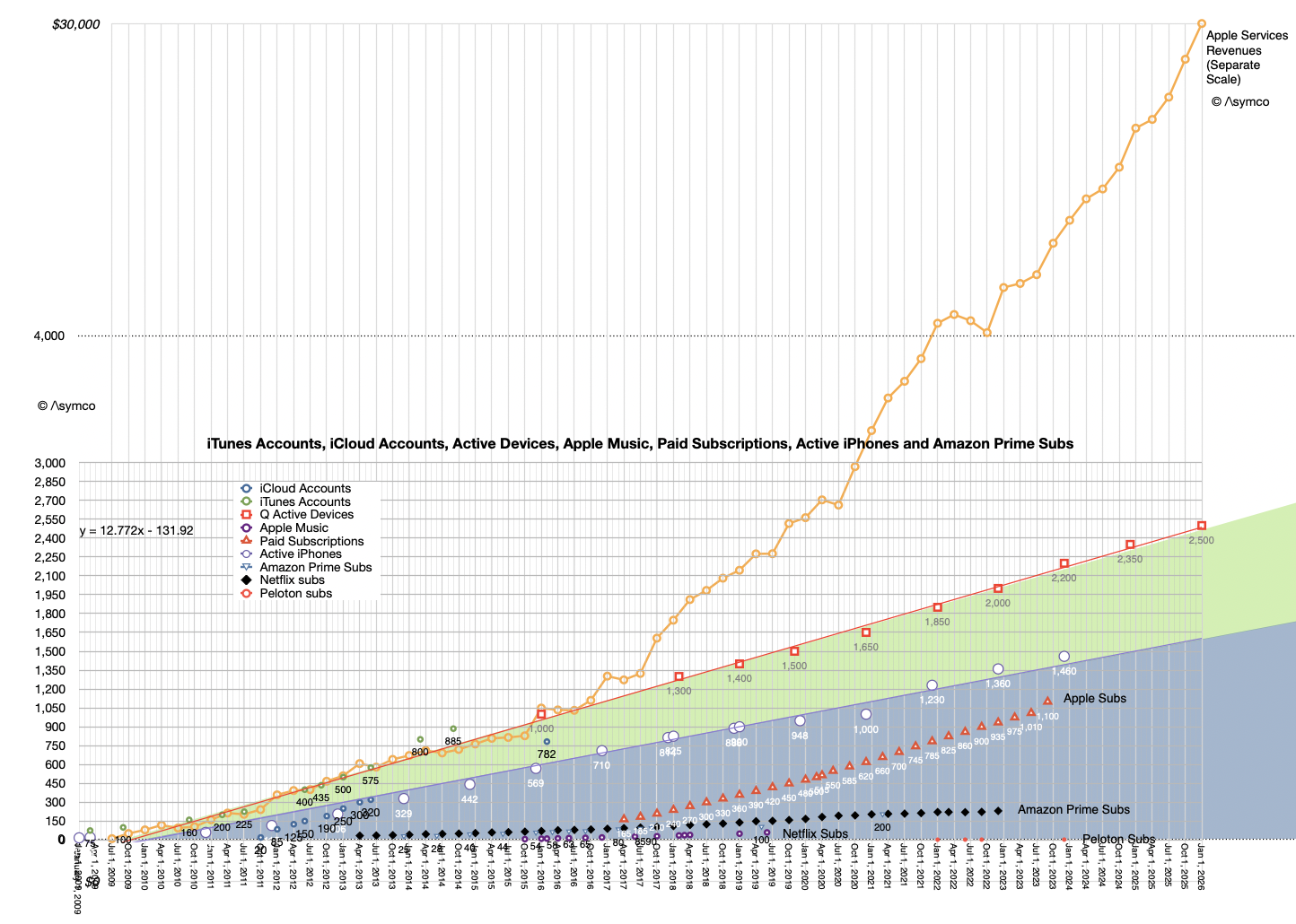
    A graph showing the growth of iTunes accounts, iCloud accounts, active devices, Apple Music, paid subscriptions, active iPhones, and Amazon Prime subscriptions over time, with trends highlighted for various services and revenue.

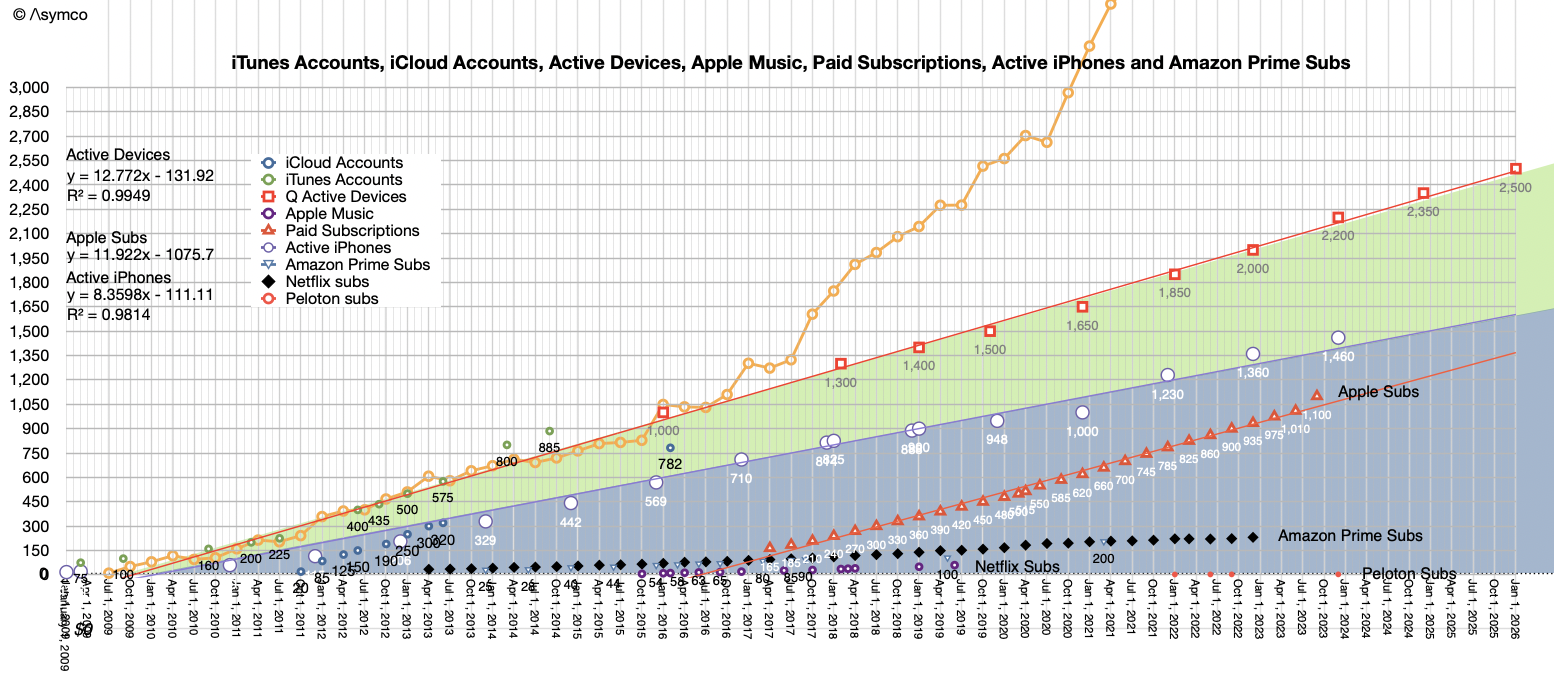
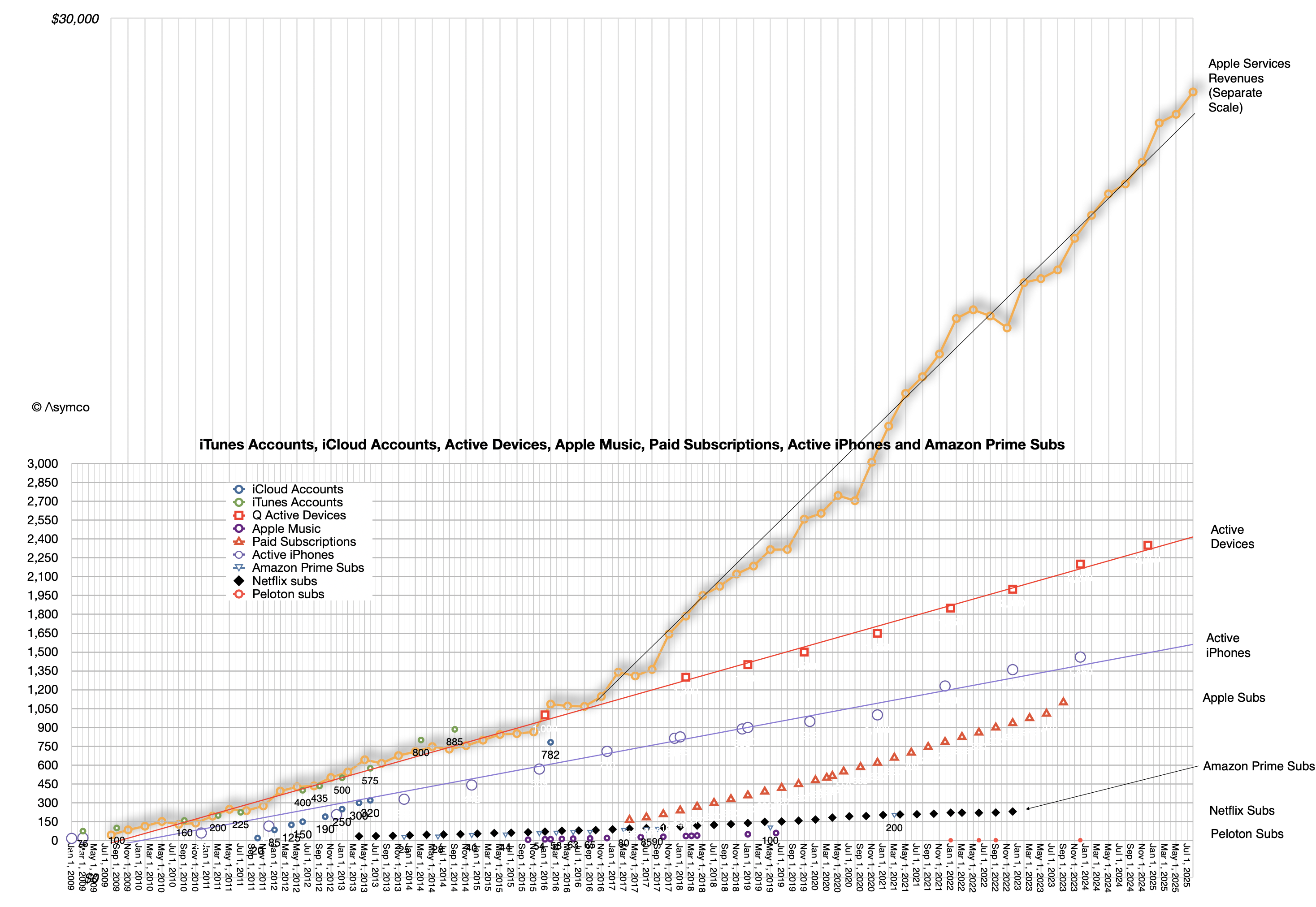
    The line to focus on is the red with square points. "Q Active Devices" is the history of what Apple calls "Quarterly Active" devices or those which ping an Apple server at least once a quarter. The data appears to be linear, or the growth is about 150 million per year at least since 2016. Historic data on the iPhone is also shown with a blue line. That is also consistent with about 100 million new iPhones in use every year. This is a bit higher than the 78 million bottom-up analysis of new users. I'd argue that Watch numbers may be a bit too high and perhaps iPad as well.

    The mix is a matter of debate but overall this consistency allows for some confident forecasting.

    • The iPhone will reach 1.7 billion active users by this time next year.
    • There will be three billion active devices by early 2029.
    • Services, which is shown in the second graph is clearly correlated to active device growth.
    • The consistency in active device growth is far more important than device sales in a particular period and determines the value of the company.

    Knowing this, here are some additional observations:

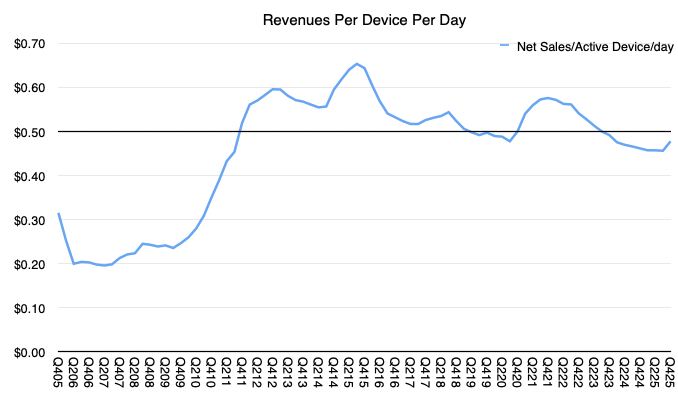
    Yearly revenues per active device are $129, services revenues per active device are $45 for a total revenue per active device at $174/device/yr. That is equivalent to 48c/device/day. Data shows that daily revenues have been an average of 53c/device/day for 59 quarters. My rule of thumb is 50c/day per active device is a good estimate for Apple's revenues, and estimate that I have been holding for over 14 years.

    Line graph showing revenues per device per day over time, with a blue line representing net sales per active device. The y-axis ranges from $0.00 to $0.70, while the x-axis denotes time periods from 09/09 to 04/25, illustrating fluctuations in daily revenues.

    There are additional implications. With a base of 1.65 billion iPhones, and knowledge of replacement vs. new-to-product/switcher growth what is their average lifespan and thus replacement rate and therefore what is the average selling price?

    This will be discussed in a future post.

  10. The Joy of (new) Numbers

    Research

    In the latest, (Fiscal Q3, Calendar Q2 2025) conference call, Tim Cook made a welcome announcement: "We also recently marked a significant milestone. We shipped the 3 billionth iPhone since its launch in 2007."

    This was welcome because the company has not been providing iPhone unit shipment numbers since Q4 2018. What it has meant is that the number of iPhones sold and their average selling price had to be estimated. Active iPhones were occasionally provided but quite rarely.

    With this update, the veil has been party lifted. I, as well as you I'm sure, rushed to assess how well we have been estimating the iPhone economy over the last seven years. Prior to Tim's data dump, my own estimate for total iPhone shipments was 3.104 billion, including the last quarter. [Keep in mind that the 3 billionth iPhone may have shipped in the beginning of the quarter which amounts to more than 50 million units prior to announcement so my error of 104 million is minus perhaps 50 million.]

    In the worst case, my error amounts to about 3.4% over the entire lifespan and perhaps 5% over the estimate period. That is perhaps not criminal since, after all, what's 100 million iPhones between friends?

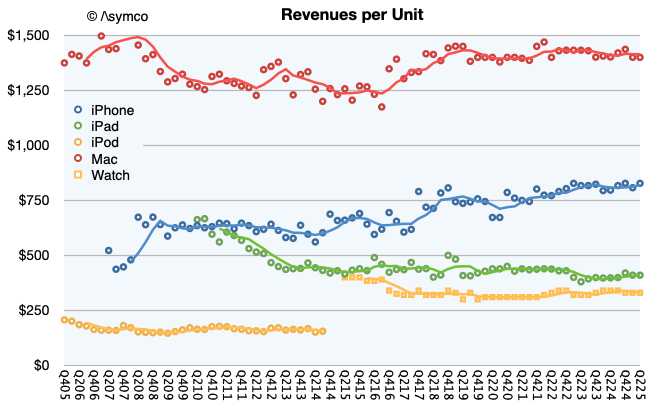
    I adjusted the estimated average selling price to reflect this error and shaved essentially one quarter's worth of shipments from the data set. In other words, my estimate would have been that 3 billion was reached in March rather than June. Mea culpa.

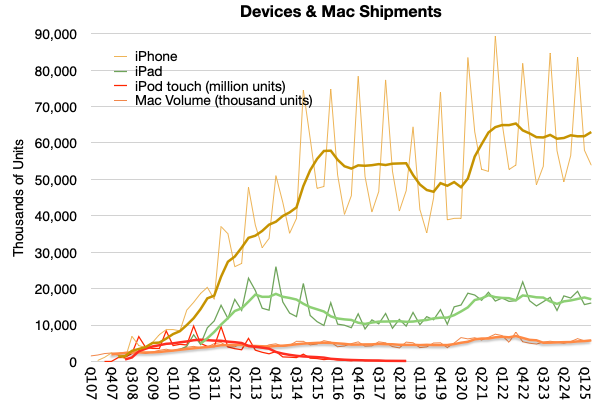
    The new view into the entire iPhone shipment history is shown below. Also below is the impact of adjustment in the revenue per unit (i.e. average selling price.)

    Note that I used trend lines to show the four-period (12 months) running average to remove the seasonality. Perhaps there is something to be read in the pattern. I would say that there are some notable surges as during the initial uptake, during the first "supercycle" in 2014, the surge during Covid and perhaps the "China recession" of 2018.

    Clearly we are not at the highest sales levels today, as the Covid surge will take some time to grow into but at the same time the volumes are not decreasing. You can see the contrast to the iPod touch when an alternative was available, namely the iPad. The demise of the iPhone has been greatly exaggerated.

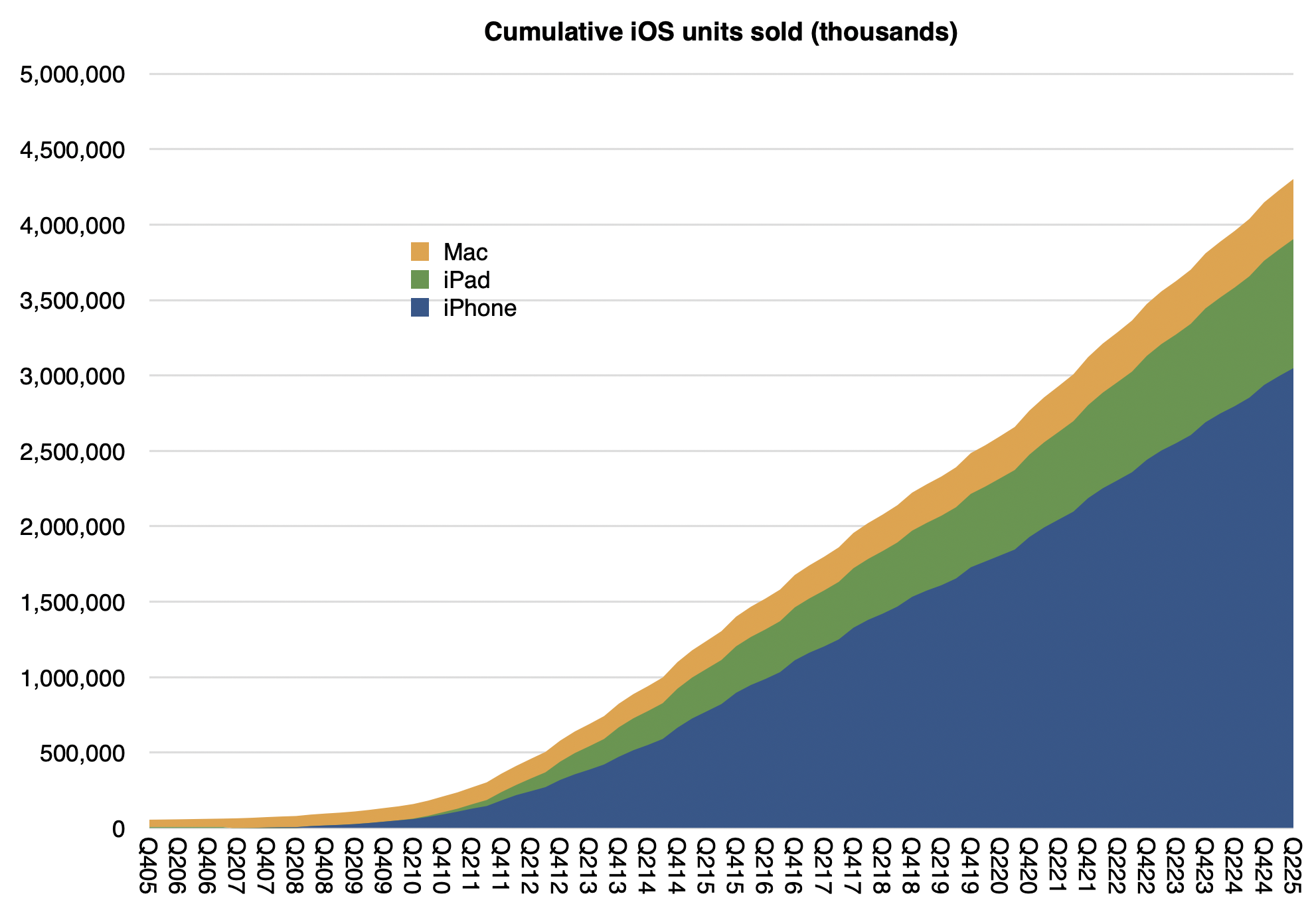
    Note also that I also included the iPad, Mac and the iPod touch for comparison. You can try your hand at reading the patterns there. For the record, my cumulative Mac estimate (since Q4 2005) is 398 million[1] and the cumulative iPad is 855 million. Here are the iPhone, iPad and Mac cumulatively with a current total of about 4.3 billion:

    Not shown are iPods (touch alone is about 114 million), Watches (probably at least 250 million) and Vision Pro (single digit millions) or wearables and home. If we did include those, it's a safe bet that Apple has shipped over 5 billion devices.

    Interesting, but not as interesting as how many are active (in use at least once a month.) For that estimate we have another set of data:

    The linear extrapolations for active devices, active iPhone and, on a separate scale, actual Apple Services revenues can be seen. Also subscriptions, as long as they were available, plus other data sets for comparison such as Amazon Prime subscriptions, Netfilx and old Apple Music and iCloud account data.

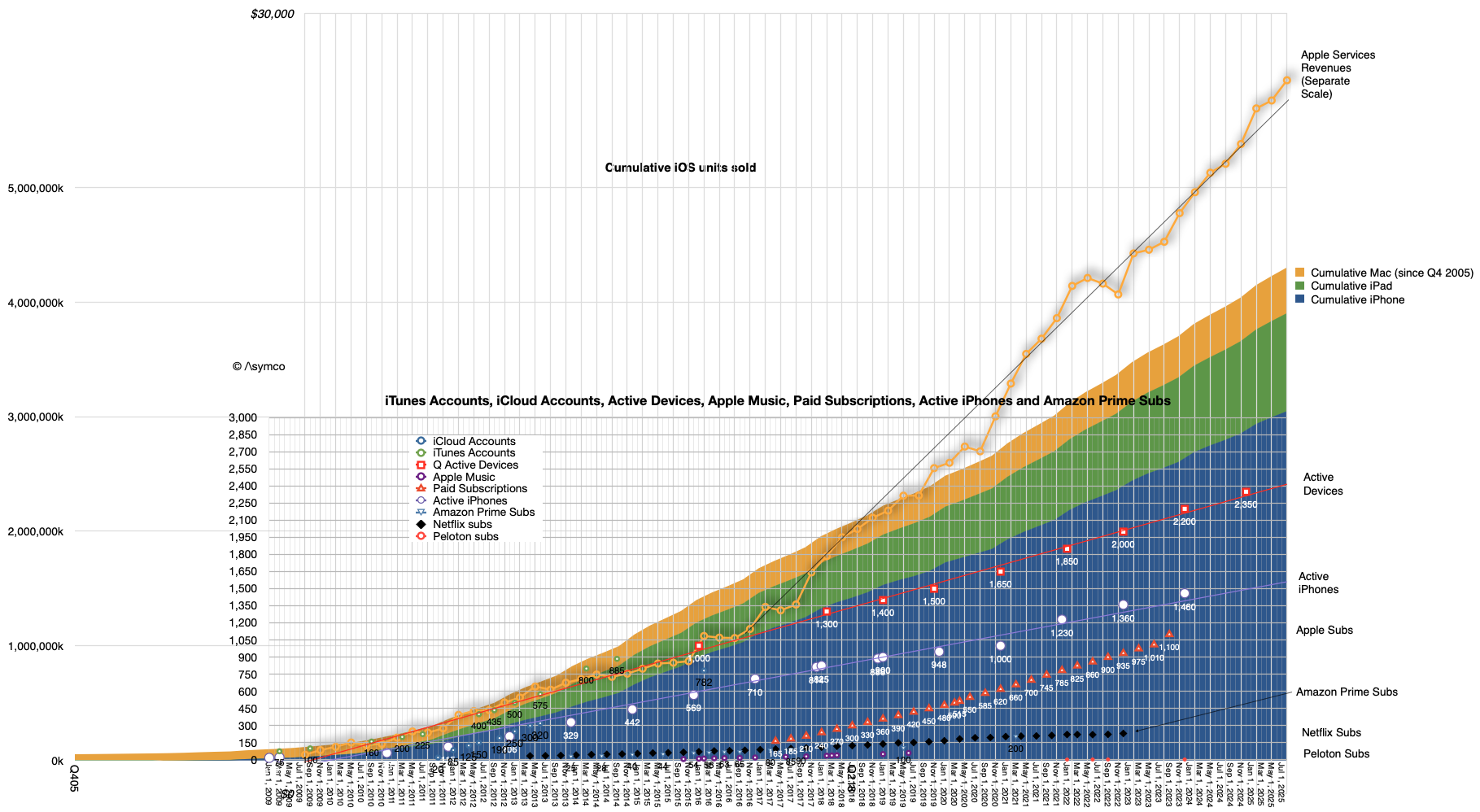
    At the risk of overloading an already busy graph, it might be interesting to show cumulative devices vs. active devices:

    The Composition of Active Devices

    The top of the area graph seems to be not too different than the top of the red dotted device line. What might be instructive is to calculate the ratio between these two: the active devices and the cumulative devices during the period from 2016 (when 1 billion active were reported) and the beginning of this year when the last figure was reported (2.35 billion active devices on Jan. 30 2025).

    Again, excluding wearables, iPod touch, Apple TV and Apple Vision Pro we have these ratios:

    DateRatio of Active devices to Cumulative iPhone, iPad and Mac sold
    Q4170.66
    Q4180.63
    Q4190.60
    Q4200.60
    Q4210.59
    Q4220.58
    Q4230.58
    Q4240.57

    What this suggests therefore is yet another way to forecast the value of Apple as an enterprise. We already know that the prediction of active devices, revenue per device and margin is sufficient to forecast the company's earnings. These all seem to be quite linear and thus predictable. Now we can add the relationship to devices sold as yet another way to calibrate or test assumptions.

    After diligently doing so, simply multiplying the results by a random number called the P/E ratio (aka "sentiment") allows you to predict the share price at any point in the future.

    Have fun.

    1. It would be interesting to consider that if, as it's been often claimed by Apple, half of Mac users and half of iPad users are new to the products, then there would be 200 million new Mac users and perhaps 400 million iPad users.
  11. Google and Apple: The Future

    Research

    In yesterday's post, I proposed a way to inspect the Google-Apple distribution deal. It could be understood as a flat-rate deal where default placement of Google search in Safari is paid for with a constant run rate. This was the assumption for a few years with estimates for this run rate ranging widely.

    Alternatively, it could be understood as a commission rate where payments are in proportion to ad sales. This is the 36% commission rate that has leaked during the antitrust trial.

    Finally, it could also be seen as an access fee for each individual. This is the 17c/user/day that seems apparent from my calculations.

    If one were to critique these options, I would disqualify the flat rate as unfavorable to Apple since the user base grows and behaviors can shift. The distribution commission sounds ideal but it would be problematic to enforce. How exactly can one track the precise income obtained by Google for each use of search, maps or YouTube on iOS or MacOS devices reliably enough with an audit trail for Apple to inspect?

    For these reasons, I believe the fee of $x/user (or possibly active device as a proxy) makes more sense. The burden would be on Apple to prove that they have such active users/devices while Google could sample their metrics to confirm. Data on active users and devices are figures that Apple already supplies publicly and a method for determining them likely could stand scrutiny by outsiders. The server logs showing active devices can't be too onerous to share.

    And so that's the model I'm going with. Having said that, the formulation of compensation for what is a complex distribution deal is likely complex. The abstraction to users/devices is one we have to live with given the challenges of inspecting the invisible.

    That's the model of the present. The future however is clouded by the potential interference of authorities. In this case, an antitrust prosecution of Google is asking whether the way Google buys distribution is anti-competitive. The legal arguments are beyond scope here but the gist of it is that buying exclusive distribution when you are dominant may close options to not-so-dominant competitors.

    The consequences, if we are to believe the commentary, are that the deal with Apple could be declared illegal and thus, stay with me here, Apple would lose a lucrative source of income.

    Let me repeat this for emphasis: If Google were found guilty of anti-competitive behavior, Apple would be punished.

    Let me expand for emphasis: If Google were found guilty of anti-competitive behavior, Google will be forced spend far less and be marched off a gangplank to swim in far greater profits.

    Given this commentary one wonders why Google's management and legal team aren't begging the judge to rule against them and why Google shareholders aren't hoisting the prosecuting team on their shoulders.

    The deal between Google and Apple exists only because both Google and Apple find it to be a better alternative to not having a deal or having any another deal. It does not exist because Apple benefits and Google doesn't or that Google benefits and Apple doesn't.

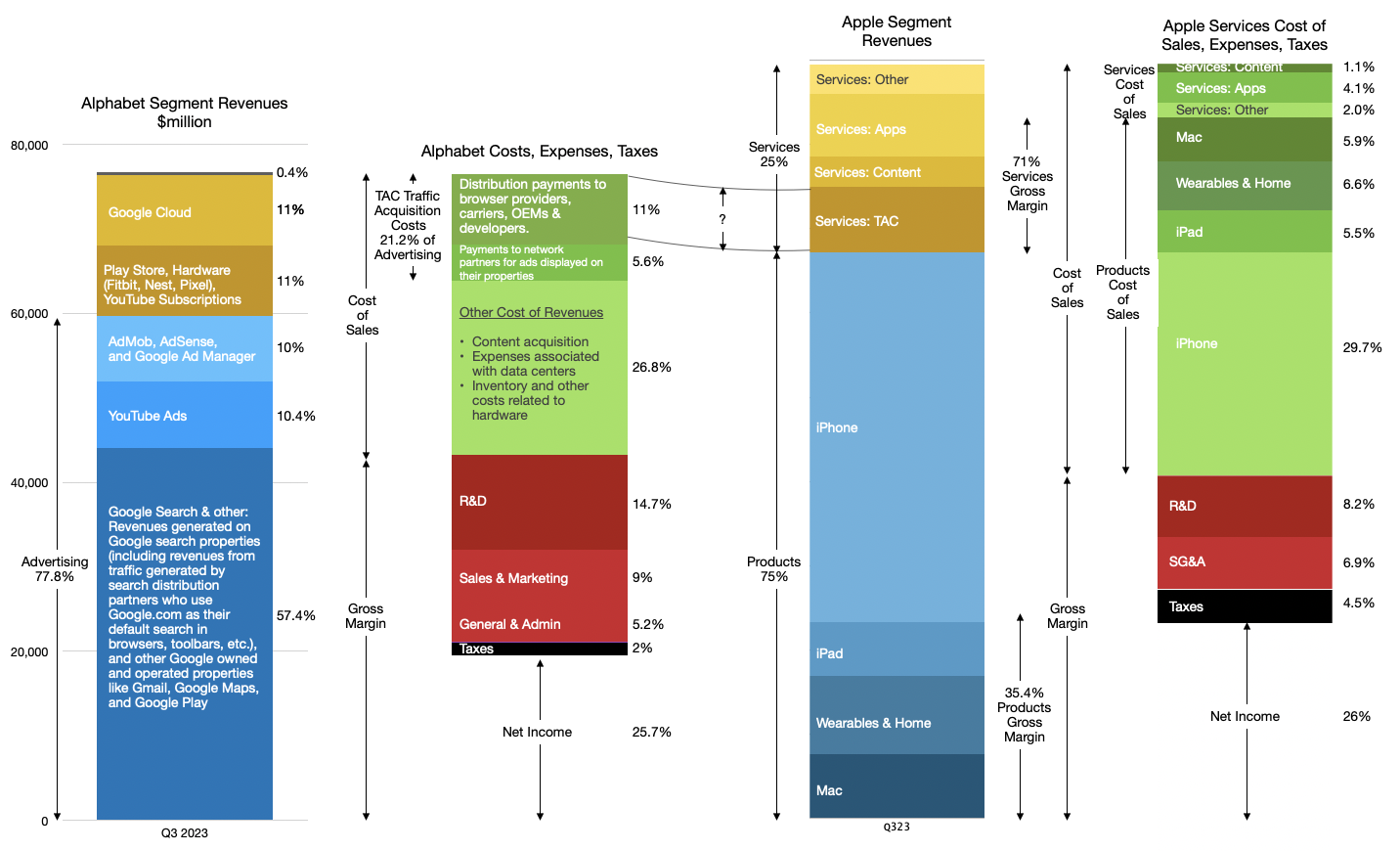
    As I've explained the first post in this series, Google's benefit is distribution or access to 1.3 billion very valuable customers. For this they pay quite a lot and Apple receives quite a lot in turn. The relationship is shown in this illustration:

    But—and here you should pay close attention—Apple also pays something for that benefit. Apple's $26b+ income from Google's TAC payments are in exchange for offering access. To Google. Not to someone else. And not to itself. Apple's costs are opportunity costs.

    If Google had not offered the area marked with a question mark in the image above then Apple would have found alternatives. Alternatives that it's saying no to today.

    Apple's alternative to the deal is what needs to be studied.

    Could, for example, Apple have signed Microsoft for Bing access in Safari? Sure! They probably didn't because, as they declared, the quality of Bing would not be as good and as a result most people would switch out of it and thus result in lower revenues. Then again, perhaps Apple could make a fortune from Microsoft. Apple could have enabled Microsoft to rise to 40% market share in search, and also improving its quality. How much would that be worth to Microsoft? How much additional opportunity could Microsoft create from establishing such a strong consumer-facing franchise—something they have struggled to obtain even with vast expenditures. Surely Microsoft could be convinced to split revenues 50/50 for what would be all marginally zero-cost new upside!

    Could Apple have developed its own search? Sure! They probably already did. Internet Search is a lot easier in 2023 than it was in 2007. Costs for computation, communication and storage drop exponentially while the number of internet hosts has stopped growing. Apple uses indexing in Siri and each iPhone, Mac and iPad runs a local search engine (Spotlight). Again, there are reasons why this is not as good or easy as signing Google up. But on the other hand, perhaps Apple could be making a killing on search. Why accept a 36% commission from Google when they could take 100% of 40% of all Search?

    But most importantly, a declaration that this deal is invalid simply means that Apple and Google would craft another deal that would work around the restrictions. And that new deal would probably turn out to be more beneficial to Apple.

    Why, I hear you ask?

    Because Google would ask for the changes! Google would be forced to re-negotiate because they lost at trial. If that were the case, Apple would naturally ask for concessions. The most certain outcome would be that Apple will be paid even more for access to its users.

    How much more? Remember that Google must ensure access to Apple's customers. According to my calculations Apple customers deliver almost 40% of its advertising revenues. The 36% commission suggests that there is plenty of head-room. Apple could ask for 50% and meter the results on a different basis. This would be a 39% increase in pricing for distribution.

    This would result in a deal worth $41 billion/yr.

    To implement workarounds, the companies would need to bridge their servers in order to ensure metering along new metrics. There would a great deal of complexity. But it would be worth it because both would find such a deal better than alternatives.

    Fundamentally, the relationship between Google and Apple exists and will continue to exist because it is mutually beneficial and a better alternative to any other agreement or no agreement. If the current deal is found unsound, for whatever reason, a new deal will be created because it will need to be created.

    Apple sits in a better position today than it ever did. Its customer base is growing while its pricing power with consumers is growing. In contrast, Google is the process of explaining that it did not break any laws. This while losing Android users to Apple. How does this lead to a vulnerability for Apple?

    What we are witness to here is Apple increasing its distribution pricing power while simultaneously decreasing its opportunity costs.

    The idea that Google being found guilty of anti-competitive behavior would result in a "hit to Apple earnings" is preposterous and fails on first inspection. The exact opposite is the likely outcome.