Asymco

Asymmetric Intelligence

Amazon

  1. Monthly Apple Users

    Research · 70 comments

    In the postmodern computing world that we live in, the measure of success isn't revenue or profit or units sold but the number of users that an ecosystem can attract. Therefore the monthly active user (MAU) unit of performance seems to be in vogue right now. E.g.:

    • Facebook claims Messenger has more than 200 million MAUs
    • WhatsApp has 500 million MAUs, 48 million of whom are in India
    • Line last month announced that it had 400 million users (active or not)
    • WeChat claimed 355 million MAUs
    • Viber claims 105 million MAUs

    Startups are aggregating these millions of MAUs in order to obtain valuations for raising capital ((It's been said that it's difficult to get funded with only 10 million MAUs)) and the faster the growth in MAUs the more "successful" the company is considered.

    When companies are acquired it's common to take the transaction value and divide it by MAUs to get an idea of "what an user is worth". This is because there are no revenues to measure and MAUs are taken as a proxy. However, the process by which a MAU becomes a dollar of profit is, to put it kindly, circuitous.

    For most (all?) it's not yet clear how it happens especially since not all MAUs are created equal and MAU loyalties can change rapidly and if we added all the projected revenues each MAU will contribute to each app on her device we might reach some absurdity. In actuality, today, for the companies listed above, there are no revenues at all directly from their services.

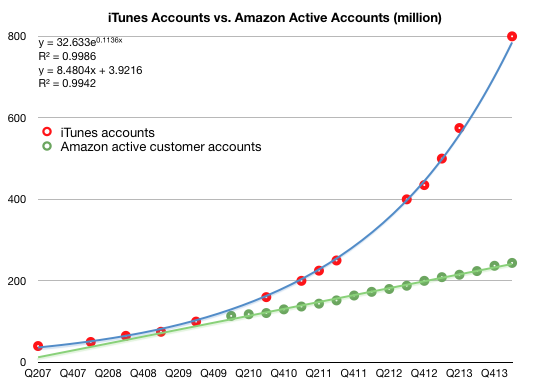
    In violation of this convention, there are some companies which manage to obtain revenues from their users. Two such are Apple and Amazon.  In the last quarter Apple reported having 800 million iTunes accounts. ((adding, for some unknown reason, that most of them have credit cards.))  These aren't MAUs since the activity level is not noted, but we do know how much is spent on iTunes and services. In addition, Amazon cites 244 million active customer accounts  representing accounts which generated purchases within the last 12 months.

    This allows us to compare Apple and Amazon in terms of accounts, revenue per account, and, via some analysis, even profitability per account.

    The following graphs tell this story. First, the total number of accounts:
    Screen Shot 2014-04-29 at 4-29-11.25.29 AM

    Note that I added trend lines to both graphs and their formulas.

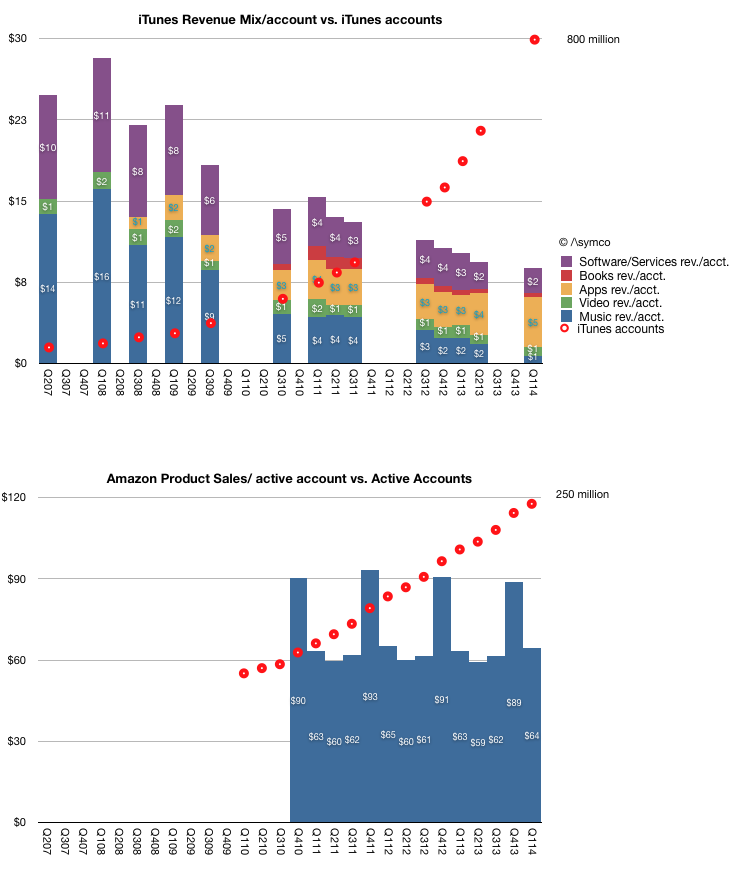
    The following are the revenue per account for iTunes (further broken into estimated iTunes segment revenues per account.) and for Amazon. Note that the vertical scales are different.
    Screen Shot 2014-04-29 at 4-29-12.05.06 PM

    This view shows just how different the economic value of users can be. In the case of Apple, it's growing its user base at (literally) exponential rates. The revenues per user does, understandably, decline. This is because new/later users don't spend as much as early users. There might be some stability toward the later stages of adoption in revenue per user. The other point about iTunes data is how the mix of revenues has shifted from music to Apps and Services pointing out how users can be migrated across revenue sources over time.

    In the case of Amazon it's growing its user base at a linear rate (note equation). The revenue per account remains very steady however.

    Broadly speaking, it would seem logical that the speed of user growth has an effect on the quality of those users. This relationship should guide further thinking about the quality of hundreds of millions of users acquired within a few months.

    Apple's user growth is a function of expanding its device portfolio and distribution. Apple has shown that there are limits this type of growth. Achieving 830 million or so iOS device sales within 7 years is an amazing feat and one can forgive not having achieved billions more since they managed to obtain significant hardware and service/content revenues from most of them and that those who reached higher figures more quickly didn't manage the same revenue per user.

    Amazon's user growth is a function of expanding its logistics and merchandise mix. This is also not easy to do globally. Arguably, Amazon cannot scale in the exponential rates seen by Apple or the other MAU aggregators because it has to depend on trucks and roads and regulators to complete most of its sales.

    I suppose, in conclusion, that there is no "right" or "wrong" business model for a user base. Both Apple and Amazon are doing well in building their customer bases and creating loyalties which will serve them well in the future. However whereas there is no right or wrong revenue structure per user, it seems to me that there ought to be some such structure. In most cases this remains a matter of faith rather than reason.
  2. Bundling and Pricing Innovation

    Research · 85 comments

    This was initially posted on LinkedIn December 16, 2013.

    Innovation comes in many forms. Many times innovation is thought of as technological improvement or as invention. We can all cite examples of inventions which turned into industries which re-defined civilization. The steam engine comes to mind but there were many others before and after. Inventing something is certainly a way to create value but it's not as common or as reliable a method as it might seem. Creating Intellectual Property is one thing, finding a defensible market and business model is quite another.

    More often companies innovate in terms of processes or the "algorithms" which are used to deploy existing resources. Wal*Mart was immensely innovative in the way it organized itself and laid out a low-cost business model. More recently Amazon has innovated in distribution and fulfillment based on the ability to dispense with showrooms for products and sell directly online. There is little in terms of technology which Amazon "invented". Rather, it deployed off-the-shelf technology in a novel way.

    But what I want to address is a more mundane sort of innovation: marketing innovation, specifically pricing. Few would consider a price model to be an innovation but in fact it's a core lynchpin to many breakthrough innovations. It was pricing which permitted Henry Ford to build an industrial empire. He could have built cars for those who could afford them as cars were defined in 1907 but he chose to build a car around a price point which was around the median of the population. A car "so low in price that no man making a good salary will be unable to own one." His business logic began with a price and the product and process followed.

    Another aspect of pricing innovation is "bundling" where products which might sell poorly independent of each other sell very well when coupled with complements. Consider the original Microsoft Office. When introduced vis-a-vis Lotus 1-2-3 and WordPerfect as separate products, it handily won the market for spreadsheets and word processors. Bundling is also the way TV is sold. Cable companies don't offer channels a-la-carte. It even took root in the car business. Automakers are now selling upgrades as "equipment packages", a method proving far more popular (and profitable) than the menu system of old.

    But there are cases where bundling has been rejected by users. iTunes broke the bundle of the "Album" where the only way you could get a single was to buy a dozen other songs. Once broken, the album bundle shows no signs of a come-back. Many are questioning whether TV channel bundling is also ripe for such a break-up.

    And there is yet another looming bundle question. For as long as the market existed, mobile carriers sold their service bundled with a device. This harks back to the days when AT&T (known then as the Bell Network) did not permit users to own their own landline phone. They argued that the device is a part of the network and choice in the matter would compromise security and safety of a crucial infrastructure. The argument played well with regulators for decades.

    This tie between the device and the service persists today but the connection has been preserved not though regulatory fiat but through incentives in pricing. Arguably, the low price of devices, and hence cost of entry, has meant that penetration skyrocketed. Cellular service now reached saturation in the US in near-record time. The upgrading to smartphones is now about 60% complete and looks to saturate a mere 8 years after reaching 10% of the population.

    So in a way, the "innovation" of the carriers has been in bundling and creating a package that was irresistible to consumers. They went from not consuming mobile networks to consuming them universally. The amount being spent by consumers on mobile services is above $1.3 trillion world-wide--a market that did not even exist 20 years ago.

    So now the question being asked, even within the industry, is whether this bundling can long last. The way I would answer the question is by following the logic from the consumer's point of view. If the bundle is valuable, then it's likely it will be tolerated, even preferred. In the case of software and car options the model works. Even in the case of TV the model is still preferred as few consumers are defecting to the IP-based unbundled alternatives. In the case of music, the consumers prefer the unbundling because there were things in the bundle which they did not need or want. They wanted a song, not a song and others which they might like.

    But in the case of network service and device, the split is more subtle. A service is useless without a device and a device is useless without a service. The bundle makes sense from the point of view of co-dependency of modules. The broader question is one of choice. The premise of unbundling might be that users can choose service and devices separately and change them arbitrarily.

    There is a fundamental problem with this however. A service that can be switched on or off easily by consumers is economically challenging for network operators. The economics of networks are such that financing them requires steady cash flow and every operator desires stability. So incentives will be put in place for consumers to stick around, and these incentives (read innovations) work. But isn't the device itself such an incentive?

    We end up back where we started. The business model and economics of operators world-wide is such that the device is a critical part of the incentive structure which preserves the network's economic balance.

    It may be an illusion, but a cheap phone (with a long-term contract) is a fundamental innovation devised by telco operators even before the phone became mobile. Operators have come to love it and no matter how many technology generations go by; how many family plans, bucket plans, weekend minutes, rollovers, and data packages; no matter how many tweaks and re-brands the model gets, it will persist. There simply isn't sufficient win-win value in alternatives.

  3. The Critical Path #103: The Amazon Electric Car

    Podcast · 13 comments

    A history of retail as a series of innovations in transportation. How to think about Amazon in a continuum of changing consumer behavior. The source of Amazon's market power and its hypothetical disruption. What would Amazon do and not do to improve its business.

    via 5by5 | The Critical Path #103: The Amazon Electric Car.

    (Note:  This recording took place a few days before  Amazon announced the drone-based Prime Air prototype service.)

  4. What's an Active User worth?

    Research · 86 comments

    Apple has sold 700 million iOS devices. Google claims one billion Android device activations. Microsoft has about 1.5 billion Windows users and Facebook about 1.19 billion. LinkedIn has 259 million users and Twitter has 232 million. Amazon has 215 active account holders and PayPal 137 million.

    Markets place a value on these users implicitly when company shares are priced. For example, Twitter whose users are worth about $110 or FaceBook's $98 and LinkedIn at $93.

    This consistency suggests a universally accepted value per social media user but what is the value of an ecosystem user? Apple, Google, Microsoft and even Amazon aspire to enable ecosystems which should be seen are more valuable than mere communities. Ecosystems enable a higher level of economic activity because they are unbounded by the medium itself. Any number of media can be created. Or so the theory goes.

    If we could determine a value for an ecosystem user we could test it against the going value of a social media user. Fortunately we have enough data to do so.

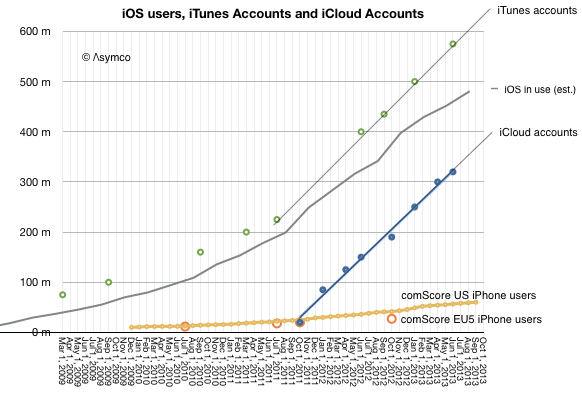
    The total number of iOS devices sold per quarter allows us to measure the install base of device users. With some assumptions regarding the retirement and attrition rate we can get the following history:

    Screen Shot 2013-11-11 at 11-11-11.52.34 AM

    Since the total number of iTunes accounts is updated with some regularity I've added it to the graph. I've also shown on the same graph the total number of iCloud accounts. For calibration, I included survey data showing the number of iPhone users in two regions (US and EU5).

    These combined graphs give us an upper bound of active users (iTunes accounts) and a lower bound (iCloud) calibrating our device-based estimate. The regional iPhone data offers some additional test on growth.

    The result is "about 500 million" ((482 million by my count but with quite a bit of margin of error)) with a growth of about 11 million per month.

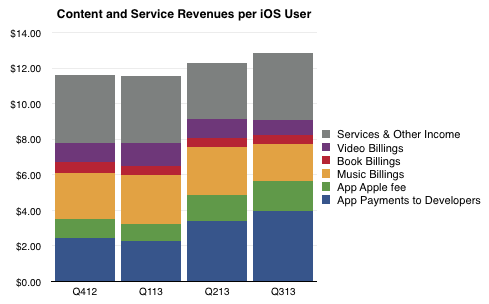
    So if we know with some confidence that there are about 500 million active users as part of the iOS ecosystem, how do we know how much value they generate? The answer is in the consolidated iTunes revenues as reported by Apple: $4.26 billion/quarter. With some attention to the reported media retail and purchases, the following picture of the average iOS user's quarterly spending emerges:

    Screen Shot 2013-11-11 at 11-11-11.50.23 AM

    The bottom line is that in the last 12 months the average iOS user contributed  about $48/yr to the ecosystem via Apple's own properties. They also bought the device and paid for cellular service in most cases. They may also have engaged in quite a bit of browsing and online purchases which fed other ecosystems. But as far as Apple is concerned, it transacted about $48 per user.

    As Twitter revenues last year were $317 million, the Twitter user today generates about $1.36 of revenue per year or one thirty-fifth of what an iOS user generates through iTunes and iCloud alone. And note that the number of iOS users is about twice that of Twitter.

    Of course one could argue that the iOS user's participation is not profitable for Apple. It does obtain massive cash flow from iTunes which finances its fashionable data centers and bandwidth but it does not presume to value itself primarily through this revenue.

    Or at least the market doesn't think so. We don't hear much about how Apple is worth so many dollars per user. ((I suppose the corollary to this is that Apple users are disloyal or fickle or fleeting, and quite contrary to observed behavior.))

    The paradox is that while the device which enables this commerce is where Apple guides the consumer's perception of value, markets discount devices and bid up services. In other words, users continue to pay for the devices which delight them enough to participate in services (especially the monthly billable kind) but markets walk right by these shiny baubles and and shower money on services which have negligible sales and even fewer profits. There must be some serious misdirection going on here. The question is who's being fooled.

  5. An interview with Niaz Uddin at eTalks

    Research · 29 comments

    My thanks to Niaz Uddin for asking some good questions and posting my replies:

    Horace Dediu on Asymco, Apple and Future of Computing | eTalks.

    Full interview is here, excerpts below:

    Niaz: Why do you study Apple?

    Horace: Apple is an interesting company to study because its success comes from being a serial disruptor. This is a very rare type of success formula. I am trying to "reverse engineer" its operating model and I hope that such a model is one which others might learn from if they were to emulate it. The trouble is that very few others seem to want to emulate Apple. Why that is is also an interesting question.

    Niaz: […] Do you think apple has lost its image that it has created over the years as a center of innovation and building excellent products?

    Horace: I cannot comment on how Apple's image is measured by people in the industry. I have been listening to commentary on Apple for about a decade and I have never seen any change in pattern. The company has always been perceived as a failure by a majority of observers. With respect to its products, I also do not see a change in the pattern established over the last decade.

    Niaz: Are you optimist about the future success of Apple? Like after 10 years and then 20 years?

    Horace: Let me put it this way: if there were no Apple then somebody will have to invent an Apple to do the same thing Apple does. In that sense I'm optimistic that there will be an Apple in some way in perpetuity.

    Niaz: What will be the next big innovation from Apple?

    Horace: I have no idea but it's likely to involve refining new user interaction methods. Similar to the breakthroughs that came from the use of a mouse, a scroll wheel and a touch screen. It means making computers better at gleaning our intentions without our getting involved in explaining them.

    Niaz: Will Apple, Google and Samsung be the major player for the future of computing? Or we can hope to see some new faces?

    Horace: I am fairly sure Samsung will not be because they have not yet grafted software and services to their operating structure. I would give Amazon a higher probability in being a successful platform alternative.

    Niaz: In 2011 you’ve written a blog post ‘Steve Jobs’ Ultimate Lesson for Companies’ on Harvard Business Review Blog and you have cited ‘A leader should aspire to do more. A leader should claim to have left a legacy not just on their company but on all companies.’ As you know Google, Amazon, Samsung, Facebook … all have learnt lifetime lessons from Steve Jobs. What do you think about the impact that Steve Jobs have created?

    Horace: He led by example and like all great leaders sacrificed much as a way to inspire others to follow him. He also spent time in the wilderness and chose asceticism. This gave him authority. Many historical figures had the same quality. The problem is that few business leaders have it but I don't see why they shouldn't.

    Much more on evaluating Tim Cook's performance, the iPhone portfolio, the rise of Android, Microsoft/Nokia, wearable technology and disrupting Google. Check it out on eTalks.


  6. The Anti-Apple

    Research · 272 comments

    Building a successful business is hard. Many try, few succeed and those that do tend not to thrive for long. So success in business it should be respected. Especially in highly competitive industries like technology. The fragility of success however should also give one pause to think about how delicate a business model is.

    The presumption that companies can shift business models at will is usually false. Businesses are balanced on a knife's edge of dependency on multiple variables. Almost all resources are expended on preserving this balance.

    This being my observation, I take issue with assumptions that large companies can "pivot" on a dime or that they can change their business models "when conditions are right". Consider Microsoft's dilemma. They have all the resources in the world and yet they could not pivot to take advantage of a change so mundane as a low power microprocessor (which enabled a mobile computer and hence a new ecosystem and profit model for software.)

    Or consider the dilemma of Apple which after building a successful computer business which included system software, could not pivot to license that system software so others could build computers with it.

    Or consider the dilemma of Nokia which had an early and large leadership in smartphones including having its own OS and platform and large volumes and users bases. It could not pivot to allow into an ecosystem and had all its advantages disappear.

    Each company thought they could manage change but none of them actually did.

    It's with this thinking about inertial navigation that came to consider the idea that Amazon has a flexible business model which, though unprofitable today, will be profitable some day.

    The premise that Amazon can, on a whim, change its business model from selling other people's products at a razor thin margin while investing in capital-intensive distribution to selling other people's products at a large margin while not investing in capital-intesive distribution is not credible.

    I would argue that Amazon's existing business model is a direct consequence of the market it's in: that it could not be anything else given the circumstances it finds itself in. Enlightenment may be an illusion.[*]

    That's not to say that there is no wisdom in the management of Amazon. Quite the contrary; recall the respect that's called for in creating a great business. Managing the business to this point was a work of decades of vision and creativity.

    What I take issue with is the premise that Amazon is the "anti-Apple" in its hunger for growth and patience for profits. Apple has its own "Amazon-like-business": iTunes has been growing at a steady 25% or more and it also has its ancillary zero-profit hardware analogue to the Kindle called Apple TV.  iTunes is a great business in the Amazon vein, harvesting hundreds of millions of users (and their credit cards.) Presumably iTunes could also some day "flip the switch" and become profitable, but something magical needs to happen. Something like becoming a payments processor or retailer of other things. Analyst beware however. There might be conditions that make such switch flipping extremely difficult.

    At an even deeper level, Apple and Amazon are much more alike than they are different. They are both hired for similar jobs (convenience, ease of use and a controlled, predictable environment for average users interacting with technology). They both focus on delighting customers and controlling all the variables which come into contact with that delight. They both have long-term views and are driven by vision rather than competition.

    Where they differ is in others' perception of sustainability. Whereas Apple is perpetually given an expected lifespan of less than a decade, Amazon is expected to have an indefinite lifespan. This is because Amazon is seen as having no competition and Apple is seen as having infinite competition. In other words, Amazon is perceived as a monopoly and Apple is perceived as the  innovator that is in a permanent state of being disrupted by the low end.

    I disagree with both assumptions. I've always thought Apple fragile but dedicated to moving into new markets as older markets are disrupted. It's a tough strategy and one which (literally) nobody believes possible. But I've also thought Amazon's monopoly status fragile. This too is not a popular idea but the company depends on many variables.

    Retail is hard and it is being disrupted by technology wielded well by Amazon. But it's also subject to further disruption. Amazon's job to be done can be done by alternatives. Buyers are typically hiring Amazon for convenience, not just price and ease of use is where the value is. But again, new information technology which makes shopping, discovery and delivery of products directly from the vendor, bypassing the aggregator (i.e. retailer) could shift value along the value chain yet again.

    By the time Amazon reaches some point of monopoly in distribution it could be too late to make the switch to profit generation.

    I don't want to suggest that failure is inevitable, but I want to point out that success is not certain by any means. Disruption happens.

    --

    * It's possible that Enlightenment is also an illusion at Apple. Even if they once had it, there are forces which act on companies that make them lose their wisdom.

  7. That Competition Thing

    Research · 62 comments

    Bill, I think the smartphone market has always been competitive. [Only] the names have been changed.

    Tim Cook responding to Bill Shope's question on the competitive landscape, April, 2013.

    Indeed, over the years, the companies considered Apple's primary competitor have been many.

    In years gone by in the phone market there were RIM and Nokia and Palm and HTC. In the iPod era there was Creative and Sony and innumerable others long forgotten (not to mention the tyranny of DRM).

    Even today we struggle to decide whether Apple competes with Google first or Samsung. Or perhaps with the iPad it's with Amazon or  Microsoft. Or maybe iTunes is threatened by Netflix or Spotify. The Mac surely competes with HP and Dell and Toshiba. What about iCloud? Clearly it's Dropbox or Google Drive. iWork? Both Office and Google Docs.

    Doing a competitive analysis for Apple is then mostly a struggle of whom to compare it to. So forgive me that I only track the few challengers shown below.

    Screen Shot 2013-08-13 at 8-13-2.14.59 PM

    Note also that these companies all may compete with Apple to some degree but they may not compete with each other. Competition, it seems, is not transitive.

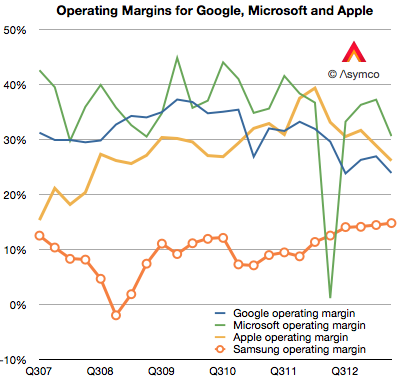
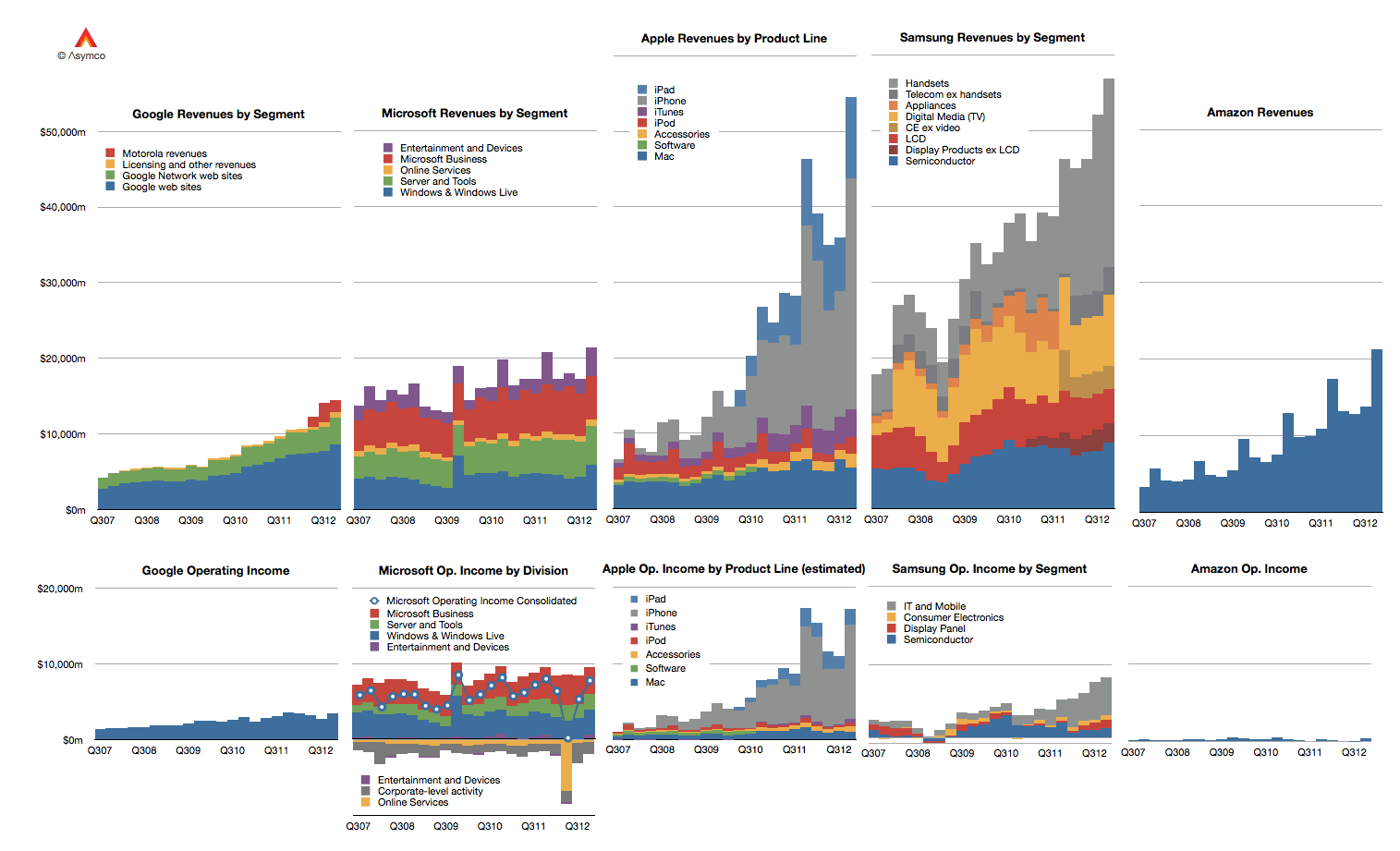
    There isn't much that I can observe in the data that hasn't already been observed. Google shows steady but not spectacular growth in revenues with decreasing margins. Microsoft shows even more modest growth in revenues with flat earnings. Apple growth is moderating from near vertical while earnings pause. Samsung has great growth but there is a similar set of doubts about its sustainability and finally, Amazon continues to grow the top line by 20% and  has nothing to show for it.

    Operating margins have mostly fallen with the exception of Samsung whose increasing reliance on smartphones has led to a modest increase, though not nearly to the level of the others. (Amazon, lacking in profits, cannot be compared.)

    Screen Shot 2013-07-30 at 7-30-10.54.44 PM


    In summary there is little change to report.

    Except that it's been reported that in the last quarter Samsung managed to "dethrone" Apple from the phone operating profit crown. This is a matter of estimates and for that we need to understand clearly the assumptions.

    I estimate that this is not the case. That indeed Apple remains most profitable phone maker by a wide margin.

    To estimate operating margins you need to estimate gross margin and the allocation of operating expenses (SG&A and R&D) to a particular "division" or product line. The problem is that Apple does not operate as a divisional organization so its marketing and R&D budgets (i.e. people) are not assigned permanently. You have to move them around based on whatever is being worked on at any given time.

    What's more, we need to account for the huge SG&A costs associated with iTunes and Retail. They both consume vast resources which cannot be allocated directly to any product. There are 41,000 people working in retail.  Also, some of the expenses for iTunes are overhead and cannot be considered cost of sales. That's also SG&A. Then there's corp research and design (Mansfield and Ive), which are not allocated to any particular product. When you slice out these costs, there is very little to apply to iPhone, etc.

    So if (and it's a big, sanctimonious if) you want to cast iPhone out as a separate business unit, it would be wildly profitable. There is a huge gross margin of 46% (this assumes a cost per unit of $316) and only another 5% of sales spent on engineering and marketing leaves a 41% operating margin or $7.4 billion. (Why only 5%? Because there's only 10.8% to allocate and after taking out iTunes, Retail you're really only left with 4.49% for SG&A and 3.3% for R&D or 7.79% so 5% is about two thirds of the operating budget).

    If you take all of Samsung's IM division which is PCs, Tablets and phones their operating profit was only $5.6 billion.

    You can see the difference in the grey areas of operating profit in the first graph above.

    Bear in mind that this is still an artificial comparison. The split of profit between product groups is not only an estimate by the analyst, it would be an estimate for Apple itself since it has only one P/L.

  8. Apple retail vs. Amazon retail

    Research · 55 comments

    As part of a continuing series on the iTunes economy I described how iTunes fits within Apple's overall revenue and cost structure. The operation is a modest contributor accounting for single-digits percent of revenue and operating margins.

    One additional question is how does iTunes compare with other non-Apple retail businesses. The obvious comparable businesses are Google Play and Amazon's digital content businesses. Unfortunately we can't compare iTunes with Google Play because Google does not reveal any details about Play revenues (or units sold/downloaded or payments to developers or any other data.)

    Also unfortunately, we can't compare iTunes with Amazon digital sales because Amazon does not provide that detail either.

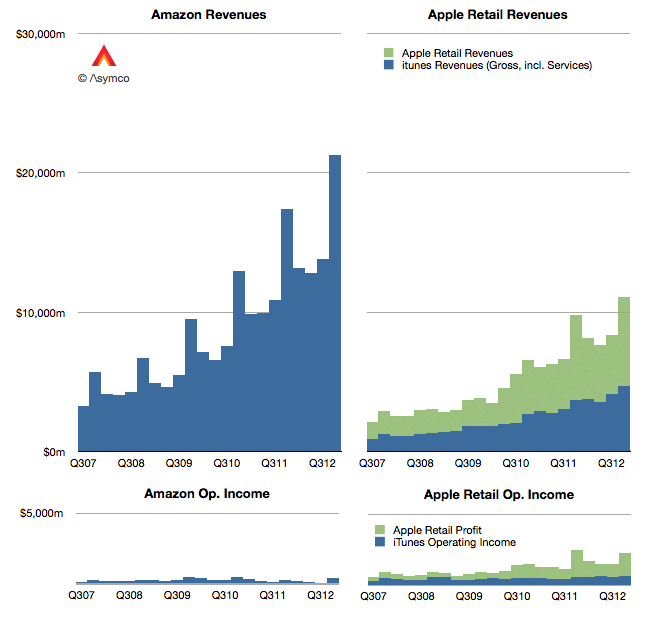
    What we do have is Amazon's overall revenues (and operating margin.) So that's what I have compared:

    Screen Shot 2013-03-27 at 3-27-2.09.30 PM

    Since we have Amazon's overall retail revenues it seemed fitting to also add Apple's physical store retail data on top of iTunes for additional perspective.

    Here are some observations:

    1. Since 2008, Amazon's sales grew by a factor of 2.18. Apple's combined iTunes+Retail grew by 2.14x.
    2. Apple's gross retail revenue was $11.1 billion in Q4, 52% of Amazon's overall revenues.
    3. Apple's operating income from retail in 2012 was $6.8 billion, over ten times Amazon's $676 million.

    Although Apple's overall retail operations are only about half of Amazon's they are far more profitable on an operating level. They are also growing at a similar pace. Amazon as an equity is priced at approximately twice sales. By that ratio, Apple's retail business would be worth $70 billion. Of course, that valuation presumes that, as with Amazon, operating profits are disposable.

  9. Bits v. Bytes: Follow the money

    Research · 68 comments

    Google announced its first computing product: the Pixel. It's not the first Chromebook but it is the first device which is uniquely branded as a Google product (Motorola notwithstanding.)

    It's a curious choice given that companies which have "crossed-over" from being service or software oriented to hardware have started with more "mobile" devices. Amazon launched the Kindle as a low-end product and gradually moved it up-market. Microsoft launched with the Surface tablet and then followed with the Pro version as a hybrid laptop/tablet.

    It's also curious since Google has spent years contributing to the development of mobile phones and tablets under the Nexus sub-brand. This was an approach consistent with earlier Chromebooks as well.

    But the Pixel is a high-end product. It's priced at the top of the range of what a laptop computer might cost (given the dimensions).  Perhaps it's part of a pattern where Google will hone its hardware skills toward releasing a phone or tablet it can call its own. Starting with a more traditional computer is "easier" than trying to deliver on the more demanding smaller form factors.

    And yet, the more obvious question is why would Google want to be in the hardware business? Isn't being a web-focused company implicitly suggesting that hardware is a commodity to be farmed off to perpetually impoverished and violently abused OEMs?

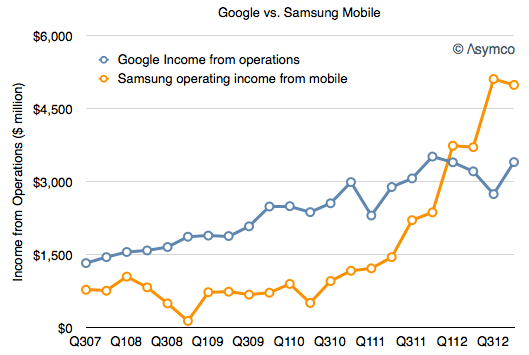
    The truth is quite different from this. Samsung currently makes far more operating profit from Android phones than Google does from all its operations. 

    Screen Shot 2013-02-22 at 2-22-3.47.58 PM

    When looking at the patterns of sales and profit capture for hardware vendors since 2007 the contrast is stark:

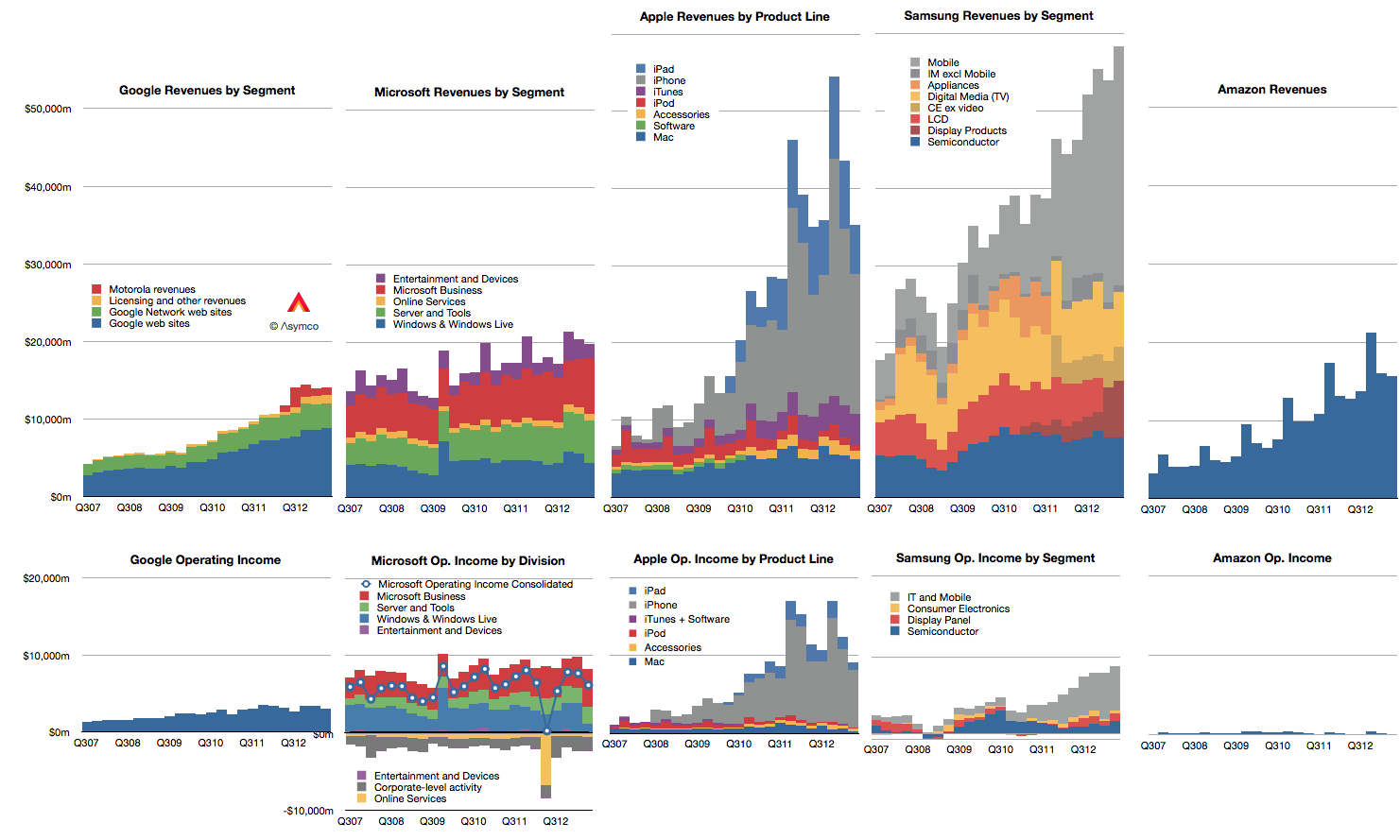
    Screen Shot 2013-02-22 at 2-22-3.32.46 PM

    Apple and Samsung tower over the fortunes for software only Microsoft or service-oriented Google and Amazon. Although all companies are growing, the value, as defined by the buyer, resides in the whole product. Putting aside all the theory, the numbers are staggering. Google, Microsoft and Amazon are skimming profits but they are not particularly efficient at profit generation vis-a-vis the integrated Apple (and increasingly integrated Samsung.)

    The question is which of the companies illustrated above will prosper from the value chain evolution under way?

  10. The new age of Capital Intensity

    Research · 117 comments

    In the post reviewing Samsung's Capital Structure I noted that its component divisions have historically taken 90% of capital investments and that the overall capital intensity for Samsung Electronics has increased in proportion to its component revenues.

    In another post regarding the capital structures of other technology companies with different business models I noted that Apple has changed its capital structure to a significant degree over the previous three years.

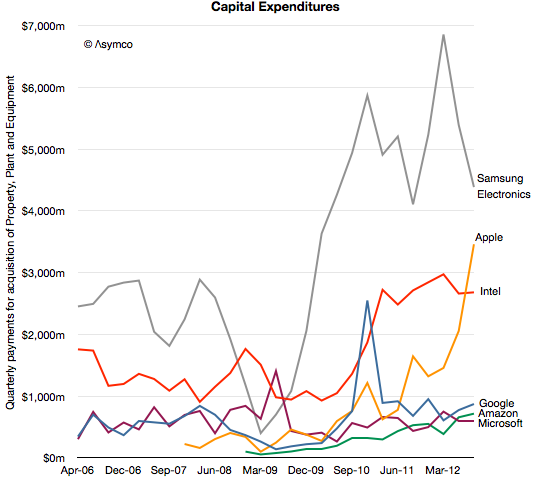
    In the following graph I combined these observations to show how capital expenditure patterns may be used to discern the underlying business model.

    I would group "cloud" or "platform" based companies like Google, Amazon and Microsoft as a cohort which, although spending significant amounts on capital equipment, do so mainly to support services. Their primary employment of capital is to sustain the infrastructure of data centers necessary to deliver the services underpinning their business models.

    I would group Intel and Samsung as "component" based companies which use capital to build production capacity that delivers, hopefully, a control point in the value chains they participate in. Note that I am assuming that Samsung Electronics' CapEx primarily targets semiconductors and displays as it did during the 2006 and 2007 period when data was available.

    Therefore, given the patterns over the last six years, it might be possible to classify a company's core business by just looking at its CapEx: The services group showing growth but relatively stable patterns and the components group showing more volatility, macroeconomic sensitivity and an overall higher level of spending, especially as a percent of sales.

    The question that pops up then is in what category does Apple fall?

    My observations for over a year have been that Apple is increasing its capital spending to such a degree that it is neither fish nor fowl. It operates data centers but presumably does not operate fabrication plants. And yet it spends more than Intel and Google combined.

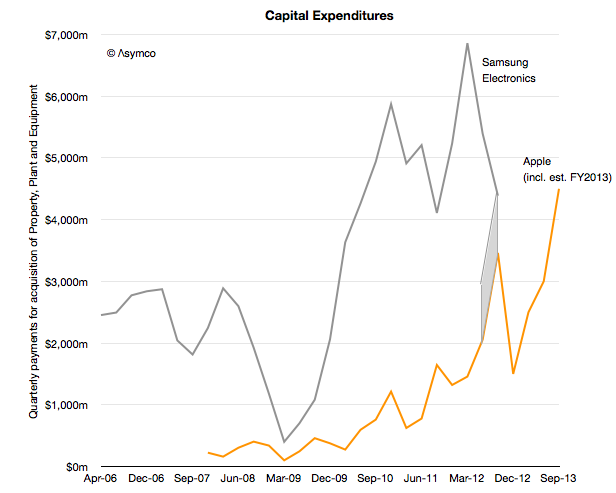
    Contrasting Apple and Samsung Electronics tells an even more interesting story. In the following graph I've added two additional items of information: First, although CapEx spending is recorded in the cash flow statement, Apple reported in its yearly (10K) report that it spent an additional $2 billion for equipment which did not pass through cash flow.

    If we were to add $1 billion to each of the previous two quarters, the graph would look like this:

    The second piece of information is that Apple projected its spending for the following fiscal year. I've added that spending in a pattern matching the last fiscal year.

    Apple is still spending less than Samsung. In its fiscal year 2012 Apple spent about $10 billion while during the same time frame Samsung spent nearly $22 billion. However, Apple has begun to bump against Samsung's spending level on a quarterly basis.

    I consider this extraordinary evidence of an extraordinary shift in strategy.

    For a year we've been debating here to what degree Apple has a "capital intensive" business and what exactly could it be spending capital on. One early hypothesis has been that it's on data centers or on real estate for spaceship campuses. These can be easily dismissed on the knowledge that they can't cost that much (and that the spending happens gradually). Another hypothesis is that the tooling for milled aluminum cases and other mechanical components is expensive and Apple has to buy a lot of it. But, again, the level of expenditure is in the league of Intel and Samsung which make vast quantities of semiconductors in very expensive plants. It's hard to imagine milling machines being cost equivalent to chip foundries.

    The comparison with Samsung, whose vast capital commitments are legendary and are its primary strategic asset puts Apple in a new light. Perhaps we can't yet call Apple a semiconductor company or even a fabricator but they are putting their "money where their mouth isn't". We can infer that it's not going where the company currently operates. The capital is being deployed almost silently and, though vast in scale, barely gets a mention from analysts. Not even a single question has been raised at any earnings call about this spending.

    So what tale does this capital tell?

    One interpretation is to apply the value chain disruption theory and ask whether Apple is acting to counter a potential disruption. In other words, that this is a specific threat response from an incumbent. There is some logic to this because  the antagonism between Samsung and Apple is so strong that it might justify a reaction of this kind.

    However, I believe that there is a more measured process at work over a long period of time. The one distinguishing advantage and attribute that Apple has  is its preference for integration. This preference is not a secret and Tim Cook repeats it often. The integration is evident with their move into retail and component design, in other words in both directions along a value chain. So my hypothesis is that this is part and parcel of an ongoing re-alignment of their role in the value chain.

    This second explanation suggests that Apple simply wants to control all the areas which affect the value they produce. First because they feel that there are areas that are not good enough and the product/experience cannot be good enough if its constituent parts are not good enough. Second because without control there are constraints to what it can do strategically.

    Whatever the reason, I read the evidence of increasing commitment and engagement in parts of the value chain as part of a continuous evolution of Apple's role. Furthermore, it's something that should be seen as a signal of a new era in how technology companies operate. We see hints of "vertical integration" with Microsoft building hardware, and Google buying Motorola and Amazon selling devices. Apple did all these things and now it casts an eye over the next frontier: components.

    ---

    If you want to learn more about the future of the technology industries and the evolution of value chains, consider participating in Asymconf.

  11. The policymaker's dilemma

    Research · 33 comments

    Here is an exchange with Robert van Apeldoorn, Journalist with Trends Tendances Magazine in Belgium. (www.trends.be/fr). The exchange took place in early September via e-mail.

    Robert: -Information and Communications Technology (ICT) is considered in Europe as a way to push growth, and is a target of national and EU policies (digital growth,etc), but the result seems to be a failure: the European computer industry (hardware) is almost dead (ICL, Siemens computers bought by Fujitsu, Olivetti almost out of computer business, Nixdorf dead) since the 90’, and the telco industry seems to be in crisis. All European companies are out of the handset business (big and fading exception is Nokia, but with  American software), and Alcatel is suffering with telco equipement manufacturing. It seems that at best, Europe can be a good niche player, with companies like ARM (chips). Technology seems to be reduced to localized services (computer services), some software businesses. What do you thing about that point of view? Is it correct or exaggerated ?
    What will remain to the European companies ?

    The main problem is perphaps the creation of European platform/ecosystems. Almost all are American today: Apple IOS-iTunes, Android, Amazon,…

    Why Symbian didn’t succeed as a competitive platform ?

    Is it possible to create European platforms? After all, IOS succeed after a short period of time.

    What are the European tech companies that could play an important role in the near future ?

    My answer: You are correct in this observation. Europe has failed to generate growth on the basis of ICT. The reasons are that the rate of change in ICT is rapid and getting more so. If European businesses require intervention, support or other forms of assistance in terms of policy, the time for that coordination to take effect is longer than the cycle time of disruption.

    Almost all growth has come from companies that entered the space. Google, Amazon, Apple and Facebook and even Microsoft came into positions of power from outside the industries they entered. Policy tends to offer means of sustaining incumbents or finding "logical" or defensible entrants. I should mention that the problem of industrial policy failing is not unique to Europe. Japan and to a lesser degree Korea are also facing crises of innovation due to policies designed to sustain rather than disrupt.

    It's understandable given the need to justify spending other people's money. No policy maker wants to spend it recklessly. However, the process of unforeseen growth is, well, unforeseeable. It cannot be predicted and it's very likely to come from somewhere other than where you expect it.

    This quickly becomes a lengthy discussion, but fundamentally the innovation process is chaotic. It's very similar to the process of artistic creation. The crisis in innovation comes from not having sufficient chaos. If Europe wants to preserve, sustain, nurture, and maintain it will do so at the expense of creative destruction. Nobody likes chaos but everybody wants innovation. Unfortunately they are concurrent things.

    thank you very much for these interesting answer. Usually the answer is the lack of venture capital or the compartimented market.

    So Nokia was an exception ?

    If a lack of venture capital is the problem then what is the cause of a lack of venture capital? There is plenty of capital on the continent. Why should it not be allocated to ventures? Capital markets in Europe are quite free and liquid and capital will find the best opportunities. The problem is that there are few fundable opportunities.

    I think Nokia was not an exception in the sense that it was not a "managed" success. The company (and Finland) emerged from a crisis in the early 90s. The crisis forced a re-evaluation of priorities and the success of Nokia could be attributed to a lack of emphasis in what was considered sustaining at the time (consumer electronics, TVs, natural resources, etc.) Entry into mobile phones was not what policy would have suggested was the biggest opportunity at the time. The market for mobile phones was projected to be insignificant in comparison to what was seen as success of the time (Sony, et. al.)

    [Addendum: What are policy makers suggesting as the key investment themes? Which projects get funding today and which don't?]