Samsung's mobile marketing lead for the country, Sitthichoke Nopchinabutr, also provided a surprise and hinted that the company might turn on Google and focus primarily on Windows Phone. About 15 to 20 phones based on Android, Bada and Windows Phone would ship in 2011, but the majority of them would use the Microsoft OS. For every 50 Windows devices, 24 would be Android models and just five would use the in-house Bada OS.
When I wrote about the absence of copyright enforcement on the Android marketplace, I was trying to point out that Google did not have the interests of copyright owners at heart. This attitutde is also apparent in many ways from the absence of desktop sync for Android (and hence the absence of discovery or acquisition of commercial media) to the absence of protection for the app developer.
Moreover, recently Google TV was blocked from all major US TV content and Google faced litigation from copyright holders in print publications and before that for YouTube infringements and before that from newspaper publishers for Google News' unlicensed reuse of their content.
Therefore it should not come as a surprise the following revelation that Android lacks any common DRM framework.
The hurdle has been the lack of a generic and complete platform security and content protection mechanism available for Android. The same security issues that have led to piracy concerns on the Android platform have made it difficult for us to secure a common Digital Rights Management (DRM) system on these devices.
Setting aside the debate around the value of content protection and DRM, they are requirements we must fulfill in order to obtain content from major studios for our subscribers to enjoy. Although we don’t have a common platform security mechanism and DRM, we are able to work with individual handset manufacturers to add content protection to their devices.
Unfortunately, this is a much slower approach and leads to a fragmented experience on Android, in which some handsets will have access to Netflix and others won’t.
But the absence is not just oversight. DRM is, by its nature, proprietary and, by necessity, "closed". DRM ultimately includes "secrets" which would always be revealed in open source. If Android is to be open source, then it cannot include a DRM framework.
This leaves the problem of content protection up to the device vendors who must license schemes from various third parties.
More and more, I’m convinced that Android isn’t a single platform. It’s a meta-platform upon which handset makers build their own platforms.
In other words, Android fragmentation seems to be not only impossible to rein in, but it may actually be by design. Google is doing nothing to stop the centrifugal force that is building up in its ecosystem. They have neither the means nor the incentives to control the spiraling.
Can you imagine Microsoft launching a Microsoft branded phone to compete with its Windows Phone licensees? When Microsoft launched the Zune, their licensing model (PlaysForSure) was quietly folded up.
A Google phone makes little sense, but then again Google does not seem to care much about its ecosystem or relationships with Android device vendors. They even claim that they have no idea how many phones are being built using Android and, except for activations, have no way of measuring the number sold.
From their point of view, if Motorola feels it's unfair to have to compete with a Google branded Samsung (or HTC) designed phone then too bad. There's lots of white label vendors lined up to make these with or without anyone's blessing.
In fact, the biggest opportunity for Android growth seems to be the large unlicensed (and illegal) grey market which seems to be rapidly expanding.
None of this should come as major surprises, but Gartner's data allows for a bit more granular detail in the overall view of the market. Here are new points derived from Gartner's sell-through data:
The smartphone market is growing at nearly 100% (96%).
The overall market is growing at 35%.
The non-smartphone market is growing at 25%.
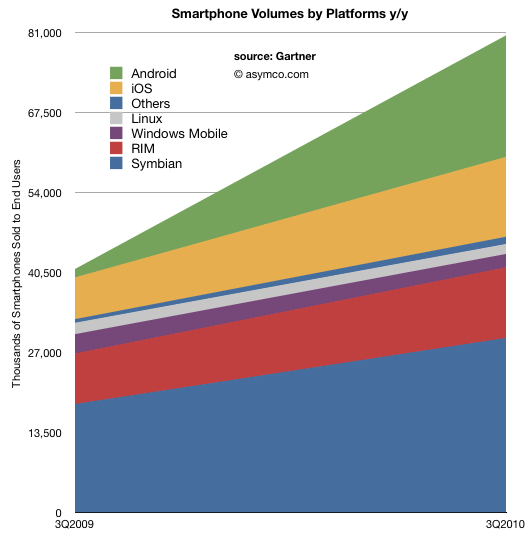
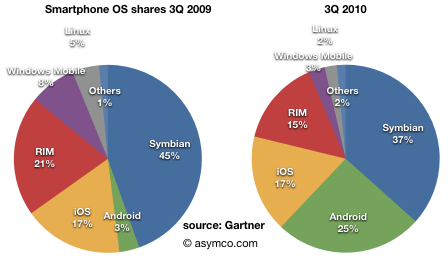
Android grew at 1,340% y/y. iOS grew at 92%, Symbian at 61% and RIM at 40%.
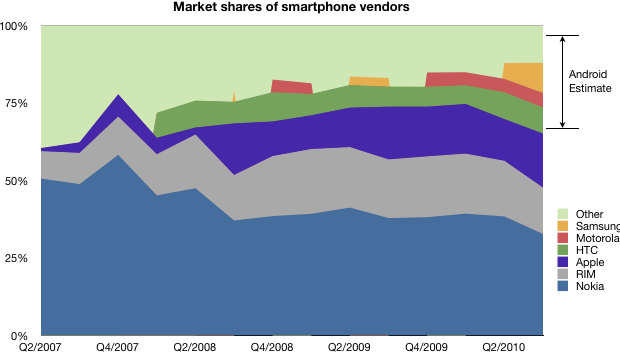
Platform market shares (below) shows a more even distribution of platform volumes between four main platforms:
Non-branded mobile phones grew to 33% of the market, with 141% unit growth. This is an alarming figure for the low-end of the market. The unbranded market excludes ZTE and Hauwei which grew below the overall market growth (9.8%, 27% respectively). The implications were most dire for Motorola (-36% units growth), Sony Ericsson (-23%) and LG (-14%). Nokia grew but, at 3.5%, well below market growth.
In 3Q 2009 41 million smartphones were sold. In 3Q 2010 80.5 million were sold. If we were to split the growth among platforms, nearly half the growth was Android. 27% of the additions were Symbian and 16% were iOS. Only 8.3% of the growth was RIM devices.
Windows Mobile and Linux were the only smartphone platforms to shrink volumes. However, even though the platform is deprecated, 2.2 million Windows Mobile devices were still sold last quarter -- more than Android sold a year earlier.
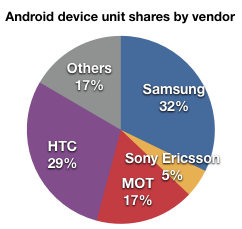
Gartner released sell-through data for the handset market. In the release appears an estimate of total Android 3Q Smartphone sales (20.5 million). Combining this with what some of the vendors have reported in terms of units sold, we can estimate the share of Android by vendors.
Note that this is a rough estimate. We don't have data on Sony Ericsson's smartphone units sold and we don't know the mix of HTC's Windows Mobile vs. Android. I'm also assuming LG as part of Others. The data from Gartner is claimed to be sell-through whereas vendors report sell-in so there is more roughness about each vendor.
Regardless of these potential sources of error, it's a very safe bet that Samsung and HTC are the largest Android vendors by a fairly large margin.
It's perhaps noteworthy that both are also committed Windows Phone vendors. According to pdadb.net here is the count of Windows Phone SKUs by vendor:
HTC 12
LG 5
Samsung 2
Dell 2
Toshiba 1
Motorola is keeping its Windows Phone options open, leaving "Others" as the only likely exclusive Android vendors.
Belfiore wasn’t shy about criticizing Google’s Android OS. Even though Google currently dominates the mobile OS market, its strategy of licensing the Android OS to manufacturers is similar to Microsoft’s previous approach with Windows Mobile: It’s open-ended, and there are few restrictions on how manufacturers can use or modify the OS.
As a result, Android is suffering from some of the same issues as Windows Mobile did: Android works better on some phones than others, manufacturers are shipping different versions of the OS on different phones, some Android phones are shipping with bloatware made by carriers, and some app developers complain that it’s difficult to make software because of the hardware and OS fragmentation.
Android was initially an attempt to commoditize Windows Mobile with a symmetric but "free" alternative. The idea was to conform to OEMs and operator business models. This was directly copied from Microsoft's early 2000's playbook for entry into mobile.
Trouble is that Microsoft realized their purely modular, operator and OEM centric approach was failing to be competitive on the user experience and decided to move into a more integrated approach, closer to Apple's integrated model.
But while Microsoft dropped their vision, Android was still patterned after their approach.
Peter Chou, chief executive of HTC, had previously said he saw “little value” in HTC running its own application store. But he has also said that it was no longer enough for HTC to simply customise the standard Android user interface with its own “skin”: “It is not enough to be skin-deep. We need to go bone-deep.”
HTC was the world's biggest Windows Mobile vendor, at one time claiming to have sold over 80% of all WinMo phones ever made.
I always considered them to be the natural leaders in the Android licensing cohort. First, because they are the most agile and second because they had the operator relationships that allowed white-label operator phones.
HTC aspired to differentiate itself by "skinning" Windows Mobile and have carried their Sense UI over to Android offering a brand image distinct from competitors. However, HTC's branded strategy may have upset their operator partnerships (no evidence of this, just hypothesis). In the event, HTC, though prosperous, is not the largest single Android vendor.
Now the comment above from Peter Chou indicates that HTC is going to integrate the experience further. Building its own APIs, store and perhaps more. Not satisfied with "re-skinning" perhaps it will "re-bone" as well.
Going "bone-deep" sounds a lot more integrated and inter-dependent than modular to me.
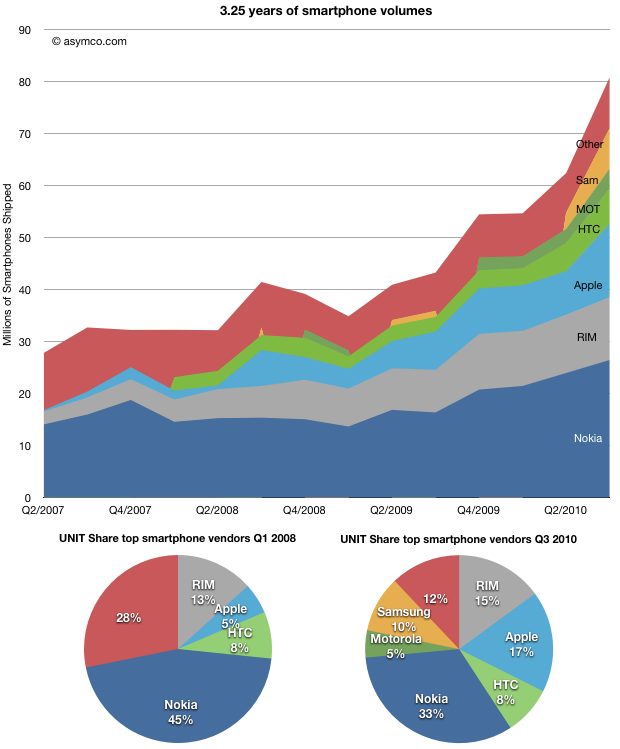
If we look at the growth of smartphones independently from all phones, the category looks impressive:
Smartphones are now almost 24% of all phones, up from 10% three years ago.
What's also impressive is all participants in the market grew their volumes. The rising tide did lift all the boats.
For this reason it's somewhat perplexing to hear absolute statements about the imminent death of certain smartphone competitors. The non-smartphone market is still 76% of the total phone market. And it's the biggest and easiest target for all smartphone competitors. The data shows that, for the time being, calling the end for vendors or platforms in a market that's doubling every three years is premature.
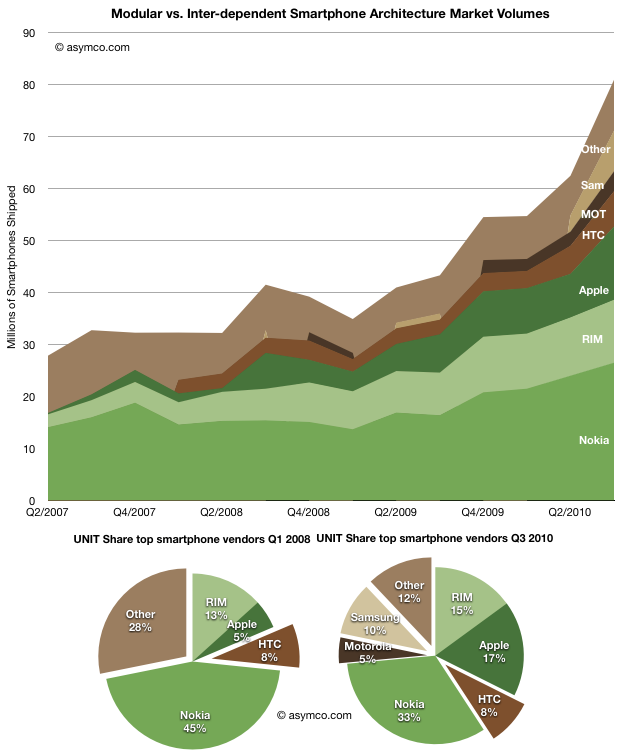
But what I really want direct attention to here is a subset of the market: modular platforms.
If you recall from the modular vs. inter-dependent dichotomy discussion, modular architectures are a way to implement products by licensing core components rather than keeping an integrated development model. I stated that modularity tends to be the better approach when markets are mature/over-serving and inter-dependency is the better approach when markets are young and the products not-good-enough.
Looking at the chart above you should note that the market is growing extremely quickly so it's not "mature" in that sense, implying a healthy future for inter-dependent players.
So how are modular vendors faring at this stage of the market and what are the prospects of module suppliers (i.e. mobile operating systems).
To help clarify, rather than looking at vendors individually I grouped them by architecture. I took the charts above and changed the colors so that modular vendors (in shades of brown) are represented separately from inter-dependent vendors (in shades of green).
When looking at the market this way we can make some important observations:
Even though the overall market grew, the share of the market held by modular architectures is smaller than that for inter-dependent. It's also not increasing. In 2008 modular players held 36%, in late 2010, they held 35%.
The suppliers to the modular market changed over the same period, so to a large extent they are fungible. During 2007, the vast bulk of the brown area above was using Windows Mobile. The vast bulk in 2010 is using Android.
The addressable market for Android is constrained to the modular market. Therefore the growth potential depends on whether that brown area increases dramatically relative to the green.
Vendors don't change architecture easily. My knowledge of the competitors makes me believe that none of the green players will change from Inter-dependent to modular, and even if they wanted to change it's not a simple thing to do. Conversely, changing from modular to inter-dependent is enormously challenging. Company processes, competencies and priorities must change dramatically.
So what's the bottom line?
For an Android dominant future, several conditions must be met; one will need to believe all of these to be true:
The addressable market for modular solutions will have to grow much faster than that of inter-dependent vendors. [The chart shows in-line growth--again due to the overall growth of the market. The green guys above won't just roll over.]
The split of licenses between Android and Windows Phone within the addressable market must favor Android. [Again, this is unlikely as "politics" will interfere. (I won't even touch IP issues.)]
The current modular vendors will not become inter-dependent or the current inter-dependent vendors will become modular. [Now why would they tear themselves apart if they are growing?]
The profitability of Android vendors must be high enough to make modularity sustainable [more about this later.]
Talk of Android (or iOS) "domination" is still wishful thinking. With the acceptance of Windows Phone within the value chain (device vendors, operators, developers), the brown area above will be served by two very powerful and motivated competitors. Politics and lawsuits will add drag on growth. Established brands are important to consumers and new brands (like ZTE and Huawei) will have a hard time joining the top tiers with or without Android. Established integrated vendors like Nokia, RIM and Apple don't have modular DNA but do have massive distribution.
In the end, the real limitation is that the brown area itself is not going to get disproportionately large. Android is limited by its addressable market and that market is a lot smaller than the whole market.
Looking at the world through modular/inter-dependent lenses lets you see that mobile platform dynamics will not evolve as they did in the PC era. At least not for the foreseeable future.
Take a look at this chart. It combines the known shipment data with the total market size for smartphones as defined by Canalys.
Knowing the platform/vendor make-up we can estimate the percent of the market that was Android.
Note that the major unknown is still how much the platform hedgers (Samsung, Other) split their volumes between Android and Windows Mobile (yes, it's still being sold).
Given this information, I would estimate Android share was around 30% globally. Canalys estimates 25%, which makes this analysis look reasonable.
On a platform basis, Android gains were mostly at the expense of RIM, Symbian and Windows Mobile as we know that the iPhone share remained steady.
Note that in years past the licensing vendors predominantly opted for Windows Mobile, a market that Microsoft wants to regain.
Based on a reader query, I tried to find out where, by city, my readership is concentrated. I also sought to break this audience down by operating system.
Here are some observations:
For the last 30 days, here are the top operating systems used to reach Asymco.com, with the number of views from each.
Macintosh 153,768
Windows 101,329
iPhone 78,716
iPad 34,878
Linux 7,262
iPod 5,516
Android 4,869
(not set) 1,236
BlackBerry 447
SymbianOS 396
Looking at each OS, I can list the top cities where readers came from.
Macintosh 153,768
London 6,513
San Francisco 5,316
New York 5,089
Cupertino 4,293
Austin 2,589
Sydney 2,182
Helsinki 2,131
Los Angeles 1,918
Seattle 1,847
Portland 1,482
Windows 101,329
London 3,827
New York 3,275
Helsinki 1,598
San Francisco 1,504
Seoul 1,409
San Jose 1,260
Chennai 1,226
Sydney 1,116
Seattle 1,100
Melbourne 1,035
iPhone 78,716
San Francisco 5,203
New York 4,406
London 4,053
Chicago 2,328
Seattle 1,836
Los Angeles 1,638
Melbourne 1,430
Seoul 1,402
(not set) 1,376
Sydney 1,261
iPad 34,878
London 1,759
New York 1,060
San Francisco 1,020
Chicago 857
Melbourne 739
Outremont 694
Santa Rosa 585
Seattle 555
San Jose 456
Santa Clarita 440
Linux 7,262
San Francisco 376
London 233
Helsinki 180
New York 131
Cambridge 126
Bangalore 109
Nantes 109
Sydney 107
Perchtoldsdorf 93
Paris 86
iPod 5,516
Eau Claire 471
Melbourne 396
Seattle 290
Abuja 248
San Jose 214
Hudson 197
Sydney 195
Budapest 109
Boston 95
London 86
Android 4,869
Seoul 761
(not set) 325
Dallas 248
New York 169
Amsterdam 148
Calcutta 131
San Francisco 81
London 74
Los Angeles 74
Bergen 72
BlackBerry 447
New York 121
(not set) 78
Waterloo 56
London 50
Buenos Aires 16
Hong Kong 9
Oldsmar 9
Fairfield 7
Wappingers Falls 6
Boston 5
Symbian OS 396
Helsinki 216
Kauniainen 23
London 21
Seoul 13
Tehran 10
Frederiksberg 6
(not set) 4
Chennai 4
Krakow 4
San Francisco 4
The first surprise for me is that Seoul is the most popular source for Android views.
The second is that London is so prominent. Although the US is the biggest source of traffic by far, London is a very concentrated source from the UK.
The third is how there seem to be no Blackberry readers in the SF area.
Apple's "Back to the Mac" was a clever play on words. Everyone expected it to mean that the event was going to focus back on new Mac products. As we had been so steeped in iDevice news the Mac was feeling neglected. It was time to take the discussion "back to the Mac."
Instead Apple told us that the Mac and OSX were going to become more like Devices and iOS. iOS innovations were what's going "back to the Mac"
So it wasn't "back to talk about the Mac" it was "OSX went to iOS and iOS is going back to OSX." The strategic upshot of it is that "the Mac is an extension of the device portfolio." Heady stuff. We'll need to chew on this for a while.
But some implications are easy to foresee. For example, the consequences for competitors. When Apple launched the iPhone, competitors followed suit, powering their phones with a variety of "open" operating systems. When Apple launched the iPad, competitors followed suit, powering their devices with a variety of "open" operating systems. These reactions to Apple's initiatives by dozens of "open-wielding" competitors are all being touted as the inevitably winning strategies.
So, as we've observed all of Apple's strategies being copied, I can't wait to see the competitors follow its "back to the Mac" strategy:
It won't be long before Dell takes UI and hardware design elements from the Streak "back to the PC." Think of the magic that will happen when Android Froyo "hooks up" with Windows 7. Both Android and Windows being "open", if I squint hard enough I can just visualize the tweet from Andy Rubin of the command line to build a new Windows 8 with Android mojo. The Android Market selling Windows Apps. It will be beautiful.
Or perhaps we'll soon see "back to the Blackberry" as RIM takes QNX interface elements back to their core business. Not so sure about the command line make statement there.
Or maybe Nokia will announce "back to Symbian" as they take gestures from the ultra-open MeeGo to do an evolution of their majestically open Symbian.
These initiative will surely be helped by the vast community of open developers surging to support the great open merged PC/tablet/device future.
As a clue to the sarcasm challenged: The power of Apple's integrated approach across its product lines goes deeper than the user experience.