ZDNet reports Sony Ericsson are abandoning Symbian for Android, and Samsung headed down the Android and Bada road a while back. There are precious few device manufacturers remaining as foundation members, e.g. ZTE, Sharp and Compal, none of whom are exactly trend-setting industry leaders.
I was going to ask what happened to 'Open always wins?' but decided against it.
What I will say is that open sourcing Symbian was not a new beginning for the platform but the beginning of the end. I don't think anybody seriously considered it a viable multi-vendor platform, least of all Nokia.
The chances are extremely small. There are three scenarios where this would make sense:
If there was a specific market that required it. It would also need to be a large opportunity since developing a new platform and diluting existing platforms need significant upside. The only such market is the US, but there are better options available, namely Android that have better potential and Android is treated as a toxin by Nokia (see metaphor).
Specific users. Windows Mobile used to be justified for business users, but Windows Phone is not targeting business users.
The last option would be "strategic" i.e. Microsoft paying Nokia for using the OS (directly or indirectly through marketing co-spend or other symbolisms). I don't think Nokia is desperate enough yet.
Although it's never prudent to say never, I just don't see any logic for Nokia to add to its bill of materials for phones while facing price pressure.
Despite being based on Android, a Facebook phone would be competition for Google as much as it is for Apple. Google benefits from ad revenue tied to their search and other services which would likely be supplanted by Facebook services on a Facebook-based phone.
A quick follow-up on Anssi Vanjoki's observation on Android. When he suggested that Android would be just a short-term solution for phone providers the metaphor he used was that it was equivalent to peeing in your pants for warmth in winter.
I wanted to point out that strategically, using Windows Phone is the same thing, except that vendors have to pay for the urine.
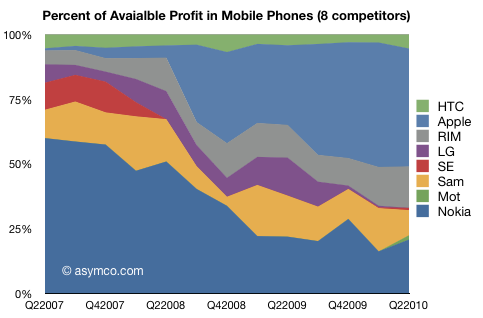
A quick update on the analysis of mobile phone profits. If the available profit[1] (i.e. excluding losses) were summed and each vendor's profit were measured as a percent of this total, this chart would tell the story of the last three years:
Note that profit share has mostly shifted from Nokia to Apple, though Sony Ericsson and LG were also casualties and Motorola has not had anything to lose.
Some assume that the future belongs to the Koreans but we see that the relatively small amount of profit that Samsung has (less than RIM actually) has not changed much. HTC is also shown to be a steady performer but not having displaced much from competitors.
Will Android change this picture? As I've argued before, Android is most attractive to the unprofitable and the strategically constrained. Can having undifferentiated new products change this? As Nokia is unlikely to license Android, and RIM seems very unlikely and Apple is out of the picture, the only possible contenders are Samsung, LG, HTC, Motorola and Sony Ericsson.
Motorola and Sony Ericsson have both returned to profitability but with a very small volume Android strategy. However the incumbents fielding Android are really facing a far more sinister threat: the smaller local brands in China (e.g. ZTE) and emerging markets.
On profitability, the smaller challengers are unlikely to make a large impact, but they will constrain the profits of other licensees. The distribution of phones on a global scale is challenging without a brand, and brands are very expensive to build. It's still possible over a longer timer frame that a small brand like HTC can emerge on a global stage. But in terms of profit capture, challengers will mostly "steal" from the already constrained big brands running with Android.
--
[1] Profit is not the only measure of success and can sometimes be a deceptive indicator. For this reason I look at a longer time frame so that anomalies, seasonality and business cycles are smoothed over. As flawed as it is as a measure, the most important reason to pay attention to profit is that it's the only fuel for growth in the long term. Companies that are consistently unprofitable (e.g. Motorola) face diminishing degrees of strategic freedom further lubricating a downward slope toward financial distress.
The iTunes app store has gone over 310k apps approved and has 250k apps in its catalog. The Android Market, in spite of (or perhaps because of) an abundance of copyright infringements, is growing nearly as quickly. According to at least one source, there are over 130k apps.
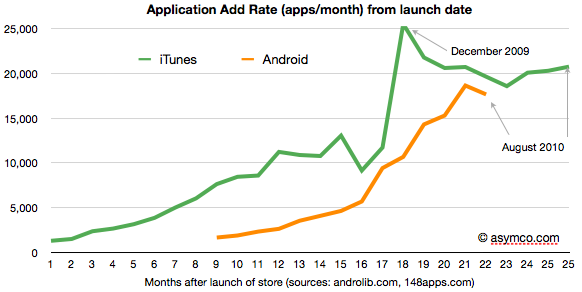
The way to study these two catalogs is to look at the number of new applications being approved (or added) on a monthly basis.
Even better would be to index to the same starting date, as in the following chart.
The Android Market grew grew more slowly than the iTunes store for the first two years but has accelerated to nearly the same rate now. Meanwhile, the iTunes Store has shown seasonality around the holidays (though we'll have to see if it repeats this year) and has held fairly steady at 20k/mo.
The policies are also shifting: On one hand, Apple has also signaled that they are not willing to accept "me-too" copies of simple apps. On the other hand they clarified policies and began to allow interpreted code apps. Google has not yet reacted to infringements on its store but it's probable that they will have to respond with some policing as download volumes grow.
The fact that the Android store is not policed or curated reduces the barrier to listing for developers and, in theory, should encourage a more rapid add rate. But the Star system of the iTunes store encourages more attempts to find hit apps. So in many ways we see that the two have an orthogonal approach:
The iTunes store is a hit-driven star system with long tail paid app value model
The Android Market is a flea market model with an ad-supported value model
There are few conclusions we can draw at this time about long term sustainability--after all these are ongoing and fairly young experiments. It does seem that both platforms are attractive enough today to create critical masses of apps, perhaps exactly because they don't put forward the same value model.
France Telecom-Orange CEO Stephane Richard has invited the heads of Vodafone, Telefonica and Deutsche Telekom (T-Mobile) to Paris on 8 October to discuss the development of a common operating system for mobile devices. He told Le Figaro that mobile operating systems were the Trojan horse used by Google and Apple to establish relationships with mobile customers. The four operators have nearly 1 billion customers combined and the capacity to influce industry. The initiative could take several forms including a joint venture or a common apps development unit. He added that the operators aim to retake the reigns of innovation, rather than be followers.
In the interview Richard also stated that carriers have decided not to advertise the iPhone any more.
This attempt at operator cooperation in software has been tried before, but it predictably failed (does anyone remember Savaje?) Symbian itself was an attempt at mobile phone vendor cooperation on systems software. There are various consortiums for "open mobile OS" based on Linux (e.g. LiMO which started as a Japanese effort). Even the Open Software Alliance is a rubber stamp body rather than an attempt at development.
Although one can safely dismiss the potential of this effort on the basis of a lack of competence, the arrogance reminds one of the rigidity in response to the disruption under way. The fact that high-speed data networks allow operator disintermediation cannot be changed by "innovation" on systems software.
But the odd thing is why even bother. The solution to taking control over the user experience and services platform is straight-forward: each operator could fork a version of Android as their own and hire a team to integrate white label services. It's much more straight-forward than coordinating a joint effort. China Mobile have already done their own non-Google Android.
Lots of people apparently think it’s a big deal that Gartner is predicting Android will surpass iOS for second place. But why is that necessarily a good thing, given that they’re predicting Symbian will remain in first place? Who thinks Symbian is actually doing well? Nokia’s board sure doesn’t.
I also noted with amusement that by 2014 "other" is slated to sell 85 million units or nearly 10% share, up from 6.1% in 2009. These "others" will be selling more than twice what Apple is expected to sell this year. Is "other" WebOS, Bada, MeeGo, LiMO? If so they're in for a healthy future.
But dwelling on details like these is missing the point. To see how improbable this prediction is, let's go back to 2006 and ask what Gartner was forecasting would happen now.
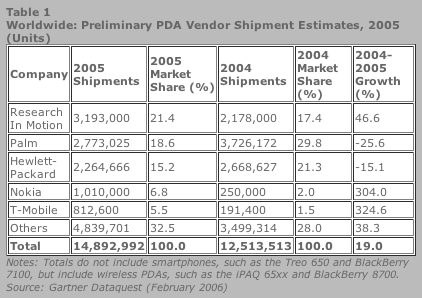
First thing to note is that in 2006 Gartner was busy tracking PDA sales. You might wonder why this is relevant. The reason is because a significant proportion of RIM's Blackberries counted as wireless PDAs and were therefore considered to compete with Palm's Treos, HP's iPaq and Dell's famous Axim. Nokia was in the running with its Communicators. Here is how Gartner characterized the equivalent market in early 2006:
So I'll just come out and say it: In 2006 Gartner did not have a clue what a smartphone was. By their admission:
Gartner defines a PDA as a data-centric handheld computer weighing less than one pound that is primarily designed for use with both hands. These devices use an open market operating system supported by third-party applications that can be added into the device by end users. They offer instant on/off capability and synchronization of files with a PC. A PDA may offer WAN support for voice, but these are data-first, voice-second devices.
In other words, in 2006 Gartner was splitting phones with operating systems into two separate markets: data-oriented wireless PDAs and voice-oriented smartphones. The split was mostly based on the judgement of the analyst on whether a device was "voice" or "data" oriented. I suppose they used the primary input method as a proxy: numeric keypads meant the device was one-handed and therefore voice-oriented. If the device had a full keyboard and/or a stylus-actuated touch screen then it was a two-handed data-oriented device. But even this proxy was not quite enough, sometimes devices were classified whimsically.
To make it more complicated, they bundled non-cellular but Wi-Fi enabled PDAs with wireless PDAs. This made some sense from a corporate IT point of view (their primary customer base) as these data-oriented devices would be used either on a LAN or a WAN (Wide Area Networks: what Gartner anachronistically called cellular networks.)
The presence or absence of a cellular radio did not enter into their view of these devices. So if you asked Gartner in 2006 to forecast smartphones (as we know them now) in 2010, I suppose you'd get what they forecast for "data-centric" devices.
So assuming that today's smartphones are mostly "data-centric" we would have to look back on their view of that market and not the voice market which was seen as an entirely different thing. Their answer should have had something to do with the market leaders and participants in 2006. As the table above shows Gartner showed that RIM, Palm and HP led in 2005 with Nokia and T-Mobile[1] pulling up the rear.
However, from a platform point of view, at the beginning of 2006
Microsoft Windows CE was the No. 1 PDA operating system (OS) in 2005 as 7.05 million PDAs were loaded with the OS, up 33 percent from 2004 shipments of 5.28 million units. Palm OS PDA shipments declined 34 percent to 2.96 million units in 2005.
In late 2006, Gartner made further predictions for the year:
In 2006, Gartner expects the PDA market to increase by 6.3 percent to 16 million units. The market will continue to be driven by broader availability of cellular-enabled PDAs from wireless carriers. Gartner estimates that 53 percent of all PDAs shipped in the first half of 2006 featured integrated cellular capability, up from 46 percent during the same period in 2005. “The share of PDAs purchased by enterprises will continue to increase; it accounted for 49 percent of all PDA shipments in the second quarter of 2006 and Gartner expects that the enterprise market will account for 52 percent of all PDA shipments in 2006,” said Todd Kort.
At this time I have not yet dug up a Gartner "Wireless PDA OS" four year forecast from the year 2006 but I suspect it would not show devices running Google's Android operating system or any running something called iOS.
[1] T-mobile is in the list because it was common practice in 2006 for operators to market Pocket PC Phone Edition devices made by HTC under their own name. Orange, Vodafone and Verizon also had own-brand HTC Windows touch-based devices. Now what does that strategy remind me of?
Android is an open platform. We saw at IFA 2010 all sorts of devices running Android, so it already running on tablets. But the way Android Market works is it's not going to be available on devices that don't allow applications to run correctly. Which devices do, and which don't will be unit specific, but Froyo is not optimised for use on tablets. If you want Android market on that platform, the apps just wouldn't run, [Froyo] is just not designed for that form factor.
How appealing are tablets that don't run any apps? Or content?
It still amazes me that a Google exec would say that it's acceptable that consumers are led to make purchasing mistakes with his product. Apparently any malfeasance is excusable in the name of openness.
That means no seamless integration with Gmail. No Google Latitude. No multitouch in the map app, either. And in place of the free and fantastic turn-by-turn Google Navigator app, Verizon installed its VZ Navigator service -- a feature which costs $10 a month to use.
It would be one thing for Verizon to set the default search and map app to Bing with the option to switch back to Google. But it's utterly inexcusable for Verizon to destroy the possibility of a switch without the user having to root the device and, under Verizon's company policies, void their warranty. And on top of that, repeatedly charge you for a sub-par service instead of keeping the gold standard of navigation apps for free.
And as bad as that is, there's now a rumor that Verizon will be doing this again. On every single one of its Android devices.
After speaking with a Verizon representative about the Bing debacle on the Fascinate -- who also lied about the existence of a search alternative -- The Droid Guy contacted two Verizon tipsters who told him that the carrier "is dropping the Google Search from all future Android Devices and offering Bing in it's [sic] place."
Regardless of motivations, the restriction if broadly applied would have Verizon reneging on its pledge to support the openness of Android and reflects a wider trend of the OS being artificially restricted by carriers. Most US providers are disabling Android 2.2's tethering support in favor of their own, and AT&T has banned non-Market Android apps under the pretext of security. The moves paradoxically leave Apple's iPhone more open in some areas, as its users can choose Google, Bing or Yahoo for search and don't have first-party apps deliberately hidden or broken.
Verizon, unfortunately, is also what ruins the phone. Or, rather, what it’s forced Samsung to do to the phone, which you could sum up in a word: Bing. Bing is the default—and only—search engine on the Fascinate. A Google Android phone. In the search widget, in the browser, when you press the search button. Bing. No, you can’t change it. There’s no setting for it, and the Google Search widget that you can snag from the Market is blocked (or at least very carefully hidden). Being unwittingly forced into Verizon and Bing’s conjugal relationship is infuriating on its own, but the implementation also feels like the sloppy hack that it is.
Android is “open”, but who it’s open for, primarily, are the carriers. (Somehow I doubt we’ll see any Windows Phone 7 devices where Google is the one and only search option.)
The primary defense of Google's Android strategy is that it's beneficial in driving traffic to Google's services/properties. This is by no means a certainty. To the contrary, it seems likely that the Android experience will be defined by operator back-room deals.
Coupling a lack of control over the platform, the revenue streams, the user experience, the potential banishment of AdMob from iOS and an attack on Google's brand, Android is currently winning the war with Google.
However, my money long term remains with Google. They can and will eventually beat Android. Perhaps with Chrome.
[Footnote: if anyone wonders why Verizon, Google's best friend in mobile, is gutting Android, you need to remember an exclusive five-year deal Microsoft struck with the carrier to provide search and advertising services on the phone. Microsoft was rumored to pay $500 million for the opportunity.]