Asymco

Asymmetric Intelligence

app

  1. Where is the monetization? Follow the compute

    Office Hours Research · 3 comments

    An Office Hours question asked by Roger S., June 9, 2026.

    Q: Beyond selling more capable hardware — phones, Macs, iPads — is there real monetization in all of this AI?

    Absolutely. They gave us an architecture: it’s about intent, about orchestration, about routing a request through multiple models and input types, and then deciding whether it goes through an app or back to Siri. Where’s the money? My answer is: follow the compute.

    If this works on-device, the user is happy buying the device, with the memory it needs, and Apple bundles all of that into the purchase price. Developers still sell their apps, but they’re not selling extra compute. But if a result requires heavy computation in the cloud, through an app, then trace it: who sends you the bill? That invoice comes from somewhere. If it’s a developer or a model supplier, it isn’t free — they’ll ask you to subscribe to get the answer, priced as a fixed fee or variable. Apple gets its usual commission, thirty percent or fifteen, somewhere in between.ssss

    If Siri depends on services that don’t go through an app, then Siri charges back through iCloud for the compute. So all they’ve really done is take the exact same business model — Services with subscriptions — and either fold compute into existing subscriptions or add new ones. Apple gets the same distribution commission it always has. Nothing changes. In fact, the absence of any commentary from Apple about new economics is, to me, a tacit acknowledgment that nothing different is needed.

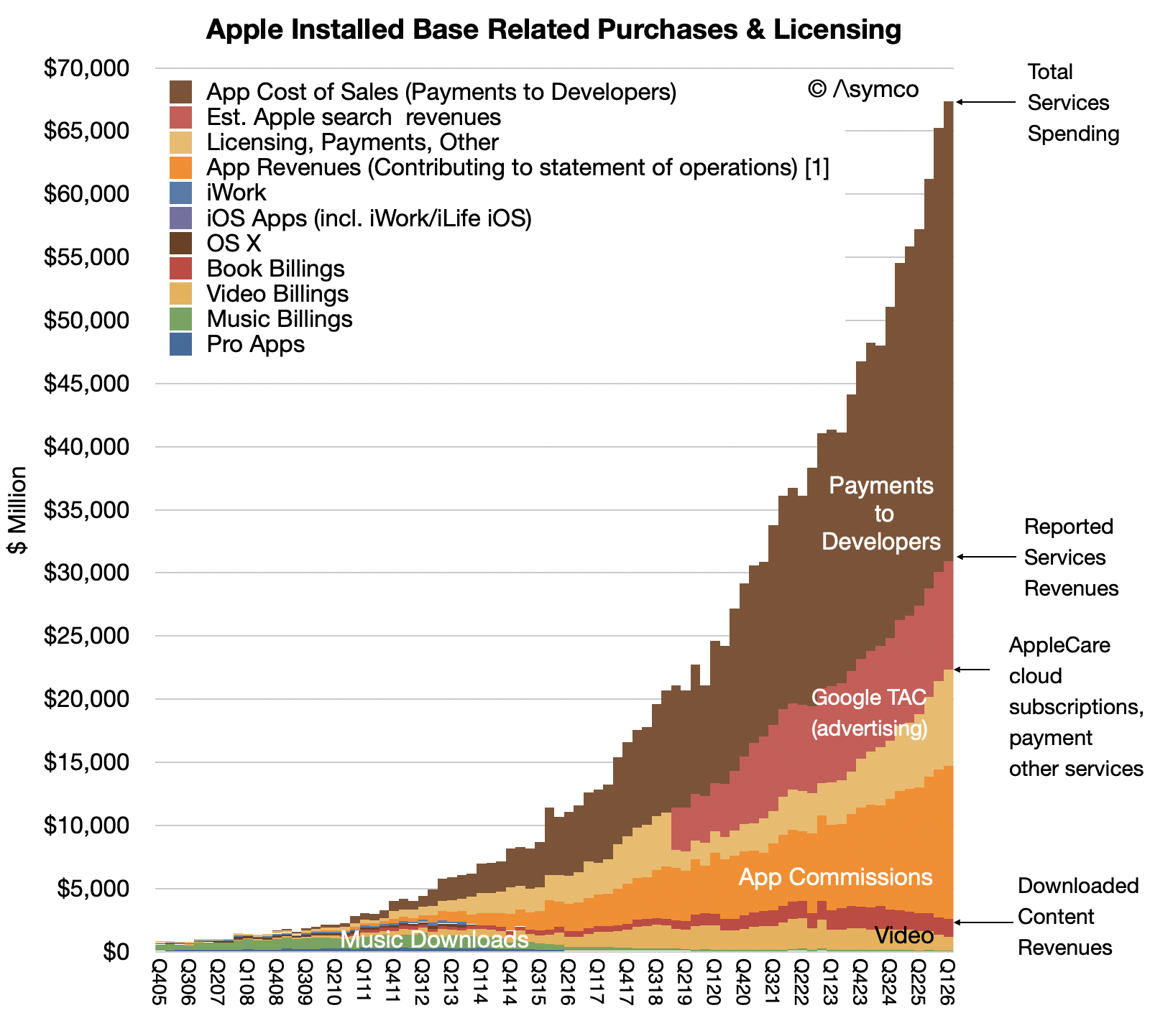
    That means the App Store, and if anything economically interesting happens, you’ll see another kink in its trajectory — the way we saw a kink when subscriptions became dominant. To users, it’s invisible. Maybe the monthly services bill rises ten percent; maybe they add a couple of subscriptions and drop one. It all reflects in Services, at a 72%+ gross margin, with a hardware uptick alongside. I reckon it’s a ten-year cycle before half of the Apple base are AI active daily, paying something for it. Developers will just see more of the same, only bigger.


    Editor’s Note: This was one of the questions asked by participants in Asymco’s June 2026 Office Hours live Q&A session, open to Asymco One subscribers.


    Subscribe to Asymco One for more in-depth analysis and commentary like this.
  2. WWDC Special: Asymco Office Hours - June 2026 - Live Q&A with Horace Dediu: Recording & Transcript

    Office Hours

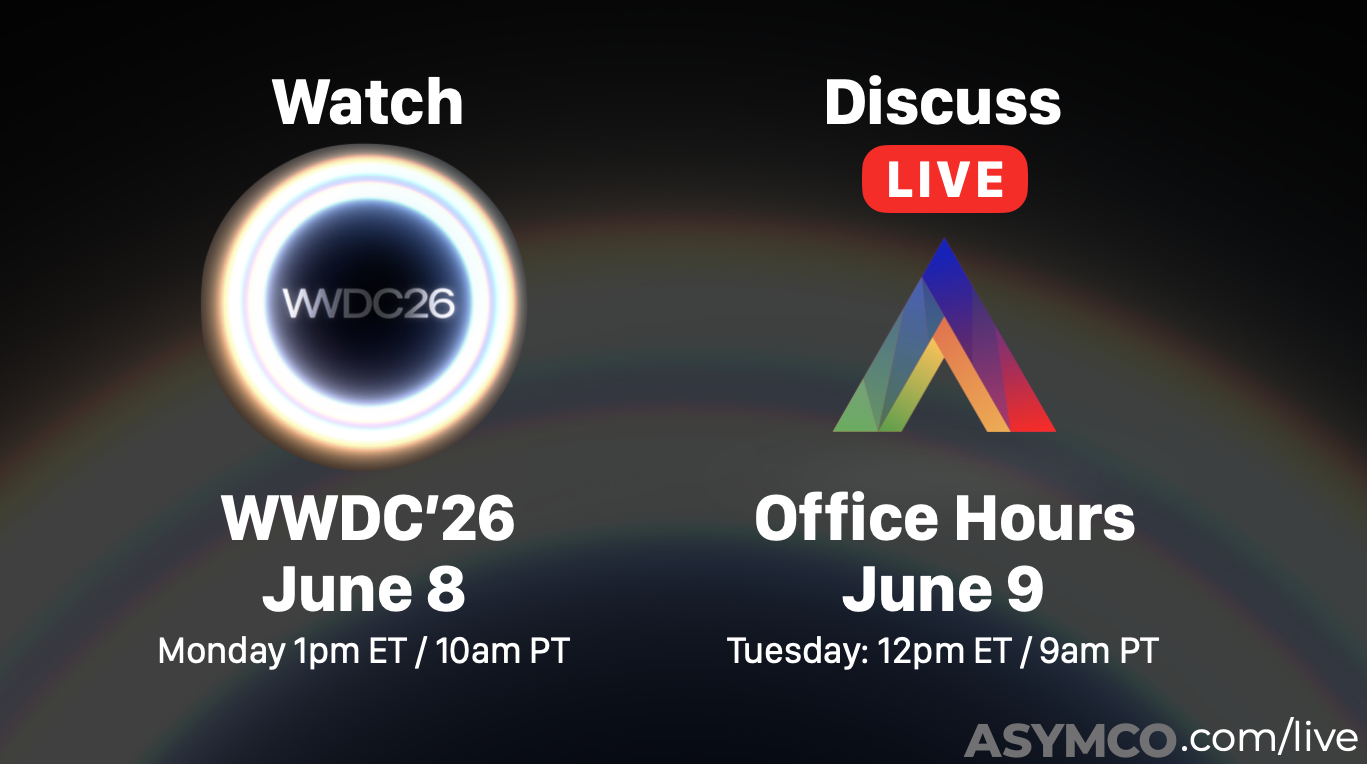
    Recording and transcript of the June 9, 2026 Asymco One Office Hours, recorded the day after Apple's WWDC 2026 keynote. Horace Dediu shares his impressions of the event and takes questions from Asymco One subscribers.

    Recording

    Subscribe to Asymco One to listen to the recording and read the transcript.

    Transcript

    Sign up and latest updates at asymco.com/live.

  3. Apple confirms not using Google models, apps or search in Apple Intelligence

    Nota Bene · 5 comments

    One Foundation Model runs on Nvidia GPUs hosted in Google’s cloud and some Google proprietary model data used to refine Apple's Models.

    Apple has shared new details about the technology behind its latest Apple Intelligence platform, explaining how its new Apple Foundation Models (AFM) work and clarifying the company's relationship with Google. During a post-WWDC technical discussion, Apple executives said the company does not use Google’s Gemini models, Google Search, or Google Assistant infrastructure to power Siri or Apple Intelligence

    Craig Federighi, Apple’s Senior Vice President of Software Engineering:

    “Of course, we don’t have the Gemini app as our app. In fact, none of that client code is part of how we run on iOS. For these models, we use none of the models that Google deploy to their customers, nor do we use the infrastructure and means by which they deploy models to their customers. And then, when it comes to the knowledge base, we of course don’t use Google Search or anything like that as the foundation of our system. So I hope that’s clear. The amount of the Google Assistant we use is none.”

    Source: The Mac Observer

    NB: Apple introduced five foundation models.

    • AFM Core (used for expressive voices and invitation capabilities on device)
    • AFM Core Advanced (on device)
    • AFM Cloud
    • AFM Cloud Image image generation and editing tools, including spatial reframing
    • AFM Cloud Pro complex reasoning and agentic actions; Nvidia GPUs hosted in Google’s cloud

    These models are custom-built for Apple Silicon, trained using proprietary data, and refined using outputs from Gemini frontier models. The company emphasized that there is no direct use of Gemini itself.

  4. Meet the System Orchestrator: Toward Intent-centric Computing

    Research · 1 comment

    The end of apps? Not so fast.

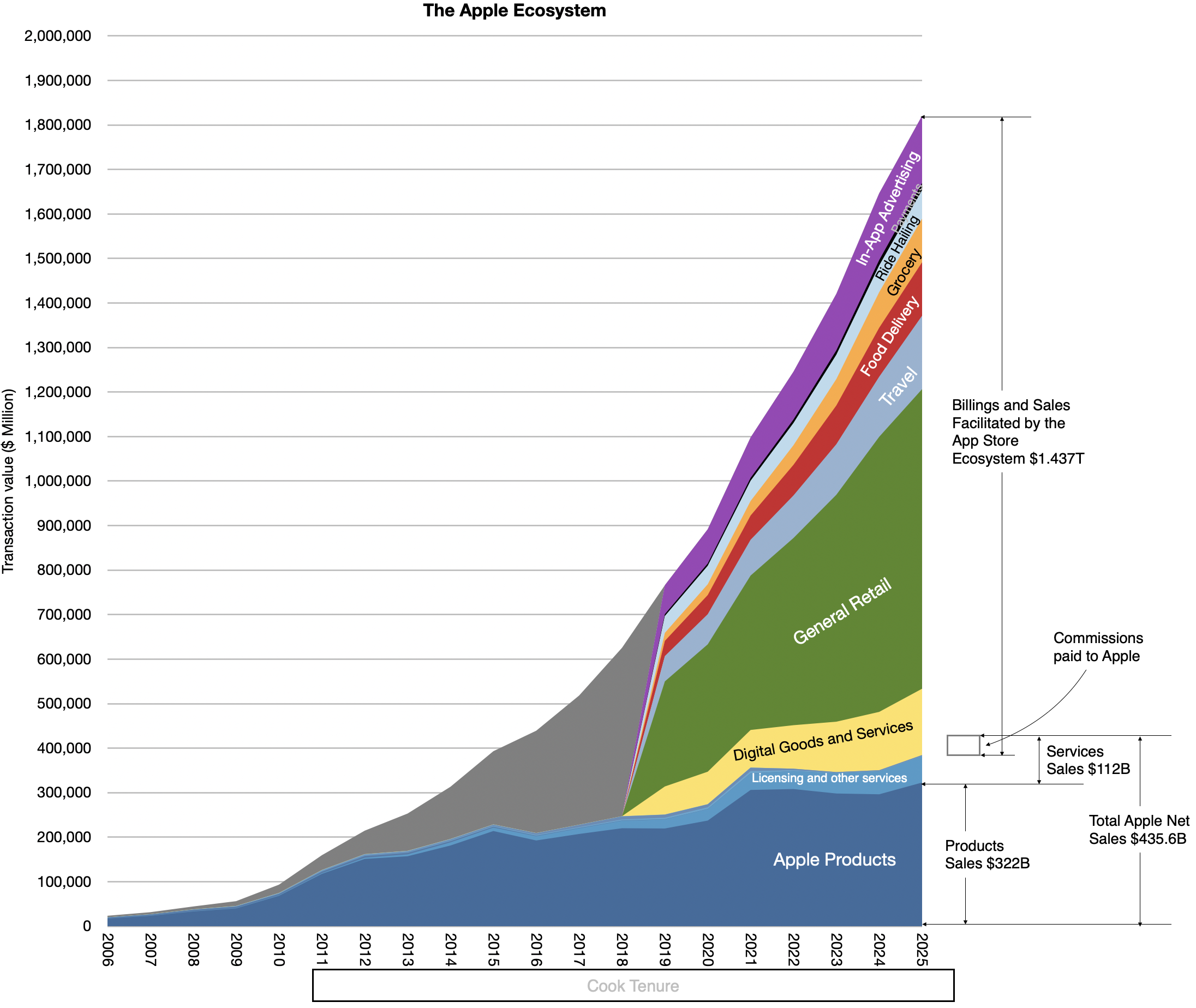
    The traditional computing "stack" is usually portrayed as a layered cake where the base is silicon, on top of which are system-level interfaces, followed by the operating system, then core services, and finally applications. The User interacts with the applications only. This is an app-based ecosystem which exposes "tools" for users to use as they try to accomplish tasks. This ecosystem for Apple is approaching $2 Trillion/yr in economic transactional value.

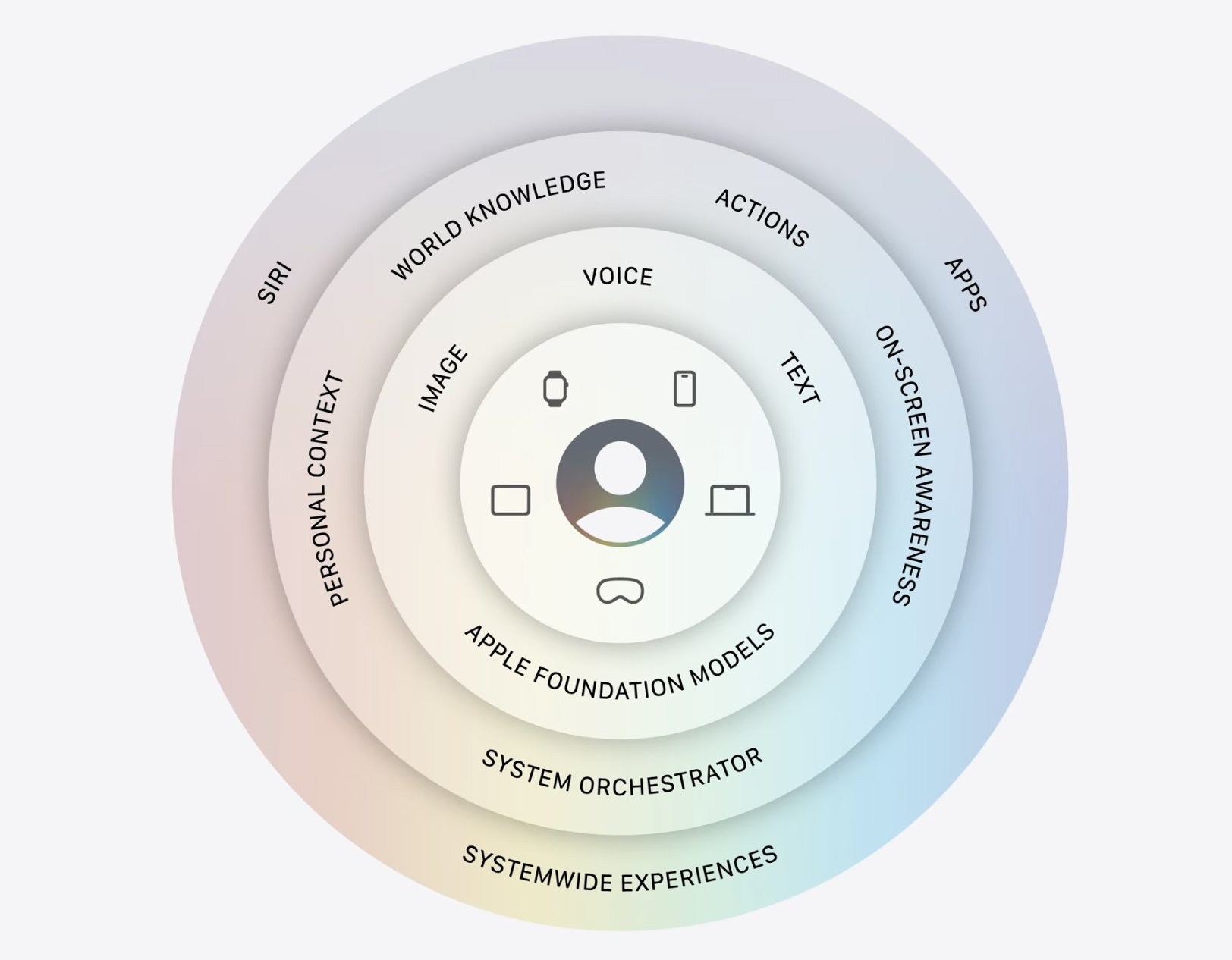
    The diagram above, introduced as the new Apple Intelligence architecture, is quite different. The user is connecting using various devices via various input methods (image, voice, text) to prompt an orchestrator to tap various knowledge bases (local and remote) to initiate either Siri or an App to act on some intent.

    The role of the operating system is now that of "orchestrator' that connects inputs to knowledge and decides how best to fulfill an intent. It sometimes connects to a chatbot (Siri) but also initiates apps to act.

    This might be seen as moving from an app based ecosystem to an intent centric world. For the original Siri, queries were usually routed to apps (calendar, weather, stopwatch, music, etc.) In this new world Siri AI will resolve the intent directly and have the ability to construct & deconstruct interfaces / experiences on demand. There are many tasks that do not need third party applications.

    However, the diagram still shows Apps as equal to Siri in terms of Systemwide Experiences. Apple announced a Foundation Models framework and expanded App Intents. Intent-centrism doesn't deprecate apps. It transforms them them from intent destinations to callable functions.

    Using the nomenclature of integration/modularization and business model evolution, it modularizes what was integrated, subtly shifting the locus of value. The App Store becomes an API directory. That's a business model shift. Classic innovation theory suggests that as the value chain evolves, some profit will evaporate from one point and condense in another point in the chain; usually wherever the new point of modularization has been injected.

    The old points of concentrations were the OS (where Apple captured profit) and the Apps (where developers did.) The new points might be in the orchestrator and in the foundation models.

    But I don't think it's that simple.

    Models might be commodities and orchestrators are not much different than OSs. Intent action requires access to private app data. bank accounts, calendars, messages. Authentication is an app responsibility and thus earned trust. Every app removed or disintermediated becomes a permission the orchestrator needs. Would banking credentials be granted directly to the device/OS? Much peril lurks there. This local data is where app control lies.

    Where the threat for apps lies is in the possible loss of user interaction. It's also a great part of the cost of development. Shifting from a point of contact with the customer to a callable function comes with costs and benefits that are not easily predictable.

    Transitioning the OS from a layer between hardware and applications to a layer between foundation models and experiences fundamentally shifts the architecture, but, in the case of Apple, it preserves its value as the agent of trust and discovery.

    For this the value created and captured remains and perhaps increases.

    It's clear to me that Apple has engineered this quite carefully and thoroughly.

  5. Intent Computing vs. Spatial Computing

    Research · 1 comment

    You don't have to choose.

    In the grand debate on the future of computing, we've been led to believe that there was a choice coming, a new interface to replace the touch UI interface that emerged in 2007.

    One camp believed that the future was ambient or intent computing where conversations and minimal interactions would replace taps and swipes and staring at screens. Apps would disappear as well as almost all visual interfaces. Devices would be not much more than microphones and perhaps earbuds. The initial instance was Amazon Alexa but more recently the quixotic Humane and rumors of a OpenAI pendant or tchotchke that linked us to the great mind in the cloud without messy screens.

    The other camp dove into virtual reality so that everything we see is generated by computing. The world itself would be re-painted by the machine and every photon hitting our retinas would be computed and every move we make, every breath we take would be tracked as forms of input.

    These are opposite ends of a spectrum: from minimal or almost no interaction to full immersion at the exclusion of passivity. From seeing nothing to seeing everything and from barely hinting intent to monitoring every muscle moved.

    The passive computing seemed to be winning. The VR or Visual Computing was not catching on. Device sales are not great and prices too high. Worst of all, devices are too onerous for mass consumption. In terms of wearables, eyes were losing while ears were winning.

    However lost in the WWDC news tornado was the updates of VisionOS 27. The list of updates is long and quite esoteric but it's clear that there was a lot of work involved in expanding the power of Visual Computing especially in the creation of new apps and content. Also all AI advances are being applied to VisionOS and even adapted in clever ways: Siri AI can be activated by just looking at the glowing orb that embodies it in the spatial world.

    Clearly Apple is not deprecating Spatial Computing. It's a remarkable creation and those of us who use it find it irresistible and irreplaceable.

    What the update clarifies most of all is that there isn't an evolutionary branching in the future of computing. The touch UI did not immediately obviate the need for traditional personal computing interfaces. The smartphone brought computing to more people and more contexts but keyboard and pointer computing cannot be fully replaced by touch. We have a situation where there is co-existence between touch and non-touch computing. Indeed we also have sensor computing in the form of Apple Watch and AirPods. Perhaps there were will also be Apple spectacles to expand the compute real estate on the body.

    Intent computing will probably reside primarily with our phones and wearables but Spatial Computing will strengthen their position alongside keyboard computing. Spatial was always a "high commitment" interface. To use it you strapped in, settled down and became acclimated. Then you became productive. A session was going to last at least 20 minutes, perhaps even a few hours.

    Intent computing is a few seconds of use. Perhaps a few seconds strung out in multiple sessions but it was far more "glance" computing than "sit down" computing.

    So why not have all forms of computing?

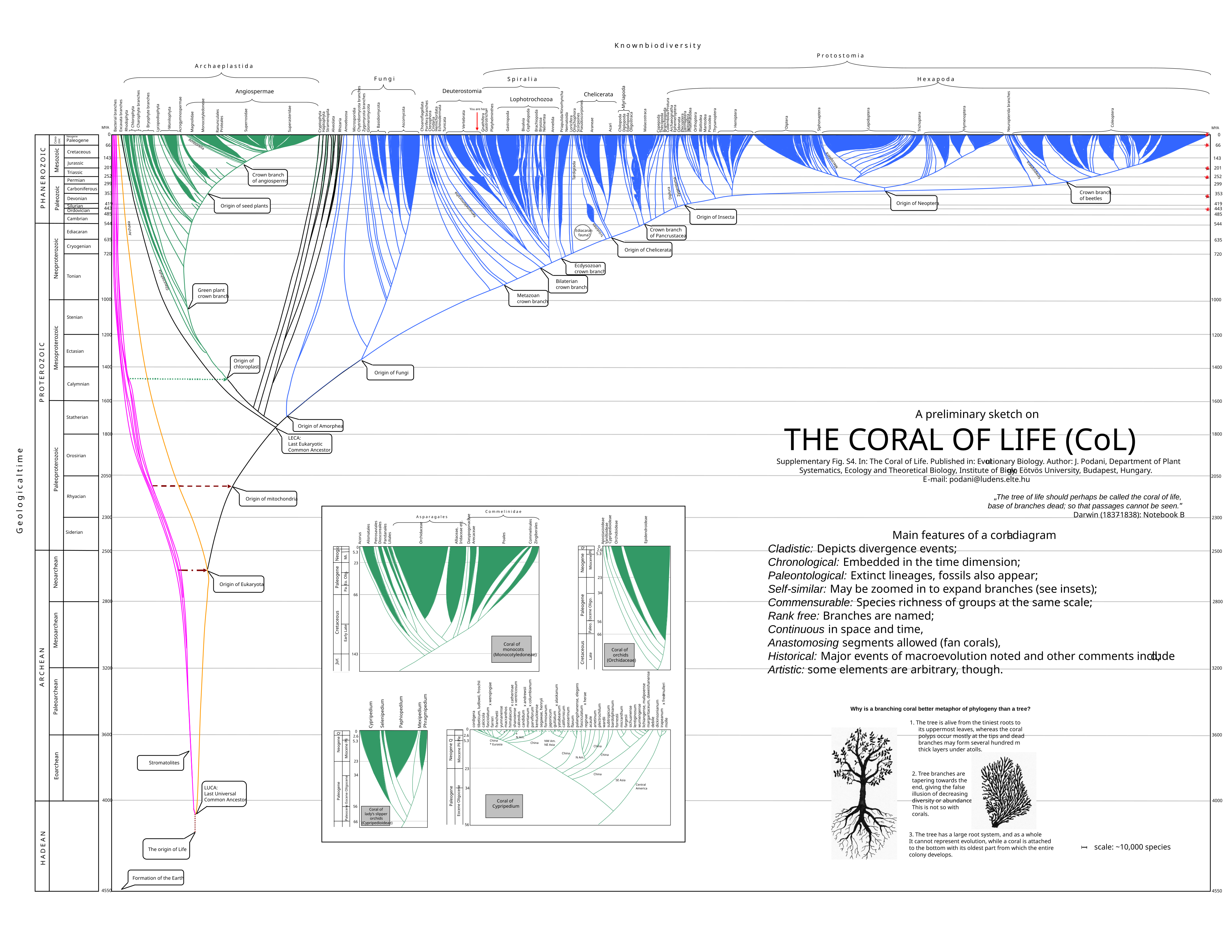
    As the diagram on the coral of life shows, evolution results in a multitude of "form factors". Some do become extinct (see the scroll wheel iPod or the stylus PDA.) But most survive and coexist.

    Spatial Computing is extraordinarily powerful. It will evolve and it will probably become the highest utility for those who create.

  6. Apple Intelligence: Show me the money!

    Research · 3 comments

    AI sales are booming. AI FCF not so much. So what new cash flows does Apple Intelligence unlock?

    Portrait of Charles Babbage (c. 1820)

    Apple's release of a new framework for AI at WWDC26, centered mainly on new layers in the device/OS which process intent to either on-device or world models and couple it to experiences which are system-wide, including apps.

    This is how the data and the inferences flow but what about the cash?

    I am writing without a full picture in mind, and perhaps one does not yet exist, but my assumption for at least three years has been that the value of AI will split between the creation of (frontier) models and their distribution. Apple chose to focus on local models, license or partner for frontiers and stitch together the means for distributing both.

    That is until on-device will be good enough to perhaps bring all models in-house.

    But distribution is always where it's at. So how do the new announcements affect this?

    Let's follow the money. The costs of inference will be partly borne by Apple for what they keep in private cloud but mainly by apps and hence subscriptions which will include marginally increasing compute costs. This will lead to increasing or new subscription pricing and the usual commissions for App Store distribution.

    The fact that this is all implied rather than explicitly stated should be seen as a tacit acknowledgment that the Services business will not change much, if at all. It will perhaps benefit from an uplift if the new AI-powered apps are very popular.[1] This new AI might create more demand or expand existing demand. That will all depend on the innovations developers come up with.

    But the elephant in the monetization conference room is hardware. AI demands a huge step-function increase in computing resources--both compute and storage and integrated memory. The minimum requirements are already leaving two to three year old hardware behind.[2]

    Again, if AI is compelling enough, users will need to upgrade. Not just their phones but the Macs, iPads, Vision Pros, Watches, probably AirPods too. Then there is Home which is seeing foreshadows of a significant AI enabled upgrade. This means HomePods but also probably new devices altogether. Rumors of spectacles coming are par for the course. Health will also be revolutionized.

    This idea that AI is monetized through hardware should hardly be a surprise…

    1. Services has a lot of headroom for growth as non-consumption is still pretty competitive
    2. But don't worry, adoption curves being what they are, and regional/political obstructionism will imply a decade or more before perhaps half the install base is using Apple Intelligence with some frequency.
  7. The Apple Ecosystem Approaches $2 Trillion

    Research · 10 comments

    The iPhone maker is trading at 2.5x its ecosystem value and 1.5x its economic impact

    Apple today announced the global App Store ecosystem facilitated over $1.4 trillion in developer billings and sales in 2025, according to a new study by economists at Analysis Group. For more than 90 percent of the billings and sales facilitated by the App Store ecosystem, developers did not pay any commission to Apple. Since 2019, the size of the App Store ecosystem has nearly tripled, as the App Store remains the safest and best place for users to discover and download apps. .

    Source: Apple

    Bill Gates once said you have a platform when other people make more money from it than you do.

    In other words, success is if there is more value created on top of it than captured from it.

    Few platforms qualify but Apple's certainly does. Apple's ecosystem is shown in the graph below.

    Apple's direct payments to developers were about $126.7 billion but, as the Analysis Group report shows, Apple and the developers enabled transactions dwarfing app store transactions. In 2025 Apple captured a tiny fraction of the economic activity it induced on its platforms (about $57 billion out of $1.437 trillion or 4%).

    Combining the billings and sales facilitated by the App Store and Apple's direct sales of products and services leads to a total of over $1.8 trillion. I call this the Apple Ecosystem (Apple + App Store.)

    But that's not everything. There are lots of economic activities on the platform that do not involve the App Store. Activity on browsing and social media and messaging apps probably add another 50% on top of this, perhaps even 100%. I call this the Apple Economy (Apple + App Store + All other transactions.)

    Ultimately, the 1.4 billion Apple users using 2.5 billion devices are likely inducing as much as $3 trillion of economic activity.

    It seems to me that we need a way to measure a multiple of this activity as perhaps a fundamental metric of value creation.

    At $4.57 trillion current market cap, the value is only 2.5x its ecosystem and 1.5x its economic footprint.

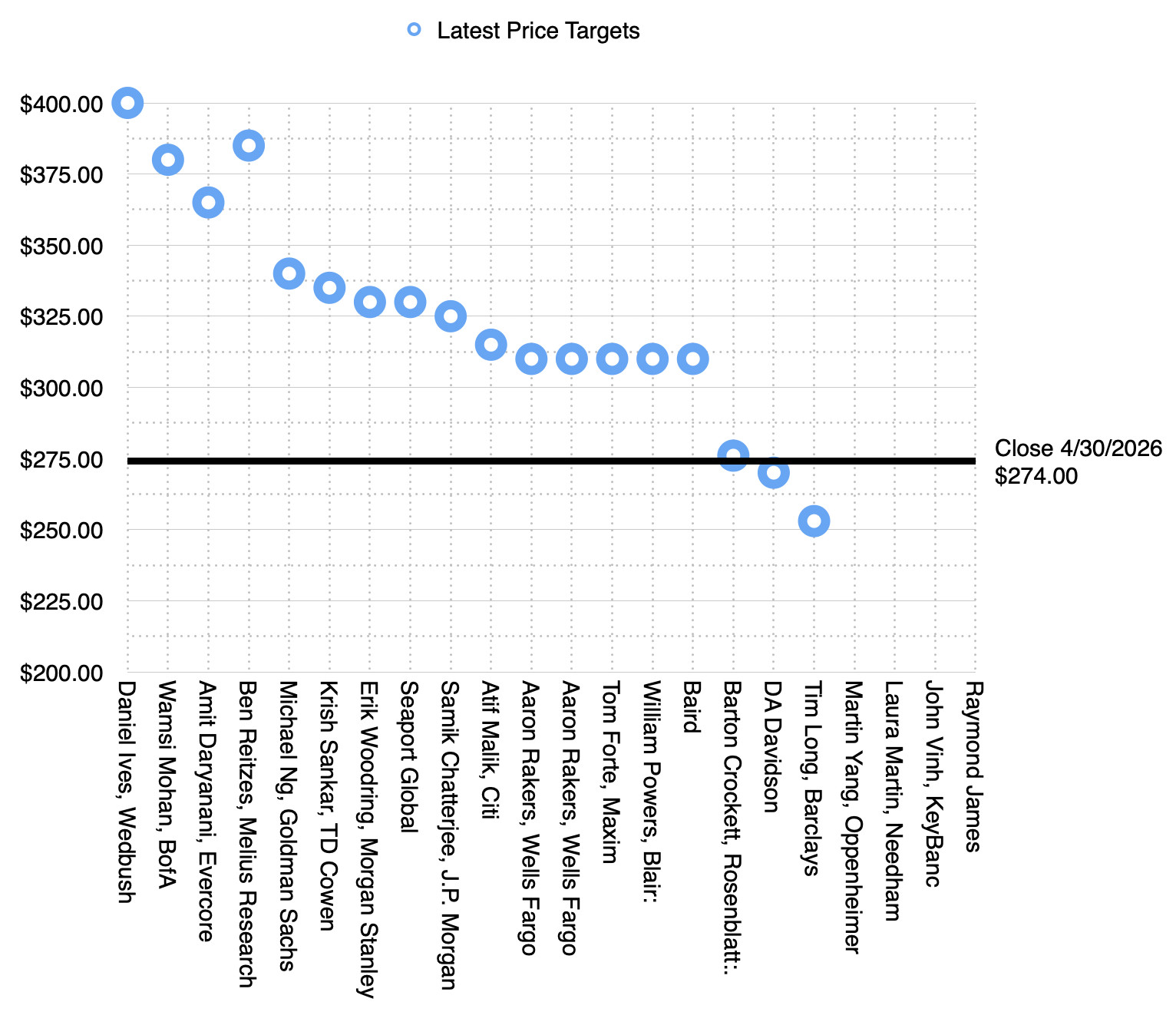
  8. Citi reiterated a Buy rating and a $315 price target

    Nota Bene · 3 comments

    AI or bust

    Citi reiterated a Buy rating and a $315 price target on the stock in a research note. The nod of approval comes ahead of Apple’s week-long Worldwide Developers Conference, which begins June 8.

    Analysts believe the headline at next week’s conference will be Apple’s long-overdue revamp of its digital assistant, Siri. Citi expects a new Siri app to resemble something like OpenAI’s ChatGPT chatbot while also serving as an AI assistant across applications on Apple’s operating systems.

    “Siri will handle multi-step requests, understand personal data, analyze on-screen content, generate emails or messages using both web and device context, and surface rich card-based results for everything from news to calendar data, while also completing actions across apps and shortcuts,” predicted Citi analyst Atif Malik.

    Apple will pair that overhaul with deeper AI integration across its Mac, iPad, and iPhone operating systems, Citi said. Examples could include more AI features in writing, search, and photo editing.

    “Edge AI has not yet taken off, but its long-term potential is substantial as consumers and enterprises increasingly prioritize low-latency, privacy-preserving, and cost-efficient AI experiences over cloud dependence,” Malik wrote. “We believe a meaningfully upgraded Siri will be a key to unlock the potential.”

    Strong demand for the Mac Mini, which can run AI agents like OpenClaw, shows how edge AI is already spurring more hardware sales. Extend that demand across phones and tablets, and Apple could be an edge AI winner.

    Source: Yahoo Finance

    NB: In other news, Apple Plans iPhone Bill Splitting Shares up 2.95% reaching the $315 target…

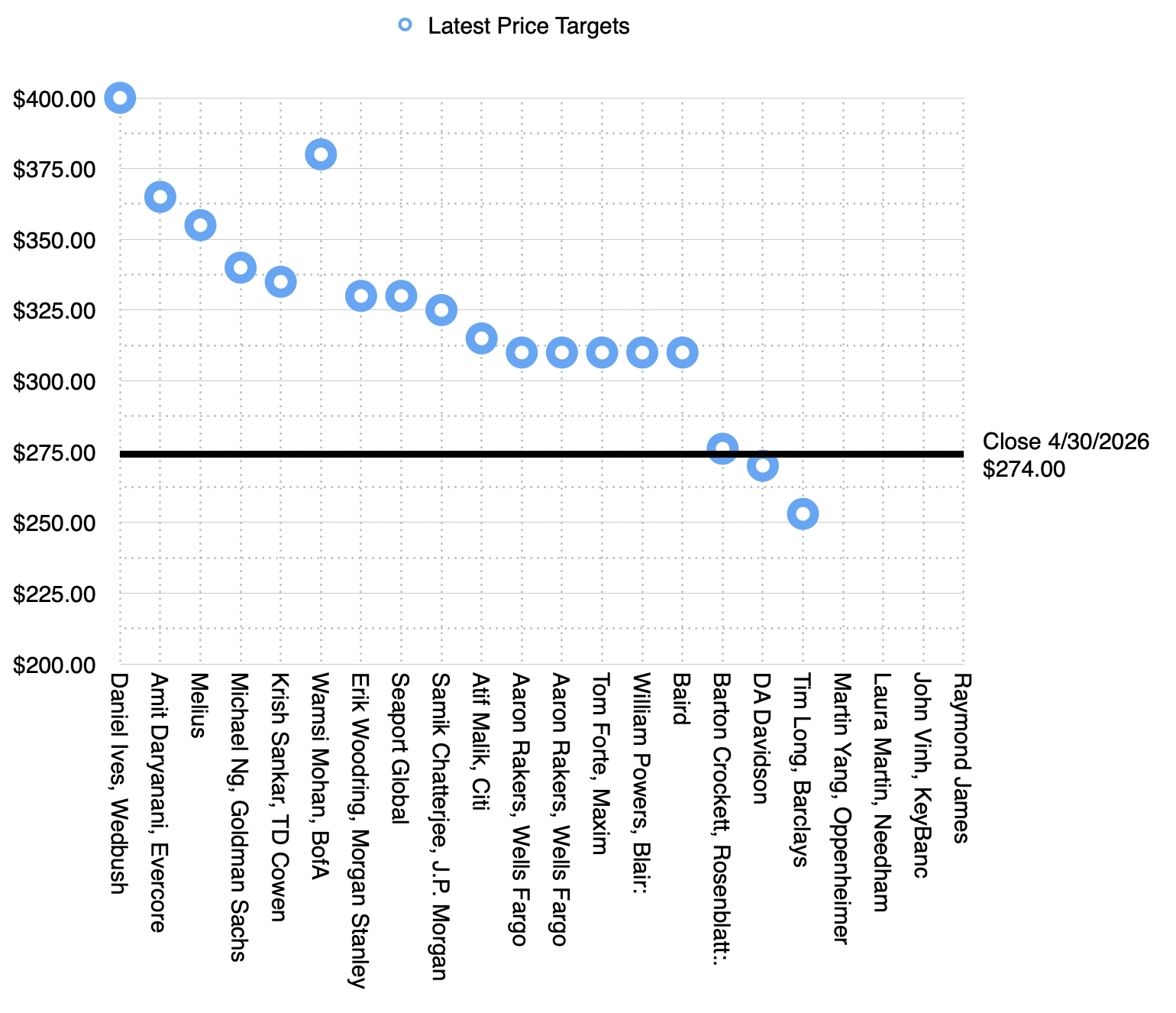
  9. Melius’ Ben Reitzes raises price target on Apple to $385

    Nota Bene · 6 comments

    The company “may be on the brink of some real AI sizzle.”

    Reitzes said people are becoming more comfortable using voice commands, and Apple could benefit from this shift as technology becomes more voice-driven.

    Reitzes also said the upgraded Siri could become a standalone tool that many Apple users rely on, even instead of apps like OpenAI’s ChatGPT. He described it as an “agent-style interface” that could make the Apple ecosystem more unique and spark fresh excitement among developers.

    Additionally, he highlighted that no other consumer tech company has both parts of that system under one trusted setup. He added that this advantage will become even clearer—and more valuable—as AI systems get more complex and start acting more independently.

    Overall, he expects Apple to post about $613 billion in revenue by fiscal 2028.

    Source: TipRanks Financial

    NB: Latest analyst targets are shown with Melius' stepping up. Analysts are coming round.

    This upgrade follows Bank of America boosting its price target to $380 a share.

    “In an agentic world, value accrues to the platform that controls user intent, personal context, app access, permissions, identity, authentication, payments, and trust,” said BofA’s senior equity research analyst Wamsi Mohan. 

    “Smartphone is the scaled consumer device where these factors already converge,” he added. “If AI assistants become the new front door…we think Apple should have meaningful leverage over model providers, app developers, merchants, advertisers, and payment networks.”

    An agentic version of Siri could boost 2030 revenue by as much as $65 billion, Wamsi and his team estimated, adding up to $2 billion in incremental earnings over the next four years.

    Reitzes sees the new Apple Siri as a stand-alone app that has the potential to replace ChatGPT for Apple's 2.5 billion installed devices, while proving to be “an agentic interface that can further differentiate the Apple ecosystem and ignite a level of excitement with developers not seen since the early days of the App store.”

    But it’s also likely to establish Apple as the leader in consumer-use AI.

    “If agentic AI shifts the market from answering questions to taking actions, the critical control point becomes centered around owning the endpoint,” Wamsi said. “Apple does not need to own the best frontier model if it owns the trusted interface that routes intent across local models, Apple-controlled cloud models, external models, and app actions.”

    Reitzes at Melius sees that shift, which he describes as a “shot in the arm” for Apple’s app store, driving “a massive new product cycle that keeps iPhone growth going.”

    He’s also observing that Apple’s architecture, with on-device models handling lighter workloads and its private cloud taking on the larger ones, makes it unique.

    “No other consumer technology company has both legs of that architecture under a single trust model, and we think that gap becomes more visible, and more valuable, as agentic complexity scales,” he said. 

    “Agentic AI is a structural tailwind that will force consumers to get the latest and greatest Apple device because it will work better than other brands.”

  10. Bank of America increases AAPL price target considering agentic and on-device AI

    Nota Bene · 4 comments

    Upgrades keep coming but are they justified?

    Bank of America upped its price target on the tech giant, citing a potential boost from agentic artificial intelligence.

    Shares rose 0.5% in premarket trading.

    “In an agentic world, value accrues to the platform that controls user intent, personal context, app access, permissions, identity, authentication, payments, and trust,” analyst Wamsi Mohan wrote in a note to clients. “Smartphone is the scaled consumer device where these factors already converge. If AI assistants become the new front door to search, apps, commerce, scheduling, payments, and workflow completion, we think Apple should have meaningful leverage over model providers, app developers, merchants, advertisers, and payment networks.”

    Mohan raised his price target to $380 from $330 and reiterated his Buy rating on Apple.
    Delving deeper, Mohan said that the company's benefit in agentic AI comes from its semiconductors and iOS, as Apple's silicon can dictate what happens on a devices (which is important for latency, reliability, privacy and costs) and iOS will determine how the AI is used by the user. “Our analysis around token usage suggests Apple will need to rely on distributed compute (on device), Private Cloud Compute and third-party compute to deliver a robust AI experience,” Mohan added. “Removing the net cash neutral target, in our opinion, is a reflection of a new period of AI-driven investments to enable this agentic era.”

    As such, Mohan believes that the coming Siri redesign needs to be integrated into the iPhone and make it an agent that is capable of understanding intent, retrieving context, bringing up apps, and completing workflows. If this were to happen, an agentic version of Siri could boost fiscal 2030 revenue between $15B and $30B, or as much as $40B to $65B if users really became acclimated to it.

    Source: Seeking Alpha

    NB: Updated price targets with BofA change highlighted.

  11. The App Store Annual Fraud Prevention Analysis

    Nota Bene · 3 comments

    Just in time for WWDC, hello industrious eurocrats!

    In 2025, Apple prevented over $2.2 billion in potentially fraudulent transactions, adding to a total of more than $11.2 billion in the past six years.

    Here are the highlights:

    • 1.1 billion+ fraudulent customer account creations rejected
    • 138,000+ fraudulent developer enrollments rejected
    • 28,000 illegitimate apps on pirate storefronts detected and blocked
    • 9.1 million+ App Store submissions reviewed
    • 2 million+ app submissions rejected for failing to meet Apple's standards
    • 371,000+ app submissions identified as spam, copycats, or misleading
    • 443,000+ app submissions cited for privacy violations
    • 1.3 billion+ ratings and reviews processed
    • Nearly 195 million fraudulent ratings and reviews blocked
    • Nearly 7,800 deceptive apps prevented from appearing in App Store search results
    • Nearly 11,500 potentially fraudulent apps stopped from inclusion in App Store charts
    • $2.2 billion+ in fraudulent transactions prevented
    • 5.4 million+ stolen credit cards prevented from being used
    • Nearly 2 million user accounts banned from future transactions

    Source: Apple Newsroom

    NB: Do alternative app stores provide similar fraud prevention Analysis? Does the European Union review these analyses to determine how their citizens are protected. In the alternative, is the EU benefit analysis of users end at arbitrary market access metrics? I don't hear much about alternative App Stores and their popularity. Quelle surprise!