Asymco

Asymmetric Intelligence

app

  1. Star system vs. flea market: How Apple and Google target talent

    Research · 8 comments

    The iTunes app store has gone over 310k apps approved and has 250k apps in its catalog. The Android Market, in spite of (or perhaps because of) an abundance of copyright infringements, is growing nearly as quickly. According to at least one source, there are over 130k apps.

    The way to study these two catalogs is to look at the number of new applications being approved (or added) on a monthly basis.

    Even better would be to index to the same starting date, as in the following chart.
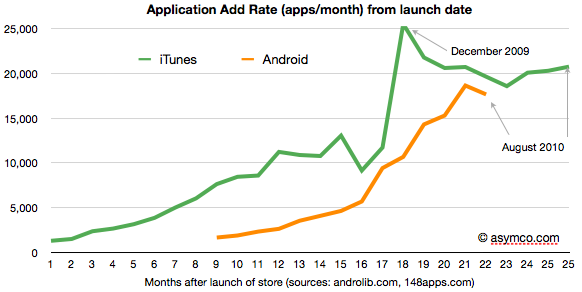
    The Android Market grew grew more slowly than the iTunes store for the first two years but has accelerated to nearly the same rate now. Meanwhile, the iTunes Store has shown seasonality around the holidays (though we'll have to see if it repeats this year) and has held fairly steady at 20k/mo.

    The policies are also shifting: On one hand, Apple has also signaled that they are not willing to accept "me-too" copies of simple apps. On the other hand they clarified policies and began to allow interpreted code apps. Google has not yet reacted to infringements on its store but it's probable that they will have to respond with some policing as download volumes grow.

    The fact that the Android store is not policed or curated reduces the barrier to listing for developers and, in theory, should encourage a more rapid add rate. But the Star system of the iTunes store encourages more attempts to find hit apps. So in many ways we see that the two have an orthogonal approach:

    • The iTunes store is a hit-driven star system with long tail paid app value model
    • The Android Market is a flea market model with an ad-supported value model

    There are few conclusions we can draw at this time about long term sustainability--after all these are ongoing and fairly young experiments.  It does seem that both platforms are attractive enough today to create critical masses of apps, perhaps exactly because they don't put forward the same value model.
  2. RIM Quarterly update: just the numbers

    Research · 11 comments

    Noteworthy data (with my notes in parentheses.)

    • 12.1 million phones shipped, 11 million sold through (estimated iPhones for this Q range from 11 to 13 million)
    • Net subscriber account additions were 4.5 million which was lower than anticipated (41% of units sold through were to new subscribers which implies nearly 60% were to existing users)
    • Revenue grew 31% over the same quarter last year and GAAP earnings grew 76%.
    • The BlackBerry subscriber account base grew 56% year-over-year to over 50 million
    • RIM has shipped approximately 115 million handhelds to date. (note: 120 million iOS to date)
    • BlackBerries are available through over 565 carrier and distribution partners in approximately 175 countries and international markets (vs. 150 carriers and 88 countries for the iPhone)
    • Approximately 52% of revenue in the quarter was generated outside the United States and over 45% of BlackBerry subscriber account base is outside of North America. (70% of iPhones were sold outside the US through the first half of this year)
    • Torch was launched with one carrier but will expand to 75 next quarter
    • To date over 35 million BlackBerry Smartphones have downloaded App World at an average of over 1.5 million Apps are being downloaded every day which is up 40% sequentially (iOS apps are running at 17 million downloads per day)
    • Average selling price for RIM devices was $304 (vs. $600 for the iPhone)
    • Gross margin was 44.5% (upward of 50% for the iPhone)

    Research In Motion CEO Discusses F2Q2011 Results - Earnings Call Transcript -- Seeking Alpha

  3. Android tablets without apps

    Research · 37 comments

    Android is an open platform. We saw at IFA 2010 all sorts of devices running Android, so it already running on tablets. But the way Android Market works is it's not going to be available on devices that don't allow applications to run correctly. Which devices do, and which don't will be unit specific, but Froyo is not optimised for use on tablets. If you want Android market on that platform, the apps just wouldn't run, [Froyo] is just not designed for that form factor.

    via Google's Hugo Barra: Android 2.2 'not optimized for tablets' - Google 24/7 - Fortune Tech.

    How appealing are tablets that don't run any apps? Or content?

    It still amazes me that a Google exec would say that it's acceptable that consumers are led to make purchasing mistakes with his product.  Apparently any malfeasance is excusable in the name of openness.

  4. Android is open unless you want to change your search engine to Google, or use tethering or Google maps or non-market apps

    Research · 10 comments

    That means no seamless integration with Gmail. No Google Latitude. No multitouch in the map app, either. And in place of the free and fantastic turn-by-turn Google Navigator app, Verizon installed its VZ Navigator service -- a feature which costs $10 a month to use.

    It would be one thing for Verizon to set the default search and map app to Bing with the option to switch back to Google. But it's utterly inexcusable for Verizon to destroy the possibility of a switch without the user having to root the device and, under Verizon's company policies, void their warranty. And on top of that, repeatedly charge you for a sub-par service instead of keeping the gold standard of navigation apps for free.

    And as bad as that is, there's now a rumor that Verizon will be doing this again. On every single one of its Android devices.

    After speaking with a Verizon representative about the Bing debacle on the Fascinate -- who also lied about the existence of a search alternative -- The Droid Guy contacted two Verizon tipsters who told him that the carrier "is dropping the Google Search from all future Android Devices and offering Bing in it's [sic] place."

    via Verizon Rumored To Replace Google With Bing On All Android Devices | Markets | Minyanville.com.

    Lots more in the linked article.

    This story just keeps getting better and better.

    Regardless of motivations, the restriction if broadly applied would have Verizon reneging on its pledge to support the openness of Android and reflects a wider trend of the OS being artificially restricted by carriers. Most US providers are disabling Android 2.2's tethering support in favor of their own, and AT&T has banned non-Market Android apps under the pretext of security. The moves paradoxically leave Apple's iPhone more open in some areas, as its users can choose Google, Bing or Yahoo for search and don't have first-party apps deliberately hidden or broken.

    Read more: Electronista

  5. It takes nearly $1 billion/yr to run iTunes

    Research · 44 comments

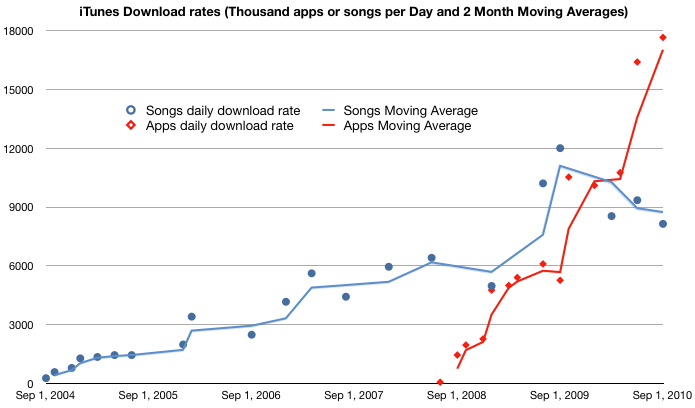
    In recent articles I highlighted the acceleration in iTunes App downloads where the rate is approaching 18 million apps per day and the cumulative total apps which is about to overtake the cumulative songs downloaded.

    We now turn our attention now to constructing the iTunes income statement: namely total sales, gross margins and deduce its operating budget.

    Gross Sales

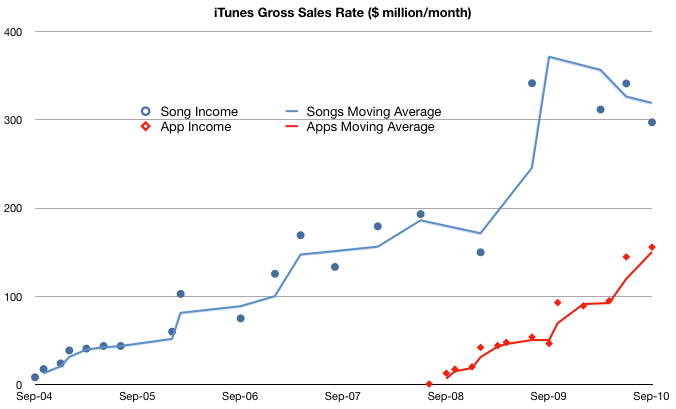
    To obtain the top line (income) for iTunes we need to know the average selling price (ASP) for songs and for apps. Apps are easy, we received that info in June: $0.29 per app. For songs, it was easy before early last year: $0.99/song. After the selective price increase, the blended price needs to be estimated. I chose $1.10 for 2009 and $1.2 for 2010. These are just assumptions and can be adjusted but should give us a rough estimate:

    I followed the convention of using income rate or $/month to show the history of sales. It shows that even with a price less than a third of the music product, apps are generating over half of the sales of music. In other words, apps are adding 50% to iTunes sales today. If the decline in music units continues and the app sales increase with the current trajectory then app sales value will overtake music sales next year, consistent with the cross-over of cumulative units sold.

    Gross Margin

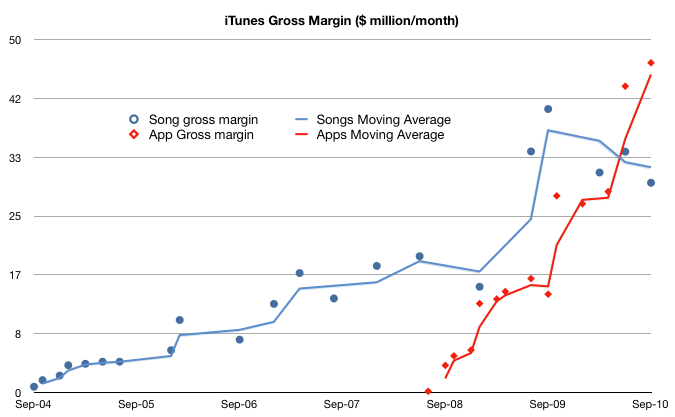
    If we know how much Apple pays music licensors and developers (i.e. cost of goods sold) we can calculate how much it keeps for operations (gross margin). Apple's app margin is 30 percent. The music margin was never official but the consensus has been 10 percent for a while.

    Using these figures, we get the following chart:

    This shows that what is left after paying the content license, Apple "keeps" about $50 million every month to run the App store (iTAS) and another $30 million to run the Music store (iTMS).

    The Operating Budget

    Apple has made a point of saying that both iTAS and iTMS are run at "break even" implying that the gross margin is used up in operating costs (CAPEX, R&D, SG&A). To be sure, the cost of bandwidth and the data center(s) needed must be considerable.

    But the operating budget for the store is beginning to reach a level that may be beyond what can be spent reasonably. The amount left over for operations has increased from ~$30 million a month in 2009 to $75 million/month today.

    In fact, if this burn rate is maintained (even though it's increasing) the operating budget for iTunes is nearing $1 billion/yr.

    I'm not an expert on the cost of operating data centers but $ 1billion a year seems like a lot. I would love to see an analysis of how this could be allocated.

    Implications

    I would also add that because of the increasing mix of apps, the overall gross margin percent is increasing. I estimate that to be a blended 17%--a healthy margin for a content store--and an increase from 10% before the app store came online.

    Finally, one implication of the economics involved is that a budget like this may provide a significant barrier to entry for any competitors looking to take on the iTunes juggernaut. iTunes has reached content critical mass (12 million songs), user base (160 million users) and wide distribution (23 countries for songs and 80+ countries for apps).

    These are non-trivial operational issues that even the best in the "cloud" business models will find challenging.

    Footnote:

    This discussion excludes video sales, rentals, book sales as we don't have solid histories for these product lines. However, we can do a spot check on the cumulative totals:

    • 450 million TV episodes downloaded implies $1 billion in sales.
    • 100 million movies downloaded probably adds at least another $1 billion
    • 35 million books adds another 500 million.
    • Compare with 11.7 billion songs at ASP of $1 for about $12 billion in song sales and 6.5 billion apps at ASP of $0.29 or about $1.9 billion.

    iTMS content downloads have generated $16.4 billion in sales to date.

  6. iTunes app total downloads to overtake songs this year

    Research · 17 comments

    Last week I posted the iTunes download rate graph that showed how Apps are being downloaded much more rapidly than songs and revealed an inflection point in the song rate.

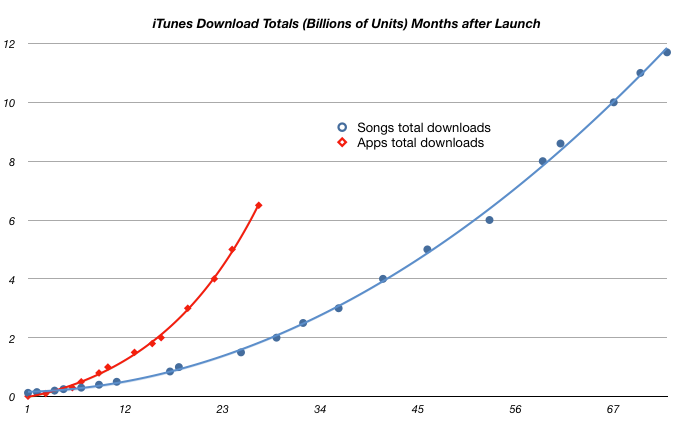
    Based on the recent updates to iTMS and iTAS on Sept. 1, the following graph shows the cumulative units of songs and apps downloaded indexed to the same starting date.

    As can be seen, the App store has reached the same total downloads in 2.2 years as the iTMS reached after five years. The two curves are likely to be the same height (around 13 billion each) before the year is over.

  7. iOS users downloading 17.6 million apps/day. Songs, not so much.

    Research · 26 comments

    Thirty days after the launch of the iTunes App Store, Apple announced that 60 million apps were downloaded in the first month of operations generating sales of $30 million. "This thing's going to crest a half a billion, soon," Jobs said adding that it may be a "$1 billion marketplace at some point in time."

    Mr. Jobs was being modest.

    To see how modest we have the following data:

    If the current download rate is maintained (17 million apps/day) and if the pricing of $0.29/app is preserved, then $1.8 billion will have been spent on iOS apps this year.

    With the rate of downloads increasing as steeply as it is, $2 billion in sales is not unlikely in the third year of the store. Twice what Jobs was predicting for "some point in time".

    The other line in the graph is the iTunes music download rate. I've written about it before and pointed out that the point of inflection in the download rate coincided with the increase in price for songs from $0.99 to $1.29. Not much more to say here except that the trend continues and music downloads continue to slow.

    As far as Apple is concerned, the slowdown in iTMS is more than offset by the increase in iTAS. As far as the music industry is concerned, I don't think CD sales are increasing. Does anyone know?

  8. 54 apps have been downloaded for every iOS device sold

    Research · 19 comments

    At the September 1st music event, Apple announced that 6.5 billion apps were downloaded and that there had been 120 million iOS devices sold.

    This works out to 54 apps per iOS device.

    On June 7 Apple reported 5 billion apps over 100 million iOS devices or an average of 50 apps for iOS device.

    On April 8th, I computed that the app attach rate was 47.

    Is this rate noteworthy?

    Let's rewind to two years ago.  August 27th, 2008, soon after the App store launched.

    Nokia had just declared that its users had downloaded over 90 million applications over the past 2 years. An analyst estimated that over 100 million users globally use Nokia smartphones/converged devices, implying an attach rate of less than 1 app/smartphone.

    My, how expectations have changed.

  9. Wàlt Dìsney loves Android

    Research · 38 comments

    I went to the link below to look at some of the apps. I clicked Top Free tab and scanned through the featured apps. As Google puts it: "This is a showcase for some of the featured and top ranked applications and games available on Android Market".

    Note the spelling in some of these top downloads:

    Wàlt Dìsney

    S0uth Pàrk

    Famìly Gūy

    Sp0ngeb0b

    the Sìmpsons

    Hellò Kìtty

    via Android.com - Market.

    It's Android so it's open (to copyright violations).

    I should note that if these free apps are monetized through Google's ad network there seems, to my untrained eye, a clear legal liability.

  10. September Music Event: Just the numbers

    Research · 20 comments

    • 300 Apple Stores
    • 10 countries with Apple Stores
    • >1 million store visitors some days
    • 80k 1:1 sessions/week
    • 120 million iOS devices sold to date
    • 230k new iOS activations per day
    • 6.5 Billion apps downloaded
    • 200 apps downloaded every second
    • 250k apps available on App Store
    • 25k iPad apps available on App Store
    • 275 million iPods sold
    • #1 portable game player: iPod touch
    • 50%+ of portable game device share US and world-wide
    • 1.5 billion game and entertainment titles downloaded to iPod touch
    • 11.7 billion songs downloaded from iTunes
    • 450 million TV episodes downloaded from iTunes
    • 100 million movies downloaded from iTunes
    • 35 million books downloaded from iTunes
    • 160 million iTunes accounts
    • 23 countries for iTunes music downloads
    • 12 million song library
  11. Breaking Android: How Google's lack of control affects their value chain

    Research · 27 comments

    A few years ago I read a book called "Breaking Windows" which was the story of the DOJ investigation into Microsoft's abuse of monopoly. The book was written by a journalist who tried to summarize some of the findings from the published internal emails.

    One of the takeaways was the logic of Microsoft's entry into the Office market. The main internal justification was not that it would be a hugely lucrative new business, but that it was a necessity to the maintenance of the Windows business.

    The story was that Lotus, having a huge installed base, could (and did) arbitrarily refuse to upgrade their software to the latest Windows version and in so doing, could kill the franchise. Lotus owned the "killer app" and could hold Windows hostage. Users would rather keep their applications than upgrade a largely invisible OS.

    Another way to read this was that Microsoft needed to "vertically integrate" Windows so that it encompassed not only the OS but also the key applications that ran on the platform. A purely horizontal OS platform was obviously not viable as a business even back in the early 90s.

    What reminded me of this story was the news that Dell is launching a new smartphone in the US.  Called Aero, it will run Android 1.5, an ancient version released in April of 2009, 18 months ago.

    Now think about the idea of Adobe coming to market next week with a new version of Photoshop that ran only on Windows XP. Or even more poignantly, if Office were not part of Microsoft, seeing a *new* version of Word that only worked with Vista.

    Through an aggressive acquisition plan twenty years ago, Microsoft avoided this scenario. Google today is faced with the prospect that not only the devices (which sit on its OS) but also services and apps on top would choose to remain on old versions of Android. There is nothing to stop them from doing just that. Unlike Microsoft, Google does not enforce licensing terms for Android. It is at the mercy of the value chain.

    Couldn't Google crack down and deprecate Cupcake? It's not as easy as that. Not only do they not have license terms that permit that but in the phone business, development lead times are so long and global distribution can be so elastic that a low volume vendor like Dell has no choice but to sell multiple OS versions of their own products. Microsoft has almost the same problem with Windows Mobile, with a variety of given-up-for-dead Windows Mobile 6.5 powered devices still in the pipeline while Windows Phone 7 is imminent.