Asymco

Asymmetric Intelligence

app

  1. Announcing Asymco Data Downloads

    Research · 10 comments

    Much of what is published here relies on data, lots of data. It's important that data be published along with conclusions, but data in spreadsheets is often difficult to read. Spreadsheets are not "productized" so they are hard to explain and therefore impossible to share.

    However, I am considering sharing the data I have in a format that is easier to read than a spreadsheet but richer than a screen shot of a chart.

    To that end I've begun experimenting with a solution based on a service called Roambi. Interested readers can download Asymco authored "roambi" files which I call ADDs (Asymco Data Downloads) will display rich data sets on iOS devices. These representations are interactive and easy on the eyes.

    Rather than bore with details, the following images should be sufficiently descriptive.

    So, to start, I am making available the market data from the article Android's Pursuit of the Biggest Losers for your viewing pleasure.

    Here is a quick FAQ about this new way of enjoying analysis:

    • Q: What is an ADD?
    • A: An ADD is an Asymco Data Download, a new way to look at the data behind the analysis with far more detail and a visually appealing representation.
    • Q: How do I get ADDs?
    • A: You will see the latest ADD featured in most pages in this blog and new ADDs will appear from time to time in blog articles. Here is an example:
    • Q: What do I need to get and use ADDs?
    • A: Any iOS device (iPod touch, iPad or iPhone) and download the Roambi visualizer app which is free.
    • Q: Is the iPad version different than the iPhone?
    • A: Yes, much better.
    • Q: Where can I get help on using the app?
    • A: Hopefully you won't need help, but there is help in the app and at Roambi's site.
    • Q: Will ADDs work with Android?
    • A: No.
    • Q: Will ADDs work with <insert non-iOS device here>?
    • A: No.
    • Q: Can I see ADDs on a Windows PC or with a Mac?
    • A: No.
    • Q: Can I download the actual spreadsheets?
    • A: No.
    • Q: How much does it cost?
    • A: ADDs are free.
    • Q: What if I see an error?
    • A: Send me a message.
    • Q: Will you publish more of this data, like the Apple financials?
    • A: Yes. I hope to publish all my data. Stay tuned.
    • Q: I don't have time to read your blog every day, can I just get the data?
    • A: I'm considering ways of creating a "premium" service. If you are interested send me a message that you would like to receive email-based links. Send request to: horace.dediu -at- asymco.com.

    Tap Here To Download

    Tap Here To Install Roambi

  2. Revisiting the App Forecast

    Research

    From a forecast I made on March 21st: 300k Apps Approved by August:

    My initial estimate in February for the 200k milestone was by May 1st. I was clearly off by nearly 40 days. If the add rate is maintained at 20k/mo 300k will come around in August although I’m not as confident in this forecast. The rate of app addition seems to be accelerating.

    As of today the Approved app counts are as follows:

    AppShopper: 297,165

    148apps.com: 296,662

    148apps.biz: 296,157

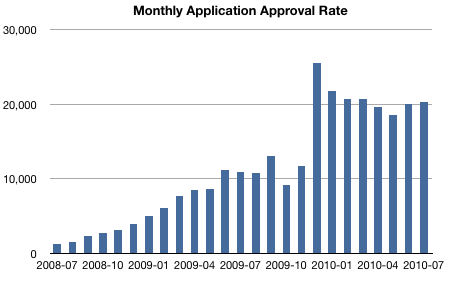
    The monthly rate of addition is shown in the following graph:

    The 20k/month has been steady during the last 7 months so I think the last 4k apps will be added in the next week, making the 300k roll-over in August, as forecast. The approval rate did not accelerate however but stayed pretty steady. There was a similar plateau in the middle of last year around 10k apps/month.

  3. New data on iTunes: 11 billion downloaded

    Research

    When Steve Jobs announced 150 million accounts with credit cards on the iTunes Store, iBookstore and App Store, he stated that as far as he knows it has "the most accounts of any store on the web".

    More interesting is the claim that iTunes has enjoyed 16 billion downloads.

    Subtracting the 5 billion app downloads, that leads to Music+Video adding up to 11 billion (books at 5 million is still too small to make an impact.)

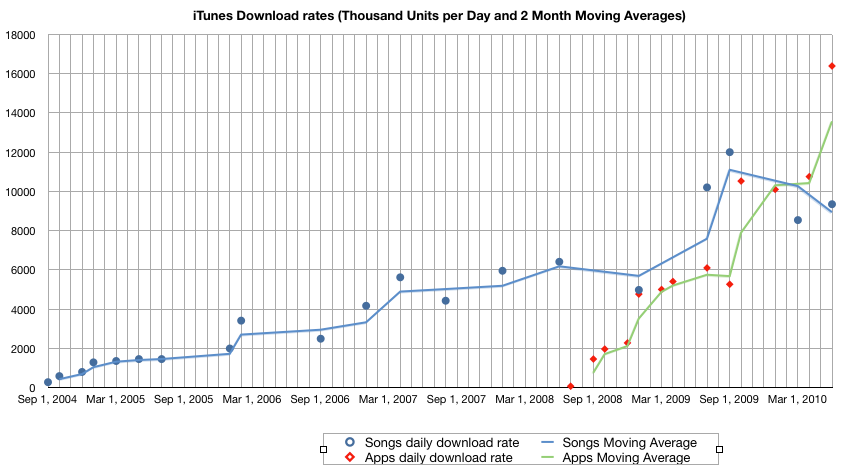
    The last download data on iTunes was in February when Apple reported 10 billion songs downloaded. The new data implies the daily download rate is about 9.3 million per day.  The forecast I had suggested 11.1 billion by June 1 so it's come in a bit less than expected.

    12 billion songs is expected in September.

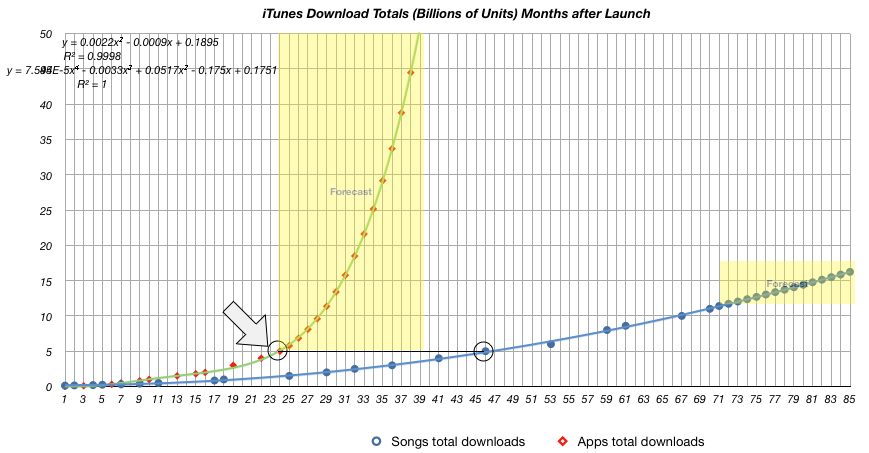
    The graph that follows shows actual and forecast cumulative downloads for the App Store and iTunes store based on months after launch.  As it shows, 5 billion apps took 24 months whereas 5 billion songs took 46 months.

    This graph shows the download rates.  The green line (apps) clearly overtakes the slowing blue line (songs/media).

  4. WWDC Context: A quarter million apps approved

    Research

    Six months ago IDC predicted 300k apps before end of 2010.

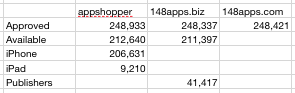
    Here is a quick mid-year check: As of today there are around 215k available, with 250k likely approved by the end of WWDC.

    These are the stats from three app store tracking spiders:

    Apple's WWDC banners proclaim 200k apps which was the last public count stated at the April iPhone OS 4.0 launch event.

    Looks like IDC's forecast will not be a stretch especially as the new iPhone will create a new wave of apps.

    Also noteworthy is the nearly 10k iPad apps available in less than 3 months.  The original iPhone reached 10k apps in about six months.

  5. People are using apps way more than they are using search

    Research

    Steve Jobs On iAds:

    [It's to] make developers more money.... People are using apps way more than they are using search. So if you want to make developers more money, you’ve got to get the ads into apps. But the mobile ads we’ve got today rip you out of the app..." Apple has figured out a better way.

    This is pretty much the same as his statement on the iPhone 4.0 launch: asymco | On a mobile device Search hasn't happened.

  6. Will Apple rule the iPad market? (part II)

    Research · 12 comments

    Continuing from Will Apple rule the iPad market? | Asymco.

    The first claim is that

    it is unclear if [Apple] will end up dominating the market the way it has come to rule the digital music player market with the iPod.

    After hearing a thousand voices cry out that the iPad is nothing more than a bigger iPod touch (which, plainly, it is) it's amusing to read that its similarity with a sibling ends when it comes to market performance.

    Let me make one claim up-front: the iPad is more of an iPod than the iPod.

    The original iPod was successful because it had a significant integrated value chain bolted on. Apple disrupted music with a value chain, not a product. It changed the way music is bought, consumed and even how it is produced. It changed the economics from retail down to songwriting.

    This is why it came to dominate its market. Every competitor that took a run at it did so with a partial solution to the value chain. Often it was nothing more than a music player, and in some cases (e.g. Zune) it was bundled with some other pieces of technology, but poorly executed and too late.

    The iPad comes with an even bigger value chain bolted on: the App Store. Apple is flogging not just an "app player" but also a new way to develop and distribute software. If you cut "music" and paste "apps" you see the immediate parallel between iPod and iPad. The app ecosystem will quickly grow to be larger than the music ecosystem with the mobile software business already eclipsing the music business.

    A competitor launching a tablet device will have to somehow overcome the momentum of billions of downloads fed by hundreds of thousands of apps built by tens of thousands of developers for hundreds of millions of users.

    The iPod juggernaut pales in comparison to the iPad supernova. The iPod had no apps or dedicated developers. Its ecosystem consisted of a handful of music companies. The only thing that made it "sticky" was the tie-in with one type of content.

    The iPad on the other hand has a thousand other jobs to do for its users. It has a rich tapestry of functionality and a multi-dimensional (literally) user experience.  It's a platform. It's even powerful enough to impose new standards on the web itself and to suggest that search is a bygone activity.

    So to suggest that Asus or Dell will somehow build "iPad killers" sounds asinine. These competitors don't even grasp what the product is and what it's for.  Sony said they don't see a market for it. Microsoft, trapped in the innovator's dilemma and overshooting the market by miles, said they don't understand what the point is because users want full PCs.  Google asked what's the value of a big iPod. I could go on, but there was not a single company in the industry who recognized what they were looking at in January. Apple keeps a tight lid on new products so that competitors don't get a head-start on copying, but in the case of the iPad, advance knowledge would not have had any impact. Competitors look at the iPad and see nothing.  They'll only react once the market explodes and they start to feel belated pain.

    If, and it's a big if, they do recognize what an iPad is, their response cycle is going to be measured in years. On hardware, they were blown away with a product that had twice the power, half the bulk, twice the battery life with half the price of what they had on the shelf. They may catch up on hardware in a year or two and launch some sort of iPad-like assembly of components, but that is like making the first iPod killer in 2002.

    Then there is software. Their software supplier (Microsoft of Google) will have to build a platform that works. That will take years. Years during which the iPad will penetrate every geography, demographic and vertical market.

    Google might move more rapidly than Microsoft, but they will produce an open source poster child of a platform. Fragmented and rough around the edges to the point of looking like a hobby project. Their flea market store will also have the smell of fresh glue about it. Microsoft is so far behind the curve that I don't even think they will try to move the tiller.  Their view of the market was betrayed by the recently knifed Courier demoware. To suggest a challenge to the PC/Windows model inside Microsoft is a career-limiting move so don't expect their brightest to be lining up to propose new platforms to management.

    What about HP? Assuming they overcome the pitfall of NIH that kills 80% of integration efforts, they will still need to perform an enormous amount of heavy lifting to get WebOS to be a competitive experience on a tablet. Most opinions were that Palm came pretty close with a smartphone, but that was nowhere near enough to stay alive, never mind challenge iPhone.

    Then there is the ecosystem. Building it is just not something I can even begin to roadmap. What about developer tools, SDKs, frameworks and evangelism? With a Palm division, HP is the best positioned of the PC vendors but it has a chance at being a player as much as Creative did vs. the iPod, or needless to say, Palm vs. the iPhone.

    So the iPad challengers face five daunting obstacles:

    1. Recognition of a threat from a seemingly benign product
    2. Execution on hardware against the best integrator on the planet
    3. Execution on software against a new UI metaphor fortress surrounded by a patent moat
    4. Integration of hardware and software to a sublime whole
    5. Re-building a value chain for which they have no handle vs. a broad and deep existing universe of app/content creation distribution and consumption enjoying logarithmic network effect value.

    That does not even touch the logistics, sourcing, margin and pricing challenges of world-wide distribution of the whole value chain. Nor does it cover the lock-in of advertisers to new tools for creatives or the billions of daily views from a platform that is blindingly dazzling.

    To put it in the language of disruption, by the time the competitors launch symmetric attacks on the iPad, Apple will be the incumbent. And we all know that symmetric attacks never work against entrenched incumbents who have all the levers of power at hand to deploy in a withering counter-attack.

  7. The mystery of the Quantum Leap in the App add rate

    Research

    The app store crossed 200k apps in early may and is on its way to a quarter million apps approved by end of June.

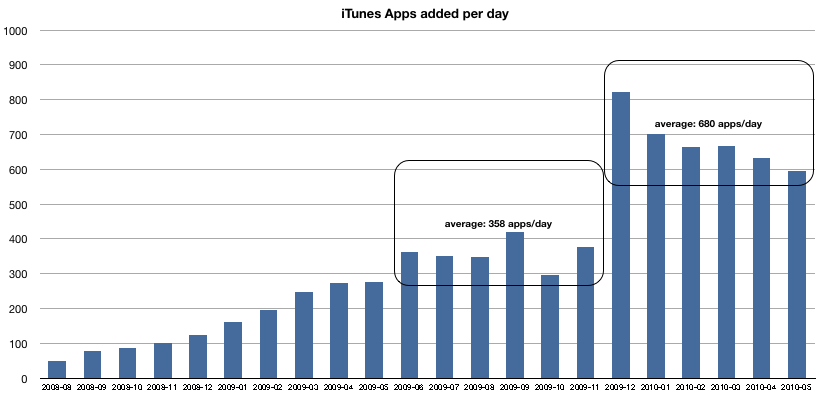
    On the way to this total, the rate of addition of apps has been increasing to around 630 apps added every day.  What's perhaps interesting is that this app add rate has not been increasing in a steady way.

    The graph below shows how the add rate has been increasing (sourced from 148apps.biz).  During the first year, the add rate was increasing steadily.  Then it reached a plateau of about ~350 apps/day for six months in the later half of 2009.  Then it jumped dramatically in December to over 800/day and then leveled off to an average of 680/day during the last 6 months.

    The pattern could be due to the rate of applications being submitted changing or due to the rate apps are approved. Clearly there is a seasonal explanation for the December jump, but the rate has held pretty steady after that month and has remained far above the rate during the trailing six months.

    My guess is that the app approval process and resourcing for the task has been improved during the last six months.  On a monthly basis the new normal seems to be around 20k apps/mo.

  8. 200k apps (IV)

    Research

    The avalanche of media outlets offering their content for Apple’s mobile devices demonstrates that Flash is no longer necessary to watch video or consume any kind of web content. And the 200,000 apps on Apple’s App Store proves that Flash isn’t necessary for tens of thousands of developers to create graphically rich applications, including games.

    via Thoughts on Flash.

    How about that! On February 2nd from your correspondent: 200k Apps by May 1.

    Including apps that have been removed, the total apps approved is about a quarter million. 200k available apps crossed over on March 23.

  9. iPhone OS download rate 10X Blackberry

    Research

    Today, Research in Motion co-CEO Jim Balsillie said his BlackBerry App World has 20 million registered users and nearly 1 million daily app downloads.

    via Apple Doing 10-20X As Many App Downloads A Day As BlackBerry.

    As previously stated, The App download rate increased to a record 10,753,000 per day during the last 90 days.  That makes the download rate for the iPhone platform 10x that of the Blackberry Platform.  The iPhone platform is nearing 100 million installed base.  Blackberry is citing 20 million registered users.  I think everyone is pretty clear on where this is going.