
Asymco

Asymmetric Intelligence

app

  1. The Mobile Web vs. the Objective-C Web

    Research

    At one point in time, J2ME (now Java ME) and WAP were the starting points for a discussion on mobile strategy and the web. Then, for a brief period of time, you talked about HTML/CSS. Now, for a growing majority of mobile strategies that don’t require a global presence on widely varying devices, the discussion begins with iPhone. Smart client is now iPhone app, and in many cases, the app is primary to the experience, not secondary to the browser. And iPad app may soon replace iPhone app as the starting point.

    Frankly, as the adoption rate of iPhone increases and if iPad follows suit, it will become increasingly difficult to argue in favor of a starting point other than iPhone OS. The NPR iPad app, for one, provides a much more pleasant user experience than NPR.org.

    via Cameron Moll: Designer, Speaker, Author The Mobile Web vs. the Objective-C Web.
  2. 300k Apps Approved by August

    Research

    Apple leads the App Store race with 170,000 apps

    Palm announced 2k apps on their store and Google recently crossed over 30k. Blackberry has 5k. Ovi maintains about 7k apps.

    According to Appshopper there are 199,885 apps approved and 172,662 available on the App Store. (200k will certainly be crossed today March 21st). Due to churn and policy enforcement Apple has removed 27,223 apps from its store over the years.

    In the case of Android, policing may not amount to much catalog erosion so the 30k figure is more comparable to the "approved" Apple figure.

    With 27th the deadline for inclusion by the April 3rd launch date, the rush to submit new apps for the iPad is on. No doubt, there will be a significant surge in new apps in March. This might lead to a new record of over 25k apps added in one month.

    My initial estimate in February for the 200k milestone was by May 1st. I was clearly off by nearly 40 days. If the add rate is maintained at 20k/mo 300k will come around in August although I'm not as confident in this forecast. The rate of app addition seems to be accelerating.

  3. Palm sell-through down 15% year-on-year

    Research

    Smart phones sold to retail customers totaled 408,000 units, down 15% from a year earlier and 29% sequentially

    By some estimates, Apple pre-sold more iPads online in one week than Palm sold smartphones through Sprint and Verizon stores in 3 months.  What's more remarkable is that year-on-year decline implies Palm sold more Windows Mobile devices than WebOS which was not on the market a year ago.

    link: Palm Narrows Loss but Retail Sales Decline - WSJ.com

    • The company said there are over 2,000 apps in the Palm App Catalog.
    • ASP was $367, down from $375.
    • Almost all volume was from WebOS products (Windows Mobile devices are gone)
    • For Q4, the company expects revenue to be less than $150 million.
    • Q4 gross margin likely in the mid-teens.
    • Guidance for $150 million in revenue, down 57% sequentially.

    After hours market cap for Palm is about $833 million down 13%.  Expected revenue and ASP imply about 410k units will be sold into the channel in the following quarter.

  4. App Store vs. Facebook as Platforms

    Research · 1 comment

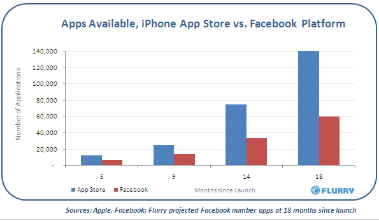
    Since the App Store launched in July 2008, 35,000 unique companies have released applications, which translates to 58 new companies launching apps each day. This appears to be the largest amassing of 3rd party developer support by any development platform in such a compressed timeframe. For example, comparing the number of applications created for the Facebook platform to the App Store over their respective first 9 months, Apple boasted 25,000 apps to Facebook's 14,000. Comparing respective growth in apps after 14 months, Apple had widened its gap to 85,000 apps over Facebook's 33,000. At the App Store's 18 month mark, reached this January, the number of iPhone apps was reported to have exceeded 140,000 compared to 60,000 we estimate Facebook had reached over the same number of months. Apple now leads Facebook with over twice as many available applications. We believe the difference in growth rates can be attributed to the App Store providing better monetization possibilities for application developers than Facebook. Developers, like all rational companies, pursue markets where the path to revenue generation is clear.

    link: Flurry Smartphone Industry Pulse, February 2010

  5. Korean Regulations Stifle Mobile Games Market

    Research

    South Korea is considering banning access to the Android Marketplace to its residents if Google continues to offer game apps that are not approved by the country's regulator

    link: Korea may block Android Market due to game laws | Electronista

    Currently, South Koreans have a choice of two Android-powered smartphones that have access to the Android Marketplace, and more are due for release this year. There are about 4,400 games on the Android Market available to South Koreans, with all of them needing to be rated.

    Apple has gone around the South Korean laws by not offering any gaming apps at its App Store for iPhones and iPod touch devices. South Korean developers put up locally approved games under the entertainment category in the App Store, however. Many South Korean iPhone owners create a second account outside of South Korea that does grant them access to games on the App Store as well.

  6. Advanced Task Killer Sounds like a Winner of an App

    Research

    Now, unlike the Apple iPhone, the Droid can run more than one app at a time. This sounds like a fantastic feature, and a major selling point. Unfortunately, it is very hard to turn an app off, so it doesn’t take long for the phone to become overwhelmed. How big of a problem is this? The number one downloaded app in the Droid app store is “Advanced Task Killer” an app you must use dozens of times a day to kill apps that are slowing down your phone.

    Much more here: Thoughts on the Downside of the Droid -- Seeking Alpha