Asymco

Asymmetric Intelligence

app

  1. Android Market passes 50k apps

    Research

    Android has already crossed the 50,000 app mark, new stats from AndroLib show. Just a week after Google officially confirmed the 38,000 app mark, a raw estimate now says the mobile app store has added 10,000 more apps within at least a few weeks.

    via Android Market passes 50,000 apps | Electronista.

    The AppShopper iTunes app store spider shows the following totals today:

    • Total Apps Approved: 222431
    • Total Available Apps: 191465
    • Total Available iPhone Apps: 188005
    • Total Available iPad Apps: 4902
  2. The Progress of the Platform

    Research

    The Progress of the Platform.

    On why there is a ban on intermediate layers of software development on the iPhone OS.

    But the reason isn’t technical. It’s partly business (Apple doesn’t want another company to control any important part of the iPhone platform), but it’s also in no small part grounded in aesthetics and the progress of the platform. Apple wants developers to do things the iPhone and iPad Way because they believe it will result in a better user experience and better designed apps. That’s an aesthetic, design-centered argument about how touch apps should be done. Apple has created tools customized to the iPhone and iPad; hell, they built a whole new touch-based operating system. They created a whole set of user interface metaphors that are supposed to be standard and system-wide, and they want developers to do things the new way not because Apple just loves power, but because they believe it’s necessary to force developers to think about the new world of touch-based computing correctly. All of this in service of giving users who are taking their first steps into touch-based computing a great experience.

    Developers who want to write software for the iPhone have to write iPhone-like software. To do otherwise will hinder the progress of the platform.

  3. On a mobile device Search hasn't happened

    Research · 7 comments

    This is one of the most thought provoking things I've ever heard.  Some of the implications are unfathomable.  Before we dive into the implications of iAd, here is the exact quote from the Apple Special Event, April 2010 (iPhone 4.0 launch) around 45 minutes in.

    When you look at a mobile phone, it's not like the desktop.

    On the desktop, Search is where it's at.  That's where the money is.

    But on a mobile device Search hasn't happened. Search is not where it's at. People aren't searching on a mobile device like they are on a desktop.

    What's happening is that they're spending all their time in apps.

    When people are looking for a place they want to go out to dinner they're not searching. They're going into Yelp. They're using apps to get the data on the internet rather than a generalized search.

    And this is where the opportunity to deliver advertising is.

    Not as part of search but as part of apps.

    Jobs is making a set of huge claims:

    1. There is no search on devices.
    2. There is no money in search on devices.
    3. Apps create an inventory of billions of ad impressions every day
    4. Apps are better at delivering the data from the internet than a browser
    5. Apps are therefore the new browsers and eyeball aggregators

    This is heavy stuff.  I believe what gives Apple the confidence to make these claims is the vast amount of data on user behavior that the app store collects. It's possible they're wrong, but it's more likely they're right.

    If they're right, what are the implications?  First, obviously, iAd adds up to a lot of cash « Asymco.  Second, this has dire consequences for Google.  Jobs could not be more blunt: search is not where the money is at.

    I can chip in some personal experiences that confirm this preference for apps over browser interfaces, but I leave it as an exercise to the reader.

  4. App download rate steady above 10 million per day

    Research

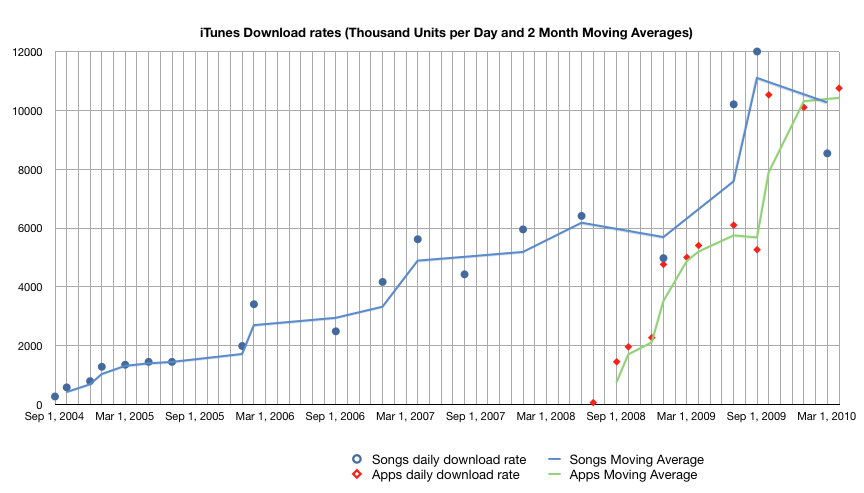
    The App download rate increased to a record 10,753,000 per day during the last 90 days.  This remains below the peak reported iTunes music rate of 12 million per day in the fall of 2009, but above the more recent rate of 8.5 million per day reported in March.

    The download rates for iTunes are reported to have fallen as tiered pricing has been introduced while App download rates continue to increase.

  5. Time to Download 4 Billion Apps: 21 months

    Research

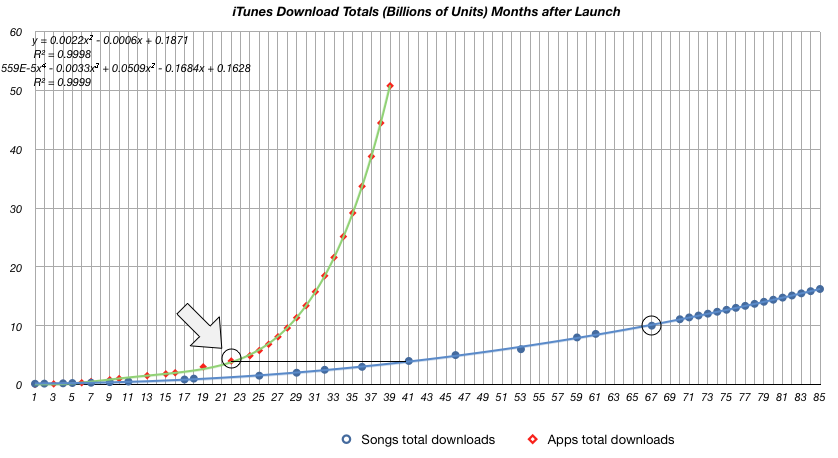
    Last week's announcement of "well over" 4 billion apps downloaded came 21 months after the App Store opened on iTunes.  To give a perspective on how fast that is, 4 billion songs took 41 months to sell on the iTunes Music Store.

    The graph below shows the last actual data provided on both the App Store and the Music store downloads (circled) plotted from time of launch.

    It also shows a curve-fit forecast of each store's downloads.  If the growth persists, 10 billion apps could be shifted in 28 months post launch, which is around November of this year.

  6. Daring Fireball: New iPhone Developer Agreement Bans the Use of Adobe's Flash-to-iPhone Compiler

    Research · 4 comments

    My reading of this new language is that cross-compilers, such as the Flash-to-iPhone compiler in Adobe’s upcoming Flash Professional CS5 release, are prohibited. This also bans apps compiled using MonoTouch — a tool that compiles C# and .NET apps to the iPhone. It’s unclear what this means for tools like Titanium and PhoneGap, which let developers write JavaScript code that runs in WebKit inside a native iPhone app wrapper. They might be OK. The folks at Appcelerator realize, though, that they might be out of bounds with Titanium. Ansca’s Corona SDK, which lets you write iPhone apps using Lua, strikes me as out of bounds.

    via Daring Fireball: New iPhone Developer Agreement Bans the Use of Adobe's Flash-to-iPhone Compiler.

    Nota bene:  Apple will release its own app front end that allows a simpler development environment (than XCode).

  7. iAd adds up to a lot of cash

    Research · 3 comments

    "The average user spends over 30 minutes every day using apps on their phone. If we said we wanted to put an ad up every 3 minutes, that's 10 ads per device per day. That would be 1b ad opportunities per day."

    This is going to take some time to sink in over at the Googleplex.  By pushing Android, Google removed themselves from this opportunity.  Jobs continues:

    "We do not have any plans to become a worldwide ad agency. We tried to buy a company called AdMob, and Google came in and snatched them from us. We bought Quattro instead. They're teaching us and we're learning as fast as we can."

    Not to put too fine a point on it, but I did suggest iAd was coming on Dec. 30 of last year:

    I think it’s a certainty that Apple will introduce an ad serving platform for the iPhone (and any tablet) in 2010. This will amount to a checkbox that developers will check when submitting their app to the store. Doing so will allow Apple to place ads on the app in return for a check in the mail to the developer for the impressions.

  8. Apple sells 450,000 iPads in 5 days, users download 3.5 million apps

    Research

    Apple said Thursday that it has shipped over 450,000 iPads since the device went on sale this past Saturday, spurring 3.5 million app downloads for the new tablet device by its earliest adopters.

    via AppleInsider | Apple sells 450,000 iPads in 5 days, users download 3.5 million apps.

    Jobs also updated with 600,000 downloads of iBooks.  The first day sales of books was 250k, so it's keeping a bit above 1 book per device.  First day apps was 1 million, so the app attach rate is now 7.8, well above the 3 from day one.  Keep in mind that the iPhone attach rate grew to over 50 so it's early days to see how iPhone compares to iPad as an app magnet.

  9. One billion apps downloaded in 93 days

    Research

    A bit less than one year ago, on April 23rd 2009, Apple reported 1 billion apps downloaded.

    158 days later, on September 28th 2009, Apple reported 2 billion apps downloaded.

    99 days later, on January 5th 2010, Apple reported 3 billion apps downloaded.

    93 days later, on April 8th 2010, Apple reported 4 billion apps downloaded.

    The download rate for the past 93 days was 10.7 million apps per day.

    Given 85 million iPhones and iPod touches sold, the 4 billion app downloads amount to 47 per device.  (Although that number is likely to be considerably higher due to many iPhones/iPods having gone out of use--an attach rate of well over 50 seems like a good estimate).

  10. Nokia Tablet?

    Research

    "Getting a strong Intel backing here could be an important advantage," says MKM Partners analyst Tero Kuittinen, who sees the Nokia tablet as part of an array of mobile computers.

    via Nokia Aims a Tablet at Apple: Exclusive | Technology | Financial Articles & Investing News | TheStreet.com.

    No doubt Nokia's tablet plans preceded the launch of the iPad--product cycles being what they are.  And the relationship with Intel is certainly a big part of this push (vs. on the handset side where Intel has no cards to play).

    However, the elephant in the room is what software will run on this Tablet.  Any discussion on competitive potential of iPad competitors must include a view on the software/platform and ecosystem that tablet will rest on.

    This is not a hardware business.  In fact, the hardware is designed to get out of the way.

    The hardware is so understated — it’s just a screen, really — and because you manipulate objects and interface elements so smoothly and directly on the screen, the fact that you’re using an iPad falls away. You’re using the app, whatever it may be, and while you’re doing so, the iPad is that app. Switch to another app and the iPad becomes that app. If that’s not magic, I don’t know what is.

    source: http://db.tidbits.com/article/11152