Asymco

Asymmetric Intelligence

carrier

  1. Will T-Mobile's hundred dollar smartphone with ten dollar data plan win subs?

    Research · 21 comments

    Chief Executive Philipp Humm said in an interview that many of his smartphones will eventually be made up of Google-powered phones costing less than $100, half as much as the smartphones typically available at U.S. carriers. In October, to lower the cost of monthly bills, Mr. Humm introduced a limited data plan that costs $10.

    via T-Mobile Smartphones to Head Down Market - WSJ.com.

    T-Mobile seems to be attempting to differentiate on price. In a regular market reaching saturation that might be a viable strategy. However the market is neither regular not saturated. T-Mobile's chances of gaining large share are limited.

    Churn, or the chance that a user will switch networks is still very low. If anything, AT&T and Verizon are more sticky and lose fewer customers than T-Mobile and Sprint.

    Mobile computing saturation (25% to 30% penetration) is also not nearly at a point where competition on price leads adoption.

    Lastly, the $100 price point is being put against the standard $200 price point which itself is an illusion for the user. The drop in smartphone entry price is not as powerful going from $200 to $100 as it is from $300 to $200. Psychologically, $200 is an inflection point. Apple's $100 3GS pricing (now $49) is defensive and probably effective.

    In short, the market for telecom services is not very "liquid" and users are quite trapped in their carrier contracts, pricing is not yet a basis for competition and pricing illusions persist.

    In conclusion:

    Mr. Humm, in an interview at the Consumer Electronics Show in Las Vegas, acknowledged that the likelihood Verizon Wireless getting the iPhone as well could affect his subscriber numbers.
  2. Are mobile networks commodities?

    Research · 23 comments

    Apple has been contemplating a SIM card that would make carrier switching a lot easier. Sounds great, doesn't it?

    "Apple is relenting," said Rodman Renshaw analyst Ashok Kumar. "They are now completely backing away from their plan to take the carrier out of the equation," said Kumar,.

    via Apple to Kill Carrier-Irking iPhone Plan - TheStreet.

    This brings to mind a recent article I wrote that any talk of mobile dominance by platform vendors is bunk.

    ... no single platform can win a disproportionate share because it would threaten the balance of control the operators require. So talk of “dominance” of one platform or another is hyperbole. The most likely scenario is an even distribution of share between 4 or 5 competitors.

    The power of distributors in the mobile phone value chain cannot be ignored. It's not fair, it's not convenient and it's not consumer friendly, but as long as networks are not good enough for mobile computing, mobile computers cannot commoditize the network.

    The consequence (for those of us who try to foresee the platform game) is that operators will continue to play platforms off against each other leading to the scenario I suggest above.

  3. Daring Fireball Linked List: Andy Rubin Talks Android

    Research · 29 comments

    What value have the carriers brought? Seriously. What software on Android phones have the carriers added that’s any good at all?

    Things you don’t hear iPhone users say: “Man, this iPhone would be even better if my carrier could ‘add value’ to it.”

    via Daring Fireball Linked List: Andy Rubin Talks Android.

    Good questions.  I would seriously like to hear any answers to these questions as I have never used any of these operator software phones.

  4. RIM Quarterly update: just the numbers

    Research · 11 comments

    Noteworthy data (with my notes in parentheses.)

    • 12.1 million phones shipped, 11 million sold through (estimated iPhones for this Q range from 11 to 13 million)
    • Net subscriber account additions were 4.5 million which was lower than anticipated (41% of units sold through were to new subscribers which implies nearly 60% were to existing users)
    • Revenue grew 31% over the same quarter last year and GAAP earnings grew 76%.
    • The BlackBerry subscriber account base grew 56% year-over-year to over 50 million
    • RIM has shipped approximately 115 million handhelds to date. (note: 120 million iOS to date)
    • BlackBerries are available through over 565 carrier and distribution partners in approximately 175 countries and international markets (vs. 150 carriers and 88 countries for the iPhone)
    • Approximately 52% of revenue in the quarter was generated outside the United States and over 45% of BlackBerry subscriber account base is outside of North America. (70% of iPhones were sold outside the US through the first half of this year)
    • Torch was launched with one carrier but will expand to 75 next quarter
    • To date over 35 million BlackBerry Smartphones have downloaded App World at an average of over 1.5 million Apps are being downloaded every day which is up 40% sequentially (iOS apps are running at 17 million downloads per day)
    • Average selling price for RIM devices was $304 (vs. $600 for the iPhone)
    • Gross margin was 44.5% (upward of 50% for the iPhone)

    Research In Motion CEO Discusses F2Q2011 Results - Earnings Call Transcript -- Seeking Alpha

  5. European Operators contemplate own OS. Why not just fork Android?

    Research · 31 comments

    France Telecom-Orange CEO Stephane Richard has invited the heads of Vodafone, Telefonica and Deutsche Telekom (T-Mobile) to Paris on 8 October to discuss the development of a common operating system for mobile devices. He told Le Figaro that mobile operating systems were the Trojan horse used by Google and Apple to establish relationships with mobile customers. The four operators have nearly 1 billion customers combined and the capacity to influce industry. The initiative could take several forms including a joint venture or a common apps development unit. He added that the operators aim to retake the reigns of innovation, rather than be followers.

    In the interview Richard also stated that carriers have decided not to advertise the iPhone any more.

    Phone carriers want to team up against Apple and Google. - HardMac Forum

    This attempt at operator cooperation in software has been tried before, but it predictably failed (does anyone remember Savaje?) Symbian itself was an attempt at mobile phone vendor cooperation on systems software. There are various consortiums for "open mobile OS" based on Linux (e.g. LiMO which started as a Japanese effort). Even the Open Software Alliance is a rubber stamp body rather than an attempt at development.

    Although one can safely dismiss the potential of this effort on the basis of a lack of competence, the arrogance reminds one of the rigidity in response to the disruption under way. The fact that high-speed data networks allow operator disintermediation cannot be changed by "innovation" on systems software.

    But the odd thing is why even bother. The solution to taking control over the user experience and services platform is straight-forward: each operator could fork a version of Android as their own and hire a team to integrate white label services. It's much more straight-forward than coordinating a joint effort. China Mobile have already done their own non-Google Android.

  6. Android is open unless you want to change your search engine to Google, or use tethering or Google maps or non-market apps

    Research · 10 comments

    That means no seamless integration with Gmail. No Google Latitude. No multitouch in the map app, either. And in place of the free and fantastic turn-by-turn Google Navigator app, Verizon installed its VZ Navigator service -- a feature which costs $10 a month to use.

    It would be one thing for Verizon to set the default search and map app to Bing with the option to switch back to Google. But it's utterly inexcusable for Verizon to destroy the possibility of a switch without the user having to root the device and, under Verizon's company policies, void their warranty. And on top of that, repeatedly charge you for a sub-par service instead of keeping the gold standard of navigation apps for free.

    And as bad as that is, there's now a rumor that Verizon will be doing this again. On every single one of its Android devices.

    After speaking with a Verizon representative about the Bing debacle on the Fascinate -- who also lied about the existence of a search alternative -- The Droid Guy contacted two Verizon tipsters who told him that the carrier "is dropping the Google Search from all future Android Devices and offering Bing in it's [sic] place."

    via Verizon Rumored To Replace Google With Bing On All Android Devices | Markets | Minyanville.com.

    Lots more in the linked article.

    This story just keeps getting better and better.

    Regardless of motivations, the restriction if broadly applied would have Verizon reneging on its pledge to support the openness of Android and reflects a wider trend of the OS being artificially restricted by carriers. Most US providers are disabling Android 2.2's tethering support in favor of their own, and AT&T has banned non-Market Android apps under the pretext of security. The moves paradoxically leave Apple's iPhone more open in some areas, as its users can choose Google, Bing or Yahoo for search and don't have first-party apps deliberately hidden or broken.

    Read more: Electronista

  7. Google vs. Android Part IV

    Research · 35 comments

    Verizon, unfortunately, is also what ruins the phone. Or, rather, what it’s forced Samsung to do to the phone, which you could sum up in a word: Bing. Bing is the default—and only—search engine on the Fascinate. A Google Android phone. In the search widget, in the browser, when you press the search button. Bing. No, you can’t change it. There’s no setting for it, and the Google Search widget that you can snag from the Market is blocked (or at least very carefully hidden). Being unwittingly forced into Verizon and Bing’s conjugal relationship is infuriating on its own, but the implementation also feels like the sloppy hack that it is.

    via Daring Fireball Linked List: Matt Buchanan on Verizon's Samsung Fascinate Lightning.

    John Gruber astutely adds:

    Android is “open”, but who it’s open for, primarily, are the carriers. (Somehow I doubt we’ll see any Windows Phone 7 devices where Google is the one and only search option.)

    The primary defense of Google's Android strategy is that it's beneficial in driving traffic to Google's services/properties. This is by no means a certainty. To the contrary, it seems likely that the Android experience will be defined by operator back-room deals.

    See also: asymco | Android vs. Google Part II

    Coupling a lack of control over the platform, the revenue streams, the user experience, the potential banishment of AdMob from iOS and an attack on Google's brand, Android is currently winning the war with Google.

    However, my money long term remains with Google. They can and will eventually beat Android. Perhaps with Chrome.

    [Footnote: if anyone wonders why Verizon, Google's best friend in mobile, is gutting Android, you need to remember an exclusive five-year deal Microsoft struck with the carrier to provide search and advertising services on the phone. Microsoft was rumored to pay $500 million for the opportunity.]

  8. Nokia's fifth last chance

    Research · 26 comments

    The cellphone maker will unveil its new flagship model E7, which comes with a large touchscreen and full keyboard, at the show in London, two sources with direct knowledge of Nokia's plans told Reuters.

    via PREVIEW-Nokia bets on new smartphones for recovery | Reuters.

    Analysts have been saying that Nokia has one last chance to fix (software, UI, strategy, etc.) for some time now.

    Nokia sold 24 million smartphone units sold in Q2 which represented significant growth. Sales and Profits however were both down but to say that Nokia is facing imminent demise is misguided.

    How is Nokia able to sell so many units when its portfolio elicits so much pathos?

    The reason Nokia can still coast with poor products is that they have a vast distribution network. I don't know the exact distribution but let's assume that half their phones go through carriers and half through distributors who resell unlocked phones world-wide. Carriers will continue to carry the phones because they slot into well-established portfolio slots and distributors will continue to distribute because the product is competitive in markets where there are no other unlocked smartphones at the same price.

    So predicting imminent failure without taking into account distribution inertia is showing a lack of understanding of the market. The same insensitivity to distribution is why so many predictions of Microsoft's "death" or RIM's "death" fail.

    The less sensational but more accurate description of Nokia's predicament is that their strength in distribution prevents them from reforming their business model in order to benefit from the disruption that mobile broadband is bringing to mobile telecommunications.

    That's a mouthful.

  9. The Android abdication

    Research · 18 comments

    When I wrote about Android's pursuit of the biggest losers, I made the explicit claim, backed by data, that Android was most attractive to device vendors who were in financial distress. Android is a lifeline to sustain failing business models. But underlying that claim was the more sinister implication that Android is sustaining to the incumbent operator business models. That means that Android is subject to operator manipulation and its market access as well as those of competing platforms will be throttled to maintain control.

    The article below makes an even stronger case.

    As a result, we now have a situation where the U.S. telecoms are reconsolidating their power and putting customers at a disadvantage. And, their empowering factor is Android. The carriers and handset makers can do anything they want with it. Unfortunately, that now includes loading lots of their own crapware onto these Android devices, using marketing schemes that confuse buyers (see the Samsung Galaxy S), and nickle-and-diming customers with added fees to run certain apps such as tethering, GPS navigation, and mobile video.

    The dirty little secret about Google Android | Tech Sanity Check | TechRepublic.com.

    I would not say that Android is enabling the consolidation of operator power. I would say that operator power never wavered.

    The article concludes:

    Despite the ugly truth that Android is enabling the U.S. wireless carriers to exert too much control over the devices and keep the U.S. mobile market in a balkanized state of affairs, Android remains the antithesis of the closed Apple ecosystem that drives the iPhone and so it’s still very attractive to a lot of technologists and business professionals.

    But, the consequence of not putting any walls around your product is that both the good guys and the bad guys can do anything they want with it. And for Android, that means that it’s being manipulated, modified, and maimed by companies that care more about preserving their old business models than empowering people with the next great wave of computing devices.

    That sounds about right.

  10. Android is a BlackBerry killer

    Research · 2 comments

    Much has been made of the potential for Android to reduce the growth of iPhone. The iPhone seems to be doing very well and continuing to be supply rather than demand constrained.

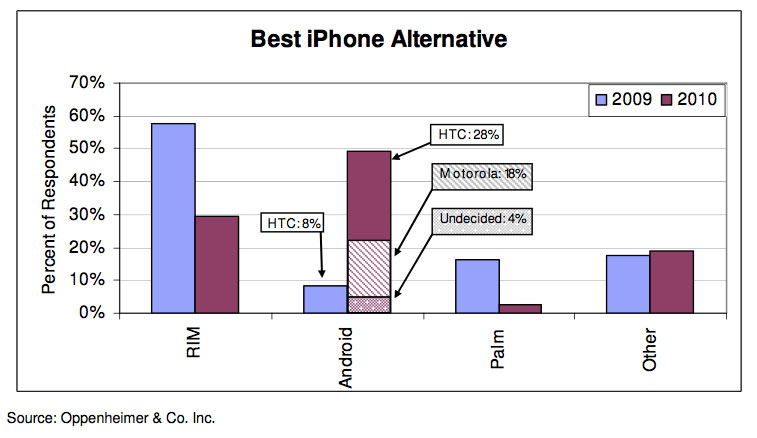
    RIM however seems to be under significant pressure.  A Goldman Sachs analyst first pointed this out in her last report and placed a "Sell" on RIMM.  The fact is that most of RIM's sales are in the US on the carriers other than AT&T.  In those very same carriers, Android is being pushed hard as a customer retention strategy, so iPhone is pressuring RIM only indirectly through Android.

    The evidence is also in survey data.  In the graph below, we see how iPhone buyers are considering Android as the most credible alternative to the iPhone whereas they considered BlackBerry the best alternative a year ago.  In terms of vendors, what RIM lost HTC gained.

    One can only wonder what will happen when the iPhone enters unrestricted distribution in the US.  The results in other markets speak for themselves.

    AppleInsider | Apple's recurring revenue stream: 77% of iPhone 4 sales were upgrades.

  11. Tim Cook on iPhone Distribution: eight new carriers, three remain exclusive, total of 151

    Research · 7 comments

    You can look at the number of carriers we added which was eight as I had mentioned, and out of the 151 carriers at the country level it is a good number but not a significant number. Obviously the existing carriers performed very well in addition to the adds.

    ... There are three main countries where iPhones have a contractual exclusive relationship. That is the United States, Germany and Spain. There are a few smaller countries where we have an exclusive or co-exclusive but those three are the ones that are the major markets. Over the past year we have moved a number of markets from exclusive to non-exclusive. In each case as we have done that we have seen our unit growth accelerate and our market share improve. But that doesn’t mean we view that formula works in every single case. I would just sort of reiterate what I did last time that this is how we are learning so far. That is the result we have seen so far. We think very carefully about each of these at the country level to conclude what is in our best interest.

    via Apple Inc. F2Q10 (Qtr end 03/27/10) Earnings Call Transcript -- Seeking Alpha.