During the last quarter the company added $5.2 billion to its cash, long- and short-term marketable securities accounts for a total of $51 billion. This amounts to about $53 per share vs. $49.43 per share in July (making the share price about $250 ex-cash).
I would caution again that when reading commentary about Apple's cash that many observers exclude long-term securities from the "cash" total.
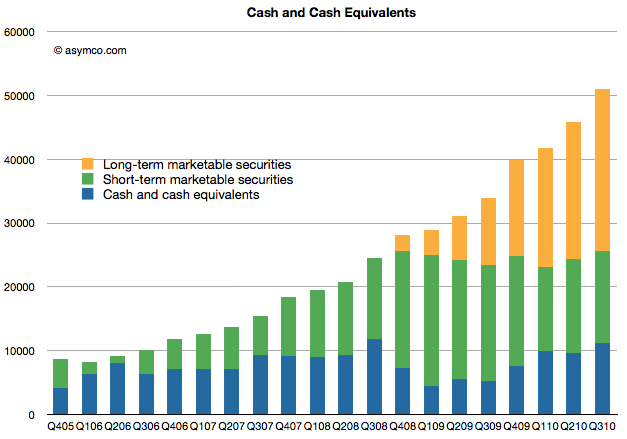
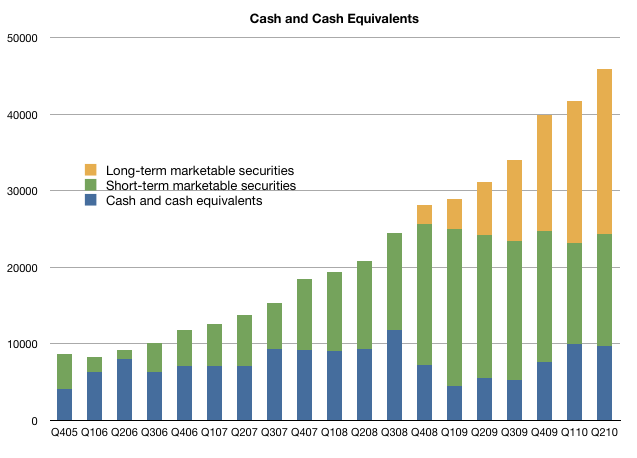
To see the difference in the total, this chart breaks out the three different accounts over time.
Note that without long-term securities, the cash wold appear to have stayed roughly constant since Q4 2008.
Also note that in the third quarter of 2006 the company had just crossed $10 billion. The cash equivalents are now over five times bigger. The amount also doubled since Q3 2008. It is the largest cash hoard of any technology company.
The question of what this cash will be used for remains open with management repeating that opportunities might arise to do something big.
Following earnings growth of 68%, after hours trading of AAPL at $300/share shows a P/E of 19.8. The company added over $5 billion in cash for a total of $51 billion or $52.9/share.
Excluding cash from the price of $300 leads to an enterprise value of $249 and a trailing twelve months earnings of $15.15. The ex-cash P/E is therefore 16.44.
P/E/trailing Growth is 0.29.
My guess is that this is keeping AAPL cheaper than the S&P 500 on both P/E and P/E/G.
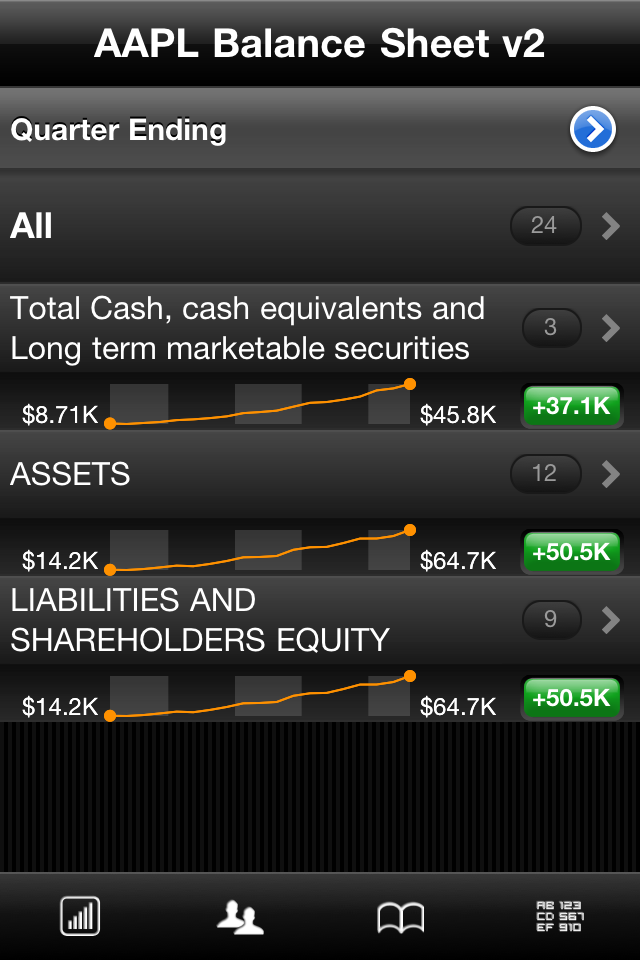
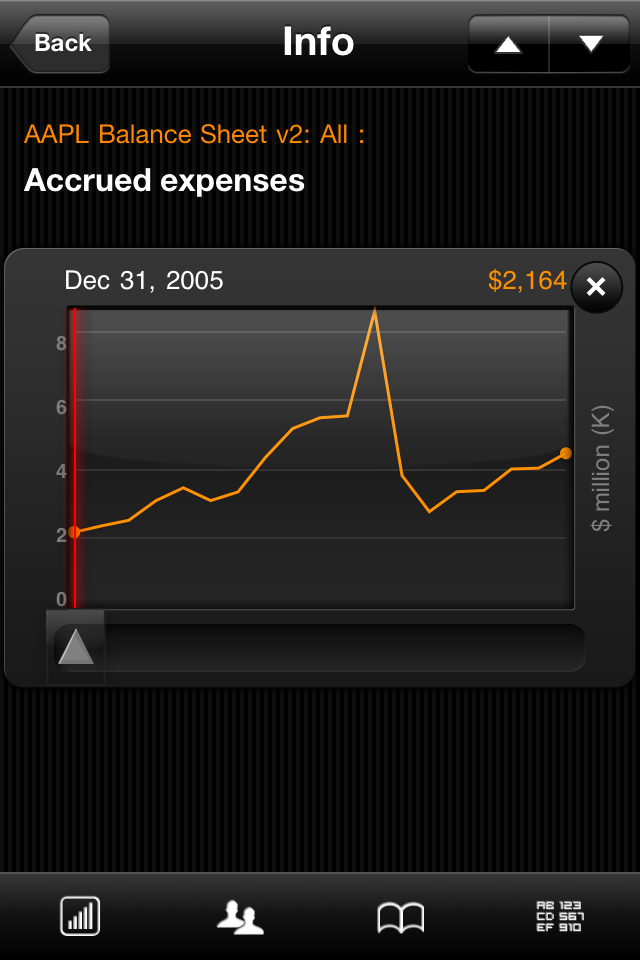
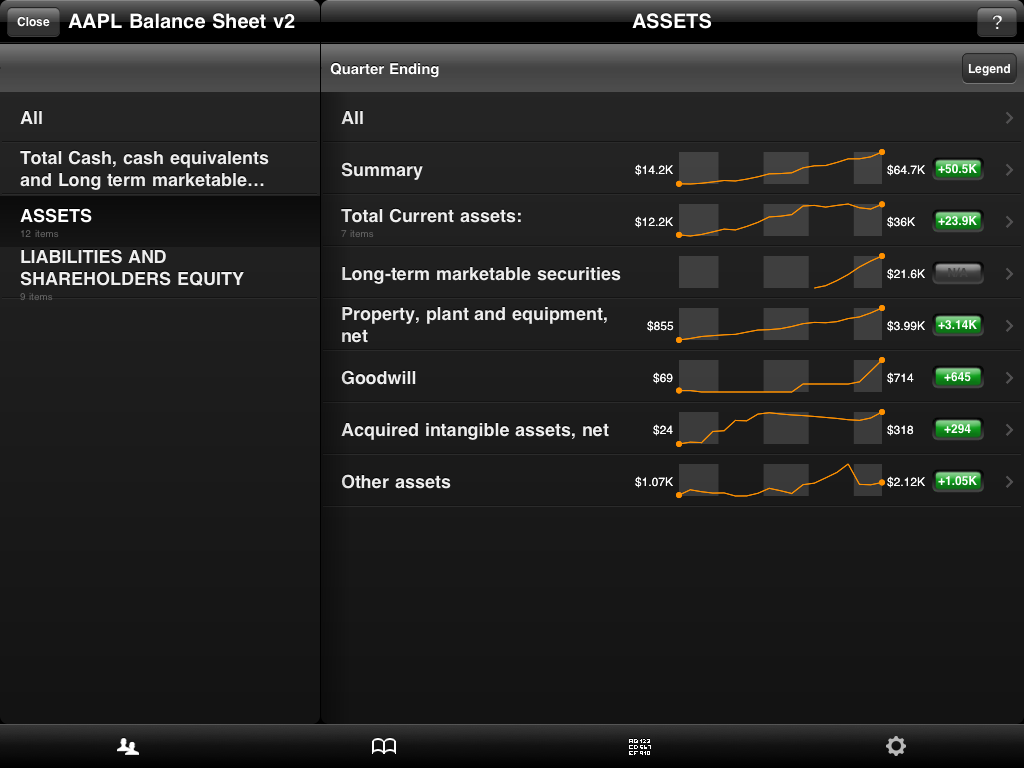
Let your fingers do the walking through Apple's income statements since FQ1 2005. Glide effortlessly through juicy bits of assets and liabilities. Slide your finger through nineteen quarters of financial goodness.
A special bonus: included is a separate visualization of Apple's liquid assets: cash, cash equivalents, Short-term marketable securities and Long-term marketable securities. $$$$$!
Brilliant to use and look at on both iPhone, iPad and iPod touch:
My recent exposé of Apple's cash (and cash equivalents and long-term securities and short-term securities) drew quite a bit of attention, which is good. Because it needs to be demystified. However, the story does not end there. Part of the problem of cash is that the liquid stuff can often itself change in perceived value due to mis-management.
Cash has to be valued on the basis of what's to become of it. So what can become of it?
The value in liquid assets can be returned to shareholders in the form of a dividend, which means double taxation on profits; not the best idea usually. Or it can be returned in the form of share re-purchase which tends to have only a temporary effect on share prices, again not a great return. The value can also be increased by means of investment in projects that return higher than what investors expect their cost of capital to be. This is the best option but investment is difficult when the amount involved is so big that no project or set of projects could possibly cost enough to employ the capital. Finally, the value can be completely destroyed through large acquisitions.
I say destroyed because the history of large acquisitions is almost universally known to be value destructive (1). The urge to M&A is why cash on the balance sheet for large companies is usually discounted and share prices "get no credit for it." This is plaguing Apple with a P/E ex-cash in the teens.
Is this fair?
Companies faced with low growth are more likely to blow their cash on desperate acquisitions than those with high growth, but the best way to judge the probabiliy of cash evaporation is by looking at management track records.
Which leads us to Microsoft. Their pursuit of Yahoo shows how desperate they had been in trying to catch Google and how poorly that would have turned out. Having failed only because Yang refused to sell, Microsoft would have gone through a large part of its cash and even raised debt to finance a dud. With this propensity, it's no wonder that Microsoft's cash is considered an endangered quantity.
Microsoft used to have the largest cash position in tech. They still have $44.5 billion--a mere billion or so less than Apple. Some of the value already evaporated on dividends and medium sized acquisitions ($500 million for Danger that ended up as Kin(dling)). The chances that they'll blow billions again on desperate means to chase competitiveness are high. I would say it's a certainty.
On the other hand we have a high growth company like Apple that has not traditionally spent money on business acquisition. (They do spend on asset acquisitions--IP, code, developers but not on new business models.) Thus, on reputation alone, Apple's cash can be considered "safer" and hence worth more than Microsoft's.
Whether Apple can expose that cash to risk that enhances its value is another matter, but their CEO is on the record stating that "it's not burning a hole in their pocket" and the CFO repeats every quarter he is intent on its preservation.
This, in my opinion, makes the difference between Apple's $45 billion and Microsoft's $44 billion a lot more than $1 billion.
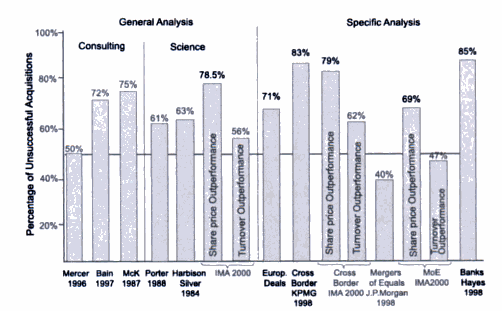
(1) Various studies have shown that at least 50% of acquisitions have been rated as failures. See failure rates by various studies charted below. Source: Prof. Dr. Thomas Straub (2007) "Reasons for frequent failure in Mergers and Acquisitions"
During the last quarter, the company added $4.1 billion in cash to reach a total of $45.839 billion or $49.43 per fully diluted share. This is divided into three types of holdings (long- and short-term marketable securities and cash equivalents).
Some (most?) financial reporting services do not include long-term marketable securities in their databases. This is a tragic error which mis-states most of the balance sheet ratios that investors may depend on. Offending sources include Capital IQ (which feeds finance.yahoo.com.)
To illustrate, the following chart shows the total cash equivalents for the company. The orange colored bars represent long-term securities. If they are excluded, an investor may conclude that Apple's cash has been *declining* since 2008 when the opposite is true. The company is shifting an increasingly larger proportion of its holdings to long-term (but fully liquid) securities.
The company devotes 9 pages in its 10-Q to describe and value the cash positions it holds. It's a pity that most aggregators of the company data don't bother to note $21 billion in assets.
With the iPad still unavailable three months after its launch and with only 1.7 million iPhones available for purchase in the first three days, Apple's inability to meet demand is surfacing as its most immediate and glaring problem. This problem merits the deployment of some of the cash Apple is hoarding.
As I wrote in May, Apple's next billion users are in waiting. However, to serve them in a timely manner requires a new approach to product launch and ramps.
Apple has imposed upon itself a yearly product cycle for the iPhone and the iPod [and, probably for the iPad]. This is a brilliant move because it keeps the product fresh without having it seem disposable. It also keeps competitors within its turning radius. However, the challenge is that the distribution network has to be filled rapidly and drained rapidly to maximize availability. This gets harder and harder as the volume grows. Imagine having to manufacture and ship into the channel a billion devices in less than a quarter.
This year's iPhone 4 launch was heavily over-subscribed. If Apple had enough supply, launch sales could have gone as high as 2.5 million, one analyst believes. Apple admitted mis-diagnosing demand and problems arose during the reservation process. There were insufficient units for pre-order, never mind for users walking into stores. The shocking thing is that three months on, the iPad is still unavailable to impulse buyers who might want to pick one up with their iPhone. This despite the fact that most of the world does not have any purchase option.
Now I ask what will happen next year? Supply may balance with demand by October and strains will show again around Christmas. Then what? The iPhone 5 will be getting prepared with another 50% to 100% growth in demand. How will June 2011 and June 2012 look? Will Apple have 4x the supply of iPhones and iPads needed to maintain growth?
There are various solutions possible, but if Apple wants to maintain the product cycle, the event marketing and the "reveal" that builds brand value, it needs to change the way it manufactures. By investing in automation, locating plants near to buyers and by integrating suppliers into production, it can get the quantum leap in supply it needs. These are capital-intensive solutions, but Apple's capital is underemployed. I see no better use for the rapidly-building cash pile.
Daniel Eran Dilger in fine form after Apple became the world's largest technology company by market capitalization.
These days, Apple’s primary competitors have all fallen down on their knees while clutching their gutted bellies...
Who is left? Google, the paid search giant that backers hope will beat Apple in hardware and software platforms… despite Google being neither a hardware vendor (nor marketer nor retailer nor support provider) nor having any real experience in managing a software platform for consumers. Fans of Google suggest that the company will take on Apple by acquiring a competing version of everything Apple has built over the last decade: iTunes, a mobile platform, hardware expertise, user interface design savvy, development tools, and a user base.
The problem is, they don’t also foresee that Apple could compete against Google in its own home territory of ads.
The key assumption in the "Google can buy anything Apple already has" is that of the three things that make up a company (resources, processes and priorities) the only thing cash can buy is resources, and, in the tech world, even those are fragile things with legs that can walk out the front door.
Google's "copy-paste" competitive approach vis-a-vis Apple falls down when you realize that Apple has been successful mostly because of its processes and priorities. It's well known that all of its vanquished competitors could (and did) recruit legions of Apple employees, elevating them to positions of responsibility, with naught to show for it. Grafting engineers and IP onto Google (or Nokia or Microsoft) cannot make it into an Apple.
Conversely, through a risky, long and arduous path, Apple could become a Google. Success with ad-based search requires resources (mostly CapEx), algorithms and distribution. With the $42 billion (soon to be $100 billion) in the bank and eye-watering free cash flow, there are few no resources that Apple cannot buy.
With iAd the world will witness an Apple that can make loads of money in Google's home turf, while Google burns cash and bridges with Android trying to defend its soft platform underbelly. The irony is that Apple can knee-cap Google without even trying to do search. After all, Jobs said plainly enough: On a mobile device Search hasn't happened.
Judging by the stock prices of the two companies, I suspect investors know this already.
About a month ago, we said we'd like you to use a credit card when you buy your iPad, and that was the best way we could think of to make sure that people only brought two per individual," said Johnson. "And then it came to our attention that Diane [Campbell], through your story, was very interested in buying an iPad with cash, and we made a decision today to change that."
Johnson said our story triggered a company-wide policy change. As of today, anyone can pay for an iPad with cash.
As a gesture of goodwill toward Diane Campbell, the woman whose experience brought the issue considerable publicity, two employees visited her home today to offer her an iPad free of charge.
"I am just so excited," said Campbell. "Words can't explain right now."
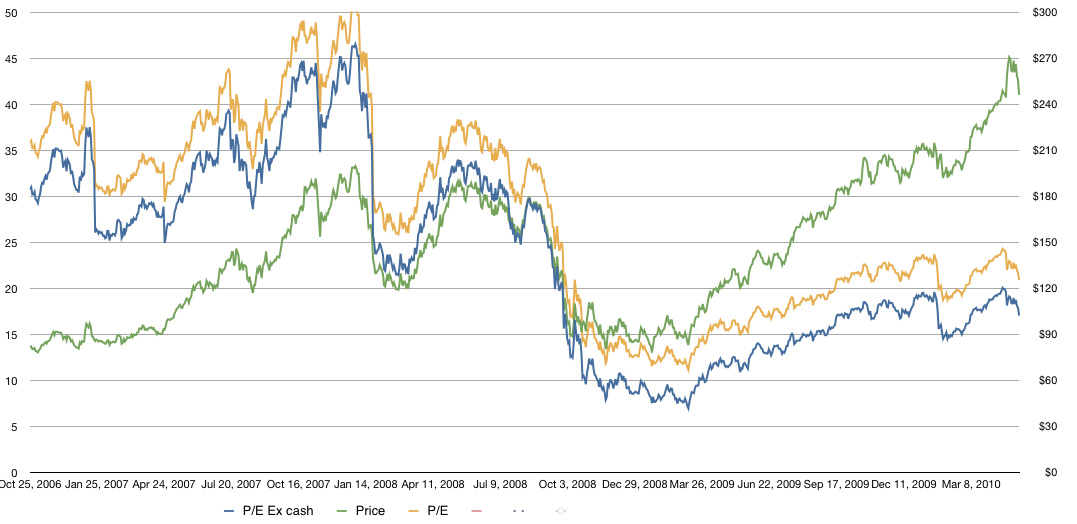
In the graph below I show Apple's historic share price overlaid Apple's P/E (with and without cash).
The share price is the line in green with the scale on the right and the P/E (trailing twelve months ex-cash) is shown in blue with the scale on the left. The P/E including cash (which is what is usually cited) is shown in yellow.
As the graph shows, while the stock has risen, the P/E has fallen. This is due to earnings accelerating faster than the stock price. As valuation is usually correlated with growth, it stands to reason that Apple continues to be discounted as a growth stock.
Buried in the news that HP is buying Palm is an updated lower guidance for the fourth quarter, otherwise known as a warning.
The Company expects revenues for its fourth fiscal quarter to be in the range of approximately $90 million to $100 million on a GAAP (1) and a non-GAAP basis. Revenues for the fourth fiscal quarter are being impacted by slow sales of the Company’s products, which has resulted in low order volumes from carriers. Palm also expects to close its fourth fiscal quarter with a cash, cash equivalents and short-term investments balance between $350 million and $400 million.
$90 million in revenues for an average ASP of $300 would put unit sales at 300,000 for the quarter. RIM just sold 10.4 million devices, Apple sold 8.75 million. 300k is just an astonishingly small number.
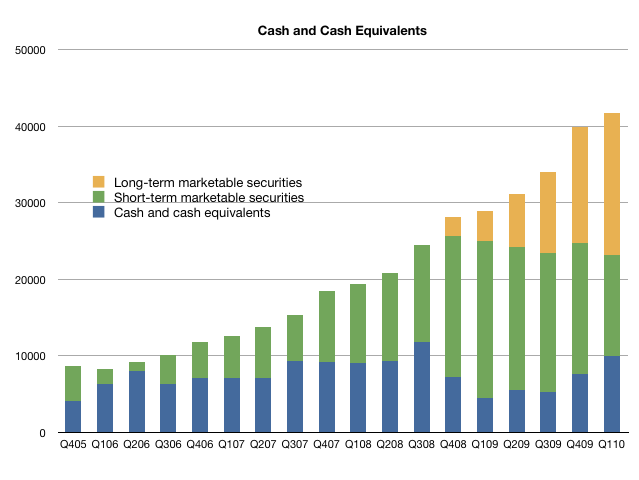
Apple's cash continues to grow. This quarter it reached $41.7 billion, a sequential increase of $1.9 billion. This time last year, the cash was about $29 billion with a y/y increase of nearly $13 billion. This is equivalent to $45.19 per share.
Many financial sites report this figure incorrectly (e.g Yahoo finance with $24.8 billion) and are often cited by journalists. This error is because Apple holds much of its cash in "Long-term marketable securities" and some choose to report only "short-term" holdings as cash. Apple's "Long-term" securities are the same as their "short-term" securities, namely US Treasury bonds. The distinction is in the maturation date, not their liquidity. Apple makes a clear statement of their cash position every quarter and highlights the composition of their holdings.
Note that more than one third of cash is currently in Long-term securities and exclusion of that item would indicate a decrease in Apple's cash.
Note also that cash grows in a seasonal pattern. Q1 is typically the lowest growth, and Q4 the fastest.