Asymco

Asymmetric Intelligence

disruption

  1. Talent follows where business models lead: The Media Business Disruptions

    Research · 46 comments

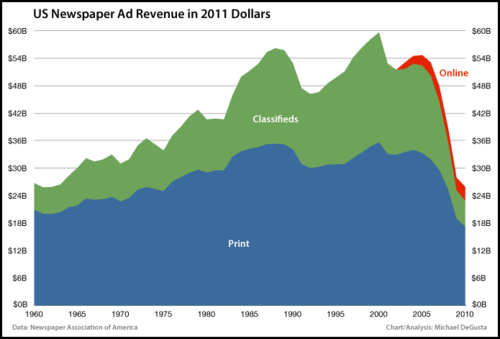
    Michael DeGusta created beautiful and informative charts on how The Newspaper Business Implodes.

    With charts, he also told the story of how the recorded music industry followed a similar path:

    Image (media.tumblr.com)

    He writes:

    As in the music business, digital revenue is failing to make up for the loss of traditional revenue. Ominously, online revenue is largely flat, basically unchanged from 5 years ago and still below its 2007 peak.

    What I find fascinating is how both industries reacted to the crisis of old media. They embraced the new "digital" distribution model, earnestly tried to transplant their business models and found no succor.

    Many observers may say that both print and music businesses were "foolish" and that they ignored the new medium of web. That somehow management dithered and missed the new wave blaming failure on incompetence. Putting aside the fact that all industry participants seem to have conspired to be foolish at the same time, this is not supported by the data. As the charts show, both industries built digital businesses. Newspapers have some of the most desirable web properties and digital music is a growing business with clever new distribution deals. They became quite smart in their respective adaptations of web distribution.

    They may have started slowly but there are many cases where incumbents reacted slowly to technological change, and won.

    But it's not working.

    The reason is that what we have here is a disruption. Unlike a sustaining technological shift, the new medium of the web did not permit the same business models to continue. Money was being made, just not in the same way and thus could not support the cost structures of the incumbents. Consumption of news and music is increasing but the way that it is valued is changing.

    Furthermore, it's become modularized. All the objects contained in a newspaper could, with the web, be offered independently of one-another (opinion, news, classifieds, lifestyle can each be built by specialists.)

    This is because the technology of the printing press benefits the integration of content while the technology of the web benefits the disintegration of content (similar phenomenon to the music industry's bundling into albums, vs. unbundling of digital downloads.)

    Now I'm going to take a leap and suggest that a re-birth of the container of the newspaper in the tablet medium will require a re-integration once again. As I've pointed out before in The integrated iPad news daily: Read all about it! the answer is not in integration or disintegration per se. It's in approaching the question of value chain evolution with an eye toward what is good enough and what isn't. Integrate when the product is emerging and unsatisfying, modularize when the product is mature and over-serving.

    We're observing the same phenomenon with television. Netflix, a distributor, is vertically integrating by entering production with an exclusive top talent series.

    Developers are not the only innovators that see disruption happening. Just like in "The Daily", in music and television, talent follows where business models lead.

  2. Changing places: Microsoft trades HP for Nokia

    Research · 56 comments

    The juxtaposition of HP's strategy of increased independence and Nokia's new strategy of increased dependence can't be more striking.

    HP is probably Microsoft's biggest customer. As the largest licensee of Windows it probably generated more revenue for Microsoft than any other company. The fact that HP invested in a new operating system for its mobile efforts shows a level of discomfort with the lack of strategic leverage.

    Nokia, on the other hand, has been resolutely independent in its software strategy. For over a decade it held out against licensing any OS, especially one from Microsoft. The pantomime theatrics that took place over that decade will make a great case study some day.

    But now we have a complete reversal of roles: The abandonment of platform independence by a mobile giant at precisely the same time as the acquisition of platform resolve by an IT giant.

    It seems almost poetic. And that should be a clue. Whenever you see poetry, you need not look far for some truth.

    These chess moves are taking place in the context of a greater game: the collision and disruption of IT and Telecom. It's not surprising that massive market forces are causing incumbents to react. HP, Microsoft and Nokia are in the throes of fundamental disruption. Even if these moves may not be all in the same direction, they each react in ways that make sense to them.

    It's also very likely that all the moves are for naught. Incumbents rarely win with reactions. Let's not forget that the entrants came with different business models. Apple and Google are not making money in the ways of Nokia and HP (who are channel dependent) or Microsoft (who is license dependent). The reaction must itself be asymmetric. So far it's not clear where the asymmetry lies.

    Read more:

    HP/Palm’s Rubinstein believes in integration

    WebOS: HP, and HP Only. QNX: RIM and RIM Only

    HP’s PC group spends 0.7% of sales on R&D

    The reason Robbie Bach was fired

  3. It's time for Apple to look at owning factories again

    Research · 95 comments

    Toshiba plant to make LCD panels for Apple: report | Reuters.

    Apple will invest in a portion of the investment for the factory, the Nikkei said.

    This is one of the more interesting news items I've seen for a while.

    [UPDATE] Toshiba denies rumor Apple will invest in mobile display subsidiary

    There was a time when Apple designed and owned factories. From an interview with John Sculley:

    That went all the way through to the systems when he built the Macintosh factory. It was supposed to be the first automated factory but what it really was a final assembly and test factory with a  pick-to-pack robotic automation. It is not as novel today as it was 25 years ago, but I can remember when the CEO of General Motors along with  Ross Perot came out just to look at the  Macintosh factory. All we were doing was final assembly and test but it was done so beautifully. It was as well thought through in design as a factory--a lights out factory requiring many people--as the products were.

    During the 90s the manufacturing function moved outside Apple's ownership umbrella. It was more economical, more flexible and more scaleable to outsource manufacturing to Asia. The time has come to rethink this.

    For the past few decades outsourced manufacturing has grown in scale and scope as prices fell and quality increased. However there are signs that this global web of suppliers and assemblers is reaching a point of disruptive change.

    Press attention has focused on labor practices, pay structures and the enormity of factory towns where literally millions of workers are employed and housed. As is often the case press attention only hints at some causality and as such misses the point. Journalists looking for a story about child labor or suicidal workers might serve us better by putting the spotlight on the fact that factory towns are not competitive.

    centralized Manufacturing is not good enough for the coming mobile computing disruption

    The real problem with Chinese factory towns is that they are not flexible enough. By concentrating facilities and workers, electronics manufacturers have improved on measures of scale and quality but are still only able to ramp up and down on individual products once or twice per year. This does not meet the need to increase responsiveness to markets and the pace of development and design. It also reaches some critical overweight mass. Capacity cannot double or triple again to meet the need of six billion consumers. There are signs that the business model must change.

    Typically a product is born in Product Marketing, progresses through Design, R&D and then to Manufacturing and finally to Sales. Each of these stages of development has to be re-started for each new product, often in a pipeline fashion. However, some of these stages are increasing their cycle times while others are at their limits. This limits the throughput of the whole chain. If, for example, R&D can put out two product designs in the space it takes for one Sales cycle then they need to be tasked with different product while they wait for "capacity" in Sales to catch up.

    My contention is that the bottleneck in device product development is now manufacturing. The evidence is that Apple (among many others) cannot meet demand. Sometimes it's a lack of components, but often there is a forecast error and capacity is simply not allocated. What I also see is that this bottleneck is not solvable with the current value chain architecture. When there are 5 billion consumers of platform devices, centralized factory town manufacturing does not match the cycle time of either design or of consumption.

    The answer to low capacity is more investment in more lines of production, more workers and more suppliers. However the problem is that this takes time. The window of opportunity for a product is less than six months.

    Consider the iPhone product cycle. A new variant goes into development 18 months to two years before it's launched. It's ready for manufacturing a few months before launch. The R&D team is off making the next version long before the product hits any shelves. The cycle time for R&D changes unpredictably. Sometimes it slips, sometimes it may be shorter because the changes are minor. Perhaps marketing sees the need to react to changing market conditions. However, manufacturing plods along at an inflexible rate.

    How can it be fixed?

    I'm not an expert in this area, but as a student of disruption I see signs of opportunity to re-engineer the manufacturing business model. The patterns from history are plain to see: Centralized systems get broken down and re-aligned with new bases of competition. Value chains disintegrate and re-integrate as profit algorithms change.

    The new algorithm says you need to ramp production quickly (up and down) and to increase "product turns" from one to two each year. Each ramp needs to be even bigger than they are now. Maybe by a factor of two. Products should be built closer to where they are consumed to drive costs and delays out of transportation and tariffs. Carbon footprints need to be reduced.

    Sounds daunting. But the rewards could be enormous. The business model may need re-definition. By owning the means of production, the value added can be shifted to another point (i.e. production can be run at a loss in exchange for higher margins elsewhere.)

    All this requires capital. Lots of it. Apple has it. I see no better use for it than to re-define production as a synchronized development module.

    It's time to look at owning factories again.

  4. The asymmetric competition between Google and Apple app stores

    Research · 56 comments

    In the latest version of Android, Google shifted from bitmaps to vector rendering for maps.  The shift is probably more a function of available processing power on the device than a strategic shift to position value on the device rather than in the cloud. Vector maps, which are much more efficient in terms of bandwidth and local storage, have been the choice for in-car navigators but Google has always been using bitmap tiles which are fetched from a server and delivered only if the device is using a data connection. The downside for vectors is that they require a bit more local processing power.

    I doubt that Google's move to vectors is part of a shift to more app-centered/edge-of-network strategy.

    How is this relevant?

    Google has been riding a wave of re-centralization of value toward the center of the network as broadband made the cloud feasible. Keep in mind that Microsoft rode a wave of de-centralization as value moved to the PC and away from the mainframe. As intelligence was pushed to the edge, Microsoft accrued value from enabling the edge as a locus of productivity. This is no small thing.

    Then came apps.

    The supernova that is the App Store illuminated the possibility that apps are perhaps a "pushback" on the center. Like all good disruptions this was unforeseen: Apple built the store and the apps sold; by the billions. Apple joined the world in a scramble to react. Something profound was happening, but the very brightness of this explosive growth blinds us to what is actually going on.

    My hypothesis is that there is a tug-of-war going on between the mobile cloud and the device-at-the-edge. Both will become better and neither is good enough. Technology roadmaps point to both higher availability of local storage/processing power as well as faster, cheaper and more ubiquitous mobile broadband. So technology insight by itself is not enough to give us a clue to the outcome.

    What I would focus on is what is more natural for the user.  Note that Twitter and Facebook both have better interfaces with their apps than they do with their browser interfaces. That and innovations in game interaction points out that apps are as much a disruption of UI metaphors as they are of the locus of power in the network. It would not surprise me if people end up spending a larger part of their lives tethered to device-enabled social media, "firing" the PC from the job of social interaction.

    If we believe the app will grow as the preferred interface for the web (and I'm leaning in that direction) then the implications are potentially harmful to Google. Google does not "do" interfaces. Their strategic assumption has been that interfaces are commodities. The browser is the universal interface. Perhaps HTML5 will offer sustenance to the concept, but it's not a panacea. Web apps have a long way to go to become competitive with hand-crafted app UIs. (While web apps have been possible for iPhone since its inception, developers vote en-masse for apps and almost zero popular web apps exist. Ditto for Flash-to-app interface ports.)

    This brings us to focus on the asymmetry of business models.

    the App Internet

    What we end up with is the "app internet": a potential disruption of the browser-as-interface and the re-integration of the user experience around the device. Because the iTunes store allows money to be attached to new interface innovations, developers follow and compete on better interfaces rather than on access to the back end.  The asymmetry ensues from the fact that by attaching profit to the point where the user touches the screen, Apple took the basis of competition for developers away from the cloud.

    In other words, the point where the electrical charge of the human skin is detected is suddenly the exact location of value capture from mobile computing.

    Of course, Google is responding, but since they did not focus on seamless and curated experiences, developers are not seeing returns for investment in interfaces at the touch point. As a consequence, Google apps developers seek ad revenues. In turn, this is a road that leads to less innovation in interfaces and more innovation in network-dependent services.

    I sense a distinct asymmetry in app trajectories between the platforms due to core business model choices. Asymmetric competition causes the great fortunes to be made and great fortunes to be lost.

  5. The iPhone is not superfluous, not easily copied, not revolutionary and not a premium product

    Research · 61 comments

    The release of the iPhone is rightly acclaimed as a watershed event in the history of telecom. It was a sensation. But it was also a product that was widely underestimated and dismissed. Even today expert opinion is divided. The critics of the product transitioned directly from labeling it a superfluous bauble to an obvious and copyable sustaining innovation. Advocates of the product describe it as revolutionary and dazzling with the potential for capturing significant profit share due to premium pricing and positioning.

    So which is it?

    I'll argue that it's none of the above. The iPhone is not superfluous, not easily copied, not revolutionary and not a premium product. What it is is disruptive.

    First, we have to quickly define disruptive potential.

    A product is disruptive if it competes with an existing, incumbent set of products on a new basis. It competes along a new measure of performance. That means it's either "low end" and hence cheaper, simpler, more modular and conformable, or it creates a "new market" where completely new measures of performance or quality are relevant.

    In both "low end" and "new market" disruptions the product is usually wrapped in a business model that insulates it from incumbent response due to inherent asymmetries. Incumbents will find the economics of the entrant product unattractive and will be motivated to ignore it or actively avoid copying it.

    The consequences of disruptive product entires are often catastrophic for the incumbents because, over time, the disruptor product vacuums up all the profits in the industry, robbing the incumbents of the fuel to respond by the time they become motivated to do so. In essence, the transfer of value to the new basis of competition happens so slowly that the threat is imperceptible until it's too late.

    If we look at this definition, it's startling that the iPhone does not seem to fit.

    As a phone, it's not cheaper, nor modular and hence not "low end". It did not create a new market.  As a phone, although it did recruit more regular phone users into becoming smartphone users, it was not the first or last phone to do so. Its phone business model was not a radical departure. It was not ignored by the mobile phone incumbents who reacted with various degrees of urgency and vigor. It was actively copied in every way from the UI to the ecosystem to the pricing model and distribution.

    The only thing that seems to have happened according to the disruptive formula was the transfer of profits from incumbents to Apple, at least temporarily.

    So the iPhone seems to be correctly classified as a sustaining innovation. Something that moves the phone market forward and which, except for a temporary misallocation of profits, will entrench the incumbents after they manage to copy it effectively.

    However, here is where we have to dig a little deeper.

    Market analysis easily becomes myopic when looking only at a market defined by a product. I've argued in the past that strategic insight comes from looking at products that cross over their market boundaries. Especially products that are hired to do different jobs than the same products in their categories. The iPod may seem like an MP3 player but it caused catastrophic profit collapse in multiple industries. It knocked out the CD business, it crippled the component audio system "Hi-Fi" industry, it razed the music retail business and affected the entire music value chain. It's still pounding at the gates of video and TV production. And, almost as a side-show, it crushed the Walkman.

    Even though it was a music player, the MP3 device market was the smallest target for the iPod. It turned out to be far more dangerous to ancillary industries. The reason is subtle: it competed as an integrated ecosystem. You hired the iPod to serve you music everywhere, not just in your living room. And it did the job in an integrated way from source to earbuds taking what was a hodgepodge of modular components built around analog music and smoothly integrated them to deliver music in new, non-consuming contexts.

    The lesson is therefore that when looking at the iPhone one has to look at ancillary industries not just at phones.

    Phones have always been a component in a wider inter-related telecom value network. Even today they are often called "terminals" in the industry meaning that they are the end points of a network. Similar to the PC, the iPhone enables a migration of intelligence away from the center toward the edge of the network resulting in a de-valuation of the network itself.

    I argue that the real disruption of mobile computing (i.e. iPhone) is made possible not by the smartphone technologies but by mobile broadband. Once broadband became mobile with 3G the smartphone could shift its focus (jobs it's hired to do) from voice to data. That shift is disruptive to incumbents because they built their businesses around operator distribution and operator service economics. With apps, mobile computing brings with it services which allow all communications to be independent of operators. Selling ringtones, maps, email and video-on-demand are all dead business plans today. But operators clung on to these hopes for many years and forced vendors to comply to this strategy.

    The incumbents relied so much on the telecom value chain, where the value flows from the monthly service charge, that they would not deploy technologies or business models that were asymmetric to operator business models. This is the root cause for Nokia and Samsung and Motorola and LG "missing the boat" on smartphones. All the vendors had the pieces of technology on their shelves. But when they took these technologies to their customers, the customers rejected the package.

    This is why entrants like RIM and Apple could easily gain a foothold and grow. They had modest volumes, sold new concepts like business email and new UIs with iconic designs, but did not go after the core business model. This is similar to how iPod/iTunes got a toehold with the record labels. By the time the disruption took hold, operators were addicted to the new high-ARPU being generated even though they were all pure bitpipe plans. A bird in the hand is worth two in the bush, so the new device brands stuck.

    Do the incumbents still have time to respond effectively? It's less and less likely. They cannot build the new computing ecosystem without the distribution power of operators. Note that iPhone 'clones' in Android are still sold via operators and that nobody is interested in making either iPod touch clones or iPad clones sold independent of the operator channel/subsidy model. This is not because of technical or economic reasons but because of a lack of distribution (and lack of integrated content).

    When you step back and look at the phone in the context of the network business model as well as the shifts in consumer jobs to be done you realize the potential is far greater than taking share from incumbents. The iPhone is not divided into a portfolio of different phones, but it's a part of a portfolio of new mobile computing products. It just happens to be the only one which still depends on the cellular operator distribution network.

    Seen as part of a new mobile computing paradigm and following the trajectory of the mainframe, mini-computer, PC and laptop, the iPhone is an essential, non-superfluous device for a vast population of new users.

    Seen as an integrated app ecosystem with strong network effects, it's not easily copied. Responses that only account for it as a glass and metal object of desire will fall way short of being competitive. As the hardware was always available to competitors, it's not a revolution in hardware or even in user experience.

    Most importantly, seen as a computing alternative merged with a communication appliance, it and its siblings are not premium products. The pricing and service structure around it make it seem a low cost alternative for solving the jobs it's hired to do.

    In other words, it is as disruptive as it gets.

  6. Why the Mac keeps growing

    Research · 63 comments

    When the iPhone vs. Android rhetorical war heats up, both sides bring up the history of Macs vs. Windows PCs. The commonly held thesis is that Windows triumphed as the PC was commoditized (and modularized). This triumph was at the expense of the over-serving and over-priced Mac.

    This is a largely accurate view of what happened during the 90s. But the problem with this thesis is that (1) the PC's job has been slowly changing in the last decade (2) the Mac keeps growing faster than the PC and (3) Apple keeps capturing a vast portion of the profits in the PC industry.

    These anomalies or contradictions to the thesis imply that something changed. What changed and can these changes turn the tables on the market and create an opportunity for a new computing disruption?

    The PC of the 90s was hired first by companies as a productivity boosting tool and second by consumers as a way to duplicate their work productivity and communications in their personal lives.

    However something changed with PCs when the laptop became "good enough". With portable computing, the job the PC was hired to do evolved. It was more important that the product be well designed (for aesthetic value, usability and reliability) than just fast and spacious. The microprocessors were plenty fast but what mattered more was low power consumption, a low profile and tighter integration with software.

    The product was also purchased in a different way. A desktop could be purchased on specs alone, sight unseen, from a catalog. But a laptop had to be touched, hefted and the screen had to be observed and the whole design contemplated before a purchase decision was made. The product had an integrated keyboard, display, touchpad and storage. It was not easily serviced by end users. It was, in a word, re-integrated.

    You can see how portability changed the job and therefore everything else as well. Consumer tastes became important, retail distribution became necessary and R&D resources had to be applied to solve what was no longer good enough: the whole package.

    Vendors which did not prioritize design, retail and R&D were left flat-footed.

    At the same time, systems software became more commoditized and productivity software became portable. The old measures of performance were being over-shot while the new measures of performance were under-served.

    While this shift was underway on the hardware side, Microsoft continued to improve their product to serve more demanding business productivity jobs. Their software was not getting optimized for this new portable consumer job. They left the new market open to disruption.

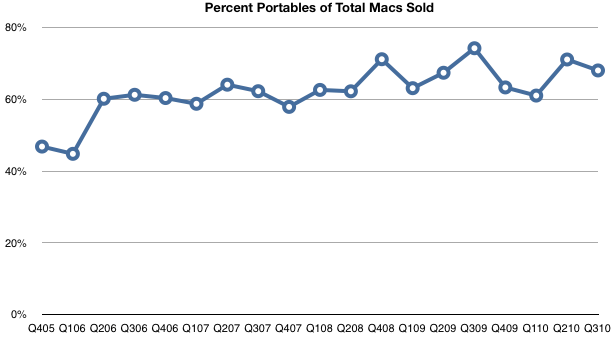
    In stepped the MacBook with good enough (and improving) office productivity. With excellent appeal along the dimensions of performance consumers demand most of all. It was priced higher than other laptops but the price points were affordable and, inflation-adjusted, lower than they'd ever been. It should not be a surprise that Apple was one of the first vendors to see its portables line become bigger than its desktop lines. The market evolved to the point where what Apple had was what the buyers needed.

    The shift to portability is a compelling story for Apple as disruptor in the PC market. It may not result in a complete reversal of the PC hegemony but it allows Apple to grow a product line at triple the growth rate of the market. A market that was considered completely dominated by entrenched incumbents with an unbreakable profit formula.

    But with the iPad Apple is clearly also aiming at disrupting the Mac (and, transitively, the PC as a whole.) The iPad can be seen as an evolution toward seamless portability; the mobile computing paradigm shift.

  7. Citizen Publisher

    Research · 11 comments

    In March this year Richard Stengel, managing editor of Time magazine, was speaking about the iPad.

    For a while many movies were more like filmed plays, until directors really learned to take advantage of the opportunities of the medium. For the iPad “The medium is waiting for its Orson Welles.”

    The idea that a new medium needs a new media is not novel. The implication that the new media needs a new genius to define it also follows naturally. However, the implications of new media for the creative industries that are built around them are more difficult to perceive. How are the structures of these industries shaped by disruptive innovations?

    Disrupting theater

    To see just how disruptive cinema was, consider the plight of acting talent. In the early years of the cinema (1890s–1900s), performers were not even identified in films. In other words, they were not in the "credits" and far from being "billed". The reason was that stage performers were embarrassed to be in film. Silent film was considered pantomime and since one of actors' main skills was their voice, they were concerned that appearing in films would ruin their reputations.

    Early film was also designed for the working classes, not for intellectuals. With peep shows as the original presentation format, followed by nickelodeons, film was seen as only a step above carnivals and freak shows. Clearly not something that an aspiring actor would want to be associated with.

    So here we have a classic disruption: The new medium was of a far lower quality than live theater. Even lower than the Vaudeville and Burlesque shows. It was, as many other disruptions are pronounced, a toy.

    However, it had a market--a profitable market. Over time, the product improved and within a few decades completely drained the profits from theater, leaving it to serve only the most demanding customers willing to pay high ticket prices and satisfying only their high brow tastes.

    So going from Theater to Cinema involved more than technological or technique innovation. It required business model innovation. Specifically, Cinema technology brought about the "Hollywood" industry, or more specifically, the Star System and the Studio System.

    The Star System was a branding technique designed to signal quality to the public. It remains a basic and fundamental innovation: celebrity as product. The Studio System was a production and value chain innovation.

    The integrated producer

    By the 1930s technological change led to a new value chain: vertical integration, ownership and effective control of distribution and theaters.

    During the Golden Age (early 20s to early 60s) eight companies constituted the Hollywood studio system. Of these eight, five were fully integrated conglomerates, combining ownership of a production studio, distribution division, and substantial theater chain, and exclusive contracting with performers and filmmaking personnel.

    The studios’ efficient, top-down control over all stages of their product enabled a new and ever-growing level of lavish production and technical sophistication.

    Readers may recognize this as the "inter-dependent" business architecture model.

    The studio system allowed iteration and innovation and factory-like efficiency in production. This architecture held sway as the technology remained relatively stable and the market for content expanded to cover most of the world's population.

    In the late 60s and 70s, modularity emerged as a more practical alternative and control over production was separated from distribution. (Theater ownership was removed by anti-trust action). The system that emerged gave more power to producers and directors (e.g. Kubrik) and the talent became independent of the studios.

    The new Welles

    Which brings me back to Orson Welles. Welles' masterpieces were the product of an industry that allowed innovation to happen. They were the product of an era. An era defined by integrated innovation and inter-dependent value-creating business with common ownership and control.

    So when print publishers today think about their future in the era of the iPad, they should consider their value chains and business architectures. Could the new Welles create the new iPad genres to jump off the screen if he worked in a regular publishing firm that outsources practically everything? Or will he emerge from a firm that operates an integrated value chain. A firm like Amazon that owns the device, the publishing system, the retail store and maintains direct relationships with readers?

    It's my opinion that before there is an Orson Welles of iPad there needs to be a Studio System and a Star System for iPad apps. The Star System is nearly there with the current App Store, but it needs discovery and a systematic way of promoting talent. The Studio System has yet to emerge.

    This does not bode well for traditional publishing houses aspiring to embrace the iPad. They are not in a position to create these Systems around this new media and hence to nurture the next Orson.

    It's perhaps ironic that Orson Welles' masterpiece "Citizen Kane" (1941) was the story of a publisher.

  8. Which size really matters? Market Share vs Profit Share

    Research · 27 comments

    One of the most hotly debated subjects in the mobile phone business is the importance of market share. It's also a topic of lore in the PC industry. Briefly the two arguments are:

    • Market share matters more because it drives network effects which ultimately drive competition out of the market, creating the opportunity for monopoly rents.
    • Profit share matters more because profit is the only fuel that can drive innovation. Any macro downturn or shift in strategy can cause a company to cease investing in unprofitable projects.

    The old disruptor's adage: "Be hungry for profits and patient for growth" is challenged by the equally disruptive: "Grow share with lower prices in exchange for new revenue sources."

    There are many rich anecdotes to support each strategy, but how about some data? Fortunately we have some: the market and profit shares for vendors covering 80% of the world's largest technology market over a three year period. The vendors are a good proxy for the market, the time frame is long enough to cover seasonality and anomalies and the market is very big (over 1.2 billion devices) and very broad (world-wide).

    The only question is how to measure success. One measure is how various strategies benefit the asset owners, i.e. the share holders. Benefit to society, employees and consumers are very difficult to measure. But share holder benefit is easily obtained by measuring change in share prices.

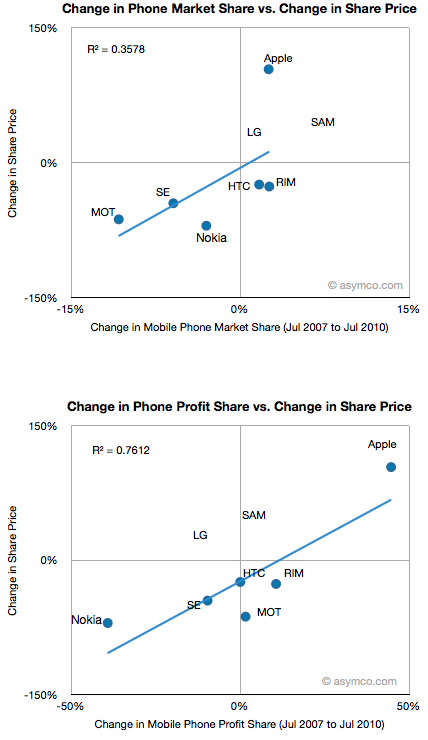
    So, here are two charts:

    1. The percent change in market share vs. percent change in share price for the top mobile phone vendors.
    2. The percent change in profit share vs. percent change in share price for the same vendors. (see note 1 for time frame discussion).

    I showed the R-squared value of the correlations. (See note 2 regarding LG and Samsung). At r-squared of 0.36 share price is not well correlated to market share while at 0.76 it is rather well correlated to profit share. To a financial analyst this would seem obvious. After all, share price reflects the present value of future cash flows which are clearly coupled to profit and hence to profit share growth. However, as many technology observers would point out, market share determined the success of Microsoft and Google, and to some degree Nokia.

    High market share can cause competitors to be starved of components or ecosystem developers. At the same time, high profit share can cause competitors to be starved of capital.

    What does this analysis add to the argument? Note that this data covers a hardware business. Is hardware relevant? It does not scale as rapidly and has a short shelf life. It's also notoriously difficult to distribute. However, outside of the service revenues for cellular voice and data, device hardware is the only pool of money that has any material dimension in the industry. It's also the pool of money with the highest margin in the industry. For the time being and the foreseeable future, hardware is the only business model worth anything in mobile computing.

    The data shows that in this particular but substantial market profit share is closely correlated to shareholder value creation. It also shows that profit loss is closely correlated with shareholder destruction. The dominant data comes from Apple and Nokia, which appear to be polar opposites in performance on both measures.

    In other articles I've shown how profits have shifted from incumbents to entrants in the smartphone disruption. This shift has resulted in direct benefit and loss to the owners of the two asset classes. To suggest that market share alone is a determinant of "success" in the device market must exclude the effect on shareholders and, ultimately, the management and employees of the companies concerned. The virtuous/vicious cycles will be fed by the profit variable more than any other.

    I don't think the market share argument holds water in this market and this data supports my belief. It may be that as value shifts over time away from hardware the benefit will shift as well, but business models alternatives to hardware have not emerged after ten years of experimentation. If anything, the idea of selling hardware as a way of capturing service revenue was pioneered by RIM and perfected by Apple. Nothing I've seen so far is challenging this model. Whoever attempts to siphon the device pool of money (which has remained fairly constant over the smartphone disruption) needs to solve system-wide problems like the dependence on the network and the life-cycle of portable electronics.

    ----

    Notes:

    1. The dates when performance was sampled are are July 1 2007 to July 1 2010. The latest quarter (3Q10) has not been included in this data as it has not been fully reported. The data will be updated with the latest quarter as soon as it's possible.
    2. For many competitors the share price is dependent on more than performance in the mobile phone market. In particular, LG, Samsung, Motorola and Apple have diversified product lines which affect their share prices. Two of those companies (LG and Samsung) are conglomerates and their share performance is dominated by businesses other than mobile so I did not include their data in the correlation measure (though their place on the chart is shown). Motorola and Apple's stock prices were, to a very large extent, driven by their mobile phone performance over the same period so their data is included in the correlation analysis. The other vendors have been primarily focused on mobile phones.
  9. Android's Pursuit of the Biggest Losers

    Research · 170 comments

    The mobile phone market is intertwined with the telecommunications industry which is vast and there are numerous competitors which are much more dynamic and better capitalized than the moribund PC or music player vendors. It’s also a regulated and fragmented global market with 1.2 billion units and 5 billion consumers—far greater than any of the markets Apple played in for its first 30 years.

    Nevertheless, the iPhone has had a huge impact on the industry. To show just how much of an impact, I dove in and pulled over 500 data points on three years’ financial performance of seven competitors responsible for 80 percent of units being shipped today. The time frame covers the iPhone’s participation in the market so it allows for “before-and-after” comparisons.

    I divided the findings into five articles:

    1. Unit Volumes. The evolution of market share.
    2. Revenues. The shift in where dollars are spent.
    3. Selling prices. The tale of ASP erosion.
    4. Operating margin. Profitability ratios over time.

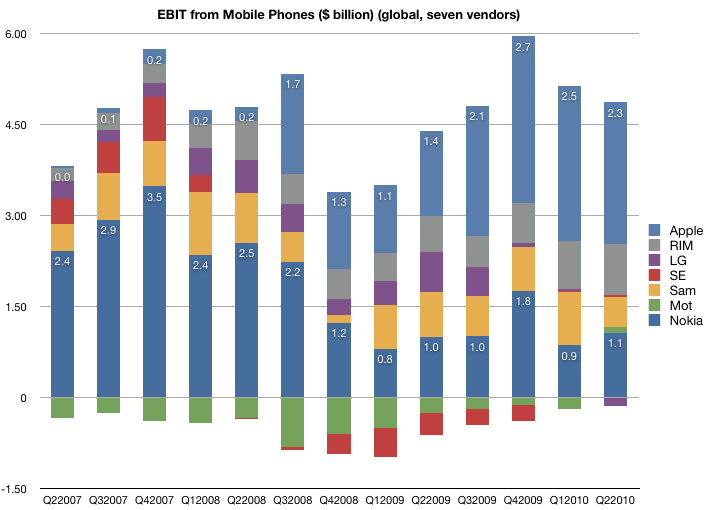
    Now I turn my attention to draw a bottom line from all the data above, namely the operating earnings (EBIT or Earnings before Interest and Taxation).

    The first chart shows the EBIT from the top seven vendors of mobile phones since the quarter when the iPhone launched. I annotated Nokia and Apple's bars to give perspective.

    The total available profits in the industry dipped to a bit under $4 billion at the trough of the recession, and have recovered to nearly $6 billion in the holiday quarter last year. However, not all vendors are profitable. As you might expect from looking at the operating margins, Motorola and Sony Ericsson have been generating losses for most of this time period. They have both reached profitability in the last quarter, though at very low levels and after having lost a large part of their sales. LG has turned negative this past quarter after being a modest earner for some time. Samsung has maintained a fairly even consistency in its profit capture, though with its expanding market share, it seems to have come at the cost of pricing.

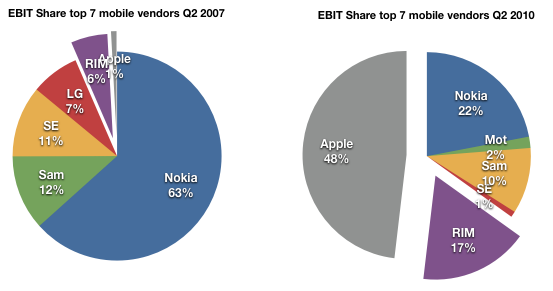
    Finally, looking at the pure smartphone vendors RIM and Apple, the picture is nothing short of astonishing. This before-and-after share-of-available-profit chart shows that the two entrants went from about 7% profit share to 65% in three years.

    Apple in particular is capturing about half of the available profits with three percent of the units. It dwarfs all the other vendors, more than double the nearest (Nokia). All that in three years and with the added burdens of only three models, a recession and limited distribution.

    What does it all mean?

    Here are my conclusions, enumerated:

    1. The lack of a real response. The recurring theme in this series of articles has been that giant multinational incumbents in a vast and rapidly growing industry, enjoying all the advantages that size and incumbency, have had their profits taken from them. And they don't seem to have put up much of a fight.
    2. It's all wealth transfer. Note the total amount of profit available has not increased markedly; this is not about incumbents growing the pie. Two thirds of what should have rightly been theirs moved from the incumbent shareholders to the entrant shareholders.
    3. Speed. This shift of profit occurred over an unprecedentedly short period of time.  Three years is no more than two product cycles in the industry and it's an order of magnitude faster than what happened historically to other industries.
    4. Disruption is the diagnosis here. The incumbents were caught in the headlights. Disruptive innovation leads to asymmetric competition and this is what we just witnessed. History has shown that the shift of profits is usually the last stage of disruption and is usually irreversible because the change in business models cannot happen at the rate of change of profit transfer.

    Which leads me to one final point.

    When analyzing the potential for challengers to the new winners, the most cited is Android. Can Android affect this redistribution of profit once again? And to whom?

    If Android is to become the dominant platform, does it depend on the success of its licensees? Who are these licensees and what are the chances that they will be able to align their businesses to what Android offers (a new revenue model based on services and advertising).

    One problem I see is that Google is making a bet on those same vendors who are now squeezed in the middle of that last pie chart: Samsung, LG, Motorola and Sony Ericsson. Nokia, Apple and RIM will certainly not take the OS over what they already have as it dilutes their differentiation and margins. That means Android is aligned with the biggest losers in the industry.

    So how likely are these disrupted ex-giants to recover and take Android forward? My bet: slim to none. Android does not offer more than a lifeline. It is not a foundation for long-term profitability as it presumes the profits accrue to the network and possibly to Google. Profit evaporation out of devices to Google may be a possibility at some time in the future, but only if the devices don't need too much attention to remain competitive. But because they're still not good enough (and they won't be for years to come), it's certain that attention to detail is what will be most important to stay abreast of Apple.[1]

    So here we have the real challenge to Android:  partnership with defeated incumbents whose ability to build profitable and differentiated products is hamstrung by the licensing model and whose incentives to move up the steep trajectory of necessary improvements are limited.

    In other words, Android's licensees won't have the profits or the motivation to spend on R&D so as to make exceptionally competitive products at a time when being competitive is what matters most.

    [1]: I would argue the same lack of symmetry with licensed software vendor Microsoft is what led the the failure of the same incumbents to make a dent in the industry with Windows Mobile [2003 to 2010].

  10. The parable of the transistor

    Research · 6 comments

    This weblog could be read as a diary of the disruption of the mobile industry. There is lots of topical analysis and opinion, but sometimes I'll post on the "theory" which describes what's going on in a more abstract, and long-term, level. Theory is like a bullion cube: savory, but too concentrated to be enjoyed undiluted. For this reason, the most palatable way of administering theory is through example. So we kick off with an example of what happened to another technology industry as a result of the emergence of a disruptive technology.

    The following is a draft article I wrote describing the "electronics industry" for POSTWAR AMERICA: AN ENCYCLOPEDIA OF SOCIAL, POLITICAL, CULTURAL, AND  ECONOMIC HISTORY. It is itself based on a presentation by Clayton Christensen at the Open Source Business Conference in 2004.

    ----

    The consumer electronics (CE) industry began in 1920 when radio broadcasting commenced in the United States. Radio technology sustained a growing electronics business throughout the 1930's and 1940's, however, the electronics industry underwent a major transformation after the war. The critical development came after 1948 when the transistor was first invented. The transistor and the subsequent development of solid-state semiconductors dramatically and profoundly changed the industry. The change the transistor brought was not just evident in measures of technical performance but also in the economics of the industry and the business models required of its participants

    "Electronics" has a precise definition: technology based on the controlled flow of electrons. Prior to the transistor, the control of electron flow in a system was through a component called the electron tube (or vacuum tube). The tube in its simplest form is a gas-filled glass cylinder, much like an incandescent light bulb, with two electrodes or terminals inside. When the negative terminal is heated it emits a cloud of electrons which the gas inside the tube carries to the positive terminal. This device allows current to flow in only one direction since the positive terminal is not capable of emitting electrons. It is called a diode and is simply a one-way current or conduction valve. Hence the "semi" in semiconductor. Semiconductors can be designed into complex products that amplify, store and communicate; the core applications of CE devices.

    The transistor is significant because it is a "solid-state" semiconductor. Solid-state means that it is composed of solid components, unlike tubes which required a sealed gas to operate. The consequence of this shift from gas to solid components completely changed the industry and created unforeseen growth, wealth and societal change.

    NEW ECONOMICS

    The invention of solid-state semiconductors allowed new economies of production: components were smaller, cheaper and could be produced with a process closer to printing than to assembly manufacturing. Because of the subsequent advances in assembly, the cost of electronics products decreased even as quality and reliability increased. Power requirements and physical dimensions were also reduced, allowing greater portability.

    These implications might have seemed foreseeable to the engineers and businessmen of the 1940s who first looked at a transistor, but what happened is something completely unexpected: almost all the companies dominant in the electronics industry in the 1940s and 1950s who spent huge fortunes to perfect the transistor for their products went out of business or withered away to insignificance. New, giant CE companies emerged in Japan who perfected new product categories rather than challenge the incumbents and their existing products.

    The emergence of Japan as a powerhouse of CE has been debated as a motivation for changing US industrial policy toward a more interventionist model. Transistor technology was seen as a strategic national defense asset and the innovations and production associated with it were not to be allowed out of US control. Additionally, American politicians argued the case that it was US taxpayer-funded defense, educational and space efforts which produced these innovations, hence they "belonged" to the United States government, and future innovation will similarly need taxpayer funding. Unless something is done, Japan would dominate American industry.

    What happened in fact was far more mundane. The transistor disrupted the industry. Small upstarts were able to take the invention, wrap a new business model around it that motivated the current players to ignore or flee their entry. They thus successfully displaced the entrenched incumbents even though the incumbents were investing heavily in the technology and the entrants weren't.

    THE INDUSTRY THAT EMERGED

    The postwar half-century began with the radio as the center of the CE world. It ended with the television dominant, alongside a whole galaxy of mobile devices.  All employed the transistor, which itself underwent dramatic increases in power and equally dramatic decreases in size. Some of the significant breakthroughs along the way are listed in Table below. Note in the table the absence of any companies which dominated the CE industry before the transistor (RCA, GE, Zenith, Westinghouse, Philips, Magnavox, Curtis-Mathes, ITT, Packard-Bell, Philco, Siemens, Sylvania, Western Electric).[3]

    • 1957 Sony TR-63 Transistor Radio. Portability enabled privacy which allowed young people to listen to Rock-n-Roll.
    • 1960 Sony portable TV. Made a second television in the bedroom possible.
    • 1962 Sony CV-2000, first home videotape recorder. The concept of "time-shifting" was born.
    • 1970 Olympus Zuiko Pearlcorder Microcasette recorder. Audio recording became a discrete affair.
    • 1972 Pulsar Quartz Digital Watch. Quartz meant cheap but accurate watches for everybody.
    • 1972 HP-35 Pocket Electronic Calculator. The end of the slide-rule.
    • 1976 Atari Pong Game. A new use for TV: interactive games.
    • 1976 JVC HR-3300 VHS VCR. Mass-market cartridge-based video recording. Video rentals took off.
    • 1977 Atari 2600 Game Console. Game cartridges added a new category of content consumption.
    • 1979 Sony Walkman. Portable high fidelity music for your ears only.
    • 1980 Sony Boom Box. Portable high fidelity music for you and your neighborhood.
    • 1983 Sony CDP-101 CD Player. Loss-less audio reproduction for all.
    • 1984 JVC Camcorder. Home videos were born.
    • 1986 Motorola Bravo Pager. Contact somebody even if they are not near a phone.
    • 1996 Toshiba SD-3000 DVD Player. Loss-less video reproduction for everybody.
    • 1998 Nokia 5100 mass-marketed phone. Easy to use, customizable cheap mobile phone.
    • 1998 Diamond Multimedia Rio. Mobile digital compressed music consumption.
    • 1999 Tivo Series1 Digital Video Recorder. Skip commercials and freeze real-time video.
    • 2001 Apple iPod. All your music with you all the time.

    DISRUPTIVE IMPACT

    When the transistor was introduced in the late 40s and early 50s, most designers considered it inferior to existing vacuum tube technology as far as performance was concerned; transistors could not handle the power that was required to be used in the main CE products popular at the time, notably, the big tabletop radios and floor standing televisions. The transistor could not amplify sound as well as a tube, but it was small, solid, and used low power. Therefore, RCA, Zenith, and Westinghouse looked at the transistor as a electronics component with great potential, but one needed to be improved to match the tube as an amplifier before it could be used as a substitute.

    Every CE company was required to receive a license for the transistor from its creator AT&T, before they could put it in their products. But they took out these licenses in order to experiment with the new technology, hoping they themselves could improve it sufficiently for use in the CE products.  Altogether, these CE companies spent an aggregate $2 billion (in today’s dollars) trying to make solid-state electronics good enough that they could make popular high-end CE products with them.

    And while tube companies were trying to fit the transistor into large products, other companies, especially in Japan, were developing the first transistor-based products.  One critical one was a transistor hearing aid, first marketed in 1952. While hearing aids were a tiny market in comparison to radios and televisions, it was a market that valued the miniature size and low-power requirements of the transistor. In 1955, Sony introduced its first pocket radio. The sound quality and reception of those radios was very poor relative to the "console" systems available in living rooms. But Sony chose to sell the pocket radio to teenagers. Teenagers were delighted to have a product that was inexpensive and that they could carry with them, allowing them to listen to the rock and roll music their parents may have disapproved of.

    Thus, a booming new market emerged based on a hitherto neglected feature that transistors made possible: portability. Meanwhile, the existing big American CE companies felt no need to change their business plans because the new products, in their opinion, were going to new customers not existing customers. Had Sony tried to sell its pocket radio to the parents, the product would have been judged to be inferior because they had the alternative of a high quality vacuum tube radio in their homes. Then in 1959, Sony introduced its first portable television, and again, the portable television was marketed to a whole new cohort of consumers who could not afford expensive, tube-based consoles. Since the alternative for these consumers was no TV at all, they were willing to accept a product with a somewhat inferior picture and reception.

    By the 1960s, solid state electronics had become capable of handling the power required to make larger CE products, making it possible for the big American CE companies to incorporate solid state electronics in the big home products area that they dominated.  And, indeed, by the end of the decade all of the products for the mainstream living room market were using solid-state semiconductors. However, they were largely being made by Japanese companies. The Japanese perfected the semiconductor components through their foothold markets to such an extent that the American offerings were not nearly as good. The venerable vacuum tube companies were doomed.

    THE CYCLE REPEATS

    The table ends with four company names that are distinctly non-Japanese. The phenomenal process of innovation-based disruption is under-way again. This time, the incumbents are the same Japanese companies that used the transistor to disrupt the previous incumbents while the new entrants are small companies focused on microprocessor-enabled digital media or communications. In a cruel irony, the incumbents framed the innovation of digital media products as not good enough for the living room while the entrants saw it as good enough for a new, non-consumptive mobile or time-shifted usage. The existing customers saw the digital products as inferior while the new customers saw portability as a fair trade-off for quality.

    A future article will discuss how the telecom industry saw voice mobility as sustaining but data mobility as disruptive.
    ----

    REFERENCES

    1. Electronics (2nd Edition), Allan R. Hamley, Prentice Hall, August 3, 1999.
    2. The Innovator's Solution, Clayton M. Christensen, Michael E. Raynor, Harvard Business School Press, September 2003.
    3. "The Top 100 Gadgets of All Time", Chris Null, Mobile PC, March 2005.
    4. Sony, John Nathan, Mariner Books, April 2001.
    5. The Road Ahead, Bill Gates, Nathan Myhrvold, Peter Rinearson, Viking Press, November 1995.

  11. Mobile phone companies consolidate while the smartphone market expands

    Research · 2 comments

    In Japan’s second cell-phone merger this month, Fujitsu and Toshiba said Thursday they will merge their handset operations ... NEC, Casio Computer and Hitachi merged their phone units earlier this month.

    via Fujitsu and Toshiba to Merge Cellphone Units - DealBook Blog - NYTimes.com.

    Mergers usually happen in a mature industry when there is excess capacity and decreasing growth.  In the mobile phone market we've seen several companies disappear or merge over the past decade:

    • Ericsson
    • Sony
    • Alcatel
    • Siemens
    • Casio
    • NEC
    • Hitachi
    • Fujitsu
    • Toshiba
    • Palm
    • Handspring
    • Motorola tried but failed to get itself acquired.

    But we've just seen forecasts where the smartphone market is growing and is expected to continue growing at 40%. Why is there consolidation in a growing market?

    The obvious answer is that none of the companies listed above had any significant smartphone businesses.  But that begs another question: why? Is the smartphone market so different than the mobile phone market?

    If the answer is yes, then there is an implied asymmetry.  Asymmetry is symptomatic of disruption. Disruption then leads one to ask how the other incumbents will cope?