
Asymco

Asymmetric Intelligence

disruption

  1. Why Nokia's board backed the CEO in a stay-the-course strategy

    Research · 2 comments

    Nokia chairman Jorma Ollila said the company's management is fully supported by the board

    via Nokia board backs CEO, new device strategy | Electronista.

    In my assessment of Nokia's competitive response to the mobile computing disruption I had anticipated an effective re-organziation to begin in 2013, so it came as no surprise that a stay-the-course plan is still being supported at this stage.

    This is to be expected because a disruption, by definition, discourages a symmetric response from the incumbents.  Indeed, management would face serious scrutiny and probable dismissal if they did address the challenge head on. A symmetric response would begin with a declaration that the entire asset base of the company is a sunk cost to be written off.  That would include its products, distribution network, development processes, resources and priorities.  Such a response can only come about from a near-death experience.

    You can certainly see the dilemma: It would be absurd for management to declare that their top rank position in the mobile phone market is an undesirable situation to be in.  It would be even more absurd if they suggested scrapping their entire world-leading volume business to re-focus on a new business--doing basically what Motorola has done when they were facing oblivion.  The chances are, however, that this is precisely what needs to be done, and the sooner the better.

    So being sensible is the path always chosen.  Being bat-shit crazy is not an endorsable strategy.

    Essentially, management is paid and incentivized to protect an eroding asset, not to destroy and replace it.
  2. Misdiagnosing Failure: Why Disruptive Innovation Models Miss on Apple

    Research · 2 comments

    In a thought-provoking article in The Motley Fool (Predicting Failure: Testing the "Disruptive Innovation" Model ) summarizing recent research in disruptive innovation, the following quote jumped out at me:

    Then again, the model is dead wrong 15 percent of the time. Lest you think Thurston won’t admit to failures, he points out several instances where his own predictions are wrong. Take the Apple iPhone, he says -- if you apply the model to this specific product, instead of the company as a whole. Apple was a new entrant in mobile phones. The iPhone provided better Internet performance and a better interface at a higher cost -- not poorer and cheaper -- yet it was very successful from the start. “When it’s wrong, it’s interesting,” Thurston says. “We hope to improve the theory.”

    This is of particular interest to me because I've always felt that Apple had a disruptive track record that was not recognized by disruption theory practitioners.  I think the reason is that casual observers place Apple's products in narrow categories rather than seeing the real jobs that the products are hired to do.

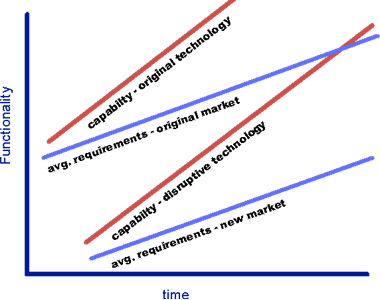
    The reason iPhone gets misdiagnosed by disruption theory is that it is placed alongside other phones and looks sustaining. That's what the quote above implies and it's a common mistake. I first did that myself. However a cursory review of how the product is used (see ComScore and Nielsen surveys on usage) shows that it's used for browsing and applications more than for mobile telephony.  These jobs it's hired to do have more in common with personal computing. Therefore, when you put an iPhone next to a computer, its disruptive potential becomes clear. This placement also leads you to think of a trajectory that predicts the iPod touch and the iPad as natural improvements for Apple.

    That is why I classify the category the iPhone competes in as Mobile Computing--a category of products that is undoubtedly disruptive (less powerful but more convenient and often cheaper) vis-a-vis traditional personal computing.

    Similar analyses for the iPad, the iPod would also reveal a pattern of new market disruption for Apple.

  3. Is Android Disruptive?

    Research · 1 comment

    The common thread among the Android fans is that Google is the agent of disruption of a hated operator business model. Since disruption is well understood (though not by many) it is fairly easy to evaluate this hypothesis.

    The problem with disrupting network operators is that disruption can only happen when the underlying service/product they provide becomes "good enough" i.e. more than what customers can absorb. A new basis of competition emerges and we all know what happens.

    Here's the problem: since mobile broadband is by all accounts not good enough, it cannot be disrupted. Operators are very critical in building out this new mobile computing future and they are investing and will reap rewards. Bitpipe models will only emerge after 4G when there will be ubiquitous high speed networks and competition will shift away from coverage and more to price and convenience of plans.

    What is happening instead of operator disruption is that mobile voice which is more than good enough is being disrupted. Businesses built around mobile voice (e.g. handset vendors who have not developed a viable business model around data) will simply evaporate and their profits will condense around entrants who have mobile computing platforms.

    Google is moving on this opportunity but they are not executing in a way that ensures they control the future platform due to the their being on the wrong side of the modular/integrated dichotomy.

    Android will disrupt but I expect it will take 10 to 15 years. The life cycle of a new global network generation rollout is about 10 years. We're in the middle stage of the 3G cycle that traces its beginnings to early this decade. 4G will take another 10 years.