Asymco

Asymmetric Intelligence

Fortune

  1. Asymco Bulletin 008 - Apr 12, 2026
    Bulletin

    Asymco Bulletin is a digest of all the work we have published for the week ending Apr 12, 2026.

    Research

    Can a company outlive its founder? Microsoft at 51, Apple at 50 and The Auteur Theory of Business

    Much more was said of Jobs’ departure signaling the end of Apple than of Gates’ departure signaling the end of Microsoft. And much more was celebrated of Apple 50 than Microsoft 50. Why is that?

    If you were to structure an experiment to determine the influence of processes and personalities on the outcomes of a company, you would be hard pressed to find a better pair to study. Apple and Microsoft were founded almost at the same time, due to the same enabling technologies (microprocessors) and led by two iconoclastic founders of the same age acting out of similar impulses.

    The divergences were that one concentrated on software while the other on hardware. But rather than pairing up in a match made in heaven, both tried to outmaneuver the other in order to avoid dependency. →

    Valuation in a time of AI
    Valuation in a time of AI

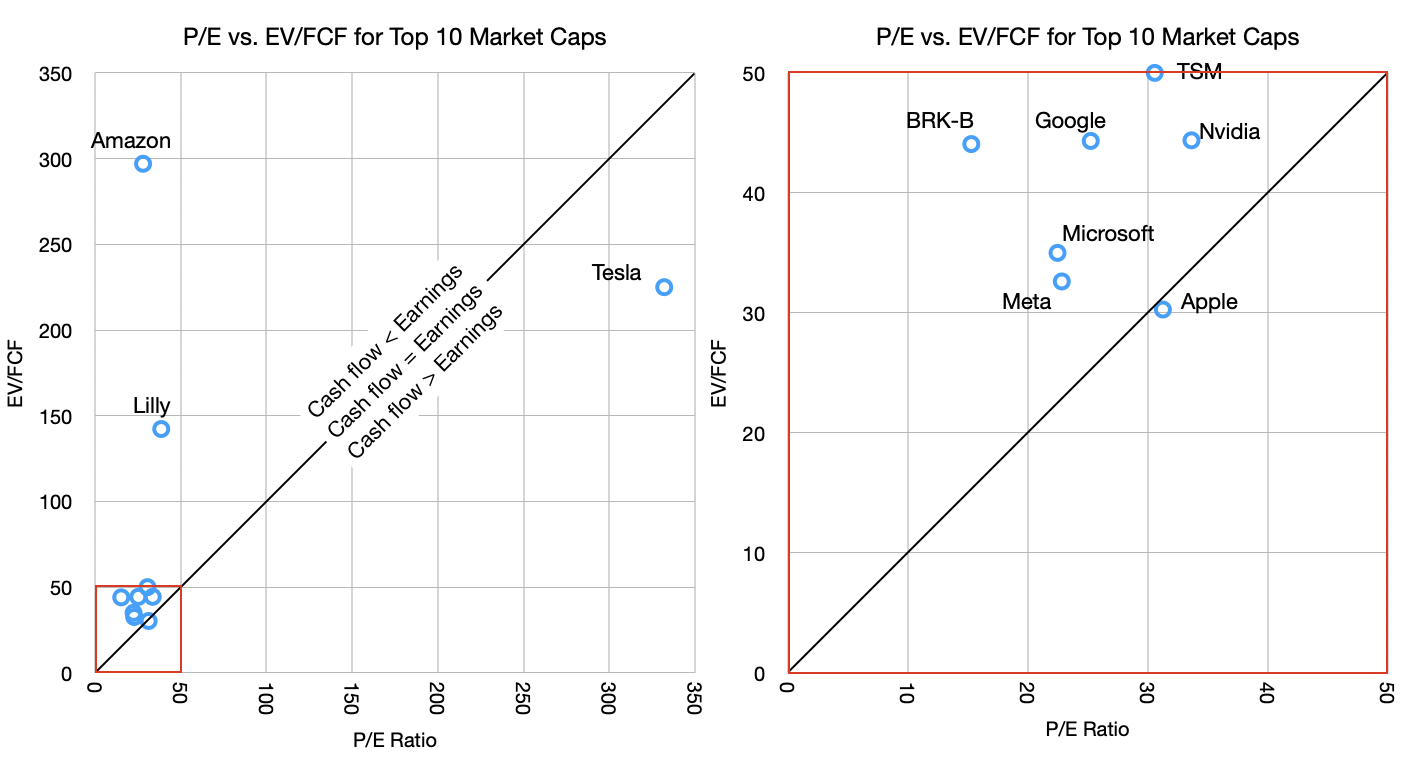
    Cash flow is a fact, earnings are an opinion and share price is a dream.

    A company’s total worth is the number of outstanding shares multiplied by their value. This product is called the market capitalization or Market Cap.

    That’s a simplification. If you want to be more accurate, you should take the Market Cap and net out cash and debt–these are not part of the future flows of cash that can benefit shareholders.

    More precisely, there is another measure called the Enterprise Value (EV) which is the total price tag of a company, representing what it would cost to buy the entire business and pay off its debts. EV = Market Cap + Total Debt + Preferred Stock + Minority Interest – Cash and Cash Equivalents.

    This is the precise and complete measure of the firm’s value but we use the shortcut of Market Cap since In most cases the Preferred stock and minority interest are negligible and if cash equals debt then the result is EV =~ Market Cap. it’s easier to calculate anyways as the shares outstanding and share price are easily available. Not so for EV. →

    What are the odds of Apple surviving?
    What are the odds of Apple surviving?

    A tale of two Apples

    What are the odds of it surviving another year, ten years, 50 years?

    Companies don’t last long. A recent study that analyzed thousands of European firms yielded a corporate life expectancy figure of 12.5 years. The Boston Consulting Group analyzed the entry, growth, and exit dates of 35,000 publicly listed companies and determined that one in ten of all public companies fail each year, a fourfold increase since 1965.

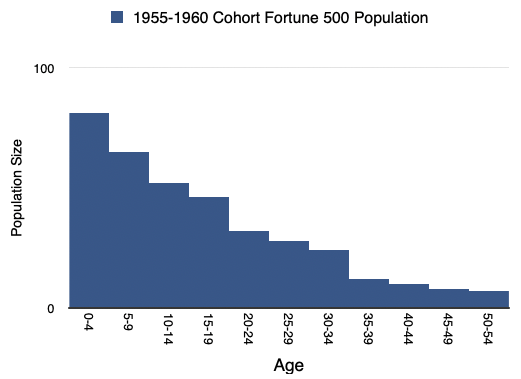
    As I illustrated many years ago in a talk titled “The Unfortunate 500” most companies die not long after adolescence. Of the Fortune 500 1955-1960 cohort, the 81 companies which joined the index in those years, only 7 remain there today. One third of the corporations on the 1970 Fortune 500 list were no longer in existence thirteen years later. Broadly speaking, as a population, large companies that make it to the Fortune 500 listing have life expectancy within that group of 17 years. →

    iPad at 16

    Redundant or Post-PC?

    Today marks the 16th anniversary of when Apple released the first-generation iPad.

    To many, including Alan Kay, the tablet form factor makes much more sense than the PC form factor. It’s more approachable, more intuitive and certainly smaller and more portable. As the graph shows, quickly after launch, the iPad overtook sales of the Mac.

    The problem arose that whereas the iPad was smaller, the iPhone what smaller still–so much so that users would take phones with them everywhere. At the same time, the “PC” shrank as well so that many notebook (laptop) computers became thin, light and had day-long battery life. The Mac at least became no bigger a burden to carry than an iPad.

    So the iPad was stuck in the middle between an iPhone, that did more and more, and a Mac that was very portable. At this point many said that the iPad was a dead end form factor. →

    AI as Infrastructure

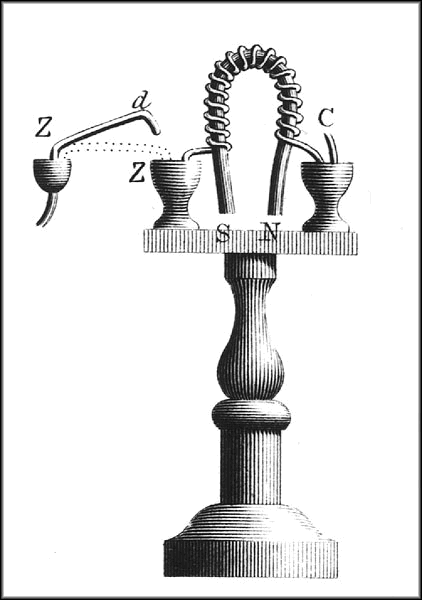
    ON September 3, 1821, 37 years after James Watt invented the concept of horsepower and started charging £5/horsepower/year for the use of his steam engine, the first demonstration of the production of a mechanical force by the interaction of an electric current and a magnetic field was given by Michael Faraday in the basement of the Royal Institution in London.

    1820 is, in many chronicles, noted as beginning of the industrial revolution. It marked the end of 50 years of war, whose conclusion unleashed pent-up demand. That demand was served by relatively free trade, guaranteed by British naval power, coupled with property rights and financial instruments which allowed inventions of the previous century to finally be harnessed for commercial gain. The steam engine is the canonical invention of the era and its implementation as a source of power for factories, shipping, rail and machinery is legend.

    Not usually noted as coincidental to this period is the electric motor. Yet not long after Faraday’s 1821 demonstration in London, the first DC electric motor capable of turning machinery was invented by William Sturgeon. In 1832 he built on Faraday’s electromagnet by incorporating a commutator which oscillated the direction of current to ensure continuous rotation.


    Nota Bene.

    The Motley Fool asks: Where Will Apple Stock Be in 5 Years? → Not reading this article is probably a wise decision. Shares could perform in line with the S&P 500’s long-term average Investors can follow a straightforward exercise to try and figure out where Apple’s stock price will be in late March 2031. It’s important to consider both the valuation and profit gains. We just released a […] →
    Apple’s services continue to see increased engagement, spending

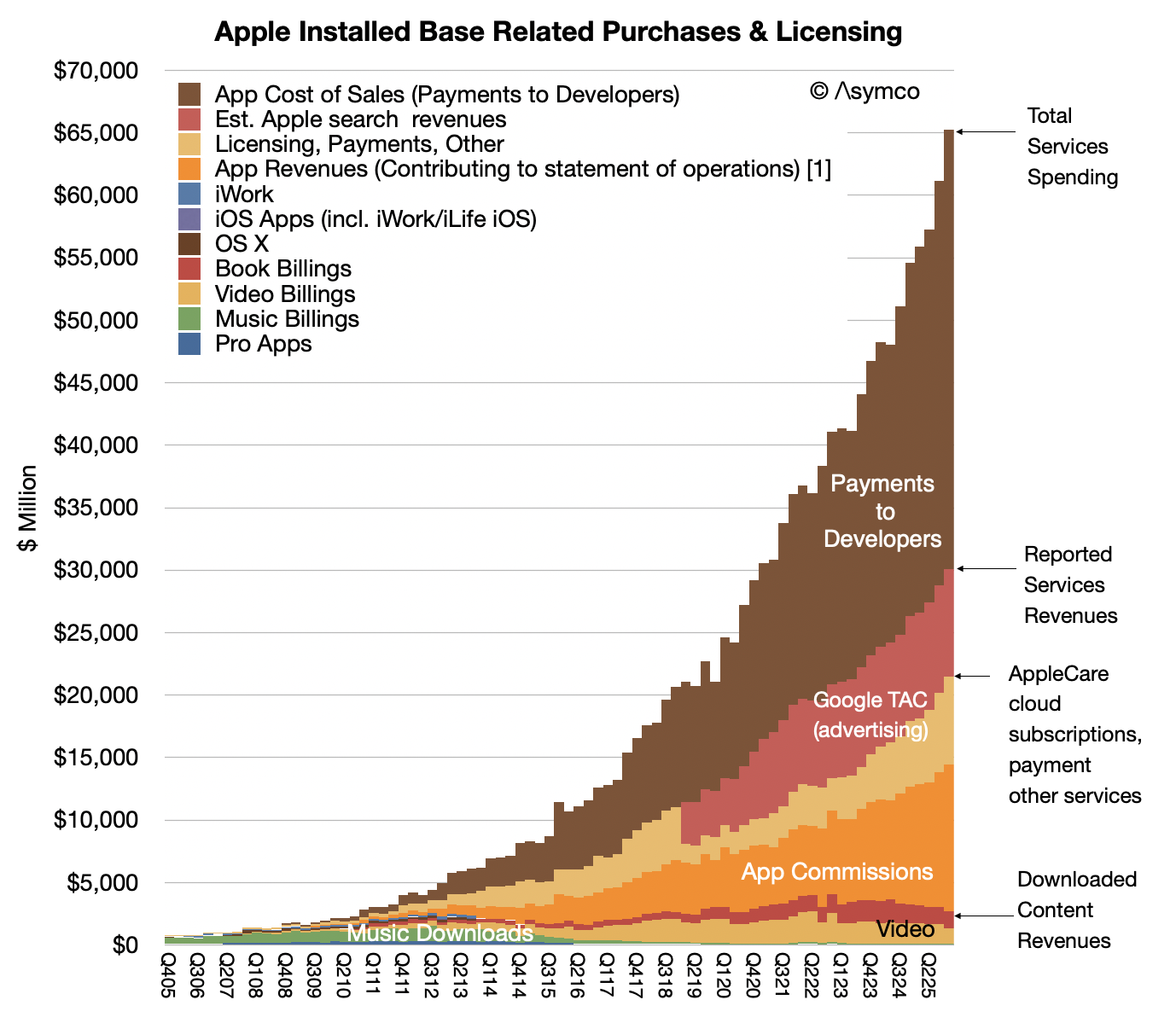
    Apple’s services continue to see increased engagement, spending → The survey of 3,500 smartphone users reveals a significant rise in average monthly spend on Apple services to $13, driven by increased adoption of premium offerings like AppleCare/One, Apple TV+, and Apple Music, with notable shifts towards AI features despite muted upgrade intent, though potential US bias may affect overall accuracy. →

    KeyBanc maintains a lack of clarity of thought → The analyst's note on Apple is overly cryptic and lacks clarity, making it difficult to assess its validity or relevance. →

    iPhone sales continue to surge into February – Bernstein → February saw robust iPhone sales driven by the iPhone 17 line, with global unit sales up 26% and ASP climbing 6.9%, yet January-February revenue estimates oddly lag behind projections, sparking confusion. →

    Morgan Stanley has a stark message for investors in Apple → Morgan Stanley's survey indicates strong potential for Apple stock, highlighting record iPhone upgrade intentions, especially in China, improved switching rates, and significant interest in a future foldable iPhone. These factors support robust FY26 shipment forecasts and suggest a possible revenue boost from new products. Despite some concerns about declining willingness to pay for AI features, Morgan Stanley maintains an optimistic outlook with a $315 price target. The article criticizes TheStreet's editorial approach for misrepresenting the positive survey findings as negative news about Apple. →

    Mac mini and Mac Studio orders booming → Apple's Mac sales are surging due to the M5 chips' enhanced AI capabilities, outpacing other platforms and driving demand despite current shipping delays. →
    Gartner adds their Mac Q1 estimate to the pile

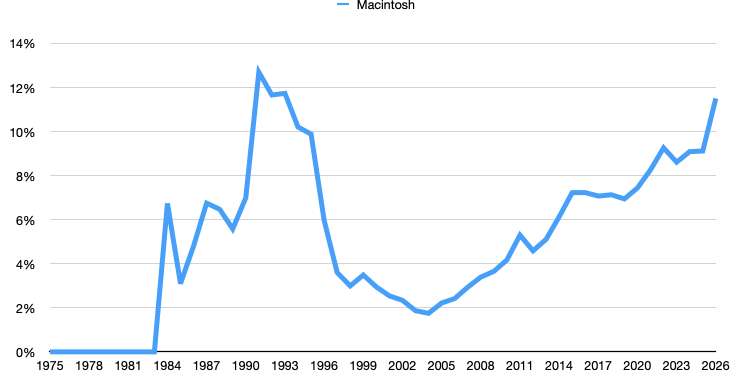
    Gartner adds their Mac Q1 estimate to the pile → In Q1 2026, Apple's Mac sales surged impressively by 10.7% to 12.7% year-over-year, driven by the MacBook Neo's appeal, securing a 10.6% global market share and maintaining fourth place among PC vendors, amidst a 4% rise in overall PC shipments. →


    Office Hours
    Asymco Office Hours Live Q&A with Horace Dediu: April 8, 2026

    Asymco Office Hours Live Q&A with Horace Dediu & Gene Munster took place on April 8, 2026 → Topic dicsussed: Apple Topics discussed: 

    • Geopolitics: China concentration; Taiwan tail risk
    • Financials: Solid near-term growth
    • AI: Critical narrative shift; not yet proven
    • Growth Strategy: User expansion
    • Business Model Evolution
      hardware → services → Personal AI
    • Moat: Privacy + integration; trust;

    Consider subscribing to Asymco One gives you full access to our research, analysis, and commentary. Subscribe with code BULLETIN for a discount.

    Feedback: Have questions or comments? Reach out to us at contact@asymco.com. We’d love to hear from you.
  2. What are the odds of Apple surviving?

    Research · 2 comments

    A tale of two Apples

    What are the odds of it surviving another year, ten years, 50 years?

    Companies don't last long. A recent study that analyzed thousands of European firms yielded a corporate life expectancy figure of 12.5 years. The Boston Consulting Group analyzed the entry, growth, and exit dates of 35,000 publicly listed companies and determined that one in ten of all public companies fail each year, a fourfold increase since 1965.

    As I illustrated many years ago in a talk titled "The Unfortunate 500" most companies die not long after adolescence. Of the Fortune 500 1955-1960 cohort, the 81 companies which joined the index in those years, only 7 remain there today. One third of the corporations on the 1970 Fortune 500 list were no longer in existence thirteen years later. Broadly speaking, as a population, large companies that make it to the Fortune 500 listing have life expectancy within that group of 17 years.

    What are the odds of Apple surviving?

    To illustrate further, here is the list of the companies that joined the Fortune 500 In 1976, the year of Apple's birth:

    EntryCompanyExit
    1976SuCrest1976
    1976International Systems & Controls1977
    1976Kewanee Industries1977
    1976Hunt International Resources1979
    1976Peabody Holding1979
    1976Consolidated Aluminum1981
    1976HP Hood1981
    1976Envirotech1982
    1976Peabody International1984
    1976Hughes Tool1987
    1976Cameron Iron Works1990
    1976Foxboro1990
    1976Tektronix1994
    1976Mapco1998
    1976Molson Coors Brewing2009
    1976Baker Hughes2014
    1976Masco2014
    1976Ball2014
    1976Ecolab2014
    1976CF Industries2014

    Not one of those in the 1976 cohort are on the list today. The longest to survive managed to stay on for 38 years.

    Apple joined the Fortune 500 in 1983. Here is a list of all the other companies that joined the index in 1983.

    EntryCompanyExit
    1983North American Coal1983
    1983Datapoint1986
    1983MEI1986
    1983Mobay1986
    1983Coleco Industries1988
    1983Liquid Air1988
    1983AH Robins1989
    1983Sipco1989
    1983Wilson Foods1989
    1983Oxford Industries1991
    1983DR Holdings Inc of Delaware1992
    1983Media General1992
    1983Wisconsin Dairies Cooperative1992
    1983Ametek1994
    1983Hanson Industries NA1994
    1983Meredith1994
    1983Snap On1994
    1983Sun Diamond Growers1994
    1983Universal Foods1994
    1983Worthington Industries1994
    1983AMDAHL1994
    1983Dr Pepper Seven Up1994
    1983Diebold1994
    1983Echlin1998
    1983Stone Container1998
    1983Tyco International1998
    1983Flowers Industries2001
    1983Cooper Tire & Rubber2005
    1983Tribune2008
    1983Holly2011
    1983Apple--

    Apple is the only survivor from that cohort.

    Out of about 2500 companies that existed in the Fortune 500 index since 1955, 50 are still in it. That's a survival rate of only 2%. Approximately 87% of all people born globally between 1955 and 2026 are still alive today. This is why I titled my talk The Unfortunate 500. If this was a human population it would be considered chronically unhealthy.

    However, unlike people, large companies that make it past age 50 tend to stay alive (or independent, as most who exit the index do so because they are merged or acquired--another distinction from biological entities).

    But the way they manage to be resilient is by adapting to a changing world in some fundamental ways. The environment a business lives in (technological, market, economical) changes more rapidly than the biological environment (genetic, radiological, reproduction).

    Companies have to essentially re-define themselves and become something that has little to do with their initial conception.

    In the case of Apple there are clearly two separate entities. The original and the one that was reborn in 1998 when Steve Jobs returned. When you look at the company closely, it's pretty clear that the second Apple was fundamentally different even though the original founder returned.

    In some ways one could argue that Apple 1.0 eventually strayed from its original culture and the reset in 1998 returned it to a core that was resilient but it's more complicated than that.

    To measure "distance" in terms of corporate culture you need to think of culture as a three dimensional vector. it's a composition of resources, processes and priorities (RPP). The combination of these forms what we call the "DNA" or the "culture" or the unwritten constitution of the firm.

    The vector of RPP for Apple changed dramatically in Apple 2.0 in terms of resources (capital, software, silicon), processes (engineering, operations and marketing), and priorities (focus, integration, product/service cohesion)

    I would summarize it as there being a tangible "theory of the firm" for version 2. The first version was very much a theory of the team: a group of great people without a binding operating model.

    Stay tuned as we explore the Theory of Apple.

  3. Apple at 50 - Ben Thompson interviews Horace Dediu

    Podcast · 4 comments

    Ben Thompson of the Stratechery interviews Horace on the Stratechery Plus Podcast to discuss Horace's journey to become an influential tech analyst: early career in research, business school under Clayton Christensen, and his time at Nokia during the rise of the iPhone. 

    The conversation further explores Disruption Theory in the context of both smartphones and AI, why Christensen misjudged Apple, and whether AI could challenge today’s tech giants. It also marks the launch of Dediu’s new paid service Asymco One and reflects his continued conviction in Apple Inc. at its 50-year milestone.

  4. Other Products

    Research · 6 comments

    From the way Apple reports its revenues you might think that the company has several operating segments. There are the iPhone, the Mac, the iPad for which units and revenues are reported. Then there are Services and Other Products for which we have revenues only.

    Services is a collection of all non-hardware revenues and is (finally) being recognized as a non-trivial business. With reported revenues of $26.6 billion in the last twelve months, it's big enough to be a Fortune 100 company and set to double in four years. ((Although a non-zero business, the valuation of Services continues to confound observers who cannot separate it from the hardware businesses it attaches to--which themselves are considered near commodity value--thus paradoxically valuing the overlying asset of Services near or precisely at zero. Incidentally, Facebook is Fortune 98 at $27.3 billion and it is also one of the top 5 largest business by market capitalization.))

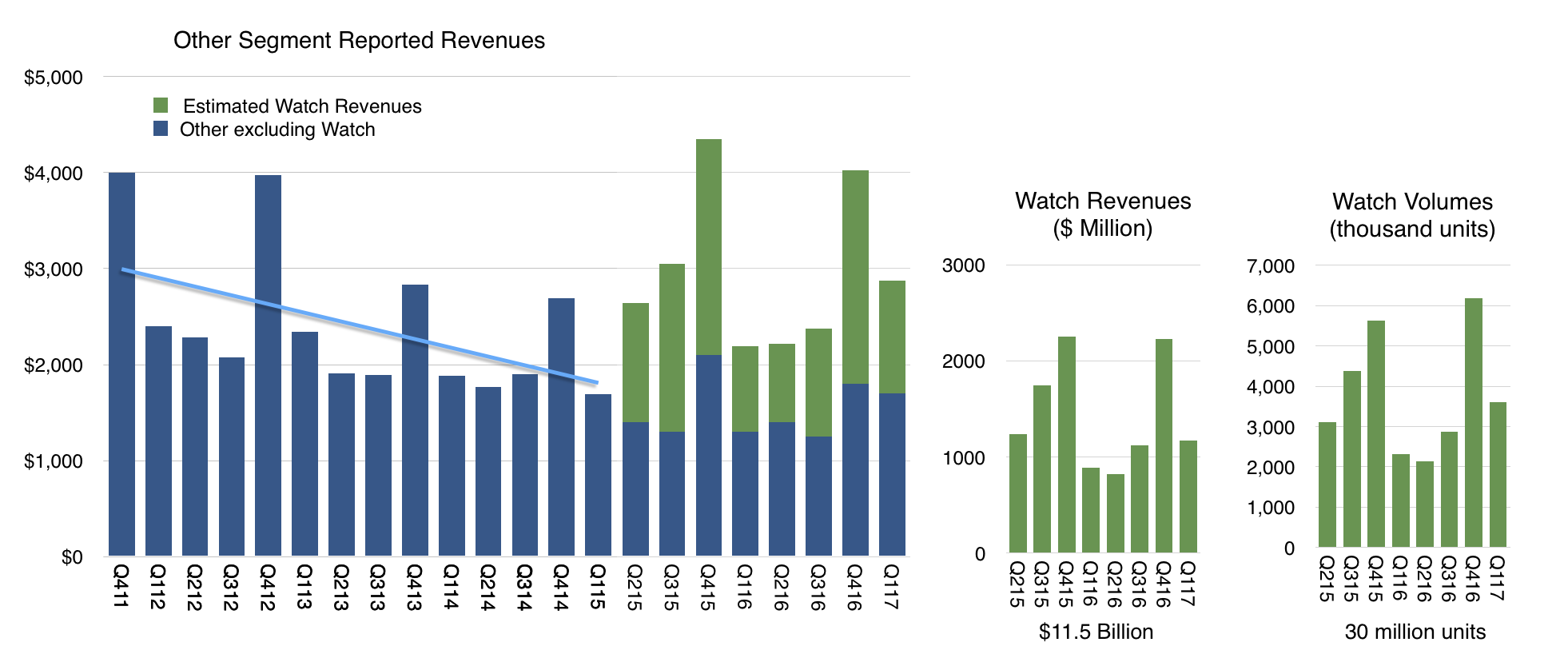
    That leaves "Other Products" which now becomes the revenue segment that is  "most likely to be ignored." This segment had revenues of only about $11.5 billion in the last 12 months which would place it at only a Fortune 245 ranking, equivalent to a Toys "R" Us or Biogen. How should we value Other Products?

    Other includes many hardware products including iPod, Apple TV, Beats, Apple Watch, AirPods and, soon, HomePod. Each is a significant product, with Watch probably the largest single contributor. But since we don't have specific unit numbers, we are left guessing at the contribution of each.

    The Watch itself has been a point of scrutiny as it could be initially teased out of the mix through an observation of the before-and-after launch vs. trend-line as shown below:

    This separation of Watch became harder to discern after the launch of AirPods. Though they are still very hard to obtain, they might be "moving the needle" by now with a contribution that would muddy the Other category further. Same with updated Beats headphones.

    This separation will be harder still with the launch of HomePod later this year. This product is priced at a point similar to the Watch and the quantities sold will be very hard to estimate without Apple's revealing of actuals.

    Fundamentally however, all the "Other products" will have a common relationship to the iOS and MacOS hardware: attachment to and integration with a "parent" platform. Apple TV might be stand-alone but I strongly doubt there are many sold into offices or households which don't have iOS usage.

    This means that "Other Products" are very similar to "Services" in that there is a dependency on a primary platform and, as it has been argued, they are therefore fragile. If the core platform declines then the Services and Other Products decline as well.

    Given this dependency it makes little sense to carve these categories out as separate businesses. They cannot stand alone. They are very much the "children" of the parent platforms.

    This is why it's assumed that Services, (a Fortune 100 company) and Other Products (a Fortune 250 company) can be discounted to zero. By focusing attention on the iPhone one can capture all the essential value of Apple. This is in contrast to the "sum-of-parts" valuation that could be applied to a set of independent business units in other companies.

    And yet I started this discussion with the point that you might be tempted to look at Apple on the basis of these reported revenue segments. The choice of what Apple reports is arbitrary. It could report no segment revenues at all and publish just one revenue number. This is roughly what Google Amazon and Facebook do. Or it could report segments in some other way. For instance, app store revenues and AirPods could be reported as part of "The iPhone Division". Or maybe it could bundle all iOS devices and services and accessories into another segment called "The iOS Group". Or it could create a "Devices group" and a "Personal Computing" group. Microsoft famously shuffles its revenues into creative segments based on various organizational structures or choice of what it wants to project as its focus.

    There is no limit to the ways Apple could slice revenues into segments. The reason Apple does it the way they do is mostly due to historical reasons. The company used to report the iPod separately as a segment but it no longer does. It also used to report Software separately, because, presumably,  it charged for it but now it no longer does. It also separated laptops or portables from desktops.

    The current reporting system is tempting us to draw certain "business unit" conclusions. These boundaries are illusions because Apple does not have business units. It has only one Profit and Loss statement (P/L) and is organized functionally. There is no "head of iPhone" or "head of Mac" responsible for each siloed revenue and cost structure. Instead, the entire business should be seen as a whole because it is managed as a whole.

    This is easily evident in how the products are designed and marketed and how they are engineered. The iPhone may spawn AirPods and AirPods may have no value outside the iPhone but the iPhone is valuable precisely because it has AirPods and Apps and Music and iCloud. And Apple TV, and HomePod and whatever comes next. The reason the iPhone can be sold at three times the price of competitor products is because of the Services and Other Products and iPad and Mac symbiosis. This integration drives the satisfaction, loyalty, price and brand value. There there are the Apple Stores and the launch events and the countless details that make up the ownership experience.

    The fact is that you can't slice and dice Apple.

    There is one Apple and it must be analyzed as a unitary entity. That analysis is therefore difficult. It is easy to pick up the numbers given and study them in isolation. The iPhone, the iPad, the Mac. We all do that.. However we miss a great deal in doing that.

    The lesson is that data we obtain leads us to see something but it also blinds us by taking attention away from what we cannot see. All data lies by omission. That which is left unmeasured may be where all the truth lies.

  5. Codifying asymmetry: How Apple became Jobsian

    Research · 79 comments

    Any student of organizational theory must struggle with the question of how to assign weight to the influence of the leadership of a company. In the case of Apple, the question is:

    Is Jobs is the embodiment of Apple or is Apple already Jobsian, imbued with his ethos?

    John Gruber summed up (start at 8:00 min) the "Apple is Jobsian" argument by saying that Apple is Steve Jobs' greatest creation and that he has been working on crafting the company as much as he has been crafting products. The result being that it's well designed for sustainable longevity.

    The arguments for "Jobs is Apple" are mostly rooted in anecdotes of a supreme leader that is indispensable to every decision and detail. There are also ample examples from history of companies who foundered after the departure of founders (Apple itself is notably cited.)

    But beside armchair quarterbacking, what evidence is there that Apple is being engineered to operate independent of its founder? Unfortunately there is almost no organizational analysis for Apple. Unlike many of its contemporaries, there aren't org charts or tell-all accounts on life in Cupertino. There are no anonymous "mini-aapl" blogs or tales from the disgruntled.

    For this reason, a recent quote about the mysterious "Apple University" in Fortune caught my eye.

    First a brief review of what was known.

    Apple University was first mentioned in 2008 when Joel Podolny was hired from running Yale Management School to join Apple in creating this new "University". I remember at the time thinking what such a thing might be. To leave the top job in one of the top business schools to join Apple must require some powerful incentives. I envisioned Apple entering into a far more ambitious iTunes project where they could be offering degree programs or teaching resources through the familiar store front.

    But nothing was heard about Apple University again. Until yesterday.

    According to the article in Fortune and some additional details from another source, Joel Podolny has been building an understanding of how Apple is run. He's then been asked to codify this understanding into a curriculum that can be taught to Apple employees.

    The idea that Apple is trying to capture its institutional processes and knowledge is very compelling. Few companies have self-knowledge. Fewer still try to codify it and teach it to new generations of leaders (Disney, McDonalds and Toyota have in-house training programs but they are mostly aimed at new hires).

    For those who don't bother, the consequences are a more rapid descent into disruption. I've experienced the consequences of the failure to remember decision processes. Knowledge about decisions disappears once the decision maker moves on, leaving a new generation to figure out the causes of success (and failure) all over again.

    The evidence of the forgetting of history abounds at companies like Sony and Microsoft which seem to be behaving exactly opposite to how they once did. Sony, once a serial disruptor, turned into a sustainer. Microsoft who pioneered software as a business, cannot find new business models for software.

    Apple's decisions and outcomes are the stuff of legend. They famously act asymmetrically to what is "conventional wisdom". Wisdom imparted supposedly through business schools but systematically contradicted by Apple's principles:

    • Accountability without control
    • Lack of "P&L responsibility" for top management
    • Saying no to "better things"
    • Building products before markets are identified
    • Functional vs. hierarchical or divisional organzation
    • A disregard for polite consensus

    So if this type of decision process is not codified, how is it going to persevere when convention dictates otherwise?

    If the article is correct and there is an effort under way to codify and teach new generations "the Apple way" then the case for Apple being Jobsian grows a lot stronger.

  6. Flummoxed, again

    Research · 184 comments

    The last time I took a snapshot of the iPad death watch it was March 9th, 2010. Almost a year ago. The now-classic quotes are reproduced here.  Last May I wrote:

    Apple keeps a tight lid on new products so that competitors don’t get a head-start on copying, but in the case of the iPad, advance knowledge would not have had any impact. Competitors look at the iPad and see nothing.  They’ll only react once the market explodes and they start to feel belated pain.

    I thought that would be that. As the success of the product would become self-evident, predictions of imminent demise would trail off. The pain of share loss would prompt a wave of challenger copycats. Imitation would be the the best form of flattery.

    But no.

    Critics were not silenced. One year, 15 million units, and $9.2 billion later I went back to the source of the quotes and found the following (published quotes dated after March 9th 2010). (Cited from aaplinvestors.net with some editing for brevity and relevance):

    “Problematically, the Android competition is just as expensive as the iPad lineup, so Apple obviously feels free to continue gouging consumers on iPad pricing.” Paul Thurrott, Windows IT Pro, 3 March 2011

    “Apple’s iPad 2 might be ‘magical’ but it still should’ve been better ... It needs more G’s. It’s still just a toy” Zach Epstein, Boy Genius 2 March 2011

    “11 reasons NOT to buy an iPad 2 ... Reason 5: Competition David Gewirtz, ZDNet, 23 February 2011

    “Given what I’ve seen of Honeycomb and Motorola’s excellent tablet, Cupertino will have some serious catching up to do with their iPad 2.” J.P. Mangalindan, Fortune, 4 February 2011

    “We very carefully chose our tablet processor, the Nvidia Tegra 2, and to really compete it will take [Apple] some time. You know, [Nvidia] is well known for graphics.” Jonney Shih, Asustek Computer, 3 February 2011

    “If you were to ask me in two years time, will Apple have less than 50 percent of the global tablet market, I think that’s a certainty. Neil Mawston, Strategy Analytics, 31 January 2011

    “We have an extreme focus on the innovation of LePad and LePhone because these products will dominate the future market. Though Apple is winning a significant share in the Chinese market, it has not gained a clearly leading position yet. Our advantage is we know this market better.” Liu Chuanzhi, Lenovo, 27 January 2011

    “The iPad may still be the lone leader, but with 100+ competitors on the way, it won’t likely keep its majority market share unless the pending next generation iPad really addresses all the complaints about the current version, like a missing camera and a lack of a USB port, and the company has to add those features without a major price increase - a tall order, to be sure.” James Brumley, Investopedia, 13 January 2011

    “Hands-on PlayBook demonstrations at CES showed its differentiation in multitasking and performance, which may be difficult for Apple/Android to rival.” Mike Abramsky, Royal Bank of Canada Analyst, 11 January 2011

    “Apple Inc.’s popular iPad is getting its strongest competition thus far as consumer-electronics manufacturers unveil tablet computers with bigger screens, front-facing cameras for video chatting and more.” Rachel Metz, AP Technology Writer, 3 January 2011

    Apple may be simply trying to get in ahead of Research in Motion’s aggressively priced PlayBook or combat the early success of Samsung’s Galaxy Tab.” Rick Aristotle Munarriz, The Street, 29 December 2010

    4. Competitors are coming. Brett Arends, Wall Street Journal, 22 December 2010

    Reason 6: WiFi is still unreliable David Gewirtz, ZDNet, 16 December 2010

    “I can’t imagine anyone under the age of 30 wanting an iPad. A PS3, Wii, GameBoy, or even a useful laptop maybe, but an iPad? Furthermore, I do not recall ever seeing anyone under 30 actually using an iPad.” John C. Dvorak, PC Mag, 13 December 2010

    “We hope our tablet PCs can reach a global market share of 10-20% initially, and become the market leader in two to three years.” Gianfranco Lanci, CEO and President, Acer, 26 November 2010

    “It’s a nice-to-have product, for those of us who don’t have a budget, but is it a must-have product? I don’t think so.” Ashok Kumar, Analyst, Rodman & Renshaw LLC, 12 November 2010

    “Steve Jobs never says anything without thinking through it carefully. But I think in this case he may be a little afraid of this category. And he’s finding whatever he can to attack because he sees [seven-inch tablets] as a challenge to the dominance of the iPad.” Adam Hanin, VP Marketing, Viewsonic, 1 November 2010

    “There could literally be millions of first-generation iPads gathering dust in people’s home offices already. This product is the tech industry’s biggest MacGuffin yet.” Paul Thurrott, Windows IT Pro, 23 October 2010

    “I cannot see a need for the thing.”John Dvorak, MarketWatch, 22 October 2010

    ”For those of us who live outside of Apple’s distortion field, we know that 7″ tablets will actually be a big portion of the market and we know that Adobe Flash support actually matters to customers who want a real web experience.” Jim Balsillie, Research In Motion, 20 October 2010

    “iPhone and iPad have been amazing products that have opened new markets. But I do not think they will own either market in a few years. Android will.” Fred Wilson, AVC.com, 18 October 2010

    “The constant search for an ‘iPad killer’ and the sheer multitude of tablet computers launching in the next 18 months should make Apple aware that its competition is fierce and will only become tougher.” Barbara E. Hernandez, PCWorld, 5 October 2010

    “HP’s New Tablet Could Be an iPad Spoiler HP’s decision to bundle a tablet computer with its new $399 printer could make trouble for competitors.” Cliff Edwards and Aaron Ricadela, Bloomberg Businessweek, 23 September 2010

    “Our tablet will be better than the iPad.” Chang Ma, VP Marketing, LG, 20 August 2010

    “Not only is Apple typically lost in the enterprise, but it focuses very little of its time there. And with a new, potentially more compelling tablet coming — the Cisco Cius — the iPad’s success in the corporate world could be short-lived. Here’s why:... 10 The power of Windows” Don Reisinger, Channel Insider, 5 August 2010

    “I don’t think there is one size that fits all…I’ve been to too many meetings with journalists who spent the first 10 minutes of the meeting setting up iPad to look like a laptop.” Steve Ballmer, Microsoft, 29 July 2010

    “ [...] It still isn’t the device that I’d take to a meeting because it has no input.” Bill Gates, Microsoft, 2 June 2010

    “Which means I end up on the iPad — and tablets more generally — where I started. Tablets will not create a new category, but will supplant (or merge with) one or more of the current substitutes: smartphones or netbooks.Here I am less optimistic about the iPhone and webOS than I am about Android. ” Joel West, professor of Innovation & Entrepreneurship, College of Business at San José State University, 30 May 2010

    “The iPad is useless. Beautiful, but useless. The iPad is too heavy. It’s awkward to hold and view in public. It’s fragile. It requires expensive accessories to protect it and extract more functionality. ”Josh Belzman, MSNBC.com, 20 May 2010

    “Mum, the iPad is not ‘amazing.’ It’s just marketed very well, both by Apple and its culpable partners in mainstream media. ” Paul Thurrott (in response to comment by Mum), Paul Thurrott’s Super Site for Windows, 26 April 2010

    “In short, I don’t get the ‘magical and revolutionary’ vibe that Apple chief executive Steve Jobs touted at the iPad’s January unveiling.” Rob Pegoraro, Washington Post, 9 April 2010

    “The first troubling sign is the fact that you can still get an iPad today. They didn’t sell out. The pure slate form factor has failed all these years because, other than for vertical applications, people want and/or need a keyboard for regular use. The fact of the matter is that a touch screen or bluetooth keyboard just doesn’t compensate.” Jonathan Yarmis, Ovum, part of Datamonitor Group, 6 April 2010

    “I don’t get it. It costs $500 for the basic model, when you could get a laptop with a lot more functionality for about the same price. The iPad hype machine has been in full effect this week, and I still think it’s just that—hype. ” Alex Cook, Frontier Outlook, 3 April 2010

    “As far as what this means to Apple, one thing to keep in mind: Even if the iPad sells more than the iPhone did in its first year, it’s still only around 5% of the company’s revenue. So it’s a very small slice. From there, it probably doesn’t grow as large as the smartphone market. So, if you’re buying under rumors, keep perspective in mind. The iPad’s a great product, but it’s probably not a game-changer.” Eric Bleeker, Analyst, Fool.com, 31 March 2010

    “The iPad will remain an expensive, niche device compared to all-purpose netbooks.I think that one of the iPad’s most important uses will be for reading ebooks and publications. Even so, though, when it comes to the marketplace, netbooks will sales still far outstrip those of the iPad.” Preston Gralla, PC World, 30 March 2010

    “Don’t Believe the iPad Hype. Apple has sold out pre-orders of the forthcoming device, but it could all be a marketing tactic. By not manufacturing enough iPads for the initial launch date, is this a case of Apple shooting itself in the foot?” Mike Schuster, Minyanville.com, 29 March 2010

    “‘iPad Killer’ May be Palm’s Last Hope”Tom Bradley, PC World, 20 March 2010

    “Even if your company has relented and now supports the iPhone, as growing numbers of businesses do (70% of the Fortune 100 are at least testing it, says Apple) you’ll want to say “No” to the iPad and other tablets. Here’s why: 8. Speaking of money, there is no money in the company budget to pay for iPads. 9. Not supporting iPad will be the enterprise norm. Robert McGarvey, CIO Update, 16 March 2010

    “This morning, the fool’s parade gets started. Apple is taking online “pre-orders” for its iPad tablet, which is supposed to begin shipping on April 3. Buying a new kind of product sight unseen is foolish. Especially given how mysterious Apple has been on what the iPad can do and what restrictions on capabilities and media access it will place on users and content providers.” Galen Gruman, InfoWorld, 12 March 2010

    “The recent launch of Apple, the iPad tablet, has won the award for the second edition of Fiasco Awards delivered this Thursday in Barcelona. From the more than 7,000 people who voted via the website www.fiascoawards.com, 4,325 have considered it the fiasco of the year. Fiasco Awards, 2010, 11 March 2010

    “I think I’ve mentioned this once or twice before, but it bears repeating until it sinks in: the Apple iPad is not unique, nor necessarily the best of breed in the media tablet sector it is spearheading. And it ain’t gonna help Apple shareholders any.’” Anders Bylund (TMF Zahrim), 11 March 2010

    From this critical review, it looks like 2011 will indeed be the year of the iPad 2.

  7. The $85 Smartphone and the imminent extinction of non-smartphones

    Research · 136 comments

    In a recent article I made the claim:

    My bet is that by the end of 2012, it will be hard to find any branded phones which won’t run a smartphone

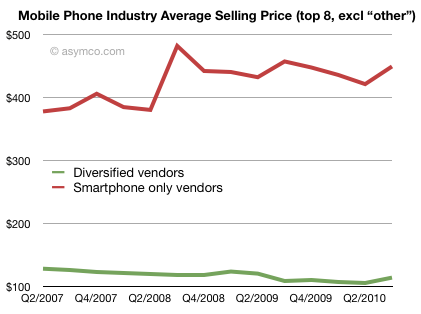
    I also showed how pricing has evolved over the last three years.

    Two days later an article in Fortune's Google24/7 blog highlighted the possible price points of low-end smartphones:

    I had a chance to speak with Jim Tran, VP/GM – Handset Line of Business for Broadcom, who was able to elaborate on the details of the new processor and what it meant for the industry.  Here are some of Broadcom's bullet points:

    The BCM2157 baseband, since it combines many functions on one chip, is able to run more efficiently, meaning less battery power will be needed than on current basic handsets

    Low-cost, low-power, 65 nm digital CMOS process means the silicon will be cheap

    The dual-core processors will run at 500-800mhz.

    Supports portable Wifi hotspot and Android 2.2 and up

    But the kicker is the price.  Tran says that phones made from the BCM2157 chipset will retail for under $100 and may dip as low as $75.  Those devices should debut in just 3-6 months (and we might hear about them next month at CES)....

    To be clear, That sub $100 price is not the cost of materials, it is the suggested retail price after the manufacturers (and carriers) have taken their profits.

    via 2011 will be the year Android explodes - Google 24/7 - Fortune Tech.

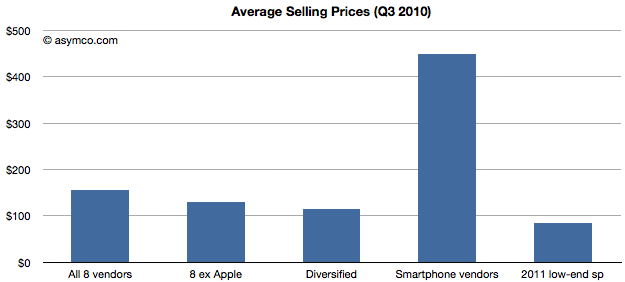
    My own data shows that the average selling price for the top eight phone vendors for Q3 of 2010 was $156. Smartphone-only vendors were charging $450 on average and diversified vendors selling both smart and non-smart phones were charging $144 on average.

    Nokia's ASP for its entire line-up was $88 (spread over about 84 million non-smart and 26.5 million smartphones).

    What strikes me about the claim from Broadcom is that a $100 retail price for a smartphone implies an ASP of about $85 or so (assuming $15 or a very modest 18% channel mark-up).

    That means that a smartphone could be built using this chip which would have nearly half the average price of all branded phones sold last quarter.

    It would also be priced cheaper than the average price Nokia charged for all its phones (75% of which were non-smart phones.)

    And this type of phone could be available not in three years in three months.

    The chart above shows how prices could collapse.

    Of course, low price is not the only condition for the widespread substitution of smart devices in vendor portfolios. But it does take away a significant objection. It no longer seems far-fetched to say that in another two years the price points for smartphones will be low enough to make them marketable in all markets. This may in fact be true next year.

    I suspect that non-branded vendors will lead the way and make these devices widely available in emerging markets. The question will then be entirely up to the branded vendors whether they will follow or will they try to market dumb phones vs. smart phones at similar price points. Will buyers opt for a branded device with no ecosystem or unbranded device with the Android ecosystem?

    It becomes harder to envision any reason why non-smart devices will earn positions in portfolios two years from now.

    Note that I'm not suggesting that the market for high-end smartphones is threatened yet--there is still a lot of innovation that still needs to happen to shape that market into one of mobile computing (vs. mobile phoning).

    Instead, what I am suggesting is that the bottom of the phone market is very vulnerable to becoming smart. This may sound like an odd sort of disruption, but it's a very sinister threat to companies who are in the business of selling brands and not platforms.