Recording and transcript of the June 9, 2026 Asymco One Office Hours, recorded the day after Apple's WWDC 2026 keynote. Horace Dediu shares his impressions of the event and takes questions from Asymco One subscribers.
Takeshi Narabe On the secret of Apple's success, you have previously noted that the key to Apple's success was its ability to integrate hardware, software, and services to create products that are perfectly hired for a specific job to be done. You also highlighted how they moved beyond mere devices to lock customers into an ecosystem like iOS, iCloud and Apple stores. So this analysis is now very well known. So do you still think this is one of the biggest reasons of Apple's success?
Horace Dediu Yes, we have to recognize Services has only been a story for the last 10 years. And arguably integration of software hasn't been really all that important before 1998 when Apple brought Steve [Jobs] back and with him came NextStep, which was [an] operating system based on Unix. And that was much more robust and much more focused around software engineering than the original MacOS. Or, what I would say [constituted] version 1 of Apple, which began in 1970s until the 1990s.
Most people tend to think of Apple as one continuous story for 50 years. [But] it's at least two major stories. I would say pre-98 and post-98. And post-98, it's been so different. And it's much more, I would say, something [that can be studied] as a theory.
I think in the first decades Apple was more, let's say, a story of people. There were people who were brilliant. There were people who were celebrated [as they are] now. But the second half of Apple is much more about building a business that has longevity, [that] can last a long time. It's an unusual priority.
I think for many companies in the world, they don't think about longevity. And that is why, even Tim Cook recognizes that it's the next 50 years that are more important [than the last 50 years]. So thinking about a century is really important and I think [that] is core to the current culture of Apple. Now, of course, this means, as you said, integration, and that is one of the key things. But fundamentally, beneath all that, there's this point about culture.
Takeshi Narabe Culture?
Horace Dediu Culture in the sense of what are the priorities? What do we concentrate on and to what degree do we need to focus? They [management] repeat these things all the time. Focus, focus. What means this? It means saying no to many things, but it also means saying yes to the things where you can bring great things to bear. It's where Apple has a unique advantage. And that means saying no to a lot of things.
We know about the car business that they eventually rejected even though they worked on it for many years. I think ultimately that decision was based on a realization that they couldn't bring enough contribution. And that's not just an economic decision. Of course they could have made money. There are even phone companies in China that make cars today. But it isn't what they thought of as important.
Takeshi Narabe All right, thank you. So you also mentioned to what extent do you attribute Apple's dominance to the ability to tap into non-consumption addressing latent demands that consumers themselves hadn't yet realized.
Horace Dediu So this is also one of the keys indeed. i learned about this by listening to my professor Clayton Christensen, who observed that great companies not only compete effectively, but they also create their own markets. They create their own demand.
[It's an] Extraordinary idea. And when you look at Apple, you do see that they use a different language. They talk about customers not asking for the product. But they also fundamentally build something that compels the user to buy it. When it was something that wasn't conceivable. Steve Jobs famously said, the customer hires us to find out what they want. So this is a fundamental thing.
And there are many examples. And I think one of the struggles today, for example, is Vision Pro, a product that is very difficult to find how it's going to solve problems. But at the same time, it's an extraordinary product. I think the jury is still out on the Vision Pro, but there are many other examples where I think initially they thought things would go in one direction and they went in another direction.
But even the iPhone, I like to repeat the fact that when the iPhone was introduced, Steve Jobs said it was three things. That it was a widescreen iPod, that it was an internet communicator, and it was a phone. But I point out that these days, those three jobs of being a music player, being a telephone, and being a browser, are not among the most popular things people do with it.
So it's fascinating how they introduced it as a blank slate. [It was] software, written by third parties [that discovered the compelling uses], and it developed in its own ecosystem. That is also a very interesting lesson there.
But it is fundamentally about really being humble. I think, again, it's a cultural trait, being humble and saying, maybe we don't know fully what to do, but to concentrate on quality and concentrate on doing at least something useful for people. And then later, new things will appear.
— This is the first part of a series of excerpts from an interview with Asahi Shimbun newspaper on Apple & Innovation.
On April 4, 1975, Bill Gates and Paul Allen founded Microsoft, a software company destined to become a tech behemoth (and key Apple frenemy).
Perhaps the most interesting thing about Microsoft and Apple is just how similar the companies were in several ways. Gates and Steve Jobs, the CEOs who came to represent the two companies, were both born in 1955. Both later dropped out of college.
Gates and Allen created Microsoft when they saw a gap in the market following the launch of the Altair 8800 kit computer. In Silicon Valley, the Altair inspired the creation of the Homebrew Computer Club, where Jobs and Steve Wozniak first showed off the Apple-1 computer.
Much more was said of Jobs' departure signaling the end of Apple than of Gates' departure signaling the end of Microsoft. And much more was celebrated of Apple 50 than Microsoft 50. Why is that?
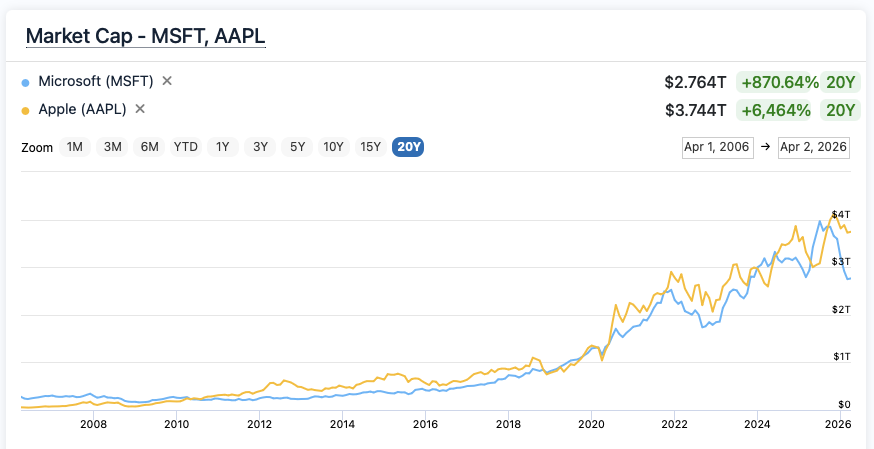
In the case of both Microsoft and Apple, we have seen successful transitions from founders to successor managers that not only preserved but broadly expanded the companies. Cook, Ballmer and Nadella outdid their predecessors as measured by every metric of financial performance. They both reached the pinnacle of business success as measured by market capitalization.
It's romantic to think that business are embodiment of people but in reality they are the seemingly sterile combination of resources, processes and priorities. These are heavily influenced by the people who assemble or define them but ultimately the processes must outlast biology or we are doomed to have to re-invent everything.
Put another way, if a founder builds something that does not outlast him then what has he really accomplished?
After the flurry of new product launches this week, I've read a few comments suggesting that this is a new strategy for Apple, or a pivot of sorts. The premise is that the 17e and the MacBook Neo are new low-end products that are intending to compete in markets that have been either uninteresting or unattractive to Apple in the past. Thus the company is now turning to either addressing affordability, memory costs or competitive pressures.
The flaw with this argument is that there is an assumption that Apple segments its markets by price. The bigger assumption is that *all* markets are segmented by price. This is naive in the narrow and broad sense. If you ask me, any marketer that segments by price is not very good at their job.
Remember, when you segment, you are making an explicit causal statement describing a purchase decision. In other words you are specifying the reason people buy a product. Price segmentation suggests that the reason for any purchase is that it reflects what the buyer can afford. Rich people buy expensive versions of a product and poor people buy cheap versions of the same product. The problem is that I've known many poor people who buy expensive things (actually most luxury brands sell to the less affluent) and many rich people buy cheap things (shunning conspicuity). The correlation is poor and the causation is actually nonexistent. Most importantly, you are missing the ability to create any new products because "new" simply implies higher or lower price.
In the case of technology products, performance is also a factor. Here again, there might or might not be correlation between performance and price and customer income/net worth. Many people of means buy low performance products and many who are constrained financially will pay for performance. For instance, a non-wealthy aspiring YouTube influencer may very well purchase a high performance computer for video editing. And a millionaire pensioner could well opt for a MacBook Neo to communicate with grandchildren.
So what is causation for technology, or, for that matter, any product or service? The answer that comes closest is the "job-to-be-done". What outcome is desired and circumstances are present when a purchase decision is made? What are the forces pulling and pushing the decider? It might be tempting to generalize and say that the young are poor but it would be wrong to generalize that they don't demand performance.
This is a transcript of an Asymetric podcast. It was lightly edited for legibility.
Judd Rubin: Three continents, one conversation, this is Asymetric. We are very excited to have Balaji Srinivasan with us today. Balaji, you're a busy man, Horace you're on the run as usual, so why don't we dive right in. Thanks for joining us today.
Balaji Srinivasan: Good to be here. Good to see you, Horace.
Horace Dediu: Likewise.
Balaji: I know you from online, from Twitter, or at least, I know of your work. It’s always interesting for people to understand how they're maybe thought of by folks who are maybe a little bit on the periphery. And I, we've, always thought of you as the most quantitative Apple analyst, I guess you and [John] Gruber would be the two people who, if you're in the Apple ecosystem, might be the most perceptive commentators outside of Apple itself.
Horace: And John's a qualitative guy, right, so that makes sense.
Balaji: Yeah, exactly. And I'm not like a huge, I mean, it's funny, certainly I have a lot of Apple equipment, but I wouldn't consider myself an Apple fanboy, per se. I converted to Apple when they supported BSD in OSX, because it was a better compute experience.
And, for the last, almost 20 years, the typical developer/engineer/founder, whatever, set up has been a Mac laptop locally, and then all your compute is on AWS or a Linux box or something in the cloud.
Horace: Yeah, me too, actually, because when I started my university work, it was all on Unix, and this was in the days of VAX computers, Digital Equipment, and I just loved that interface at the time of DOS. This felt like, you know, ages ahead. And then I moved from a console to a workstation, which would have been a large screen using the X windowing system and that was my career for five years.
I wasn't even on a PC anymore, I wasn’t using a Mac, but in 2000 when they switched, roughly around that time they switched to being, like you said, BSD. And I was like, okay, Mac is the way to go. Anyway, we don't want to talk about necessarily Apple, tell us what you're working on these days.
Balaji: Sure. I've actually got the crypto plan for world domination that I thought I might discuss with you. Which is essentially how if you're a crypto maximalist, so to speak, how I think crypto is the most important threat to the Big Five.
And essentially the plan for the next decade for how crypto goes after, not just FinTech, but Messaging, Log-in, Social, Search; Crypto Phone, Crypto OS, compilers, databases, advertising, actually reinventing CPA (cost per action), hosting, data centers, creator monetization, and then, on the back end, equity, compensation, privacy, and then most importantly: values.
I actually think that people are underestimating the scope of how big of a deal crypto is and that the Big Five don't really get it. The Big Five, meaning, Google, Apple, Facebook, Amazon, Microsoft.
And there's pieces of their empires that I haven't yet figured out how crypto might disrupt. Amazon's physical logistics, for example, but there's much more of it that is crypto vulnerable than I think people think. And your audience might be interested in this. Some of this is new, even, for maybe my audience.
So we could go area by area. And push back.
Horace: Yeah, the one thing I would caution on, is this usage of the word disruption, because I'm also a student of Clay Christensen. To what extent what I challenge you to answer is, to what extent might these Big Five find [crypto], possibly sustaining?
So if they would say, ‘Oh, well, thank you very much. We'll take it from here.’ So, I agree that there's an opportunity here to disrupt, but many times people just assume change is always disruptive, but change can be sustaining as well. So, please tell us.
Balaji: So, actually, on that point, there's a colloquial usage of disrupt, which just means a change. And then there's the more technical, the Clayton Christensen version, which is, it starts out as sort of an inferior product in some ways, but it's 10x on one axis, it's sort of underestimated. And then it takes the bottom end of the market, and then zooms up to the top in such a way that the incumbent finds it difficult to adopt it because it attacks their margins and so on.
Right? That's assuming the kind of, more technical --
Horace: That's what I mean, yes. That's low end disruption. There's also new markets where it basically carves out for itself a new niche and it does things that nobody's asked it to do. Or markets that are non-consuming, like, you know, emerging markets or something like that, and grows from that base as opposed to low end.
But, yes, generally speaking, that it comes in and is not good enough initially.
Balaji: Yeah, so I think that this fits, as I'll go through each of these examples, I think each of these fit both the sort of colloquial usage, as well as the more technical usage. But let me go one by one and just talk through these points.
So first, at a high level, I'm actually pretty confident that, with the exception actually of Facebook and Twitter, I think crypto is kryptonite to large companies because they don't understand it. And in particular, they're sort of frozen by antitrust and they can't take on more regulatory risk, even if they had the personalities internally to do so. I actually give a lot of credit, even if I think Libra was misguided in some respects, in terms of implementation, I give a lot of credit to [Mark Zuckerberg] for trying to get into crypto relatively early and putting out a project. Even if, in many respects, I think the parameters were flipped, as I can get into, to simply push through that relatively early, starting in 2018, when the other companies didn't get there is because he has a founder's mentality still.
And I think Twitter is actually the dark horse here where it's the furthest ahead on Bitcoin, specifically, as opposed to crypto more generally, that's an internal distinction in the community that I can talk about. But I don't think that Google, Apple, Microsoft, Amazon actually get it because they're not founder led.
And also because they're under this regulatory microscope.
Horace: By the way, just a funny story. So I'm here in Germany because I'm at an event for e-bikes called Eurobike, or just bikes in general. So I'm a fan of Micromobility, I've been talking about it for a couple of years now. I get the same impression. I've spoken to people at those companies that they're not seeing it, they’re not feeling it. Their entire mobility focus is still automotive. It's not that there's a cognitive problem. They understand the idea, but they can't actually implement it, it's this innovator's dilemma thing.
Balaji: Yeah. I mean, it gets to the fundamental thing, right? Which is that a founder is able to say, ‘Hey, we were doing X for such a long time and X got us to where we are, but now we're doing, not X. We’re doing the opposite of that.’
And they have the credibility to turn the entire organization, in particular, to impose short-term costs for long-term benefit to cannibalize or disrupt, in the colloquial sense, an existing product for a new one.
You know, Satya [Nadella, Microsoft CEO] is actually the exception. I would put him, if I rank order the existing companies by their crypto friendliness…
What's interesting is it's the $100 billion and $10 billion and $1 billon companies that are much more crypto friendly than the trillion-dollar companies.
So Shopify, for example, gets it, right? Coinbase. Stripe, I think, is coming around. So the ones that are sort of like the sophomores or the juniors, as opposed to the seniors, are going to, I think, use this to slip stream. And I think this is a disruption again, you know, I know you're from the Christensen club, so I may use that colloquially, so poke at it.
I think this is a change or an alteration or a forcing function, whatever you want to call it. That is actually on par with the desktop to internet transition. That you can think of this as, just like you went from on disk to online, the transition from online to on chain involves a similar number of cultural and technical changes that render the current generation, basically like the Borlands and DEC Alphas and so on of the previous generation.
Horace: So tell us how do you think that… You gave a lot of examples, of things going on chain --
Balaji: Yeah, so let's go to specifics. Let's start with the obvious, which is FinTech. One of my colleagues, friends, Chris Dixon runs the crypto fund at a16z. He observed a while ago that many Unix command lines became apps.
For example, GIT became GitHub. That's an obvious one, but had these command line chat apps that effectively became Facebook and IRC and Slack and so on and so forth, right? Command line apps turned into full-blown UXs. Crypto is actually the reverse in some ways where every FinTech app can be turned into a crypto command line. For example, Affirm or PayPal or Funbox, or, many of these things that essentially are doing cashflow transformations of some kind can be written as a few lines of code in Solidity. Which is Ethereum's programming language. And that alone is actually kind of a big deal where you can write that down and then just start piping arbitrary amounts of money through it, between countries, where it really is the internet of money. Any user can route money to any other user, if both users have a crypto address, if they have a Bitcoin address or an Ethereum address for the purpose of smart contracts.
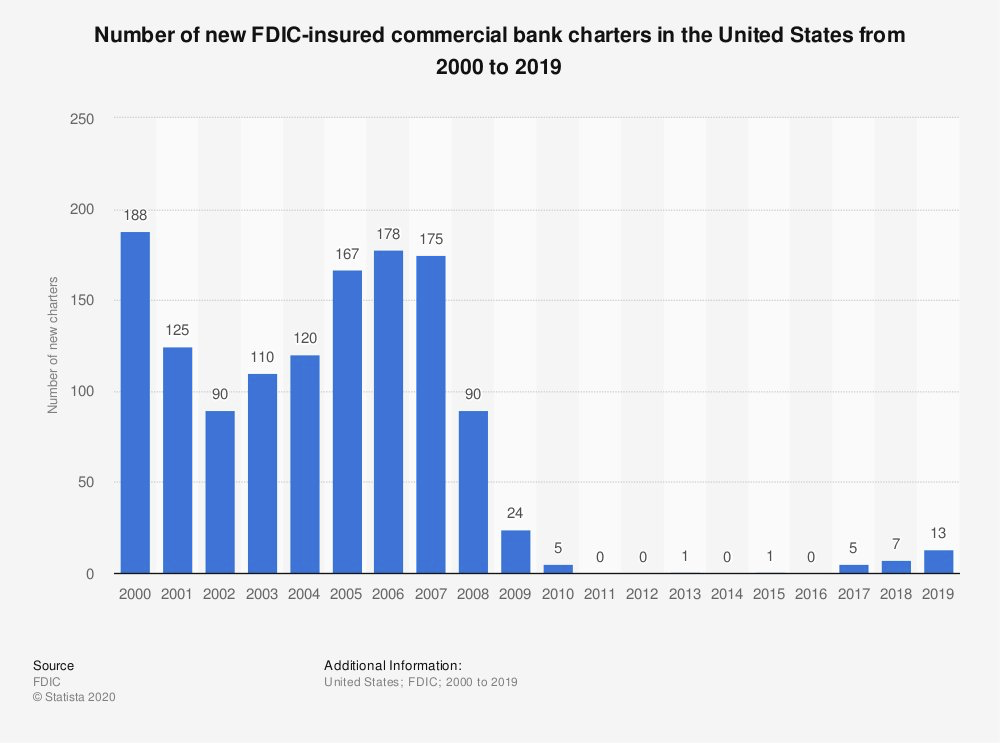
And so that's just a fundamental backend change. And one way of thinking about it is over the last 10 years, since the financial crisis, Dodd-Frank basically stopped the issuance of new banking charters. Were you familiar with that? Did you ever see the graph of that?
Horace: No. No, tell us.
Balaji: So, you're a graph guy - I've got a chart on this somewhere on Twitter, but basically the way that they dealt with the banks' failure during the financial crisis is to effectively reward them by eliminating their competition entirely by refusing to issue new bank charters for almost a decade. And, here's the graph over here.
The state's solution to the financial crisis was to stop issuing commercial bank charters for almost a decade and to reward failure by regulating away competition via Dodd-Frank.
The network solution was FinTech and now DeFi.
The reason I bring this up is FinTech is a front end, Blockchain is a backend. Over the last 10 years... You're probably familiar, at least to some extent, with the FinTech side of things. Imagine if, when I sent you a message via Gmail, that behind the scenes, Google printed out the email, put it on a Pony Express, took it to you cross continent, scanned that and put that into your inbox.
And it looked like it was digital, but it actually had this antiquated pre-internet backend of a two or three-day delay in there, but the company did the best it could to obscure that. You know, all of those hacky steps in between, yeah? That's a good analogy for what FinTech is, where it's this shiny web-like front end, but on the back end, you're dealing with pre-internet mechanisms for settlement where it's often FTP or flat files or some horrible Cobol-era file format. It just wasn't set up for the workloads that we have when you actually press on that. Right? Once you set it up and you give people the expectations of being as performant as a Facebook or a Twitter or a Gmail, and you start putting huge workloads through - that the financial system doesn't anticipate, you get things like the Robin Hood issue of earlier this year.
Horace: Yep.
Balaji: Right? You make people think that it can handle internet-like workloads. But it can't, it just kind of simulated that. Taking that Gmail analogy a little bit further, with Gmail, every email that I send you is basically non-fungible. In the sense that each one is just a different set of characters. But if it was fungible, if it was money where every dollar is the same as every other dollar, Google could… when I hit a button to send you a hundred bucks, Google could just extend you effectively a hundred bucks on credit where it's assuming I'm good for the hundred bucks. Right?
And that is essentially the mechanism by which a lot of FinTech companies operate where they're like a central buffer that makes users think that this stuff is instant and fast, but it's actually not on the backend. Okay, so FinTech is a front end. Blockchain's a backend, where it's a genuine innovation.
So it's almost like this flanking thing where bank charters were cut off. FinTech built all of these fancy front ends on top of banks by doing deals with banks, by now, more recently starting to get licenses in Utah and places like that. And then blockchain, the crypto space, built a completely different set of rails where they essentially, over 10 years, got people to accept these things as money-like.
And now they're coming together where, with Robin Hood, with Square, most FinTech companies are aware that crypto is a big deal. It's not going away. And the reason many of them have a hard time getting their head around it is that it flips basic assumptions.
What Satoshi did with Bitcoin is he flipped absolutely basic assumptions. Where the concept of Bitcoin starts with the idea that deflation is actually good if it's coming from productivity. The typical macroeconomist would say hyperinflation is bad, but deflation is also bad. A little bit of mild inflation is good. This is what you'll read in every Econ 101 textbook.
Horace: Yep, that's true.
Balaji: And so Satoshi said, actually, no, that's not the case.
You want to have users be able to hold their own funds and you want to have a fixed monetary policy that gives certainty for investing in the future. That can't be monkeyed around with, by the Fed open markets committee, to bail out banks and stop transactions and so on. That meant so many flips of fundamental premises.
Number one, digital gold being good rather than bad. Number two, that users should be able to custody their own money rather than having it at banks and they should be able to take that risk. Number three, that transactions by default should all be able to go through. So it's like a default approved as opposed to a default sanctioned and so on and so forth. They basically just flipped fundamental premises.
And when you flip fundamental premises, you can often get to just a completely different environment, completely different worldview, completely different set of solutions. I mean, it's like land animals versus sea animals or like Google's culture versus Apple's culture, right?
I mean, now they've become more similar but Apple for a long time, it used to be very private internally and Google was very public internally. Both of them worked on their own terms, but were just fundamentally different in terms of their premises and axioms.
Horace: Let me get back to this example you gave us, of online as a way to do fundamental transactions. Now, one of the things that, and this seems very much, like you said, behind the scenes, because from the front end the consumer is given an illusion of technical competence. But in the backend, it's actually still jury rigged.
Now, the thing that I would ask is what does that mean and how does it feel different for the consumer? Because if you fix the backend, then yes, it's much more robust and clean and probably safer. But I think that the way it affects behavior is not so much that people feel different about that interface, but rather that they will do more of it.
In other words, that, like you said, it was about volumes that caused the cracks to appear in Robin Hood. So to me, the question, the reason, let's say I'm not skeptical, but I'm slightly reluctant to dive headfirst in on crypto is that I'm asking all the time is: How does it feel different for the end user?
And the end user would have to have some sort of emotional response to this change and say, ‘Wow, this is really amazing! Now it's much better.’ Or, ‘Now I can do things that I couldn't do before.’ So what I would posit is that the change you speak of would allow the users to suddenly say, ‘You know, I may do a wire to pay for a very large sum, but now I would do it a hundred times a day. Or I would do it to pay my friend, or I would do something financially that I never did before.'
And I, by the way, I feel this pain a lot because I live in two countries and you probably do as well, and you have to always transfer money and it's an absolute nightmare. And it's almost confiscatory in the way they steal money on the way, to try to transfer funds internationally.
So do you see this driving new user behavior or is it simply that you fixed something that was broken?
Balaji: Absolutely, excellent question. Let me give a few points on that. An interesting thing Evan Williams once said, in a sort of counter-intuitive way, was that the way to get people to adopt an app is to not do something totally different, but to take something they're already doing and just cut out steps. Make it just faster, simpler, etc.
You know, people were blogging and then they did Twitter. People were blogging and then they did Medium and made it simpler, with front end editing. And that's one view, that technology is incremental. But the other view is it's transformative. Wait a second - our lives are so different than the past.
And here's how I reconcile those, then let me get to specifics. If you go from physical mail to email, just sending point to point email, to a group email with reply all. To a group email with reply all where you add attachments of images to a Facebook thread, to then real-time chat in something like Slack or Discord where you're attaching images.
Each one is an incremental step over the previous one. But if you were to think about how expensive it would be to do a Facebook thread by physical mail. You'd have, I don’t know, a thousand friends and you'd be printing out the thread each time and sending postcards to each of them, with someone saying LOL…
If you would just diagram that out and see how many packets were moving back and forth between those thousand participants of which maybe 95, 99% of them are, actually, not even participating. So therefore they wouldn't even go and send in their postcards. And you'd say how much of a cost that would be on the legacy postal system?
At a certain point, when it's a million postcards to be one simple Facebook thread that we take for granted that has some images and a reply and maybe a link or something like that. Well, then the quantitative difference makes a qualitative difference.
Horace: Absolutely. Yup.
Balaji: Right? And in the same way, that's basically what's happening with crypto. And one way of thinking about it is - and this is now changing, but in the first 10 years, what crypto was best for and by the way, within crypto the term ‘crypto’ is an overarching thing that encompasses... There's just different people who have a beef with the term. One group, are those people for whom, you know, crypto used to mean cryptography, right?
And the second are those folks who think of Bitcoin as its own area, as distinct from crypto in general. I think crypto is the right term for the space as a whole. I think, in particular, cryptocurrency and blockchain is to cryptography roughly as the internet is to software. Software is not synonymous with the internet. Computer science is not synonymous with the internet, but it’s certainly the most frequent deployment and monetization point for it. And, in the same way, I think many cryptographic concepts will be deployed and monetize within the blockchain and cryptocurrency space.
On the second thing, just to finish this little tangent for a second, Bitcoin people think of Bitcoin as the only real cryptocurrency and everything else is a scam and a fraud and blah, blah, blah.
Which I don't believe. And I don't think Satoshi Nakamoto believed that, but this is something you'll probably hear more and more of.
But just in terms of that term, ‘crypto’ is basically thinking of the space as a financial and technological and efficiency related movement. There’s also a very strong overlap, which I'll get to on the ethical aspects and how it's actually a pro-freedom movement. And those overlap. And a Bitcoin maximalist would be like purely on the pro-freedom side, or in their mental model of it.
Okay. Just coming back up the stack. So, end-user benefit basically in the first 10 years, crypto benefited what I'd call the power users and the marginalized. The people who are at both ends of the spectrum. It's the exact opposite of the bell curve.
It's not the person in the middle. It's a person at the extremes. And so that's why I like the example of, ‘Hey, I'm buying coffee at Starbucks. You know, this crypto thing doesn't seem like too much of a benefit.’ It's actually a good point. And the reason is crypto is good for transactions that are very large, very small, very fast, very international, very automated and/or very transparent.
So those six things: large, small, fast, automated, international, transparent.
Your Starbucks [order], maybe it's 10 bucks or 15 bucks, whatever, for coffee and bagels or something like that. You know, big city prices nowadays. That's not a very large nor very small transaction. It's not millions of dollars. It's not a cent. It doesn't need to be very fast because to clear it, settlement can happen over a day or something like that. It doesn't need to be ridiculously fast. It doesn't need to be very automated because with both you and the clerk, there are humans monitoring the transaction on both ends.
It's not very international. You're both literally in the same coffee shop and doesn't need to be very transparent. There's no reason for either of you to have that receipt on chain. So everybody thinks about coffee payments because that's maybe the most frequent thing that people actually buy on a daily basis.
There are not too many other things. People used to buy a newspaper on daily basis, but they don't really do that anymore. They may have a subscription, but they don't consciously buy it. So relatively a few other things you buy on a daily basis. You don't buy a chair on a daily basis. You don't buy a computer on a daily basis.
So they think about their coffee purchase, but that's actually sort of the opposite. So where crypto is actually really good - let's start at the power users first. The power users can be split into two overlapping groups, which are engineers and investors. Both of them are trying to do things like, for example, move a million dollars across the world to Japan in a day to do something, right?
The engineer might be doing that because they're moving money around on the back end of Airbnb or Uber or PayPal or something like that. They're pooling capital from lots of users and trying to do something with it. Take the profits from one area and move it to another. Accept all of these wire transfers in different currencies and convert them into USD within Airbnb's main account, something like that.
Brian Armstrong, founder of Coinbase, saw what a big deal this was as an Airbnb payments engineer. He realized it was not a solved problem. That's actually how he got into Bitcoin originally. So as an engineer, you understand it from that perspective. An investor understands it from a similar perspective where you want to do an international wire and, you know what? It's actually still a pain to do that.
Wires get lost. There's [the matter of] correspondent banks. It's a huge pain to do a wire trace or something. But you know what's really simple? If both sides use USDC, which is the stable coin I helped launch, but it's the number two stable coin in the world. Maybe the number one, if you think of it, as in terms of legal stable coins, you can go to a website, stablecoinstats.com.
Right now, it's $26 billion outstanding in USDC and over the last 24 hours, it was $694 million in volume. Okay. That's quite a lot of wire.
Horace: Impressive. Yeah. That’s striking.
Balaji: That's striking. The whole space is bigger than people get from the outside.
A good metaphor is crypto is a country. It's a fractal country of a hundred million people, which is bigger than most people realize. Cambridge had a study on this last year. It's probably bigger than that now, but it's a hundred million people who hold some crypto, according to the surveys, spread across countries.
And the key is you have to have that sort of value flip right in your head to think of it as money. It's basically like, do you think of the yen as money or not? Do you think of the ruble as money? And if you do, then you can participate in the Japanese or the Russian ecosystem. And if you do not, then you do not.
But crypto is like a country that is exponentially expanding. And there's a million people at the core and then 10 million people around that and a hundred million and it'll keep growing. And then once you’re part of this economic environment, all these other people accept cryptocurrency as money, all of these things become possible.
And once the other person, on their side, accepts USDC as a dollar equivalent, well, I can hit enter. And just like how sometimes you'll send somebody a file and you'll talk to them on the phone for a minute or 30 seconds, and they'll be like, ‘Oh, okay. I got the file in my inbox, done.’
You can now do that with an international wire transfer with USDC. You can hit enter, and they will see it on chain in a few seconds. Now, at first, all that's doing is it's similar to the transition from mail to email, where you go from a two to three day delay to seconds. But then over time that increases the metabolism of business.
For example, I sold a company, Earn.com, to Coinbase several years ago.
One of the things we did there was kind of a V1 of this where we would accept Bitcoin from somebody in Greece or Japan, let's say $10,000 worth. And then we were able to issue a thousand $10 amounts of Bitcoin to a thousand individual people in different places for microtasks.
And the thing is that, because I could get that $10,000 wire or wire equivalent from them same day, you didn't have to know whether they were good for the money.
Horace: I think it's unbelievable. But let me bring you back to the Big Five and the questions [from earlier in the discussion]. We just did FinTech, I think convincingly, the next question is how does this, which yes, it will increase metabolism, but how –
Balaji: How does it disrupt the Big Five?
Horace: Yeah. In particular, those examples you gave: messaging and platforms and coding and all these other things.
Balaji: Let me just tie up one last point on the previous thing, if you don't mind. I mentioned [crypto] is good for the power user and the marginalized.
So the power user - the dev or the investor wants to move millions of dollars around the world with the keystroke. The marginalized, that's somebody who just wants to hold on to a bank account equivalent. That's somebody in a Venezuela or a place where the currency is being inflated. Or Nigeria, where people are being pushed out by the police.
But it's also anybody who's de-platformed or canceled or ostracized, or basically locked out of the financial system for whatever reason. Like the OnlyFans.com thing recently, [which is an] obvious example of something where… That's what cryptocurrency sells, where the banking system can't just lock you out.
And what's interesting is sometimes these are the same entity at the same time. Something like binance.com, for example, is both a power user of crypto but it's also marginalized where it's sort of on the margins of the legal systems in the world.
A couple of other quick points on this before I move on.
One thing people often talk about is, ‘Where are all the use cases for crypto?’ Well, now there are many of them are out there. You know, I've actually got a post on this: And What Has Blockchain Ever Done For Us?Crypto has transformed crowdfunding, it's transformed international wire transfers, it's transformed gold.
Just those three applications are worth trillions of dollars, but there's way more. If you go to defipulse.com, it's transformed loans, it's transformed derivatives. Many of these applications are actually out there and already at substantial scale.
But a very important point is speculation was installation. Without people speculating that this thing could be big, it wouldn't have had a price. Without it having a price you couldn’t treat it as money. Without it being treated as money, you couldn't build all of these apps. The loans wouldn't work because it'd be just sending zero for zero.
The thing about crypto, in particular, is it has the opposite emergence mode from social networks. You know, we've now been tuned to such an extent to DAUs (daily average users) and MAUs (monthly average users) and whatnot, that we sort of forget in the 2000s, that those were metrics that people scoffed at and poo-pooed because social networks were piling up all the users, but where the money, you know?
Even as late as 2012 or 2013, there was an article, something like why Facebook will never make a significant profit. And just a few years later, [people were saying] ‘Oh my God, they're so evil, They're dominating the world.’
And you've seen all these kinds of things. With Facebook in particular, it piled up users. It made money, actually, pretty early on, but Twitter, Pinterest, Snapchat, this entire model of piling up users before making money was, and is, a common one. Now people understand it so much that they think that's the default emergence mode of new technology,
But crypto flips that. Where it piled up the money before it had the users. Making money, almost in the literal sense, before the users came. So it flipped it around. And so instead the question people were asking is, ‘Oh, where's the utility?'
Now it's actually coming.
But I wanted to point that out. It's the opposite of the social network model, MAUs and DAUs, there’s a totally new set of metrics you need for crypto, which are not daily active users, but daily inactive holders - that is people who are holding for the long-term and are committed to it.
So that's macro, let's go to specifics. So I mentioned FinTech. Pretty much every FinTech app is going to get backend blockchain-ified. Unless there is some prohibition within the country on that. And if that is the case, it'll probably get out-competed internationally, even if it has a captive market at home.
And the reason for that is, if you think about an email address, it is something which is uniform across geographies. I don't need to look up the postal code of this, or the zip code of that. With an email list, you don't need to know whether somebody is in Nigeria or Switzerland or India. Just hit enter and you send it. That uniformity alone is something that blockchain addresses give you. It’s way easier to do a cross-border deal with somebody in Japan and Brazil or Nigeria with the smart contract than it ever was before.
In fact, one might even argue international business didn't even really exist before smart contracts and cryptocurrency. And the reason I say that is if a Brazilian company wants to acquire something in Bangladesh - -
Judd: You need locals.
Balaji: Yeah. You know, what you might do is say, all right, there's not too much law on the Brazil - Bangladesh interface, but there'd be U.S. - Brazil and U.S. - Bangladesh. So let’s set up an intermediate there and work through the precedents on both sides and get A plus B and B plus C.
The other country you might use for this is China, but if we actually go down to brass tacks and think about what the obligations are for each side and how the legal systems interact, you sort of need that centralized intermediate, the U.S. and China are the only two countries that do so much business worldwide.
There's probably a Chinese enterprise in Bangladesh, probably a Chinese one in Brazil, and so you could make the things add up and the laws add up and the property rights add up. But that's something that only works at scale. For large companies doing those kinds of transactions, you can make it work and you'd probably set up a U.S. or Chinese intermediary to help make it work. To lubricate it.
But if you wanted to do it direct - how do you do direct? These people don't speak each other's language? They certainly don't know or trust each other's legal system. So all kinds of weird peccadilloes. But on chain, everybody can read the same code. So, essentially, the pooling of money, the friction of diligence, the consistency and uniformity of naming, all of those things are 10x improvements just from a developer-investor standpoint, the power user standpoint with FinTech.
So all FinTech gets disrupted by blockchain. That's very clear to me, it's already happening in some ways, but that's very obvious. All right, let me pause there and get your thoughts, feedback, and then I’ll move on to the next one.
Horace: Yeah, exactly. I love the way you framed it in those six categories of applicability.
Most people don't experience small transactions or international or transparency's not a concern of theirs. But that allows me to classify this as the type of disruption where it would allow things to happen which normally wouldn't happen. It would allow, like you said, inter[national] deals to happen in ways that no one would even think of doing today.
And as a result, it's sort of a new market disruption. It would unify people who are now divided by country boundaries. It would unify them in, as you said, this new country, this country of coin, [of] which they would be all effectively citizens that would somehow communicate and understand each other so much better, because they are not divided by these artificial boundaries. And I think that would, if you said the exponential growth is current[ly happening], then it would encompass a substantial part of the globe. And that in itself is so powerful that we can't even fathom the consequences of. But it's effectively, in the FinTech world, I think what you're saying, and I'm sort of reading ahead of it here, so what you're saying is that once that platform or that foundation is laid, you can imagine a lot of new things emerging and that will build new empires. Is that where you getting at?
Balaji: Yes. I actually think crypto is to America as America was to Europe. Like you can, and let me explain what I mean by that. It's actually-
Horace: No, I get it, yeah.
Balaji: And just like you had, so why is that actually a good analogy and not just simply verbiage? If you know different kinds of distance metrics, the most obvious distance metric is the great circle distance on the surface of the earth between two people.
That's just the distance as the Crow flies. You know, on the surface of globe. There's another distance metric, which is the geodesic distance between two people in a social network. You could have, for example, you and I right now are closer geodesically than we are geographically. And then there's people outside who are closer geographically than geodesically. People I don't know, or haven't spoken to, but they’re within a mile of me or, or within a mile of you.
And so those metrics, they actually have typologies associated with them. Just like you can have a cartography of continents, you can have a cloud cartography of who is close to who in the social network. In many ways, you're probably closer to people in Cupertino and New York and various financial capitals around the world than you are to people who are a mile away physically.
And that is something, when you start visualizing what that cloud continent looks like, with all the nodes colored by what coins they hold, you know, a big orange for Bitcoin and blueish for Ethereum and so on and so forth. You start getting a visual that looks a lot like the European incursion into the New World.
Without, of course, any Native Americans or anything like that, it's sort of the pure expansion of different demographics into this new region where people are spending more and more of their time. And VR will make this more than a metaphor. It'll actually be like physical space.
Now the one thing I would edit on your point is that when I said crypto's a country and you said without internal boundaries, there actually is a lot of crypto tribalism. So it's actually an interesting thing where just like there was the New World and the Old World, there's a crypto world and the fiat world, and there are conflicts within the crypto world and there are alliances with folks in the fiat world.
So it's actually an interesting analogy to the age where the French and the English and the Spanish and so on all slugged it out for the Americas. Again, without the native population there, it's sort of the pure version of that. So with that as an analogy, it's something where you can build things from scratch. All these ideas that were infeasible in the Old World, like democracy or so many innovations that the U.S. had in terms of governance and —
Horace: The federation, the transportation networks, the frontier, the way the U.S. was constructed, mostly accidentally, allowed it to become a superpower.
And I think the continental scale of it, which again was accidental by acquisition of territories peacefully and not peacefully, but generally Europe was stuck in a centuries old grid of monarchies, feudalism and all the other baggage they had carried. It just wasn't able to have a frontier mentality. I sometimes think that that conquest of land, that the open horizons is reflected in the dynamism and the ability to invent that followed.
Balaji: Yes. This is Frederick Jackson's Turner's frontier thesis, and one can argue whether these changes were all good or all bad. I think there were some both good and bad innovations that came back from the New World to the Old. For example, The French Revolution, they were in part inspired by The American Revolution, but had a much worse result.
Communism actually, there were a fair number of Americans that were involved in it. There's a book by Kenneth Ackerman, for example, Trotsky in New York, where he raised money in New York. Also Lenin was basically released by the German government. Even the New York Times had something of this, like Lenin was a German agent.
So some of that stuff that came back to Europe from the Americas, that’s not that well-known, but it's also not that obscure. You can Google around and find it. Some of that stuff that came back from the Americas was not good, but some of it was. The modern railroads and the history of how many technical innovations came back from the U.S. to everywhere else. From mass production to, I mean, in some ways bad, but the atomic bomb, nuclear power, all of these things that you would not have had without that fresh new, clean slate to build things and have influence back [the Old World].
And I think that's very similar to what we're seeing in crypto, where in many ways it's already changing the financial system. The most obvious is every government in the world, every bank, knows what CBDCs (Central Bank Digital Currencies) are, at least in concept. And China is shipping a digital Yuan. Which means that a post on a message board by a pseudonymous guy 10 years ago has shook the entire world, and is already a topic for not just discussion, but active execution by the governments of a billion people.
And that's, that’s-
Horace: Just while we're on this cultural aspect, what is your opinion on who Satoshi is? I'm curious as you seem to know —
Judd: Are you Satoshi?
Balaji:. No, I'm not Satoshi. I wouldn't tell you if I was Satoshi, but I'm not Satoshi.
Judd: What if we asked twice?
Balaji:. What's that? What if you asked twice? Ha ha. No, I mean, Satoshi Nakamoto had a very important combination of skills.
First, he was a world-class programmer. The thing about something like Bitcoin is computer security. The late Dan Kaminsky, who was a friend of mine and absolutely a genius in computer security had an article in 2013 where he said, I tried to hack Bitcoin and I failed. And this was very exciting.
The point that he made was that, in most applications, security can rightfully be a little bit of an afterthought. That’s to say that in the early years of the web, maybe not so much today in 2021, but in the early years of the web, you just needed to stand up a site and get users. And you could sort of assume that there wasn't that much to be hacked and people didn't care that much. And so people would optimize for growth over security, because if you have growth and no security, then you can hire engineers and add the security later. But if you have security and no growth, you have no money, and it doesn't matter. Nobody cares if it's secure.
And the thing that's different about cryptocurrency is that security is a fundamental characteristic. If it's hacked, even once, if you can duplicate coins, inflate coins, and that's a persistent issue and an unfixable issue, then the value goes away.
So security wasn't an afterthought. Satoshi built the code like you'd build the code for a space shuttle. Where it was just a different mentality from the very start. And so, first of all, he’s a genius programmer. But, second, he clearly had a deep humanities background to build something — I mean, with many kinds of inventions, there's Newton and there's Leibniz. You know, there’s an idea in the air and there's simultaneous invention of some kind.
But Bitcoin wasn't like that. It really was something where one person's genius shaped the world and it took a while for people to catch up. And it wasn't like there were a lot of contemporaneous Bitcoins with similar ideas. It was something where it was kind of out there and it took a while for people to get it. And even still today, people don't get it because it flips premises.
And unless you're actually reasoning from first principles… people will quote Econ 101 as if it's like some kind of inoculation against this thing that’s at a trillion dollars [in market value]. It's similar in my view, by the way, the American, just to digress on this for a second, the American school and maybe the international school of macroeconomics, I think is similar to like Soviet economics where the Soviet Union had all of these prizes that were given out for Marxist economics. But it didn't amount to a hill of beans because their premises were actually wrong. Some of it was good. Like, I think Kantorovich did linear programming. Some of the math was useful, but it was something where the premises were wrong. And one of the reasons for that is that with macroeconomics, you can't actually run experiments very easily. Because the maximum that we know in macro is something like communism doesn't work. In the sense if you compare a North Korea versus South Korea or China before Deng Xiaoping to Hong Kong and Taiwan and Singapore, or East Germany versus West Germany. You take ethnically similar populations, you partition them, run the experiment for 40 years, communism impoverishes one side of the country versus the other. We've now seen that multiple times. So that's the extent to which you can see that within macroeconomics and so in that sense you've got controlled experiments, but that's not actually the fundamental principle of macroeconomics.
It's something more like John Lanchester wrote this in London Review of Books, you know, almost a decade ago. And Tyler Cowen wrote about it. The fundamental principle of macroeconomics is governments aren't households. Meaning governments can print money, meaning governments can seize things at gunpoint, and so on and so forth.
And this type of stuff, this kind of discussion goes to philosophical roots. It goes to economics. It goes to history. It goes to policy. It's inseparable.
Horace: But just to build on that, the way I would say it, governments typically have a monopoly on violence. What it boils down to is that they can do these things, which are not allowed by households, is because they have armies.
Balaji: Yes.
Horace: They have police forces that effectively are armed. Citizens may or may not be armed, but generally never could match the firepower of the state. So this is — the monopoly on power is monopoly on violence, at this moment.
Balaji: That's right. And the thing about that is that the modern school of macroeconomics is backed not by mathematics, but by guns. Actually, Paul Krugman, in an interview with Joe Weisenthal said, fiat currency, if you like, is backed by men with guns. It's like Mao’s thing, “power comes from the barrel of a gun.” Whereas, and so once we're honest about that, we're like, oh, it's not Econ 101, it's AR-15. Right? And so once you realize, okay, that's actually the backing. These fancy formulas, it's just like the Soviet Union, the Marxist stuff was backed by AK-47. Right?
So once you realize that, okay, well, I'll give you another one, which is Bitcoin is backed by SHA256. So Bitcoin is actually backed by cryptography and mathematics versus violence. And that's just a fundamentally different set of premises. So the reason this is inescapable to talk about is that you can use JavaScript without really knowing much about history. But to understand the problem that Bitcoin solves, you really do need to understand history and philosophy. And that's why Satoshi was-
Horace: Yeah, exactly. I was going to bring you back to Satoshi. So he's a humanist and he's also a programmer par excellence. But you also speak of him in the past tense. Why do you do that? Is he not still with us? And what’s happened, what will happen with his share of Bitcoin?
Balaji: Well, nobody knows. It's something, which is interesting, where it shows that with good enough OPSEC, to my knowledge, nobody's actually, de-anonymized him.
A lot of people suspect that Satoshi was close to Hal Finney, who was an early extropian and programmer, but nobody knows for sure. Some people think it's Nick Szabo. I don't think it's Nick because Nick has never published code to my knowledge. So I don't think he could have done it himself, but Nick has published ideas that are clearly influential on Bitcoin. But the reason we speak of it in the past tense is for him to authenticate a message he'd have to do so from the private keys that are associated with early Bitcoin addresses that we know belong to him that only he would hold.
He could trivially do that. And he has not done that in last seven years. And Hal Finney actually died of Lou Gehrig's disease, I believe, around that same time. So it sort of connects that Hal Finney might be Satoshi, but it's not known. And nobody really wants to poke into it because in many ways what Satoshi did, it’s amazing that it was a human being who did it, like a single human being. And I think it really was a single human being because something like that is just sort of hard to do as a team. Satoshi… the fact that he has disappeared means that Bitcoin is “decentralized,” or rather it is one of the forces that makes Bitcoin feel decentralized.
It is something where there's no identifiable leader, yet it has massive global adoption. Now, you can argue, well, the core developers and the miners and the reference client, and so on, are points of centralization. Each of these are tested over time. I think mining centralization just got tested. People had made the point, oh, China could take over mining, but China just cracked down on mining.
It was a huge drop. If you looked at the Bitcoin mining charts, the hash rate dropped from, I think, around 180 exahashes to like 80 exahashes. That's a huge drop. The biggest drop I think ever in Bitcoin history. And all that happened was what you'd sort of predict by looking at it. Transactions slowed down for a little while, and now it's back up to 140 exahashes.
So China, which is probably the largest and most organized and ruthless and technologically competent state, all the things combined, took a hard swing at Bitcoin mining, actually pushed it out of the country. Bitcoin kept ticking. So Satoshi's absence has helped decentralize it because everybody can imprint their own thing on it.
In this sense, Bitcoin is like Linux where ferocious competitors like Google and Facebook still collaborate on Linux. And the reason is Linux is a demilitarized zone where one party's contributions cannot be deleted or removed by the other parties. It is a true commons where you can give, but not really take back.
And that's what Bitcoin is like: a truly decentralized technology where every user is a root user. Nobody else can de-platform you, nobody else can take away your funds. It is something where you have parties that can be highly dis-aligned, but aligned on BTC. Very, very powerful thing.
And a big part of that comes from Satoshi’s absence and disappearance.
Horace: Okay. Take us home then, back to the Big Five. How do we think about all this building up to something much more visible.
Balaji: All right, so the first 10 years, we can very much compare the current era to the year 2000 for the internet where you had infrastructure, you had Yahoo, you had AOL and you had the early broadband connections.
You have the first billionaires, you had everybody knowing what the internet was, but a lot of the applications of daily use didn’t yet materialize. And there were a lot of people who’d use the internet to check news or send email, but you could basically get away with a completely offline life, even in the year 2000. By the year 2010, that was not true.
And by the year 2020, it's flipped the other way around. Now you need a phone in many places in Asia to get in with your vaccine passport and so on and so forth. And so I think that's similar to where crypto is today. Where the infrastructure is being built out. We have the exchanges, we have the mining, we have the coin developers.
We have the first billionaires. We have widespread awareness of it. But yet today, you can still live a completely crypto free life. I do not believe that will be true by 2030. And I believe it will be totally flippened by 2040, where it'll be crypto first for the entire financial system. But let me go to specifics, okay?
So we talked about FinTech. Every loan, every mortgage, it'll start with all the digital stuff first because that’s which is easiest. The stuff that has an offline correlate to it, like mortgages, will be harder because you have to have so-called crypto oracles recording the transfer of things offline. But all the FinTech stuff, that's kind of obvious.
Okay, then messaging. The big thing about crypto is it allows for provably, encrypted end-to-end encrypted messaging. See when, nothing against WhatsApp, but it just tells you that it's end-to-end encrypted. They could have a bug in the implementation. It's not easy for the user to verify that. You know, it feels the same as Facebook Messenger.
It's trusted [as] end-to-end encryption, but then you can get backdoors and stuff put in. Whereas with crypto messaging… You know, it's funny, when you say cryptocurrency is taking two concepts that seem to be totally distinct like encryption and money, they have, of course, come together since the advent of HTPS and credit card payments on the internet twenty-five years ago.
But crypto has put them directly together in a very powerful way. In the 1990s and the 2000s people talked about this thing, they still talk about it, called the public key infrastructure problem, which is if you could assume that everybody had public and private key pairs, you could imagine this magical world where all of these privacy preserving things were possible.
Now many of your [listeners] may not know what public and private key pairs are. Roughly speaking, a public key is like a sealed envelope that you can give out and people can then put a message in there and seal it up and send it. And only you with your private key can actually see what's inside that envelope.
They can send you messages that only you can decode. There's many other uses for them, but that's one way of explaining them. The thing about it is, when you talk about everybody having a private key and public keys that are out there, well, you could do secure messaging.
For example, if your public key is out there next to your Twitter account, I could just take that public key. I could gin up a message. I could post that to you publicly, but only you would be able to decrypt it. The reason public key, private key, the whole public key infrastructure problem has been hard to solve is you need people to keep their private key available and secure at all times. So if you want to keep it available, you can just put a post-it note on your desktop computer, but it wouldn't be secure. If you want to keep it secure, you could go and put it in a lockbox somewhere, but it wouldn't be available. You’d forget where it was.
To have something be secure and available at all times is actually very expensive. It's like your wallet, it’s like your cell phone. It's something which, you've got eyes on it at all times. And that's something which basically has to be on your person and you need a strong incentive for doing it.
And so the big thing that crypto has done is it's made that incentive literal. It's money. If you lose your private keys, you lose money. And so because of that, everybody, millions of people, hundreds of millions, billions of people will have private keys that they can encrypt messages with. And so that will unlock end-to-end encrypted messaging in a provable way where you don't have to trust WhatsApp, or what have you.
And that's going to become more and more important as you're seeing, for example, Apple ran all these billboards on privacy and, I’m not sure what your stance is on that, but the CSAM thing, if you saw that, recently was basically cracked. Where people were able to put fake caches on people's devices to make it seem as if they had CSAM on there, but they didn't.
And I think you're going to see more and more of this, where there's a lot of advertising based assertions of privacy that are then eroded by some action and people will not want to take the Big Five’s word on trust. They already don't. And they're going to want provable end-to-end encrypted messaging.
We already saw this earlier this year, where there was an exodus in part from WhatsApp to Signal over some rumors that’s WhatsApp’s new terms of service were making it more feasible to eavesdrop on you. And I'm not sure how true that was or not, but you're actually starting to see consumer demand for privacy, which people didn't think existed.
Let me pause there. That's messaging, let's talk about that.
Horace: I think therefore the, let's say, the disruptive technology, as opposed to business model, is trusted encryption. And I think that what you're saying, effectively, is that the incumbents are going to struggle to implement. That's why I'm struggling. I'm thinking of it as a competitive question.
But if the struggle seems to be what you're suggesting, this is asymmetric or contrary to the way they would implement this new demand for privacy.
Balaji: Yeah, here’s the thing. A lot of people tried to separate blockchain and cryptocurrency.
They were like, ‘Oh, this blockchain thing is a great database, but this crypto thing it's weird and unregulated and volatile and it's bad. And so let's do it without that.’ And they tried to do enterprise blockchain where eight banks would get together and have some shared database. And that actually was the worst of both worlds solution where it had all the complexity of enterprise and all of the technical complexity of blockchains.
And the thing is that every application of blockchains will involve a crypto component. So the reason that big companies will find it hard to adopt this is… Why do people have these public and private key pairs? Because they have cryptocurrency, probably because they have an Ethereum or a Bitcoin address or a wallet locally on their computer. That is the prerequisite.
That installation is like having a web browser locally on your computer. And from that you can access internet. If you have a crypto wallet on your computer, you can access the financial internet. And if you do not, you cannot. And so these big companies, because they haven't yet grasped the nettle of how important it is to have Bitcoin and Ethereum integration in their messaging and payment apps, will not get that until too late.
They'll try their own in-house solution because they understand open source, but they don't understand open state. You know, they understand open source in the form of GitHub and open source code and whatnot. But open state is yet another level where it's not just a source code that’s public, it's a database that’s public. The Bitcoin blockchain is public. The Ethereum blockchain is public. Every user is a root user. It's shared state. It's the next step after open-source. They just don't get that culturally. And by the way, I wouldn't call it trusted end-to-end encryption. I'd actually call it something slightly different, which is verifiable end-to-end encryption.
It's end-user verifiable. So that's the big difference. Trust only if you can verify.
Horace: So that gets us to messaging. Potentially you get a situation where unless they buy the whole concept, as you said, the implementation has to be coin plus blockchain. So it's not just blockchain. It has to have this, sort of, pain.
Well, I call it pain because it's like you suffer if you lose, you know, it's verifiable
Balaji: Yes. That's right.
Horace: And, so I think what you're getting at culturally in terms of what's asymmetric about this technology is that it's not just utility, it's utility plus consequence. And that consequence or consequential nature, I think, is what is difficult to absorb for, not just the Big Five, but almost any larger platform company or technology as we know it.
We get into a state of triggered, let's say, consequences, which are negative. And people are just squeamish about it. And I think that you can't be a manager in these companies and say, ‘Man, the consequences of this, I mean, we could get sued, you know?’
Balaji: Exactly.
Horace: Am I getting close?
Balaji: Absolutely. Because, you know, what’s more scarce than financial budget? Risk budget.
Horace: Yes.
Balaji: Yeah. These giant companies have cash cows and are under regulatory scrutiny. So they don't have the risk budget.
They don't have the appetite for risk. And it's actually true that their risk is greater than that of a small company on doing this because they're under the microscope more. That doesn't mean it's impossible. [Jack] Dorsey has managed it with Twitter, but that may be because he's just under the level of scrutiny, where the Big Five are under that maximum scrutiny.
But even Facebook has actually said, ‘You know what, we're going to take the hit on this.’ I give them props for trying in the space. Simply as a founder, it's actually a non-trivial thing to do, but it is one of these things where the short-term incentives are so strong to not take a risk. And you really need CEO buy-in to do it.
I mean, as I said, Satya did a decent job on this, where Microsoft was relatively early on Ethereum support on Azure, and so on. And there's some of that. There’s some of the public cloud stuff they're doing, like the safe things. But putting it into Google Pay or Apple Pay or things like that, or buying it at the corporate level, these guys are all going to be late adopters on that because the risk budget isn't there. You need consensus within the company. And the thing about a crypto company is everybody is hired from the crypto country. Everybody's hired and they already have that consensus.
It's similar to the 1990s and early 2000s, and people thought open source was communism. Ballmer said something like that. If you remember that in the year 2000-ish. And this is hard to remember right now, but if you remember in the early 2000s, there was a cultural and ethical movement around tech, related to open source that was pro-Linux, anti-Microsoft, anti-corporate in some ways and so on. And that actually gave a lot of the early energy for people in technology thinking of themselves as the good guys.
And then over time the good guys became the big guys. And now they are sort of in play at safe corporate mode with lots of MBAs and spreadsheets and chiseling of customers and all the stuff that is hard to escape when you've got millions or billions of users and all this regulatory pressure. But it just changes your culture.
Then on top of that, they've got all of these political disputes internally at the company and leaks and all of this stuff. And so now crypto is like the next version of that, where it is not simply a technology, it has an ethical component to it. It has that philosophy, that community aspect, where it is returning power to the user, it is pro-privacy. It is decentralization as opposed to these centralized tech companies. That by the way, as a user —
Horace: I would even take it a step further. It has an ethical component, which may be a bit squishy, but I'd say it has even a political component. And I think by political here, I mean it's divisive in some ways. And you have to accept the premise that as a participant, you have essentially a partisan point of view.
And that itself is a giant leap because I think the neutrality of, the implicit neutrality, of a company’s governance is like, ‘You know, we play both sides of the aisle where we're going to be.’ And I don't mean this in the sort of left-right sense. But this is a new dimension.
Balaji: Absolutely.
Horace: And if you want to participate, you have to be willing to put yourself in that state. I sensed this myself because I find myself being drawn into this world. And that's been uncomfortable for me because I do not wish to be partisan. I do not wish to be political.
I do not wish to make a statement with my support for a currency or whatnot. But this discomfort also attracts me in the sense that, intellectually I'd say, ‘Well, that's interesting.’ We call the show Asymetric - as an asymmetry, it's fascinating, right? That you have to be in that dimension now. And that's what I think fundamentally would be the root of the disruption. In the true sense.
Balaji: That's right. I think I was able to articulate this in a recent post. That's the difference between Web 1, Web 2 and Web 3.
So Web 1, roughly, was about technology risk. Can we even build it? Can we make packet switched networks? Can we make web browsers, all of that stuff? Can we make operating systems? Okay. Web 2, it wasn't that tech risk went away completely, but much more of it shifted to market risk. Now that you had open source databases and you had all of this open source tooling, a lot of it was, ‘Hey, we know we can build it.We can snap together this web app or later this mobile app, but will people buy it?’
Will this consumer behavior be adopted? Will they use, you know, Snapchat versus FrontBack? If you remember FrontBack, there were a lot of these fruit fly type experiments with consumer internet, in particular, where the risk was not so much, ‘Will the app work?’ It is, ‘Will people actually buy it, will they use it?'
And now we're in the third stage, which is Web 3. With crypto [related] things, we know we can build it. The tooling has now become mature enough that it's not, again, there is still technical risk, but you can launch a token or a coin and we know people will buy it.
It's actually kind of interesting that there's almost always going to be some demand for the thing, at least, you know you can get it off the ground. But the question is now will people ban it? So in other words, Web 1 was about tech risk. Web 2 was about market risk, but Web 3 is about regulatory risk.
Horace: Yeah, that’s what I mean by political. I think I've used this word in maybe my own way because regulatory ultimately gets into the question of politics and that isn't, again, the classical left-right divide, but more like, ‘What is your philosophy? What do you believe in?’ What matters is your point of view and, and that you're forcing people to have that.
That's the thing here. I think it's forcing people and you cannot separate them any more, saying, ‘I'm neutral. I just believe in tech.’ It's forcing you to make a stand and that’s a very uncomfortable position for any corporate entity. It forces them to become partisan, in a way, on this dimension.
And that is what they will resist. I'm sort of taking your point here. And I'm trying to, myself, think of how this becomes disruptive
Balaji: You’re right. You’re right. When you're serving a billion people, they have an Innovator's Dilemma-like thing. The problem for them is that this is a, whether you want to call it political belief or partisan belief, or what have you, ethical belief, in decentralization, which is growing exponentially.
If you think about the number of crypto adopters as just one metric, it's like a hundred million today. And it was certainly not that in 2010. Sub 1,000,000, probably, sub10,000, probably sub 1,000, even in 2010. So that's massive, massive growth, but it's growth that they feel that, probably correctly, that it would be challenging for them to tap into without taking a significant messaging and risk budget hit.
Now, again, can they do it? I mean, as I said, Dorsey has managed it. I think Facebook could have, rather than doing Libra or Diem, they could have just built Bitcoin and Ethereum into their Messenger app and started with that. And that would have been smart. And they could still do that in VR, potentially. They're at least further ahead.
They've actually taken some of the hits internally on getting there. They've got some engineers, but the biggest companies that want to be all things to all people and do inoffensive things… You know, the thing which people tell startups, they tell them focus, focus, focus, focus, focus.
You almost can't focus too much on some micro demographic. You win there and then you level up, and you win there and you level up again. And the big company is not going to be able to focus because they're all things to all people. And that's now something which is no longer simply a market thing, but it's also a political / ethical thing, where you have to essentially bet on decentralization.
Horace: I'm starting to get it. Do you want to get into some of the others - we've done messaging, do you want to get into some of the others?
Balaji: So we talked about FinTech. We talked about messaging and, by the way, messaging is not simply, just like you go from email to group mail to Facebook threads.
Messaging starts with one-to-one messages, but every single messaging app will be rebuilt with verifiable end-to-end encryption, where you'll use your, probably your Ethereum name, but you could do one to one messages. You could do one to N, you could do N to N. You could do blogs, you could do blogs behind encryption walls.
You can do Slacks. All of these things are being built around so-called DAOs (Decentralized Autonomous Organizations) today, which combined sort of messaging plus corporate governance plus communities. So, relate to that login.
So right now, a huge moat for these big tech companies is log-in. With Apple login, with Facebook login, with Google login, with Twitter, where they've got hundreds of millions of users and you can use their APIs and implement logging onto your site, but you're also subject to them.
They can cut you off. That's no longer the case with something like ENS (Ethereal Name Service), where you can log in as Horace.eth. Just your local private keys are determined, not a password that can be reset, not account that you can be deplatformed from. That is a fundamental change where the solution to that equation, the private key, is held locally on your computer and that's the sufficient and necessary condition to log in.
If you have that you can log in. And if not, you can’t. So that completely changes login where it means that for example, you can't be deplatformed from social networks. It means you can authenticate also without people necessarily knowing who you are besides the fact that you have that key.
It's a structural shift in how you actually even log into systems and it's sort of like phone numbers or emails. Where, if I have a collection of your phone numbers or your emails, like on a sub stack, or in a set of numbers that have opted into text messaging, I can contact you. But even better than that, because nobody can even intermediate with the phone number the telcos could in theory, stop you. But with this kind of messaging login combination, they can't really stop me from messaging somebody on ENS.
So that disrupts Facebook login, Twitter login, Google login, LinkedIn login, all those - and it’s already happening with applications like Uniswap, for example, you could log in with ENS.
Number four: Social. So when you've talked about messaging and login, you get to social and social is basically just sending lots of different kinds of messages back and forth to each other.
Decentralized social networks are now actually out there and early and working. Just technologically - Mirror, Bitclout, Capsule Social, many others. A lot of the DAO chat-style networks are out there. I've invested in a bunch of these. I'm going to invest in more, no particular endorsement of any one of them, but decentralized social networks are now actually out there where every like and post equivalent is actually on chain versus simply in a centralized database. And the way of thinking about what a big deal that is is you do not have root access to Twitter's database or Facebook's database. But with a decentralized social network, a developer can hit enter and print out every tweet equivalent from the beginning. They can print out the social graph, they can index a social graph and they can search the social graph.
So there's applications, so-called block explorers. This gets us from Social into Search. One thing that is not very much thought about, because this battle happened almost 10 years ago, is how Google strive mightily try to buy Facebook. They were really annoyed at the emergence of Facebook and LinkedIn and Twitter because they were dark to them.
These are graphs that they couldn't search and they knew how big it was going to be. And they were like, ‘Oh, we're only gonna be able to index the open web, this is closed.’ The only thing that really came out of open social was the open graph standard. But they weren't able to get these social networks to open up their databases because, of course, they could make more money with them closed than open because if the database were open and anybody could read and write to them, well, they would not be any more the monopoly provider of advertising on their platform.
That's why Twitter shut down Tweetdeck and deplatformed all these companies that were initially building on its open protocol, it made more money with advertising vs having an open protocol. The critical thing that decentralized social networks have solved is the alignment of interests between the developers and the users and the platform creators where everybody just benefits from the token’s appreciation. And now you can build on this decentralized social network in a way that you could not do so on Twitter, because they'll deplatform you. You can't build on Facebook's API, they’ll deplatform you if you get successful enough.
So decentralized social networks, don't just enable decentralized social they also enable decentralized search because an underappreciated aspect of Google… First, a lot more searches are done on Twitter these days than people realize. I think it's, it's crept up quite a lot relative to Google. I'm not sure if you have this behavior, are there days where you search on Twitter more than on Google?
Horace: Not more, but there are days. And when I do, it's frustrating because I don't find searching on Twitter easy.
Balaji: It's not that easy, but —
Horace: But I sense what you're saying. Also with the Facebook problem that the shift to social from web was, I think Google dropped the ball there. I think that's one of the greatest failures that they didn't manage to transition to social in any way.
Balaji: Yeah, they got YouTube. That’s their big one that they did get.
Horace: YouTube was, yeah, it's the best thing they've done actually since search.
Balaji: So alright, so extending this point, a very important technical point where you’re thinking about search is [that] closed social network databases are harder to index in the open web, but blockchains are easier to index in the open web. And, this actually is something which most people don't realize, blockchains, until really the last year or so, were for the most part used to contain financial data.
And so block explorers like Blockchain.com or btc.com, that are indexes of the Bitcoin blockchain, or Etherscan.io [which] indexes the Ethereum blockchain. Those don't look like search engines to people, really, because the data structures they were indexing were things that weren't really things you thought of as being on Google.
You're looking for Bitcoin addresses and transactions and later on smart contracts and tokens, but these are very high volume search engines. And to show how behind the eight ball Google is, Google hasn't built a block explorer for Bitcoin, even. Or any of the major crypto chains. Forget even Ethereum, they haven't done Bitcoin. And that’s so within their core competency, it has zero regulatory risk, but just shows how behind they are, that they haven't done that in 2021. The reason that's important is what we've just proven over the last year, which is a huge milestone, is something like Bitclout or Mirror shows that you can host social networking data on a blockchain. There are others like Hive and Steam that have also shown this. And once it's all on chain, it becomes so much easier to index for the purposes of search.
People for example, stood up a thing, cloutavista.com to index Bitclout. This is a demo, I'm not saying any particular decentralized social network will win, but in 10 days they were able to stand up the search engine.
How long would it take you to stand up a search engine for Twitter? It would take basically forever because you need access to their API. They're not going to give you access to the API. And if they do, it's going to be very throttled and very expensive, and you'll have to raise venture just to pay for that. They can cut you off or change it at a moment's notice. They don't care about your business. And even if you give them a hundred percent of the company, they might not care.
Search will be transformed by block explorers. There's so many different ways from a technology standpoint that blockchains are easier to index.
Just one example, there are entire PhD dissertations that are written on freshness indexing. You've got a million websites, you've got a limited crawl budget. You can't crawl all of them every second. It'll make the servers mad, but it'll also use up your own bandwidth. And they don't update every second.
So how do you actually crawl them? Well, you have to have some statistical model of when they're likely to get updated and you have to go back to the website when it's predicted to have been updated and you have to have some provision for them going from one update a week to one update a day when you see a lot more changes than they used to have, and you're updating your parameters… It's this huge mathematically complicated thing.
And that's just one aspect of search indexing. And all that goes away with blockchains because you just subscribe and you get a block every 10 minutes or one minute, and it's got all the changes there. So, just the architecture obviates that entire —
Horace: It’s self indexing.
Balaji: It’s self indexing. You get a change set. You know, this is also related to the broader move towards, log structured databases and so forth, which, if you've got listeners who know about what's been happening in data science, that's been a big deal. But it all kind of comes together where you have Kafka and so on.
These change sets that are coming in, you can just subscribe to them as opposed to having to go out and get them. You don’t have to crawl. So that simplifies fundamentally - that alone makes search easier.
Okay. Going a little bit further. The Crypto Phone, you know what's happened recently with Apple and the CSAM thing?
The reason that it's bad for Apple to be searching your phone like that is today they're searching for photos with incredible possible levels of false positives, because people can put these adversarial machine learning images on somebody's phone and frame them for a very serious crime.
Tomorrow, though, they can use the same technology to scan for cryptowallets on phones. And it may be ordered to do so by governments. So that alone is going to mean, and there's already pushes for a crypto phone out there. Foundation Devices, for example, there are people who are building it. But a crypto phone is also important because of other things like payments. You have all this pressure on Google and Apple for payments.
The fact that you've got login, payments and identity, getting decentralized and app developers making more money and users having their funds secure. These are the kinds of pressures that could actually lead to a new mobile operating system. And actually that gets to the next point, which is Crypto OSes.
So that's actually where, unbeknownst to most people, the operating system innovation today is happening in crypto. The reason is, a blockchain like Ethereum has a compiler and a database and a built-in programming language, and is as complicated as a web browser in many ways. Because you can write programs on it.
You don’t just write programs on it. You write programs that interface with other programs on it. Ethereum is a programming environment where one Solidity program can call another. That's what it means to be composable. You know, you can take a loan and you can pipe it into a Dex (decentralized exchange), and you can pipe that into interest, and so on and so forth.
So the innovation in operating systems is happening in crypto where the operating system and the payment system and the login, and then eventually the social network, they're all just kind of baked into one thing that's happening in plain sight. But that's actually what comes after Android and iOS and Windows and so on. It's in plain sight and it's an operating system that also has the community, the fan boys, which are critical for it, because they're all the token holders.
Horace: I’m already extrapolating what you're saying. So my concern now is this, what you're saying is effectively, then… Let me put it to you from an investor's point of view and say, okay, I got you. It sounds like the value of Apple, Google and others will probably start to evaporate.
Balaji: Well, I wouldn't say… it's gonna take like 10 or 20 years. These are huge incumbents —
Horace: Like I said, I’m just extrapolating. I ask you this then, okay, what would you do instead? Who would take their place? And the answer, if I may, it sounds like there is no way to concentrate profit anymore in an operating system. Because, by nature, this isn't going to be replaced by another Apple or another Google.
Those business models will simply not longer be viable. You're going to have to find ways of creating value elsewhere. Because what you're saying, effectively, is search is not value accruing. Platforms that are effectively communication platforms are no longer accruing. And so that includes Facebook and messaging. And even the phone itself. So then, what would be the new empires if there were new empires to be built?
Balaji: The coins.
Horace: The coins themselves?
Balaji: Yes. Because basically, if you think about the whole fiduciary duty model of a corporation and people have pushed back on that, they said, ‘Oh, you know, a corporation has duties to the community, not just to its shareholders’ and so on.
Crypto answers that by making the community the shareholders.
Horace: So would you recommend any coin in particular or is, are they all pretty good?
Balaji: Well, they’re definitely not all pretty good. I would say if you're just starting out, buy Bitcoin. That’s just where to start.
I think Ethereum is also, obviously, at very large scale, and those are like the number one and two. Once you are familiar with… If you can only do one thing, buy Bitcoin. If you're a little more adventurous, buy 50/50 Bitcoin and Ethereum. Beyond that, I could go on for hours and hours about different kinds of coins and what they do.
But what I will say is if you think about what happened with the internet, it took all these different forms of media, like radio and television and newspapers, and it turned them all into packets. And what crypto is doing is it's turning every single existing financial instrument into on chain debits and credits.
Because ultimately what is a loan? It's debits and credits somewhere. What is a mortgage, what is a derivative? What is equity? What is a cap table? And the fundamental mechanism of value creation… what’s the most important data structure in Silicon Valley? You can argue it was the cap table. You know, the capitalization table determines who holds what equity. And that little Excel data structure, with a thousand odd rows is what led a thousand odd people to build Google in 2004 and align all these people from around the world to build this amazing thing. Even more than their billion row data sets.
That cap table is now on chain. If you go to something like the Brave Basic Attention Token, or any of these other tokens, and you look on Etherscan, you go from a thousand people to 50,000 or 100,000 or even 1,000,000 people that hold a given token.
So you've scaled up the basic aligning function of Silicon Valley, the equity shares for shareholders, into something that is not equity, but it's like Equity 3.0 or the sequel to equity. The problem with this, of course, is the reason crypto is not equity is it's API keys. It's something which you can use to interface with an app.
It is your encrypted messaging system. It is your login. It's all these things that a share doesn't do. And so fitting it into older classifications, like the SEC and others want to do is just sort of like trying to treat every packet that's being sent to your house as physical mail and requiring you to get a stamp for it and saying, 'Oh my God, I can't believe how bad you are. You're not in compliance. You don't have a stamp.’
It's this old way of looking at things that I don't think is going to survive long-term. I think we're in the middle of, you know how there's a Reformation and then the Counter-Reformation you're familiar with that. Right?
Horace: Yeah, sure.
Balaji: We're in the middle of what I would call the Decentralization and the Counter Decentralization in both the U.S. and China. They're pushing back on decentralization. Pretty hard in China and fairly hard in the U.S. And I think it's going to increase.
But I think the rest of the world also has a say. And I think what's really under-appreciated is, and this is kind of related to this also, you know, that Google, Apple, Microsoft, Amazon, Facebook have to deal with; the rest of the world no longer wants to have American tech companies be able to deplatform their political leaders in these countries. Or unbank them. And they don't want the Chinese companies to do so either because the new boss would be same as the old boss. So I wrote a series of articles on this, where what I think happens is that the new non-aligned movement is the aligned movement, the decentralized movement. Where just like many of these countries have actually said, ‘Hey, you know, for military or government purposes, we should look at open source software first versus proprietary software.’
They're going to, over time, shift to using Bitcoin and Ethereum and other decentralized cryptocurrencies for different purposes. Because they are a transaction and soon communications networks that cannot be shut down by American or Chinese companies. And that's another thing which a Google or Apple or Facebook can't really compete with because the whole point is it's not them. Unless they manage to launch a fully open source project.
You know, React is something Facebook launched that is a genuinely open source project that people can use. Because even if Facebook cuts them off, you can go and modify it. Unless they actually launch a chain and take the whole hit of doing that, they won't have the trust. Because people don't want them to have server side control.
So going a little bit further, advertising and e-commerce. So, the engine of Facebook and Google is CPM and CPC ads. Costs per impression. And then per click. Every thousand impressions, every click, you pay them. They don't usually do full CPA advertising where you only pay them when something is sold.
If [you’re] Casper mattresses, though, what you'd want to do is you say, ‘Hey, I'm selling a mattress for X dollars. I only want to pay Google when I've got a conversion that came through Google.’ The issue with this is Casper as an incentive to understate the number of conversions and Google has an incentive to overstate it.
You would need an incorruptible neutral third-party ledger of all transactions in order to actually do full CPA advertising. And guess what? That's what the blockchain is.
So CPA advertising is going to be an area where I think that's going to start really hitting the Big Five in an area where they don't expect it because the people within the crypto community, on both the e-commerce and the consumer side, the merchants and the consumers are at sufficient scale where if a pure CPA thing was introduced, it would just be better.
It would be something where you might offer discounts to people because of it. It gives you better analytics. And then what this also does by the way, is it's better for merchants because it means automated accounting. All the stuff that you're currently paying PwC or all these guys to do, can be turned into a shell script if all your stuff is on chain. Which is a huge thing, because it also automates diligence and then automates M & A, you can start actually stacking things. Once you, I mean, we're talking five or 10 years out, but once you start going from, okay, all transactions are on chain, then all financial statements are on chain, then actually M & A can be put on chain because these higher order abstractions can be built on it.
And this is sort of like saying in 1990, well, once you've got emails, you'll have blogs and social networks. We're looking far out, but that's what happens once you start having more stuff on chain, it becomes more programmable. Okay, so CPA advertising: there’s e-commerce, there’s accounting, a few more pieces.
[Let’s talk about] hosting. AWS. So, centralized hosting is going to be tricky to fight head on for awhile because you know, the scale, the capacity of blockchains isn’t there yet. But it's improving dramatically. And if you look at Filecoin and Chia, and of course, Bitcoin itself, Ethereum… one of the most remarkable things is a moat that I thought 10 years ago would be very difficult to disrupt, which is just the sheer scale of Facebook and Google's data centers, right?
That's something that seemed like only a huge centralized company could do. We have now proven that if the protocol is fixed, people will do massive multi-billion dollar international data center build outs, not just for Bitcoin mining, but for Chia and Filecoin and many other lesser well-known coins.
If the protocol can make money, people will buy the hardware and they will rack and stack it. And that means that many things that we think of as companies will be turned into monetizeable protocols and decentralized in this way. So the hosting, the data centers will get there.
Creator monetization. This is another attack where, you know, Facebook and Twitter are now trying to do these newsletters and so on. But for 10 years, 15 years, they really didn't give creators a cut. And with crypto, creators, don't just things like NFTs, they don't just make money from art, they can make money from equity-like appreciation. People can buy into their coin to go and attend their events, or you could log into a Substack equivalent by just holding enough of the coin.
So this combines like the earlier things I was saying about login. So the crypto, the encryption, the payments are kind of the same thing. It also kind of attacks the Big Five and other tech companies on the backend. It's like holding a coin is in many ways better than equity compensation. It's liquid, it's marked to market. If it's legal in a country, you would just do that.
Some countries are just going to be smart and they're going to stop with all this stupid stuff from the 1930s and orange groves… just using 100 year old regulations to harass founders today. You have to deal with it because that's what the environment is.
And you can, I think, make a very strong argument that crypto is not the same as equity because you can use it for API keys, you can use it for other things. But eventually there'll be countries, and actually, even in the U.S., Wyoming has passed DAO laws.
There are states within the U.S., both subnational and international regulators that are enlightened and are going to say, absolutely, we want the entire stock market on chain. We want the stock chain. We want the transparency, we want the throughput, we don't want to have the Robin Hood situation where we're still dealing with DTCC (Depository Trust and Clearing Corporation) and these antiquated ways of recording stock transfers with paper certificates. We want modernity, we don't want to talk about orange groves and try to fit a square peg into a round hole.
So I think equity compensation, the backend, that gets transferred to coins. And these companies that are used to outbidding are not going to be able to do so, because if you actually look at the growth of Bitcoin and Ethereum and other coins over the 2010s, as remarkable as the growth in the Big Five tech companies are, those coins make them look like slow growth companies.
The story of the 2010s, in retrospect, with zero offense to Uber or Airbnb or Stripe, it was Bitcoin. That was the biggest hit of the 2010s. It was bigger than all the other startups combined, because it wasn't a startup. It was a coin.
I mentioned FinTech, messaging, login, social, search, crypto phone and crypto OS, advertising, hosting, data centers, creator monetization, equity compensation.
There's also values. You know, this is very important, actually. It almost goes unsaid, but it shouldn’t. The initial values that tech stood for back in 2012, or thereabouts, Twitter called itself ‘the free speech wing of the free speech party.’ And there was a huge emphasis on this during the Arab Spring. And of course with open source. And that strain still exists. The current non-free and focused, very state aligned thing where you're censoring people, for contesting, what the WHO is saying, where the WHO changes what it said last week is, is basically the Western equivalent of the Chinese censoring Li Wenliang for getting the message out.
And I certainly don't agree with everything that is said on social networks, but I do agree that the centralized authority is not always right. And to simply treat that as truth and censor people who are saying something contrary to that means it's not a free society anymore.
So the values aspect, anybody who cares about those values, and those are some of the most ideologically motivated and committed engineers, those folks are going to crypto. Then there’s, obviously on the privacy end, you only get verifiability if you've got the private keys locally.
So you put all that together and that's actually a recipe for attacking enormous swaths of the whole thing.
There's one other aspect I'll add there, which is when the back ends become open, this actually disrupts APIs in a very fundamental way. Because right now, yes, you have APIs, but they're pretty siloed. You'd use a bunch of APIs in your app, but to make Stripe talk to Shopify, to this or that, maybe you'd use Zapier or maybe you'd write your own customer integration. It's not that easy to work with because you don't have root on those databases.
With crypto backends you do have root, you have total root access. Every user can look at every single row of the, it's not exactly a row, but every entry in a blockchain. Any user who owns coins can write and any user with sufficient compute can write blocks. And so, because of that, anything that's like the next Google Docs or the next messaging app that's built on a blockchain has much better interop[erability] between chains because it transforms what an API is.
API access, your API key, is holding the coin. And you can do anything you want so long as you hold enough coin, within compliance of the protocol. So what I just outlined, that’s essentially a recipe for 10 years of disruption.
Horace: Absolutely. But let me say this - I think it's not just disruptions of the Big Five as you put it, or maybe Big 100. A lot of possible asymmetries here. But my concern or, rather, optimism even, is that this is about institutions more, even, than private equities. It's institutions that have been built throughout the Industrial Revolution. And you talked about putting equities on, the very idea of holding paper to represent something else. The very idea of institutions, which are there to ensure transactions and trusts.
Those, again, I'm sort of parroting the ethos of coin, but you've effectively shown the roadmap as how it happens in the ways that are very tangible. My point is this - because when I wanted to have the show with you was to ask a sort of a profound question.
Is someone living in a 21st century, as my son was born in 2005, will they see as much change throughout their life as someone born in 1900? Or even someone born in 1800 living through the 19th century.
So if I asked this question of myself, because it's not so much about me but the next generation. And I struggled with this question because I felt like the first 20 years of this century, haven't been all that exciting in the same way that the first 20 of the last century or even the one before it. If you think about the 18th Century, sorry, 19th Century- early 1800s were very volatile. There were the Napoleonic wars. And then we ended up with the Industrial Revolution taking off. Steam engines, railroads. It was a crazy century. And then you get to the 20th and you've got World War I already would have passed [by now]. We would have had the invention of the airplane, the mass production of automobiles.
We were heading into the Roaring 20s by now, and the 21st Century looks pretty lame so far. And I thought to myself, you know, all of these changes… I am a technologist. So I think of all the changes that we saw in the previous centuries, it was due to technological innovation, due to inventions.
And the formation of the Industrial Revolution was fueled by capitalism. That's what we call it, capitalism. But I ask myself, and I’ll put the question to you, is: Do you think someone born in 2000 and then living 100 years, which is not improbable, would they experience this century in as much of a sense of wonder and change and drama that the 20th Century, now, of course, there's a lot of negative things have happened. But, fundamentally, someone born in 1900 dying in the 1990s would have seen a completely different world.
And that's exciting. That's very exciting to think that you're part of this dramatic, poetic change. And good and bad, but generally progress. And I would say I'm excited now from what I heard, that possibly the 21st Century will be even more exciting because it certainly would undo a lot of things, if what you say is true, but also might create new things we cannot imagine.
Certainly, 1900 Man would not have imagined life in the 1990s, no way. And I don't know if we can, and we should be humble about what will be created from this creative destruction that has to happen. But do you believe, as I do that, should we be optimistic that something will emerge, that will be even more exciting than than the last century?
Balaji: Yes, though, let me get my take on that, I actually did a whole interview - it’s funny because we think about some of the similar things, but I did a whole interview with Sotonye, which you might find interesting on this topic of 1800s, 1900s, 2000s, actually, in its own way.
My thesis is 1950 was sort of peak centralization. And in many ways, if you go forward and backward in time, we're getting more decentralized from then. So 1950, you had one telephone company and two super powers and three television [networks]. You had AT&T you had the U.S. and U.S.S.R., and you had ABC, CBS, NBC.
If you go forward in time, 1991, the internet frontier opens, NSF (National Science Foundation) repeals its acceptable use policy and allows commerce on the internet. Backward in time, 1890, the frontier closes, the western frontier. Frederick Jackson Turner, his [essay], the frontier thesis, where he talks about how actually it was the frontier that made America, more than even democracy or capitalism.
It was exit, it was immigration, it was the free soil. And the fact that people could just start a new community or a new business, or go out west and, and make their name on nothing that gave America its character. Now, of course, there's the Native Americans and so on, which obviously complicates that story.
With the internet you have a frontier that did not have that issue. And if you go backwards and forwards, there's lots of parallels where as the centralized state in the west, its grip loosens. We see the Coronavirus and the Spanish Flu. We see left and right fighting in the streets. And we saw that in the 1920s and 1930s.
We see the tech billionaires, and we have the Robber Barons of the past. We see the private banking era of the past, and we have the cryptocurrencies of the present. We see the same, well, not the same but similar, arguments in William Jennings Bryan’s Cross of Gold speech on monetary policy was a huge thing in the late 1800s in the U.S. and digital gold is an issue again.
We see fundamental arguments over the role of the state and all this stuff with sanctuary cities, and gun laws being different at local level from the federal level and states pushing against the federal government as similar to some of the tectonic plate movements in the 1930s with the federal government versus the states. And then also even the mid 1800s.
And what I think happens is all of those things get resolved in the opposite direction this time. Where if you ramp up from, arguably, the 1700s, you might track it all the way back to 1492, or something like that. But at least from the 1700s to 1947, technology's favored centralization.
You've had railroads, telegraph, radio, television, movies, mass media and mass production, where a few people could control a lot. And then you go to de-centralization with the transistor, the personal computer internet, remote work, smartphones and now cryptocurrency where you're decentralizing power away from the Maos and the Stalins and the Pol Pots. And even the FDRs. The people who run these gigantic countries, where who's the number two after them? All of this power is concentrated in a few people.
Now we're actually decentralizing it out. And, in many ways, people talk about inequality rising, but actually in many ways, equality is rising and that's actually what people have a problem with.
And what I mean by that is A) global income equality is converging because China, India, other countries have been rising, relatively, they were very poor 40 years ago. But it's not just them. It's also chunks of South America and Southeast Asia and Eastern Europe and Russia, and so on.
B) consumption inequality is plummeting because a kid in Nigeria or India or Brazil has basically the same Google experience as Larry Page because it costs just fractions of a cent. And then C) and this is to my point, power inequality is decreasing because some kid in India or Nigeria is not going to grow up to be the president of the U.S. but they can become the founder and CEO of their own tech company. Or their own crypto protocol. And so they can rise in a different way, which doesn't include migrating to the U.S. and doing that whole 20th Century rigmarole.
So I do think it's an exciting century in many ways. I actually think the 20th Century was a much worse century than the 19th Century, because the 20th Century was two world wars and communism and socialism for much of the planet.
It was okay in the U.S. and Western Europe. But [for] much of the planet, it really sucked. And now it actually might flip where the U.S. and Western Europe, the U.S. more so even, that feels like it's kind of… Maybe not all of the U.S. I'm actually bullish on individual states like Wyoming and Colorado and cities like Miami and so on. They've gotten behind crypto. And the reason I just keep saying, ‘crypto crypto,’ is because, as we just went through, the sheer scope of applications is difficult to realize until you've gone through it. It's really a big deal. It's a civilizational technology. It's not simply like a toaster oven or something.
So those states have gotten behind crypto. I think there's pieces of the West that are going to be good, there’s pieces that aren’t. And it's almost like a flip of the 20th Century where it's the East that is more capitalist, that's India in particular, but it’s also east Asia, it is probably Eastern Europe that is maybe more capitalist than the U.S., much of the U.S., and much of Western Europe.
So, that's my broad scope of history.
Horace: Yeah, I wouldn't be as… my judgmental question on better or worse was not really that most people would be better off or [had] suffered more, but more in this poetic sense. We feel like we've made progress
Balaji: Acceleration, yes. Yes.
Horace: And the 20th Century… I don't think that you can argue that the technologies that emerged, that someone born in that century would have witnessed —
Balaji: Yes, they go from out houses to flush toilets, and so on.
Horace: Yeah, exactly. Not distributed very well, but the thing about the 21st is I cannot imagine how it's going to go. But to me, I sense that we will [eventually] feel like we're making progress. And I think we'll feel, because the first 20 years, it hasn't felt like that. I mean, we've certainly had a lot of… the joke goes, you know, we didn't get flying cars, but we got 132 characters.
So there's going to be much more coming. And I think there's a sense of wonder in the sense of opportunity, a sense of optimism in the sense of the decentralization. But also, like I said, that optimism around the small states. I live in Finland now, but my point is -
Balaji: Yes. Small states, yes.
Horace: I said this once, the 20th Century was the century of the large state. The superpower was every everyone's idea of success. But now, I think it's going to be much more the small states that are going to be the 21st Century giants, if you will.
And so that's my point. I agree that it might be a very different feel from an individual point of view, but I think, as a civilization, we're probably going to look back, or historians will look back on 21st and say, what was the defining thing?
Like, I think of the 19th Century, sort of as the steam century. And I think of the 20th as the chemical engineering [century]. You know, at the end of the day, it was the fact that we built everything on top of energy that was suddenly released, right?
Balaji: Well, it's interesting, because I'd say the 20th century had a lot of stuff.
You can argue this, but going up to the moon landing. Then after 1969, outside of digital technology, things really slowed down. It's hard to think of some, I mean there's a microwave oven and stuff like that. This is the point Thiel has made, people have made this with the website, WTFhappenedin1971.com.
I think partially it is the gold standard, but partially it is, essentially, the sort of risk aversion that arose after that point in time. When nuclear power plants were made very difficult to build and regulations were enforced in such a way that it was just difficult to take risks, voluntary risks.
Balaji: It's by J. Storrs Hall. It's self published. It has a really bad looking cover, but it's really good. It's something where you learn something from every few pages. Highly recommended —
Horace: I did my own conference once on the subject of what happened to modernism.
The idea of utopia, it being foreseen in the 1950s based on technological progress, which, I put it to you this way. So if you were born in 1900, by 1950, you were middle-aged. But you would have seen all of this progress. And if you were, technologically sort of extrapolating it you'd say, well, that's where you get the flying cars by the 1990s.
So you see the ad copy, the way advertisers were, and the usual visuals from the 1950s of flying, or progress in agriculture, in transportation, progress in, not so much computation, but the extrapolation of the first half of the 20th Century.
And I pointed out that the last place where such optimism existed was in the tech sector because the rest of the country, the rest of the world, felt like it was in stagnation. And, again, we can quibble on this or discuss this on another episode. But I think we're in agreement that possibly this is the key.
If someone were to look back on the 20th and then say, okay, maybe it was internal combustion. But someone looking back on the 21st would say it's Bitcoin.
Balaji: Yes.
Horace: It’s crypto. That's the biggest thing that happened in this century.
Balaji: It is. I actually do think Bitcoin, the impact of it is at least on par with the steam engine. Maybe more like the Reformation or even the Bible, in terms of where it's going to be long-term. It is just such a fundamental, it's a social technology, because it just changes the relationship of people to each other and decentralizes power in this very, very, very fundamental way. And I don't think people get that.
Horace: I think that's a great thesis. That's what I wanted to do in this show is to sort of zoom out as much as possible. But you took us zoomed in to explain that these are the building blocks. And it's hard for people to, you need —
Balaji: Yes, crypto is too zoomed out in some ways, right?
Horace: Yeah, but you need the mind that can grasp this, can go both ways. And that that's very hard, flexible plastic minds. I've spoken to people in the community who are very nuts and bolts. And then there are some who are very idealistic and some very ideological. And most people, when they look at this and say, ‘My God, it’s filled with nerds and it's filled with ideologues. They're a bunch of maniacs.’ So it's important to bridge those two somehow. So thanks for all that.
Balaji: Hopefully this was good. We talked about applications and of relevance to your audience. Happy to do it again. This was great.
The old cliche is that we were promised flying cars but ended up with x where x is something trivial or mundane. Perhaps the best "x" is "140 characters". This statement is meant to de-value the technologies developed in the last few decades. Instead of building grand things, we build trivialities. The irony is that x is often wildly popular and ubiquitous. x also generates a lot of profits and is likely to change behavior. Indeed, the flying car alternatives are almost always better ideas.
Flying cars are an example of "extrapolated technology" where we take a trajectory of improvement and expect it to continue forever. x are examples of "market creating" technologies which create new behaviors and which allow more people to do more things that they could not do before.
The flying car dream comes from a century of improvements in cars, and airplanes. The idea that cars must continue to get better and flying must come to personal transportation. When they are faster than what roads and human reaction times can allow and when they have more space than we can fill and when they have more cupholders than we can drink from it's time to look for a new domain--the sky--for them to enter.
The alternative is literally unthinkable to the extrapolator: that we might drive less or not at all.
The promise of super-fast computers on every desktop and every living room of the 1990s is countered by an acceptance of a computer in every pocket and a tablet in every living room in the 2010s.
So in many ways the grandest technological revolutions are a study in humility rather than ambition.
Humility as a business model or as an operating principle is one of, if not the most most powerful tools for a manager . The queen of the virtues is most elusive but most enabling.
And so here we are, the Apple Card has arrived. And the Apple car hasn't. The contrast is deliciously ironic. The cynics are out and having their fun. The users are out ordering the product. The cycle repeats.
Except the Apple Card demands explanation. It's not explained by Apple sufficiently. It sounds like a slightly easier credit card. Perhaps a bit easier to keeps tabs on, perhaps a bit easier to manage payments and easier getting bonuses. It sounds, well, easier.
But easier doesn't rock anyone's world, they say.
It's just another card, they say.
How can this change anything?
Here's the thing: follow the integration. First, Apple Card comes after Apple Pay, more than 4 years ago. Apple Card builds on the ability to transact using a phone, watch and has the support of over 5000 banks. Over 10 billion transactions have been made with Apple Cash. Over 40 countries are represented.
I am quite sure Apple considered their card entry at the same time they considered Pay entry. The extension to a credit instrument is only logical as an addition the the Wallet.
The emphasis is on convenience, ease of use, integration and assistance. It's what a credit card should be if you invented it today.
The application process is easy. It's designed for the iPhone. No delays, no paper, no signatures.
It promises "A healthier financial life" through help in understanding your spending and acting on it. The goal is not to keep users in debt but to keep them loyal. Think about the asymmetry here.
The partner, Goldman Sachs, is chosen for their willingness to also align on incentives.
But more than anything the release of the Apple Card brings into question what could be next. The Card may not have been on everyone's mind four years ago when we first saw Pay.
Now the die is cast. Apple's goals seem to include enhancing financial and physical health. These are mundane goals, perhaps.
You've probably heard of Jony at Apple but probably don't know about Johny.
Jony is a celebrity executive known as the face of Apple Design. Johny is the executive in charge of custom silicon and hardware technologies across Apple’s entire product line.
Under Johny's leadership, Apple has shipped 1.7 billion processors in more than 20 models and 11 generations. Currently Apple ships more microprocessors than Intel. ((Trailing 12 months’ PC shipments 265 million. Equivalent iOS devices 281 million. Not included are Apple processors in Apple TV.))
The Apple A11 Bionic processor has 4.3 billion transistors, six cores and an Apple custom GPU using a 10nm FinFET technology. Its performance appears to be almost double that of competitors and in some benchmarks exceeds the performance of current laptop PCs.
A decade after making the commitment to control its critical subsystems in its (mobile) products, Apple has come to the point where is dominates the processor space. But they have not stopped at processors. The effort now spans all manners of silicon including controllers for displays, storage, sensors and batteries. The S series in the Apple Watch the haptic T series in the MacBook, the wireless W series in AirPods are ongoing efforts. The GPU was conquered in the past year. Litigation with Qualcomm suggests the communications stack is next.
This across-the-board approach to silicon is not easy or fast or cheap. This multi-year, multi-billion dollar commitment is rooted in the Jobsian observation that the existing supplier network is not good enough for what you're driving at. Tiny EarPods, Smart Watches, Augmented Reality, Adaptive Acoustics require wrapping your arms around all parts of the problem. The integration and control it demands are in contrast to the modular approach of assembling off-the-shelf components into a good-enough configuration.
There are times and places where modules are adequate and times and places where they aren't. The decision depends on whether you are creating new experiences or new "measures of performance" vs. optimizing for cost within existing experiences or measures of performance.
The very notion of a microprocessor is a rejection of the discrete component designs that preceded it. Earlier computers had central processors made up of many discrete components. VLSI stands for Very Large Scale Integration with emphasis on Integration. As computing has progressed toward ambience and ubiquity the idea of using discrete components became normative again but that was not considered sufficient by Apple.
So while the "Silicon" in Silicon Valley has come to be seen as an anachronism, silicon development today means competitive advantage. The only problem is that it takes years, decades even to establish competence. The same duration that it took for the building of Apple as a design-centric business fronted by Jony Ive.
Apple also now needs to be understood along the dimension of silicon-centric engineering as led by Johny Srouji.
From the way Apple reports its revenues you might think that the company has several operating segments. There are the iPhone, the Mac, the iPad for which units and revenues are reported. Then there are Services and Other Products for which we have revenues only.
Services is a collection of all non-hardware revenues and is (finally) being recognized as a non-trivial business. With reported revenues of $26.6 billion in the last twelve months, it's big enough to be a Fortune 100 company and set to double in four years. ((Although a non-zero business, the valuation of Services continues to confound observers who cannot separate it from the hardware businesses it attaches to--which themselves are considered near commodity value--thus paradoxically valuing the overlying asset of Services near or precisely at zero. Incidentally, Facebook is Fortune 98 at $27.3 billion and it is also one of the top 5 largest business by market capitalization.))
That leaves "Other Products" which now becomes the revenue segment that is "most likely to be ignored." This segment had revenues of only about $11.5 billion in the last 12 months which would place it at only a Fortune 245 ranking, equivalent to a Toys "R" Us or Biogen. How should we value Other Products?
Other includes many hardware products including iPod, Apple TV, Beats, Apple Watch, AirPods and, soon, HomePod. Each is a significant product, with Watch probably the largest single contributor. But since we don't have specific unit numbers, we are left guessing at the contribution of each.
The Watch itself has been a point of scrutiny as it could be initially teased out of the mix through an observation of the before-and-after launch vs. trend-line as shown below:
This separation of Watch became harder to discern after the launch of AirPods. Though they are still very hard to obtain, they might be "moving the needle" by now with a contribution that would muddy the Other category further. Same with updated Beats headphones.
This separation will be harder still with the launch of HomePod later this year. This product is priced at a point similar to the Watch and the quantities sold will be very hard to estimate without Apple's revealing of actuals.
Fundamentally however, all the "Other products" will have a common relationship to the iOS and MacOS hardware: attachment to and integration with a "parent" platform. Apple TV might be stand-alone but I strongly doubt there are many sold into offices or households which don't have iOS usage.
This means that "Other Products" are very similar to "Services" in that there is a dependency on a primary platform and, as it has been argued, they are therefore fragile. If the core platform declines then the Services and Other Products decline as well.
Given this dependency it makes little sense to carve these categories out as separate businesses. They cannot stand alone. They are very much the "children" of the parent platforms.
This is why it's assumed that Services, (a Fortune 100 company) and Other Products (a Fortune 250 company) can be discounted to zero. By focusing attention on the iPhone one can capture all the essential value of Apple. This is in contrast to the "sum-of-parts" valuation that could be applied to a set of independent business units in other companies.
And yet I started this discussion with the point that you might be tempted to look at Apple on the basis of these reported revenue segments. The choice of what Apple reports is arbitrary. It could report no segment revenues at all and publish just one revenue number. This is roughly what Google Amazon and Facebook do. Or it could report segments in some other way. For instance, app store revenues and AirPods could be reported as part of "The iPhone Division". Or maybe it could bundle all iOS devices and services and accessories into another segment called "The iOS Group". Or it could create a "Devices group" and a "Personal Computing" group. Microsoft famously shuffles its revenues into creative segments based on various organizational structures or choice of what it wants to project as its focus.
There is no limit to the ways Apple could slice revenues into segments. The reason Apple does it the way they do is mostly due to historical reasons. The company used to report the iPod separately as a segment but it no longer does. It also used to report Software separately, because, presumably, it charged for it but now it no longer does. It also separated laptops or portables from desktops.
The current reporting system is tempting us to draw certain "business unit" conclusions. These boundaries are illusions because Apple does not have business units. It has only one Profit and Loss statement (P/L) and is organized functionally. There is no "head of iPhone" or "head of Mac" responsible for each siloed revenue and cost structure. Instead, the entire business should be seen as a whole because it is managed as a whole.
This is easily evident in how the products are designed and marketed and how they are engineered. The iPhone may spawn AirPods and AirPods may have no value outside the iPhone but the iPhone is valuable precisely because it has AirPods and Apps and Music and iCloud. And Apple TV, and HomePod and whatever comes next. The reason the iPhone can be sold at three times the price of competitor products is because of the Services and Other Products and iPad and Mac symbiosis. This integration drives the satisfaction, loyalty, price and brand value. There there are the Apple Stores and the launch events and the countless details that make up the ownership experience.
The fact is that you can't slice and dice Apple.
There is one Apple and it must be analyzed as a unitary entity. That analysis is therefore difficult. It is easy to pick up the numbers given and study them in isolation. The iPhone, the iPad, the Mac. We all do that.. However we miss a great deal in doing that.
The lesson is that data we obtain leads us to see something but it also blinds us by taking attention away from what we cannot see. All data lies by omission. That which is left unmeasured may be where all the truth lies.
A merger is the result of two entities in the same business joining forces. It is usually justified through "synergy", a euphemism for removing redundancies from their unity. Arithmetically, the desired outcome is that the resulting organization should be smaller than the individual parts (which is desired if the available market is shrinking.)
An Integration is the answer to the question of "Why two companies in different businesses are better off together." Arithmetically, it suggests that the proposed sum is greater than the individual parts.
The spin-off is the response to a situation where one company houses two unrelated businesses.
For completeness, we can define an acquisition as the purchase of an unequal entity in order to improve the value of the acquirer.
The logic of any of these is that there is a disequilibrium which offers an opportunity to those who can exploit it. What the analysis fundamentally assumes is that the status quo of firm boundaries is not optimal.
Much of the measurement of the balance in the equations assumes that the overall industry is stable and that the problems (technical or market) are largely understood and that there is no learning that needs to happen. Boundaries need to be re-drawn because they are imperfect. Boundaries may have grown imperfect for many reasons: founders/owners were separate, markets and technologies evolve at different rates, resources are inflexible, processes are entrenched and values are outdated.
However, all this arithmetic can be safely thrown out of the window if there is a new industry in the making. If there is no balance to begin with because there is an entirely new problem being posited. That is, not only do we not know the answers to technical or market questions, we don't even know what the right questions are.
When looking at the history of industry creation, the breakthroughs were always about the discovery of the right questions to ask. The early automobile industry was a scramble for solutions to a huge number of technical and market questions: technology, business model, infrastructure, usability, customer segmentation. From 1886 until 1915 there were many grand experiments with thousands of automobile firms springing up. ((Estimated 3000 world-wide))
Early computing, internet, mobile and consumer durables industries went through similar periods of grand experimentation. But the breakthroughs occurred when someone was able to ask (and subsequently answer) a question that nobody had asked before.
Henry Ford asked, "What would enable everyone to have a car". The result was not a better car but a better production system.
Steve Jobs asked, "What would enable everyone to have a computer". The result was not a faster computer, but a more approachable computer.
Akio Morita asked, "What would enable young people to have their own music". The result was not a better audio quality but a smaller audio player.
Kiichiro Toyoda asked, "How can a car be built without faults". The result was not a bigger factory but many smaller ones.
Jeff Bezos asked, "What would cause people to do their shopping online". The result was not a lot of unique sites but one infinite one coupled to a logistics and computing service.
Having great taste in questions turns out to be the principal quality of the successful industrialist: The creation of economic value and power well beyond the boundary of the firm itself.
When the correct question is asked, resources can be efficiently marshaled to answer it. The wrong or incomplete question leads to inefficient resource allocation. And so the architecture of the solution can be built. If the new problem statement is a technical one then an integrated implementation is required. If the new question identifies non-consumption then a modular implementation is required. Each of these approaches suggests different customer sequencing strategies and different application of resources and processes.
There is no right architecture for industry creation. What matters is asking the right question.
So is Elon Musk, today, asking the right question?
The presumptive question seems to be "What would enable everyone to have an electric car?" This is not a great question if it is seen as a continuation of other such questions: "What would enable everyone to have a safe car" or "an efficient car" or "a reliable car" or "a fast car" or "a second car" or "a fashionable car" or "a bigger car", etc.
These previous questions were answered by introducing sustaining improvements or modules to the existing production systems. The following graph shows the speed of adoption of various automobile technologies. Hundreds more were introduced and all could be shown to have roughly parallel adoption curves. None of these introductions changed the structure of the industry. ((The industry changed through revolutions in production systems)).
To make electric cars therefore all one has to do is to reduce the cost of electric components for carmakers. They certainly make lots of cars and can make lots more. So why not give them the economic incentives in the form of components to build electric ones? ((Incidentally, hybrid cars are slow to be adopted because the modules are not available as such. Each manufacturer is struggling to match Toyota's solution through internal development—a decade-long process.))
Tesla seems to be an attempt to incentivize carmakers to build electric cars by setting an example. Maybe it will succeed but this is not a reliable or even viable way to build a defensible business. Envy generates the wrong competitive response, usually. If that business cannot be defended then it will perish and so perhaps will the acceleration.
And so we come to the question of whether the defensibility of Tesla relies more on integration. By adding ancillary businesses, can it sustain itself and perhaps eventually pivot away from a commoditizing business (car making)?
Through the addition of a business building batteries and then a business selling home power storage and now adding a business selling home solar power provisioning, the car business becomes a module in a larger system.
So is Musk effectively asking "How to accelerate a global transition away from hydrocarbon energy?"
This gets more interesting as a question. The production, storage and use of energy have been modularized over a century and a half from the wood era through the hydrocarbon era. Perhaps the renewable era will be characterized by integration and de-networking or edge-enabled production. If so the energy problem needs to be solved through a re-integration and a new set of business models. Production and consumption can be coupled and thus production can be decentralized.
But is the answer Tesla+SolarCity? An integrated approach is appropriate if the technical problems are very difficult and cannot be solved through collaboration across firm boundaries and if buyers are eager for great leaps in performance. Join forces if introducing a new measure of performance, solving an unmet job to be done.
A modular approach is appropriate if the problem is one of scale and reach. That is, remain separate if the problems are with finding and building new markets (competing against non-consumption) and if customers are eager for convenience or conformance while being largely satisfied with performance.
This is the crucial dichotomy: The business architecture needs to match the point of time in the evolution of the prevailing measure of performance. Consider this proposed integration an experiment to determine what performance we should measure and thus where we really are.
Catalin Stelian Andrei, Editor of The Day, INTERNET PROTV asked me twenty questions:
1. What phone do you have in your pocket right now? Why that model?
I carry the iPhone 5. The last iPhone I bought was an iPhone 5C which I gave to a family member.
2. Apple is going to launch, form all we know, an iPhone with a bigger screen, long after their market rivals. Is Apple one step behind, being forced to take this road in the fight with Android and Windows Phone devices? Because many smartphone users were hoping that an big screen iPhone, a redesigned model, will be lauched long time ago, and that didn’t happen.
Making bigger phones is easier than making smaller phones. First because miniaturization has always been the most difficult engineering challenge, and second, because a smaller phone has a smaller battery making efficiency much more important. The larger the phone, the simpler it is. The third reason smaller is more valuable is that it’s easier to carry and use. The largest phones cannot be put in pockets and cannot be used with one hand. In the history of consumer, electronics size reduction has been the most consistent measure of performance, and the most rewarding. Usually the most exceptional reductions in dimensions create the highest price and profit bands. There have been niches for larger portable devices but they are consistently a small part of the overall market. If Apple were to introduce a larger device I hope they will be able to solve usability problems and make the category attractive to a larger audience.
3. What do you expect from the new iPhone 6?
I expect it to run the latest version of iOS and, with the new apps developers will ship, that should make the most impact in people’s lives. I imagine health maintenance and home automation will become valuable new franchises. Of course iOS 8 will also run on older iPhones, but I suspect the newest iPhone will somehow run the new software better and have smoother integration with services.
4. What’s the “not to do” lesson that Apple needs to learn for the now iPhone from it’s own past experience or their competitors?
The biggest challenge is to move rapidly with scale. The company has managed to grow from zero phones a year to hundreds of millions. That’s great but it’s still frustrating to wait one year for major improvements. The “cycle time” of innovation for Apple remains one year. I wish it could be faster but perhaps this is also too fast for some. In some services like maps and iCloud and iWork, which are independent of hardware (mostly,) speed is of the essence.
5. The iPhone is the most expensive smartphone on the market right now. In Romania, it certainly is. But where does Apple gains it’s most money from, selling products to users or selling services, like iTunes, App Store? And having that in mind, what will be their next step: better – breakthrough products or bigger, more complete services?
The answer to where a company “gets its profits” is best answered by asking where a buyer “gets his value” from the product. For instance you might answer the question of where a car company gets its value by saying that it’s from making people be in more than one place in a day. So the “differentiation” of a car is in answering the question slightly differently. If it’s hard to see a difference to this answer between cars then it’s hard for any one company to make a profit. For a company like Apple, we need to ask what its users value about the experience and why they are willing to pay for that. My hypothesis is that the brand's value is in making life a little bit easier. That’s what Apple competes on. Of course, some people are not willing to pay to have an easier life and some even want to make their lives more complicated so Apple’s proposal to make life easier, for a price, is not accepted by everybody—which is ok by them. But for many, paying for comfort, productivity and ease of mind is worth quite a bit. The reason Apple is able to gain a premium over the competition is that this value proposal (of paying for simplification) is either weak or non-existent for competitors. Indeed, many competitors compete on the basis of making life more complicated.
6. What does innovation means for Apple right now? What are their options for assuring a next decade of success? A new Steve Jobs person or a Steve Jobs tipe of group thinking. How hard is that to achieve?
Innovation is meaningful invention—bringing useful creations to a large number of people who then make use of that creation. The interesting aspect of making money from innovation is that it’s a rare phenomenon, requiring many disciplines to work together. It’s like a big movie that somehow works and becomes widely popular but costs little to make. Many movies are made, few are successful and very few of those which are successful are built at low cost. What we know about technology innovation is that it’s a combination that comes together under strong leadership but that leadership alone is not sufficient. The myth of Steve Jobs is that he was both necessary and sufficient to success. The truth is that he was necessary but not sufficient. To make successful innovations requires strong leadership and teamwork and a process of incentives and passion that is hard to create a formula for. How this works at Apple is its biggest secret.
7. Who are the key Apple employees right now? Do they need another Jobs or do they already have him?
All Apple employees are key. I would say that’s the magic formula. There is no chief magical officer (and there never was.)
8. What will be the next best thing for Apple? […]
I don’t know. It’s probably not knowable.
… Are they capable of another breakthrough in the market?
Yes. This is almost certainly knowable.
9. Is the smart-home project something that will really happen in the next, let’s say, two decades?
If the project requires replacement of existing infrastructure, it will not happen. If the project allows adding new items to existing infrastructure, it will almost certainly happen.
10. Growth comes from the middle and low-end smartphones, according to IDC. Would or would not be a good idea for Apple to release a handset cheaper than the 5c?
If Apple were concerned with growth then they should. But we have to ask why they avoided doing this six years ago. Not only was it obvious to do so but a portfolio strategy was the modus operandi for every competitor and had been for decades. The question isn’t why Apple does not broaden its line-up but why do the others diffuse their efforts and have such poor focus.
11. What feature or software you think would be the main battleground in the future, in the smartphone market? Apps? Battery? Camera?
Integration of all the above. When new experiences and services emerge those who are able to make them usable succeed. Usability requires integration.
12. Who puts more pressure on Apple: Apple itself, Samsung, LG, HTC, Microsoft and Nokia? And how.
I suspect competition is part of motivation but it’s not the entire story. Let’s not forget that Apple is considered to suffer from competitor pressure from software companies, services companies, media companies, hardware companies and everything in between. For instance, Apple is in competition with Microsoft, Amazon, Google and Samsung but the competition is not transitive. In other words Amazon is not perceived as being in competition with Samsung and neither is Google competing with Nokia. So somehow Apple should be sensitive to every perceived alternative to every aspect of its products. This quickly becomes an absurd idea. Apple is a system of things and systems can’t be compared with components.
13. What is Apple’s sensitive spot today. What do you believe Apple fears the most?
Losing people. The problem of retaining talented people is the most difficult challenge, especially when they become very wealthy due to the success of the firm.
14. In 2012, you described the fall of Nokia in competition with Samsung at the Guardian Mobile Business Summit due to the disruption theory: the launch of the smartphone. Is Apple in danger of becoming a victim of the same story in the near future? What technology could replace the smartphone and when?
Yes, every company is vulnerable to disruption. The defense is not to protect against it but to self-disrupt or enable self-destruction. Self-preservation is an instinct in humans so this is psychologically very difficult. The crisis comes not from a technology change but a business model change and that implies a cultural change. Companies embrace any and all technologies which sustain their business models and reject, resist and ignore any and all technologies which disrupt their business models. Changing business models is like a brain transplant; it happens so rarely that we can count it on one hand. By the way, because it’s so rare is why companies who attempt it are discounted by the market.
15. You've been a Nokia executive. From this perspective, how do you see the deal with Microsoft and the future of Windows Phone and the Lumia brand?
This is a long story. I can’t really do it justice now but I will say that it seems that Microsoft understands that they need to become an integrated systems company and not a component supplier. The same became evident to Nokia so they needed to merge.
16. You've also worked with people from RIM. Do the have the capacity to innovate?
Perhaps but scale also matters. RIM and HTC may not have the time to grow.
17. Let’s imagine that no big company owns my personal information. If I wanted to sell that to someone, what would be the right price to ask? How valuable are individuals in the war for gaining personal information?
The price of your personal information will be set by auction. It’s up to you to decide if you want to create a reserve price or to let the highest bidder win. As of today most people would trade all their personal information for almost zero price. This will not last and consumers will find out their value over time. I can’t predict how it will change but it will be a combination of offers being made and personal data catastrophes which will act as warnings.
18. Do you believe in phoneblocks project from Motorola?
Only people who want more complicated lives will want to build their own products. There are some such people (for example children) but they are not willing to spend a lot for that complication so the overall market for increasing complexity is small.
19. The last question. What could trigger an Apple fall and when?
The most common trigger for failure is success. To continue succeeding is very hard because motivation disappears. What can cause a crisis of motivation would be that there is a loss of belief that there are problems left to solve.
Put another way: Why is it that everyone wants to copy Apple’s products but nobody wants to copy being Apple?
Being Apple means, at least:
Insourcing all aspects of operations which affect the customer experience. Increasingly that has meant insourcing everything, a toxic idea to every MBA-trained professional since forever.
Organizing functionally and having no product level P/L responsibility. That also means removing almost all incentives for employees to climb ladders and thus prove their worth.
Developing products using integrated "heroic" efforts which shun every best (or even adequate) process for product development.
I asked somewhat rhetorically because it's an open question. Apple's operating model and devotion to integration have been asymmetric to technology dogma for decades. To the casual (read: naïve) observer, pursuing the Apple way seemed also to be tied to one individual. You could not "be Apple" unless you were also Steve Jobs and there was only one of him.
But it seems I did not give enough credit to other observers.
According to Microsoft, they began negotiating the buying of Nokia assets in earnest (coincidentally) in February. It has, also since February, been planning a massive re-organization along functional lines. Thus, by owning significant hardware operations and organizing functionally, Microsoft might go about two thirds toward "being Apple-like". The development process is the final hurdle and it may be a bridge too far, but my thesis that nobody wants to copy Apple is now in tatters.
And it gets worse. We can see a similar, though far weaker, example in Google's approach to integration. Their purchase of Motorola did not result in an integrated business, with Motorola being kept at arm's length and allowed to wither on the vine. Crucially, while Google bought Motorola's IP, Microsoft only licensed Nokia's. Microsoft clearly valued Nokia for something different than what Google valued Motorola for.
Nevertheless there is a semblance of similarity. We can generalize enough and say that Apple (iOS), Google (Android/Chrome) and Microsoft (Windows (Phone)) are all becoming near facsimiles of each other. They are all producers of Software, Services and Hardware. Each came from a different basis but expanded into areas which were missing.
Google started with a service, expanded into systems software and bought into hardware.
Apple started with hardware running its own software, expanded into application software and is developing services.
Microsoft started with software, expanded organically into services and bought into hardware.
All three major platform companies are now racing to offer that which completes them as an integrated producer and eliminates the dependencies on others as a modular producer.
This is re-integration of the computing industry--a reversal of the dis-integration brought about by the personal computer. Mobility, it turns out, was as important to the evolution of the computing value chain as microprocessors were to the previous era. It just had the opposite effect.
I should point out that Apple was more lucky than enlightened through this sea change. Having always been integrated, Apple was out of favor during one period of the computing epoch, but, simply by surviving, its model came back into favor in the next. I don't think anybody there foresaw just how dramatic the shift would be and how important their structure was to being successful.
But there is one company which seems left out of this discussion. Samsung is absorbing a large part of the available profits in computing today and it's not an integrated hardware/software/services player. Does this mean that there is room to be a module in an interdependent world?
I argue that no, there isn't. Samsung must either stretch into becoming one of the ecosystem contenders or be relegated to a commodity hardware company--a path clearly visible when looking at Chinese entrants. Samsung itself benefited from disrupting from below and should be aware of the threat it faces as it races up-market. More importantly though there is the ability of creating new markets altogether. This new market creation and rapid iteration due to integration is what the Google/Microsoft/Apple trio are seeking.
Without the components of software (ecosystems included[1]) and services, Samsung will depend on the good graces of suppliers. They may not be as keen to share when profits accrue to the whole rather than the part.