Technorati and I are proud to announce the first investor summit dedicated to the long-term investors in Apple.
We will host folks interested in discussing the fundamentals of Apple as a business and how it operates as a recurring revenue model.
Titled "The Goose That Lays The Golden Eggs" it was inspired by a blog post from 2013 foreshadowing how human nature instinctively discounts Apple and yet how that nature is mismatched to how Apple actually works.
If you are curious about why Wall Street says "Sell" and Warren Buffet says "Buy" on Apple you might want to spend some time with us.
Agenda:
How to read the company’s performance given its published results. We will review how to build a model of the company’s financials and how it can be used to forecast the next quarter. We can go line-by-line through the income statement.
How to think about the markets Apple considers important. This is the best way to forecast the company’s performance beyond its current portfolio. This requires calibrating your sense of timing of innovations. What is too early, what is too small, what is something where Apple can’t exercise control? Innovation theory is essential to this understanding. If you know where Apple could go next and where it won’t it helps you build patience into your planning.
How to understand Apple’s culture and its resources and processes. This gets into the critical management question that leadership at Apple is concerned with. I’ve had a few conversations with and have some great insight from former managers. Curiously, this is Apple’s greatest competitive advantage and its sustainability is the key “moat” question. Most people don’t even realize that this is the most important question for investors.
How to understand the market’s reaction to Apple. If you understand the three points above it becomes necessary to juxtapose how others see the company. There is a compelling case of asymmetry of information even though “everyone” is watching the same data. I use the fable of “The Goose that Lays the Golden Eggs” to best describe how most people react when they observe Apple. Apple is something which cannot possibly exist and therefore it is fragile and must be treated as a transient system. It leads to deep discounting in the market. This cognitive illusion has an opposite: monopolies are over-valued because they are seen as invulnerable and permanent even though they are brittle. I use antifragility as another metaphor. Many anecdotes from Steve Jobs also indicate that he understood this asymmetry and instilled it in the company. Investors need to understand this dynamic in order to profit from it.
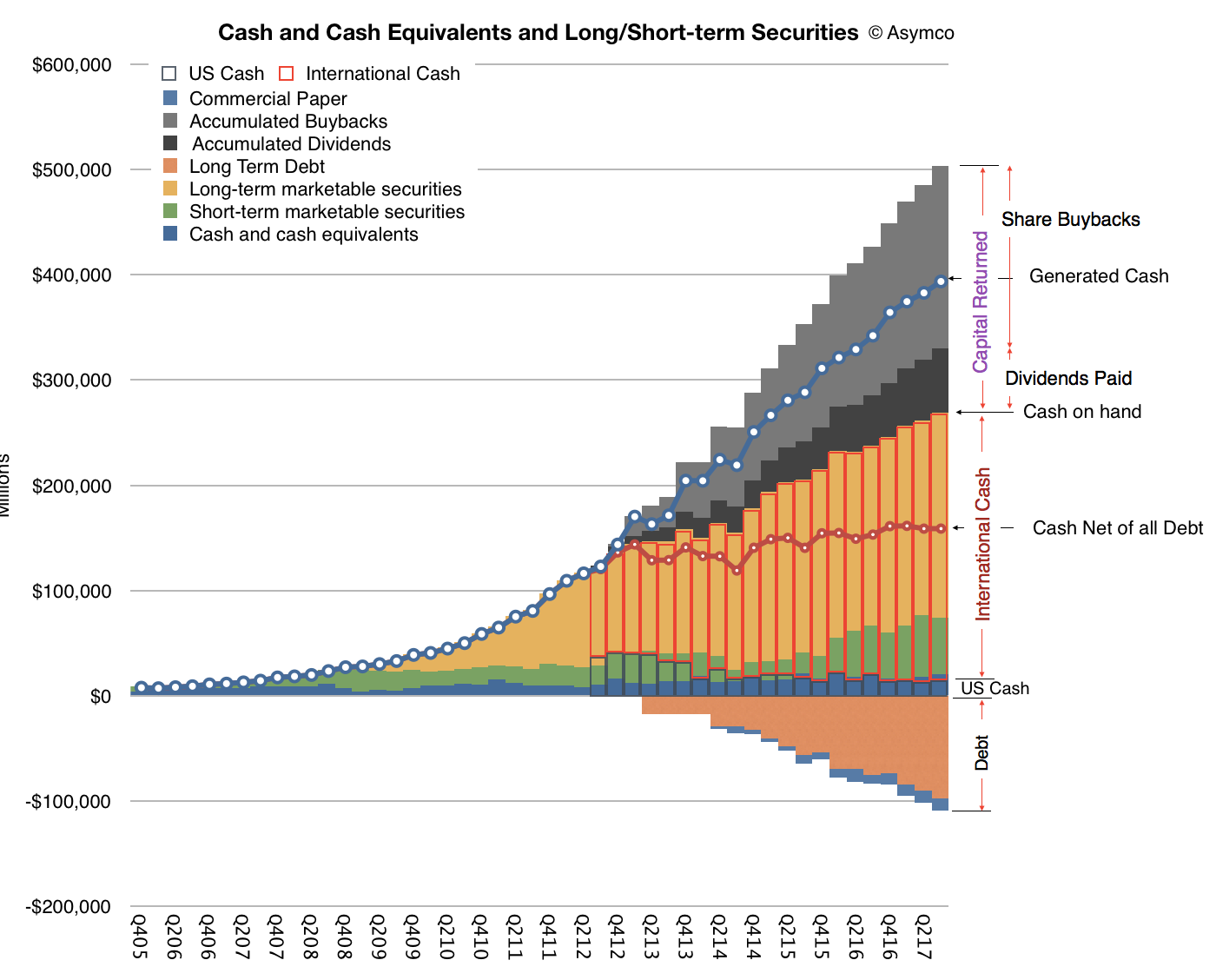
To the nearest million, as of the end of September 2017, Apple's cash and investments totaled $268,895,000,000. Note that this includes investments in the form of short- and long-term marketable securities. Long-term marketable securities are not always accounted as "cash" because strictly cash is considered a liquid asset and some securities may not be sufficiently so. Nevertheless, most analysts would agree that Apple's securities are sufficiently liquid to qualify as cash. Note that for archaic reasons this cash is separated into US and non-US holdings with $17 billion located in the US.
Most businesses keep very little cash on their books. Why does Apple have so much cash?
Indeed Apple's cash is extraordinary. It amounts to about 30% of its market capitalization. One reason is that Apple has taken many loans, totaling about $100 billion.
Whoa! Why would Apple need to take out loans? Does it have problems with cash flow? ((Companies often borrow because they need to plug gaps in profitability, best measured as "free cash flow".))
Quite the contrary, Apple's operating cash flow is eye-watering. In the 2017 fiscal year (ending September) Apple generated $63,598,000,000 from operations. The loans are not needed to operate. They are used to pay shareholders.
Why does Apple need to pay shareholders?
Because it's their money.
Wait, I thought you said this was Apple's cash.
Apple is holding it for them but if it has more than it needs it's obligated to return it. You see, If you were to look for "cash" in financial statements you find it on the balance sheet as an asset. Since it is growing and since a balance sheet has to balance, there has to be a liability that grows in proportion to offset the cash asset. That liability is called Shareholder's Equity. This is a "debt" the company has to shareholders. If it pays out cash to shareholders then it zeros out an asset and a corresponding liability. The net is zero as far as Apple is concerned but shareholders get something in return for giving Apple money in the first place.
So hold on, it takes out loans to pay shareholders because it "owes them money" while it has too much money? This makes no sense.
Yes, welcome to tax laws. Although it generates more money than it can use, and that money should thus be returned to shareholders, some of the money is collected outside the US. US (and US only as far as I know) tax laws have a "repatriation tax" that is levied on money coming into the country. This has nothing to do with corporate taxes which are levied on earnings. So after paying shareholders with the cash it had in the US, Apple had to borrow money to pay shareholders money they had outside the US.
Why not just pay the repatriation tax?
Because then shareholders would get less than 70% of their money. They would probably complain and blame the managers for being incompetent. Such blame usually comes with a lawsuit attached.
What about the new tax law that lowered the repatriation tax rate?
Now Apple has no option but to pay the tax and repatriate the cash. It's still a tax. The amount will be about $38 billion or about 15%. Previous repatriation "holiday" levies were around 10%.
How exactly does the company give money to shareholders?
The payments are called "dividends" and shareholders must treat them as income--a form of double taxation because these funds are after the company paid earnings tax and possibly repatriation tax. Apple does pay dividends regularly but because of tax inefficiency (i.e. because government policy discourages dividends) the company mainly buys its own shares and retires them.
Huh?
Yes, it makes little sense but the math is simple. If the company buys its own shares and makes them disappear then existing shareholders will end up owning more of the company, making their shares more valuable. They can realize the gain if/when they sell the shares (and pay capital gains tax instead of dividend income tax on the already (double) taxed profits.)
Does that mean that it is going private?
No. The owners of the company remain the same: whoever owns shares owns the company and they can be traded in public exchanges. In theory they could reduce the share count to a single share and there would presumably be a single shareholder who would own the company, making it "closely held" but the company's managers are still required to report and act as if it was public. Going private usually means a set of shareholders agree not to allow the shares to float on the open market and thus to also keep the affairs of the company out of public eye. It reduces liquidity and is generally harder for shareholders to exit their investment. This has nothing to do with reducing the number of shares in circulation--which is what Apple is doing.
But buying shares does not seem to affect the share price so the shareholders are not benefiting from the repurchasing. Isn't this a waste of cash? Aren't the shareholders being robbed?
The share price is an argument between shareholders and potential shareholders on the value of the company. It should reflect reality but many times it doesn't. Over time however the math catches up with sentiment. In other words realization that there are fewer and fewer shares available compels people to not sell them, increasing the price. Short term investors tend not to pay attention to this but they are not the shareholders who Apple wishes to pay back anyway.
Why doesn't the company spend the money on other things? You said they return what they can't use. Why can't they use it?
Simply, because it's more than can be spent wisely. The company considers its mission to be very narrow: add value in specific areas where they can create tremendous value uniquely and under conditions (technologies and business models) they can control. Many such projects don't require capital. Manufacturing, data centers and Apple stores require capital but R&D and sales not so much. Creating products is very cash efficient. For example, the iPhone--the most successful product of all time--cost almost nothing to develop; certainly nothing that required Apple to dip into its cash. Funding for the type of product development Apple does comes from existing cash flows and mostly consists of salaries for their employees.
What about acquisitions? Why not buy other companies?
It buys companies but usually small ones which are essentially acquisitions of teams and their intellectual property. Apple does not buy "business models" or customers or cash flows which is what large companies are valued for. Operationally, it's also because Apple has a strong culture and it wishes to preserve it. Acquisitions dilute culture which is why integrations often fail. Statistically, large acquisitions are value destructive and the larger they are, the more likely they are to fail. Incidentally, when a company is acquired with cash that hole in the balance sheet is filled with something called "goodwill" which reflects some intangible value of the new asset. If and when the acquisition is deemed to have failed the goodwill is written off and so is shareholder equity. That's how shareholders are robbed.
What about keeping it? Doesn't having lots of cash make Apple more powerful?
As individuals we think that having lots of cash makes us rich. For companies it's the opposite. Cash is a liability. If you come across a company that is cash rich and has nothing else, its enterprise value will be zero. Companies are valued on their future cash flows, meaning their ability to generate cash, not how much they managed to keep. In other words, cash is a measure of past success and investors are interested only in future value. That future value comes from the intelligent allocation of resources toward a valuable goal. A company rich in cash but poor in vision is likely to be taken private or broken up and shut down. Cash is an IOU to shareholders with a thank-you note for the support through the years.
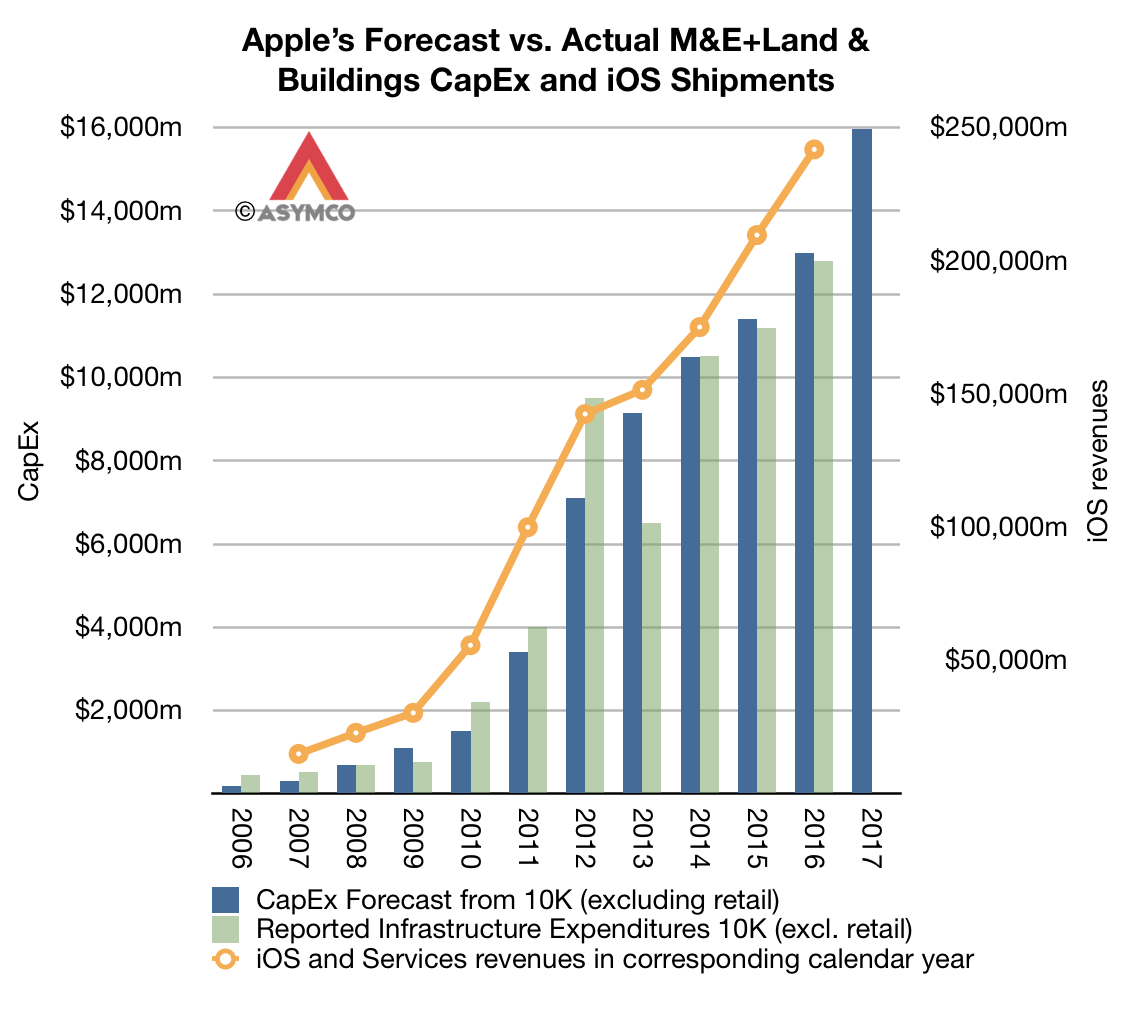
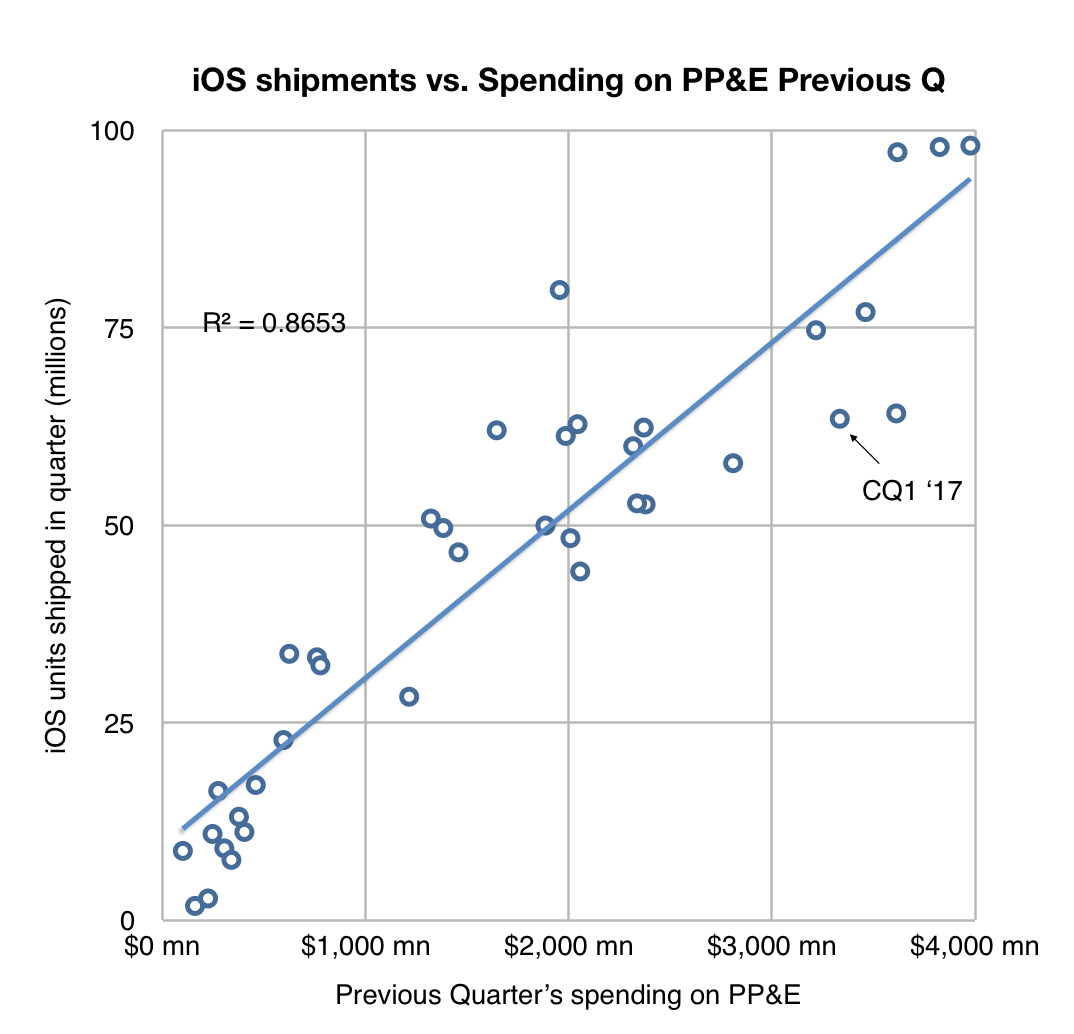
Predicting Apple's yearly revenues has been fairly easy. The following graph shows the relationship between budgeted spending on Machinery, Equipment, Internal-use software, Land & Buildings and the shipment of iOS device revenues.
The company conveniently publishes a full-year forecast of these expenditures every fiscal year so by October we know roughly how sales will be during the following year. This pattern has held for 10 years so there is little uncertainty about the 11th year of iOS devices.
Although the two are not very tightly coupled, there is a causal link between them: spending on machinery and equipment for production leads to more production which leads to more sales (assuming prices are stable--which they are).
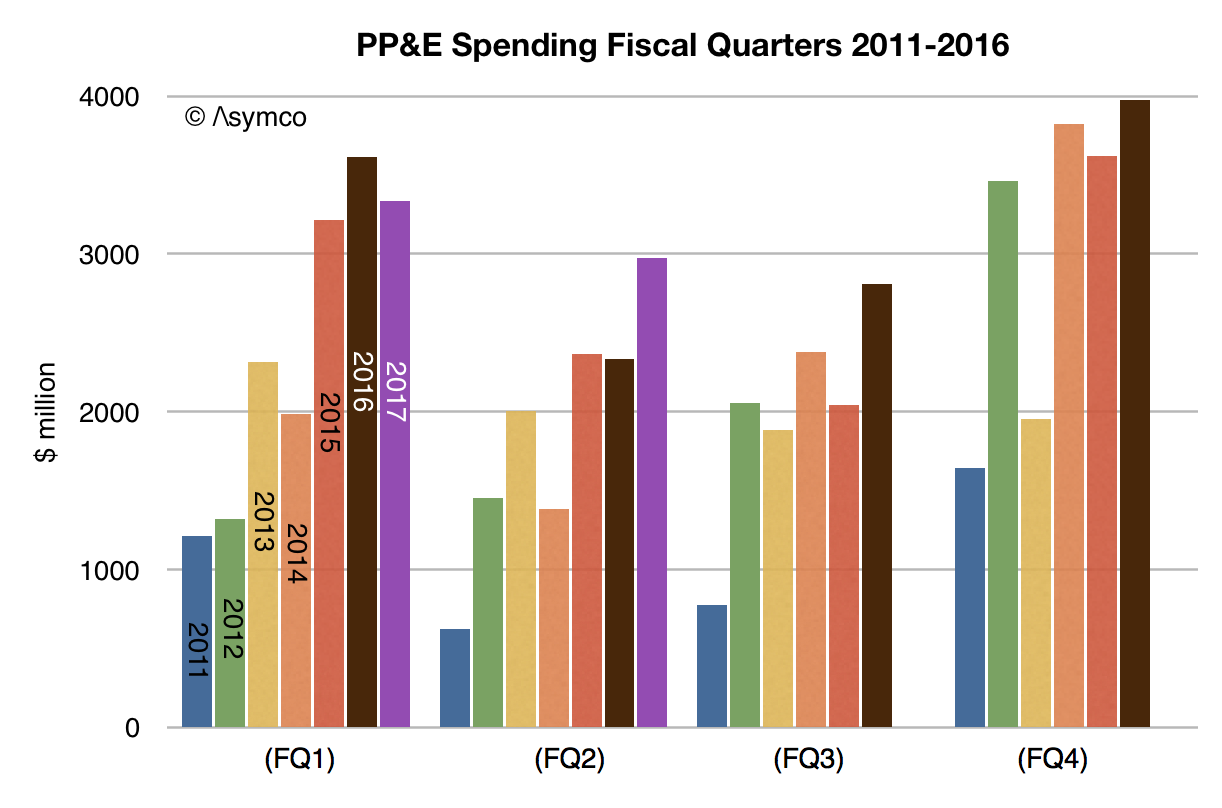
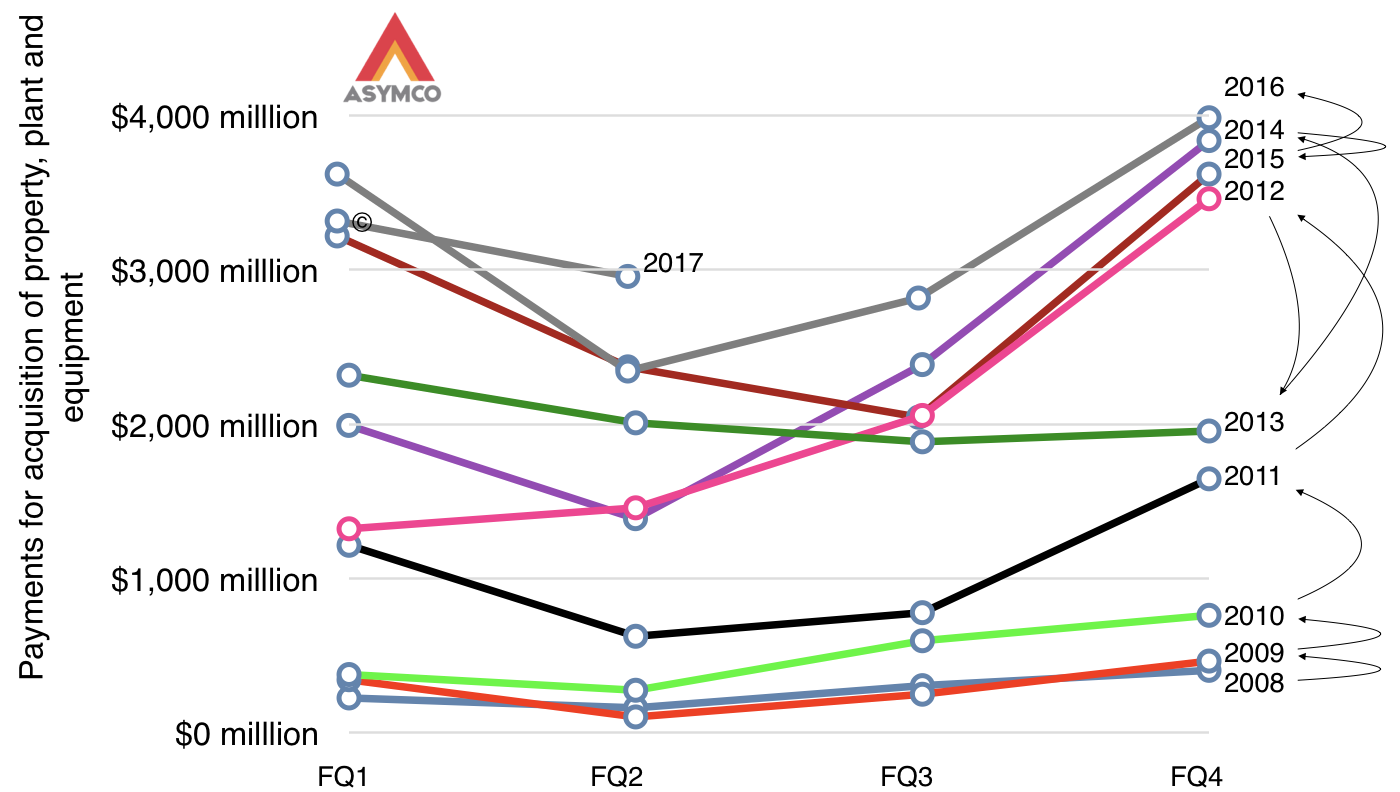
We are, as of the time of writing, half-way through a fiscal year and the quarterly spending can be inspected for any surprises. None are evident as the second fiscal year (first calendar quarter of 2017) shows a new high in capital spending at nearly $3 billion, placing us on track for the surge into the production of the new iPhone (and iPads.)
The quarterly relationship between sales and spending is less precise as equipment buying is "front-loaded" into a production cycle but there is a strong correlation nonetheless.
When looking through the data, quarter after quarter, year after year, there is a consistency and reliability to the spending/revenue relationship which implies, to me at least, a high degree of certainty.
This predictability, however, has not detracted from the volatility in Apple's share price--an instrument designed to embody precisely this prediction.
Apple's share price continues to see swings of more than 70% in any given 52 week period. In the latest 52 week period the shares traded between $89.47 and $154.88, a 73% swing.100% is not unheard of. Incidentally, S&P 500 volatility ranges around 45%. Apple is by far the largest company in the world and fairly old by large company standards. It should attract a certain premium of stability.
And yet it doesn't. Skepticism around the company is continuously evident. It's in the headlines written every day which concoct convoluted reasons to doubt future performance. It's in the conversations I have with investors who question the tiniest of details in the design of a product (like headphone jack or home butto) in order to gauge their impact on the survival of the firm. It's in the continuous parade of "disruptive entrants" or "established giants" ready to knock the company off its perch by virtue of simply existing.
Perhaps the panic it induces in investors with its reliable profits is Apple's most predictable attribute.
Berkshire Hathaway, led by Warren Buffett, now owns about $1.4 billion of Apple. Occasionally we hear about various "celebrity investors" taking positions in the company or exiting those positions. The last one I remember was Carl Icahn. He seems to have exited Apple before Berkshire entered. There are some who will act because of these decisions. You should not be one of them.
Nor should the management of the firm act in response to investor decisions or concerns. Management is specifically distinct from ownership in the corporate construct precisely in order to bring professionalism to the role. The manager must set priorities as they see fit, irrespective of what the transient owner might prioritize. The separation of ownership and management is one of the greatest innovations in commerce.
There are many opinions on what priorities should be. Delivering a specific financial ratio, achieving a certain market position, changing the world for the better. These have all been cited as top priorities. I happen to believe that what matters most is the creation and preservation of customers. That is because I see customer creation as causal to the other desirable outcomes and it is therefore the more important priority.
And this is why, whenever possible, I try to deduce how well a company is performing on this metric. The greatest companies (by market capitalization) today are certainly examples of achievement in customer creation. Facebook, Microsoft and Google are members of the "billion user club" or companies that crossed a billion active users.
But do they really have a billion customers? Microsoft has over 1.2 billion users but many (most?) of those users are using computers that their employers provide on which Microsoft software was installed. They may not have made the choice to purchase the tools they are using. Microsoft certainly has millions of customers in the form of "accounts" purchasing its products and services, but It's not likely that there are a billion people who have directly chosen to buy a Microsoft product.
Facebook has over a billion daily users. Facebook users are certainly using the service of their own accord but they are not paying for the service. Quite the contrary, the actual customers of Facebook are companies buying an advertising service offered in the form of exposure to those billion users. The Facebook users are the product being sold, not the buyers. Thus Facebook's total number of paying customers is probably only in the tens or hundreds of thousands. ((Orr Sella @orrsella pointed out that Facebook has stated that they have 3 million businesses actively advertising on their networks.))
Same with Google. We don't know how many accounts Google send invoices to but the number is very likely not even in the 100 million range. Its billions of users are beneficiaries of services but they are not paying Google/Alphabet.
Amazon has many millions of customers, if not billions. Prime membership is above 50 million but not above 100 million. Amazon may some day have a billion customers but there are limits to how quickly that can happen. The growth potential is governed by logistics and that's as much an issue with atoms as it is with electrons.
Which brings us to Apple. Apple does not offer a figure on its specific user count, but we have some viable proxies:
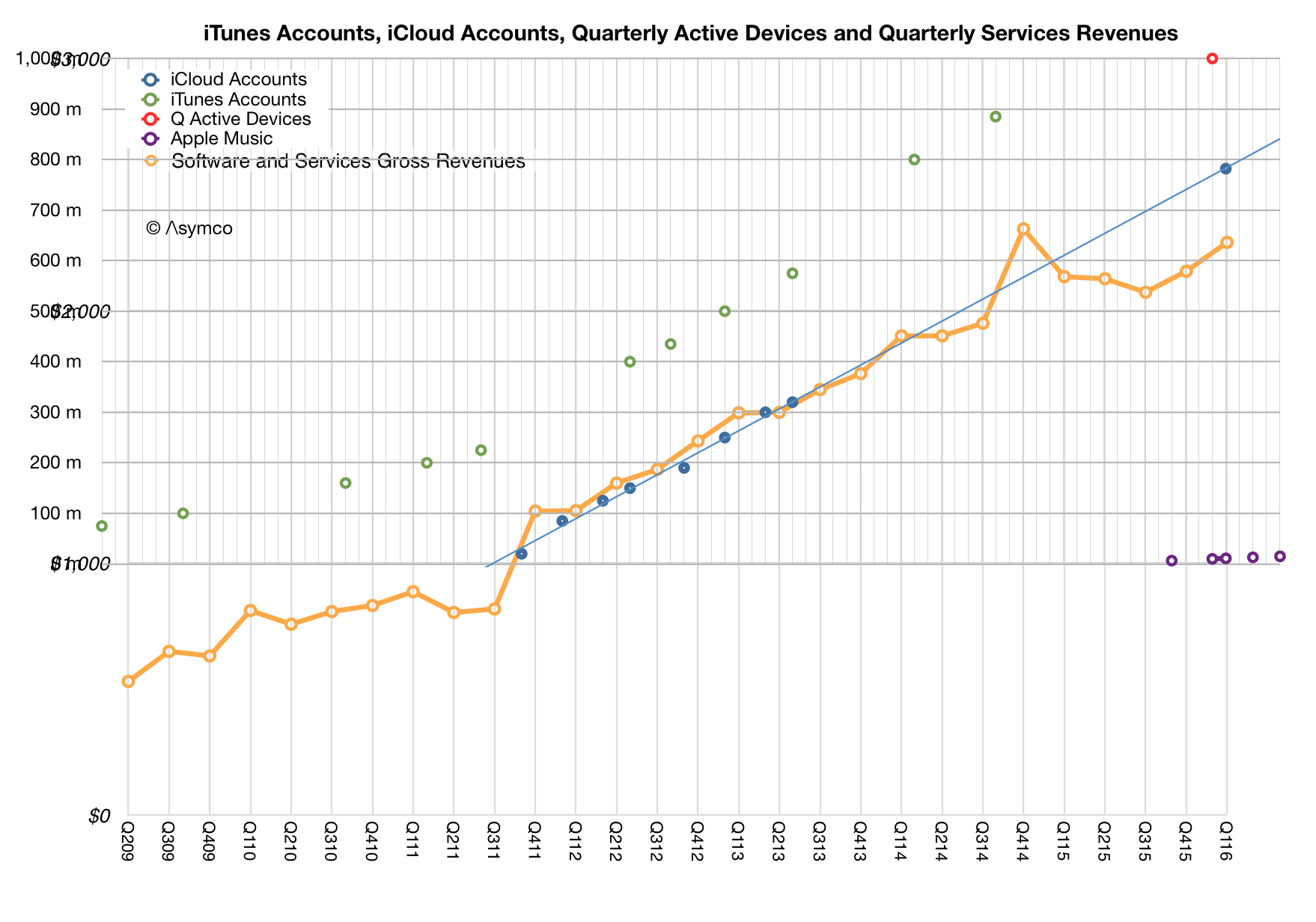
iCloud accounts reached 782 million in February 2016.
iTunes accounts reached 885 million in September 2014
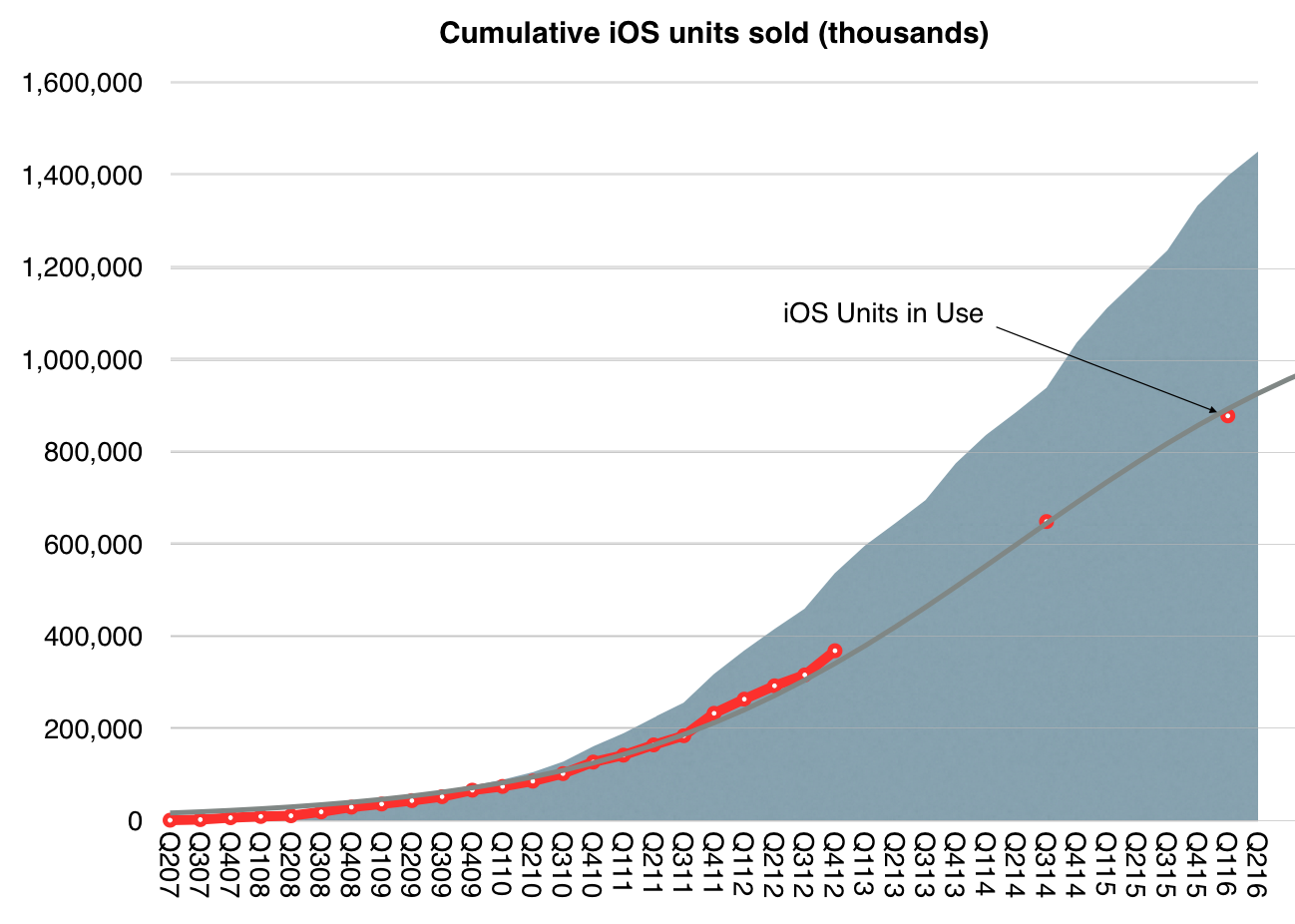
Active devices reached one billion in January 2016. That number is likely above 1.1 billion now. (Includes all devices, hence Macs and Apple TVs).
These figures are also parts of patterns (shown below) which offer an indication of predictable growth.
In addition to the absolute figures and their growth there is also the question of loyalty (frequently cited by the company), switching from other platforms (also frequently cited) and revenues. The company publishes specific figures on service revenues for consumer attached devices showing a run rate of $41 billion/yr in services for their device base.
In combination, a picture emerges which shows that Apple has nearly a billion customers. I can't say how many with any precision but it's certainly above 500 million (on the basis of iCloud and iTunes accounts). It's below one billion because some users have more than one device.
Even though it has not happened yet, the trend is pretty clear. Apple will at some point in time have a billion paying customers.
What is more significant than the specific count is that these customers mostly chose to be customers individually. Some may have been given the products as gifts, but the vast majority bought the items for themselves. Apple benefitted from hundreds of million of individual purchase decisions.
Furthermore, having made the decision to purchase, chances are that they will do so again. Apple customers are a recurring revenue stream. In fact, it's fairly easy to calculate that being an Apple customer is equivalent to spending about $1/day on its products and services, indefinitely.
Apple is not there yet, but a billion dollars a day from a billion customers is not inconceivable. That would be quite an achievement.
Bernard Desarnauts had a great idea a few weeks ago: the world needs an event to discuss Apple Watch. After recovering from the shock of not thinking of it first and then from the shock that nobody else had either, I immediately agreed and along with Ben Bajarin and Farshad Nayeri, we quickly rallied to organize and anchor this event: Glance: A Deep Look at Apple Watch.
We had some big questions to answer:
What is the strategy for Apple Watch? Is it an object of beauty and desire, placing Apple in the "luxury sector" or is it a computer infiltrating what is otherwise a technology-free zone with utility in an asymmetric attack?
How can developers discover the killer jobs to be done? Beyond tentpoles what will the primary reasons people will use the watch? What does the data tell us so far? What can be observed from interviews?
Given the sales performance to date, what can we expect from the product? What is the addressable market? What will be the installed base? How quickly will it grow?
What is the platform strategy, especially with the cadence of OS releases? Is Apple treating this as a separate platform? Will it eventually become independent of the iPhone as the iPhone cast off its dependence on the Mac/PC?
What is the hardware strategy? What are the constraints from manufacturing, materials, battery life and screen space? What will be the replacement schedule? What is the role of modular internal designs?
We realized that we did not have the answers. So we recruited a great cast of participants to help us:
Bob Moesta, the founder and developer of the theory of jobs-to-be-done marketing agreed to do a live interview to understand what jobs watches, and in particular Apple Watches, are hired to do.
Josh Clark, the premier UX designer who wrote Designing for Touch will explore the question of user experience in glanceable space.
Liza Kindred is considered the top expert on fashion tech–she’s writing the book on the future of commerce–brings keen understanding of wearables.
Abdel Ibrahim the most prominent blogger and writer on the topic of Apple Watch. Has forgotten more about the Apple Watch than you will ever learn.
Carolina Milanesi one of the most respected technology market analysts, now at Kantar and often quoted on all things Apple.
Greg Koenig, product designer at Atomic Delights will educate us on the atoms that make up the Watch.
Investors who will participate in panel conversations:
Special guest: Jean-Louis Gassée, former head of Apple Engineering, current VC and everything in-between will have a fireside chat with Tim Bajarin Legendary technology analyst who has been around long enough to see furthest ahead.
We will explore Apple Watch as a very curious interaction between form and function, luxury and utility, exclusivity and ubiquity, tiny screens and big audiences, short attention spans, big data.
We have developers, designers, investors, marketers and analysts contributing to what could be the biggest leap in computing since the smartphone.
If you are interesting in becoming one of the innovators on this newest of platforms or planning a strategy to invest, or even (actually especially) if you are a skeptic, you can't miss this conference.
Dan Niles, a former analyst who is now a portfolio manager, said on a CNBC appearance that the WWDC event actually had nothing of any real meat for investors
The "investors" that Dan Niles refers to are undoubtedly those who invest (or, more accurately, speculate with) money. But the audience for the event was an entirely different set of investors. These investors ((All nine million of them)) invest their passion, intellect and a substantial fraction of their lives with Apple.
For them WWDC had a great deal of meat. Indeed, for them, it was probably the most significant event Apple ever staged.
The path to realizing this is to imagine the world as the "D" in WWDC see it. Developers don't just build. Using an analogy of building or construction, they are architects and designers as well as contractors and craftsmen and artists as well as builders. And not of just of houses but of cities and communities. They see and think through tools and techniques for building and innovations in building materials. Innovations which allow them to imagine first and, later, to build new cities in ways that were never before possible.
We were therefore witnesses to an event which was, in essence, a cement conference. A new building material was introduced along with the methods for using it and the tools for shaping it. Perhaps some observers expected to see skyscrapers and interstate highways presented, and thus were disappointed. But they should not have had such expectations. A cement conference is esoteric. It's about the rudiments which, when combined with imagination, ingenuity and a lot of work, generate livable spaces.
A few spaces go beyond comfort and delight us. Fewer still enlighten and cause the sprit to soar.
And yet it was still a cement conference.
Perhaps the way to understand the show better would be to "play it backwards." Rather than the way it was presented, let us begin with the end:
We were shown a new concrete formulation which when coupled with a new way of mixing, forming and curing can lead to increases in productivity of construction. This is especially true when producing shapes that are complex, intricate and built into modules.
We were then introduced to some pre-formed kits that allow the materials to be combined for new uses such as flexibly shaped hospitals and gyms. And we would have to stretch only slightly to imagine how this might lead to better health and wellbeing.
Then we were shown examples of new ways that this cement was used to create new work environments. We had a preview of "show homes" beautifully architected and designed. And these homes were seamlessly connected through new transportation networks and allowed for easier commutes. Again, it did not take much to imagine how these workspaces and homes would lead to greater productivity and how other spaces could be built around them that made such a collection of communities a wonderful place to be.
Some saw banks, and some saw art galleries and some saw warehouses, but all who were there were seeing a new world, populated by many loyal citizens.
Perhaps not populated by all. Indeed, such a country is not for everybody, perhaps only a billion people could be resident and it would not be cheap to live there. But still, imagine.
So this was the way I saw WWDC 2014. A cement conference cheered by cement enthusiasts but leaving Architectural Digest writers asking what the fuss was all about.
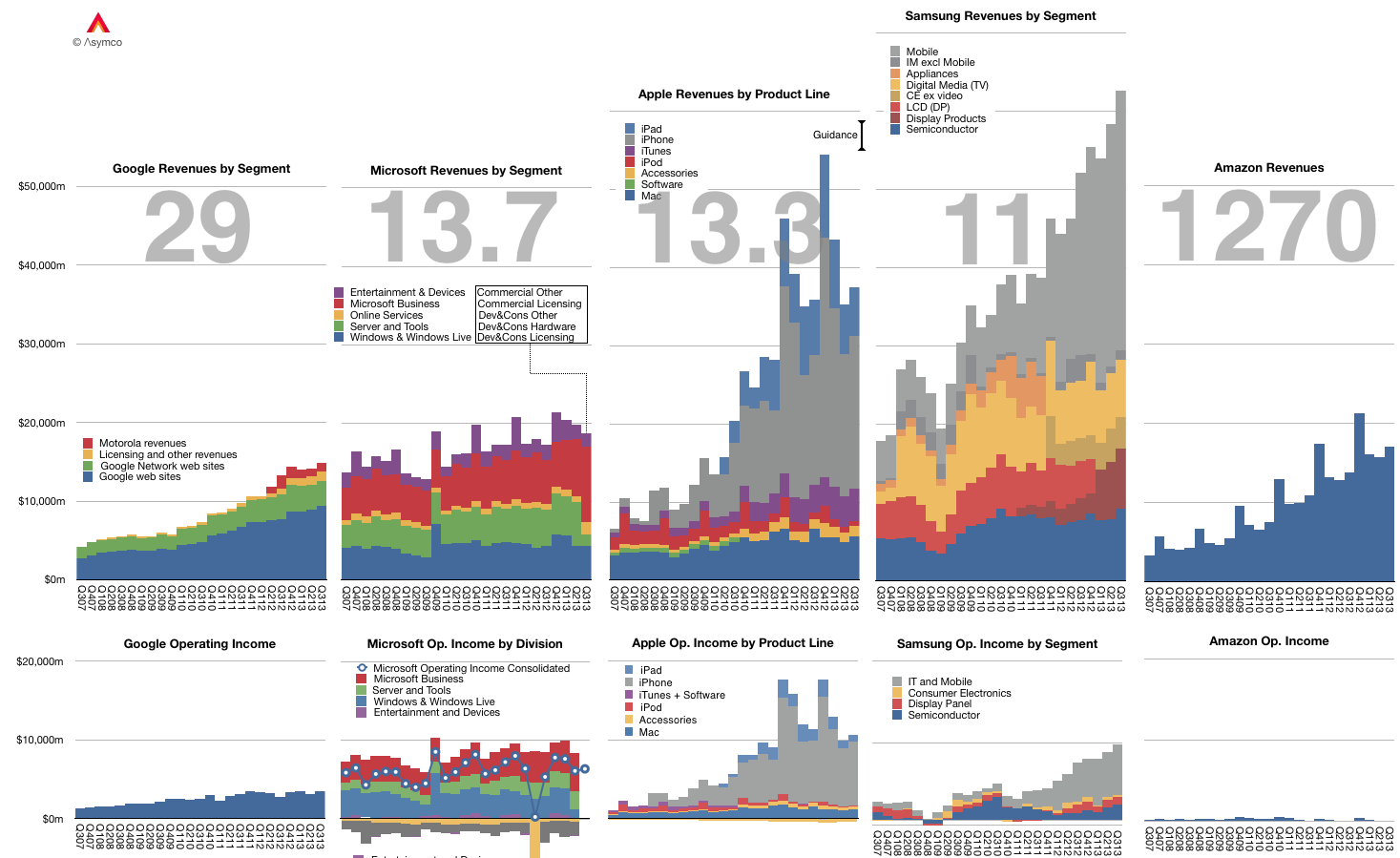
The graph below shows the Revenue and Operating Income for a select group of companies. The large numbers represent the share price to earnings (trailing twelve months) ratio (P/E or PE ratio).
Of course the P/E ratio hides a lot of subtlety. It mostly fails to account for the fact that earnings are largely a matter of opinion. A company can defer income (as Apple and Microsoft do), it can invest earnings (as Amazon does) and can otherwise avoid declaring it since it's taxable.
A better measure is the Enterprise Value to Free Cash Flow ratio (EV/FCF). It reflects a "harder" measure of performance in the form of free cash flow. It is not a matter of opinion but a fact. Enterprise Value also excludes cash which is a measure of past performance.
Nominally both P/E and EV/FCF measure the valuation of a company. They give what amounts to the number of years that current performance can be expected to last. For example a P/E or EV/FCF of 10 can be read as "If I purchase a share today, I should expect the company to pay me back in earnings in 10 years." Any earnings after 10 years are essentially "profit" for the investor.
Inverted these ratios are a measure of Yield or how much of the total investment is paid back in a given year. In the example above, the Yield would be 10% or "If I purchase a share today, the company will pay me back 10% a year in earnings."
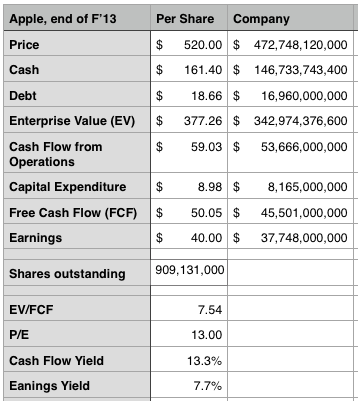
Relying on P/E is troublesome since, as mentioned above, it's deceptive. We get into difficulty when P/E and EV/FCF differ greatly. If a company has minimal cash and declares all free cash flow as earnings then the ratios are the same. However, consider how different these two ratios are for Apple:
The P/E ratio is 13 while the EV/FCF is 7.5. ((It would be very interesting to have both ratios available for all the companies in the graph above.))
This means the investment horizon is nearly half of what P/E suggests. (The cash flow yield should give pause). Put another way, the market suggests that Apple has 7 more years of current profitability and not 13. Note that the P/E ratio for the S&P 500 is above 19.
As Apple's deferrals are increasing investors should look again at what the company's worth. We had similar confusion when the company was deferring most of its iPhone revenue.
All theoretical and empirical diffusion studies agree that an innovation diffuses along a S-shaped trajectory. Indeed, the S-shaped pattern of diffusion appears to be a basic anthropologic phenomenon.
This observation dates as far back as 1895 when the French sociologist Gabriel Tarde first described the process of social change by an imitative "group-think" mechanism and a S-shaped pattern. ((Tarde was probably influenced by mathematician Pierre François Verhulst who first published the logistic function in 1845)) In 1983 Everett Rogers, developed a more complete four stage model of the innovation decision process consisting of: (1) knowledge, (2) persuasion, (3) decision and implementation, and (4) confirmation.
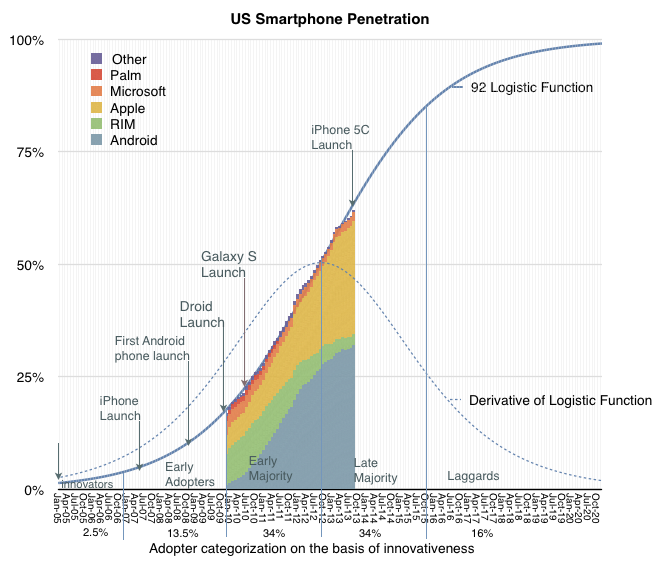
Consequently, Rogers divided the population of potential adopters according to their adoption date and categorized them in terms of their standard deviation from the mean adoption date. He presented extensive empirical evidence to suggest a symmetric bell shaped curve for the distribution of adopters over time. This curve matches in shape the first derivative of the logistic growth and substitution curve as shown below.
In the graph above I applied the Rogers adopter characterization to the data we have on the adoption of smartphones in the US. The latest data covering September is included.
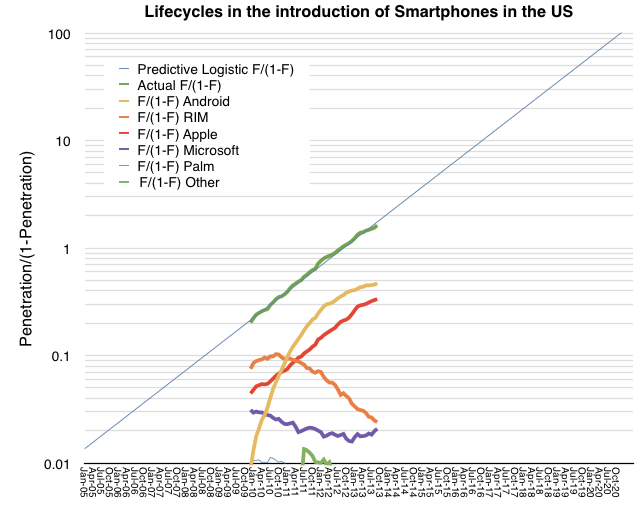
The fact that smartphones in the US follow the theory is exciting, but what can we conclude about the adoption of specific platforms? There has been quite a bit of turnover in the leadership of the market in the first half of the time frame given. You can see this more clearly in the following fractional market share transformation.
Note that, with the exception of the iPhone, if each platform is studied individually, it would not follow a logistic (i.e. linear) pattern even though, as a whole, the technology does.
This then is the big puzzle: while we might be able to predict how smartphones will diffuse into society, we can't seem to predict how any single firm will fare. This means that an investor cannot make a credible "bet" on the technology ((Indeed investors often get burned when new technologies emerge. While the technology booms, individual firms supplying it often fail. See the history of transportation, communication, computing and energy.)). If they choose a single company as proxy, chances are they will lose. If they bet on a basket of companies then, again, chances are they will lose. There is usually one unforeseeably clear winner.
Before we get further into the question of picking winners or predicting the future division of share among rivals, we should understand the underlying causes for this pattern of adoption.
Rogers concluded that the learning behavior of individuals is the underlying cause of the symmetry of the diffusion process.
At the beginning, when an individual is confronted with a new (learning) situation they make many mistakes. These mistakes are gradually reduced (by learning) over time because more and more information is received and acts as a stimulus. The gain in learning per trial is proportional to the product of the amount already learned and the amount remaining to be learned before the limit of learning is reached.
Arnulf Grübler ((The Rise and Fall of Infrastructures, Physica-Verlag 1990)) explains:
This is exactly equivalent to the F(1-F) transformation of the logistic curve. It should be emphasized that these properties of the learning process were found in real learning situations and are confirmed by a large number of laboratory and field experiments. Thus each adoption of an innovation in a social system is equivalent to a learning trial by an individual. Thus, the symmetric diffusion pattern results from the way messages about an innovation are emitted and processed by social learning.
So these observers of the process assign learning behavior as the cause for adoption of a technology. Can the learning behavior be applied to individual platforms? It's tempting.
The hypothesis would go as follows: adopters are not only processing messages about the new technology but they are also trying different platforms as they enter and as they upgrade their phones. If we see platform choice as a learning process then if one platform has a natural advantage, it settles into a dominant position as users "learn" of its advantage. Conversely, if no platform has an advantage then platform "churn" repeats as rivals gain/lose positions of leverage in the market.
The pattern shown so far seems to point to Apple's iPhone having a logistic pattern indicating that it might be benefiting from a learning pattern. The alternative platforms may simply be jockeying for temporary advantage.
It's an interesting hypothesis. To be developed further we need to answer what any learnable advantage might be. I suspect it has to do with the ability to solve unmet and unarticulated needs. In other words, that the winning product solves a set of "jobs to be done" which are difficult to pin down and are perceived rather than defined.
My responses to questions from Juliette Garside of The Guardian newspaper:
Q: Will noise from Icahn distract the Cook from focussing on product?
A: Investors may think that they can influence management but they do so only when companies are in distress. It’s only then that shareholders can affect some change with their votes as they have a common purpose. The voice of investors carries little weight or distraction when a company is successful. At first glance it seems that Icahn thinks he can unlock value in Apple by getting management to accelerate share buybacks. That’s a modest goal and not one which needs to distract managers.
Q: What will do most for the share price – a buyback or a blockbuster new device?
A: Neither. What will do most for the share price is a change in the perception that Apple is not going to survive as a going concern. At this point of time, as at all other points of time in the past, no activity by Apple has been seen as sufficient for its survival. Apple has always been priced as a company that is in a perpetual state of free-fall. It’s a consequence of being dependent on breakthrough products for its survival. No matter how many breakthroughs it makes, the assumption is (and has always been) that there will never be another. When Apple was the Apple II company, its end was imminent because the Apple II had an easily foreseen demise. When Apple was a Mac company its end was imminent because the Mac was predictably going to decline. Repeat for iPod, iPhone and iPad. It’s a wonder that the company is worth anything at all.
We cover the valuation question regarding Apple and tech in general as seen through investors' eyes. This discussion ranges a bit on P/E compression and the psychology of investors--which might change with Apple TV.
We also look at who is most vulnerable in the ongoing mobile computing disruption and who are the up-and-coming challengers. Finally, I introduce the Perspective app which I used for all my live presentations.
I'll post more about Perspective in the future as it will be my platform for publishing complex or rich data.
There is no shortage of information about what happens to companies in distress. The cause of distress varies widely and is often not well understood but the actions and symptoms of distress are very consistent. We can look at examples in each industry, even in each product category for a rich set of distressed company data.
For over a year I've been chronicling the decline of incumbents in the mobile phone industry. However, decline cannot continue indefinitely. At some point a company "exits" the industry. Either through a sale or divestiture or, rarely bankruptcy. The list of exits is already long. The length and the correlation between exit and the lack of recovery implies that Nokia will also exit.
But how, exactly?
Will Nokia be acquired? If so, then by whom? What other options exist? How can we analyze this?
The easiest way to guess is to look at what happened to other companies in similar circumstances. The clearest and easiest comparison to apply is Motorola. Motorola was at one time the largest phone vendor and it went through a violent decline. Like Nokia, it was diversified into networks and a few other businesses. Unlike Motorola it's not an American company. This matters because American companies are more comfortable targets for corporate raiders. The legal and boardroom mechanics are not "better" or "easier" in the US than in Europe but they are more familiar to those who might engage in it.
So one avenue that Motorola traveled on was the intervention of activist investors who forced management change, affected strategy and pushed some tactical initiatives. This external pressure was successful in the case of Motorola. The company was split up, it was re-purposed and re-focused and, with a bit of good luck, was acquired.
The process however still took two years. In that time the company languished but stayed alive. Its headcount was reduced by nearly two thirds. It was in a precarious situation throughout. Its story is not over but ownership did change hands and those who took a risk with it while in distress managed to get a reward.
This example (and Sony's acquisition of Sony Ericsson and HP's acquisition of Palm) cannot apply to Nokia. An activist investor is unlikely and the company has not yet made itself attractive to a buyer. So what would Nokia need to do to be acquired?
The first step toward an acquisition will be divestiture of its Nokia Siemens venture. The second will be a spinoff or sale of its non-smart phone division. The third might be the allocation of its IP across these separate entities or in a separate holding.
As the company is broken up, value can be released. Investors will be able to value it better and make appropriate assessments of risk. Only at this point would an acquirer perhaps buy the "rump" Nokia smartphones group.
However, even this scenario is not without huge risks. By the time the split is completed, the operating companies could have deteriorated to such a degree that they are no longer viable. Timing is critical.
So if the smartphone group is isolated and made available, who could buy it? Microsoft is always cited as the primary buyer. I've been skeptical of this as Microsoft has found it difficult to make hardware work. It acquired Danger leading to Kin which failed. It has struggled with Xbox for a decade and has yet to recover all its costs for the effort. It has failed embarassingly with Zune. It also has shown no particular success with its original Surface table computer.
But management has re-committed itself to a new hardware effort with the new Surface. This renewed potential opens up the possibility of entering into the integration of a phone again into their business, and Nokia would be remarkably well positioned to help.
At this time, the possibility still seems remote. The company has dismissed speculation of building phones again and again. Unlike PCs, the phone platform is not yet mature and volumes and distribution are very different.
However, there is one other option.
Microsoft has historically "rescued" technology companies in distress with cash infusions for minority equity stakes. It injected some cash into Apple, Barnes & Noble and even Facebook. It did so not because they wanted to own these companies but because they wanted them to survive or thrive. The move acts as a signal to the industry, partners and developers. So what I see more likely than an acquisition is Microsoft capitalizing a spun-off Nokia Smartphones company in exchange for a small equity stake.
The valuation of this stake will be huge as I expect billions of dollars for single digit share ownership. However, Microsoft would not be doing it to get a return from those shares. It would probably later sell them at a loss. But it would be buying a strategic option whose value may be far greater.