Asymco

Asymmetric Intelligence

iPad

  1. iPad vs. iPhone: why we got the iPad forecasts wrong

    Research · 17 comments

    The iPad was announced to a loud chorus of disapproval and disdain. It's easy to forget the overwhelming scorn and insult poured on the product for months before and after sales start. Analyst forecasts were comical. At this time it looks like all 12 month iPad unit forecasts will have missed by more than 100% (mine included).

    As data on iPad performance was published for the first quarter's sales, the mood swung from ridicule to ridiculous.

    Without regard to the growth of comparable products, analysts seem to have latched on to production figures which are notoriously inaccurate. The problem with production numbers is that they are only very loosely coupled with shipment numbers to customers. There are questions of work in progress inventory, finished inventory and the actual accuracy of reports. Production also follows a ramp and is not constant over time.

    Another way to analyze a new product is to think about the distribution. Although late in the quarter some large distribution deals were made public, the channel did not have much time to be filled before the end of the quarter. Not only that but there is easily obtainable evidence that the iPad did not reach most international markets. Apple announced how they were rolling out a few countries every few months.

    This trickle of international sales indicated to me that the iPad sales pump was not yet fully primed. My initial estimate was for in-line sales of 3.3 million which I aggressively increased to 5 based on some of the production numbers being mentioned.

    This figure turned out to be 22% too high, but not as big an error as some of the other analysts.

    Another way to look at it is through comparable products. The nearest comparable product to the iPad is actually the iPhone. It was a similarly "revolutionary and magical" product launched with a similar constraint on production and distribution. It was also built and marketed by the same people. They've been down this road before and have honed the process from the iPod through the iPhone over a decade.

    If we look at the iPhone and compare it with the iPad, we see just how popular the iPad really is. It may not follow the same seasonal pattern as the iPhone, but it will probably ramp in a similar way. In the following chart I also show the iPhone Growth rate (right scale).
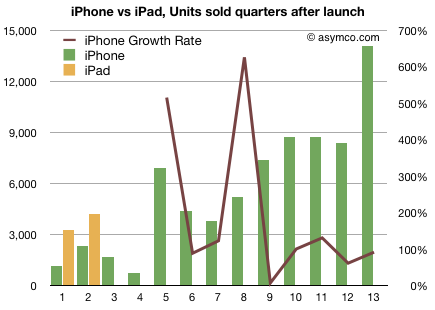
    The iPhone has been able to maintain over 100% y/y growth on average. I don't see a reason why the iPad can't repeat this pattern over the next three years.
  2. CDMA iPad and the 150 million iOS devices next year

    Research · 52 comments

    The Verizon distribution for iPad is an unexpected development. Coupled with distribution through AT&T stores, and rapidly expanding retail points of purchase, it seems that the iPad is destined to be the most widely distributed product Apple sells. The iPod never reached operator points of purchase and the Mac is orders of magnitude more constrained.

    What seems to be happening is that Apple is pulling out all the stops and going for unrestricted iPad distribution. This may also foreshadow unrestricted iPhone distribution next year. It may also portend a CDMA iPad (or at least an LTE version) next year.

    If it happens all estimates for next year need to be revised sharply. I had been expecting 100% growth for the iPad and 50% growth for the iPhone. These might need to be increased to 150% and 100%.

    The consequence could be that total iOS devices sold could top 150 million for calendar 2011.

  3. iPad: IT gets it

    Research · 27 comments

    In the last article on the share of PCs highlighting the unwillingness of market analysts to categorize the disruptive iPad as a PC I imply that Gartner does not "get it".

    This is partly willful and partly instinctive. The willful ignorance is due to a belief that their customers (IT managers mostly) do not want to hear about the iPad as a viable technology. Certainly there is a lot of anecdotal evidence that the iPad is unworthy of consideration as a business tool.

    However, there is also increasing evidence that IT does in fact get it. I have met several senior IT managers who are whispering that the iPad will change everything. For us to decide which way the wind blows, we need to think harder about the process by which technology gets adopted in large IT organizations. Understanding how the technology is hired by IT managers to improve their career prospects unveils who wins and who loses in IT.

    The main hypothesis I put forward is that IT is an example of "rule of man" not "rule of law". The idea that law or "standards" (as doctrine is known by the jargon,) defines the products in use is a conventional myth. Standards change and they change quite dramatically based on who's in charge. The "standard" during the 70's was the Mainframe, the "standard" in the 80's was the DOS PC and the "standard" in the 90's was client-server and in the 2000's it was the web. Each new standard was a violation of the previous standard. So how did this change happen?

    Each evolution of technology standards affects the career of the IT manager. The adoption of technology is the primary driver for advancement in the profession. In most cases the technology being adopted is sustaining. In rare cases it's disruptive and can cause unforeseen re-distribution of IT power (and wealth).

    As IT is a cost center, naturally, organizational behavior (or, in the vernacular "politics") dominates the decision process. Senior managers look at each technology and ask: how can this help me achieve my career goals? Let's try this exercise with various innovations that have come along in the last few years.

    1. The Web in 1998. As IP based networking was catching on, the new technology offered a new way to tie existing assets together. It was also a completely new communication channel with customers. This was a great opportunity to increase IT consumption. It would lead to more work, more budget, more visibility and even a strong link between the profit centers of the company and the IT world. The web was an opportunity. It led to a firestorm of adoption.
    2. OSX in 2004. As Windows PCs were widespread and, given the support infrastructure behind them, worked well enough, an IT manager would look at a Mac and see no opportunity to increase their value add. They could not offer new software tools with it, and the old tools would probably not work without debugging. They could not move a Mac to new use cases and could not increase headcount to support it. The Mac was not a career opportunity.
    3. The iPad in 2010. As an IT manager looks at the iPad (and smartphones in general), he sees a similar opportunity to the Web ten years ago. The company users love their devices. Top executive love their devices. They see consumerization happening and there is no denying the explosive growth. There are challenges with integration but these devices are not a direct threat. The iPad is an opportunity to migrate to a completely new form factor and increase IT consumption.

    What this means politically is that the manager who figures out a way to roll out mobility in the organization will get the same uplift in his career as his predecessors did when they brought in disruptive waves. Those periods have become the stuff of lore and legend. Every IT manager with ambition is looking to create and ride a new wave. If the person is a mid-level manager, they will scramble to be the champion of the new technology and become a rising star. If the person is a high-level manager, they will see it as a way to protect their empire by co-option. Jostling for a vehicle to bring in the technology will begin. These vehicles are typically vendor relationships. Small vendors (example) have a better chance as the traditional vendors (for example SAP) and integrators are not quick enough with product development and don't have the products to sell.

    This IT manager's job-to-be-done analysis is crucial to understanding the adoption of IT technology.  Sustaining IT products do not sell themselves even if they are superior. Conversely, new products cannot be kept out of an organization even if they violate standards. What matters is whether they help the decision maker to achieve personal goals.

    My own intuition, having worked in such an organization (albeit briefly), and after a few conversations, is that the iPad and the mobile devices it represents is going to influence a generation of IT spending.

    Even though Gartner doesn't, IT goes get it.

  4. Gartner: as a Media Tablet, iPad deserves to be ignored in PC rankings

    Research · 40 comments

    "Media tablet hype around devices such as the iPad has also affected consumer notebook growth by delaying some PC purchases, especially in the U.S. consumer market. Media tablets don't replace primary PCs, but they affect PC purchases in many ways," Ms. Kitagawa said. "At this stage, hype around media tablets has led consumers and the channels to take a 'wait and see' approach to buying a new device."

    Gartner Says Worldwide PC Shipments Grew 7.6 Percent in Third Quarter of 2010.

    Fascinating. I'd love to hear more about the non-iPad "media tablets" that delayed PC purchases last quarter. Maybe I don't get out enough.

    But more to the point, let's combine the data from Gartner and the forecast for iPad.

    I show below the impact of the iPad on PC vendor sales. I'm using my own estimates of world-wide PC sales (you can see other estimates here (Apple 2.0))

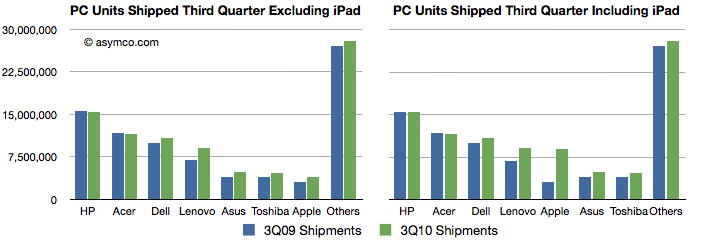
    The world-wide PC units shipped without and with iPad:

    When including the iPad Apple goes from 7th to 5th ranked, and with 50% growth clearly within shot of top rank next year.

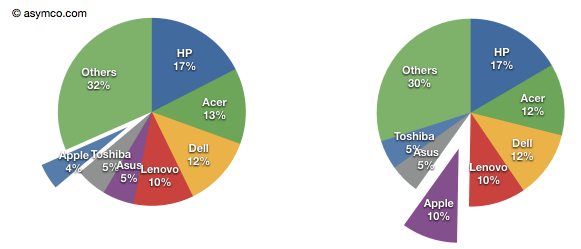
    Now I look at PC unit shares:

    With the iPad Apple goes from 4% share to 10% share. Again, within striking distance of number one or two in a year.

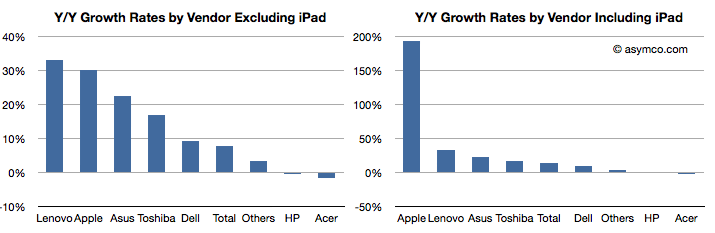
    Finally, growth rates:

    Apple's share growth goes from second to first but also several times higher than any of the others.

    When Gartner spins the iPad as a "Media Tablet" it's clear that the device is disruptive. Reminds me of what Gartner thought about Smartphones four years ago.

    I cannot think of a better endorsement for an investment than a snub from Gartner.

  5. How many iPads next year? Analyst Sees 45 Million IPads In 2011

    Research · 19 comments

    The contact, says [Ticonderoga's] White, shipped more than 6 million parts to Apple during the third quarter of the year and expects to ship 7 million more in the fourth quarter.

    Since Apple uses one unit of this particular component in each iPad, that adds up to shipments of 13 million iPads in the second half of 2010. For 2011, the contact believes Apple will sell as many as 45 million iPads

    via Analyst Sees 45 Million IPads In 2011, Next Gen IPad Launching Soon - Elizabeth Woyke - Mobilized - Forbes.

    These numbers are not unreasonable. I expect about 35 million next year, though that could go up considerably depending on what we hear about last quarter.  We only really have one data point so far meaning the data set is to double in a few days.

  6. The strategic tension inherent in the iPhone franchise

    Research · 25 comments

    I don't write product reviews and I don't pass judgement on individual products but I do own and test various products. For example I have the Android powered Samsung Galaxy 5 (GT-I5500) and the experience is, in my opinion, better than for recent Symbian phones but not as smooth as for Apple's products.

    But that's not what this article is about.

    It's about the price. The price for the Samsung is one third that of the iPhone 4 (both devices unlocked and sold in Europe with a 23% VAT). It was also purchased in a department store with as much hassle as buying a pair of gloves.

    When it comes to the product, it may be a fair trade-off: one third the price for one third the product. The specs are not only worse but the whole experience is rougher and cruder. But that "one third the product" may be just good enough for a large population of users who are now satisfied even with "one tenth the product". The price point should be evaluated as a valid threat.

    But Apple can respond. It's not like this is asymmetric competition. As the iPod shows, Apple can make money with low end products. Easily. Is this entry price point (€200 unlocked) something Apple should cover? My answer would be an unqualified yes.

    For operator distribution, the subsidized price combined with a high-end offering is by far the best marketing mix (price, promotion, positioning, etc.) However, for non-operator distribution, a lower spec unlocked device sold through tens of thousands of points of purchase (like the iPod, and soon, iPad) makes a lot of sense from a platform point of view.

    These two channels are often in conflict due to subsidy and exclusivity clauses. This conflict makes the decision to ignore the non-operator channel compelling. The economics for the operator channel are always going to trump the non-operator channel. But as the platform expands across geographies and income segments not covered by the operator-subsidized channel, these populations will need to be addressed.

    So this is the inherent strategic tension for the iPhone franchise: Whether to use the iPhone brand to enable ubiquitous mobile computing outside operator channels, or use iPod/iPad as a complementary but separate brand to engage in an orthogonal attack.

    I suspect the decision has been made. We will observe the consequences next year.

  7. Ticonderoga sees over 15 million iPads in 9 months

    Research · 13 comments

    White contends iPad could be “one of the most coveted gifts” this holiday season; he sees the company selling 7.1 million units in the September 2010 fiscal year, with 19.9 million in 2011, and 25.8 million in 2012.

    The analyst said his target is based on 20x his interest expense/income adjusted calendar 2011 pro forma EPS estimate, plus net cash of $49.43 a share.

    via Apple: Ticonderoga Starts With Buy, Street-High $430 Target - Tech Trader Daily - Barrons.com.

    If Apple hits 5 million in the just ended September quarter and 7 million in the December quarter, we're looking at over 15 million iPads in nine months of sales. The iPhone took about 20 months to reach the same level.

    If the iPad is ramping up more than twice as fast as the iPhone, (aka the Jesus Phone) what does that make it?

    See also: iPad Death Watch : AAPLinvestors

  8. iPad lead seen as 'overwhelming'

    Research · 37 comments

    Chris Whitmore predicted 2.0 million iPads would be sold in 2010 soon after the product launched. (asymco | Analysts predict iPad sales)

    More recently, Chris Whitmore writes for Deutsche Bank:

    "We believe Apple's lead in the tablet market will prove difficult to close by the onslaught of competing products coming over the next several quarters," he writes in a note to clients issued early Monday. "Ultimately, we expect the slew of upcoming competition to fall flat from a user experience standpoint while struggl[ing] to materially undercut the iPad on price."

    How far ahead is Apple (AAPL)? According to Whitmore:

    12-18 months in content (see chart)

    2 or more years in terms of other media acquisition and integration via iTunes

    Untold dollars in terms of component pricing

    via iPad lead seen as 'overwhelming' - Apple 2.0 - Fortune Tech.
    Compare this fresh (re-)assessment with the following points I made in May of this year:

    The iPad comes with an even bigger value chain [than the iPod] bolted on: the App Store. Apple is flogging not just an “app player” but also a new way to develop and distribute software. If you cut “music” and paste “apps” you see the immediate parallel between iPod and iPad. The app ecosystem will quickly grow to be larger than the music ecosystem with the mobile software business already eclipsing the music business.

    ...

    So the iPad challengers face five daunting obstacles:

    Recognition of a threat from a seemingly benign product

    Execution on hardware against the best integrator on the planet

    Execution on software against a new UI metaphor fortress surrounded by a patent moat

    Integration of hardware and software to a sublime whole

    Re-building a value chain for which they have no handle vs. a broad and deep existing universe of app/content creation distribution and consumption enjoying logarithmic network effect value.

    asymco | Will Apple rule the iPad market? (part II)

    Welcome to the club, Chris.

  9. Updated estimates for Apple's fourth quarter earnings

    Research · 12 comments

    We expect revenue to be about $18 billion compared to $12.2 billion in the September quarter last year. We expect gross margins to be about 35%...

    We are targeting EPS of about $3.44.

    via Apple Inc. AAPL Q3 2010 Earnings Call Transcript.

    I've updated my estimates from the July forecast as follows:

    • iPhone units: 12.2 13 million (65% 77% growth)
    • Macs: 4 million (30% growth)
    • iPads: 3.3 5 million
    • iPods: 9.4 9.7 million (-5% growth)
    • Music growth: 26.7% 25%
    • Peripherals growth: 21% 15%
    • Software growth: 8%
    • Total sales: $19.0 $20.5 billion (56% 69%y/y growth)
    • GM: 42.3% 40.4%
    • EPS: $4.78 $5.00 (73% 81% y/y growth)

    The main news items that affected the changes in estimates were:

    1. iPhone continues to be supply constrained.
    2. iPad supply nearly matching demand though not yet rolled out in all markets
    3. new iPods look compelling though offset by back to school promos

    Follow other estimates at Deagol's site:
    Deagol's AAPL Model: Fiscal 4Q 2010 Final Estimates

  10. Hewlett-Packard is bundling a tablet with a $399 printer

    Research · 17 comments

    The bottom line: HP's decision to bundle a tablet computer with its new $399 printer could make trouble for competitors.

    HP's New Tablet Could Be an iPad Spoiler - BusinessWeek

    HP took the control panel display from a printer and made it detachable. The idea, according to the manager in charge, is that this will encourage printing. Printing is a good business for HP because they manage to charge $7500 per gallon of ink.

    I suppose there can be some sense to this idea but I don't use inkjet printers so I can't judge how popular this can be. But the headline suggestion that the new display panel cum web pad is "an iPad Spoiler" calls into question the author's motivations. Maybe he did it for a bet.

    But the real gem is a quote from Richard Shim an IDC PC analyst who says "Everyone is trying to figure out the opportunity for these types of devices, how to position media tablets in a way that they don't cannibalize other businesses."

    That's an interesting comment coming from a PC analyst. It says that the vendors in the industry are already feeling that the iPad is substituting regular PCs (and hence the need for a response that is sustaining not disruptive).

    This acknowledgment means it's only a matter of time before the idea of iPad as PC morphs from crazy talk to conventional wisdom.

  11. Forecasting iPhone production and sales

    Research · 22 comments

    Analyst Jeffrey Fidacaro with Susquehanna Financial Group in a note to investors:

    1. Apple to build 3 million CDMA iPhones in December
    2. That would put total GSM and CDMA iPhone production for the quarter at between 21 million and 22 million.
    3. For the current quarter, Apple is set to build between 18.2 million and 18.4 million GSM-only iPhones.
    4. Expects Apple to sell a record 11.6 million iPhones in the fourth quarter of the company's fiscal 2010. 39 percent q/q increase[1][see UPDATE below]
    5. As for the iPad, suppliers were said to have plans to build 7 million units for the current quarter, a 56 percent increase from the previous three-month frame.
    6. Expects Apple to ship 4.75 million units into the current quarter, 45 percent growth q/q, to a total of 13.4 million units in calendar 2010.

    via AppleInsider | Suppliers say Apple will build first 3M CDMA iPhones in December.

    What I don't get from these numbers:

    • current quarter production: 18.2 million
    • current quarter units sold: 11.6 million
    • inventory at end of Q: 6.6 m units [I am assuming minimal inventory at start as iPhone 4 was just launched]
    • next quarter production: 21 million
    • next quarter units sold: ?
    • inventory at start + production = 27.6 million

    My own estimate is for more than 12 (and up to 13) million units will be sold this quarter. I think inventory of more than half of production is too high for Apple. They usually carry only about 10% inventory.

    My December quarter units sold may need revision but now stand at 14 million. If I substitute 14 million in the "?" above  then the inventory at end of December would be 13.6 million which would be nearly 100% of units sold--clearly unacceptable. Either production is too high or sales are too low.

    I am at 4.7 million iPads for the quarter an 13.9 million for the year. No major difference in opinion.

    ---

    [1] This forecast for 39% growth would make this quarter the second lowest growth quarter for the product. This makes is hard to believe because every launch quarter has usually been breaking records for growth. The 3G launch saw 516% growth and the 3GS saw 644%. To see 39% for the iPhone 4 makes me wonder especially as the comparable year ago quarter was not a launch quarter so growth should be off a low base. Last quarter, when the iPhone 4 was leaked and the channel was drained the product had 61% growth.

    Compare also to the Mac which had 33% growth last quarter. Are we to believe that launch quarter iPhone growth is barely higher than Mac growth?

    The figure of 11.6 million is also in-line with other analysts which seems to indicate another forecasting failure for the cohort.

    [UPDATE] I checked the figures and 11.6 million iPhones is equivalent to 58% growth y/y. The (now corrected) article was citing q/q growth. However, 58% growth is still the second lowest growth quarter for the product.