Each of Apple's individual business lines is profitable. Last quarter only the iPod experienced negative year-on-year unit growth but still generated a positive sales growth due to higher ASP.
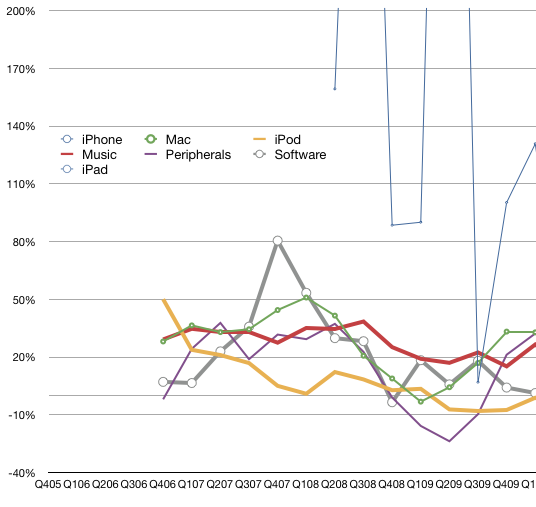
Here is the list of each product line and its y/y sales growth:
Unit Growth, Sales Growth
iPhone 131%, 124%
Mac 33%, 27%
iPod -1%, 12%
iTunes n/a, 27%
Periph n/a, 32%
Software n/a, 1%
Overall sales grew 49%.
A historic perspective for unit growth (iTunes, Peripheral and Software sales growth) is shown in the graph below.
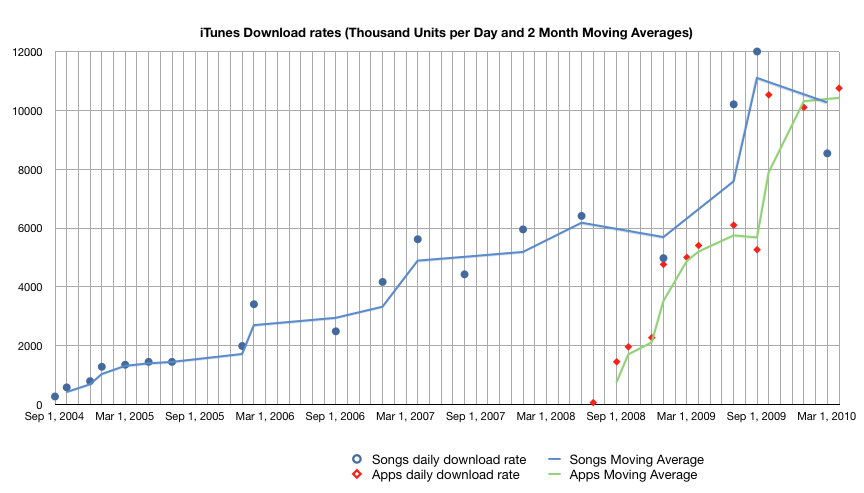
The App download rate increased to a record 10,753,000 per day during the last 90 days. This remains below the peak reported iTunes music rate of 12 million per day in the fall of 2009, but above the more recent rate of 8.5 million per day reported in March.
The download rates for iTunes are reported to have fallen as tiered pricing has been introduced while App download rates continue to increase.
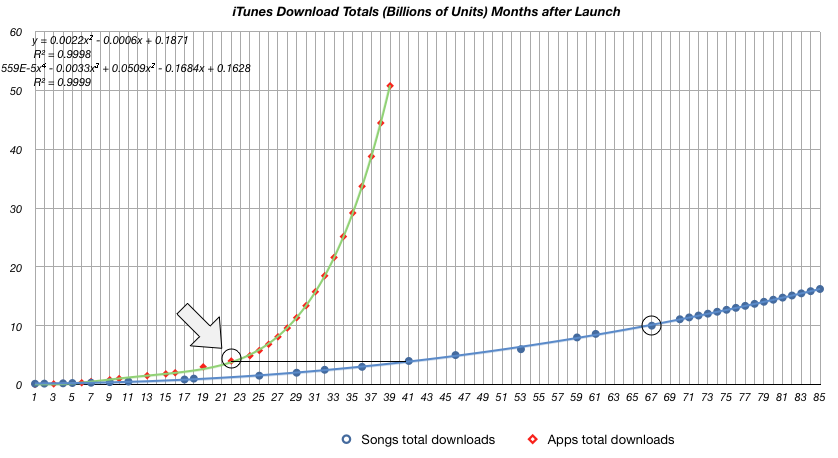
Last week's announcement of "well over" 4 billion apps downloaded came 21 months after the App Store opened on iTunes. To give a perspective on how fast that is, 4 billion songs took 41 months to sell on the iTunes Music Store.
The graph below shows the last actual data provided on both the App Store and the Music store downloads (circled) plotted from time of launch.
It also shows a curve-fit forecast of each store's downloads. If the growth persists, 10 billion apps could be shifted in 28 months post launch, which is around November of this year.
Growth within the siloed Apple ecosystem will actually stifle the grass-roots innovation
It's interesting that this comment came on the day after Rob Glaser left Real Networks. Let's take a stroll down memory lane of Glaser quotes:
(in 2003) “It’s absolutely clear now why five years from now, Apple will have 3 (percent) to 5 percent of the player market. … The history of the world is that hybridization yields better results.”
“Apple’s (market) share will go down if they continue to do this. The only way to presently put songs on an iPod is to (buy) them from iTunes.”
The (unforeseen) standard that emerged from the iPod is iTunes marketplace. It allowed Apple to establish itself as the premier and dominant merchant of all media including disruptive new media like apps. The iPod was "closed", "siloed" and "locked-in" users. But it worked and grew and grew to the point where it set the standard.
The same arguments raised against the iPhone were raised against the iPod and Windows before it. Last I checked iPod had 70% share 9 years after the launch and Windows has 90% share 20 years after launch. iTunes sells more songs than any other retailer on the planet and more apps that anyone imagined possible.
Perhaps this data bears repeating:
140,000 apps - made by over 28,000 developers
Users downloaded an average of 3.7 apps each in December.
One Quarter of apps downloaded are paid. Average cost of $2.59/app.
Each iPhone user spends an average of $10/mo.
There are over 75 (est.) million active users
200 million apps are being downloaded every month
$500 million in revenues each month. 70% to developers or $385 million
All these numbers are increasing and accelerating. iPhone Platform Fastest Ecosystem Ramp in History.
One observer has posted that WMM (Microsoft's answer to iTunes App Store) has 520 apps in it now. The store launched in Nov 1 with 281 apps. That means there will be about 300 apps added in the first two months. The growth rate is therefore about 150/mo.
This has to be the slowest growing app store among all the contenders, though Palm may also be similar.
By way of comparison, iTunes App Store is growing at about 10k apps/mo. with Android about 3 to 5k/mo.
How does this make sense coming from the company that is known for "developers, developers, developers" and is the largest software company in the world?
The implications of the new app transaction model are profound. To begin with, consider the following:
10 MB limit - Devs can now get their apps under 10MB much more easily. This allows them to take advantage of users downloading over the carrier networks and not wi-fi. They can offer more content via in app purchase and make up the difference.
Rankings - It will be curious to see how Apple changes the rankings over time. "Top Paid" and "Top Free" just don't really don't make sense anymore with this model. Will they make "Top Freemium" or something equivalent?
Infrastructure - Developers have to deal with content delivery and updates to that content. Apple handles the transaction in the normal fashion and takes their 30% but then they leave it up to the developers to actually get the content to the iPhone. What if there is a bug in the content? The developer has to deal with making sure the user is notified of the update and then initiate the update.
Piracy - There has been a lot of talk about how this may help fight piracy but I think the numbers will tell a different story.
Apps as content - The deeper story relates to the transformation of the app store into a content store. I made that prediction a year ago but had no idea how it would happen. In the long term I expect Apple to merge the iTunes music/video content management system with the app store content management. This way you could buy music/video/books/games from within an app and have it available through your iTunes UI.
Addiction - "Apping" as the activity of using iPhone apps has come to be known, is already something that did not exist a year ago but has proven to be wildly useful/common/profitable. Only a year has passed and we are already in the realm of uncharted waters.