Asymco

Asymmetric Intelligence

Mac

  1. Back to the PC

    Research · 67 comments

    Apple's "Back to the Mac" was a clever play on words. Everyone expected it to mean that the event was going to focus back on new Mac products.  As we had been so steeped in iDevice news the Mac was feeling neglected. It was time to take the discussion "back to the Mac."

    Instead Apple told us that the Mac and OSX were going to become more like Devices and iOS. iOS innovations were what's going "back to the Mac"

    So it wasn't "back to talk about the Mac" it was "OSX went to iOS and iOS is going back to OSX." The strategic upshot of it is that "the Mac is an extension of the device portfolio." Heady stuff. We'll need to chew on this for a while.

    But some implications are easy to foresee. For example, the consequences for competitors. When Apple launched the iPhone, competitors followed suit, powering their phones with a variety of "open" operating systems. When Apple launched the iPad, competitors followed suit, powering their devices with a variety of "open" operating systems. These reactions to Apple's initiatives by dozens of "open-wielding" competitors are all being touted as the inevitably winning strategies.

    So, as we've observed all of Apple's strategies being copied, I can't wait to see the competitors follow its "back to the Mac" strategy:

    • It won't be long before Dell takes UI and hardware design elements from the Streak "back to the PC." Think of the magic that will happen when Android Froyo "hooks up" with Windows 7.  Both Android and Windows being "open", if I squint hard enough I can just visualize the tweet from Andy Rubin of the command line to build a new Windows  8 with Android mojo. The Android Market selling Windows Apps. It will be beautiful.
    • Or perhaps we'll soon see "back to the Blackberry" as RIM takes QNX interface elements back to their core business. Not so sure about the command line make statement there.
    • Or maybe Nokia will announce "back to Symbian" as they take gestures from the ultra-open MeeGo to do an evolution of their majestically open Symbian.

    These initiative will surely be helped by the vast community of open developers surging to support the great open merged PC/tablet/device future.

    As a clue to the sarcasm challenged: The power of Apple's integrated approach across its product lines goes deeper than the user experience.

  2. iPad: IT gets it

    Research · 27 comments

    In the last article on the share of PCs highlighting the unwillingness of market analysts to categorize the disruptive iPad as a PC I imply that Gartner does not "get it".

    This is partly willful and partly instinctive. The willful ignorance is due to a belief that their customers (IT managers mostly) do not want to hear about the iPad as a viable technology. Certainly there is a lot of anecdotal evidence that the iPad is unworthy of consideration as a business tool.

    However, there is also increasing evidence that IT does in fact get it. I have met several senior IT managers who are whispering that the iPad will change everything. For us to decide which way the wind blows, we need to think harder about the process by which technology gets adopted in large IT organizations. Understanding how the technology is hired by IT managers to improve their career prospects unveils who wins and who loses in IT.

    The main hypothesis I put forward is that IT is an example of "rule of man" not "rule of law". The idea that law or "standards" (as doctrine is known by the jargon,) defines the products in use is a conventional myth. Standards change and they change quite dramatically based on who's in charge. The "standard" during the 70's was the Mainframe, the "standard" in the 80's was the DOS PC and the "standard" in the 90's was client-server and in the 2000's it was the web. Each new standard was a violation of the previous standard. So how did this change happen?

    Each evolution of technology standards affects the career of the IT manager. The adoption of technology is the primary driver for advancement in the profession. In most cases the technology being adopted is sustaining. In rare cases it's disruptive and can cause unforeseen re-distribution of IT power (and wealth).

    As IT is a cost center, naturally, organizational behavior (or, in the vernacular "politics") dominates the decision process. Senior managers look at each technology and ask: how can this help me achieve my career goals? Let's try this exercise with various innovations that have come along in the last few years.

    1. The Web in 1998. As IP based networking was catching on, the new technology offered a new way to tie existing assets together. It was also a completely new communication channel with customers. This was a great opportunity to increase IT consumption. It would lead to more work, more budget, more visibility and even a strong link between the profit centers of the company and the IT world. The web was an opportunity. It led to a firestorm of adoption.
    2. OSX in 2004. As Windows PCs were widespread and, given the support infrastructure behind them, worked well enough, an IT manager would look at a Mac and see no opportunity to increase their value add. They could not offer new software tools with it, and the old tools would probably not work without debugging. They could not move a Mac to new use cases and could not increase headcount to support it. The Mac was not a career opportunity.
    3. The iPad in 2010. As an IT manager looks at the iPad (and smartphones in general), he sees a similar opportunity to the Web ten years ago. The company users love their devices. Top executive love their devices. They see consumerization happening and there is no denying the explosive growth. There are challenges with integration but these devices are not a direct threat. The iPad is an opportunity to migrate to a completely new form factor and increase IT consumption.

    What this means politically is that the manager who figures out a way to roll out mobility in the organization will get the same uplift in his career as his predecessors did when they brought in disruptive waves. Those periods have become the stuff of lore and legend. Every IT manager with ambition is looking to create and ride a new wave. If the person is a mid-level manager, they will scramble to be the champion of the new technology and become a rising star. If the person is a high-level manager, they will see it as a way to protect their empire by co-option. Jostling for a vehicle to bring in the technology will begin. These vehicles are typically vendor relationships. Small vendors (example) have a better chance as the traditional vendors (for example SAP) and integrators are not quick enough with product development and don't have the products to sell.

    This IT manager's job-to-be-done analysis is crucial to understanding the adoption of IT technology.  Sustaining IT products do not sell themselves even if they are superior. Conversely, new products cannot be kept out of an organization even if they violate standards. What matters is whether they help the decision maker to achieve personal goals.

    My own intuition, having worked in such an organization (albeit briefly), and after a few conversations, is that the iPad and the mobile devices it represents is going to influence a generation of IT spending.

    Even though Gartner doesn't, IT goes get it.

  3. Forecasting iPhone production and sales

    Research · 22 comments

    Analyst Jeffrey Fidacaro with Susquehanna Financial Group in a note to investors:

    1. Apple to build 3 million CDMA iPhones in December
    2. That would put total GSM and CDMA iPhone production for the quarter at between 21 million and 22 million.
    3. For the current quarter, Apple is set to build between 18.2 million and 18.4 million GSM-only iPhones.
    4. Expects Apple to sell a record 11.6 million iPhones in the fourth quarter of the company's fiscal 2010. 39 percent q/q increase[1][see UPDATE below]
    5. As for the iPad, suppliers were said to have plans to build 7 million units for the current quarter, a 56 percent increase from the previous three-month frame.
    6. Expects Apple to ship 4.75 million units into the current quarter, 45 percent growth q/q, to a total of 13.4 million units in calendar 2010.

    via AppleInsider | Suppliers say Apple will build first 3M CDMA iPhones in December.

    What I don't get from these numbers:

    • current quarter production: 18.2 million
    • current quarter units sold: 11.6 million
    • inventory at end of Q: 6.6 m units [I am assuming minimal inventory at start as iPhone 4 was just launched]
    • next quarter production: 21 million
    • next quarter units sold: ?
    • inventory at start + production = 27.6 million

    My own estimate is for more than 12 (and up to 13) million units will be sold this quarter. I think inventory of more than half of production is too high for Apple. They usually carry only about 10% inventory.

    My December quarter units sold may need revision but now stand at 14 million. If I substitute 14 million in the "?" above  then the inventory at end of December would be 13.6 million which would be nearly 100% of units sold--clearly unacceptable. Either production is too high or sales are too low.

    I am at 4.7 million iPads for the quarter an 13.9 million for the year. No major difference in opinion.

    ---

    [1] This forecast for 39% growth would make this quarter the second lowest growth quarter for the product. This makes is hard to believe because every launch quarter has usually been breaking records for growth. The 3G launch saw 516% growth and the 3GS saw 644%. To see 39% for the iPhone 4 makes me wonder especially as the comparable year ago quarter was not a launch quarter so growth should be off a low base. Last quarter, when the iPhone 4 was leaked and the channel was drained the product had 61% growth.

    Compare also to the Mac which had 33% growth last quarter. Are we to believe that launch quarter iPhone growth is barely higher than Mac growth?

    The figure of 11.6 million is also in-line with other analysts which seems to indicate another forecasting failure for the cohort.

    [UPDATE] I checked the figures and 11.6 million iPhones is equivalent to 58% growth y/y. The (now corrected) article was citing q/q growth. However, 58% growth is still the second lowest growth quarter for the product.

  4. 70 percent of college freshmen are entering school with Macs [Updated 2]

    Research · 2 comments

    Increasingly, companies are giving their employees a choice to either use Microsoft Windows PCs or Apple Inc.'s Macs, the analyst said. And, increasingly, employees are choosing Mac over Windows. To boot, Chowdhry said 70 percent of college freshman are entering school with Macs, up about 10 percent to 15 percent from a year ago.

    via Microsoft shares retreat after downgrade.

    Remarkable indeed.  I remember when in 2007 40% Macs was headline news at Princeton, having quadrupled from 10% in 2003.

    [Update] Chowdry’s estimate seems an exaggeration but Mac share on campus seems to be growing. The most current data shows a probable 50% penetration in private colleges (my estimation is 70% is accurate for Ivy League schools) but a probable 20% penetration at public schools.  Still way above retail share in the US (10%) and way above corporate share of practically naught.

    [Update 2] According to survey data from Student Monitor, among those who planned to purchase a new computer, 87% planned to buy a laptop. And among those students 47% planned to buy a Mac.
    47 percent of 87 percent is a lot more believable. The chart from Fortune Tech shows that intent to buy for Apple went from 14% to 47% since 2005.

    More data, some courtesy of Macobserver readers:

    Macs at Harvard:

    • 2005: 32% (of total computer purchases)

    Mac share at Princeton (freshman class):

    • 2003: 10%
    • 2007: 40%

    George Fox University provides a laptop as part of the tuition.  Here are their numbers for Mac usage:

    • 2006 1% (Actively discouraging Macs)
    • 2007 40% (Change in IT support policies)
    • 2008 100% (Only option offered)

    The U.S. Coast Guard Academy.

    • 2008: 0% (Dell)
    • 2009: 25% (15” Macbook Pro issued, incoming freshman subsidize half the cost and 100% of any optional upgrades including printer
    • 2010: 50% (plus juniors and seniors allowed to replace older Dell with Mac if desired, not sure the financial arrangement).

    University of Virginia (survey data):

    • 2001: 3%
    • 2002: 4%
    • 2003: 4%
    • 2004: 8%
    • 2005: 13%
    • 2006: 20%
    • 2007: 26%
    • 2008: 37%
    • 2009: 43%

    UC Davis:

    • 2006: 7%
    • 2009: 23%
  5. 3Q review: The iPad adds over $700 million of operating profit with an average selling price of $662

    Research

    The iPad units numbers were not a surprise (except perhaps to some of the professional analysts who do not read Apple's press releases). Among the more accurate (amateur) analysts, the range was from 3.2 to 3.45 million with an average of 3.32.  My estimate of 3.3 million was the mode of the distribution.

    Apple sold 3.270 million in the first ever quarter.  The ASP came in at $662.39, below my expected $700 but higher than the iPhone.

    The only unknown is the gross margin.  Given the overall GM and the other products' margins, I am backing out a 33% margin for the quarter.  I had expected 40% but the lower margin may be a result of launch quarter issues (shipping and allocation of stock) and perhaps a lower target margin for the product.  It should be noted that the iPad margin sits between the Mac and iPod (around 30%) and the iPhone (around 60%).  The iPad is a new category that sits between the Mac and iPhone in terms of usage and it seems it sits also half-way in terms of margins.  Going forward, I'm still modeling a 40% GM for the iPad.

    Overall, I estimate the iPad added $717 million of operating profit to Apple's bottom line. Not bad for a product that was almost universally panned on launch day.

  6. 3Q review: Mac units grow 33%

    Research

    Apple Reports Third Quarter Results.

    I was surprised by the poor predictions of Mac units by the analyst community with estimates ranging from 2.86 million to 3.51.  It was fairly clear to me early in the quarter that the product would get 30%+ growth.  There was little news except overall Mac momentum to shape the forecast and it seemed logical that the growth would stay inline with the last quarter which was 32.8%. I dialed in 33% after the first month and stuck with this so my forecast came out to 3.46 million.

    In the event, 3.472 million were sold for a growth of 33.4%.  The ASP came in at $1,267, slightly down from $1,278 last quarter and $1,289 the year before. ASPs are eroding but Apple are holding the rate down with product updates. Looking forward, I'm forecast $1,300 ASP.

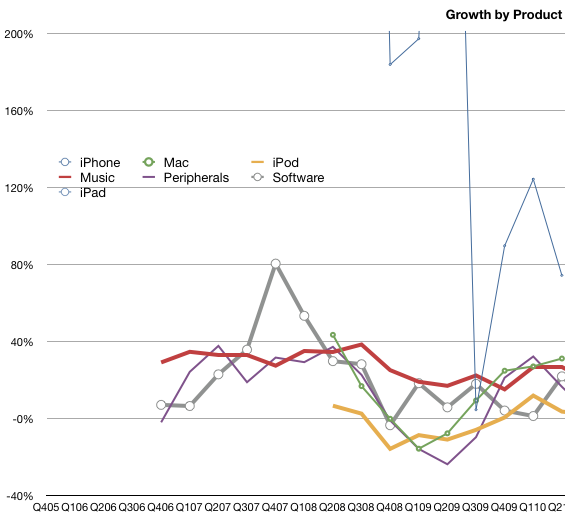
    I estimate gross margin for the Mac at 27%. This is down from 31% a year ago. Revenue growth year-on-year was 31%.  The Mac  franchise is still doing better than most PC vendors and is gaining share. The graph below shows the growth by product revenues.  The Mac is now the second fastest grower after the iPhone (the iPad is not included yet as these are y/y growth rates.)

  7. Accuracy of Apple unit volume forecast

    Research

    From Apple's FQ3 press release:

    "Apple sold 3.47 million Macs during the quarter, representing a new quarterly record and a 33 percent unit increase over the year-ago quarter. The Company sold 8.4 million iPhones in the quarter, representing 61 percent unit growth over the year-ago quarter. Apple sold 9.41 million iPods during the quarter, representing an eight percent unit decline from the year-ago quarter. The Company began selling iPads during the quarter, with total sales of 3.27 million."

    My unit forecast.

    In millions of units.

    Product Asymco Actual Diff Error
    iPhone 8.500 8.398 0.102 1.2%
    Mac 3.462 3.472 -0.010 -0.3%
    iPad 3.300 3.270 0.030 0.9%
    iPod 9.398 9.406 -0.008 -0.1%

    Rankings of various analyst forecasts are at :
    Deagol's blog.

  8. Safari claims 200 million installed base, WebKit at 500 million

    Research · 1 comment

    Safari continues to lead the pack in performance, innovation and standards support," said Philip Schiller, Apple's senior vice president of Worldwide Product Marketing. "Safari now runs on over 200 million devices worldwide and its open source WebKit engine runs on over 500 million devices

    via AppleInsider | Apple releases Safari 5 with extensions, expanded HTML5 support.

    Safari's installed base includes Mac, iPhone, iPod touch, iPad as well as the number of Windows versions.  Assuming 45 million Macs, there are probably around 50 million PCs using Safari.

    WebKit includes all iOS devices as well all Android and Symbian/S60 and Palm Pre.

  9. Ballmer thinks the iPad is a PC; analysts who measure market shares don't.

    Research · 2 comments

    8:50 am: Walt circles back, notes that Ballmer uses the term PC to include things that most people don’t think of as PCs. Is the iPad a PC?

    Ballmer: Of course it is. What do you do on it? Answer email….A guy tried to take notes on it at a meeting I was at yesterday–that was interesting [chuckles from the audience]. He suggests that the positioning of devices like the iPad as something beyond the PC is just a marketing tactic.

    via Steve Ballmer and Ray Ozzie at D8 Conference: on Competitors, Tablets, Future of Computing and much more | Microsoft | ithinkdifferent.

    If only the analysts would add the 2+ million iPads shipped this quarter to Apple's Mac units and declare that Apple's market share doubled(*).  If only things were so simple.

    At least on this I agree with Ballmer.

    (*) The iPad is already outselling the Mac on a weekly run-rate.

  10. Why Apple is on top today: the top 10 technology decisions

    Research · 91 comments

    As Apple overtook Microsoft in market cap and as Steve Jobs reminisced about some recent history, I thought I'd reflect on some of the decisions that brought Apple to the pinnacle of technology companies.  The criteria I used to select these is how improbable and hence courageous they were when taken and how much impact they have had on the industry. Since the impact of these decisions could not be felt for a long time, the courage required to act early is all the more remarkable.

    At the time they were made, none of these decisions did anything to move the stock price or cause great rejoicing. In fact, in many cases the decisions were ridiculed by those who should know better. Yet each one became a massive pillar of the foundation of Apple as it is today.  As you read through, think of the decisions that Apple competitors made or did not make in the same time frame.

    Top 10 Apple technology decisions of the 2000 decade in reverse order:

    • 10. HTML 5 (canvas). It was initially introduced by Apple for use inside their own Mac OS X WebKit component, powering applications like Dashboard widgets and the Safari browser. Still in its infancy, the canvas element is an Apple technology that promises to finally offer a credible Flash equivalent.  Remember that Flash is now over 10 years old and was incubated at a time when the Web was barely 1.0.  HTML canvas finally brings vector graphics to the modern era.
    • 9. H.264. The decision to support a standard video codec at a time when the industry was mostly arguing over whether Blu-ray or HD-DVD would win signaled a foresight that physical media was not long for this world.  The consequences are still being weighed as YouTube and other media sources are shifting their inventory to this format.
    • 8. iTunes. iTunes started as a personal music database, grew into a music and media store-front, a payment processing engine, device synchronization and updating center, and finally an application store.  It was forked into both a PC and a mobile version.  Without iTunes the iPod would have been just another MP3 player.
    • 7. WiFi. Implemented in Airport before the spec was finished, WiFi gave the laptop wings.  Think back to when you still had to plug a wire into a computer to have it communicate. PC's did not catch up in being wireless for years.  WiFi was even a rare feature on mobile phones when the iPhone shipped in 2007 with some operators (Verizon) banning it from their phones even in 2009.
    • 6. FireWire. Along with iTunes brought iPod to life.  Launched at a time when external drives required screwdrivers and a circuit board to install, FireWire made opening your computer case to expand it as common as opening the hood of your car to fix it.
    • 5. iLife. Did to user-generated media what word processors did to words and spreadsheets did to numbers. A singularly great reason to get a Mac.
    • 4. Portability. OSX migrated across three different CPU architectures in less than 10 years. Apple revealed that they built it from day one to be portable to different CPUs.  That took amazing foresight in the late 90s.
    • 3. WebKit. Speed and flexibility.  The biggest reason why we can surf on a phone today.
    • 2. Multi-Touch UI. Seven years in development and still sublime.  Starting down this road in 2003 must have seemed science fiction.  But, unlike other companies, Apple took this science experiment and went to market.  Steve Jobs said how he wanted a screen keyboard and how scrolling opened his eyes to making a phone. That took vision.
    • 1. OSX/Cocoa. The company's backbone.  Everything above hangs off OSX. Remarkably scaleable, portable, robust and reliable.  With roots going back decades, it's the canonical OS. Somebody should build a monument to it.
  11. iPad outsells iPhone (part II)

    Research

    “Checks indicate that US iPad sales remain strong post-launch, driven by rising consumer visibility to iPad’s user experience, sustained PR/word-of-mouth marketing, 3G iPad launch, and broadening iPad apps/content,” Abramsky wrote in a note to clients this morning. “We believe Apple is now selling >200k iPads/week, greater than US Macs (est. 110k Macs/week) and just below US iPhone 3GS first quart (246k/week).”

    Retail checks in mid-May showing widespread iPad stockouts at Apple stores and Best Buy. The 3G iPad is sold out at many Apple stores and about 25 percent of them now have only selected Wi-Fi iPads available. Waiting lists are not uncommon.

    ... Abramsky raised his global iPad outlook for 2010 from 5 million to 8 million.

    via Apple Selling More iPads Than Macs | John Paczkowski | Digital Daily | AllThingsD.

    iPad is not only outselling iPhone version 1, but, soon, iPhone version 3.