Asymco

Asymmetric Intelligence

MacBook

  1. Asymco Bulletin 006 - Mar 28, 2026

    Bulletin

    Asymco Bulletin is a digest of all the work we have published for the week ending Mar 28, 2026.

    Research

    The Next 50

    In Apple’s first 50 years it shipped 5.13 billion computers. This shipment total is higher than any other computer company in its first 50 years. There actually are no other PC makers that are 50 years old. But all these things were true also 40 years ago. So what are we celebrating now that we did not celebrate at Apple 40? The answer is Services, the consistency in growth in user base and the potential trajectory of growth to never-before imagine audiences. The biggest change is a change of horizons. →

    People don’t like wearing things on their faces and don’t trust those who do

    Says Neal Stephenson who first coined the term “metaverse” This revelation came soon after Meta canceled the Metaverse. Let’s look into Neal Stephenson’s mea culpa:

    When I was working at Magic Leap, and people asked me why I thought that [Metaverse] was a good idea, I would ask the rhetorical question: “do you really think that twenty years from now everyone is still going to be going around all day staring at little rectangles in their hands?” →

    The Biggest Bundle?

    The Biggest Bundle?

    How everyone is wrong about AI. The newspaper was an unexpected development It was not a product that anyone asked for. Like many innovations, it wasn’t an invention. It was not patented or discovered in a laboratory. It emerged as a result of the convergence of three disparate technologies: continuous roll printing presses, the telegraph, and the railroad. This convergence occurred by the 1830s, facilitated by a business model aptly named “the penny press”. Stepping back, the printing press was initially developed in the 1450s, 40 years before Columbus’ voyage. It went through numerous evolutions. The big change was moving →


    Nota Bene

    Apple, Samsung Dominate 2025 List of Highest-shipping Models Across Regions → In 2025, Apple dominated premium smartphone markets across North America, Europe, and Asia-Pacific, while Samsung excelled in entry- to mid-tier segments in Latin America and the Middle East and Africa. →

    Tim Cook: Apple just had best launch week ever for first-time Mac customers → Neo brought Apple its strongest launch week performance, presumably by attracting first-time Mac buyers, and helping customers transition out of netbooks and Windows laptops. →
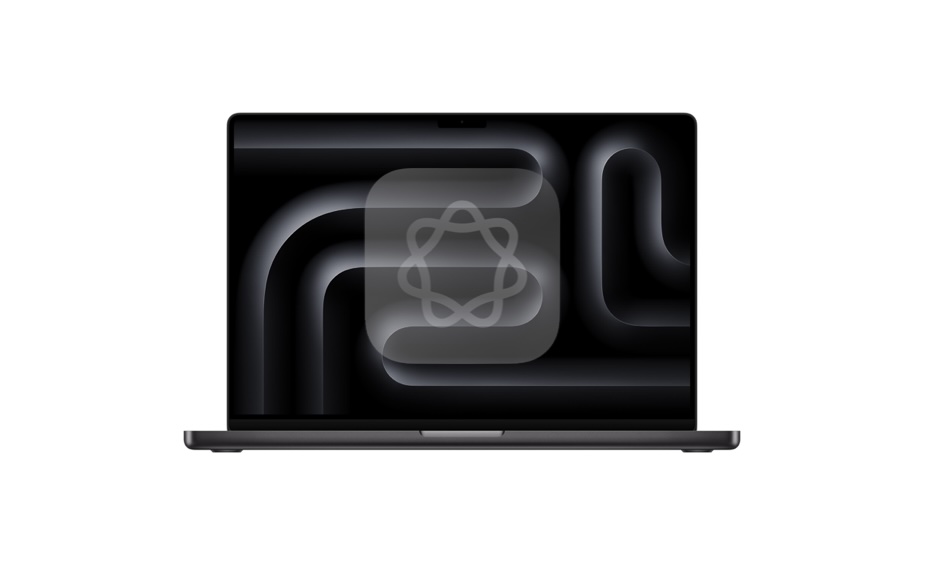
    Running a data-center AI model on a MacBook

    Running a data-center AI model on a MacBook → Apple's MacBook Pro, with its unique Apple silicon architecture, could revolutionize personal AI by enabling powerful AI models to run locally without relying on cloud data centers, potentially shifting the competitive landscape in Apple's favor despite current perceptions of lagging behind in AI advancements. →

    Apple’s China smartphone sales jump 23% as overall market fell 4% to start 2026 → Apple defied market trends with a striking 23% iPhone sales surge in China, outpacing competitors despite broader smartphone shipment declines. →
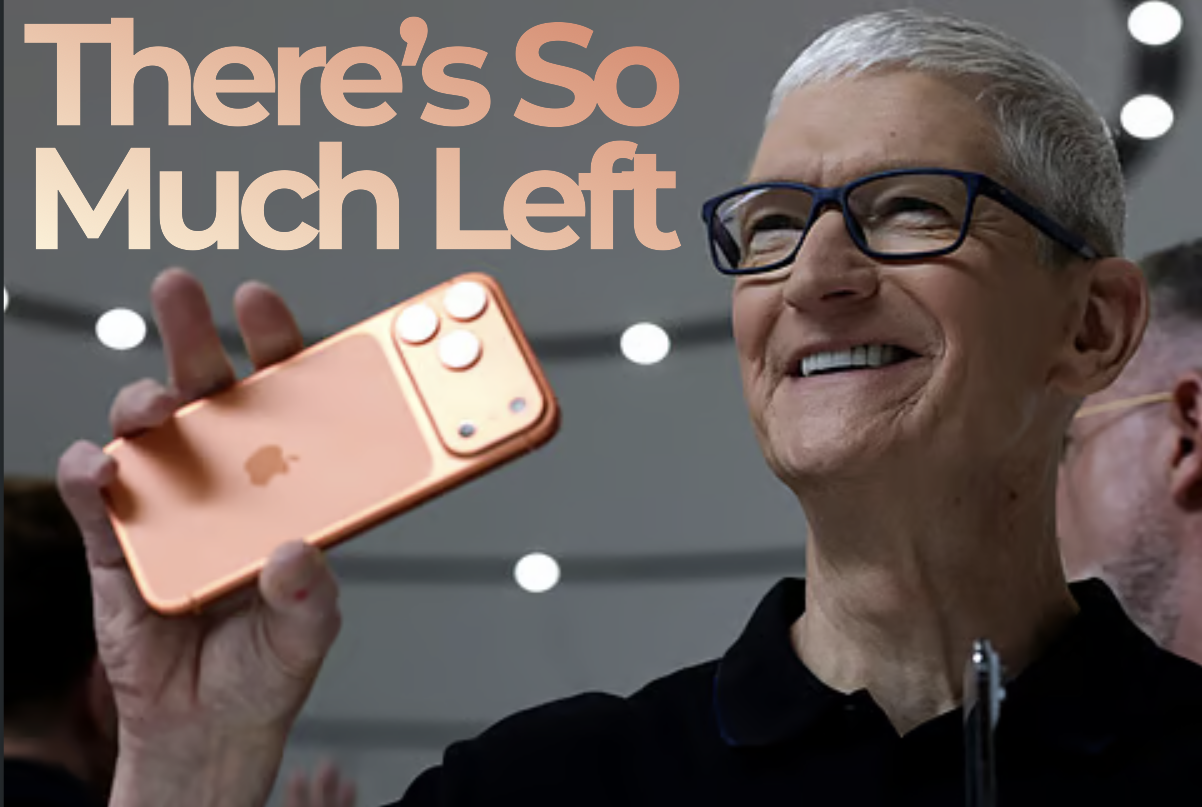
    “There’s So Much Left” in iPhone: Tim Cook

    “There’s So Much Left” in iPhone: Tim Cook → Apple's relentless focus on user-centric innovation, epitomized by the ever-ascendant iPhone, underscores its enduring dominance and untapped market potential. →

    Amazon developing a new phone more than a decade after its first → Amazon's renewed attempt at a smartphone, "Transformer," aims to integrate AI and deepen Prime ecosystem ties, learning from past Fire failures by addressing trust, scale, and developer engagement challenges. →

    Mac fastest growing PC brand in India in Q4 2025 → In 2025, India's PC market soared to a record 15.9 million units, with Mac sales impressively up 24% year over year, hinting at a bright future despite looming 2026 challenges. →
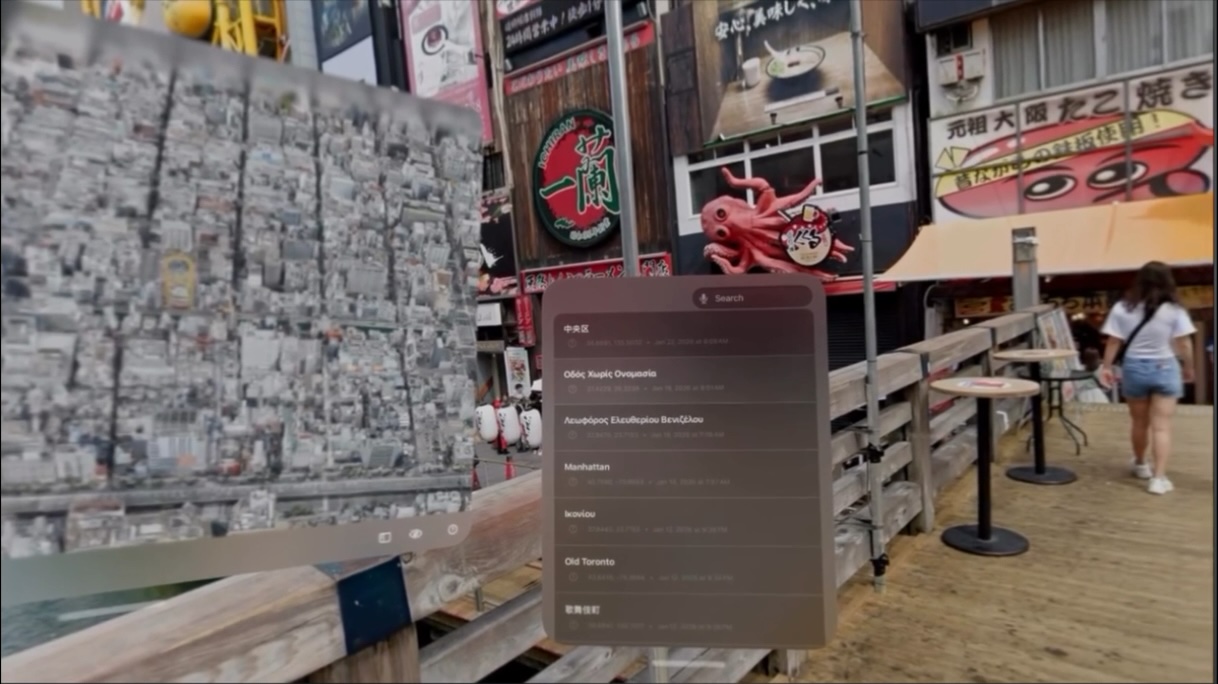
    Forget Streetview, Immersion hints at what’s to come

    Forget Streetview, Immersion hints at what’s to come → "Waddle transforms visionOS into a portal of immersive exploration, where experiencing surpasses explaining." →

    How to read the MacBook Neo as bad news for the stock → "Apple's Neo success is misleadingly painted as a margin threat, ignoring cost efficiencies and manufacturing leverage." →
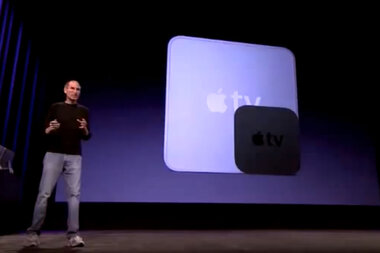
    Apple TV is a categorization failure

    Apple TV is a categorization failure → Apple TV, launched in 2007, struggled for 19 years as a misunderstood, underappreciated gateway to content, overshadowed by Apple's product-centric reputation. →

    Apple’s Custom Silicon Opens up Potential for a Cellular MacBook → "Apple's C1X modem not only matches Qualcomm's performance but also reshapes the economic landscape for always-connected MacBooks, hinting at a future where seamless cellular integration redefines portable computing." →

    Apple turns component crisis into competitive advantage → Apple leverages the memory crisis to aggressively capture market share from struggling Android, PC, and Chromebook competitors. →

    Survey shows record upgrade interest for iPhones → Morgan Stanley forecasts Apple as the sole major smartphone vendor to gain market share in 2026, driven by strong upgrade intent and advanced features, while Android struggles with rising costs and declining loyalty. →
    MacBook Neo Market Impact: Analysts weigh in

    MacBook Neo Market Impact: Analysts weigh in → Market analysts predict the MacBook Neo will disrupt the low-end PC market, especially in education, by leveraging Apple's higher margins and user-centric design, despite challenges from price-sensitive K-12 sectors dominated by Chromebooks. →


    World’s most respected Apple Analyst. —Macfilos

    Like what you read? Get more from Asymco One:
    full access to Asymco's research, analysis, and commentary.

    Subscribe with code BULLETIN for a discount.

    Feedback: Have questions or comments? Reach out to us at contact@asymco.com. We’d love to hear from you.
  2. Apple’s Custom Silicon Opens up Potential for a Cellular MacBook

    Nota Bene · 1 comment

    iPhone Air share of mix samples 2x iPhone Plus

    Explore how Apple’s C1X modem performs in the real world, with Ookla Speedtest data from Q4 2025 showing the iPhone Air matching Qualcomm’s X80 download speeds while setting new latency benchmarks.

    iPhone Air marginalizes competing slim form-factors. The iPhone Air has largely eclipsed the Samsung Galaxy S25 Edge globally, out-sampling it 3-to-1 in the U.S. based on Speedtest data, while the Edge remains statistically negligible in terms of adoption across European markets. South Korea remains the primary competitive exception, driven by strong home-market bias.

    In 2024, the iPhone 16 Plus was the clear laggard of the range, capturing a mere 2.9% of the launch mix. By sunsetting the iPhone Plus and replacing it with the design-centric iPhone Air, Apple more than doubled the share of this roster slot to 6.8%. This suggests that “Slim” as a category successfully resonates with a segment of the market that “Large” simply did not.

    Apple’s newest hardware cycle centered on a key question: could Apple’s first high-performance modem, the C1X, improve upon the original C1? Furthermore, could it match the industry-standard Qualcomm X80, without the thermal headroom of a “Pro” chassis. Despite its slim form-factor, the iPhone Air does include a vapor chamber to aid cooling, while its titanium frame also aids heat dispersion. Qualcomm remains a formidable incumbent with its X85 modem, which alongside MediaTek’s M90, will feature in newer Android flagship devices this year. Based on comparisons with the X80, our data suggests that Apple’s silicon has reached a critical maturity point, shifting the conversation from a performance gap to a strategic “equalizer” in real-world performance.

    Source: Ookla®

    NB: Lots of very interesting data in the source. Definitely worth looking at carefully. The conclusion is quite a bombshell…

  3. Why not maroon? The Macalope ponders the power of color

    Nota Bene

    Never underestimate the power of color

    If a cheaper MacBook with a less powerful chip excites you, then you’ll love what else Apple is expected to ship soon! The iPhone 17e is expected imminently, adding an A19 chip and MagSafe charging, something the horny one did not realize the 16e did not have. A new base model iPad and iPad Air are expected early this year, but will just be speed bumps of the existing models.

    Source: Macworld


  4. mini

    Research

    We want things to get better. The desire of improvement and an increase in performance is seemingly innate. The old adage goes that using the word "new" is the most effective way to increase sales. "New & Improved" if you want to be redundant.

    For many in technology, New & Improved means faster with more of every measurable parameter. More memory, more pixels, more storage, more bandwidth, more resolution. In devices, the tendency has been to communicate "new & improved" through an increase in screen size. We are subject to this to such an extent that phones are becoming unusable with one hand, stretching screens to the edge of the device and then wrapping those screens around the edges and then even folding the screens so that we have to unfold or unroll to use the product. Maybe an origami phone is in the works.

    But there is a parallel movement where "New & Improved" means smaller. This is the trend to miniaturization. Smaller is better because it's more portable, more conformable. Things sold by the ounce are better than things sold by the pound. The best computer, the best anything, is the one you have with you and having it with you is more likely if you can take it with you. So that which you can take with you is the best. QED.

    Apple has had a great history of miniaturization. The original Macintosh was tiny compared with personal computers of its day. It had a handle so you could take it with you. Apple pioneered laptops with breakthroughs in utility and form which made them truly portable. The iMac followed with a degree of integration and portability which made it iconic. Of course the iPod and iPhone were marvels when they first appeared.

    Over the years these products expanded into ranges with "good, better, best" type segmentation. The bigger being the best in performance and the smaller typically being the most convenient. However it seemed that the positioning was toward "bigger is better" for a lot of these products. The iPhones Plus, the iPads Pro, etc. As even the largest were getting thinner, the "mini" versions appeared to be neglected. You could get "good enough" portability from the larger products so why bother with the minis.

    It came to a head when the iPhone SE was discontinued last fall. Its demise felt like the end of an era. I always considered the SE as the "Steve Edition". It was the last design Steve Jobs was involved in and it pained me to see it go. With it seemed to go the positioning around "mini".

    But also last fall we saw a re-boot of another almost-forgotten mini: the Mac mini. For me the Mac mini was quintessentially Jobsian. I remember that he loved tiny products. His launch of the iPod nano was spectacular; reaching into his jeans' watch pocket to pull it out on stage. Holding the Mac mini up as if a tiny tray. Even the iPod shuffle was a quirky and lovable idea ((probably the first Apple wearable as you could actually pin it to your clothes)). And let's not forget the Mac Cube which made the iMac look huge.

    When the Mac mini was released last fall in Brooklyn with a huge spec bump and a thunderous reveal I thought something was up. When the MacBook Air was also out at the same event I felt that the company was signaling something. Perhaps a re-dedication to the low end.

    Also in parallel there is the wearables product line. The AirPods and the Apple Watch are jewelry. The essential qualities of products you wear are that they be small and beautiful. The smaller the better. Above all, both the Watch and AirPods are marvels of miniaturization. They pack so much in so little volume and that volume is shaped in such an aesthetically elegant way that they become daily essentials. I use my Apple wearables more than any other Apple product. Watch glances and time with AirPods exceeds the iPhone unlocks and iPhone use time. The fact that we don't even realize that the smallest Apple products are also the ones we use most is a testament to their conformability to us.

    So the Mac mini that is suddenly the Mac Maxi in performance, the MacBook which is an extraordinarily small laptop, the wearables success, all pointed in a direction that the iPhone did not: that "mini" was back.

    And now we see the iPad mini being re-launched with a huge spec bump. We should take the hint. The iPad mini is just charming. I have been trying it out for a few days and it has worked its way into my routine. I have an iPad Pro that I use on a desk to design presentations (and to deliver them). I use it with a keyboard for dealing with email on my lap or on a plane and take it instead of a laptop when going to meetings.

    But the iPad mini worked its way to my nightstand. It the one I reach for when on a couch. It is like an iPhone but when you're at home it's better than the iPhone because you can linger on that new true tone screen. It works well one handed. It now has Pencil support so it can be used for sketching and doodling.

    I am an analyst not a product reviewer but I sense how it fills a gap between iPhones and larger devices--in a home setting. Of course it can be used in an office. It is much easer to take with you if you carry a laptop in a bag.

    Fundamentally explaining mini is pointless. mini is something that is felt more than it is perceived. You can see the attraction of a tiny product only when you come face-to-face with it. In a picture it's hard to get it--there is no frame of reference. What draws me to a MacBook or to a mini or a Watch is when it's touched and held and carried or worn. The experience of the product is not how it works but how it works with you. You have to be part of it. It's not asking "Does it look good?". It's asking "Does it look good on me?" mini means more personal.

    That is the nature of mini and that is why I love the new minis: the iPad mini, the Mac mini, the MacBook (mini) and that is what I dare to hope that there is an iPhone mini coming.

  5. The Genealogy of the MacBook Pro

    Research · 18 comments

    I was an early user of the first MacBook Air. When that product was launched I saw in it something different: a dedication to a new measure of performance: thinness and conformability. The key image used to launch the Air was the laptop sliding neatly into an inter-office envelope. The implication was that the laptop does not need to have its own special "laptop bag". It could fit into any bag. Users would be able to slip it into all manner of new contexts. It sought to compete with computing non-consumption.

    The Air was launched by Steve Jobs in 2008 and was almost universally panned. It was considered underpowered and the dedication to thinness was seen as irrelevant to what consumers wanted. The stock price fell.

    The product went on to become Apple's most popular laptop. It still is. It grew the base of Mac users to over 100 million today.

    For the same reason, I was an early adopter of the newest MacBook Retina. The even thinner new MacBook was spectacularly thin. It was smaller than an iPad. It had no ports except one USB-C and a headphone jack. It required dongles for physical connections. It had a new keyboard that barely registered movement and it had a new trackpad that did not move at all but played mind tricks to make you think it did.

    As I used it over the last year, I became used to it. It was not my only laptop. I had an older 15 inch Pro, but over time I came to use the MacBook Retina exclusively. I thought I could not do "real work" with it but I managed. I got used to the keyboard. I got used to the trackpad. I got used to the need for a dongle to connect a display. But these challenges were more than offset by delightful improvements. I was delighted by the small power brick and the ability to use any USB power to charge it. I was delighted at the all-day battery life which meant I would charge it the way I charged my Phone: at night.  I was delighted that I could use it in places where I could not use a laptop: on any airplane tray, stowing it in the seat back pocket. And I no longer cared what bag I had for my computer. It did not make me productive by completing tasks more quickly. It made me more productive by letting me be do things when and where I otherwise couldn't. I love my MacBook.

    Now Apple launched a new Pro Mac laptop.The new Pro laptop has the same (slightly improved) keyboard as my MacBook. It has the same (larger) trackpad as my MacBook. It has the same (but more of) USB-C port.  It has something new called a Touch Bar which puts function keys into a touch screen but mainly it feels like a grown-up version of my MacBook Retina. It's faster too.

    Overall, the new MacBook Pro feels to me like an evolution of the MacBook of 2015. I remember at the time thinking that this baby MacBook is probably the wave of the future: the new keyboard, new trackpad, new thinness, new USB-C, deprecation of other ports. These required enormous engineering efforts and it would be silly to leave them on only one model. In any case, from where I was standing all these were "better". Not along the previous definition of goodness but along a new definition: making the computer more conformable and easier to put into use in more places. The very ideas that drove the development of the Air of 2008. Indeed the very idea that drove the development of laptops since the 1990s.

    What's fascinating to me from a product management point of view is that the groundbreaking new features which re-define the product's direction are not designed to trickle-down from the top-of-the-line to the bottom, but rather that they trickle-up. The low-end product gets the updates first and the the Pro products adopt them later.

    And we can even trace this genealogy of features through to an even "lower-end" product: the iPhone. The iPhone "ethos" of usability and conformability has permeated through to the Macs, starting from the lowly and advancing to the top of the range. The question of where Apple's design direction comes from can be answered: the bottom.

    All this is consistent with a strategy of "low-end evolution". A way to defend the low-end rather than abandon it in pursuit of what the most demanding customers are asking for. Rather, Apple seeks to incubate a new performance measure. Re-defining goodness.

    So is this new MacBook Pro a worthy successor to the MacBook Retina? My attention is riveted by the Touch Bar. It seems a completely new way of interacting but requires discovery and practice. What Apple has to achieve is allow the product to work well without it but also to allow users to evolve their experience with it. Over time we got used to trackpads instead of mice (many resisted the change). We got used to a different, small travel keyboard. We got used to new ports (HDMI vs. VGA) and we got used to wireless everything (it may seem easier, but remember having to always enter credentials vs. plugging in a cable).

    The touch bar is a new UI metaphor. It will take time but it is looking at me right now, winking.

  6. On Feeds and Speeds

    Research · 54 comments

    And a lot of folks in this tablet market are rushing in and they're looking at this as the next PC. The hardware and the software are done by different companies. And they're talking about speeds and feeds just like they did with PCs

    Steve Jobs, iPad 2 launch event March 2011.

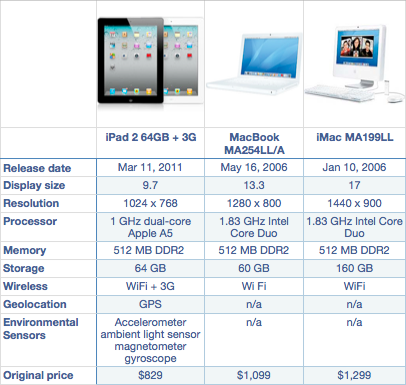
    I'm not above doing a feeds and speeds comparison.

    All the products above have dual core processors, 512 MB of memory. The iPad processor is a bit slower. The iPad also has a slightly smaller resolution screen than a MacBook from mid 2006. However, unlike the others, the iPad has cellular broadband connectivity, loads more sensors, and a battery that will last at least 5 times longer.

    It's also a lot cheaper and a lot smaller.

    Although five years old, nobody would question that the MacBook or iMacs shown above are still computers. They still run the latest versions of OS X and are probably still in widespread use.

    The new iPad is still not considered a computer by the majority of market analysts. One wonders how long this will go on. The specs of the iPad are just going to keep getting better...