Asymco

Asymmetric Intelligence

Microsoft

  1. If RIM did not exist today and someone were to suggest it, could it ever get funded?

    Research · 22 comments

    Consider what RIM had to overcome to even be: It was an outsider entering the mobile phone business at a time when incumbent market power was far more concentrated. It evolved from data-only pagers awkwardly adapted to carry voice without pandering to the fashion consciousness of its contemporaries obsessed as they were with the RAZR. Its foothold market was the most difficult market to enter, the US; and within it, in most difficult sector--business users.

    RIM's solution has no architectural elegance and their non-standard approach to email using their own servers and protocols defied all IT policies regarding security and the entrenched use of Exchange. Even after Microsoft offered a cleaner solution (Exchange push) that avoided the RIM back end, businesses otherwise committed to Microsoft stuck with RIM for mobile email. In spite of various government opposition, RIM continues to grow internationally.

    Even its acceptance may be an accident of history.

    The absence of interoperable SMS in the US early last decade meant that there was no reliable way to send text from one mobile to another across CDMA and GSM networks. The Blackberry was hired to to the same job that SMS was hired to do anywhere else, but by the time SMS was working in the US, the use of Blackberry increased irrespectively.

    It should be no wonder then that the company can be considered both disruptive and a dead end. Analysts have been split about it from day one. Gartner advised against adoption by any self-respecting IT shop.

    Equities analysts are still split into bulls and bears more evenly than any other company in this space. See: RIMM: Street Split Sharply On The Stock; Avian Cuts Rating (Updated) - Tech Trader Daily - Barrons.com

    The arguments are pretty straight forward:

    • Competitive pressure from 'better' architectures, uninspiring products, lower growth

    vs.

    • Fierce loyalty of users, continuing international expansion, continuing growth

    The market has largely voted with the bears as the price shows absurdly low valuation (4.3x EV/EBITDA) but the company continues to show growth quarter after quarter.

    My own point of view has been for some time that RIM's disruptive days are over because the engineer in me says that their code base is a dead end. But the disruptive analyst in me leads me to be hesitant in proclaiming their imminent demise. The fact remains that their product is good enough for a subset of the users who want nothing more than a messaging phone. I will add however that this subsets unlikely to grow especially relative to the number of users who will opt for more highly functional devices.

    So the riddle of RIM remains: rumors of its death has been exaggerated but it's not an unforeseeable growth story anymore. As a result the company is in limbo.
  2. BusinessWeek: Nokia failed because it's in Finland

    Research · 12 comments

    How Nokia Fell from Grace - BusinessWeek.

    The author asserts that company success and failure are determined by the location of its headquarters. He also adds a bit of stupid manager theory to flesh out his thesis for Nokia's failure.

    I've already debunked the stupid manager theory here. So let's look at what's left.

    The bad geography thesis is a far less common theory than the stupid manager theory but maybe it's worth analyzing.

    Here are the basic questions anyone can ask:

    1. When did Finland become a bad location, exactly? It was clearly a good location for Nokia when it was winning and growing. It seems to have become a bad location for Nokia around the same time its business began to slow down. That puts Finland at a geographic disadvantage around 2005 or so. As far as anyone can tell nothing changed with the population or intellectual capital of the country around then (if anything all the surveys seem to show it's gotten better). So whereas Nokia was successful in Finland and unsuccessful in Finland and Finland did not change, Finland cannot be causal to the failure.
    2. If Finland had something to do with it, did companies in Finland succeed at the same time as Nokia and fail at the same time? I don't have any evidence to confirm or deny this but I will say that the iPhone's most popular application is written in Finland (Angry Birds by Rovio). So there are still creative and clever people around.
    3. If location in "hub" locations like Detroit for automobiles or New York for finance, ensures success... oh, never mind.
    4. Since Sony was successful in Japan in the 70's and 80's then should they also have moved in the last decade when their business turned? Is Japan also an isolated place for innovation?
    5. What about Microsoft? Seattle was the technology boonies when Microsoft moved there.
    6. Finally, when Hewlett and Packard started in the agricultural plains south of San Francisco, I'm sure the residents of electronics hubs of New Jersey and upstate New York pointed and laughed.

    The hypothesis that location matters in success or failure of business models is so easy to disprove that it's hardly sporting.

  3. When will the smartphone become a commodity?

    Research · 21 comments

    I am taking a comment thread and promoting it to an article so as to expose it to a larger audience. There are two points of view:

    Ariel writes:

    I believe that next year and perhaps the year after that will see intense competition on the OS platform front, but eventually one will dominate the other(s) by a significant margin (and this also depends on the cloud and how it will be adopted across platforms). This happens as a result of a unified platform in which many can compete on lower margins instead of the development of the entire package and platform, which all goes hand in hand with commoditization.

    However, to predict that smartphones will not be commoditized within the next three years is bold to say the least. The desktop was settled very quickly, and in this industry of exponential growth, it can be assumed it will not take longer for a similar scenario to settle.

    I reply:

    I’ve been observing (professionally) the smartphone market from its inception and was holding my breath for the commoditization of handsets that Microsoft promised all the way from 2004 through 2009. Several generations of Windows Mobile were predicated on the imminent stabilization of hardware and user experiences years before the iPhone came along. Not only Microsoft but Palm via PalmSource, Symbian as a consortium of all incumbents, Sun & IBM via Java, DoCoMo with iMode and not least of all, Qualcomm with BREW all made the same bets and ran with horizontal strategies toward a smartphone future built on the lessons of the PC industry. The only holdout for the integrated approach was the one company that everybody marked for dead: RIM. It’s also the only one who raked in all the profits.

    All this happened before 2007.

    To suggest that this time, in 2010, it’s different: that the definition of the smartphone as it exists today is the product at its zenith; that user experiences and expectations and hardware specifications and platform dynamics will be henceforth frozen with minor sustaining tweaks to look forward to is, in my opinion, a far riskier bet.

    I don’t try to be a futurist or predictor of how the product will evolve, but I can see a dozen ways of how the very definition of a smartphone will change and how in 4 years we’ll have products that won’t be recognizable as such today.

    So much depends on when the smartphone (or more broadly mobile computing) reaches this point of good enough. It's at the root of all hypotheses of how the market will evolve.

  4. Gartner: Windows Mobile attracts far more developers than any rival mobile operating system

    Research · 65 comments

    Gartner in 2006 predicting mobile OS future.

    "Interest in Windows Mobile 5.0 has grown steadily, and it now attracts far more developers than any rival mobile operating system. This should improve the likelihood of IT directors being able to buy line-of-business mobile applications for the Microsoft platform. More than 10,000 developers are currently working on applications for Windows Mobile 5.0. Part of the reason for this developer momentum is Microsoft's programming model. Nick Jones, vice-president at analyst firm Gartner, said, "Every device using Windows Mobile 5.0 has the same interfaces, but that is absolutely not the case with other operating systems, such as Symbian."

    __________________

    via Gartner Says WM Can Empower Your Developers.

    A piece by Gartner that has a typical Gartner conclusion: WM 5 is going to grow the WM Developer community because of device-by-device similarities, and more freedom than RIM or Nokia devices can give.

    Love the "every device using Windows Mobile 5.0 has the same interfaces" dig at Symbian. That was four years ago. This week Gartner predicts the fragmented but magically open Android will dominate four years from now.

  5. Gartner: Symbian will lose smartphone battle, Microsoft's standardised handsets will win the day

    Research · 8 comments

    I had to do some digging to find this to contrast to the recent Gartner prediction that Symbian will be the market share leader in 2014.

    The following article appeared in 2003:

    Symbian will lose smartphone battle

    By Rob Jones at Gartner Symposium ITxpo, Cannes [07-11-2003]

    Microsoft's standardised handsets will win the day, says Gartner

    Analyst Gartner has warned that, without a concerted effort by Symbian and its backers, Microsoft will sweep them aside in the smartphone business.

    Redmond's ability to offer standardised handsets which are easier for businesses to support and use will help the software giant win corporate approval, the market watcher predicted.

    Nick Jones, vice president and research fellow at Gartner, said that, while Microsoft did not have a good corporate smartphone today, he believed it would do by the end of 2004.

    The analyst predicted that Microsoft will ship a phone boasting strong integration of a range of packages, such as Exchange and Outlook.

    Symbian, he added, needed to resolve a number of issues to be a credible, corporate alternative. Its platform and menus differ slightly on various handsets, which means that they often do not have the same user interface.

    "Symbian is not very committed to fixing this problem. So Microsoft is getting stronger and Symbian is not addressing the corporate market," explained Jones.

    "This is unattractive for chief information officers. They need standard systems and that's what Microsoft will provide.

    "If by the end of next year Symbian hasn't solved its problems, Microsoft will be a very strong competitor for a standard corporate smartphone.

    "Symbian could lose the battle and at the moment I'd have to say it will probably happen."

  6. Google vs. Android Part IV

    Research · 35 comments

    Verizon, unfortunately, is also what ruins the phone. Or, rather, what it’s forced Samsung to do to the phone, which you could sum up in a word: Bing. Bing is the default—and only—search engine on the Fascinate. A Google Android phone. In the search widget, in the browser, when you press the search button. Bing. No, you can’t change it. There’s no setting for it, and the Google Search widget that you can snag from the Market is blocked (or at least very carefully hidden). Being unwittingly forced into Verizon and Bing’s conjugal relationship is infuriating on its own, but the implementation also feels like the sloppy hack that it is.

    via Daring Fireball Linked List: Matt Buchanan on Verizon's Samsung Fascinate Lightning.

    John Gruber astutely adds:

    Android is “open”, but who it’s open for, primarily, are the carriers. (Somehow I doubt we’ll see any Windows Phone 7 devices where Google is the one and only search option.)

    The primary defense of Google's Android strategy is that it's beneficial in driving traffic to Google's services/properties. This is by no means a certainty. To the contrary, it seems likely that the Android experience will be defined by operator back-room deals.

    See also: asymco | Android vs. Google Part II

    Coupling a lack of control over the platform, the revenue streams, the user experience, the potential banishment of AdMob from iOS and an attack on Google's brand, Android is currently winning the war with Google.

    However, my money long term remains with Google. They can and will eventually beat Android. Perhaps with Chrome.

    [Footnote: if anyone wonders why Verizon, Google's best friend in mobile, is gutting Android, you need to remember an exclusive five-year deal Microsoft struck with the carrier to provide search and advertising services on the phone. Microsoft was rumored to pay $500 million for the opportunity.]

  7. Breaking Android: How Google's lack of control affects their value chain

    Research · 27 comments

    A few years ago I read a book called "Breaking Windows" which was the story of the DOJ investigation into Microsoft's abuse of monopoly. The book was written by a journalist who tried to summarize some of the findings from the published internal emails.

    One of the takeaways was the logic of Microsoft's entry into the Office market. The main internal justification was not that it would be a hugely lucrative new business, but that it was a necessity to the maintenance of the Windows business.

    The story was that Lotus, having a huge installed base, could (and did) arbitrarily refuse to upgrade their software to the latest Windows version and in so doing, could kill the franchise. Lotus owned the "killer app" and could hold Windows hostage. Users would rather keep their applications than upgrade a largely invisible OS.

    Another way to read this was that Microsoft needed to "vertically integrate" Windows so that it encompassed not only the OS but also the key applications that ran on the platform. A purely horizontal OS platform was obviously not viable as a business even back in the early 90s.

    What reminded me of this story was the news that Dell is launching a new smartphone in the US.  Called Aero, it will run Android 1.5, an ancient version released in April of 2009, 18 months ago.

    Now think about the idea of Adobe coming to market next week with a new version of Photoshop that ran only on Windows XP. Or even more poignantly, if Office were not part of Microsoft, seeing a *new* version of Word that only worked with Vista.

    Through an aggressive acquisition plan twenty years ago, Microsoft avoided this scenario. Google today is faced with the prospect that not only the devices (which sit on its OS) but also services and apps on top would choose to remain on old versions of Android. There is nothing to stop them from doing just that. Unlike Microsoft, Google does not enforce licensing terms for Android. It is at the mercy of the value chain.

    Couldn't Google crack down and deprecate Cupcake? It's not as easy as that. Not only do they not have license terms that permit that but in the phone business, development lead times are so long and global distribution can be so elastic that a low volume vendor like Dell has no choice but to sell multiple OS versions of their own products. Microsoft has almost the same problem with Windows Mobile, with a variety of given-up-for-dead Windows Mobile 6.5 powered devices still in the pipeline while Windows Phone 7 is imminent.

  8. Microsoft's billion dollar bonfire

    Research · 31 comments

    Microsoft executives told Goldberg during a recent visit to company headquarters that the company, carriers, and manufacturing partners, would spend "billions" of dollars in the first year on marketing and development of Windows Phone 7. Another source estimated a $1 billion price tag for the launch, with half of it going to marketing.

    via AppleInsider | Microsoft to spend over $500m to catch up to iPhone, Android.

    Note the scale of spending here.  The number quoted is twice Apple's yearly ad budget, for all its products.

    $500 million is roughly the equivalent of Apple's entire advertising budget for its 2009 fiscal year. In its 2009 Form 10-K filing to the SEC, the Cupertino, Calif., company listed $501 million in advertising expenses. Microsoft's fiscal 2009 advertising budget was $1.4 billion.

    But beside the unrepentant destruction of Microsoft's shareholder wealth, one other thing jumps out at me: why are the operators and vendors going along with this?

    Fragmentation increases the cost of development, marketing, operations and hinders the creation of cohesive ecosystems.

    Most companies are very aggressive in consolidating around internal platforms and standards. Supporting R&D teams and marketing teams around each platform is costly and dilutive to one's brand.

    With hundreds of Android devices and RIM and Apple increasing distribution, why would operators be willing to spend hundreds on a venture to promote a new platform? This decision is even more puzzling when realizing that the vendor of the new platform left nothing but business model carcasses behind the last time they got involved in the industry.

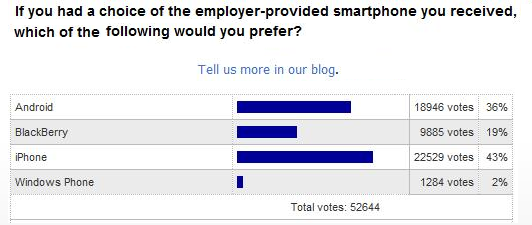
    In addition the positioning of this product is suspiciously awkward. One could argue that as a vendor or operator, having an unaddressed or underserved market (say, business users) might mean this platform could expand the distribution of your product or service. But Windows Phone is being positioned as a consumer brand and that's a crowded space where every other platform is also targeted. See the survey data below (unconfirmed source: US Army)

    So again, why would operators and licensees spend hundreds of millions to introduce yet another platform in the market?

    Maybe they are just taking Microsoft for a ride.

  9. The Android SKU paradox

    Research · 23 comments

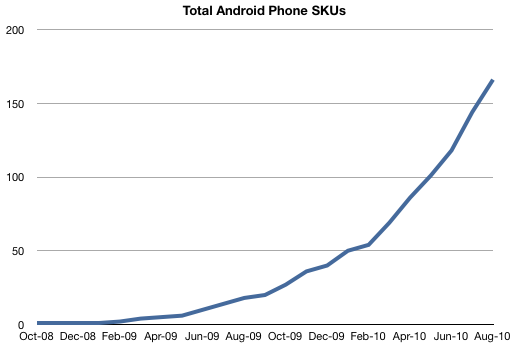
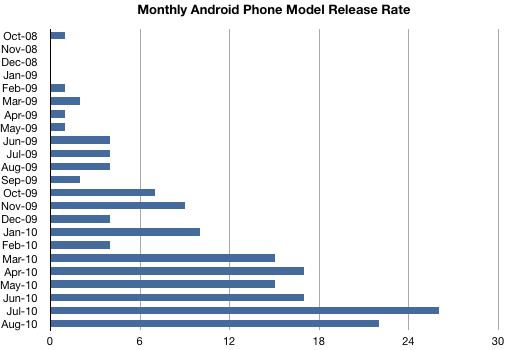
    Next month will be the 24th since the first Android device launched in October 2008. The G1 was followed by another HTC device in February of 2010 and a few others in the spring. The summer of '09 showed a steady release of up to four new phones every month. Since then the number of Android phone stock keeping units (SKUs, uniquely identifiable stockable products) increased dramatically, with the release rate increasing to 26 per month during July of this year (source: pdadb.net).

    Altogether, there are have been 166 Android phone SKUs in the market with another probable 25 or so ready to launch in the next few months.

    Now this may seem like a large number of different phone models in a short time, and it is, but Windows Mobile was even more proliferated as a licensed OS. At its peak over 50 new devices were released every month. The total now is over 1700 and it's still growing.

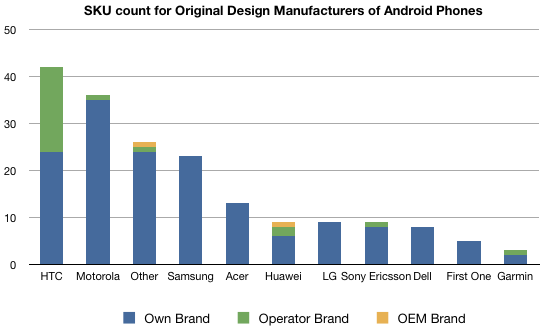
    The 183 known Android devices are distributed among 10 principal vendors with another 18 minor vendors. The 18 "other" vendors (see footnote 1) have either one or two devices in the market.

    The vendors or original design manufacturers list ranked by most devices follows:

    I broke out the devices also by the number of operator branded devices designed by the same manufacturer (green) and any devices designed and built by one vendor but sold under a different vendor's brand (orange). It shows how, excluding "other", HTC is the most prolific Android builder (and seller) but also how it still depends a lot on Operator branding.

    The proliferation of Android devices is indeed striking, but as I've pointed out before, the licensing model for Android is symmetric with that for Windows Mobile with the exception that Android is both open source and cost-free to license. This should make it highly disruptive to the paid-license model that Microsoft worked so hard to implement. It should be no surprise then that the adoption dynamics for the platform are very similar, with the same licensees that took Windows Mobile a few years ago embracing Android today.

    The proliferation still has a while to go. There is production capacity for over 2000 SKUs among all the vendors in the market (especially the "other" category) and it's only been two years since a stable version of the OS has been available. So it would not be surprising if the total number of licensed Android products will overtake the 1700 or so Windows Mobile SKUs.

    So what's the paradox?

    The question that should jump out from this data is what's the value to the participants in this, or any mobile OS licensing model? When I analyzed the Windows Mobile field in 2007 or so, it was pretty evident that very few vendors other than HTC shipped enough volumes to make a product profitable. In fact, I coined the phrase Pocket PC Paradox to describe the situation where hundreds of vendors would line up to make undifferentiated products competing for a shrinking pie. This went on first with Pocket PC PDAs, then repeated with Windows Mobile and is now repeating with Android. Nobody ever made money except for HTC, not even Microsoft.

    It's still a mystery to me why any manager would decide to make the (n+1)th Android/WinMo phone. It must be difficult to make market projections that justify the cost of developing and marketing this new product.

    But here's some help: The total number of Android phones sold through the end of last quarter was about 23 million units. The total number of SKUs launched to date then was about 118. That means that the average Android phone SKU sold 200k units (2).

    Now this may seem comically low, but I will again bring up history and point out that while the WinMo bubble was in its zenith, the average Windows Mobile SKU had 50k units sold. With the SKU count increasing more rapidly than the sales rate (40% more SKUs since June) it's very likely that the average units per SKU is dropping. So by my reckoning there's plenty more in the Android bubble to go.

    -----

    (1) The "other" category includes the following vendors:

    • Lenovo
    • Gigabyte
    • Highscreen
    • Notion Ink
    • WayteQ
    • Forsa Posh
    • Inventec
    • Kyocera
    • Pantech
    • TechFaith
    • Saygus
    • Sharp
    • Ziss
    • Alcatel
    • General Mobile

    (2) I'm fully aware that the distribution of sales over the products is not even and very likely exponential, but there is no way to predict whether a given new product will be a "hero" or DOA. The dream for every manager must be that his product will be a star, but the odds get worse and worse over time and the average units sold has to be considered as including these odds.

  10. Microsoft CIO on Android vs. iPhone: Windows Phone will dominate

    Research · 10 comments

    The OS market in the mobile space is dominated by other players. Is that a cause of worry?

    I think it’s a temporary issue. I don’t put a lot of face and snapshot and time into what is going on. On a global basis, I see what is growing and what is shrinking. Text messaging is the fastest-growing on simple phones part of the mobile market. That’s where growth is. The smart phone part of the market, or the premium market, is in the downward part of the market. It will not be there for a long time in the future.

    People want something that’s simple. The design goal for the Windows Phone 7 is that with rich experience you get simple stuff easily. Great keyboard or touch or both – so you can have that. It is too early to talk about dominating, but I’m excited about it. Android coming into the market says there is room for more innovation and we see ourselves playing a role in that space. People talked about the iPhone and thought that was the end of the world for OS. Windows Phone 7 will prove there is more room for innovation.

    via Q&A: Tony Scott, Chief Information Officer, Microsoft.

    In other words, Android's entry in the market and remarkable growth, there is room for Windows Phone. And because Windows Phone is easy to use and has a keyboard and touch it will have a chance at dominating.

    Microsoft's enthusiasm for yet another mobile platform joining the fray (along with iOS, Android, RIM, Symbian, Windows Mobile, Meego, various sundry Linux and Bada) is not just delusion. I'm sure that they gathered positive feedback from operators. By this time next year there will be dozens of Windows Phone devices on the market. After all, Windows Mobile attracted 1700 licenses.

  11. LG dreams of smartphones [Updated]

    Research · 4 comments

    LG has decided to reduce its bloated mobile phone lineup by half to around 70 from last year's 145.

    It plans to release 20 sets of smartphones this year with 15 models being Android phones.

    He said that 4.2 million phones will be Android-based, while 1.8 million will use Microsoft's Windows Mobile operating system, the executive said.

    via LG jacks up smartphone sales target to 6 mil.

    LG's already thin margins were wiped out last quarter.

    As of the end of the second quarter, Samsung’s global smartphone share was 4.8 percent, according to IDC. But LG’s presence was negligible.

    [Update] From early 2009,

    LG, the third-biggest phone maker, will produce about 50 models that run Windows over the next five years, said Scott Rockfeld, a director in Microsoft’s mobile business. Seoul-based LG will use the software as its primary program for smart phones, devices that can send e-mail and browse the Web.

    Microsoft Signs LG Phone Deal, Updates Windows Mobile (Update1) - Bloomberg.

    Why does Microsoft and LG keep talking about how many phone models they will launch? Since when does a large portfolio make up for poor products?