
Asymco

Asymmetric Intelligence

Microsoft

  1. Why Apple's cash is worth more than Microsoft's cash

    Research · 11 comments

    My recent exposé of Apple's cash (and cash equivalents and long-term securities and short-term securities) drew quite a bit of attention, which is good. Because it needs to be demystified. However, the story does not end there. Part of the problem of cash is that the liquid stuff can often itself change in perceived value due to mis-management.

    Cash has to be valued on the basis of what's to become of it. So what can become of it?

    The value in liquid assets can be returned to shareholders in the form of a dividend, which means double taxation on profits; not the best idea usually. Or it can be returned in the form of share re-purchase which tends to have only a temporary effect on share prices, again not a great return. The value can also be increased by means of investment in projects that return higher than what investors expect their cost of capital to be. This is the best option but investment is difficult when the amount involved is so big that no project or set of projects could possibly cost enough to employ the capital. Finally, the value can be completely destroyed through large acquisitions.

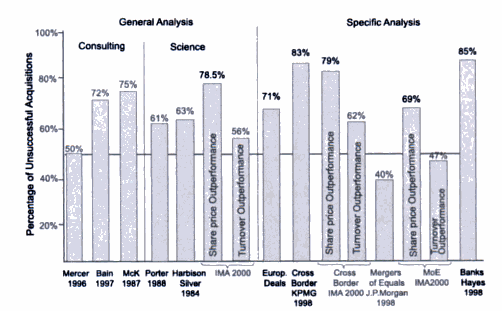
    I say destroyed because the history of large acquisitions is almost universally known to be value destructive (1). The urge to M&A is why cash on the balance sheet for large companies is usually discounted and share prices "get no credit for it." This is plaguing Apple with a P/E ex-cash in the teens.

    Is this fair?

    Companies faced with low growth are more likely to blow their cash on desperate acquisitions than those with high growth, but the best way to judge the probabiliy of cash evaporation is by looking at management track records.

    Which leads us to Microsoft.  Their pursuit of Yahoo shows how desperate they had been in trying to catch Google and how poorly that would have turned out. Having failed only because Yang refused to sell, Microsoft would have gone through a large part of its cash and even raised debt to finance a dud.  With this propensity, it's no wonder that Microsoft's cash is considered an endangered quantity.

    Microsoft used to have the largest cash position in tech. They still have $44.5 billion--a mere billion or so less than Apple. Some of the value already evaporated on dividends and medium sized acquisitions ($500 million for Danger that ended up as Kin(dling)). The chances that they'll blow billions again on desperate means to chase competitiveness are high. I would say it's a certainty.

    On the other hand we have a high growth company like Apple that has not traditionally spent money on business acquisition. (They do spend on asset acquisitions--IP, code, developers but not on new business models.) Thus, on reputation alone, Apple's cash can be considered "safer" and hence worth more than Microsoft's.

    Whether Apple can expose that cash to risk that enhances its value is another matter, but their CEO is on the record stating that "it's not burning a hole in their pocket" and the CFO repeats every quarter he is intent on its preservation.

    This, in my opinion, makes the difference between Apple's $45 billion and Microsoft's $44 billion a lot more than $1 billion.

    (1) Various studies have shown that at least 50% of acquisitions have been rated as failures. See failure rates by various studies charted below. Source: Prof. Dr. Thomas Straub (2007) "Reasons for frequent failure in Mergers and Acquisitions"
  2. Not so Sharp

    Research

    One of the biggest losers in the Kin debacle that hasn't been talked about is Sharp. OEM for the Kin, and the biggest cellphone brand[s] in Japan....but not in the states of course. Kin was supposed to be their entry point into the US market for mobile. Sharp ponied up half the ad $$ for the Kin launch...basically subsidised it with the thought it would be good for their brand and they would sell a lot of phones and be a trojan horse for other Sharp Mobile efforts in the US. Big fail. Not only did they have to tool up factories custom design hardware and sub the marketing they only sold a few thousand phones at best. Sharp's taking a huge bath on this one. And because Sharp's mobile group is in Nara Japan and had no people on the ground in WA or Palo Alto...they had little leverage or insight into the US market and got taken for a ride. I'm sure there are a lot of unhappy execs in Osaka right now cause of this...

    via Mini-Microsoft: The KIN-fusing KIN-clusion to KIN, and FY11 Microsoft Layoff Rumors.

    That link leads to over 600 comments from Microsoft employees regarding the Kin fiasco. Eye watering.

  3. Next of Kin

    Research · 5 comments

    When the Kin was launched, many, including myself, were skeptical. It was a product that contradicted much of what made sense in the industry. It was not a smartphone, it was not a platform and it was predicated on a niche use case. It was, in essence, a feature phone, and as such was not differentiable. However, most people, myself included, were willing to overlook some of these flaws on the basis that Microsoft *must* have done some rigorous product research to support this concept. We fell for the premise that the Emperor *must* have been wearing clothes.

    It turns out he wasn’t. With this knowledge, we should ask the same question regarding clothing to the “next of kin”: Windows Phone 7. There is this same sense of deja vu, that there are a lot of things wrong with WP7, but Microsoft can’t be foolish enough to fail on this. The problems with WP7 are indeed potentially fatal:

    - It is a new platform with no ecosystem facing entrenched incumbents
    - It is expensive relative to Android for OEMs while being completely symmetric in its approach to the licensing market
    - It is not leveraging the installed base of Windows Mobile, and is alienating to WM’s core business users/buyers.
    - it faces a branding challenge, like its predecessor
    - it is feature incomplete, barely on par with iPhone from 2008

    In fact, it’s hard to come up with any key value upon which to anchor the platform. Beside the fact that it is new or, if one were charitable, “fresh” in the interface, it seems to be a solution looking for a problem. Reminiscent of the Zune in many ways, it’s tempting to dismiss it.

    Yet there is always the benefit of doubt being from Microsoft. Or is there? After Kin, is it time to give up on the old adage that Microsoft persists until it wins and never gives up? The Microsoft that won was a low-end disruptor. Offering less-than-good-enough products at lower prices or bundling parts of software into compelling packages, Microsoft expanded markets and increased computing consumption. This is not in the cards for mobile computing.

    Microsoft in Mobile is not playing to its core strengths. Indeed, mobility is a disruptive force for their core. Doing “the right thing” in mobile cannot but threaten the sustaining cash cow of Windows. Microsoft seems to be floundering precisely because it’s trapped in the innovator’s dilemma.

  4. Microsoft's 7 Mobile Operating Systems

    Research

    Adding this all up, Microsoft has several mobile OS products in various stages of production, including

    Windows Mobile 6.5

    Windows Phone 7

    KIN

    Windows Embedded Handheld

    Windows Embedded Handheld 7

    Windows Embedded Standard 7

    Windows Embedded Compact 7.

    As ZD blogger Mary Jo Foley noted recently, this fact is somewhat amusing in the wake of Microsoft CEO Steve Ballmer's criticism of Google for having two different mobile OSes (Chrome OS and Android.)

    via Microsoft's Mobile Strategy Isn't A Strategy. It's A Mess.

    That's not version 7 of an OS, that's 7 different OS's in the market at the same time.

  5. Microsoft OEM VP on tablets: wait and see, could flop like netbooks

    Research · 3 comments

    Giving Android the green light:

    In addition, for the time being, Microsoft will not offer new Windows versions to support non-Intel architectures that are targeting tablet PC development, noted Guggenheimer.

    The formation of a market segment for a new product category necessitates the existence of a supporting ecosystem made up of a complete industry supply chain, Guggenheimer emphasized. He cited the netbook market as an example; units were selling well initially and people believed that the market was going to be established as a new segment, but recently market growth has slowed down considerably, Guggenheimer pointed out.

    via Whether tablet PCs can become market segment is still uncertain, says Microsoft VP.

    I remember when Microsoft used to be paranoid.

  6. IDC: I Dream of Claim Chowder

    Research · 3 comments

    A few eyebrows were raised when Microsoft presented a slide at a French event where they made the claim that 30 Million Windows Phone devices would be sold by the end of 2011.  Given that the first Windows Phone won't ship until October 2010 at the earliest, or, according to Mr. Ballmer, "by Christmas," count me among the skeptics.

    However, the claim was later retracted by Microsoft stating that they mis-quoted IDC, the original source for the forecast.  The correction was perhaps meant to put an end to the credibility crisis.

    However, the actual forecast from IDC was even more preposterous. Apparently IDC makes the forecast that 32 million "Windows Mobile" devices will sell during all of 2011--a combination of both Windows Mobile and Windows Phone devices.

    Instead, the research company forecast 2011 sales of 32 million devices running all Windows Mobile operating systems. This includes expected sales of devices with Windows Mobile 6.5, which is already on the market. IDC has not given any sales estimate for Windows Phone 7, which Microsoft has said will be available in the fourth quarter.

    Their report showed about 16 million Windows Mobile devices shipped in 2009, with a forecast of 22 million this year and 32 million next year.

    Windows Mobile shipped a total of 3.7 million phones in 1Q10, so in order to reach 22 million this year they need to ship 18.3 million for the rest of the year or, on average, 6.1 million phones a quarter.  That's a higher number than what Android shipped in Q1 with BOGO promotions (5.2m units). That's almost as high as the launch quarter for the iPhone 3G.  And all this (mostly) with WinMo 6.5!

    Alternatively perhaps IDC foresees a huge launch for Windows Phone. Assuming an erosion of the WM6.5 to 2.7 m this quarter, 2 million in Q3 and 2 million in Q4, then Windows Phone would somehow need to ship 12 million units during the last quarter.  This number is higher than what iPhone sold in its highest ever quarter.

    This sounds sillier than 30 million Windows Phones in 2011.  By claiming that Microsoft's combination of deprecated Windows Mobile (6.5) and unreleased Windows Phone 7 will continue to sell at a growth of 38% this year, they are actually suggesting an acceleration in sales going into the second half at a rate higher than what the market is likely to grow at.

    In other words, they are suggesting that Microsoft will gain share during the rest of this year. Share gains for a platform that has declined in share in Q1 from 10.2% to 6.8% with 3.7 million units sold on the back of further share losses the quarter prior. Share gains against Android that competes with a free license. Share gains with a new platform that has no clear differentiation vs. the iPhone.

  7. 40 percent of US iPhones are sold to enterprises

    Research · 1 comment

    Four out of 10 sales of the iPhone are made to enterprise users. When the iPhone came out, what most people heard in the first year from ‘07 to ‘08 was oh my God, it’s not BlackBerry secure. This is not going to work on the enterprise space.

    At the end of the day, it’s just software. That’s all it is. And by the time the 3G came out in ‘08 they had solved about 80% of the security issues.

    So enterprises today view the iPhone as a mobile computer. It happens to have a voice application on it.

    via AT&T exec: 4 out of 10 of our iPhone sales to enterprises | ZDNet.

    Compare Apple's approach to that of Nokia:

    Microsoft and Nokia have formed a global alliance to design, develop and market mobile productivity, communications and collaboration solutions.

    Under the terms of the agreement, the two companies will begin collaborating immediately on the design, development and marketing of productivity solutions for the mobile professional, bringing Microsoft Office Mobile and Microsoft business communications, collaboration and device management software to Nokia’s Symbian devices.

  8. Who benefits from the shift from business to consumer drivers for technology?

    Research · 3 comments

    Consumer tastes have overtaken the needs of business as the leading force shaping technology.

    via New King of Technology - Apple Overtakes Microsoft - NYTimes.com.

    Why is it that other "consumer-oriented" companies like Sony, Nokia and Phillips have not benefitted from this shift?  As far as I can tell they are no better off (and sometimes quite a lot worse off) than Microsoft has been during this transition.

    Clearly, although the paradigm did shift to consumers, simply being consumer focused is not enough to benefit from this shift.

    Conversely, simply being Enterprise focused (like Cisco or Oracle) has not caused dramatic loss of shareholder value.

    Thus focus is not causal to fortune.

    From personal experience I can also recall that precisely at the time when the shift was beginning (think back to when "IT does not matter" was published) at least one of these companies was looking for ways to create "Enterprise Solutions".

    This hints at the cause rooted in strategy, or, more precisely, priorities and the courage to lead.

  9. The reason Robbie Bach was fired

    Research · 37 comments

    Vague justifications about under-performance of Windows Mobile or cancelled Courier miss the whole point.  The chronic problems with Microsoft’s consumer businesses cited as causes for dismissal have roots in core processes and priorities which management changes will not address.  The failure of Zune was evident long ago. Windows Mobile has not been competitive with RIM for years, and failed to take significant share from Symbian, never mind iPhone. Tablets were the responsibility of the Windows team.  Kin is a rogue project based on a bone-headed acquisition. From a P/L point of view, Entertainment was mostly Xbox, which although deep in the hole over its lifetime, was starting to break even.

    No, the reason I believe Bach lost his head is that HP bought Palm.

    Bach lost a key account; in fact, he could be responsible for having lost the biggest account that Microsoft ever had.  Ballmer is a sales guy and he knows the importance of these relationships.  A customer like HP must be managed carefully and their strategy must be steered to fit with yours.  If HP felt they needed to go somewhere else for their mobile OS, it's a slap in the face, but if they buy the asset and IP and internalize a competing platform, then that is a dagger to the heart for Ballmer.

    Consider Google's seduction of Dell. Microsoft can tolerate Dell's affairs (Dell even fooled around with Linux back in the day.) But in contrast, HP is effectively filing for divorce.

    The blow could not have been more obvious and more cruel.

  10. Apple's R&D Efficiency

    Research · 2 comments

    In fact it's rumored that Apple brought the iPhone to market for a mere $150 million, doing so organically without acquisition outside of a touch gesture recognition company named FingerWorks.

    This begs the question: how in the world did Apple grow the iPhone platform organically from zero into the most profitable cell phone business in the world with so little investment?

    via Apple's Incredible Efficient Growth.

    Apple has always spent below the industry average for R&D.

    Here are Apple's trailing 9 quarters R&D as percent of sales:

    3.42% 3.86% 2.59% 2.65% 3.51% 3.50% 2.93% 2.54% 3.16%

    Nokia spends at least 10% of sales on R&D and Microsoft at least that much.

    But these numbers are not as spectacular as the comment above that iPhone development cost was $150 million.  To date, the product has generated $31.4B in sales.

    As the article points out, Apple spent $4.6B on R&D over the past four years and Microsoft spent 7x that or $31 billion. Cisco and Intel spent 4x.