Asymco

Asymmetric Intelligence

operator

  1. The parable of the telegraph

    Research · 22 comments

    As previously described in an earlier piece on the transistor, there is a theory that underlies much of what this web diary is about. Telecommunications is undergoing wrenching change. And not for the first time. The history of the industry is filled with disruption and thus with drama that leads to fine storytelling.

    One such great story is that of Western Union and the telegraph.

    Western Union was formed as a company in 1851 and ten years later had completed the first transcontinental telegraph line. Following on that breakthrough, it introduced the first digital real-time data service, the stock ticker, in 1866. Business boomed and by 1870 it was the world's most powerful telecommunications company.

    By any standards it was innovative: it offered remarkable and revolutionary telecom data services, a century before the Internet. But in the century that followed why didn't Western Union become the leader in voice communications, ceding that position to the Bell companies?

    Alexader Graham Bell did not invent the voice telephone with the intention of toppling Western Union. In the language of today's technology entrepreneurship he hoped Western Union would be his "exit". He pitched the phone to them as an improvement to their core telegraphy business. Bell offered the patents for the telephone to Western Union for a mere $100,000, roughly $2 million in today's dollars. In other words, today the deal would be: two million dollars to own all voice IP.

    Western Union passed

    Now why would they do that? Imagine you are an analyst at Western Union advising management on technology acquisition and M&A. What process would you use to evaluate it? First, most obviously, you would try to get feedback from marketing and sales. They should go out and survey their customer base to find out who would be interested and how much they would be willing to pay.

    The sales force would naturally seek out their best customers and ask them first. Those customers were the stock ticker users. They were extremely voracious users of the ticker tape system. It should be no surprise why we have "ticker tape parades"--there was enough of the stuff lying around offices in New York to shower down and flood Broadway end-to-end". Ticker tape was a boon to merchants and traders. Chicago would know what's happening in the New York stock exchange instantaneously. Price data was traveling at the speed of light.  The sender and receiver were in lock-step sync. To suggest to these customers a voice product would sound like a step backward. Why would they want to talk to the other party? The data was coming on tape and it was also recorded for posterity. Speaking with the other person meant confusion and delay and a mess of record keeping.

    The word from the customers would be a resounding negative.

    Second would be the business model.  How would you charge for voice? Data was subscription based, and the fees were huge. Voice would be metered and the price low. If targeting consumers, telegrams were priced by the word, but you couldn't price voice by the word. Marketing would stare back at you as if you had committed a judgement error.

    Thirdly you would look at the cost side. Operations would give you more bad news. Voice technology was different enough that it needed new infrastructure. Switchboards, operators, handsets and new power and insulator requirements were all expensive and had no clear return. Voice was a loser all around.

    So the decision was perfectly reasonable, smart even.

    This is not to suggest that Western Union did not accept any new technology or invest in it. For decades after the phone, Western Union continued to invest in innovation: It introduced an electronic payment system (called money transfer) in 1871. In 1914 it offered the first charge card and in 1923 it introduced teletypewriters. Singing telegrams followed in 1933 and fax service in 1935. Intercity wireless microwave communications were introduced in 1943. Telex came in 1958 and the product of marketing genius, the 'Candygram' in the 1960s. By 1964 its network was all wireless using a transcontinental microwave system. Western Union became the first American telecommunications corporation to maintain its own fleet of geosynchronous communication satellites, starting in 1974. The fleet of satellites, called Westar, carried communications within the Western Union company for telegram and mailgram message data to Western Union bureaus nationwide.

    And it wasn't lacking in talent either. Western Union had the best telecom managers in the business and was raking in profits to fund expansion. It attracted the best and brightest engineers for generations. Western Union probably passed on hundreds of other inventions and ideas, and rightly so.

    So what happened to WU?

    It's still around. However, due to declining profits and mounting debts, Western Union slowly began to divest itself of telecommunications-based assets starting in the early 1980s. Due to deregulation in the US, Western Union began sending money outside the country, re-inventing itself as "The fastest way to send money worldwide". In 1987, an individual investor acquired control of Western Union through an outside of chapter 11 process that was a complex leveraged recapitalization. After several other changes in ownerships and moves through bankruptcy, WU is now a public company with an enterprise value of about $12 billion based entirely on international money transfer business.

    3G as a disruptive technology

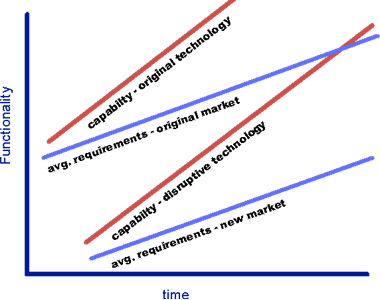
    Today we've come around full circle. Whereas voice was disruptive to a data network provider in the 20th century, data is disruptive to a voice network provider in the 21st. The mis-application of 3G network technology to sustain voice-oriented business models gives one a strong sense of déjà vu.

    The telecom world moved swiftly to 1G and 2G cellular voice. Each new generation of mobile telecom was sustaining the core business model of subscriptions feeding centrally managed networks and symbiotic device vendors benefiting from handset and switching system upgrades. Standardization, international expansion, lower price points and network effects made this industry the most ubiquitous technology distributor the world had ever seen.

    3G however was different. It was effectively mobile broadband data. It enabled data services to be de-coupled from the network operators. IP protocols did not require the servers to be located on operator premises or even to be managed or monitored by them. Devices could be general purpose computers not specific purpose communicators. Incumbents did not adapt to this well.  They continued to build business plans according to a central-switch blueprint.

    So although incumbents did not reject the smartphone as a technology, they tried to make it sustaining when plainly it isn't. They essentially tried to cram it into their business models.

    The struggle to keep the service structure of telecom centered around the network operator will continue, but short of pulling the plug on 3G and LTE, there is little that the incumbents can do to stop it.

    So what's the lesson?

    Some technologies are embraced and some are rejected. You can't fault every rejection and you can't praise every acceptance. The most likely reason for embracing something is that it helps grow your existing business. The most likely reason for rejection is that it may harm your business. Even acceptance sometimes leads to mis-application in sustaining the core rather than planning for its demise.

    The decision on how to handle something new and potentially disruptive requires a different sense of what's right and wrong about it.

    --

    Photo: Former headquarters of WU, located at 60 Hudson, New York.
  2. Windows Phone Thoughts: AT&T set to release multiple Windows Phones

    Research · 6 comments

    That makes a total of six devices for [AT&T] who is looking more and more like the premier Windows Phone 7 partner.

    via Windows Phone Thoughts: AT&T Set to Release Multiple WP7 Devices.

    With Verizon shaping Android into its image, you can read AT&T's embrace of Microsoft as the deeply-held belief by operators that they need multi-platform balance in their portfolio.

    The idea that operators will tolerate "dominance" of a platform is looking less and less tenable.

  3. Why OPK was fired

    Research · 27 comments

    Under Kallasvuo Nokia embarked on the most dramatic shift in its business since entering the mobile phone business in the early 90s.

    The shift was not into mobile software which began in 2001 under his predecessor. It was not into enterprise solutions which also preceded his tenure. OPK's main contribution was the move into mobile services.

    The concept of mobile services may be an unfamiliar one for casual observers because it has not become a visible business for operators and certainly not for handset vendors. It's also a complicated business model that requires some deeper understanding of the way the telecom industry is structured.

    What Nokia had in mind was to offer various value-added, billable services to operators which would be enabled by Nokia handsets. The types of services included music subscriptions (Comes With Music), email (several acquisitions), photo sharing, and navigation.

    The idea was that since many operators would not be capable of rolling out own brand services and could not do the heavy back-end lifting or the integration with handsets, someone could step in and roll out white labeled solutions world-wide. Third parties would also find it impossible to integrate and would lack the relationships Nokia had with operators world-wide.

    For example, Nokia could enable a South American operator to offer email services to all their customers (with or without smartphones) and that service could be offered at a certain incremental price over the basic voice plan. The client implementation could be device independent but Nokia devices would probably work better. This would lead to higher ARPU which could be shared with Nokia.

    Anyone can see that this is a complicated business plan and is therefore unlikely to be successful. But what makes it a complete failure is the realization that most buyers will resist the idea of paying for individual services separately. $1/mo for email, $2/mo for music, $3/mo for maps, etc. is repulsive. Users stampeded instead to unlimited data plans and smartphones which offered all these services and hundreds more for free or at prices negotiated with third party providers, rather than the untrusted network operators.

    And therein lies the entire cause of Nokia's strategic failure: an operator centric point of view. It led to poisoned devices and irrational business plans.

    Which leads to the question in the headline. Is this mistake recognized and is it big enough to cause such a disruptive CEO dismissal?

    I argue yes. Strategic errors are forgivable, but the they become a capital offense when they turn into a derailment of the core business. Instead of being enhanced with value-added services, the core business collapsed under the disruptive attack of unlimited data.

    But it gets worse. Like the capital offense that Robbie Bach was guilty of at Microsoft, there has to be some direct accountability. To add insult to injury, OPK single-handedly pushed through the biggest and stupidest acquisition in Nokia's history. To support this flawed vision of mobile services OPK bought Navteq for $8.1 billion in October 2007.

    Intended as a service that could be rolled out on all phones and monetized through operator billing, Nokia maps is a free service that will never return anything to shareholders.

    Missing where the puck was going is one thing but burning precious capital is another. This, in my humble opinion, is why OPK was fired.

    Speaking of pucks, here's hoping fresh Canadian eyes will see where it's going.

  4. HTC: How Taiwan Compares

    Research · 1 comment

    Taiwanese operators Chunghwa Telecom and Taiwan Mobile have reported much interest in iPhone 4 pre-orders. Both operators announced at 9pm on 26 August they would open pre-ordering at 10am on 27 August and both operators saw their websites crash, the China Post reports. By noon, some 10,000 users had signed up with Chunghwa Telecom and by 11am Taiwan Mobile had sold out all of its 3,000 iPhone 4 handsets available for pre-ordering. Rival Far EasTone said between 30,000 and 40,000 people signed up for a phone on its website and the operator will notify people that will be able to get the handset.

    Taiwan Mobile sells out of iPhone 4 pre-orders - Telecompaper.

  5. Microsoft's billion dollar bonfire

    Research · 31 comments

    Microsoft executives told Goldberg during a recent visit to company headquarters that the company, carriers, and manufacturing partners, would spend "billions" of dollars in the first year on marketing and development of Windows Phone 7. Another source estimated a $1 billion price tag for the launch, with half of it going to marketing.

    via AppleInsider | Microsoft to spend over $500m to catch up to iPhone, Android.

    Note the scale of spending here.  The number quoted is twice Apple's yearly ad budget, for all its products.

    $500 million is roughly the equivalent of Apple's entire advertising budget for its 2009 fiscal year. In its 2009 Form 10-K filing to the SEC, the Cupertino, Calif., company listed $501 million in advertising expenses. Microsoft's fiscal 2009 advertising budget was $1.4 billion.

    But beside the unrepentant destruction of Microsoft's shareholder wealth, one other thing jumps out at me: why are the operators and vendors going along with this?

    Fragmentation increases the cost of development, marketing, operations and hinders the creation of cohesive ecosystems.

    Most companies are very aggressive in consolidating around internal platforms and standards. Supporting R&D teams and marketing teams around each platform is costly and dilutive to one's brand.

    With hundreds of Android devices and RIM and Apple increasing distribution, why would operators be willing to spend hundreds on a venture to promote a new platform? This decision is even more puzzling when realizing that the vendor of the new platform left nothing but business model carcasses behind the last time they got involved in the industry.

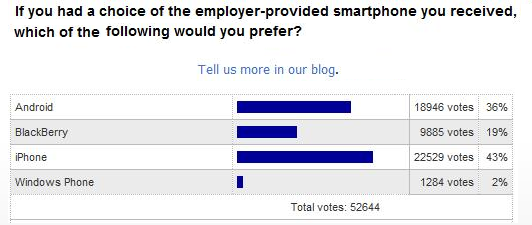
    In addition the positioning of this product is suspiciously awkward. One could argue that as a vendor or operator, having an unaddressed or underserved market (say, business users) might mean this platform could expand the distribution of your product or service. But Windows Phone is being positioned as a consumer brand and that's a crowded space where every other platform is also targeted. See the survey data below (unconfirmed source: US Army)

    So again, why would operators and licensees spend hundreds of millions to introduce yet another platform in the market?

    Maybe they are just taking Microsoft for a ride.

  6. The Android SKU paradox

    Research · 23 comments

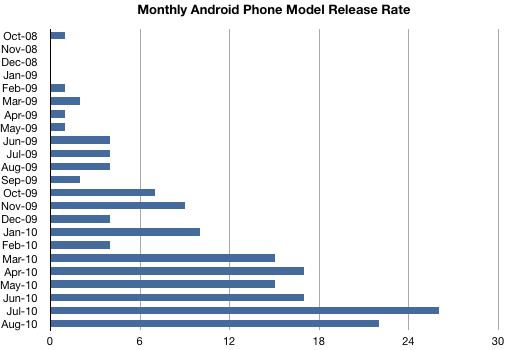
    Next month will be the 24th since the first Android device launched in October 2008. The G1 was followed by another HTC device in February of 2010 and a few others in the spring. The summer of '09 showed a steady release of up to four new phones every month. Since then the number of Android phone stock keeping units (SKUs, uniquely identifiable stockable products) increased dramatically, with the release rate increasing to 26 per month during July of this year (source: pdadb.net).

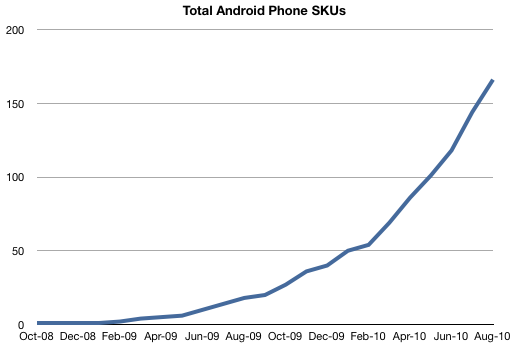
    Altogether, there are have been 166 Android phone SKUs in the market with another probable 25 or so ready to launch in the next few months.

    Now this may seem like a large number of different phone models in a short time, and it is, but Windows Mobile was even more proliferated as a licensed OS. At its peak over 50 new devices were released every month. The total now is over 1700 and it's still growing.

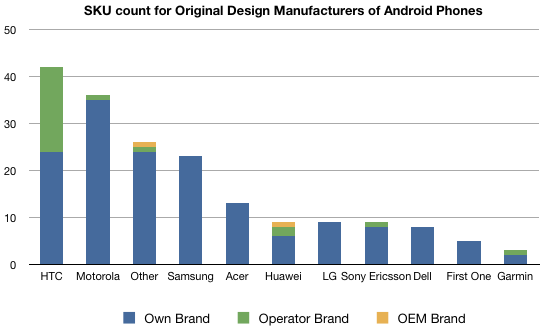
    The 183 known Android devices are distributed among 10 principal vendors with another 18 minor vendors. The 18 "other" vendors (see footnote 1) have either one or two devices in the market.

    The vendors or original design manufacturers list ranked by most devices follows:

    I broke out the devices also by the number of operator branded devices designed by the same manufacturer (green) and any devices designed and built by one vendor but sold under a different vendor's brand (orange). It shows how, excluding "other", HTC is the most prolific Android builder (and seller) but also how it still depends a lot on Operator branding.

    The proliferation of Android devices is indeed striking, but as I've pointed out before, the licensing model for Android is symmetric with that for Windows Mobile with the exception that Android is both open source and cost-free to license. This should make it highly disruptive to the paid-license model that Microsoft worked so hard to implement. It should be no surprise then that the adoption dynamics for the platform are very similar, with the same licensees that took Windows Mobile a few years ago embracing Android today.

    The proliferation still has a while to go. There is production capacity for over 2000 SKUs among all the vendors in the market (especially the "other" category) and it's only been two years since a stable version of the OS has been available. So it would not be surprising if the total number of licensed Android products will overtake the 1700 or so Windows Mobile SKUs.

    So what's the paradox?

    The question that should jump out from this data is what's the value to the participants in this, or any mobile OS licensing model? When I analyzed the Windows Mobile field in 2007 or so, it was pretty evident that very few vendors other than HTC shipped enough volumes to make a product profitable. In fact, I coined the phrase Pocket PC Paradox to describe the situation where hundreds of vendors would line up to make undifferentiated products competing for a shrinking pie. This went on first with Pocket PC PDAs, then repeated with Windows Mobile and is now repeating with Android. Nobody ever made money except for HTC, not even Microsoft.

    It's still a mystery to me why any manager would decide to make the (n+1)th Android/WinMo phone. It must be difficult to make market projections that justify the cost of developing and marketing this new product.

    But here's some help: The total number of Android phones sold through the end of last quarter was about 23 million units. The total number of SKUs launched to date then was about 118. That means that the average Android phone SKU sold 200k units (2).

    Now this may seem comically low, but I will again bring up history and point out that while the WinMo bubble was in its zenith, the average Windows Mobile SKU had 50k units sold. With the SKU count increasing more rapidly than the sales rate (40% more SKUs since June) it's very likely that the average units per SKU is dropping. So by my reckoning there's plenty more in the Android bubble to go.

    -----

    (1) The "other" category includes the following vendors:

    • Lenovo
    • Gigabyte
    • Highscreen
    • Notion Ink
    • WayteQ
    • Forsa Posh
    • Inventec
    • Kyocera
    • Pantech
    • TechFaith
    • Saygus
    • Sharp
    • Ziss
    • Alcatel
    • General Mobile

    (2) I'm fully aware that the distribution of sales over the products is not even and very likely exponential, but there is no way to predict whether a given new product will be a "hero" or DOA. The dream for every manager must be that his product will be a star, but the odds get worse and worse over time and the average units sold has to be considered as including these odds.

  7. The Android abdication

    Research · 18 comments

    When I wrote about Android's pursuit of the biggest losers, I made the explicit claim, backed by data, that Android was most attractive to device vendors who were in financial distress. Android is a lifeline to sustain failing business models. But underlying that claim was the more sinister implication that Android is sustaining to the incumbent operator business models. That means that Android is subject to operator manipulation and its market access as well as those of competing platforms will be throttled to maintain control.

    The article below makes an even stronger case.

    As a result, we now have a situation where the U.S. telecoms are reconsolidating their power and putting customers at a disadvantage. And, their empowering factor is Android. The carriers and handset makers can do anything they want with it. Unfortunately, that now includes loading lots of their own crapware onto these Android devices, using marketing schemes that confuse buyers (see the Samsung Galaxy S), and nickle-and-diming customers with added fees to run certain apps such as tethering, GPS navigation, and mobile video.

    The dirty little secret about Google Android | Tech Sanity Check | TechRepublic.com.

    I would not say that Android is enabling the consolidation of operator power. I would say that operator power never wavered.

    The article concludes:

    Despite the ugly truth that Android is enabling the U.S. wireless carriers to exert too much control over the devices and keep the U.S. mobile market in a balkanized state of affairs, Android remains the antithesis of the closed Apple ecosystem that drives the iPhone and so it’s still very attractive to a lot of technologists and business professionals.

    But, the consequence of not putting any walls around your product is that both the good guys and the bad guys can do anything they want with it. And for Android, that means that it’s being manipulated, modified, and maimed by companies that care more about preserving their old business models than empowering people with the next great wave of computing devices.

    That sounds about right.

  8. Talk of mobile dominance is bunk

    Research · 25 comments

    I've been asked in comments on this blog who will win the "mobile war".

    I use two analytical tools to answer this question: (1) history (2) value chain analysis.

    History shows that operators are very important and hence very powerful in this market. That makes sense on many levels. They control what phones you get to buy, they decide the pricing and they decide frequently how you can use the phone. This is because the networks are expensive to build and maintain and there is an implicit bargain struck that the user and device should conform to the operator.

    Value chain analysis tells me that as networks are not good enough, tight integration of the business models of the phone vendors and the operators is necessary to climb up the trajectory toward good enough as quickly as possible.

    Therefore, given the distribution of value/bargaining power in the chain, it’s reasonable to assume that it’s operators who will decide which platforms win/lose and to what degree.

    That simply means that no single platform can win a disproportionate share because it would threaten the balance of control the operators require. So talk of “dominance” of one platform or another is hyperbole. The most likely scenario is an even distribution of share between 4 or 5 competitors, so I expect iPhone and Android to get 20% share each.

    This is not “fair” or economical or efficient, but it’s the way it’s going to be for a long time. If you're a fan, don't despair. In a few years, it still means hundreds of millions of units a year for each platform.

    If you want to dream or hope for a more efficient outcome, you’ll have to look outside the cellular network model. I.e. think how iPod/iPad and Android tablets will evolve into communications products.

    (thanks to M for asking).

  9. HTC: How They Compare

    Research · 17 comments

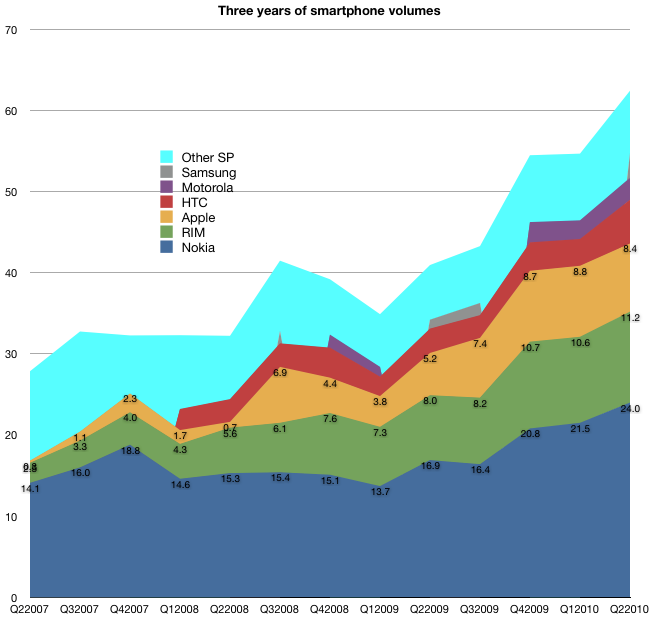
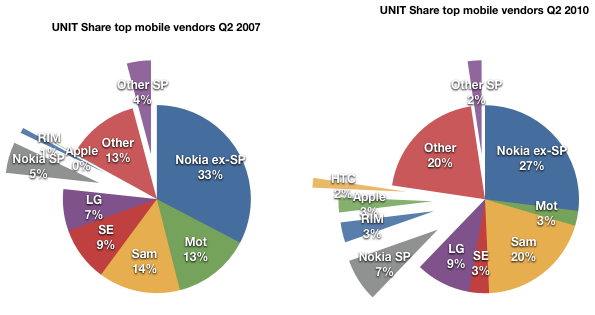
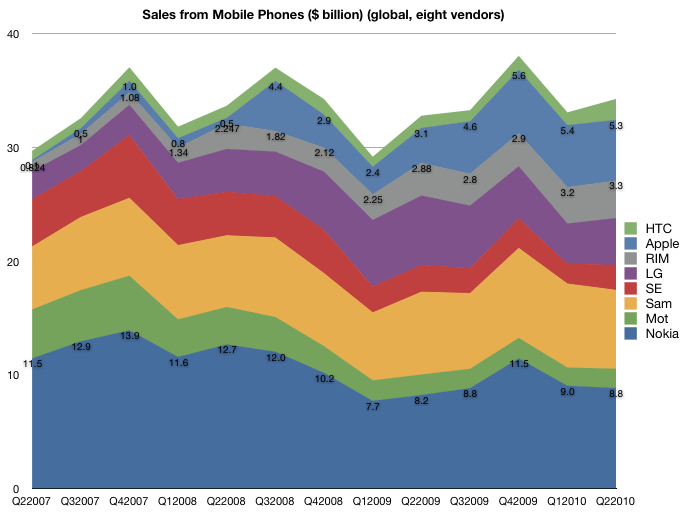
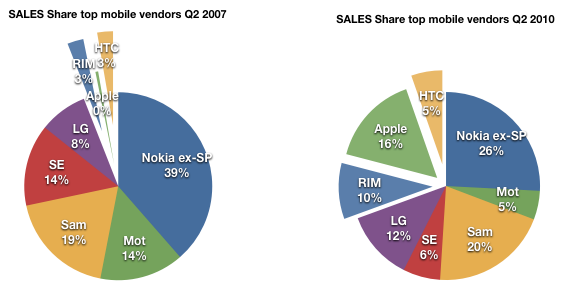
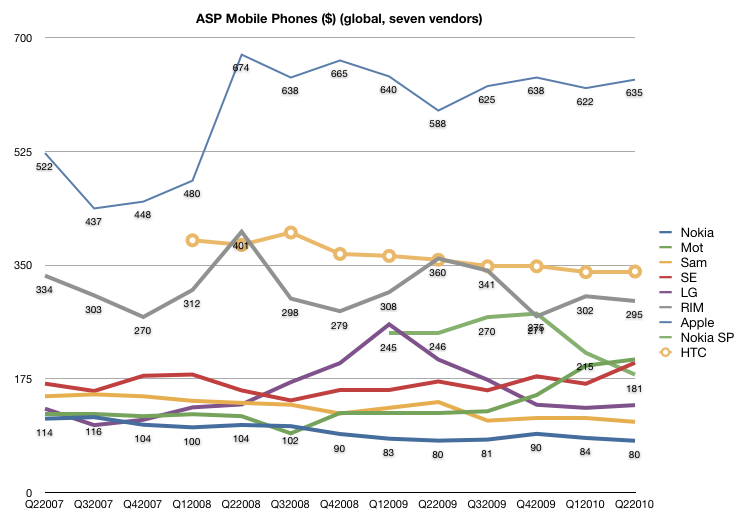
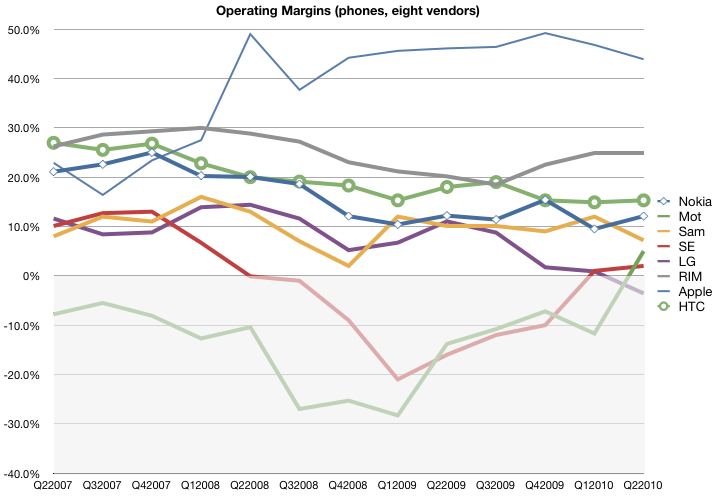
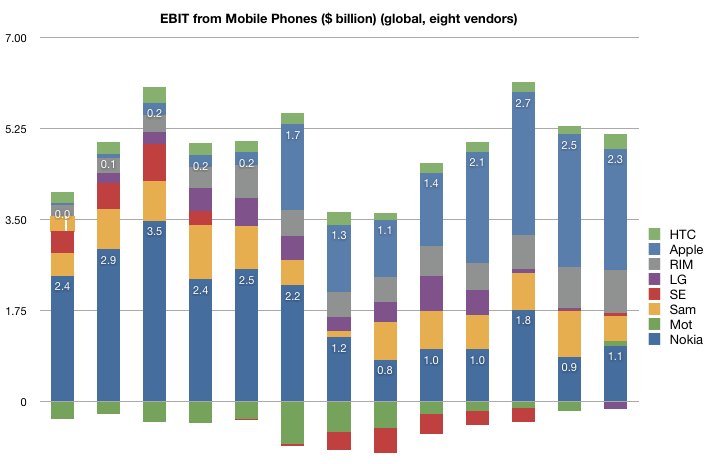
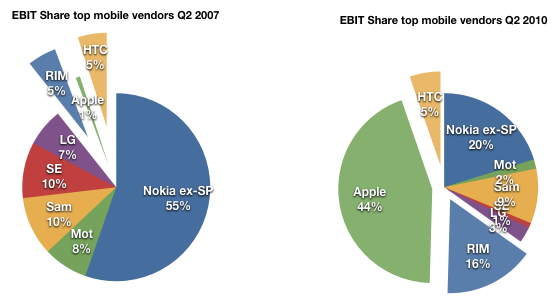
    In the last mobile market update series I wrote of  the evolution of market share, the shift in where dollars are spent, the tale of ASP erosion, profitability ratios over time and EBIT share over time.

    I did not include all vendors for various good reasons. The first survey (market share) did include an "others" category that made the volume data complete, but in the financial data sets, I chose to include the top 7 vendors that make up 80% of device volumes.

    One noteworthy vendor that was not included was HTC. HTC is an important vendor for several reasons:

    • it's a pioneer in smartphones having made the first Windows Mobile devices and the first Android devices
    • at one point it sold 80% of all Windows Mobile devices
    • even if it did not brand its devices, it was the name behind many re-branded or white-label operator branded phones
    • it has a brand of its own today and is expanding its reach

    HTC has been around building devices since 2001 and so it would be a pity to exclude them from any analysis of the effect of iPhone on the market or any discussion on the effect of smartphone disruption on feature phones.

    The challenge with HTC was that historically their branded devices and white label devices were not reported by the company separately. This matters because white label devices are valued differently. Typically these devices are not marketed by the original manufacturer so SG&A is not applied to their cost base. Operating margins, ASPs and hence profitability is not directly comparable with other OEMs.

    But HTC has recently changed its reporting. Thanks to a reader I discovered that, since 2008, HTC has been listing its ASP and Operating Margin making direct comparisons possible. I still don't have all the data, but enough to add HTC to the analysis.

    So, here are the 5 industry performance criteria, now with eight vendors listed.

    Volumes

    Note that HTC volumes start in 2008.

    The volume of units HTC sold has been increasing at about the rate of market growth.

    As a result, HTC's share has not increased as dramatically as those of the other smartphone entrants.

    Sales

    A similar story in the sales picture. Although a consistent performer, the growth has not matched that of RIM and Apple.

    ASP

    The pricing story is also a mixed one. Although HTC lies between RIM and Apple in price, the erosion is more consistent with RIM and the rest of the industry.

    Margin

    The margin story is also not as positive as one might expect. The margins for HTC started out above Apple and RIM but have dropped to closer to industry average. This is not what one might expect from an exclusive smartphone vendor.

    Earnings

    The share of earnings has remained unchanged at 5% over the period of iPhone presence. It's perhaps a credit to HTC that they did maintain their position in the market with the massive change that has come to pass.

    However, here we also have to ask if HTC is riding a disruptive wave.

    When I wrote the last series, my definition of “loser” was a company that had faced a long series of operating losses and has no viable software assets of its own, making it vulnerable to Android (and Windows Mobile). Motorola first, Sony Ericsson second and LG now coming into the picture. Nokia is not a loser in this sense since it has remained profitable and does maintain an investment in software. Same with RIM and Samsung (now with Bada). When/if they do have the near death experience, they might opt for the Android lifeline (flimsy as it is).

    However HTC does not fit the mold of either "winner" or "loser". It's the Goldilocks company, not too hot, not too cold.

    But I would add that HTC is not an example of a winner because of its adoption of Android. HTC’s dependence on Windows Mobile made their move to Android the most desperate of all. Unlike the larger OEMs, who had their low end devices to fall back on, they are completely dependent on a smartphone OS vendor. When WinMo was showing the first signs of crisis in 2007, they were the first to flee to Android (think of why they would risk the wrath of Microsoft for something so fragile as Android in 07). They are also trying hard to escape the dependence by building up their own UI (SenseUI) and I would not be surprised if they move to their own OS in the future. Being associated with Android does not confirm them as "winners" but in fact, shows their vulnerability.

    What does this all say about Android?

    Again here my thesis is that Google chose to sustain the industry rather than try to upend it. I don't judge their motives, but the fact is that with Android, Google is not in a position to disrupt telecom. There were high hopes dashed with the Nexus One and hearts broken with net neutrality and now there are patent wars to be fought. Android, with its licensees, is still at the mercy of operators.

  10. Is Android Disruptive?

    Research · 1 comment

    The common thread among the Android fans is that Google is the agent of disruption of a hated operator business model. Since disruption is well understood (though not by many) it is fairly easy to evaluate this hypothesis.

    The problem with disrupting network operators is that disruption can only happen when the underlying service/product they provide becomes "good enough" i.e. more than what customers can absorb. A new basis of competition emerges and we all know what happens.

    Here's the problem: since mobile broadband is by all accounts not good enough, it cannot be disrupted. Operators are very critical in building out this new mobile computing future and they are investing and will reap rewards. Bitpipe models will only emerge after 4G when there will be ubiquitous high speed networks and competition will shift away from coverage and more to price and convenience of plans.

    What is happening instead of operator disruption is that mobile voice which is more than good enough is being disrupted. Businesses built around mobile voice (e.g. handset vendors who have not developed a viable business model around data) will simply evaporate and their profits will condense around entrants who have mobile computing platforms.

    Google is moving on this opportunity but they are not executing in a way that ensures they control the future platform due to the their being on the wrong side of the modular/integrated dichotomy.

    Android will disrupt but I expect it will take 10 to 15 years. The life cycle of a new global network generation rollout is about 10 years. We're in the middle stage of the 3G cycle that traces its beginnings to early this decade. 4G will take another 10 years.