Asymco

Asymmetric Intelligence

operator

  1. Half of US population to use smartphones by end of 2011

    Research · 35 comments

    60.7 million people in the U.S. owned smartphones during the three months ending in October, up 14 percent from the preceding three month period, representing 1 out of every 4 mobile subscribers.[...] Despite losing share to Android, most smartphone platforms continue to gain subscribers as the smartphone market overall continues to grow.

    via comScore Reports October 2010 U.S. Mobile Subscriber Market Share - comScore, Inc.

    Separately, Nielsen reports on the same market:

    29.7 percent of U.S. mobile subscribers now own smartphones that run full operating systems.

    The most popular smartphones are the Apple iPhone and RIM Blackberry, which are caught in a statistical dead heat with 27 percent of smartphone market share in the U.S. Twenty-two percent of smartphone owners have devices with the Android operating system.

    via U.S. Smartphone Battle Heats Up: Which is the “Most Desired” Operating System? | Nielsen Wire.

    I've been tracking the Nielsen data and using it as a basis for forecasting the penetration of smartphones. While most coverage of this data focuses on splits between current OS platforms, I will look at competition with non-consumption and the impact on operator services.

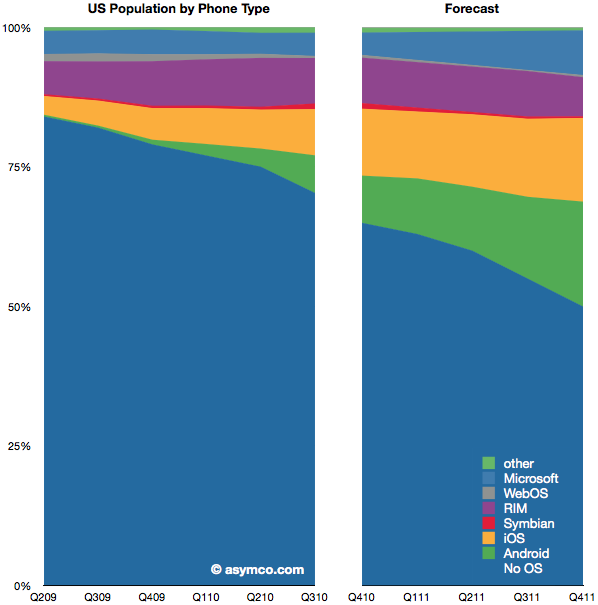
    The chart on the left shows the historic penetration of smartphones since mid-2009 based on Nielsen's reports. The chart on the right is my forecast. This is an update from the last quarter's chart here. My forecast was fairly accurate with respect to platform shares in the last quarter so I've had to make only small adjustments and extended the forecast one quarter further out. [1]

    If my forecast is correct, smartphones will make up 50% of all phones in use by the end of 2011. That's up from nearly 30% today and 18% a year ago.

    One in three of all phones in use will be either iOS or Android. That adds up to about 80 million users; up from 35 million today. Overall, 120 million Americans will be using smartphones.

    Now consider the consequences for how services are delivered by operators. The most popular product operators will be selling will be unlimited data plans. One year hence, by 2012, unlimited data plans may become the largest service revenue generator for mobile operators in the US. Pricing and competition will inevitably be in a state of extreme flux. I leave the consequences to the imagination of the reader.

    ---

    [1] Note that the charts show share of phones in use, not phones sold in a particular point in time. In other words, this is measuring platform consumption, not units sold.

  2. The iPhone is not superfluous, not easily copied, not revolutionary and not a premium product

    Research · 61 comments

    The release of the iPhone is rightly acclaimed as a watershed event in the history of telecom. It was a sensation. But it was also a product that was widely underestimated and dismissed. Even today expert opinion is divided. The critics of the product transitioned directly from labeling it a superfluous bauble to an obvious and copyable sustaining innovation. Advocates of the product describe it as revolutionary and dazzling with the potential for capturing significant profit share due to premium pricing and positioning.

    So which is it?

    I'll argue that it's none of the above. The iPhone is not superfluous, not easily copied, not revolutionary and not a premium product. What it is is disruptive.

    First, we have to quickly define disruptive potential.

    A product is disruptive if it competes with an existing, incumbent set of products on a new basis. It competes along a new measure of performance. That means it's either "low end" and hence cheaper, simpler, more modular and conformable, or it creates a "new market" where completely new measures of performance or quality are relevant.

    In both "low end" and "new market" disruptions the product is usually wrapped in a business model that insulates it from incumbent response due to inherent asymmetries. Incumbents will find the economics of the entrant product unattractive and will be motivated to ignore it or actively avoid copying it.

    The consequences of disruptive product entires are often catastrophic for the incumbents because, over time, the disruptor product vacuums up all the profits in the industry, robbing the incumbents of the fuel to respond by the time they become motivated to do so. In essence, the transfer of value to the new basis of competition happens so slowly that the threat is imperceptible until it's too late.

    If we look at this definition, it's startling that the iPhone does not seem to fit.

    As a phone, it's not cheaper, nor modular and hence not "low end". It did not create a new market.  As a phone, although it did recruit more regular phone users into becoming smartphone users, it was not the first or last phone to do so. Its phone business model was not a radical departure. It was not ignored by the mobile phone incumbents who reacted with various degrees of urgency and vigor. It was actively copied in every way from the UI to the ecosystem to the pricing model and distribution.

    The only thing that seems to have happened according to the disruptive formula was the transfer of profits from incumbents to Apple, at least temporarily.

    So the iPhone seems to be correctly classified as a sustaining innovation. Something that moves the phone market forward and which, except for a temporary misallocation of profits, will entrench the incumbents after they manage to copy it effectively.

    However, here is where we have to dig a little deeper.

    Market analysis easily becomes myopic when looking only at a market defined by a product. I've argued in the past that strategic insight comes from looking at products that cross over their market boundaries. Especially products that are hired to do different jobs than the same products in their categories. The iPod may seem like an MP3 player but it caused catastrophic profit collapse in multiple industries. It knocked out the CD business, it crippled the component audio system "Hi-Fi" industry, it razed the music retail business and affected the entire music value chain. It's still pounding at the gates of video and TV production. And, almost as a side-show, it crushed the Walkman.

    Even though it was a music player, the MP3 device market was the smallest target for the iPod. It turned out to be far more dangerous to ancillary industries. The reason is subtle: it competed as an integrated ecosystem. You hired the iPod to serve you music everywhere, not just in your living room. And it did the job in an integrated way from source to earbuds taking what was a hodgepodge of modular components built around analog music and smoothly integrated them to deliver music in new, non-consuming contexts.

    The lesson is therefore that when looking at the iPhone one has to look at ancillary industries not just at phones.

    Phones have always been a component in a wider inter-related telecom value network. Even today they are often called "terminals" in the industry meaning that they are the end points of a network. Similar to the PC, the iPhone enables a migration of intelligence away from the center toward the edge of the network resulting in a de-valuation of the network itself.

    I argue that the real disruption of mobile computing (i.e. iPhone) is made possible not by the smartphone technologies but by mobile broadband. Once broadband became mobile with 3G the smartphone could shift its focus (jobs it's hired to do) from voice to data. That shift is disruptive to incumbents because they built their businesses around operator distribution and operator service economics. With apps, mobile computing brings with it services which allow all communications to be independent of operators. Selling ringtones, maps, email and video-on-demand are all dead business plans today. But operators clung on to these hopes for many years and forced vendors to comply to this strategy.

    The incumbents relied so much on the telecom value chain, where the value flows from the monthly service charge, that they would not deploy technologies or business models that were asymmetric to operator business models. This is the root cause for Nokia and Samsung and Motorola and LG "missing the boat" on smartphones. All the vendors had the pieces of technology on their shelves. But when they took these technologies to their customers, the customers rejected the package.

    This is why entrants like RIM and Apple could easily gain a foothold and grow. They had modest volumes, sold new concepts like business email and new UIs with iconic designs, but did not go after the core business model. This is similar to how iPod/iTunes got a toehold with the record labels. By the time the disruption took hold, operators were addicted to the new high-ARPU being generated even though they were all pure bitpipe plans. A bird in the hand is worth two in the bush, so the new device brands stuck.

    Do the incumbents still have time to respond effectively? It's less and less likely. They cannot build the new computing ecosystem without the distribution power of operators. Note that iPhone 'clones' in Android are still sold via operators and that nobody is interested in making either iPod touch clones or iPad clones sold independent of the operator channel/subsidy model. This is not because of technical or economic reasons but because of a lack of distribution (and lack of integrated content).

    When you step back and look at the phone in the context of the network business model as well as the shifts in consumer jobs to be done you realize the potential is far greater than taking share from incumbents. The iPhone is not divided into a portfolio of different phones, but it's a part of a portfolio of new mobile computing products. It just happens to be the only one which still depends on the cellular operator distribution network.

    Seen as part of a new mobile computing paradigm and following the trajectory of the mainframe, mini-computer, PC and laptop, the iPhone is an essential, non-superfluous device for a vast population of new users.

    Seen as an integrated app ecosystem with strong network effects, it's not easily copied. Responses that only account for it as a glass and metal object of desire will fall way short of being competitive. As the hardware was always available to competitors, it's not a revolution in hardware or even in user experience.

    Most importantly, seen as a computing alternative merged with a communication appliance, it and its siblings are not premium products. The pricing and service structure around it make it seem a low cost alternative for solving the jobs it's hired to do.

    In other words, it is as disruptive as it gets.

  3. Are mobile networks commodities?

    Research · 23 comments

    Apple has been contemplating a SIM card that would make carrier switching a lot easier. Sounds great, doesn't it?

    "Apple is relenting," said Rodman Renshaw analyst Ashok Kumar. "They are now completely backing away from their plan to take the carrier out of the equation," said Kumar,.

    via Apple to Kill Carrier-Irking iPhone Plan - TheStreet.

    This brings to mind a recent article I wrote that any talk of mobile dominance by platform vendors is bunk.

    ... no single platform can win a disproportionate share because it would threaten the balance of control the operators require. So talk of “dominance” of one platform or another is hyperbole. The most likely scenario is an even distribution of share between 4 or 5 competitors.

    The power of distributors in the mobile phone value chain cannot be ignored. It's not fair, it's not convenient and it's not consumer friendly, but as long as networks are not good enough for mobile computing, mobile computers cannot commoditize the network.

    The consequence (for those of us who try to foresee the platform game) is that operators will continue to play platforms off against each other leading to the scenario I suggest above.

  4. China Unicom Says It Will Introduce own smartphone OS by Year-End

    Research · 7 comments

    The UPhone will run on a “totally new” operating system that Unicom developed based on Linux, Zhang Zhijiang, who heads the company’s technology department, said in an interview today at the Mobile Asia Congress in Hong Kong. The phone is being developed with Okwap, Huawei Technologies Co. and ZTE Corp., he said.

    via China Unicom Says It Will Introduce Self-Developed Smartphone by Year-End - Bloomberg.

    Operators are still considering bespoke operating systems.

    See also: European Operators contemplate own OS. Why not just fork Android?

  5. Android remains the only mobile OS still patterned after Microsoft's 2002 vision of the mobile value chain

    Research · 52 comments

    Belfiore wasn’t shy about criticizing Google’s Android OS. Even though Google currently dominates the mobile OS market, its strategy of licensing the Android OS to manufacturers is similar to Microsoft’s previous approach with Windows Mobile: It’s open-ended, and there are few restrictions on how manufacturers can use or modify the OS.

    As a result, Android is suffering from some of the same issues as Windows Mobile did: Android works better on some phones than others, manufacturers are shipping different versions of the OS on different phones, some Android phones are shipping with bloatware made by carriers, and some app developers complain that it’s difficult to make software because of the hardware and OS fragmentation.

    via How Microsoft Hit CTRL+ALT+DEL on Windows Phone | Gadget Lab | Wired.com.

    Android was initially an attempt to commoditize Windows Mobile with a symmetric but "free" alternative. The idea was to conform to OEMs and operator business models. This was directly copied from Microsoft's early 2000's playbook for entry into mobile.

    Trouble is that Microsoft realized their purely modular, operator and OEM centric approach was failing to be competitive on the user experience and decided to move into a more integrated approach, closer to Apple's integrated model.

    But while Microsoft dropped their vision, Android was still patterned after their approach.

  6. HTC to re-bone Android?

    Research · 10 comments

    Peter Chou, chief executive of HTC, had previously said he saw “little value” in HTC running its own application store. But he has also said that it was no longer enough for HTC to simply customise the standard Android user interface with its own “skin”: “It is not enough to be skin-deep. We need to go bone-deep.”

    via FT.com / Technology - HTC to target online app store.

    HTC was the world's biggest Windows Mobile vendor, at one time claiming to have sold over 80% of all WinMo phones ever made.

    I always considered them to be the natural leaders in the Android licensing cohort. First, because they are the most agile and second because they had the operator relationships that allowed white-label operator phones.

    HTC aspired to differentiate itself by "skinning" Windows Mobile and have carried their Sense UI over to Android offering a brand image distinct from competitors.  However, HTC's branded strategy may have upset their operator partnerships (no evidence of this, just hypothesis). In the event, HTC, though prosperous, is not the largest single Android vendor.

    Now the comment above from Peter Chou indicates that HTC is going to integrate the experience further. Building its own APIs, store and perhaps more. Not satisfied with "re-skinning" perhaps it will "re-bone" as well.

    Going "bone-deep" sounds a lot more integrated and inter-dependent than modular to me.

  7. Nokia's moderate-intelligence-phone performance

    Research · 60 comments

    A complete market overview will follow when all the top tier vendors report the last quarter, but in the mean-time here are some data that are available:

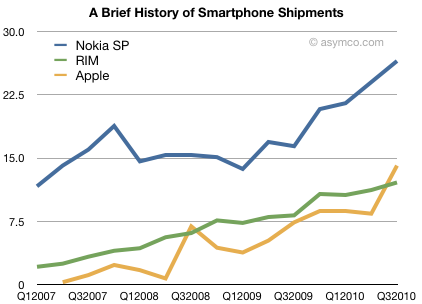
    Smartphone volumes for Nokia, Apple and RIM:

    Whereas Nokia is often criticized for being weak in smartphones, the fact is that they have grown at a decent rate over the last two years. In fact, they've opened a gap with RIM. Apple has increased share but it will take quite a while to overtake Nokia.

    So why is Nokia's smartphone performance so under-valued? Partly it's because ASPs have been dropping. A lower price and lower margin is sometimes seen as a sign of weakness. But Nokia has had a strategy of expanding into more price brackets in their core markets (i.e. outside the US). Half of Nokia's smarpthones are sold through distributors not operators and probably end up being sold unlocked and unsubsidized. Price matters in those markets.

    The other problem that Nokia takes a beating over is that their products don't get used as smartphones. Many are sold without data plans at all which makes one wonder what exactly makes their phones "smart". So many of these 100+ million/yr.  smartphones are really hired to do a feature phone job. They're "overqualified" and thus underutilized. The statistics in terms of app downloads, browser and ad impressions all lag as a result. The ecosystem suffers.

    Lastly, they are all but absent from the US. Due to accidents of history (CDMA) and various mistakes, Nokia never got a foothold in what turned out to be the most important mindshare market. A decade ago the US was a mobile data backwater, with lower data ARPU than Nigeria. It was not a market Nokia felt particularly deserving of investment. In hindsight, this was a big mistake.

    But these knocks against Nokia still should not detract from the fact that they do sell a lot of Symbian phones. Distribution still matters as does having 600 operator customers. And in many parts of the world, Nokia is synonymous with mobile phone. Many of those buyers will migrate to future Symbian devices.

    My mobile platform thesis has been that as long as penetration is not 80% and as long as operators are still in the value chain, mobile platforms will remain fragmented and split shares. The graph above shows exactly how that has evolved among the top three smartphone vendors.

  8. Escape from license-land: Measuring phone vendor commitment to licensed mobile platforms

    Research · 29 comments

    Windows Phone had its day in the sun yesterday. After discarding its previous seven-year effort with Windows Mobile, Microsoft started with a clean sheet of paper. However, whereas the software has been re-built, the business model has not. WP is still a licensed operating system whose primary customers are mobile phone vendors. With Symbian mostly out of the picture, WP becomes only the second viable commercially licensed mobile OS, after Android.

    So with two licensed platforms in the running, how do we measure success in the licensing business? Units sold to end users is one metric. But that data will have to include the performance of vendors and operators and other distributors. And it will take a year to do valid comparisons. The only indicative metric we have available today is how many devices have been committed by vendors.

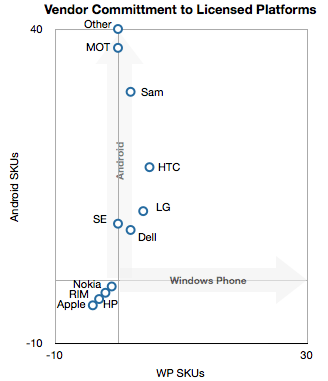
    As WP is out of the gate with device announcements, we can actually measure this. We can plot each vendor's commitment to various platforms as an early indicator of strategic success. To that end, here's the methodology: I took all smartphone vendors and tallied how many SKUs they have announced or leaked for either the WP or Android platforms (source: pdadb.net). I then plotted each vendor on two "commitment axes" (see notes below).

    The more to the right a vendor lies, the more committed they are to Microsoft's platform. The more to the top a vendor lies in the chart, the more committed they are to Google's platform. The vendors which don't have any licensed products lie below the origin.

    What we can observe is that Microsoft has pulled several, though not all vendors partially to its side. The level of commitment is not yet very high and it has not likely reduced their commitment to Android. In other words, points are moving to the right but not (yet) down.

    Framing the platforms this way helps us discuss how the market might evolve with these questions:

    1. Is Microsoft's re-entry going to peel vendors away from Android. In other words, will points move down as well as to the right.
    2. Is there motivation for some vendors to move to their own platforms like the non-committed? We've shown that profits accrue disproportionately to the vendors below the origin. As a result, is the pool of available top tier vendors going to shrink?
    3. Will vendors commit to single platforms or maintain this split OS loyalty strategy? Will we see LG migrate to WP exclusive and will Others remain exclusive in Android?

    I'll throw out my predictions to start:

    Microsoft's strategy is aimed at top tier vendors more than to the "others". This is due to a lesson they learned with Windows Mobile: having a ton of SKUs does not guarantee a healthy ecosystem (a lesson that Android has not acknowledged as true). There are positive and negative consequences. The positive is that Microsoft control the experience better, create a better brand and can participate in an effective dialogue with operators. The negative is that they are going to deal with a diminished licensee pool.

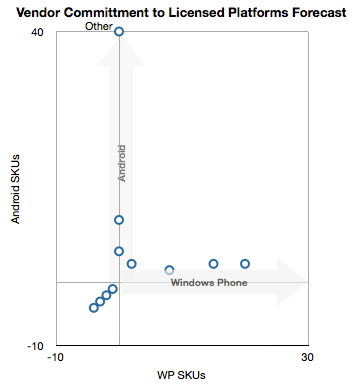
    On the second question my prediction is that vendors are going to move "down and to the left" away from the licensing model. If they can't go direct to that quadrant, vendors will consolidate portfolios around one licensed platform. The distribution of commitment I forecast will look like this:

    Maintaining multiple platform development teams is expensive. Branding is also confused. The upside is that you get to play the operator's divide-and-conquer game of platform dilution (aimed at the non-licensing players in the lower left corner).

    In particular, Samsung, with Bada, is likely to find ways out of license-land. Sony Ericsson may stick with Android and LG may move to Windows exclusively. That really leaves only HTC and Dell as licensees with multiple licenses.

    This axial alignment is not a healthy thing if you are a platform vendor. Having one or two dedicated customers means the power of the buyer is much higher and their wishes become your command.

    Which leaves only one true prize in the game: the "others". Android is clearly the darling of "Others" who are being shunned by Microsoft. Can "Others" become the lever for Google to pry open the market? History and the tangled web that is operator distribution does not point in that direction.

    ------

    Notes:

    1. I considered products announced only since Jan 1, 2010
    2. I did not consider any Windows Mobile legacy commitments
    3. "Other" vendors are off the scale with over 100 SKUs but represented as having 40 SKUs so as to be kept on chart
  9. The imminent demise of killers

    Research · 36 comments

    Before proclaiming the death of a company or product it's important to understand what makes it live. I'll illustrate with a personal experience.

    I was once asked to comment on a product designed to be a "Blackberry killer". Much like the latest Droid Pro, the product looked like a Blackberry. It had a monoblock keyboard and a nearly square screen. It was, in other words, a product designed for thumb typing emails.

    The backstory is that, like many phones, the requirements came from operators. At the time, RIM was growing extremely quickly and was causing some consternation at operators over an upstart's increasing reach into the relationship with end-users (sounds familiar?)

    The rigidly predictable response was to call all phone vendors and task them with developing Blackberry alternatives (aka killers). Of course, each vendor was called independently so they all got excited about having this opportunity to be assassins.

    So when I looked at the product my employer was building as a "killer" I asked: "Well, what makes Blackberry live?" This was not just rhetorical. I felt it was critical to the success of the product. Unfortunately it was not a question on anybody else's list. My cursory review of RIM's business would show that the product Blackberry was popular because it enabled a service, not because of the design of the device.

    RIM was like a barkeeper who enabled socializing on his premises by selling beer. The product he sold was not really beer but meeting services. A brewer looking enviously at the high margin beer being sold there might try to compete by launching "Pub-style beer" but the product won't help people socialize any more if they drank it at home. Bar patrons were paying the high price of bar beer because it had an implicit rent attached for using the meeting site.

    So no matter how much a brewer tried, unless they got into the business of managing taverns, they won't ever put the barkeeper out of business.

    But the rush to copy the design was in full force. Not only Nokia (E 61), but HTC (T-Mobile Dash), Motorola (Q), Samsung (Blackjack) and even Sony Ericsson (M600) rushed similar products out. And they all reached the market at about the same time. (Evidence that not only were they all asked to make products by operators at the same time, but that their product development cycles were roughly the same.)

    The deluge of keyboard monoblock Blackberry killers led to lots of comments predicting the imminent demise of RIM by way of powerful entrenched incumbent responses.

    RIM's market share actually grew after these launches.

    This is because none of the products addressed the real question of what makes Blackberry live and thrive. They were just pub-style beer, not thinly disguised meeting places.

    So next time you hear about the imminent demise of an upstart due to the reaction of suddenly awakened incumbents, ask whether the reaction is to the product or to the way the product makes money.

  10. The strategic tension inherent in the iPhone franchise

    Research · 25 comments

    I don't write product reviews and I don't pass judgement on individual products but I do own and test various products. For example I have the Android powered Samsung Galaxy 5 (GT-I5500) and the experience is, in my opinion, better than for recent Symbian phones but not as smooth as for Apple's products.

    But that's not what this article is about.

    It's about the price. The price for the Samsung is one third that of the iPhone 4 (both devices unlocked and sold in Europe with a 23% VAT). It was also purchased in a department store with as much hassle as buying a pair of gloves.

    When it comes to the product, it may be a fair trade-off: one third the price for one third the product. The specs are not only worse but the whole experience is rougher and cruder. But that "one third the product" may be just good enough for a large population of users who are now satisfied even with "one tenth the product". The price point should be evaluated as a valid threat.

    But Apple can respond. It's not like this is asymmetric competition. As the iPod shows, Apple can make money with low end products. Easily. Is this entry price point (€200 unlocked) something Apple should cover? My answer would be an unqualified yes.

    For operator distribution, the subsidized price combined with a high-end offering is by far the best marketing mix (price, promotion, positioning, etc.) However, for non-operator distribution, a lower spec unlocked device sold through tens of thousands of points of purchase (like the iPod, and soon, iPad) makes a lot of sense from a platform point of view.

    These two channels are often in conflict due to subsidy and exclusivity clauses. This conflict makes the decision to ignore the non-operator channel compelling. The economics for the operator channel are always going to trump the non-operator channel. But as the platform expands across geographies and income segments not covered by the operator-subsidized channel, these populations will need to be addressed.

    So this is the inherent strategic tension for the iPhone franchise: Whether to use the iPhone brand to enable ubiquitous mobile computing outside operator channels, or use iPod/iPad as a complementary but separate brand to engage in an orthogonal attack.

    I suspect the decision has been made. We will observe the consequences next year.

  11. European Operators contemplate own OS. Why not just fork Android?

    Research · 31 comments

    France Telecom-Orange CEO Stephane Richard has invited the heads of Vodafone, Telefonica and Deutsche Telekom (T-Mobile) to Paris on 8 October to discuss the development of a common operating system for mobile devices. He told Le Figaro that mobile operating systems were the Trojan horse used by Google and Apple to establish relationships with mobile customers. The four operators have nearly 1 billion customers combined and the capacity to influce industry. The initiative could take several forms including a joint venture or a common apps development unit. He added that the operators aim to retake the reigns of innovation, rather than be followers.

    In the interview Richard also stated that carriers have decided not to advertise the iPhone any more.

    Phone carriers want to team up against Apple and Google. - HardMac Forum

    This attempt at operator cooperation in software has been tried before, but it predictably failed (does anyone remember Savaje?) Symbian itself was an attempt at mobile phone vendor cooperation on systems software. There are various consortiums for "open mobile OS" based on Linux (e.g. LiMO which started as a Japanese effort). Even the Open Software Alliance is a rubber stamp body rather than an attempt at development.

    Although one can safely dismiss the potential of this effort on the basis of a lack of competence, the arrogance reminds one of the rigidity in response to the disruption under way. The fact that high-speed data networks allow operator disintermediation cannot be changed by "innovation" on systems software.

    But the odd thing is why even bother. The solution to taking control over the user experience and services platform is straight-forward: each operator could fork a version of Android as their own and hire a team to integrate white label services. It's much more straight-forward than coordinating a joint effort. China Mobile have already done their own non-Google Android.