Asymco

Asymmetric Intelligence

PC

  1. Back to the PC

    Research · 67 comments

    Apple's "Back to the Mac" was a clever play on words. Everyone expected it to mean that the event was going to focus back on new Mac products.  As we had been so steeped in iDevice news the Mac was feeling neglected. It was time to take the discussion "back to the Mac."

    Instead Apple told us that the Mac and OSX were going to become more like Devices and iOS. iOS innovations were what's going "back to the Mac"

    So it wasn't "back to talk about the Mac" it was "OSX went to iOS and iOS is going back to OSX." The strategic upshot of it is that "the Mac is an extension of the device portfolio." Heady stuff. We'll need to chew on this for a while.

    But some implications are easy to foresee. For example, the consequences for competitors. When Apple launched the iPhone, competitors followed suit, powering their phones with a variety of "open" operating systems. When Apple launched the iPad, competitors followed suit, powering their devices with a variety of "open" operating systems. These reactions to Apple's initiatives by dozens of "open-wielding" competitors are all being touted as the inevitably winning strategies.

    So, as we've observed all of Apple's strategies being copied, I can't wait to see the competitors follow its "back to the Mac" strategy:

    • It won't be long before Dell takes UI and hardware design elements from the Streak "back to the PC." Think of the magic that will happen when Android Froyo "hooks up" with Windows 7.  Both Android and Windows being "open", if I squint hard enough I can just visualize the tweet from Andy Rubin of the command line to build a new Windows  8 with Android mojo. The Android Market selling Windows Apps. It will be beautiful.
    • Or perhaps we'll soon see "back to the Blackberry" as RIM takes QNX interface elements back to their core business. Not so sure about the command line make statement there.
    • Or maybe Nokia will announce "back to Symbian" as they take gestures from the ultra-open MeeGo to do an evolution of their majestically open Symbian.

    These initiative will surely be helped by the vast community of open developers surging to support the great open merged PC/tablet/device future.

    As a clue to the sarcasm challenged: The power of Apple's integrated approach across its product lines goes deeper than the user experience.
  2. iPad: IT gets it

    Research · 27 comments

    In the last article on the share of PCs highlighting the unwillingness of market analysts to categorize the disruptive iPad as a PC I imply that Gartner does not "get it".

    This is partly willful and partly instinctive. The willful ignorance is due to a belief that their customers (IT managers mostly) do not want to hear about the iPad as a viable technology. Certainly there is a lot of anecdotal evidence that the iPad is unworthy of consideration as a business tool.

    However, there is also increasing evidence that IT does in fact get it. I have met several senior IT managers who are whispering that the iPad will change everything. For us to decide which way the wind blows, we need to think harder about the process by which technology gets adopted in large IT organizations. Understanding how the technology is hired by IT managers to improve their career prospects unveils who wins and who loses in IT.

    The main hypothesis I put forward is that IT is an example of "rule of man" not "rule of law". The idea that law or "standards" (as doctrine is known by the jargon,) defines the products in use is a conventional myth. Standards change and they change quite dramatically based on who's in charge. The "standard" during the 70's was the Mainframe, the "standard" in the 80's was the DOS PC and the "standard" in the 90's was client-server and in the 2000's it was the web. Each new standard was a violation of the previous standard. So how did this change happen?

    Each evolution of technology standards affects the career of the IT manager. The adoption of technology is the primary driver for advancement in the profession. In most cases the technology being adopted is sustaining. In rare cases it's disruptive and can cause unforeseen re-distribution of IT power (and wealth).

    As IT is a cost center, naturally, organizational behavior (or, in the vernacular "politics") dominates the decision process. Senior managers look at each technology and ask: how can this help me achieve my career goals? Let's try this exercise with various innovations that have come along in the last few years.

    1. The Web in 1998. As IP based networking was catching on, the new technology offered a new way to tie existing assets together. It was also a completely new communication channel with customers. This was a great opportunity to increase IT consumption. It would lead to more work, more budget, more visibility and even a strong link between the profit centers of the company and the IT world. The web was an opportunity. It led to a firestorm of adoption.
    2. OSX in 2004. As Windows PCs were widespread and, given the support infrastructure behind them, worked well enough, an IT manager would look at a Mac and see no opportunity to increase their value add. They could not offer new software tools with it, and the old tools would probably not work without debugging. They could not move a Mac to new use cases and could not increase headcount to support it. The Mac was not a career opportunity.
    3. The iPad in 2010. As an IT manager looks at the iPad (and smartphones in general), he sees a similar opportunity to the Web ten years ago. The company users love their devices. Top executive love their devices. They see consumerization happening and there is no denying the explosive growth. There are challenges with integration but these devices are not a direct threat. The iPad is an opportunity to migrate to a completely new form factor and increase IT consumption.

    What this means politically is that the manager who figures out a way to roll out mobility in the organization will get the same uplift in his career as his predecessors did when they brought in disruptive waves. Those periods have become the stuff of lore and legend. Every IT manager with ambition is looking to create and ride a new wave. If the person is a mid-level manager, they will scramble to be the champion of the new technology and become a rising star. If the person is a high-level manager, they will see it as a way to protect their empire by co-option. Jostling for a vehicle to bring in the technology will begin. These vehicles are typically vendor relationships. Small vendors (example) have a better chance as the traditional vendors (for example SAP) and integrators are not quick enough with product development and don't have the products to sell.

    This IT manager's job-to-be-done analysis is crucial to understanding the adoption of IT technology.  Sustaining IT products do not sell themselves even if they are superior. Conversely, new products cannot be kept out of an organization even if they violate standards. What matters is whether they help the decision maker to achieve personal goals.

    My own intuition, having worked in such an organization (albeit briefly), and after a few conversations, is that the iPad and the mobile devices it represents is going to influence a generation of IT spending.

    Even though Gartner doesn't, IT goes get it.

  3. Gartner: as a Media Tablet, iPad deserves to be ignored in PC rankings

    Research · 40 comments

    "Media tablet hype around devices such as the iPad has also affected consumer notebook growth by delaying some PC purchases, especially in the U.S. consumer market. Media tablets don't replace primary PCs, but they affect PC purchases in many ways," Ms. Kitagawa said. "At this stage, hype around media tablets has led consumers and the channels to take a 'wait and see' approach to buying a new device."

    Gartner Says Worldwide PC Shipments Grew 7.6 Percent in Third Quarter of 2010.

    Fascinating. I'd love to hear more about the non-iPad "media tablets" that delayed PC purchases last quarter. Maybe I don't get out enough.

    But more to the point, let's combine the data from Gartner and the forecast for iPad.

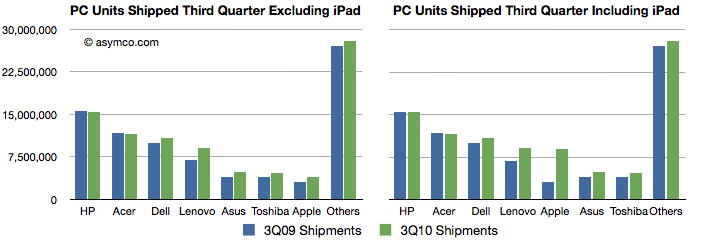
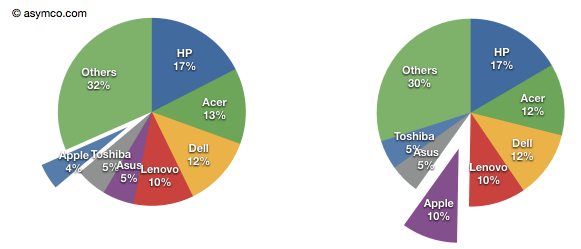
    I show below the impact of the iPad on PC vendor sales. I'm using my own estimates of world-wide PC sales (you can see other estimates here (Apple 2.0))

    The world-wide PC units shipped without and with iPad:

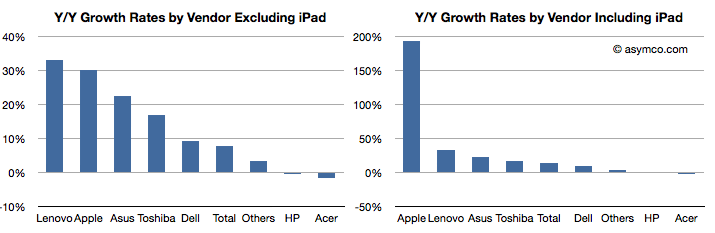
    When including the iPad Apple goes from 7th to 5th ranked, and with 50% growth clearly within shot of top rank next year.

    Now I look at PC unit shares:

    With the iPad Apple goes from 4% share to 10% share. Again, within striking distance of number one or two in a year.

    Finally, growth rates:

    Apple's share growth goes from second to first but also several times higher than any of the others.

    When Gartner spins the iPad as a "Media Tablet" it's clear that the device is disruptive. Reminds me of what Gartner thought about Smartphones four years ago.

    I cannot think of a better endorsement for an investment than a snub from Gartner.

  4. Unix's Revenge

    Research · 98 comments

    With QNX now firmly roadmapped at RIM and Android spreading among vendors like a virus, I wanted to point out that these operating systems share one ancestor: Unix.

    A technical triumph

    Technically Linux, which underlies Android, among others, is walled off from Unix from an IP point of view, but the philosophical and architectural lineage goes back to 1969's Unix. It was an amazingly well thought-out operating system which has stood the test of time mostly due to its modular architecture. It was not always clear that Unix would make it this far, and in many ways it was written off.

    There is some poetic justice in its comeback. Unix could have become a default for desktop computers. When Windows emerged from the shadow of DOS, Microsoft had the option to base NT on a flavor of Unix. But Bill Gates, no doubt motivated by license fee considerations, hired a group of developers from Digital Equipment Corporation and many elements of the NT design reflect earlier DEC experience with VMS and RSX-11. Microsoft went with that new architecture rather than Unix and that code lives on even in the current Windows 7.

    So Unix missed a chance to become the core of the desktop experience throughout the 1990's. It was relegated to the perilous high end: Sun workstations, servers and supercomputers. It seemed to be at a dead end. Fortunately, in stepped open source. Linux picked up the pieces and forged ahead to become a serious server operating system but never got beyond a toehold in the desktop.

    The death of Unix(tm) was also forestalled because of the efforts of others. Sun, IBM and even a startup called NeXT kept development alive. When NeXT was acquired by Apple, OS X was born and in 2000 Unix was once again on the desktop.

    Meanwhile, the Linux kernel also became device friendly and it was embedded into an increasing number of vertical applications while powering most of the new web servers that fed the dot com era.

    Now we've entered a new decade of devices where Unix(-like) operating systems will, on a CPU basis, probably out-install Windows. Not only is iOS based on Unix, but Android and MeeGo and even Bada are based on Linux as are QNX and WebOS. Google, Apple, HP, RIM, Samsung and Nokia are all now betting heavily on Unix or Unix-like implementations. The success is so overwhelming that there are really only two hold-outs: Microsoft and the rapidly depreciating Symbian.

    Value Chain Evolution

    There is more to this than a sentimental technology riches to rags to riches story. The history of kernel adoption is evidence of the evolution of value chains and the tension between modular and integrated business architectures. It also supports a hypothesis of why Microsoft could not respond to a tectonic shift of power.

    As a kernel, Unix was modular which allowed it to scale both down to devices and up to mainframes. It could conform to the applications above it (like being a server or being an embedded controller) and did so far more readily than Windows. In fact, Windows could not conform to applications outside its core PC and server domain.

    For Unix, the point of modularity was reached early in the 1990's and, through the Linux implementation, it allowed the lowest layers of the software to become commoditized (and free). This commodity status was actually what Microsoft tried to avoid by integrating Windows with the layers above it. This was a conscious and deliberate decision which also led to trouble with anti-trust regulators. The decision seemed to have paid off. Microsoft won.

    However, the very strategy which Microsoft used to maintain a monopoly caused its rigidity of response to a new, post-PC market. Unix fit right in with the new shift in the basis of competition: toward more personal, portable and conformable computing. Windows did not. Microsoft had to build a completely new OS to deal with devices (Windows CE has little if any shared code with Windows NT et. al.). The dual OS strategy continues to hobble Microsoft as each is stretched into new dimensions: the desktop Windows being dragged into the high end and into tablets while the device Windows is re-written to accommodate new input methods.

    The modular Unix just keeps conforming to new applications. It helps that it's open source but the open sourcing is a result of the modularity not the cause for it. So far, it looks like there is no stopping the revenge of Unix. It's been a long journey for Unix and I, for one, am cheering the comeback.

  5. Hewlett-Packard is bundling a tablet with a $399 printer

    Research · 17 comments

    The bottom line: HP's decision to bundle a tablet computer with its new $399 printer could make trouble for competitors.

    HP's New Tablet Could Be an iPad Spoiler - BusinessWeek

    HP took the control panel display from a printer and made it detachable. The idea, according to the manager in charge, is that this will encourage printing. Printing is a good business for HP because they manage to charge $7500 per gallon of ink.

    I suppose there can be some sense to this idea but I don't use inkjet printers so I can't judge how popular this can be. But the headline suggestion that the new display panel cum web pad is "an iPad Spoiler" calls into question the author's motivations. Maybe he did it for a bet.

    But the real gem is a quote from Richard Shim an IDC PC analyst who says "Everyone is trying to figure out the opportunity for these types of devices, how to position media tablets in a way that they don't cannibalize other businesses."

    That's an interesting comment coming from a PC analyst. It says that the vendors in the industry are already feeling that the iPad is substituting regular PCs (and hence the need for a response that is sustaining not disruptive).

    This acknowledgment means it's only a matter of time before the idea of iPad as PC morphs from crazy talk to conventional wisdom.

  6. IBM CEO: the PC era ended three years ago

    Research · 23 comments

    But one area where IBM won't compete with HP is personal computers. In 2005, IBM sold its PC business to China's Lenovo Group for $1.75 billion. The PC era, Mr. Palmisano said Tuesday, ended three or four years ago.

    "We wanted to get out before it was obvious to everyone," said Mr. Palmisano. "I couldn't give it away today," said Mr. Palmisano of the PC business. HP is the world's biggest PC maker.

    via IBM's Chief Thumps H-P - WSJ.com.

    Is this obvious to everyone yet?

  7. Gartner Predicts Mobile OS Market Share

    Research · 15 comments

    Lots of people apparently think it’s a big deal that Gartner is predicting Android will surpass iOS for second place. But why is that necessarily a good thing, given that they’re predicting Symbian will remain in first place? Who thinks Symbian is actually doing well? Nokia’s board sure doesn’t.

    via Daring Fireball Linked List: Gartner Predicts Mobile OS Market Share.

    I also noted with amusement that by 2014 "other" is slated to sell 85 million units or nearly 10% share, up from 6.1% in 2009. These "others" will be selling more than twice what Apple is expected to sell this year. Is "other" WebOS, Bada, MeeGo, LiMO? If so they're in for a healthy future.

    But dwelling on details like these is missing the point. To see how improbable this prediction is, let's go back to 2006 and ask what Gartner was forecasting would happen now.

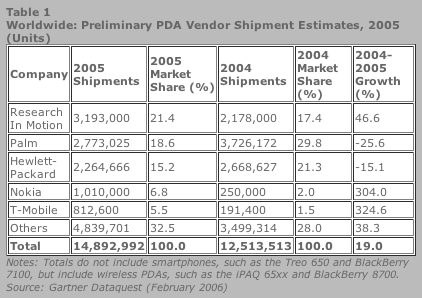
    First thing to note is that in 2006 Gartner was busy tracking PDA sales. You might wonder why this is relevant. The reason is because a significant proportion of RIM's Blackberries counted as wireless PDAs and were therefore considered to compete with Palm's Treos, HP's iPaq and Dell's famous Axim. Nokia was in the running with its Communicators. Here is how Gartner characterized the equivalent market in early 2006:

    So I'll just come out and say it: In 2006 Gartner did not have a clue what a smartphone was. By their admission:

    Gartner defines a PDA as a data-centric handheld computer weighing less than one pound that is primarily designed for use with both hands. These devices use an open market operating system supported by third-party applications that can be added into the device by end users. They offer instant on/off capability and synchronization of files with a PC. A PDA may offer WAN support for voice, but these are data-first, voice-second devices.

    In other words, in 2006 Gartner was splitting phones with operating systems into two separate markets: data-oriented wireless PDAs and voice-oriented smartphones. The split was mostly based on the judgement of the analyst on whether a device was "voice" or "data" oriented. I suppose they used the primary input method as a proxy: numeric keypads meant the device was one-handed and therefore voice-oriented. If the device had a full keyboard and/or a stylus-actuated touch screen then it was a two-handed data-oriented device. But even this proxy was not quite enough, sometimes devices were classified whimsically.

    To make it more complicated, they bundled non-cellular but Wi-Fi enabled PDAs with wireless PDAs. This made some sense from a corporate IT point of view (their primary customer base) as these data-oriented devices would be used either on a LAN or a WAN (Wide Area Networks: what Gartner anachronistically called cellular networks.)

    The presence or absence of a cellular radio did not enter into their view of these devices. So if you asked Gartner in 2006 to forecast smartphones (as we know them now) in 2010, I suppose you'd get what they forecast for "data-centric" devices.

    So assuming that today's smartphones are mostly "data-centric" we would have to look back on their view of that market and not the voice market which was seen as an entirely different thing. Their answer should have had something to do with the market leaders and participants in 2006. As the table above shows Gartner showed that RIM, Palm and HP led in 2005 with Nokia and T-Mobile[1] pulling up the rear.

    However, from a platform point of view, at the beginning of 2006

    Microsoft Windows CE was the No. 1 PDA operating system (OS) in 2005 as 7.05 million PDAs were loaded with the OS, up 33 percent from 2004 shipments of 5.28 million units. Palm OS PDA shipments declined 34 percent to 2.96 million units in 2005.

    In late 2006, Gartner made further predictions for the year:

    In 2006, Gartner expects the PDA market to increase by 6.3 percent to 16 million units. The market will continue to be driven by broader availability of cellular-enabled PDAs from wireless carriers. Gartner estimates that 53 percent of all PDAs shipped in the first half of 2006 featured integrated cellular capability, up from 46 percent during the same period in 2005. “The share of PDAs purchased by enterprises will continue to increase; it accounted for 49 percent of all PDA shipments in the second quarter of 2006 and Gartner expects that the enterprise market will account for 52 percent of all PDA shipments in 2006,” said Todd Kort.

    At this time I have not yet dug up a Gartner "Wireless PDA OS" four year forecast from the year 2006 but I suspect it would not show devices running Google's Android operating system or any running something called iOS.

    I also seem to remember that they were suggesting that Windows would be the leading mobile platform. Although it was trailing in 2006, Gartner was quite bullish on the disruptive challenger from Redmond.

    [1] T-mobile is in the list because it was common practice in 2006 for operators to market Pocket PC Phone Edition devices made by HTC under their own name. Orange, Vodafone and Verizon also had own-brand HTC Windows touch-based devices. Now what does that strategy remind me of?

  8. Estimate: iPad units to overtake netbooks in 2012

    Research · 29 comments

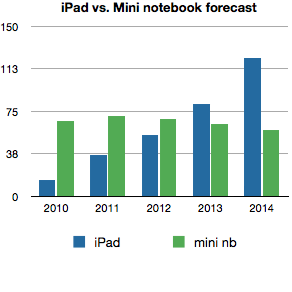
    According to Gartner, mini notebooks constituted less than 18.0% of the total mobile PC market in the second quarter of 2010, down from 20.0% of the total market at 2009-end. Gartner expects mini notebooks market share to drop to approximately 10.0% by 2014.

    However, worldwide PC shipments are projected to total 367.8 million units for the full year 2010,

    via Near-Term PC Growth Not Visible - Yahoo! Finance.

    Speculation about the iPad production ramp indicates that the iPad will ship about 14 million units this year and 36 million next year. Projecting a forward growth rate of 50% and adding the Gartner forecast above gives us the graph on the left.

    The iPad (plus competitors) will likely overtake the sales of mini notebooks as soon as 2012. The collapse in netbook sales is likely to be much more rapid than Gartner suggests.

  9. Smartphones will outsell PCs next year

    Research · 12 comments

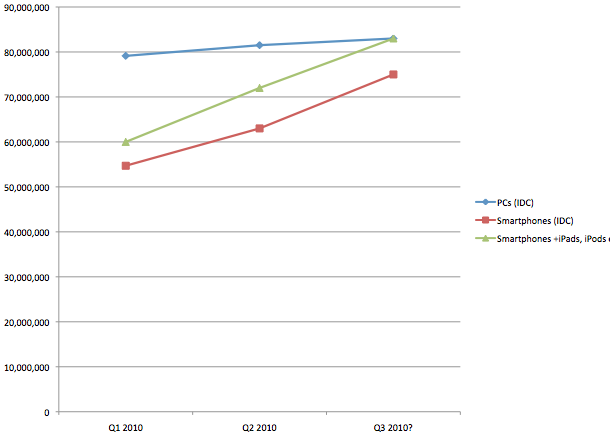
    If we add Apple's 230k "activations", Android's 200k, Symbian's 300k and estimating 130k for RIM adds up to 860k per day.

    It won't be long before we'll see smart mobile devices selling at the rate of 1 million per day (I'd bet by the holidays this year.)

    Gartner is estimating the global PC market to total of 367 million units this year (though it may need downward revision based on recent data).

    If the 1 million/day benchmark holds, and all indications are that it will, then the total smartphone/iPad/touch market will be greater than the total PC market next year.

  10. The Android SKU paradox

    Research · 23 comments

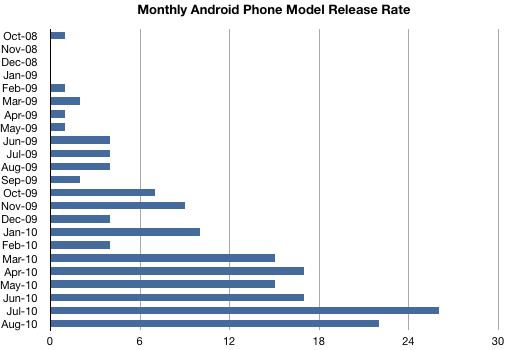
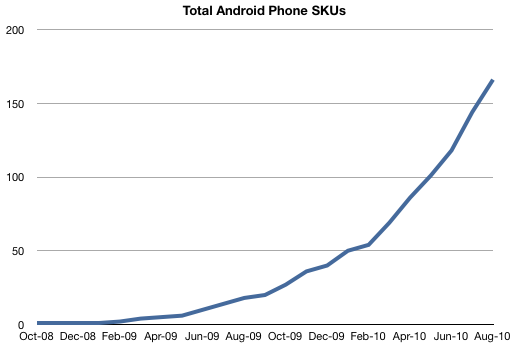
    Next month will be the 24th since the first Android device launched in October 2008. The G1 was followed by another HTC device in February of 2010 and a few others in the spring. The summer of '09 showed a steady release of up to four new phones every month. Since then the number of Android phone stock keeping units (SKUs, uniquely identifiable stockable products) increased dramatically, with the release rate increasing to 26 per month during July of this year (source: pdadb.net).

    Altogether, there are have been 166 Android phone SKUs in the market with another probable 25 or so ready to launch in the next few months.

    Now this may seem like a large number of different phone models in a short time, and it is, but Windows Mobile was even more proliferated as a licensed OS. At its peak over 50 new devices were released every month. The total now is over 1700 and it's still growing.

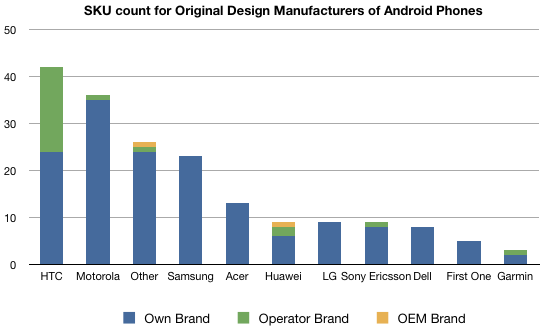
    The 183 known Android devices are distributed among 10 principal vendors with another 18 minor vendors. The 18 "other" vendors (see footnote 1) have either one or two devices in the market.

    The vendors or original design manufacturers list ranked by most devices follows:

    I broke out the devices also by the number of operator branded devices designed by the same manufacturer (green) and any devices designed and built by one vendor but sold under a different vendor's brand (orange). It shows how, excluding "other", HTC is the most prolific Android builder (and seller) but also how it still depends a lot on Operator branding.

    The proliferation of Android devices is indeed striking, but as I've pointed out before, the licensing model for Android is symmetric with that for Windows Mobile with the exception that Android is both open source and cost-free to license. This should make it highly disruptive to the paid-license model that Microsoft worked so hard to implement. It should be no surprise then that the adoption dynamics for the platform are very similar, with the same licensees that took Windows Mobile a few years ago embracing Android today.

    The proliferation still has a while to go. There is production capacity for over 2000 SKUs among all the vendors in the market (especially the "other" category) and it's only been two years since a stable version of the OS has been available. So it would not be surprising if the total number of licensed Android products will overtake the 1700 or so Windows Mobile SKUs.

    So what's the paradox?

    The question that should jump out from this data is what's the value to the participants in this, or any mobile OS licensing model? When I analyzed the Windows Mobile field in 2007 or so, it was pretty evident that very few vendors other than HTC shipped enough volumes to make a product profitable. In fact, I coined the phrase Pocket PC Paradox to describe the situation where hundreds of vendors would line up to make undifferentiated products competing for a shrinking pie. This went on first with Pocket PC PDAs, then repeated with Windows Mobile and is now repeating with Android. Nobody ever made money except for HTC, not even Microsoft.

    It's still a mystery to me why any manager would decide to make the (n+1)th Android/WinMo phone. It must be difficult to make market projections that justify the cost of developing and marketing this new product.

    But here's some help: The total number of Android phones sold through the end of last quarter was about 23 million units. The total number of SKUs launched to date then was about 118. That means that the average Android phone SKU sold 200k units (2).

    Now this may seem comically low, but I will again bring up history and point out that while the WinMo bubble was in its zenith, the average Windows Mobile SKU had 50k units sold. With the SKU count increasing more rapidly than the sales rate (40% more SKUs since June) it's very likely that the average units per SKU is dropping. So by my reckoning there's plenty more in the Android bubble to go.

    -----

    (1) The "other" category includes the following vendors:

    • Lenovo
    • Gigabyte
    • Highscreen
    • Notion Ink
    • WayteQ
    • Forsa Posh
    • Inventec
    • Kyocera
    • Pantech
    • TechFaith
    • Saygus
    • Sharp
    • Ziss
    • Alcatel
    • General Mobile

    (2) I'm fully aware that the distribution of sales over the products is not even and very likely exponential, but there is no way to predict whether a given new product will be a "hero" or DOA. The dream for every manager must be that his product will be a star, but the odds get worse and worse over time and the average units sold has to be considered as including these odds.

  11. Mobile devices overtaking PCs

    Research · 3 comments

    Smartphones, or Mobile devices, will soon become the dominant computing platform for humanity and supplant the PC which has reigned since Apple ignited the Personal Computer revolution in the late 1970's.

    via The numbers don't lie: Mobile devices overtaking PCs - Google 24/7 - Fortune Tech.

    I guess Gartner didn't get the memo. By keeping the two categories separate, it implies no overlap in consumption and hence no need to worry if you're in the PC business.