Asymco

Asymmetric Intelligence

platform

  1. Is Android more efficient than iOS at generating search revenue?

    Research · 63 comments

    Thanks to David Chu for forwarding the data that made this possible and reader Narajanan for spotting the divergence in platform efficiency.

    iOS and Android are both growing rapidly. According to Gartner, during the first three quarters of 2010, about 44 million iOS devices and 36 million Android devices were put into use. That's 80 million devices. An amazing achievement for two platforms that did not exist 3 years earlier.

    But obviously not all devices are used the same way. Devices which have unused capabilities limit network effects for a platform and for the category of product in general. Question is: how can we measure the "smartness" of a device; how much more likely is a device to be used as a mobile computer vs. being a regular phone?

    The best proxy I can think of is a measurement of browsing use. The smarter the device, the more browsing is a joy and the more it is actually done. Browsing leads to more data load on the network and creates a virtuous circle of revenues for the mobile computing value chain.

    If we could measure the increase in browsing generated by each additional phone, we could compare whether one platform is better (specifically, more efficient) at generating value asymmetric to voice.

    Fortunately we have data from Netmarketshare.com (see sources below) which attempts to track browser consumption and hence allows us to measure this variable. What we need to pair that with is the incremental increase in the installed base of devices.

    In the chart below I plotted how much browsing share increased for every phone sold by platform over the first three quarters of 2010.
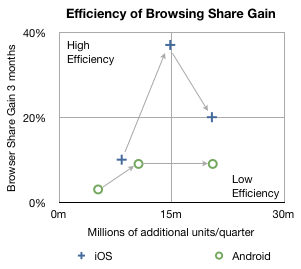
    The arrows indicate the sequence in time from Q1 to Q3. The vertical axis shows gain in share three months after the corresponding number of units shipped in the previous quarter on the horizontal axis. So, for example, the second circle means that in the second quarter approximately 10 million new Android devices created a gain of about 9% in browsing share. In the same quarter, 14.8 million iOS devices created about 37% gain in browsing share.

    In the third quarter approximately the same number of iOS and Android devices shipped (iOS  including iPads and iPod touch) but the browser gain was 20% for iOS vs. 9% for Android.

    A line drawn diagonally from lower left to upper right (0,0 to 30m,40%) could represent the average gain in share per units sold--the sort of measure we're looking for.

    Measuring that slope tells us that, on average, every million devices sold should generate a gain of 0.75% share[1]. I took the additional step of labeling two quadrants which are orthogonal to the expected trend. If browsing increases dramatically faster than 0.75%/million units then I call those devices sold as creating "highly efficient" browsing gain. If browsing increase lags dramatically below 0.75%/million units then those devices added share with "low efficiency".

    So four data points follow the trendline down the middle of the chart, however, there are two notable outliers. Finding the causes for these outliers gives clues to what's happening with the platforms.

    I believe the explanation for iOS's second quarter's extraordinary efficiency is that was the quarter when the iPad launched. It seems to have yielded a very strong spike and the trajectory of iOS improved even into the next quarter as those iPads continued to be in use. iPad seems to be a very effective way to gain browser share.

    I also believe that the cause for Android's fall in efficiency in the third quarter was that it began to be sold in large quantities in the developing world. The third quarter saw a rapid acceleration of sales without a proportional increase in what was measured as sales in the US (and Europe).

    Interpretation

    If this trend continues, and there is no guarantee that it will, then a question could be raised about Android's value to, of all people, Google.

    The core value of Android to Google is the increased use of browsing and hence search. All the other Google services and in-app ads are tiny opportunities in comparison to the potential of search on mobiles. One could argue that the raison d'être for Android since day one was to create browsing consumption. In that regard it's not as good at doing that as iOS is.

    Perhaps Google can justify the under-performance of consumption of browsing (and hence search) on Android devices as benign since there is no marginal cost added to supplying Android to non-consuming devices.

    But I wonder. There is the problem of opportunity cost: Those iOS devices that create more browsing activity are going to take more share. The more they do that the more Google will have to pay Apple for placement as the default search in mobile Safari.

    It may be a stretch, and perhaps the data is wrong, but that's what this exercise is all about: how much can we learn from fragmentary data? Without a hypothesis there is no discovery.

    -----

    Notes:

    1. Since these platforms have very low shares (less than 2% for iOS and 0.3% for Android by November) almost all the gains can be assumed to be against other browsers (e.g. Internet Explorer) and not against each other.
    2. Update: the original Unit estimates excluded iPad and iPod touch which have since been added.

    Sources:

  2. Verizon back at bat: Revisiting the last inning

    Research · 69 comments

    A month ago I wrote an exposé on the problems I felt Verizon was facing with their smartphone strategy: Verizon Strikes Out in Smartphones [Updated]

    Given new information on subscriber growth and the relationship between Verizon and Apple, it's time to look back and assess how the conclusions are standing up.

    The conclusions I drew were that Verizon had three strikes against them:

    1. The iPhone has stolen their growth
    2. They are facing the prospect of a single OS platform supplier
    3. Android is not competitive vs. iOS

    Did iPhone really hurt Verizon?

    I pointed out that based on retail sampling data from ITG and what we know from AT&T own sales data, that iPhone at AT&T was outselling Android at Verizon by a ratio of 2.5 to 1.

    The latest comScore data closely matches the assumed units of Android shipped by Verizon. Here's why: The comScore data shows the number of active users of each platform. So, for example, as the number of Android users at Verizon grew, it follows that the new users had to buy new Android phones. However, you can also sell more phones than just those for new users. Some phones are going to go to replace those of existing users.

    When it comes to Android however, all the Verizon Android devices are pretty new, having been purchased less than a year ago. Replacements would only be sold for damaged or lost devices not covered by warranty.

    So from comScore the change in subs at Verizon comes out to about 2.2 million and my original estimate was about 2 million. That's pretty close.

    On the other hand, if you look at the chart, you'll notice that the number of iPhone users at AT&T grew by a similar amount (about 2 million). However, AT&T activated over 5 million. That means that about 3 million devices were upgrades. This makes a lot of sense since we know that iPhone is the bulk of AT&T smartphone users.

    This is highly supportive evidence that iPhone at AT&T did indeed outsell Verizon Android by at least a factor of 2. Each of those phones came with a 2 year lock-in so indeed AT&T did manage to "steal" growth from Verizon.

    Another data point in support of this conclusion was provided by Turley Muller in a comment.  AT&T smartphones make up a significantly higher proportion of contract subs at 44% vs Verizon at 23%. Effectively, as a result of their sweetheart deal with Apple, AT&T got double the penetration of smartphones than Verizon since these devices are targeted only to contract subscribers. Those are high ARPU customers that either moved from regular voice plans or switched from other carriers.

    So far, the first conclusion seems to be holding up pretty well.

    Was Android a strategic constraint to Verizon?

    Verizon revealed that they had been negotiating with Apple at least since 2008 and that they were testing the phone for a year. This is not as big a surprise as it may seem. Deals of this kind easily gestate for years. The commitment may not be made until the last minute.

    Nevertheless, my point was about the fact that Android was making up to 75% of Verizon's smartphone volume in Q3. This might be a strategic constraint. But "so what?" you may say: AT&T's dependance on iPhone was even greater.

    That's precisely my point though. As we've seen with the shift by Apple to multi-carrier distribution, AT&T is now facing serious constraints on growth and the share price is suffering. Although Verizon did not deal with Google as a direct supplier, they were at risk of having much of the IP on their network at least orchestrated by a company that was not always aligned with their strategic goals. Much the same predicament AT&T is facing now.

    The tale of AT&T and iPhone does lend support to the premise that Verizon felt a bit too constrained by Android hegemony on its network.

    Is Android Competitive with iOS?

    This last point was supported by the data showing a widening higher sell-through rate for iOS vs. Android on comparable addressable markets. Although the data has been confirmed with survey data, there are issues with this interpretation. First, because the addressable base for iPhone is higher at AT&T with the post-paid contracts being more popular there, iPhone had an easier time getting sold. Second, because 3/5 of the phones were upgrades.

    The jury is still out but the apparent pent-up demand (admittedly anecdotal) for iPhone on Verizon does seem to show that given similar pricing, and a similar demographic/geographic addressable market, people do prefer the iPhone.

  3. Resetting Motorola

    Research · 31 comments

    Motorola—like HTC—is thus a bellwether for makers of Android phones, whose sales have now caught up with those of the iPhone—about 300,000 a day worldwide. Some industry analysts doubt that it will be able to create a big market for its devices and make enough profits before cheaper providers move in. If they are right, the smartphone market may eventually become like that for personal computers: a handful of huge competitors with tiny margins. The difference will be that these firms will hail from around the world rather than being mainly American.

    via Motorola: Breaking up | The Economist.

    When I argued that the meek shall inherit Android, the profitability data was the core evidence. That argument, made in August, was:

    So here we have the real challenge to Android:  partnership with defeated incumbents whose ability to build profitable and differentiated products is hamstrung by the licensing model and whose incentives to move up the steep trajectory of necessary improvements are limited.

    In other words, Android’s licensees won’t have the profits or the motivation to spend on R&D so as to make exceptionally competitive products at a time when being competitive is what matters most.

    The surge in emerging market Android entrants has been the latest setback for branded Android vendors. What should be the long term strategy for companies like Motorola and Samsung?

    Paradoxically, Motorola, being the weaker, has the best chance for successful recovery. The clue lies in both what Palm (now HP) and Microsoft did: starting with a clean sheet of paper and building their own platforms.

    This might seem futile given the network effects that current platforms are gaining, and there is a big execution risk, but the alternative is no alternative at all. The big incumbents cannot fight against the clone makers.

    Technically, building a new platform is not as daunting a challenge as it used to be. Palm, a small company, managed to do it in about 2 years. Microsoft, a large company, took 18 months. Google built theirs in about 2 years.

    They all took advantage of existing code bases (Linux or Windows CE). They also rely on web standards for their APIs (.NET or Java or HTML5).

    The challenge is bigger in attracting developers, though again, some core set of apps and developers can be obtained on the promise of brand power alone. Intel and Nokia is using this power for MeeGo.

    Motorola's advantage today is its new autonomy and singular focus on mobility. It has hit the reset button. There is no better time to be courageous and there are no sunk costs to confuse investment priorities. Android was a necessary stop-gap measure and the Droid timing was very good (before the clones and before iPhone distribution expanded). However, now would be a good time to start building a Motorola platform for the future.

  4. How sticky is Android?

    Research · 204 comments

    There is an assumption floating around the debates in this and other forums that the "battle" between mobile platforms is a land grab. The unspoken implication of this assumption is that once a user is captured she is permanently locked into the chosen platform never to move to another again as long as she lives.

    For example @dutchtender remarked:

    many people's first smart phone will be android. android can take them "cradle to grave." android will be there with a higher end solutions when they can afford it

    This is a strong but untested claim. It may be true but we owe it a bit of thought.

    A long time ago I tried to model platform growth is by using a version of Metcalfe's law. I suggested that the value of a network is proportional to n log (n) where n is number of nodes in that network[1]. This was somewhat based on common sense as it measures the possible links between n nodes with degradation due to the limits of social graphs.

    The value the network creates is what developers as well as all the other participants in the ecosystem are able to tap into. The platform vendor gets to capture a share as well of course. As the value grows it tends to create network effects or a self-reinforcing cycle.

    What I'm saying then is that we can treat a platform as a network, where each node is linked to another node by the commonality of experience.

    The proxy of the model was Windows. Twenty years ago, having Windows meant that you could exchange files with other Windows users simulating a sort of network protocol. You could also ask your peer group for help and get software tips and new consumption ideas. So the more people used Windows the more likely it was that you also had to use it. Avoiding Windows limited your ability to be part of productive society (this is no longer true by the way, which is one reason Microsoft is in trouble).

    If we fast forward to the mobile post-PC world, when it comes to platforms the shared experience is that of apps. People can communicate their app experiences and their usage better if they have the same platform. They can also learn from each other how to better use the products and how to solve problems. The more people that use a mobile platform, them more value it generates for platform participants.

    The other factor determining value is that a platform also creates sunk costs. Usually called "investments" by users these are costs that are incurred and have a potential for future value. This means that the apps purchased and time spent learning and adjusting to the platform are sunk costs which users are reluctant to abandon. (Notwithstanding the fact that as sunk, these costs should be ignored when comparing the value of another platform,--psychology is what keeps users loyal even if it's not in their best interest.) This "sunk" factor of value is not as powerful as the sharing of experiences value since it does not scale with the number of users. That cost is a constant multiplier on top of the n log (n).

    So the overall "value" of a platform is K n log(n). Where K is the stickiness of sunk costs.

    Can this be stated plainly without the math?

    When you compare two platforms you have to ask how contiguous users (n) grows and how stickiness (K) grows. The issue with fragmentation is that it actually cuts n. Many people won't be able to share experiences if their devices don't work the same way. Same with geographic density of a platform. If, as was the case with Symbian, there are few segments that became saturated with the platform then n is reduced.

    The issue with a lack of paid or compelling apps is that it cuts stickiness, so that you don't have any sunk costs. Similarly the presence of ported or common apps means that K is reduced for any single platform. Nokia's Symbian has a serious problem with both consistency and with commonality of experience. RIMM depends too much on the commonality of messaging which is quickly becoming a commodity due to portability of the experience.

    So in the end it's not just about how big the user base n is (which is the only thing that is measurable). It's how contiguous n is and how compelling the content.

    This is too sketchy a model to be practically applied but it offers a thought experiment: does any given platform have

    • A large, contiguous user base with strong concentrations of users in the same demographic or psychographic segments?
    • A significant set of unique content (apps) which require costs from the user (in terms of data, time or cash)

    It's not a clear cut case in my mind that Android benefits from these as much as iOS does. If that's the case, users are more likely to be moving on a one-way street between these two: from Android to iOS and not vice versa. The same thought experiment can be engaged in between any two platform contenders.

    ---

    [1] Metcalfe's law is actually an n*n growth curve but recent research indicates that social networks scale in value as n log (n).

  5. The PC clones of the post-PC era

    Research · 28 comments

    Since I spend most of my time thinking about what will happen, at the end of each year, rather than looking forward I like to look back to see how wrong I've been. The great thing about being wrong is that you learn something. Especially if you use a foundational theory to tie concepts together. Theory building is all about finding anomalies that adjust and improve it.

    Fortunately, exactly one year ago, on December 30 2009 I wrote an article asking if Android was disruptive. It turned out to be the right question to ask for 2010.

    What have I learned since?

    My main argument in late 2009 was aimed at the reaction of the recently launched Nexus One. A product hailed as disruptive to mobile operators. I did not see it that way. In that respect I was right. The distribution juggernaut any phone platform faces stopped the Nexus One dead in its tracks.

    I wrote:

    Here’s the problem: since mobile broadband is by all accounts not good enough, it cannot be disrupted. Operators are very critical in building out this new mobile computing future and they are investing and will reap rewards. Bitpipe models will only emerge after 4G when there will be ubiquitous high speed networks and competition will shift away from coverage and more to price and convenience of plans.

    What is happening instead of operator disruption is that mobile voice which is more than good enough is being disrupted. Businesses built around mobile voice (e.g. handset vendors who have not developed a viable business model around data) will simply evaporate and their profits will condense around entrants who have mobile computing platforms.

    So the operators are as strong as ever. But the Android platform lived to fight on, regardless of the Nexus one. And it grew in ways I did not anticipate. I had expected integrated players to maintain a large share because they would be able to improve the product more rapidly than modular vendors (and assuming that the product needed improving).

    Google is moving on this opportunity but they are not executing in a way that ensures they control the future platform due to the their being on the wrong side of the modular/integrated dichotomy.

    So Android grew but it's not yet creating profits. It is perhaps laying the foundation for future profits and defending existing profits for Google but it is not yet a big profit center[1]. That is a cause for worry. Disruptors need to be hungry for profits and patient for growth.

    I concluded:

    Android will disrupt but I expect it will take 10 to 15 years. The life cycle of a new global network generation rollout is about 10 years. We’re in the middle stage of the 3G cycle that traces its beginnings to early this decade. 4G will take another 10 years.

    Given what's happened this year does this forecast still hold?

    Mainly yes. I stand by the notion that operators will be in the driver's seat for a few years to come. However Android has grown in an unexpected way: adoption by unbranded or relatively unknown vendors selling in emerging markets.

    The Grey (market) Elephant in the room

    Until 2010, it was very difficult to sell a phone without a recognizable brand. This is because brands helped overcome purchase anxiety for those buying a device for the first time. Brands mean trust and the lack of brand meant risk. Those who cannot afford to make purchase mistakes are more likely to lean on brands than the affluent.

    But 2010 has seen a shift away from device brand value and more toward platform and function value. This shift was largely unforeseen and is very disruptive.

    The fact one in three phones are sold from "other" unbranded vendors like ZTE, Huawei and G'Five is a bombshell. Right now they're all selling voice products, but I predict that will not last long.

    All those vendors are likely to adopt Android and in doing so will explode the low end of the market. They may even crush the branded voice-oriented market.

    This growth can be slowed by operators but market forces will be very strong. These devices sell in grey markets and are often unlicensed, unbranded, untaxed and unregulated (and may even be illegal due to the absence of IMEI numbers).

    So this is the real wild card for 2011: unbranded devices running Android could be the PC clones of the post-PC era. Will this phenomenon last or will the brands fight back? If they fight, the only weapon they could wield is innovation.

    ---

    [1] Mobile efforts at Google are generating over $1 billion in revenues per quarter however these efforts include various other assets including AdMob which was acquired for $750 million. Furthermore, the headcount for Android and these other efforts is not small. I've heard as many as 3000 people are devoted to Google's mobile efforts.

  6. The parable of the the PDA: predicting the smartphone's future

    Research · 55 comments

    When reading the comments disputing the possible end of the voice-phone era I'm reminded of similar comments disputing the end of the PDA era.

    Although the Apple Newton pioneered the market in 1992 and John Sculley came up with the acronym, the Newton did not sell in significant volumes. It wasn't until 1997 with the Palm Pilot that the PDA market took off. Microsoft quickly followed with a licensed OS based on Windows CE. In 2001 Microsoft launched the Pocket PC brand to cement its attack on the PDA market. The first phones using a Microsoft OS were using something called Pocket PC Phone Edition. The first Nokia smartphones (Communicators) were built like mobile PDAs.

    The logic was quite compelling. The original PDA was built to mobilize contacts, calendars and notes. They replaced bulky paper organizers and seamlessly synced to PC productivity software like Outlook. It was a compelling product in the US where small business customers needed to keep track of hundreds of contacts. Users could even 'beam' contacts to each other via infrared. The idea of adding a phone function to the device made sense insofar as contacts could be immediately dialed from the contact app rather than typed into another device's phone keypad.

    By the early 2000's PDAs were forecast to sell by the hundreds of millions. There were millions of dedicated users who downloaded apps and thousands of developers being courted by platform builders. Palm even invented the word "ecosystem" as it refers to mobile platforms.

    However, I remember reading sites dedicated to this community and there were many people who rejected the concept of a PDA with an integrated mobile phone. They liked the fact that the PDA was not bundled with a phone plan. They upgraded PDAs in a different cycle from phones and besides, phones are for talking and PDAs were for something else.  It was even more difficult to justify the conflation of the two products when considering the corporate purchasing of PDAs. PDAs were procured by IT departments and phones came with contracts that were managed by a different department.

    What's a device vendor to do? The most avid customers of PDAs did not like the idea of burdening the product with a phone. RIM was doing its thing with moving pagers to include voice, but that was a different job to be done. The story is picked up here by this comment:

    I was hired by RIM in 1999 just before they began work on their first phone .... Coming from a two-way pager background, RIM decided that phones should have two-way push synchronization of pretty much everything that Exchange provided along with a limited WML browser. The general thought was that phones would never have sufficient power density or radios sufficient bandwidth to allow anything more. That was incredibly predictably wrong, but it's how things went down.

    Along with RIM was Ericsson, Palm, Motorola, and Qualcomm. Motorola came from a similar background as RIM and went on to build very similar devices. Both Nokia and Ericsson had come from phones and had decided feature phones should have far more sophisticated PDA functions. Palm started with PDAs then moved to the phones, but adamantly dismissed ideas like wireless synchronization for years making their first attempts at smart phone far more like early Nokia Communicators than early Blackberrys...

    So the point is that all these companies were fighting over what amounts to overgrown PDAs with phones and wireless stacks strapped on. Everyone assumed power density was no where even close to what was needed for general computing, that a full featured browser and heavy duty Internet services were impossible due to bandwidth and latency. Take a look at how our Java expert groups named standards, how people at the time talked about what features smart phones should have, and its clear that no one thought an iPhone was possible. Even Danger, which eventually went on to work on to create Windows Phone 7 and Android, was just working on a better Blackberry.

    via: shacknews

    But what does this have to do with the future of voice-phones?

    The problem is that the vendors that lost this game failed because they listened to their customers. Like with PDAs or with the original mobile phones or first generation of PCs, early adopters are not the audience that should be consulted on how to improve the product.

    Early Windows Mobile users were ecstatic about the platform and rejected new UI metaphors because they wanted a "mobile Windows". Palm fans stuck with the PalmOS even though it was well past its shelf date in the Treo because they treasured the original PDA metaphors.

    Every company paying attention to the market in 2005 would have been eagerly pursuing corporate buyers of PDAs and aiming complex products at enthusiastic PDA users.

    And yet, non-consumers should also not be trusted with their opinions. Most early surveys would show that the vast majority of consumers found that mobile phones were not good value for the money. Later the same audience would declare that smartphones were not worth buying.

    There are many voice-only users in the world who are happy with their products and not interested in any new options.

    So what's a marketer to do?

    If you can't ask early adopters and you can't ask non-consumers for hints then where can clues be found?

    What history shows is that consumers have been happy to trade up to technology that offers more option value.

    • Television went from cheap/free over-the-air broadcast with limited channel options to expensive cable with large option value in channels. Even if most of those options went unused, they are still valued.
    • Telephony went from low cost reliable landlines to high cost, less reliable but with much more option valuable mobility. Having the option to call a person vs. calling a place (where a person might be) changed the calculation of whether you make the call. Calling became much more popular.
    • Data as well went from metered dialup to unmetered high option valued broadband. From a luxury, to the least likely service an unemployed user might give up.
    • Emerging market users hungered for mobile phones even though they cost more than several months' wages because they gave access to information and increased the option value of their labor.

    Each of these huge technology transitions came associated with increased costs for the consumer, but that cost went toward the purchase of a far larger option value.

    The problem is that users cannot calculate option value in their minds when faced with a market research questionnaire. How can they envision all the ways they would use a new product they've never used before? How can they "get it" without observing it in use or spending time thinking of "how they would use it" or asking someone who tried it? In a nutshell, users are willing to pay for option value but can't envision or quantify this value without observing a finished, polished product in use.

    This is the problem faced today by branded phone vendors. Asking or observing current users of smartphones does not provide any incentive to sell low end versions. Asking or observing non-consumers seems to indicate no interest in newfangled complex or costly products.

    But the calculus that must be made is one of option value. Does the new product offer significant option value? Will this option value be easily realized? This is not easy to determine, but it's a method that is far more promising than asking users their opinion.

    The PDA was not a product that was introduced by the incumbent computer vendors because their customers did not ask for it. Once established, the PDA was not replaced by a product that PDA users asked for either.

    Smartphones are following this well trodden path. The high end devices are evolving into computer replacements nobody asked for (but everybody will use). The low end products are adding data option value to voice-oriented users who never asked for anything more.

  7. Microsoft's mobile effort: back to the future?

    Research · 41 comments

    Windows Phone 7 launched on 10 devices over 60 carriers in over 30 countries with 1.5 million of channel inventory in 6 weeks. Given the breadth of distribution, that number is not huge, amounting to less than 10k phones per operator.

    Curiously, Windows Mobile was still selling in significant volumes last quarter. Maybe even higher than WP7 is selling now. In Q3 2009 Canalys reported 3.6 million WinMo units sold. In Q3 2010  Gartner estimated 2.3 million were sold through to end users. Even nine months ago Windows Mobile was running at 3.7 million units or over 1.8 million every six weeks.

    Microsoft also announced they have 18,000 developers with 4,000 apps on the WP7 marketplace. That's one developer for every 83 devices in inventory.

    Microsoft's Achim Berg:

    our numbers are similar to the performance of other first generation mobile platforms...

    We're comfortable with where we are, and we are here for the long run; Windows Phone 7 is just the beginning.

    In terms of first generation platforms, I assume he is referring to Android and iPhone. That claim of similar volume growth is perhaps a bit too optimistic. However, he's very wrong about WP7 being the beginning for Microsoft's efforts in mobile. Not even close.

    Microsoft has had mobile software products in the market for over a decade. In 2003 Gartner declared that Microsoft would sweep Symbian aside. In 2006 they were the odds-on favorites to win the mobile platform game on the basis of developer support.

    Microsoft's Windows Mobile was selling more in 2003 than Microsoft's Windows Phone is selling in 2010. At the time, Microsoft also boasted of having a huge developer base (larger, in fact, than the number of users of the product; their .NET developer base being counted as mobile developers.)

    Furthermore, prior to the launch of iPhone's App Store, Microsoft spokespersons scoffed at the idea that Apple could field a catalog larger than Windows Mobile which led with over 13,000 apps in August of 2008.

    Dragging out these old figures isn't meant to deride Microsoft. They were not alone in failing to capitalize on early leads in mobile. Palm, Nokia, DoCoMo and Qualcomm all failed. RIM is arguably failing as we speak. Some have argued that Apple is also about to be undone by Android.

    The point is that dramatic, violent change was possible even five years after foothold markets were established.

    The question for today is: Is it still possible? Can a new platform still gain traction?

    Microsoft is clearly betting that it can. Their seemingly quixotic attack on the market can only be justified on the basis that it's still early days. They must reason that un-penetrated markets are huge and that the existing platforms are not sticky enough to prevent switching.

    At least one analyst agrees. IDC made the forecast that 32 million “Windows Mobile/Phone” devices will sell during all of 2011. I took issue with those forecasts at the time but if they deliver that volume they will get around 10% share, enough to stay on the map. If they don't then Microsoft will look more like Mobile Zune than Mobile Windows. The stakes are high.

    So even though they may have airbrushed Windows Mobile from history, Microsoft's current strategy is a direct consequence of them having failed with a seemingly strong platform.

  8. What has Android done for Apple?

    Research · 44 comments

    One of the most popular themes running through the mobile phone industry this year has been the unprecedented growth in Android adoption. I've argued that the adoption was initiated on the supply side by vendors and operators, but demand has certainly manifested itself.

    Android is almost viral in the way it spreads. With no constraints on intellectual property, pricing, contracts, modification or terms of distribution, the incentives to push product out are phenomenal. It even works, mostly.

    One hypothesis of the consequences of this viral adoption is that there will be a "commoditization" of smartphones with rapid price erosion to follow. This in turn might even lead to lower margins for Apple and RIM and most major vendors, including those selling Android itself.

    In order to test this hypothesis, we need to look at what has been happening to prices. If prices have started tipping down at more than their usual rate then maybe commoditization is happening.

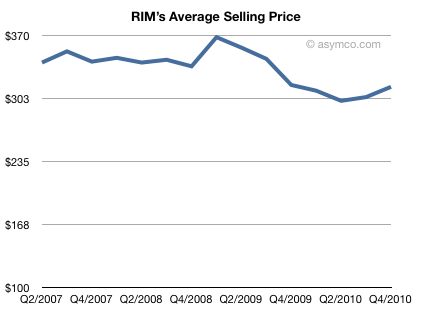
    We can begin this test with the industry's canary in the coal mine: RIM. RIM has been struggling for growth in the very market where Android has been growing the fastest. Is RIM's pricing under pressure?

    Interestingly, no. Their ASP (average selling price) decline, from an average of $350 to $310 in late 2009, came before the Android avalanche. During this year, the ASP has held steady, even rising in the last two quarters to $315 while Android activations reached 300k/day.

    So I don't see a big problem with RIM, yet.

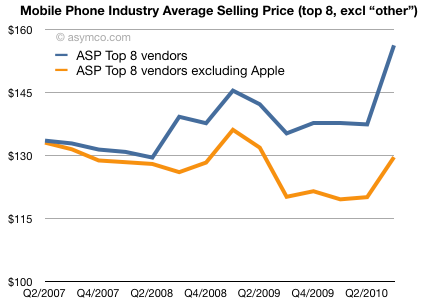
    What about the industry as a whole? Can we see patterns that suggest imminent commoditization? Using the top 8 vendors (Nokia, Motorola, Samsung, Sony Ericsson, LG, RIM, Apple and HTC) and using volume-weighted ASP (total device sales divided by total units sold) we have the following chart:

    Since the second half of 2007 the "industry ASP" (blue line) has actually increased. This is even though there was a huge recession in the middle of the time period.

    This should be only slightly surprising. If you suspected that the iPhone may have a lot to do with that, you would be right. If you remove Apple from the mix, the second line (in orange) shows that the top vendors (ex-Apple) had some, but quite quite mild erosion (from an ASP of $133 to $129)[1].

    This is far milder than what's been happening in the PC sector where prices are dropping catastrophically (According to NPD the average selling price of all Windows portable PCs has fallen from $659 in Oct. 2008 to $519 in Oct. 2009).

    So Apple was a big contributor to the industry increasing its pricing power.[2] but even without Apple the industry has been holding on.

    But is this just a lull?

    Is Android going to stop the growth?

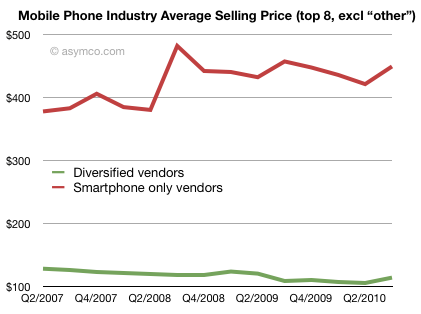
    We can look at the pricing data one more way: If we separate the eight companies into two cohorts, the "diversified" vendors who sell both smartphones and regular phones vs. the "pure play" smartphone-only vendors, we get the following price history.

    What is happening is that the diversified (Nokia, Samsung, LG, Sony Ericsson, Motorola) saw modest price declines (from $128 to $114) while the pure-players saw price appreciation (from $378 to $449). This is with the early impact of Android priced in. Unfortunately I don't have a chart showing non-smartphone prices in isolation, but I would be willing to bet it would be a significant negative slope.

    In these two lines Android is not an independent variable. Android was adapted by some of the diversified vendors (all but Nokia), but in different ways. The thing is that Motorola and Sony Ericsson had great increases in ASP with Android. Among the pure-play vendors only HTC adopted Android and its performance is undistinguished vs. RIM which didn't.

    So what, if anything, has Android done to pricing?

    I argue that there is no evidence in the pricing data of a coming commoditization of smartphones. Android vendors were able to use the platform to move to higher pricing and the more they switched their portfolio to Android the more they got a better average price. At the same time those vendors who built smartphones without Android also saw strong price supports.

    The only correlation with pricing power is whether you build smartphones or dumb phones. The more smartphones you build, the more price you can charge. This is regardless of platform.

    The reason for this is that the smartphone market is growing so rapidly (90% y/y). There is limited direct competition between smartphones and a lot of competition between non-smartphones and smartphones--a battle smartphones are winning handily, irrespective of price. Smartphones seem to be what everyone wants.

    So the real question that should be asked is:

    Why do vendors bother making any dumb phones at all?

    If you look at the third chart above you can see how attractive it must be for the diversified vendors to abandon the non-smart market to ZTE, Huawei et. al. Perhaps Nokia can still make a small profit there but to do so you need to run faster and faster toward extraordinarily low costs and prices. A point where phones cost less than everyday consumables. What keeps Samsung and LG in that game? Motorola and Sony Ericsson left once they hit profit warnings. Is that what it takes to drop what seems to be a loser business? I think not.

    My bet is that by the end of 2012, it will be hard to find any branded phones which won't run a smartphone OS. Demand and supply of smartphones will race each other to overwhelm portfolio logic at the largest companies. The zero (visible) cost of Android will snowball this effect. What's even more provocative is that I believe the "others" will follow and abandon voice-oriented phones for smartphones almost immediately after the larger group.

    So what have the Androids ever done for us?

    I've long argued that the phone market should be studied as a whole because the competition is not between platforms but between smart and non-smart. Pricing is a leading indicator of what drives decision making inside vendors and it leads margin, and thence portfolio discussion. Android is expanding the market without crushing pricing. The margin expansion is what attracts more vendors and creates more demand. It's a virtuous cycle.

    In a way, this is all good news--even for Apple. A world full of smartphone users is a better addressable market for iPhones than one filled with voice products. iPhone's traction was always in markets which had been seeded by some smartphones: the US with RIM and Europe with Symbian. Such a smartphone-soaked world will have better mobile broadband infrastructure, users with more demanding tastes and awareness of the value that a smart device can bring.

    ---

    [1] The effect of "other" vendors not among the 8 listed is a big unknown. It's been estimated that they now make up as much as 30% of total volumes and that they are beginning to ship significant volumes with Android. Without visibility into that part of the market, we should be cautious. However, the eight vendors sampled here are still a significant cohort and the conclusions still appear reliable.

    [2] This industry had, until 2007 suffered from chronic price erosion. Each sustaining innovation drove a mild burst of pricing power but it never seemed to last. From color screens to bluetooth, to 2.5G to 3G to MMS, to cameras to music playback, each hardware advance was not enough to keep the erosion away. The tipping point seems to be the iPhone and the shift to software as the component that drives price power.

  9. Verizon Strikes Out in Smartphones [Updated]

    Research · 91 comments

    [Updated]

    [ITG sent an explanation of their methodology and there is no indication that the data represents inside information.]

    ITG Investment Research analyst Matthew Goodman is forecasting monthly sales record for all of Verizon's devices "based largely on our proprietary daily point-of-sale data from thousands of independent wireless retailers across the US."

    Assuming the data is accurate, we are going to dive into it but I will state up-front that without confirmation, the conclusions below should be taken with a grain of salt. All statements should be read with a preceding "if the data is accurate..."

    So, if the data is accurate, here is what I conclude [1]:

    Verizon Has three strikes against them:

    1. The iPhone has stolen their growth
    2. They are facing the prospect of a single OS platform supplier
    3. Android is not competitive vs. iOS

    The iPhone has stolen Verizon's growth

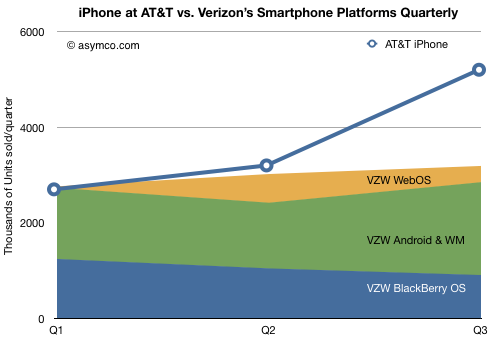
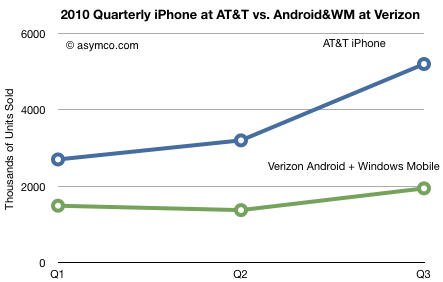
    The chart below shows the performance of all of Verizon's smartphones vs. the iPhone at AT&T. The area chart shows how Verizon's volumes grew from 2.7 million in Q1 to 3.3 million in Q3. Not a bad story in itself. However, the iPhone at AT&T went from 2.7 million to 5.3 million in the same time frame. Relative to just the iPhone, Verizon has been underperforming over the last quarter.

    Those additional 2.4 million iPhone/AT&T activations in Q3 could be due to replacements but the same could be said for Verizon's volumes. The fact remains that iPhone alone is nearly twice the volume of all of Verizon's smartphone activations.

    Just to be clear, this is a direct, apples-to-apples comparison. AT&T and Verizon smartphone performance figures are highly comparable. The two operators are highly representative of the US market. AT&T and Verizon Wireless raked in 75% of all mobile data revenue in Q2 of 2010 and account for 62% of the U.S. wireless customer base.

    In addition, Verizon enjoys a larger customer base (has 92.1 million subs vs. AT&T's 90.1 million.)  Over the time frame of the data the overall market did not increase dramatically therefore the conclusion that AT&T's win is Verizon's loss is plausible.

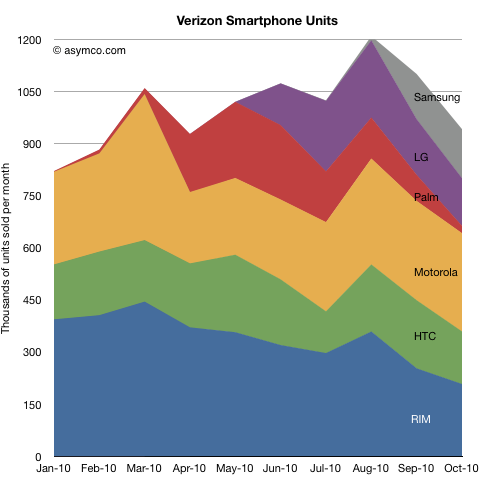
    I used quarterly data so that iPhone at AT&T could be compared. But if we look at monthly data, the story gets worse:

    These are absolute volume figures. You can see how RIM's fade was replaced to some degree by new vendors. However, growth hit a wall in August. Following widespread iPhone 4 availability, sales dropped. Coincidence? Perhaps, but the drop happened even with the addition of Samsung volumes.

    That's strike one.

    Verizon is facing diminished degrees of strategic freedom

    The other notable is that even though Verizon doubled the number of vendors selling smartphones, it seems they are growing their smartphone base slower than the overall market.

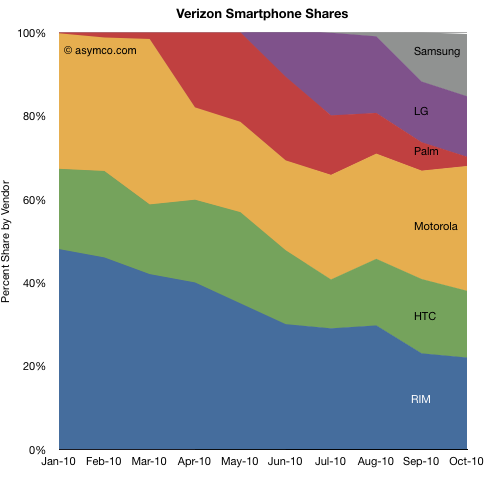
    Consider each vendor's share is shown below:

    From three vendors to six. Shares are roughly evenly split (except for Palm) but none of these vendors are able to drive volume growth.

    Consider that Motorola Droid is outselling RIM. This should be rightly noted as amazing. It plainly shows the power of Android. However that power is not something Verizon will benefit from. Quite the opposite.

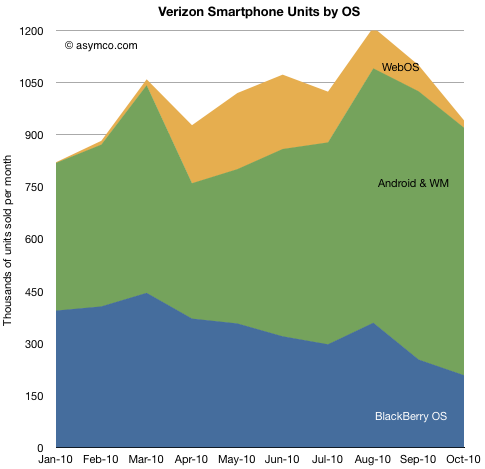
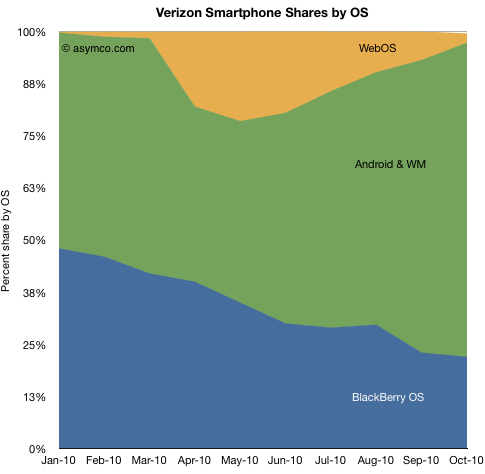
    Consider the share map by units and share of each OS:

    Android (and WM, though that's likely to be a very tiny part of the green area) made up 75% of all smartphones sold in October. It's possible that the share could grow to 90% as RIM continues to fade.

    For Verizon this would be a serious problem. Although Verizon used to have a disproportionate share of RIM's products, that OS was not enabling an ecosystem like Google's. It was a product narrowly defined around messaging. Verizon is facing the prospect of a single OS supplier who may or may not maintain alignment with Verizon's core profit algorithm. If they diverge, Verizon's bargaining power will be strictly limited.

    Strike two against Verizon.

    Android is barely enough to keep the battle with AT&T from becoming a rout.

    In an apples-to-apples comparison, in Q3 the iPhone at AT&T outsold Android at Verizon (remember, same addressable market) by a factor of 2.5. This is with a variety of devices and vendors thrown in the market. We hardly ever get to see this finely grained a comparison when looking at platforms.

    I wrote this up as a lack of competitiveness. It may seem provocative, but I define competitiveness narrowly: the competition is for a purchase decision on equal terms. These purchase decisions are fiendishly complex to predict, but the data speaks: whether it's due to brand, visibility or performance and in spite of "antennagate" the iPhone is cleaning up.

    That's strike three.

    The devil they know

    By 2009, Verizon was probably optimistic that they could head off AT&T (and Apple) at the pass. With the vast array of vendor Android roadmaps laid out in front of them they saw a way to stem the flood of defections. I think that optimism dissipated sometime this year and was replaced by a more dreadful prospect than what iPhone presented in 2007.

    It is perhaps coincidental that the rumors of a Verizon deal with Apple seem to have started in earnest right after August. It's thin, circumstantial evidence, but the only evidence we have to corroborate the data above is that Verizon has been signaling more desperation.

    Reading further into the data, I would say Verizon faced these problems and decided that they had to throw in the towel. Apple may be the devil, but so could be Google. Apple was predictably evil. But Google? The devil you know is perhaps better than the one you can't predict.

    What's more, the devil Apple seems to be helping your worst enemy way too much and the unpredictable one does not seem to help all that much.

    Final question: how many iPhones will Verizon sell

    I think this data shows that Verizon has another reason to sell the iPhone. The underperformance of their smartphone franchise is not the only determinant, but it is perhaps another straw on the camel's back.

    What would happen if (or more likely when) Verizon sells the iPhone? I believe they will sell them at the same rate as AT&T does.

    The data shows that Verizon sold, on average, about 3 million smartphones per quarter during the first nine months. That's about 1 million a month. That was based on three platforms, six vendors and widespread promotion.

    The iPhone sold almost 4 million a quarter over the same time period.

    Verizon users bought smartphones at a lower rate than AT&T users bought iPhones. This is even though the two carriers have approximately the same subs base which churns very slowly. Since a mass-market product will appeal equally to statistically equivalent populations the product should be taken-up with similar vigor.

    So the question is not whether Verizon can sell iPhones at the rate of 4 million a quarter. The question is only whether these 4 million will be in addition to the 3 million that are currently buying non-iPhones.

    My guess is that the 3 million run rate for non-iPhones will drop, but not to zero.

    The impact on the other vendors supplying Verizon may be strongly negative depending on the level of promotion Verizon puts on the product. That promotion budget is usually fixed as a percent of sales. What Verizon applies to iPhone will be taken out of what is spends on Droid. I have always said that operators will be motivated to balance their supplier power. The promotion budget is the primary instrument to meet that end.

    On the other hand, the overall market will grow so 2010's 3 million/Q will be 2011's 6 million/Q. There is plenty of room for multiple platforms.

    So my conclusion remains that iPhone will find at least 8 million new users with Verizon. The analysis above give me confidence to increase the upper bound to possibly 12 million.

    Verizon striking out means they need to change the way they play. The iPhone is a new ball game.

    ------

    [1] To assemble this discussion I used only the data provided in the article linked above and the officially published iPhone activation numbers from AT&T. Obtaining specific smartphone vendor volumes is a matter of reverse engineering the share chart and cross-referencing it to the table of vendor sales.

  10. Smartphone parochialism: How operator policies prevent or promote platform adoption

    Research · 42 comments

    When comparing smartphone platforms it's tempting to consider the global market as unified and commonly addressable. However, when you look at individual countries some strange patterns of behavior emerge:

    • Indonesia, the fourth most populous country in the world (230 million people) loves Nokia's Communicator. It's the ultimate mobile status symbol.
    • Japan had one of the largest installed bases of Symbian phones. The version running in Japan is not compatible with versions elsewhere. Famous for its Galapagos mobile culture, the iPhone is changing what the Japanese consider the basis of phone performance.
    • The iPhone just became Korea's favorite smartphone even though hegemonic Samsung and LG are doing a roaring trade selling Android phones elsewhere.
    • The US has four incompatible 3G network technologies in widespread use. No widely distributed smartphone phone works with any two. Blackberry ruled supreme until AT&T started promoting the iPhone and Verizon started promoting Android.
    • Latin America loves BlackBerry. BBM is wildly popular as an SMS alternative.
    • Saudi Arabia loves BlackBerry. When face-to-face conversations are taboo, the BlackBerry is a social lubricant.
    • Australia loves the iPhone. Android is almost non-existent.
    • Italy has more smartphones per capita than the US. The majority are made by Nokia.
    • China uses two incompatible 3G technologies. The most popular (TDSCDMA) is not available anywhere else. WiFi was illegal in phones until this year.
    • Germany has a disproportionally large installed base of Windows Mobile
    • There are no Blackberries in Finland.

    Although some of these idiosyncrasies may be cultural (like the Indonesian penchant for large devices) most of them are due to operator decisions. In some cases operators choose incompatible network technologies to protect from competition. In others they promote local vendors or price certain products out of reach.

    Sometimes big bangs take place and demand explodes for "banned" technologies or vendors. However, it's just as easy to see how the pendulum can swing against free market choice.

    Ultimately users and device vendors are at the mercy of operator decisions. In the long term operator control over platforms might diminish but it will take many years.

  11. When markets are supply constrained purchase decisions are not based on product performance

    Research · 26 comments

    The difficulty in analyzing the smartphone market lies in its extremely rapid growth. With the market growing at 90% (and 400% in some areas like China) the forces of demand and supply are disconnected. It's impossible to discern whether a purchase decision is made from a choice of comparable alternatives or if it's made from a choice between buying nothing and some alternative.

    Furthermore, another problem lies in distribution inefficiencies. The global phone market is nominally serving 4.6 billion consumers but they are not all participating in the same market.  Devices and the services they are bundled with are not fungible globally.  You cannot buy a phone is one country and easily couple it with service in another. You can't even transfer one bundle from one owner to another within the same country. Products are available only in some countries or some operators and not in others.

    Commentators focusing on mobile OS platform shares assume a zero sum game and a liquid, efficient market. Both assumptions are false. They also assume that the platform is a basis for the choices made (rather than the device, the pricing illusion attached to the device, the service plan, availability, point of purchase and network switching costs, etc.)

    There is data where competition for a single purchase decision by two comparable products with comparable specs and price plans can maybe show a preference. However that data is not public. Only an operator like AT&T who sells both Android and iPhone through the same channel has that data and they're not sharing.

    The closest I came to analyzing this was in a blog post last May. However, that data is obsolete. Since then Android growth has accelerated rapidly as vendors who were not making smartphones (Samsung, Asian second tier, Motorola and Sony Ericsson in that order) began making smartphones in volume. Their only choice in entering the market was Android. This supply-side view of the market is much more relevant than demand-side assumptions because the market is supply constrained.

    Another way to see it is this: If there is a shortage of bananas, you can't make a case for Costa Rican bananas being preferred over Honduran bananas. People will buy whatever bananas they can get (even if one may be preferred over the other). If Honduras can produce twice as many as Costa Rica then they will sell them all and it says nothing about their quality or end user preference or whether that volume advantage will be sustainable once the shortage abates.