Asymco

Asymmetric Intelligence

platform

  1. Changing places: Microsoft trades HP for Nokia

    Research · 56 comments

    The juxtaposition of HP's strategy of increased independence and Nokia's new strategy of increased dependence can't be more striking.

    HP is probably Microsoft's biggest customer. As the largest licensee of Windows it probably generated more revenue for Microsoft than any other company. The fact that HP invested in a new operating system for its mobile efforts shows a level of discomfort with the lack of strategic leverage.

    Nokia, on the other hand, has been resolutely independent in its software strategy. For over a decade it held out against licensing any OS, especially one from Microsoft. The pantomime theatrics that took place over that decade will make a great case study some day.

    But now we have a complete reversal of roles: The abandonment of platform independence by a mobile giant at precisely the same time as the acquisition of platform resolve by an IT giant.

    It seems almost poetic. And that should be a clue. Whenever you see poetry, you need not look far for some truth.

    These chess moves are taking place in the context of a greater game: the collision and disruption of IT and Telecom. It's not surprising that massive market forces are causing incumbents to react. HP, Microsoft and Nokia are in the throes of fundamental disruption. Even if these moves may not be all in the same direction, they each react in ways that make sense to them.

    It's also very likely that all the moves are for naught. Incumbents rarely win with reactions. Let's not forget that the entrants came with different business models. Apple and Google are not making money in the ways of Nokia and HP (who are channel dependent) or Microsoft (who is license dependent). The reaction must itself be asymmetric. So far it's not clear where the asymmetry lies.

    Read more:

    HP/Palm’s Rubinstein believes in integration

    WebOS: HP, and HP Only. QNX: RIM and RIM Only
    HP’s PC group spends 0.7% of sales on R&D

    The reason Robbie Bach was fired

  2. Visualizing jumping off a burning platform

    Research · 75 comments

    Here's what a platform jump looks like:

    The devil is in the details. Although there was great excitement among investors at the prospect of platform agnosticism, the reality of the press releases shows that Nokia may have some significant short term pain.

    First problem is that Symbian phones have become feature phones. They have zero platform value and will therefore have no opportunity for premium pricing. This is a risk to the bottom line.

    Second problem is that we don't have any indication when any competitive WP7 phones will ship. It could be years for the "catalytic" effect of a new ecosystem. As observers of Microsoft press-release-ware will note, these types of "strategic relationships" don't pan out half the time.

    Third problem is that the organization does not look all that different. One or two executives changed seats and one is gone, but this is not a new dream team.

    Fourth problem is that there is no clarity on any long term win for Nokia. Maps licensing seems like the only possible new source of revenue and a minor one at that. What competitive advantage did Nokia just gain? Is there any advantage Nokia has over any other licensee of Windows Phone?

    Perhaps management will address these issues, but strategy takes a long time to bear fruit and the new announcement doesn't have any short term wins.

  3. A review of Asymco Predictions on Nokia’s new platform strategy

    Research · 25 comments

    Predictions on Nokia’s new platform strategy: new OS for the US | asymco.

    Here are my predictions from January 27 for the February 11 Nokia strategy announcement followed by the actual quotes from Nokia's press release:

    • Prediction: There will be a multiple OS strategy.

    Actual: The following sub-units [make up] Smart Devices: Symbian Smartphones, MeeGo Computers, Strategic Business Operations. To support the planned new partnership with Microsoft, Smart Devices will be responsible for creating a winning Windows Phone portfolio.

    • Prediction: The US market will be the first to see a new non-Nokia OS. I would guess Windows Phone with AT&T.

    Actual: "Plans for a broad strategic partnership with Microsoft to build a new global mobile ecosystem; Windows Phone would serve as Nokia's primary smartphone platform"

    • Low end devices will remain with Symbian due to price considerations for the chipsets, components.

    Actual: "Symbian becomes a franchise platform, leveraging previous investments to harvest additional value. This strategy recognizes the opportunity to retain and transition the installed base of 200 million Symbian owners. Nokia expects to sell approximately 150 million more Symbian devices in the years to come."

    • Prediction: MeeGo will be phased out in phone products but development will continue for tablets

    Actual: Under the new strategy, MeeGo becomes an open-source, mobile operating system project. MeeGo will place increased emphasis on longer-term market exploration of next-generation devices, platforms and user experiences

    More details to follow, but so far it looks like there are no surprises.

  4. The (iPod)Touch(i)Pad

    Research · 99 comments

    The world's largest PC company just launched a "media tablet[1]". Conflating the iPod Touch and iPad brands into "TouchPad" HP joins RIM in announcing an integrated OS/device product to compete as a platform vs. iOS and Android (and to some degree even against Windows).

    There are others waiting in the wings. Presumably, Microsoft is hard at work to release a tablet-compatible Windows sometime near the middle of this decade. MeeGo is also going through its gestation period targeting Atom-based tablets. John Gruber notes the excitement around tablet platforms in his article about this post-PC renaissance in computing alternatives. I also noted that the end of the PC era was marked by the end of WinTel at CES.

    In that context, yesterday's WebOS event was perhaps anticlimactic. But it's still remarkable. Consider how far we've come. Step back now and remember the dark days only one year ago when, right after the iPad announcement, a  nearly unanimously chorus was pouring derision on the concept.

    AAPLinvestors is still maintaining the iPad death watch which I took a snapshot of back in March 2010. To reminisce: It was exactly one year ago, on Feb. 10th 2010, that Bill Gates was quoted as saying "It’s a nice reader, but there’s nothing on the iPad I look at and say, ‘Oh, I wish Microsoft had done it.’" On the same day, Shannon Zimmerman of The Motley Fool wrote: "[Apple's] hamster-wheel of innovation ... may have hit a snag with the iPad." Those are just two of dozens other memorable quotes.

    I noted last May that the secrecy surrounding the iPad prior to launch was unnecessary. Nobody understood the product for months after it launched (and many still don't a year later).

    Apple keeps a tight lid on new products so that competitors don’t get a head-start on copying, but in the case of the iPad, advance knowledge would not have had any impact. Competitors look at the iPad and see nothing.  They’ll only react once the market explodes and they start to feel belated pain.

    Indeed, responses only came after sales figures started to cause consternation among competitors.

    How did these presumably keen observers of the market fail to notice the sea change under way? This is not just a rhetorical question. It really is hard. Students of disruption know that spotting such change is a difficult skill to obtain. But it is a skill, not a gift.

    So here we are, 12 months later and the derision has turned to flattery by imitation. The only scorn I hear about the TouchPad is that it can't come to market fast enough.

    ----

    1. I find this term repugnant and highlight it here only to ridicule those who coined it.
  5. Android and iPhone: Conquistadors or pioneers?

    Research · 93 comments

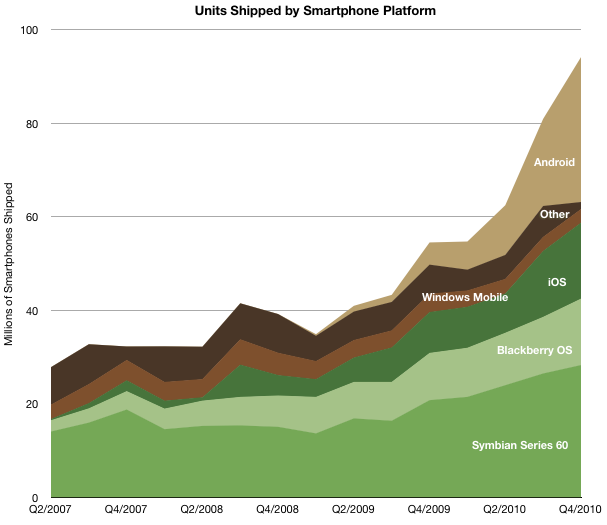
    Picking up the discussion of vendor share, I used Canalys estimates of platform shares to visualize the effect of Android on the smartphone market:

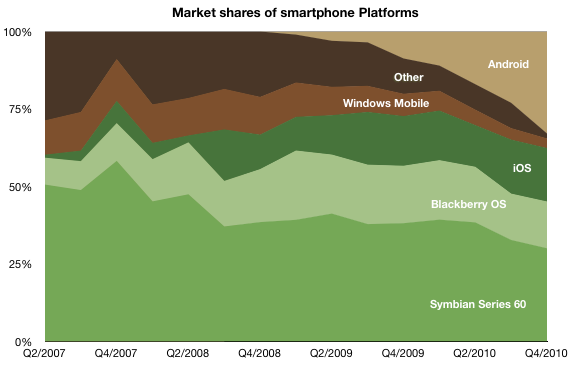
    Not wishing to belabor the point, but Android and iOS are less than 2 years old as platforms. In that time frame these two johnny-come-latelys have taken 50.2% of the most competitive technology market on the planet.

    Here is the share data:

    Since the market is not a zero-sum game, I prefer the first chart, but this second view stresses the transition away from incumbent "others" / Windows Mobile toward Android in the licensed OS market.

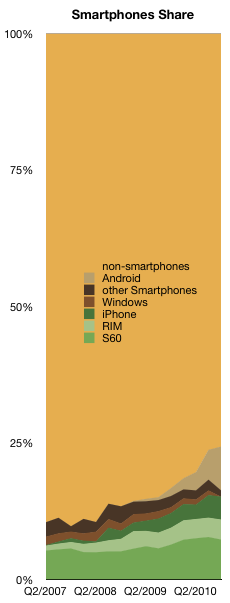
    The final chart shows the competition against smartphone non-consumption. I like this chart best of all as it shows the effect of Android in growing the entire pie for smartphones.

    What would have happened without Android is anyone's guess but my bet is that the market would not have grown as quickly. Apple is producing iPhones at capacity and RIM is growing into new markets. Symbian's strongest markets also do not overlap (much) with Android.

    However, the trend seems to be for consolidation of platforms (fragmentation within platforms notwithstanding). This trend, however, is over a very short time span. The smartphone industry started a decade ago and the time frame shown in these charts is a mere 3.5 years.

    The question remains whether the headroom visible in this chart still allows for new entrants or whether the platforms we see today are the last we'll ever see in mobile computing.

    I'm still willing to bet that there is room for innovation and for new platforms. Just like the two newcomers that came to conquer half the market emerged seven years after its inception, new contenders like Windows Phone, Bada, MeeGo, WebOS can still make an impact.

    The conquerors came with new business models and a focus on computing not telephony. Can factor innovation and the ubiquity of mobile broadband keep this market open to newcomers?

  6. Smartphone users still prefer branded phones

    Research · 23 comments

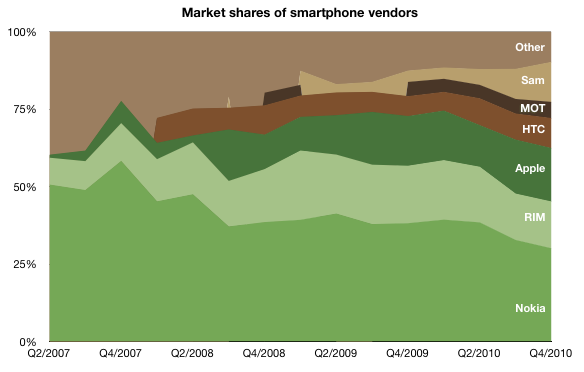
    The smartphone market has grown threefold in the span of three years. However, as noted previously, the share of units running a licensed OS has not grown dramatically. The following chart shows the vendors' shares with the same brown/green dichotomy between licensed and unlicensed OS's.

    In order to gain some insight into this licensed OS area (and who the "others" are) we need some visibility into which OSs are being licensed and what their shares are.

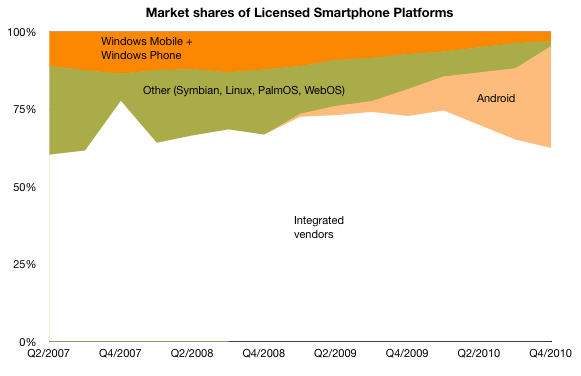
    The following chart shows the share of the various licensed platforms[1]. (I blanked out the Integrated vendors.)

    Before we dive in to understand the effect of Android, we have to understand the licensing of OSs in 2007.

    The chart shows Windows Mobile and "Other" splitting the market. Windows Mobile is rather easy to understand. It was still growing as a platform and Ballmer was famously quoted in 2007 as saying he liked their strategy "a lot".

    But "Other" is something of a mystery. What "Other" actually mostly meant was Symbian[2]. But not only the Symbian that Nokia was shipping and licensing to some vendors. At the time, Symbian also had a version called MOAP "Mobile Oriented Applications Platform" which was in use in Japan (somewhat analogous to the variants of Android now in use in China).

    Fujitsu, Mitsubishi, Sony Ericsson and Sharp developed phones for NTT DoCoMo, using an interface developed specifically for DoCoMo's FOMA "Freedom of Mobile Access" network brand. This UI platform was based on the UI from earlier Fujitsu FOMA models[3]. The user could not install new C++ applications and therefore these were not platform devices, however the industry still included these units as "smartphones" .

    So what we've witnessed in the last two to three years is the replacement of MOAP and Windows Mobile share with Android TAPAS and OMS.[4]

    But, more significantly, when looking at the rise of Samsung and Motorola and HTC we were also witnessing the demise of Palm, Fujitsu, Mitsubishi and Sharp (plus a myriad of Windows Mobile licensees even larger than the Android army).

    The significance here is that "other" in smartphones is still mostly about branded vendors. This is in stark contrast to the low-end of the phone market where “others” are quickly replacing branded vendors.

    So we can conclude that the smartphone market is so far showing a distinct preference for branded vendors. The value of the brand is still evident. But ZTE and Huawei are quickly developing Android competencies. How long will it be before the branded vendors feel the pressure from the upstarts?

    ----

    Notes:

    1. The Other category includes WebOS which was not licensed during this time frame but is not material enough in terms of share.
    2. A few million units running flavors of Linux were also on the market in 2007/2008.
    3. FOMA was also implemented with a Linux OS and the same UI.
    4. It should be noted that except for Windows Mobile, all the licensed mobile OSs including LiMO and Symbian are now open source. Android's success is not therefore due to being the only OS that is "open".
  7. Calling the end of innovation in mobile computers

    Research · 72 comments

    People are lining up to call the market for mobile phones. Analysts and amateurs alike are connecting points on charts and predicting with confidence the future of mobile platforms. Consensus is forming that there is no future but a quiescent state. By the acclamation of pundits, the survivors are declared to be iOS and Android. They are also predictably arranged in a way similar to OS X and Windows. End of story.

    Except for one thing.

    3.5 years ago neither of these platforms existed.  In fact, it was only two and a half years ago, in mid 2008, that one of the finalists even became a platform with the launch of an app store. The other "winner" only launched in a handset later that year and had no significant volumes until a year ago. In other words, these suddenly predictable platforms have been in existence for less than the life span of one device that runs them.

    To point out how extraordinary this claim is, if we look back to the history of computing, could we have declared the PC industry future cut and dried in 1978, two years after the founding of Apple? What about 1983, two years after the emergence of the IBM PC? What about 1986, two years after the Mac? Or maybe 1990, after Windows was born? Maybe the writing was on the wall in 1997, two years after Windows 95 caught up with the Mac's UX. That would be 21 years after Apple's founding. Some would argue that even today the story of desktop or portable computing is far from over.

    Sure, times have changed. Things move much faster now. But markets are also much bigger and take a long time to penetrate. Mobile channels are bounded by provincialism and parochialism.

    What's more, it's not like there haven't been platforms before these two upstarts came along. I've seen 9 mobile platforms in 9 years (PalmOS, Windows Mobile, Symbian, Java, WebOS, Windows Phone, iOS, Android, RIM Blackberry). New platforms are still emerging and evolving (e.g. MeeGo, Bada, LiMo, QNX and Tapas).

    So the existential question is this: If you were to draw a time line, would a mark in early 2011 signify the end of mobile platform history? The point in time when unforeseeable change will cease to happen?

    Let me offer a hint as to why not: every major platform battle has been sparked by an innovation built around a new input method. The keyboard integrated into a personal computer in the 1970s, the mouse in the 1980s, the stylus in the 1990s and the fingertip in the 2000s. Each of these input methods created new platforms (DOS/Apple ][, MacOS/Windows, PalmOS/Windows CE, iOS/Android), new ecosystems, new industries, new competitors and new platform battles designed to enrich forecasting pundits. I won't even try to go back to the changed in the half century of computing prior to the PC.

    So here's my challenge to the prognosticators: If you are willing to draw a line in the calendar now and say that no input methods will ever emerge in mobile computing after this point in time I'll buy the thesis that it's over and we can count our chips.

    If you think that out of the hundreds of user experience patents being filed, and hundreds of prototypes being slaved over in labs throughout the world, not a single new product will emerge with a new way of interacting with a computing device, then it's time to move on to something other than what can be declared a commodity market.

    But if you believe that, as happened four years ago, a new input method, previously only in the realm of mockups and movie magic, suddenly was shown, in a working product, on stage, then this business still has a chance of staying interesting.

  8. Of Platforms, Operating Systems and Ecosystems

    Research · 21 comments

    In the earnings Q&A Stephen Elop used the word 'Platform' once, 'Operating System' three times and 'Ecosystem' 15 times.

    Though they seem interchangeable, the three phrases have significant differences in meaning. Briefly put, a Platform is a business model concept,  an OS is a technology concept and an Ecosystem is a marketing concept.

    Platform

    A platform, as the New York Times recently pointed out, can take many forms. The Barbie doll is a platform as is the US Interstate Highway system. These are products or infrastructure that allow other products to be 'built on top' and can thus charge rents from them. When building platforms, a company needs to think of how to make their work foundational so it can support other structures. Other examples of platforms are browsers, the Apple 30 pin dock connector, Game Consoles and Facebook.

    In terms of innovation theory, a platform is a signal to industry that the company is willing to allow its innovations to be extended and thus share in the creativity of adopters. There is however a down side: platform adopters may also create so much value that users will shift loyalties to the layers above the platform thus restricting the freedom of the platform owner to modify or modernize the underlying platform.

    This loss of control over the roadmap often forces platform owners to institute draconian limits to the extensibility of the platform (e.g. the iPhone developer restrictions.) In other cases, platform owners have acquired and integrated various core apps or services so that the platform and core apps can be upgraded in sync. This was the impetus to the development of Microsoft Office. Office was motivated by a need to prevent Lotus from slowing the upgrade path for Windows not, as it's assumed, to create a new revenue source. However, again, the effect is the destruction of the ability to innovate on that particular area (no new Word Processor or Spreadsheet programs for 20 years).

    It takes a great deal of work to platformize a product. I would guess 10x more than a similar product which does not allow collaborative innovation. Platforms are difficult to build, require delicate balancing acts to maintain but can be enormously valuable due to network effects.

    Operating System

    In contrast an Operating System has a very clear technical definition. It has been extended to include many applications and services, but it's basically the control system of a computer. An OS may or may not be a platform. For example embedded operating systems typically do not have APIs to support applications. Some basic mobile operating systems support applications through a sandbox like JaveME (in this case the platform is Java) and are therefore also not platforms.

    A company licensing an OS may not accept the platform with the license or may not consider it valuable. It's even possible to license an OS and consider the platform value to be a liability to your own strategy (arguably HP fits in this scenario as regards to Windows. HP had its own operating systems and tried to build alternative platforms in spite of Windows).

    An example of an OS with minimal platform value may be WebOS which has a very limited API for native applications.

    Ecosystem

    The word ecosystem as it applies to technology was coined by Palm to describe the app vendors that built apps and the accessories for its Palm Pilot. This is not a common word as it's largely equivalent to Platform. The subtle difference is that it's used in a marketing context to signal platform value. Having a large ecosystem implies the acceptance of a platform by a large base of developers.

    For example a platform may not have a viable ecosystem if there are few developers and/or little economic value 'on top' of the platform. Symbian is often cited as being a decent OS, but a poor platform with a mediocre ecosystem.

    So these three phrases are overlapping but have a different tone. Although perhaps unintentional, Elop's emphasis on Ecosystem vs. Platform or OS, might signal that what's missing from Nokia's strategy is the motivation or encouragement of developers to participate. My prediction of WP7 licensing may not fit well with this deficiency but perhaps Microsoft's ecosystem building potential is still greater than Nokia's.

    I should also point out that Nokia's platform strategy has also included an intermediate layer called Qt that enables cross-platform ecosystems, thus making the OS irrelevant. Technically this may have merit, but it's a long haul to getting an ecosystem for it.

  9. Stephen Elop's ecosystem messages

    Research · 66 comments

    Yesterday I made my predictions on Nokia's new platform strategy. They should  be treated as pure guesswork, but they are informed guesses. I based them on public information.

    That information comes in the form of statements from Nokia's CEO at the earnings call. I made a table of all the statements that dealt with platform decisions and my interpretations of those statements.

    You may do your own interpretation, but to me there is significant evidence here to support my predictions.

    What Elop SaidMy interpretation
    In certain markets where there’s a greater preponderance of competing platform devices, we have some competitiveness problemsWe have problems in the US
    Broadly the conversation about operating system and positioning of relative operating systems in different places is something that we'll reserve for the February 11th meeting,Different markets require different operating systems
    The general comment I’d like to make though is that in today’s world it is the case that given the different price performance characteristics of different chipsets, we get into situations, where the best experiences are not necessarily delivered by systems that are capable of delivering the highest end experiences. We have to be very mindful at what level of the price curve we deliver what type of device with what operating system.Different price points require different operating systems
    When I think about geographies, the area, I've mentioned this indirectly during my comments, but I'll be more precise in answering your question and that is clearly, there is a pattern of disappointments in the United States. A pattern there where efforts have been made, competitiveness, challenges exist and we very much need to address thoseWe have problems in the US. We're going to address these.
    That's why I characterize very clearly in the framework for the decision making ahead, that whatever the strategy is that we outline on February 11th, we very clearly will be ensuring that it gives us the opportunity to reopen doors in markets such as the US and some others where we have not recently been presentWe are going to enter the US with this platform
    With respect to the question of ecosystems and so forth, it's important to note, in my opening comments, I referenced the fact that there are today different ecosystems and different patterns at playDifferent OS for different markets
    If you like the high-end ecosystems where there is particular rate of momentum and share gain taking place. At the same time, the dynamics at the very low end of market which itself is an ecosystem of sorts, is very different with very different demands and expectationsHigh end and low end require different OS
    I'll just offer that observation that today broadly in the world without any specific comment on us or our competitors, there are multiple ecosystem patterns that need to be consideredMore on the need for multiple OS
    I'd also point out that very critical in whatever combination of ecosystem or ecosystems or whatever our strategy outlines, the need to maintain sustainable differentiation between ecosystems and within the ecosystem relative to our competitors in that ecosystem is a top priority. In everything we consider, that’s something that will be very much on our mind.What we chose gives us some degree of differentiation--It's possible concessions were negotiated
    With respect to comparisons to other ecosystem shifts and things like that, the real thing that one must focus on is the quality of products in the market, the momentum that one already hasSymbian is not going to disappear
    As we’ve described the Symbian momentum that we have today; a consideration of shift of ecosystem, certainly you have to consider that potential of market share changesSymbian will lose share
    With respect to the ecosystem comment, without getting into specifics of different options and things like that in detail, what I will say is that the word catalyze is to imply that there is a wide variety of participants in our world, and that includes competitors, it includes operators, other technology firms and so forth who in many respects have a common interest relative to the potential strength of other ecosystems and how they may develop over timePartner is a tech firm that has common interest -- i.e. market entry
    The catalyst of an ecosystem could be considered as making sure the right conditions are formed in the right companies, work in such a way that alternatives emerge in a marketplace that may not exist todayLooking at growing the market for the partner-- Microsoft
    We made a decision to not proceed as people have thought we would proceedThis is not going to be business as usual
    You'll see that pattern of decision making from us in terms of being very crisp about what constitutes great experiences and ensuring that that is what we are delivering to our customers.This is a marketing-led effort. We're going to stay on message and not waffle on about technology
  10. Summary view of Apple's income statement [Updated]

    Research · 22 comments

    Since reporting on the 18th, I've mostly finished going over the the fourth quarter Apple data. Here is a quick summary of the articles that covered the financial and product performance:

    SubjectArticle
    CashHaving added $20 billion last year, Apple’s cash growth suggests total could top $100 billion next year
    GrowthApple’s Growth Scorecard: 63% average earnings growth over 16 quarters
    iPhone pricingThe end of exclusivity doesn’t change the price operators pay for the iPhone
    Sales by product65% of Apple’s sales came from iOS powered devices
    Next quarter’s estimatesEstimates for Apple’s second quarter earnings (ending March)
    Share price/valuationIs Apple a candidate for acquisition?
    Margins and platform mix of profitiOS enables 71% of Apple’s profits. Platform products power 93% of gross margin
    CannibalizationiPhone and iPad: Fine Young Cannibals?
    Operational Expenses$76 billion a year from a tableful of products

    That leaves one more: Summary view of cash flows.

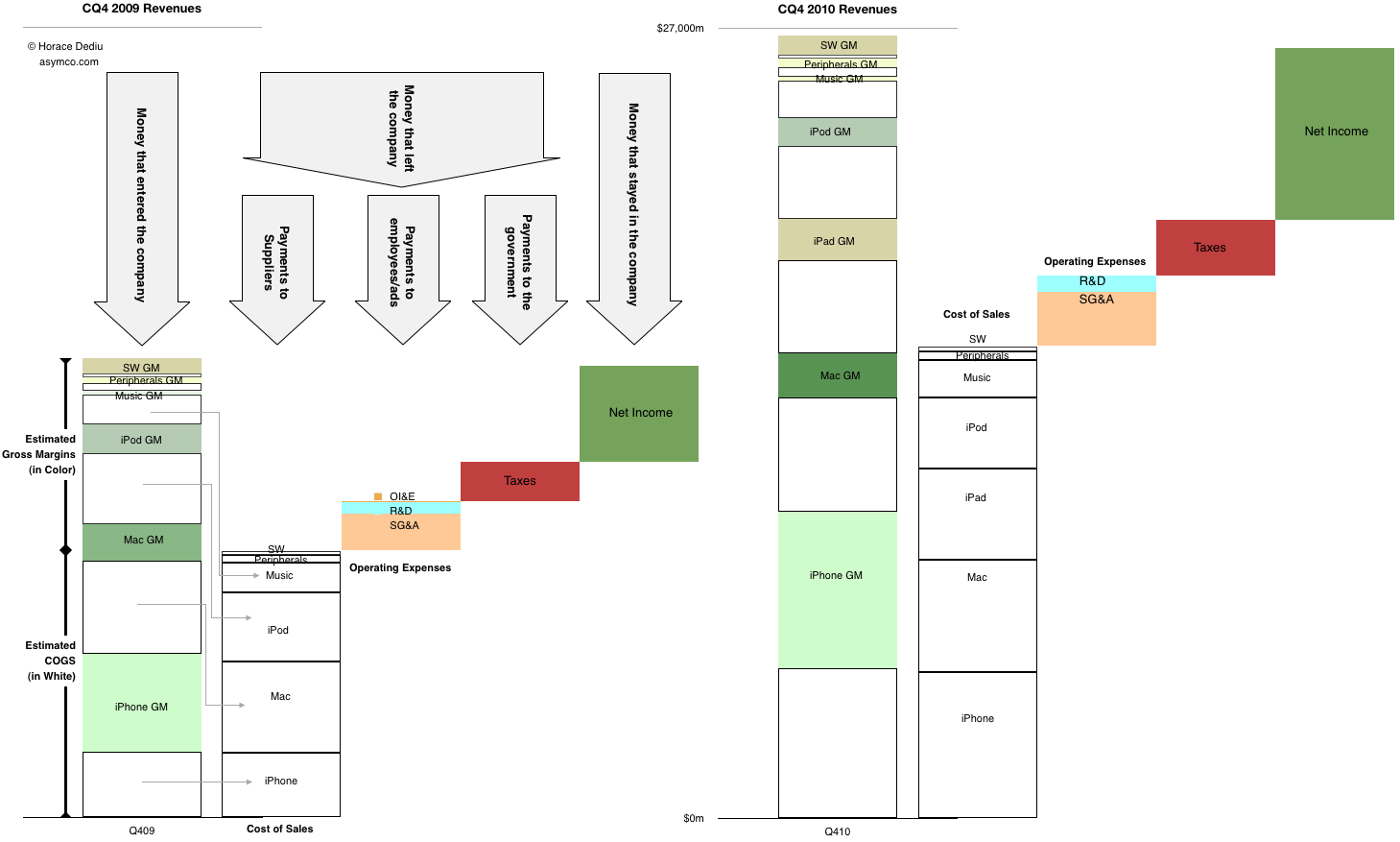
    After introducing it last quarter, this is a chart that I'm trying to improve and use as a single snapshot of growth, product mix, profitability, cost structure and overall sales. The purist in me likes to see the chart clean but it can be a puzzle to some.  So for the sake of explanation, this time I've added some annotations to the year-ago quarter.

    The left half shows flows in the same quarter a year ago and the right side shows the flows in the fourth quarter just ended December 2010. You can see where sales came from, how much of each product's sales went to suppliers and how much was available to pay employees (and who got what). You can also see how much was paid in taxes and what was retained.

    Please click on the figure (requires no scrolling when viewed on screens wider than 1464 pixels).

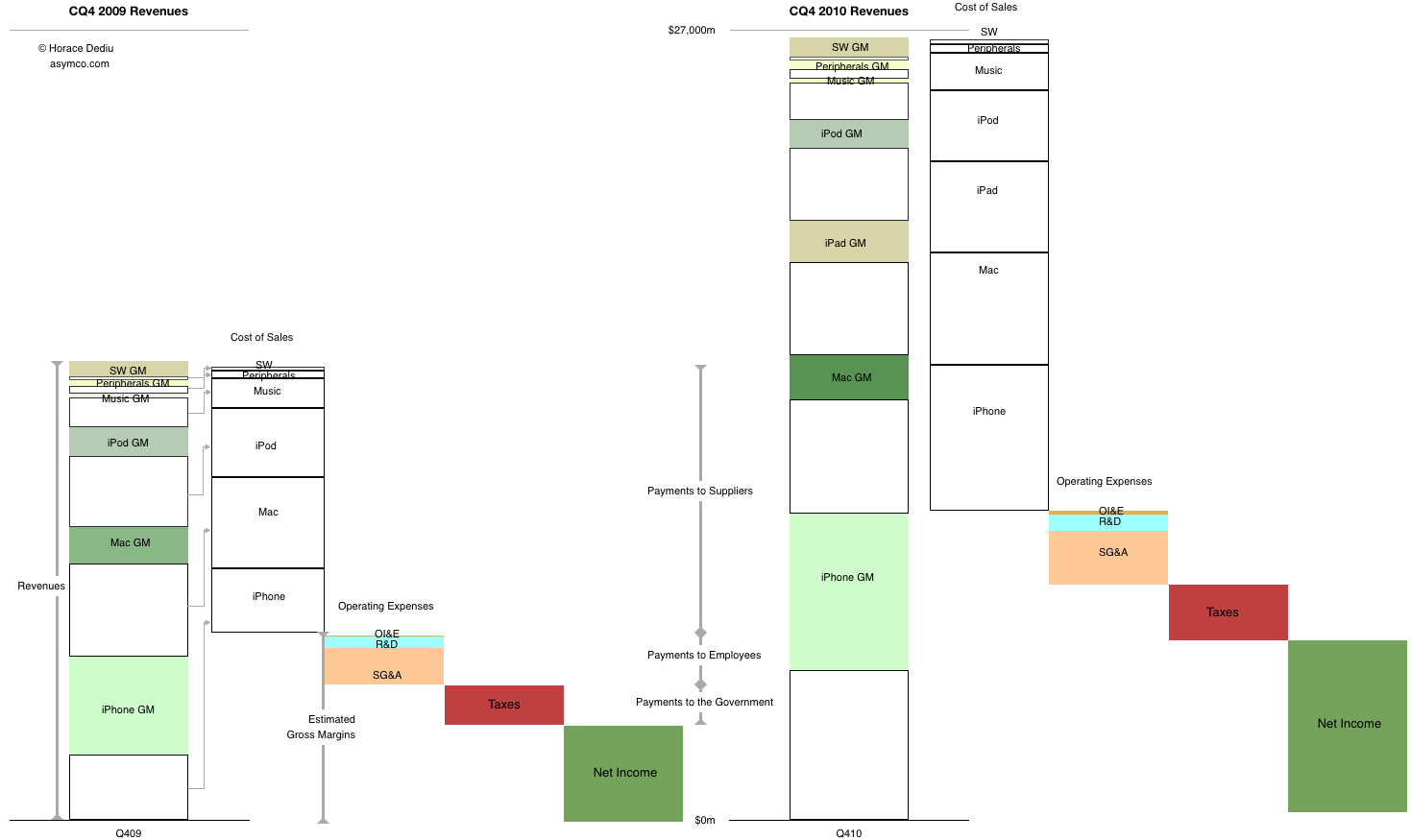
    [Update] Alternate view using "waterfall".

  11. iOS enables 71% of Apple's profits. Platform products power 93% of gross margin

    Research · 17 comments

    As the highly profitable iPhone makes up an increasingly larger proportion of Apple's sales, the overall gross margin would be expected to grow.

    Sure enough that's what's been happening.

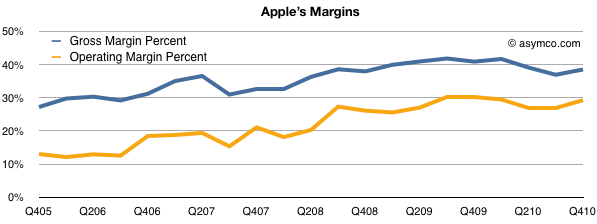
    The gross margin percent, which measures the direct or variable costs of production vs. price, shows a healthy rise in the last five years from slightly below 30% to around 40%. The Operating Margin, which also includes the overhead or fixed costs like R&D and SG&A, shows a similar rise, reaching about 30%.

    Margin expansion while sales quadruple is a good indicator that a company is producing real value not just trading sales volume for profit.

    Focusing attention on individual product lines, it's clear that the iPhone is the largest component of sales and of profits. We don't have specific product line-item gross margins from management, but we can estimate a figure for the iPhone by several means.

    First, we can work out roughly what every other product line's margin is due to their longer histories. (Mac and iPod have reliable profitability estimates). What's left can be deduced to make up the iPhone's margin.

    Alternatively, we can get estimates of the bill of materials and add in some of the other direct expenses like manufacturing, warranties, shipping and incidentals to get an estimate of the cost of production.

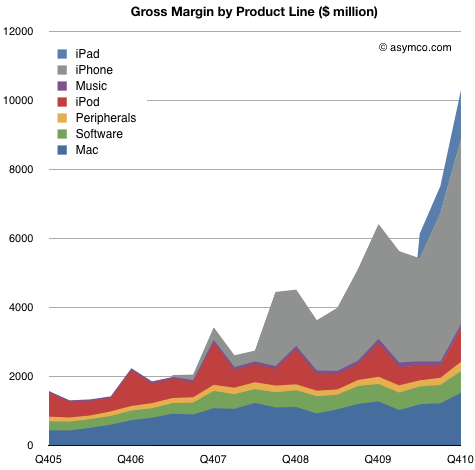
    These methods allow me to guess at a margin for the iPhone of about 50% for the last quarter. Based on these inputs we can plot the gross margins for the entire company's product lines:

    Overall, gross margins have reached over $10.3 billion in the quarter, increasing 543% from five years ago and 61% from a year ago.

    That's great, but by knowing product line profitability we can get a better feel how the company changed strategically.

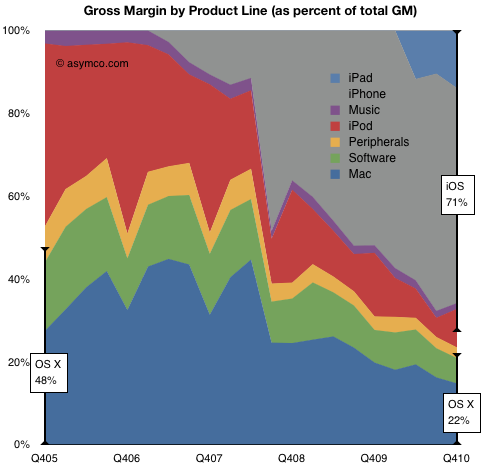
    In the following chart I show the percent of gross profit captured by each product line.

    What we can observe is that at the end of 2005, OS X based products made up nearly half the profits. The rest was mostly the iPod, which was not a software platform product.

    A short five years later, OS X products which, although having grown in volume, made up only 22% of total margin. The rest was mostly iPhone but with significant contributions from iPad and iPod. What's most important to note is that the non-OS X profits are almost all powered by iOS.

    iOS powers about 70% of Apple's current gross profits. Combined with OS X, 93% of profits are from platform products.

    So again the question about Apple being a software, hardware or media company comes back. Perhaps, those categories are not relevant. Perhaps Apple is a platform company.