Asymco

Asymmetric Intelligence

platform

  1. Half of US population to use smartphones by end of 2011

    Research · 35 comments

    60.7 million people in the U.S. owned smartphones during the three months ending in October, up 14 percent from the preceding three month period, representing 1 out of every 4 mobile subscribers.[...] Despite losing share to Android, most smartphone platforms continue to gain subscribers as the smartphone market overall continues to grow.

    via comScore Reports October 2010 U.S. Mobile Subscriber Market Share - comScore, Inc.

    Separately, Nielsen reports on the same market:

    29.7 percent of U.S. mobile subscribers now own smartphones that run full operating systems.

    The most popular smartphones are the Apple iPhone and RIM Blackberry, which are caught in a statistical dead heat with 27 percent of smartphone market share in the U.S. Twenty-two percent of smartphone owners have devices with the Android operating system.

    via U.S. Smartphone Battle Heats Up: Which is the “Most Desired” Operating System? | Nielsen Wire.

    I've been tracking the Nielsen data and using it as a basis for forecasting the penetration of smartphones. While most coverage of this data focuses on splits between current OS platforms, I will look at competition with non-consumption and the impact on operator services.
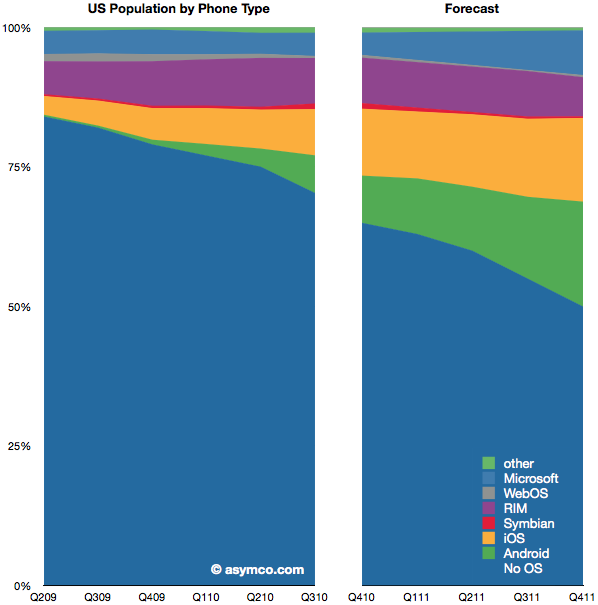
    The chart on the left shows the historic penetration of smartphones since mid-2009 based on Nielsen's reports. The chart on the right is my forecast. This is an update from the last quarter's chart here. My forecast was fairly accurate with respect to platform shares in the last quarter so I've had to make only small adjustments and extended the forecast one quarter further out. [1]

    If my forecast is correct, smartphones will make up 50% of all phones in use by the end of 2011. That's up from nearly 30% today and 18% a year ago.

    One in three of all phones in use will be either iOS or Android. That adds up to about 80 million users; up from 35 million today. Overall, 120 million Americans will be using smartphones.

    Now consider the consequences for how services are delivered by operators. The most popular product operators will be selling will be unlimited data plans. One year hence, by 2012, unlimited data plans may become the largest service revenue generator for mobile operators in the US. Pricing and competition will inevitably be in a state of extreme flux. I leave the consequences to the imagination of the reader.

    ---

    [1] Note that the charts show share of phones in use, not phones sold in a particular point in time. In other words, this is measuring platform consumption, not units sold.
  2. Are mobile networks commodities?

    Research · 23 comments

    Apple has been contemplating a SIM card that would make carrier switching a lot easier. Sounds great, doesn't it?

    "Apple is relenting," said Rodman Renshaw analyst Ashok Kumar. "They are now completely backing away from their plan to take the carrier out of the equation," said Kumar,.

    via Apple to Kill Carrier-Irking iPhone Plan - TheStreet.

    This brings to mind a recent article I wrote that any talk of mobile dominance by platform vendors is bunk.

    ... no single platform can win a disproportionate share because it would threaten the balance of control the operators require. So talk of “dominance” of one platform or another is hyperbole. The most likely scenario is an even distribution of share between 4 or 5 competitors.

    The power of distributors in the mobile phone value chain cannot be ignored. It's not fair, it's not convenient and it's not consumer friendly, but as long as networks are not good enough for mobile computing, mobile computers cannot commoditize the network.

    The consequence (for those of us who try to foresee the platform game) is that operators will continue to play platforms off against each other leading to the scenario I suggest above.

  3. Law of conservation of modularity

    Research · 32 comments

    When I applied the modularity dichotomy to smartphone operating system there were several implications that came to light. One was the question of whether the market has reached the point where products were "good enough" and the speed of innovation became less important than price. Another was: will integrated vendors be able to hold on to a healthy share of growth against non-consumption?

    Now I bring up another implication of modularity: the concept of "law of conservation of modularity".

    Clayton Christensen illustrated this as follows[1]:

    If you are writing a software application to run on top of a platform, are you permitted to modify the platform to make your application run better?

    If the platform is interdependent, changing it could cause unintended side-effects and you will not be allowed to make them. If the platform is modular, changes are possible and you will have access to the code.

    The reason is not not political. It's that in the case of interdependence, the application has to be suboptimized and conform itself to the platform so that the platform could remain optimized (to its goals). The platform needs to remain optimized is because it needs to keep improving (since it's not good enough).

    In the case of modularity, the application can be optimized and the platform can conform itself to the application because the application needs to keep improving while the platform is good enough and does not.

    Conformability is what constrains up-market progress.

    This also holds in hardware architecture. This was plainly evident in the WinTel era. During that time the microprocessor and the operating systems had a proprietary and interdependent architecture even while Dell’s product has a modular architecture.

    So the microprocessor wasn’t good enough. That meant that the desktop computer had to have a modular architecture to conform itself in order to allow this to be optimized because the line widths on the circuit were not good enough.

    This is what is meant by conservation of modularity: one side or the other of an value chain boundary needs to be modular and conformable to allow what’s not good enough to be optimized. The key question is what's not good enough: the device or the platform (the whole or part?)

    How does this apply today in the post-PC era?

    If you think about it in a hardware context, because historically the microprocessor had not been good enough, then its architecture inside was proprietary and optimized and that meant that the computer's architecture had to be modular and conformable to allow the microprocessor to be optimized. But in a little mobile computer like the smartphone, it’s the device itself that’s not good enough, and you therefore cannot have a one-size-fits-all Intel processor inside of a BlackBerry or iPhone, but instead, the processor itself has to be modular and conformable so that it has on it only the functionality that the BlackBerry needs and none of the functionality that it doesn't need (hence the ARM modular architecture is dominant). So again, one side or the other needs to be modular and conformable to optimize what’s not good enough.

    Now today (and, I believe for some time to come) in smartphones, or in any situation where logic gets embedded in a system it’s the device itself that is not yet good enough and, therefore, you cannot back off the frontier of what’s technologically possible. It has to be optimized with a proprietary interdependent architecture. That means that the processor and the operating system inside of a Smartphone has to be modular and conformable to allow that to be optimized.

    In order for you to believe otherwise you have to convince yourself that smartphones, as a system, have reached the limit of what is technologically possible.

    [1] The source is a presentation by Clayton Christensen at  Open Source Business Conference in 2004

  4. Is Android fragmented by design?

    Research · 99 comments

    When I wrote about the absence of copyright enforcement on the Android marketplace, I was trying to point out that Google did not have the interests of copyright owners at heart. This attitutde is also apparent in many ways from the absence of desktop sync for Android (and hence the absence of discovery or acquisition of commercial media) to the absence of protection for the app developer.

    Moreover, recently Google TV was blocked from all major US TV content and Google faced litigation from copyright holders in print publications and before that for YouTube infringements and before that from newspaper publishers for Google News' unlicensed reuse of their content.

    Therefore it should not come as a surprise the following revelation that Android lacks any common DRM framework.

    The hurdle has been the lack of a generic and complete platform security and content protection mechanism available for Android. The same security issues that have led to piracy concerns on the Android platform have made it difficult for us to secure a common Digital Rights Management (DRM) system on these devices.

    Setting aside the debate around the value of content protection and DRM, they are requirements we must fulfill in order to obtain content from major studios for our subscribers to enjoy. Although we don’t have a common platform security mechanism and DRM, we are able to work with individual handset manufacturers to add content protection to their devices.

    Unfortunately, this is a much slower approach and leads to a fragmented experience on Android, in which some handsets will have access to Netflix and others won’t.

    via Netflix blog.

    But the absence is not just oversight. DRM is, by its nature, proprietary and, by necessity, "closed". DRM ultimately includes "secrets" which would always be revealed in open source. If Android is to be open source, then it cannot include a DRM framework.

    This leaves the problem of content protection up to the device vendors who must license schemes from various third parties.

    The upshot is more fragmentation.

    As John Gruber points out,

    More and more, I’m convinced that Android isn’t a single platform. It’s a meta-platform upon which handset makers build their own platforms.

    In other words, Android fragmentation seems to be not only impossible to rein in, but it may actually be by design. Google is doing nothing to stop the centrifugal force that is building up in its ecosystem. They have neither the means nor the incentives to control the spiraling.

  5. What job is a Blackberry hired to do?

    Research · 15 comments

    When mobile platforms are discussed, the conversation frequently turns to market share battles between Android and iOS. I've pointed out before that the problem with this reasoning is that market share in a market that's growing at 90% is a false measure of performance.

    The more important measure is how much of the non-smartphone market is being taken by smartphones and how fast the whole phone market is growing. Competition with non-consumption is very different from platform warfare.

    But even when discussing the rivalry between current platforms, the Blackberry and Symbian are often overlooked as contenders. Windows Phone and iOS come in and out of discussion only on the basis of press releases. The truth is however that Symbian, Windows, Blackberry are not going to disappear anytime soon.  Why is that?

    The reason is that when you stop framing the market as rivalry between platforms, you see that many buying decisions are driven by specific device value propositions or jobs that the products are hired to do. For many years smartphones were purchased because they had the best cameras or the best keyboards and users never downloaded any apps or even used data plans.

    Later, smartphones were purchased because they allowed for browsing and gameplay. Very rarely did buyers opt for "iOS" or "Symbian". Most buyers don't even know what these words mean. Phones are rarely advertised according to their platforms. (As an aside, the mention of Windows in a PC ad is made possible by Microsoft funding, the same as "Intel Inside." So for platform recognition, someone needs to fund the promotion and that implies some revenue to justify it.)

    To illustrate, consider the Blackberry: A product that continues to grow despite a completely different basis of competition from the large screen touch competitors. It comes down to being good at some very specific jobs. RIM continues to grow in certain markets like Latin America and the Middle East on the basis of BBM (RIM’s sales outside the U.S. climbed 94 percent last quarter from a year earlier.)

    “A 15-year-old boy who likes a 15-year-old girl, sends her a BBM and he’s able to measure how important he is to her based on the speed of response after the letter turns to an R,” meaning it’s been read, he says. “No one else runs an end-to- end service plan like we do. That’s killer and is why it’s almost a social phenomenon.”

    or

    BBM is also popular in socially conservative Saudi Arabia where its speed -- messages are typically sent in less than two seconds, according to Morgan Keegan -- has made it a way for teenagers to communicate in a country where religious police bar unmarried couples from meeting in public.

    You could argue that the other platforms also allow for free messaging (through free texting apps) but the combination of a low cost device, a data plan and attention to detail (like Message Read notification) gives the Blackberry an edge.

    The general purpose smartphone that Google and Microsoft and Apple promote is still not the prevailing view of mobile usage for most buyers. One could also argue that many if not most Nokia smartphones are still being "hired" to do feature phone jobs.

    The fact that all these devices are classified as smart and therefore competing misses the point that they are hired for different things.

  6. Visualizing smartphone platform growth

    Research · 55 comments

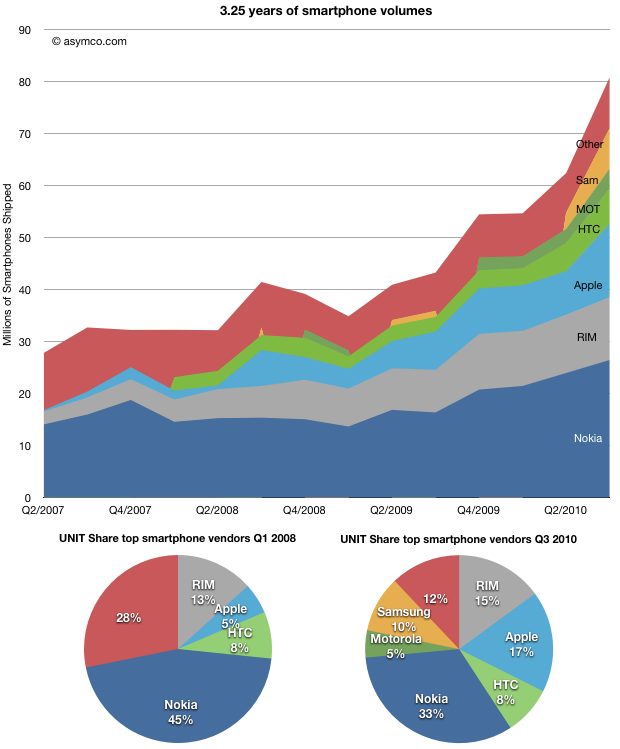
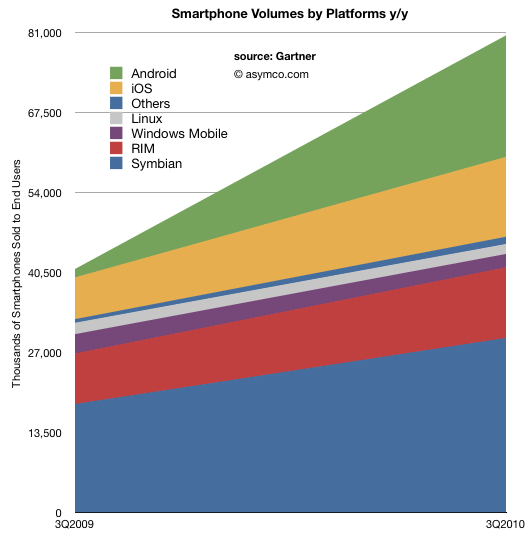
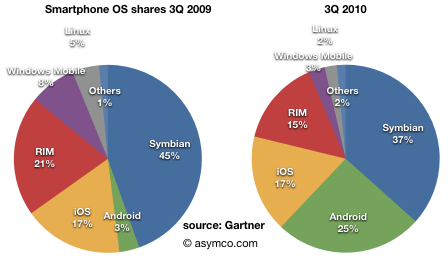
    None of this should come as major surprises, but Gartner's data allows for a bit more granular detail in the overall view of the market. Here are new points derived from Gartner's sell-through data:

    • The smartphone market is growing at nearly 100% (96%).
    • The overall market is growing at 35%.
    • The non-smartphone market is growing at 25%.
    • Android grew at 1,340% y/y. iOS grew at 92%, Symbian at 61% and RIM at 40%.
    • Platform market shares (below) shows a more even distribution of platform volumes between four main platforms:
    • Non-branded mobile phones grew to 33% of the market, with 141% unit growth. This is an alarming figure for the low-end of the market. The unbranded market excludes ZTE and Hauwei which grew below the overall market growth (9.8%, 27% respectively). The implications were most dire for Motorola (-36% units growth), Sony Ericsson (-23%) and LG (-14%). Nokia grew but, at 3.5%, well below market growth.
    • In 3Q 2009 41 million smartphones were sold. In 3Q 2010 80.5 million were sold. If we were to split the growth among platforms, nearly half the growth was Android. 27% of the additions were Symbian and 16% were iOS. Only 8.3% of the growth was RIM devices.
    • Windows Mobile and Linux were the only smartphone platforms to shrink volumes. However, even though the platform is deprecated, 2.2 million Windows Mobile devices were still sold last quarter -- more than Android sold a year earlier.
  7. What do you have to believe for an Android dominated future?

    Research · 56 comments

    If we look at the growth of smartphones independently from all phones, the category looks impressive:

    Smartphones are now almost 24% of all phones, up from 10% three years ago.

    What's also impressive is all participants in the market grew their volumes. The rising tide did lift all the boats.

    For this reason it's somewhat perplexing to hear absolute statements about the imminent death of certain smartphone competitors. The non-smartphone market is still 76% of the total phone market. And it's the biggest and easiest target for all smartphone competitors. The data shows that, for the time being, calling the end for vendors or platforms in a market that's doubling every three years is premature.

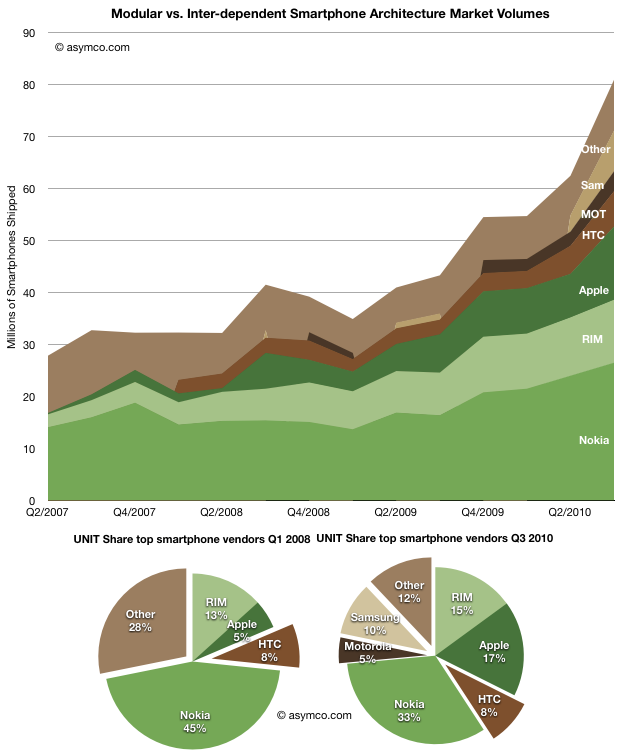
    But what I really want direct attention to here is a subset of the market: modular platforms.

    If you recall from the modular vs. inter-dependent dichotomy discussion, modular architectures are a way to implement products by licensing core components rather than keeping an integrated development model. I stated that modularity tends to be the better approach when markets are mature/over-serving and inter-dependency is the better approach when markets are young and the products not-good-enough.

    Looking at the chart above you should note that the market is growing extremely quickly so it's not "mature" in that sense, implying a healthy future for inter-dependent players.

    So how are modular vendors faring at this stage of the market and what are the prospects of module suppliers (i.e.  mobile operating systems).

    To help clarify, rather than looking at vendors individually I grouped them by architecture. I took the charts above and changed the colors so that modular vendors (in shades of brown) are represented separately from inter-dependent vendors (in shades of green).

    When looking at the market this way we can make some important observations:

    1. Even though the overall market grew, the share of the market held by modular architectures is smaller than that for inter-dependent. It's also not increasing. In 2008 modular players held 36%, in late 2010, they held 35%.
    2. The suppliers to the modular market changed over the same period, so to a large extent they are fungible. During 2007, the vast bulk of the brown area above was using Windows Mobile. The vast bulk in 2010 is using Android.
    3. The addressable market for Android is constrained to the modular market. Therefore the growth potential depends on whether that brown area increases dramatically relative to the green.
    4. Vendors don't change architecture easily. My knowledge of the competitors makes me believe that none of the green players will change from Inter-dependent to modular, and even if they wanted to change  it's not a simple thing to do. Conversely, changing from modular to inter-dependent is enormously challenging. Company processes, competencies and priorities must change dramatically.

    So what's the bottom line?

    For an Android dominant future, several conditions must be met; one will need to believe all of these to be true:

    • The addressable market for modular solutions will have to grow much faster than that of inter-dependent vendors. [The chart shows in-line growth--again due to the overall growth of the market. The green guys above won't just roll over.]
    • The split of licenses between Android and Windows Phone within the addressable market must favor Android. [Again, this is unlikely as "politics" will interfere. (I won't even touch IP issues.)]
    • The current modular vendors will not become inter-dependent or the current inter-dependent vendors will become modular. [Now why would they tear themselves apart if they are growing?]
    • The profitability of Android vendors must be high enough to make modularity sustainable [more about this later.]

    Talk of Android (or iOS) "domination" is still wishful thinking. With the acceptance of Windows Phone within the value chain (device vendors, operators, developers), the brown area above will be served by two very powerful and motivated competitors. Politics and lawsuits will add drag on growth. Established brands are important to consumers and new brands (like ZTE and Huawei) will have a hard time joining the top tiers with or without Android. Established integrated vendors like Nokia, RIM and Apple don't have modular DNA but do have massive distribution.

    In the end, the real limitation is that the brown area itself is not going to get disproportionately large. Android is limited by its addressable market and that market is a lot smaller than the whole market.

    Looking at the world through modular/inter-dependent lenses lets you see that mobile platform dynamics will not evolve as they did in the PC era. At least not for the foreseeable future.

  8. Estimating Android market share for the third quarter

    Research · 10 comments

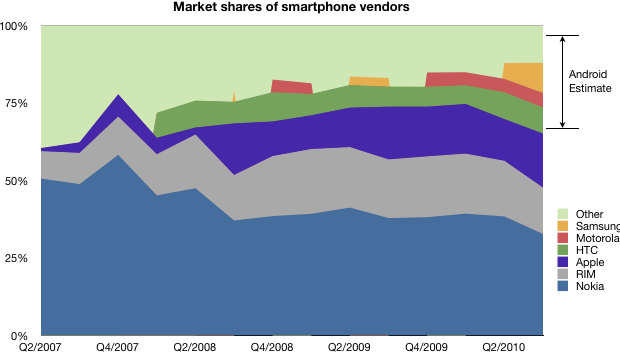
    Take a look at this chart. It combines the known shipment data with the total market size for smartphones as defined by Canalys.

    Knowing the platform/vendor make-up we can estimate the percent of the market that was Android.

    Note that the major unknown is still how much the platform hedgers (Samsung, Other) split their volumes between Android and Windows Mobile (yes, it's still being sold).

    Given this information, I would estimate Android share was around 30% globally. Canalys estimates 25%, which makes this analysis look reasonable.

    On a platform basis, Android gains were mostly at the expense of RIM, Symbian and Windows Mobile as we know that the iPhone share remained steady.

    Note that in years past the licensing vendors predominantly opted for Windows Mobile, a market that Microsoft wants to regain.

  9. Nokia's moderate-intelligence-phone performance

    Research · 60 comments

    A complete market overview will follow when all the top tier vendors report the last quarter, but in the mean-time here are some data that are available:

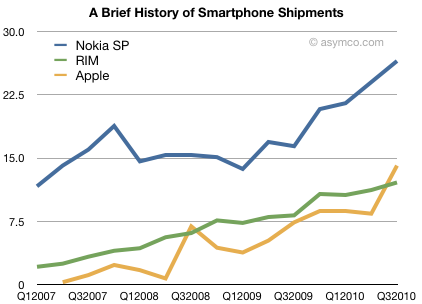
    Smartphone volumes for Nokia, Apple and RIM:

    Whereas Nokia is often criticized for being weak in smartphones, the fact is that they have grown at a decent rate over the last two years. In fact, they've opened a gap with RIM. Apple has increased share but it will take quite a while to overtake Nokia.

    So why is Nokia's smartphone performance so under-valued? Partly it's because ASPs have been dropping. A lower price and lower margin is sometimes seen as a sign of weakness. But Nokia has had a strategy of expanding into more price brackets in their core markets (i.e. outside the US). Half of Nokia's smarpthones are sold through distributors not operators and probably end up being sold unlocked and unsubsidized. Price matters in those markets.

    The other problem that Nokia takes a beating over is that their products don't get used as smartphones. Many are sold without data plans at all which makes one wonder what exactly makes their phones "smart". So many of these 100+ million/yr.  smartphones are really hired to do a feature phone job. They're "overqualified" and thus underutilized. The statistics in terms of app downloads, browser and ad impressions all lag as a result. The ecosystem suffers.

    Lastly, they are all but absent from the US. Due to accidents of history (CDMA) and various mistakes, Nokia never got a foothold in what turned out to be the most important mindshare market. A decade ago the US was a mobile data backwater, with lower data ARPU than Nigeria. It was not a market Nokia felt particularly deserving of investment. In hindsight, this was a big mistake.

    But these knocks against Nokia still should not detract from the fact that they do sell a lot of Symbian phones. Distribution still matters as does having 600 operator customers. And in many parts of the world, Nokia is synonymous with mobile phone. Many of those buyers will migrate to future Symbian devices.

    My mobile platform thesis has been that as long as penetration is not 80% and as long as operators are still in the value chain, mobile platforms will remain fragmented and split shares. The graph above shows exactly how that has evolved among the top three smartphone vendors.

  10. Escape from license-land: Measuring phone vendor commitment to licensed mobile platforms

    Research · 29 comments

    Windows Phone had its day in the sun yesterday. After discarding its previous seven-year effort with Windows Mobile, Microsoft started with a clean sheet of paper. However, whereas the software has been re-built, the business model has not. WP is still a licensed operating system whose primary customers are mobile phone vendors. With Symbian mostly out of the picture, WP becomes only the second viable commercially licensed mobile OS, after Android.

    So with two licensed platforms in the running, how do we measure success in the licensing business? Units sold to end users is one metric. But that data will have to include the performance of vendors and operators and other distributors. And it will take a year to do valid comparisons. The only indicative metric we have available today is how many devices have been committed by vendors.

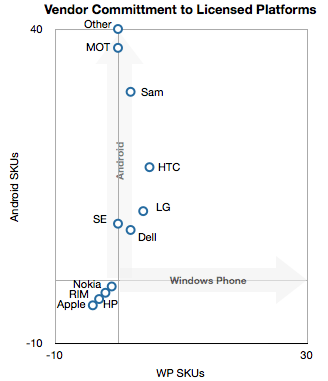
    As WP is out of the gate with device announcements, we can actually measure this. We can plot each vendor's commitment to various platforms as an early indicator of strategic success. To that end, here's the methodology: I took all smartphone vendors and tallied how many SKUs they have announced or leaked for either the WP or Android platforms (source: pdadb.net). I then plotted each vendor on two "commitment axes" (see notes below).

    The more to the right a vendor lies, the more committed they are to Microsoft's platform. The more to the top a vendor lies in the chart, the more committed they are to Google's platform. The vendors which don't have any licensed products lie below the origin.

    What we can observe is that Microsoft has pulled several, though not all vendors partially to its side. The level of commitment is not yet very high and it has not likely reduced their commitment to Android. In other words, points are moving to the right but not (yet) down.

    Framing the platforms this way helps us discuss how the market might evolve with these questions:

    1. Is Microsoft's re-entry going to peel vendors away from Android. In other words, will points move down as well as to the right.
    2. Is there motivation for some vendors to move to their own platforms like the non-committed? We've shown that profits accrue disproportionately to the vendors below the origin. As a result, is the pool of available top tier vendors going to shrink?
    3. Will vendors commit to single platforms or maintain this split OS loyalty strategy? Will we see LG migrate to WP exclusive and will Others remain exclusive in Android?

    I'll throw out my predictions to start:

    Microsoft's strategy is aimed at top tier vendors more than to the "others". This is due to a lesson they learned with Windows Mobile: having a ton of SKUs does not guarantee a healthy ecosystem (a lesson that Android has not acknowledged as true). There are positive and negative consequences. The positive is that Microsoft control the experience better, create a better brand and can participate in an effective dialogue with operators. The negative is that they are going to deal with a diminished licensee pool.

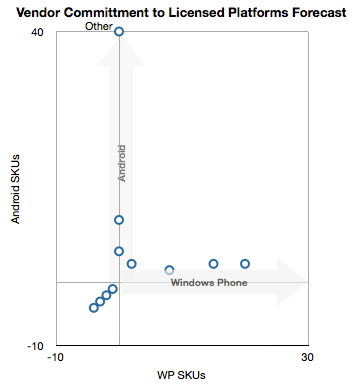
    On the second question my prediction is that vendors are going to move "down and to the left" away from the licensing model. If they can't go direct to that quadrant, vendors will consolidate portfolios around one licensed platform. The distribution of commitment I forecast will look like this:

    Maintaining multiple platform development teams is expensive. Branding is also confused. The upside is that you get to play the operator's divide-and-conquer game of platform dilution (aimed at the non-licensing players in the lower left corner).

    In particular, Samsung, with Bada, is likely to find ways out of license-land. Sony Ericsson may stick with Android and LG may move to Windows exclusively. That really leaves only HTC and Dell as licensees with multiple licenses.

    This axial alignment is not a healthy thing if you are a platform vendor. Having one or two dedicated customers means the power of the buyer is much higher and their wishes become your command.

    Which leaves only one true prize in the game: the "others". Android is clearly the darling of "Others" who are being shunned by Microsoft. Can "Others" become the lever for Google to pry open the market? History and the tangled web that is operator distribution does not point in that direction.

    ------

    Notes:

    1. I considered products announced only since Jan 1, 2010
    2. I did not consider any Windows Mobile legacy commitments
    3. "Other" vendors are off the scale with over 100 SKUs but represented as having 40 SKUs so as to be kept on chart
  11. What did Andy Rubin mean by saying WP7 was created for political reasons?

    Research · 24 comments

    In an interview with PCMag, Rubin said,

    "Look, the world doesn't need another platform. Android is free and open; I think the only reason you create another platform is for political reasons. Why doesn't the whole world run with [Android]? They don't like the people who developed, or "not invented here [NIH]"

    I note some irony in the suggestion that Windows Phone is superfluous when the acquisition of Android was an attempt to limit the growth of Windows Mobile. But that historical footnote is not entirely relevant here. The point Rubin raises is that WP is politically motivated. And by political he suggests two things: that there is mistrust of Google or NIH among potential licensees.

    The NIH argument falls flat because anyone considering WP7 would also have NIH issues with Microsoft. So that really leaves only the question of trust.

    Why would anyone mistrust Google when they offer operating systems software? How about these reasons:

    It's clear that Microsoft is buying its way back into Mobile (it went so far as to pay incentives and guarantees to established developers to convince them to port existing apps or write new ones for WP7), but that is not a political ploy. It's just good old fashioned brute force.

    The mistrust that Google earned for itself with operators, device vendors and potential content partners is rooted in its business model with Android. Hiding the costs of "openness" behind a veneer of freedom. In addition, putting forward competing products like Nexus One threaten the entire value chain.

    I'd say the politics of Microsoft licensing are a lot more transparent. Redmond is the devil they know.