I don't write product reviews and I don't pass judgement on individual products but I do own and test various products. For example I have the Android powered Samsung Galaxy 5 (GT-I5500) and the experience is, in my opinion, better than for recent Symbian phones but not as smooth as for Apple's products.
But that's not what this article is about.
It's about the price. The price for the Samsung is one third that of the iPhone 4 (both devices unlocked and sold in Europe with a 23% VAT). It was also purchased in a department store with as much hassle as buying a pair of gloves.
When it comes to the product, it may be a fair trade-off: one third the price for one third the product. The specs are not only worse but the whole experience is rougher and cruder. But that "one third the product" may be just good enough for a large population of users who are now satisfied even with "one tenth the product". The price point should be evaluated as a valid threat.
But Apple can respond. It's not like this is asymmetric competition. As the iPod shows, Apple can make money with low end products. Easily. Is this entry price point (€200 unlocked) something Apple should cover? My answer would be an unqualified yes.
For operator distribution, the subsidized price combined with a high-end offering is by far the best marketing mix (price, promotion, positioning, etc.) However, for non-operator distribution, a lower spec unlocked device sold through tens of thousands of points of purchase (like the iPod, and soon, iPad) makes a lot of sense from a platform point of view.
These two channels are often in conflict due to subsidy and exclusivity clauses. This conflict makes the decision to ignore the non-operator channel compelling. The economics for the operator channel are always going to trump the non-operator channel. But as the platform expands across geographies and income segments not covered by the operator-subsidized channel, these populations will need to be addressed.
So this is the inherent strategic tension for the iPhone franchise: Whether to use the iPhone brand to enable ubiquitous mobile computing outside operator channels, or use iPod/iPad as a complementary but separate brand to engage in an orthogonal attack.
I suspect the decision has been made. We will observe the consequences next year.
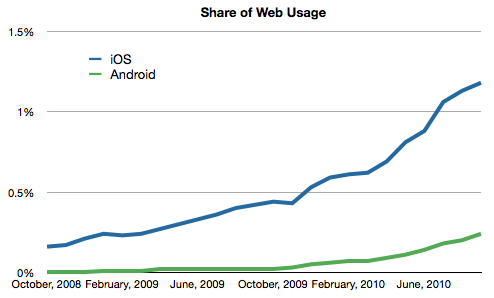
Of all the public statistics about platform share, Share of web use must be the most important measure for Google. The more browsing people do, the more searching they do and if Google search is most likely for a platform then the more income Google derives from that platform.
NetMarketshare.com has offered an insight into the split between Android and iOS as search platforms and it shows how iOS is still five times more likely to yield search revenue than Android. That multiple is likely to shrink as the gap narrows, but it still demonstrates the power of iOS to drive Google's bottom line. It's no wonder then why Google has renewed their default placement of Google search in mobile Safari (a guarantee they don't seem to share with all Android licensees.)
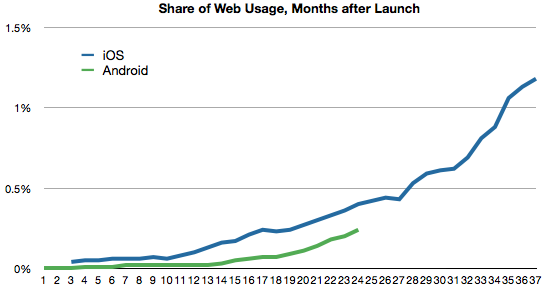
But Android launched later than iPhone, so everyone should be asking how rapidly the share of Web has grown since the start of each platform. When iPhone launched in 2007 it was almost competing with mobile web non-consumption. The alternative mobile browsing experiences were so bad that it's hard to remember anyone putting up with them. A year later, the bar was set higher and Android filled a vast chasm of demand for mobile browsing for people who could not buy an iPhone.
At the same point in the life of each platform, Android seems to be exploding in units sold. With this proliferation of Android licenses, it should be interesting to see if their unit share numbers are reflected in web share numbers. So far the story is not convincing. The growth in Web share is not pacing faster than iOS achieved at a similar point in time.
So far, 24 months into the life of each platform, iOS leads by almost 50% higher share.
iOS/mobile Safari has the advantage of iPod and iPad for distribution but that does not explain the relative lag of Android with respect to Web share as Android has a large number of SKUs.
It may be too early to draw conclusions, but anyone trying to analyze Google's strategy with Android should be paying close attention to this.
The latest litigation lollapalooza over Android reminds one of the old web adage that if you're not paying for content, you're the asset being sold.
That's certainly one of the consequences of the Android licensing model. The mobile phone vendors with no software intellectual property are pawns in a game between IP holders. It's clear that Microsoft and Apple and Oracle (and perhaps Nokia) have IP issues with Google. But it's the licensee device vendors which are most often the accused. Whether Google indemnifies or not is an open question, but the evidence is that the vendors are exposed.
The proof is in the fact that HTC is paying Microsoft for the use of Android. It's conceivable that Microsoft also asked Motorola for Android royalty payments but were rebuffed. It's also possible that since HTC is still a large scale Windows Mobile licensee, they were given a way out of the Android IP trap by Microsoft. We don't know if there were confidential deals between LG and Samsung on this issue (as they are both committed to the Windows Phone platform but shipping Android). In either case, Motorola may be forced to do the same and pay (Microsoft) for Android.
It's understood that Google gains some value from Android but also has hidden costs from it as well. Now the licensees have to recognize their hidden costs of the platform as well. There is the IP tax but also the question of control over one's destiny. Google is selling the vendors as an asset class to advertisers. Is that a positive consequence for their brands?
ZDNet reports Sony Ericsson are abandoning Symbian for Android, and Samsung headed down the Android and Bada road a while back. There are precious few device manufacturers remaining as foundation members, e.g. ZTE, Sharp and Compal, none of whom are exactly trend-setting industry leaders.
I was going to ask what happened to 'Open always wins?' but decided against it.
What I will say is that open sourcing Symbian was not a new beginning for the platform but the beginning of the end. I don't think anybody seriously considered it a viable multi-vendor platform, least of all Nokia.
The chances are extremely small. There are three scenarios where this would make sense:
If there was a specific market that required it. It would also need to be a large opportunity since developing a new platform and diluting existing platforms need significant upside. The only such market is the US, but there are better options available, namely Android that have better potential and Android is treated as a toxin by Nokia (see metaphor).
Specific users. Windows Mobile used to be justified for business users, but Windows Phone is not targeting business users.
The last option would be "strategic" i.e. Microsoft paying Nokia for using the OS (directly or indirectly through marketing co-spend or other symbolisms). I don't think Nokia is desperate enough yet.
Although it's never prudent to say never, I just don't see any logic for Nokia to add to its bill of materials for phones while facing price pressure.
With Verizon shaping Android into its image, you can read AT&T's embrace of Microsoft as the deeply-held belief by operators that they need multi-platform balance in their portfolio.
The idea that operators will tolerate "dominance" of a platform is looking less and less tenable.
I believe that next year and perhaps the year after that will see intense competition on the OS platform front, but eventually one will dominate the other(s) by a significant margin (and this also depends on the cloud and how it will be adopted across platforms). This happens as a result of a unified platform in which many can compete on lower margins instead of the development of the entire package and platform, which all goes hand in hand with commoditization.
However, to predict that smartphones will not be commoditized within the next three years is bold to say the least. The desktop was settled very quickly, and in this industry of exponential growth, it can be assumed it will not take longer for a similar scenario to settle.
I reply:
I’ve been observing (professionally) the smartphone market from its inception and was holding my breath for the commoditization of handsets that Microsoft promised all the way from 2004 through 2009. Several generations of Windows Mobile were predicated on the imminent stabilization of hardware and user experiences years before the iPhone came along. Not only Microsoft but Palm via PalmSource, Symbian as a consortium of all incumbents, Sun & IBM via Java, DoCoMo with iMode and not least of all, Qualcomm with BREW all made the same bets and ran with horizontal strategies toward a smartphone future built on the lessons of the PC industry. The only holdout for the integrated approach was the one company that everybody marked for dead: RIM. It’s also the only one who raked in all the profits.
All this happened before 2007.
To suggest that this time, in 2010, it’s different: that the definition of the smartphone as it exists today is the product at its zenith; that user experiences and expectations and hardware specifications and platform dynamics will be henceforth frozen with minor sustaining tweaks to look forward to is, in my opinion, a far riskier bet.
I don’t try to be a futurist or predictor of how the product will evolve, but I can see a dozen ways of how the very definition of a smartphone will change and how in 4 years we’ll have products that won’t be recognizable as such today.
So much depends on when the smartphone (or more broadly mobile computing) reaches this point of good enough. It's at the root of all hypotheses of how the market will evolve.
Lots of people apparently think it’s a big deal that Gartner is predicting Android will surpass iOS for second place. But why is that necessarily a good thing, given that they’re predicting Symbian will remain in first place? Who thinks Symbian is actually doing well? Nokia’s board sure doesn’t.
I also noted with amusement that by 2014 "other" is slated to sell 85 million units or nearly 10% share, up from 6.1% in 2009. These "others" will be selling more than twice what Apple is expected to sell this year. Is "other" WebOS, Bada, MeeGo, LiMO? If so they're in for a healthy future.
But dwelling on details like these is missing the point. To see how improbable this prediction is, let's go back to 2006 and ask what Gartner was forecasting would happen now.
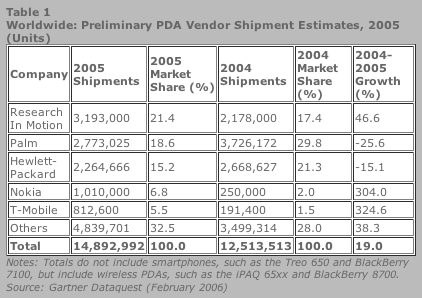
First thing to note is that in 2006 Gartner was busy tracking PDA sales. You might wonder why this is relevant. The reason is because a significant proportion of RIM's Blackberries counted as wireless PDAs and were therefore considered to compete with Palm's Treos, HP's iPaq and Dell's famous Axim. Nokia was in the running with its Communicators. Here is how Gartner characterized the equivalent market in early 2006:
So I'll just come out and say it: In 2006 Gartner did not have a clue what a smartphone was. By their admission:
Gartner defines a PDA as a data-centric handheld computer weighing less than one pound that is primarily designed for use with both hands. These devices use an open market operating system supported by third-party applications that can be added into the device by end users. They offer instant on/off capability and synchronization of files with a PC. A PDA may offer WAN support for voice, but these are data-first, voice-second devices.
In other words, in 2006 Gartner was splitting phones with operating systems into two separate markets: data-oriented wireless PDAs and voice-oriented smartphones. The split was mostly based on the judgement of the analyst on whether a device was "voice" or "data" oriented. I suppose they used the primary input method as a proxy: numeric keypads meant the device was one-handed and therefore voice-oriented. If the device had a full keyboard and/or a stylus-actuated touch screen then it was a two-handed data-oriented device. But even this proxy was not quite enough, sometimes devices were classified whimsically.
To make it more complicated, they bundled non-cellular but Wi-Fi enabled PDAs with wireless PDAs. This made some sense from a corporate IT point of view (their primary customer base) as these data-oriented devices would be used either on a LAN or a WAN (Wide Area Networks: what Gartner anachronistically called cellular networks.)
The presence or absence of a cellular radio did not enter into their view of these devices. So if you asked Gartner in 2006 to forecast smartphones (as we know them now) in 2010, I suppose you'd get what they forecast for "data-centric" devices.
So assuming that today's smartphones are mostly "data-centric" we would have to look back on their view of that market and not the voice market which was seen as an entirely different thing. Their answer should have had something to do with the market leaders and participants in 2006. As the table above shows Gartner showed that RIM, Palm and HP led in 2005 with Nokia and T-Mobile[1] pulling up the rear.
However, from a platform point of view, at the beginning of 2006
Microsoft Windows CE was the No. 1 PDA operating system (OS) in 2005 as 7.05 million PDAs were loaded with the OS, up 33 percent from 2004 shipments of 5.28 million units. Palm OS PDA shipments declined 34 percent to 2.96 million units in 2005.
In late 2006, Gartner made further predictions for the year:
In 2006, Gartner expects the PDA market to increase by 6.3 percent to 16 million units. The market will continue to be driven by broader availability of cellular-enabled PDAs from wireless carriers. Gartner estimates that 53 percent of all PDAs shipped in the first half of 2006 featured integrated cellular capability, up from 46 percent during the same period in 2005. “The share of PDAs purchased by enterprises will continue to increase; it accounted for 49 percent of all PDA shipments in the second quarter of 2006 and Gartner expects that the enterprise market will account for 52 percent of all PDA shipments in 2006,” said Todd Kort.
At this time I have not yet dug up a Gartner "Wireless PDA OS" four year forecast from the year 2006 but I suspect it would not show devices running Google's Android operating system or any running something called iOS.
[1] T-mobile is in the list because it was common practice in 2006 for operators to market Pocket PC Phone Edition devices made by HTC under their own name. Orange, Vodafone and Verizon also had own-brand HTC Windows touch-based devices. Now what does that strategy remind me of?
Android is an open platform. We saw at IFA 2010 all sorts of devices running Android, so it already running on tablets. But the way Android Market works is it's not going to be available on devices that don't allow applications to run correctly. Which devices do, and which don't will be unit specific, but Froyo is not optimised for use on tablets. If you want Android market on that platform, the apps just wouldn't run, [Froyo] is just not designed for that form factor.
How appealing are tablets that don't run any apps? Or content?
It still amazes me that a Google exec would say that it's acceptable that consumers are led to make purchasing mistakes with his product. Apparently any malfeasance is excusable in the name of openness.
The latest iOS numbers and the new iPod touch launch demonstrate what a huge hit the iPod touch has become. It's safe to assume that about half of all iPods, or between 4 and 5 million units in the current quarter, are sold as touch versions.
The iPod touch has been around about as long as the iPhone. It was launched three months after the first iPhone 2G, almost exactly three years ago. While the iPad has been in the market less than six months, a large number of potential competitors have been launched running Android and there seems to be a real rush to market. Six months is about as quickly as any hardware product can be reasonably engineered.
So the question is why is the iPad being cloned while the iPod has remained in the market by itself?
The value of the iPod is arguably as high with a healthy margin and consistent pricing. The volumes are comparable with tens of millions already sold so there is no obvious economic disadvantage to the iPod vs. iPad. Indeed, the iPod touch is a large (1.6) multiplier to the whole iOS platform. The demographics are very sweet too with a clear upsell opportunity.
One explanation might be that the iPod is a music device and that market has been locked up with iTunes, putting up a huge barrier to entry. However during the music launch this month, there was almost no mention of the iPod touch as a music player while it was loudly touted as a game and app platform. Browsing and Facetime are also huge uses for the device.
So in the iPod touch we have a mini iPad--ironically, the dig at the iPad was that it was nothing more than a large iPod touch.
So if cloners are rushing to copy the iPad, why not its smaller incarnation?
LG has reportedly told Korean sources that “it expects WP7 to outperform the two rival smartphone operating systems” – one of these platforms is definitely Android (I’m not sure about the other platform LG is referring to; Symbian? iOS? BlackBerry?).