Asymco

Asymmetric Intelligence

platform

  1. The race to a billion users

    Research · 16 comments

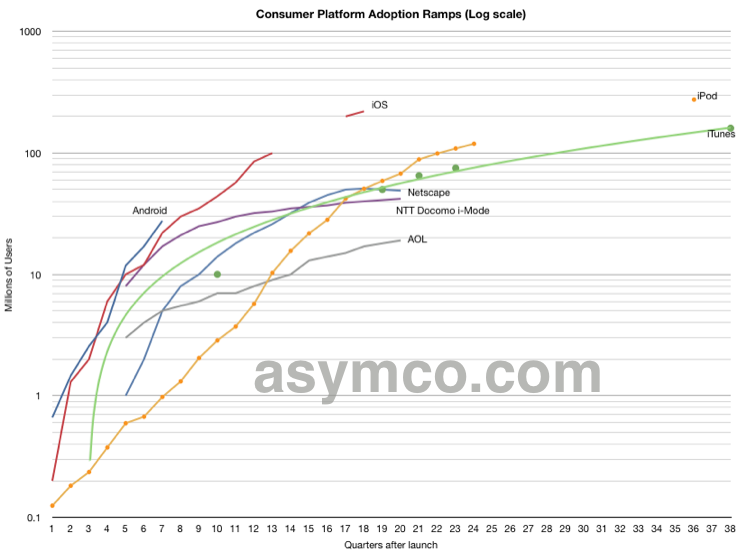
    I took the venerable Consumer Platform Adoption Ramps chart and added Android and the latest data on iTunes, iPod and iOS.

    To make it more readable (but conceptually more complicated) I put the data on a log chart.
    Discussion

    The time span covered is nine and a half years. The top of the graph marks the one billion threshold. Reaching one billion in less than 10 years is an interesting challenge for any platform and, at first glance, it seems that both iOS and Android have a shot at it. This does not seem likely for any of the other platforms.

    The challenge is that as penetration grows, it's natural for the slope for the lines to become shallower. Some platforms are simply not able to address one billion users:

    • i-Mode, AOL and other technologies with localized value networks are clearly limited to populations in their home countries.
    • iTunes is limited by the use of a PC, which has a small footprint in under-developed countries (dependency by iOS on iTunes should throw up a red flag here).
    • The iPod was embraced and extended by more ubiquitous mobile phones.

    In contrast, mobile phones in general and smartphone platforms in particular have potential to reach a billion users (per platform.)

    To wit, note that iOS and Android have similar curves to date and are both likely to overtake iPod and any other contender.

    So for the obligatory theological question: Will Android follow the curve of iOS or will it diverge and continue on a steeper trajectory? Does it matter?

    Discuss...
  2. Breaking Android: How Google's lack of control affects their value chain

    Research · 27 comments

    A few years ago I read a book called "Breaking Windows" which was the story of the DOJ investigation into Microsoft's abuse of monopoly. The book was written by a journalist who tried to summarize some of the findings from the published internal emails.

    One of the takeaways was the logic of Microsoft's entry into the Office market. The main internal justification was not that it would be a hugely lucrative new business, but that it was a necessity to the maintenance of the Windows business.

    The story was that Lotus, having a huge installed base, could (and did) arbitrarily refuse to upgrade their software to the latest Windows version and in so doing, could kill the franchise. Lotus owned the "killer app" and could hold Windows hostage. Users would rather keep their applications than upgrade a largely invisible OS.

    Another way to read this was that Microsoft needed to "vertically integrate" Windows so that it encompassed not only the OS but also the key applications that ran on the platform. A purely horizontal OS platform was obviously not viable as a business even back in the early 90s.

    What reminded me of this story was the news that Dell is launching a new smartphone in the US.  Called Aero, it will run Android 1.5, an ancient version released in April of 2009, 18 months ago.

    Now think about the idea of Adobe coming to market next week with a new version of Photoshop that ran only on Windows XP. Or even more poignantly, if Office were not part of Microsoft, seeing a *new* version of Word that only worked with Vista.

    Through an aggressive acquisition plan twenty years ago, Microsoft avoided this scenario. Google today is faced with the prospect that not only the devices (which sit on its OS) but also services and apps on top would choose to remain on old versions of Android. There is nothing to stop them from doing just that. Unlike Microsoft, Google does not enforce licensing terms for Android. It is at the mercy of the value chain.

    Couldn't Google crack down and deprecate Cupcake? It's not as easy as that. Not only do they not have license terms that permit that but in the phone business, development lead times are so long and global distribution can be so elastic that a low volume vendor like Dell has no choice but to sell multiple OS versions of their own products. Microsoft has almost the same problem with Windows Mobile, with a variety of given-up-for-dead Windows Mobile 6.5 powered devices still in the pipeline while Windows Phone 7 is imminent.

  3. Microsoft's billion dollar bonfire

    Research · 31 comments

    Microsoft executives told Goldberg during a recent visit to company headquarters that the company, carriers, and manufacturing partners, would spend "billions" of dollars in the first year on marketing and development of Windows Phone 7. Another source estimated a $1 billion price tag for the launch, with half of it going to marketing.

    via AppleInsider | Microsoft to spend over $500m to catch up to iPhone, Android.

    Note the scale of spending here.  The number quoted is twice Apple's yearly ad budget, for all its products.

    $500 million is roughly the equivalent of Apple's entire advertising budget for its 2009 fiscal year. In its 2009 Form 10-K filing to the SEC, the Cupertino, Calif., company listed $501 million in advertising expenses. Microsoft's fiscal 2009 advertising budget was $1.4 billion.

    But beside the unrepentant destruction of Microsoft's shareholder wealth, one other thing jumps out at me: why are the operators and vendors going along with this?

    Fragmentation increases the cost of development, marketing, operations and hinders the creation of cohesive ecosystems.

    Most companies are very aggressive in consolidating around internal platforms and standards. Supporting R&D teams and marketing teams around each platform is costly and dilutive to one's brand.

    With hundreds of Android devices and RIM and Apple increasing distribution, why would operators be willing to spend hundreds on a venture to promote a new platform? This decision is even more puzzling when realizing that the vendor of the new platform left nothing but business model carcasses behind the last time they got involved in the industry.

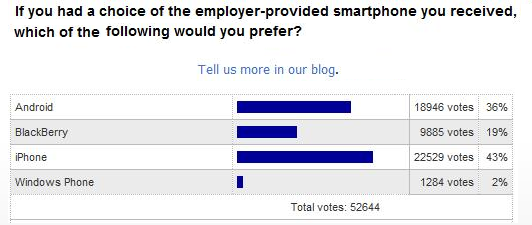
    In addition the positioning of this product is suspiciously awkward. One could argue that as a vendor or operator, having an unaddressed or underserved market (say, business users) might mean this platform could expand the distribution of your product or service. But Windows Phone is being positioned as a consumer brand and that's a crowded space where every other platform is also targeted. See the survey data below (unconfirmed source: US Army)

    So again, why would operators and licensees spend hundreds of millions to introduce yet another platform in the market?

    Maybe they are just taking Microsoft for a ride.

  4. Talk of mobile dominance is bunk

    Research · 25 comments

    I've been asked in comments on this blog who will win the "mobile war".

    I use two analytical tools to answer this question: (1) history (2) value chain analysis.

    History shows that operators are very important and hence very powerful in this market. That makes sense on many levels. They control what phones you get to buy, they decide the pricing and they decide frequently how you can use the phone. This is because the networks are expensive to build and maintain and there is an implicit bargain struck that the user and device should conform to the operator.

    Value chain analysis tells me that as networks are not good enough, tight integration of the business models of the phone vendors and the operators is necessary to climb up the trajectory toward good enough as quickly as possible.

    Therefore, given the distribution of value/bargaining power in the chain, it’s reasonable to assume that it’s operators who will decide which platforms win/lose and to what degree.

    That simply means that no single platform can win a disproportionate share because it would threaten the balance of control the operators require. So talk of “dominance” of one platform or another is hyperbole. The most likely scenario is an even distribution of share between 4 or 5 competitors, so I expect iPhone and Android to get 20% share each.

    This is not “fair” or economical or efficient, but it’s the way it’s going to be for a long time. If you're a fan, don't despair. In a few years, it still means hundreds of millions of units a year for each platform.

    If you want to dream or hope for a more efficient outcome, you’ll have to look outside the cellular network model. I.e. think how iPod/iPad and Android tablets will evolve into communications products.

    (thanks to M for asking).

  5. Gartner's Nick Jones on Symbian: Abandon ship

    Research · 2 comments

    Market share is an existential threat to Symbian, it imperils the very existence of the platform. And the main reason Symbian is losing share is the user experience which isn’t competitive with Apple or Android. Based on the early previews I’ve seen Symbian 3 looks to have polished a few of the rough edges, but doesn’t fix the problem. So if the weak UI is threatening Symbian’s very survival the Foundation ought to be seriously worried, right? Wrong. I just looked on the Foundation web site and blogs at the roadmap and features for future releases. What I see is too much effort on stuff that really doesn’t matter. For example: Audio policy packages for Symbian, WIFi direct, support for an “open cloud manifesto”, an accredited Symbian developer program for China, better multitasking, multiple personalised home screens, HDMI connection to external TVs, better web runtime support, better internal architecture and so on.

    Forget elegant architecture, forget better multitasking, forget Chinese developers, forget release schedules that don’t deliver S4 devices with a new user experience until 2011. None of these matter. People will never use the features if they don’t buy the phone. The situation is now serious enough that any developer who isn’t working on something directly related to a new UI is wasting their time. The S4 UI is a “bet the platform” project. For any organisation to be in a situation where its survival depends on one project is very dangerous, especially when their track record in the area isn’t outstanding. I think the Foundation needs a contingency plan in case the planned S4 interface isn’t radical enough or good enough. Maybe redirect some developers and start a couple of skunkworks projects to create new competing UIs for S4, or perhaps announce a competition with a $1M prize for a new Symbian UI to encourage some radical ideas.

    I think the Symbian foundation is just re-arranging the deck chairs on the Titanic and ignoring the Android iceberg ahead.

  6. Next of Kin

    Research · 5 comments

    When the Kin was launched, many, including myself, were skeptical. It was a product that contradicted much of what made sense in the industry. It was not a smartphone, it was not a platform and it was predicated on a niche use case. It was, in essence, a feature phone, and as such was not differentiable. However, most people, myself included, were willing to overlook some of these flaws on the basis that Microsoft *must* have done some rigorous product research to support this concept. We fell for the premise that the Emperor *must* have been wearing clothes.

    It turns out he wasn’t. With this knowledge, we should ask the same question regarding clothing to the “next of kin”: Windows Phone 7. There is this same sense of deja vu, that there are a lot of things wrong with WP7, but Microsoft can’t be foolish enough to fail on this. The problems with WP7 are indeed potentially fatal:

    - It is a new platform with no ecosystem facing entrenched incumbents
    - It is expensive relative to Android for OEMs while being completely symmetric in its approach to the licensing market
    - It is not leveraging the installed base of Windows Mobile, and is alienating to WM’s core business users/buyers.
    - it faces a branding challenge, like its predecessor
    - it is feature incomplete, barely on par with iPhone from 2008

    In fact, it’s hard to come up with any key value upon which to anchor the platform. Beside the fact that it is new or, if one were charitable, “fresh” in the interface, it seems to be a solution looking for a problem. Reminiscent of the Zune in many ways, it’s tempting to dismiss it.

    Yet there is always the benefit of doubt being from Microsoft. Or is there? After Kin, is it time to give up on the old adage that Microsoft persists until it wins and never gives up? The Microsoft that won was a low-end disruptor. Offering less-than-good-enough products at lower prices or bundling parts of software into compelling packages, Microsoft expanded markets and increased computing consumption. This is not in the cards for mobile computing.

    Microsoft in Mobile is not playing to its core strengths. Indeed, mobility is a disruptive force for their core. Doing “the right thing” in mobile cannot but threaten the sustaining cash cow of Windows. Microsoft seems to be floundering precisely because it’s trapped in the innovator’s dilemma.

  7. Open always wins, unless it's Symbian or LiMo or Openmoko or Qt

    Research · 59 comments

    In June 2008, Nokia made its first big move to turn around the platform, and announced that it was acquiring Symbian, with the intent of turning the OS into an open source project.

    Two years later, the move to open source has proved to be a miscalculation that is slowing down Symbian's development. It would be better for Nokia to take full control of the OS, according to Wood. A lack of support from other vendors means Nokia has to do most of the work itself, while the open nature of the platform allows competitors to keep a close eye on its progress.

    via Nokia on long comeback trail after smartphone misses - Digital Lifestyle - Macworld UK.

    Then there's LiMo foundation open source mobile Linux. Maemo is/was open source, Openmoko and Qt Extended and PalmSource/Access moving to open source and there was the Motorola Linux OS that launched years ago. If Open always wins, whatever it wins, it's not market share.

  8. Why I think Apple wants everybody to have an iPhone

    Research · 15 comments

    In recent entries I asked: Can the iPhone reach 10% of the world’s 3G subscribers? and  Can iPhone reach 20% of global smartphone market?

    These were rhetorical questions designed to demonstrate that a growth rate of 50% (compounded) over three years was clearly possible through reduction to absurdity of alternative scenarios.

    The question of iPhone as iPod vs. iPhone as Mac businesses is at the crux of any investment in Apple today and the key strategic question facing Apple and all its competitors.  Anyone holding or considering buying AAPL shares should answer this question for themselves.

    To the top-down market share scenarios above I add the following, more direct, signals Apple has made regarding their iPhone-for-all strategy:

    1. The fact that they entered the market at all.  When they were building iPods, Apple came to understand that to be a device company means to be a phone company.  The device business is much more sensitive to volume (i.e. economies of scale) than the PC business. Nokia proves this point every day.  You can’t be in the device business with low volumes and stay profitable for long. This is because you can't get component pricing low enough to sustain margins that can afford you R&D sufficient to differentiate your product.  Therefore you cannot stay in the phone business with low volumes (see Palm).
    2. Apple repeatedly signaled that they will not permit a pricing umbrella for their products.  Although the product seems priced highly now it’s only because that’s what the market can bear and because of the possibility of taking a cut from service revenues.  The iPhone is not as expensive as it might seem relative to other smartphones, it just has a huge gross margin (50% at least).  Apple can keep their costs low through volume but they can also tweak pricing down if they need to.
    3. The platform approach.  Apple is putting in an enormous effort to orchestrating a mobile platform.  This is the most obvious signal.  Platforms are expensive to build. If the cost to build a mobile phone is x, the cost to build a mobile platform is 10x.  Platforms are expensive to maintain but generate enormous rents if volumes are built and users are retained.  The platform’s value grows as the n*log(n) of the number of users (Metcalfe’s law).
  9. The next 100 million iOS devices

    Research · 9 comments

    As iOS crosses 100 million units sold 3 years after the platform launched, it's time to look forward to the next 100 million. My expectation is that well over 100 million iOS devices will sell during 2011, but even during the next 12 months (2H '10 and 1H '11) the total may well reach 100 million, making 200 million installed by June 2011 very likely.

    Here is where the numbers will come from:

    iPhone: Assuming only 50% growth (half of the average growth seen so far) gives 50 million units in the next 12 months.

    iPad: 15 million base assumption

    iPod: This is the most difficult to predict, but 46 million iPods will sell with a growth rate of -8% to -9%. If we consider the iPod touch part of the mix to be 40%, we get 19 million.

    The total with these assumptions would be 84 million. A slightly higher growth rate for the iPhone would easily push the total to 100 million.

    200 million devices in four years is quite a feat. Compare it to the growth of television which reached 50 million Americans in the first decade after commercial launch. Or consider the Netscape browser which only reached 50 million in its first four years or AOL which just crossed 20 million or in Japan where i-Mode reached 40 million users in the same time frame.

    At 200 million, the iOS platform will be 18% the size of the world-wide television audience.

  10. Android vs. Google Part III

    Research · 2 comments

    Revised language for section 3.3.9 of Apple’s developer agreement, concerning the use of data collection:

    The collection, use or disclosure is for the purpose of serving advertising to Your Application; is provided to an independent advertising service provider whose primary business is serving mobile ads (for example, an advertising service provider owned by or affiliated with a developer or distributor of mobile devices, mobile operating systems or development environments other than Apple would not qualify as independent

    via Apple Makes Good on Steve Jobs’s Promise, Invites Other Advertisers. But What About Google’s AdMob? | Peter Kafka | MediaMemo | AllThingsD.

    Apple is stating that user data must be handled by organizations that are strictly independent.  If the ad service provider is part of an organization that either competes with Apple's devices or platform, it's not independent.

    AdMob would have been allowed to operate unhindered on iOS but AdMob as part of Google is not.

    Conversely, if Google were to abandon Android, the path to riches would be open again.  As shown several times already, by pursuing a mobile device platform Google strategically abandoned some significant revenue opportunities in exchange for some extraordinarily high costs.

    Readers of this blog should not be surprised.

  11. iPhone takes share from RIM, Android takes share from Windows Mobile

    Research

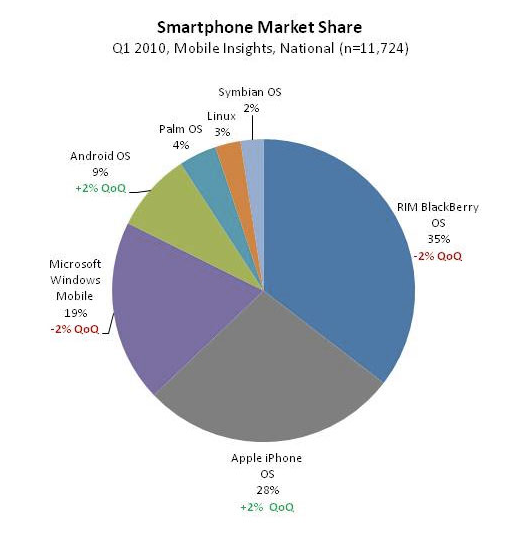
    Data tracking firm Nielsen Co.’s quarterly survey found that, in the U.S. the iPhone added two percentage points for a 28% market share in the three months ended in late March compared to the previous quarter. RIM still had the biggest market share at 35% but it lost two percentage points in that period.

    Phones that run on Google Inc.’s Android operating system also gained two percentage points for a market share of 9% over the same period, while Microsoft Corp.’s Windows Mobile phones lost two percentage points for a 19% share.

    via Appetite for IPhone Continues Undiminished - Digits - WSJ.

    Although Android is often considered in competition with the iPhone, as we've shown in the past, the two are seldom competing for the same purchase decision.  From a distribution and business model point of view, the platforms are mostly non-overlapping.

    The installed base data above shows that in their respective areas of competition: in the US, with the current operator channel, the iPhone is taking share from a similarly positioned platform (RIM) while Android is taking share from a similarly licensed alternative (Windows Mobile).