Asymco

Asymmetric Intelligence

platform

  1. IDC: I Dream of Claim Chowder

    Research · 3 comments

    A few eyebrows were raised when Microsoft presented a slide at a French event where they made the claim that 30 Million Windows Phone devices would be sold by the end of 2011.  Given that the first Windows Phone won't ship until October 2010 at the earliest, or, according to Mr. Ballmer, "by Christmas," count me among the skeptics.

    However, the claim was later retracted by Microsoft stating that they mis-quoted IDC, the original source for the forecast.  The correction was perhaps meant to put an end to the credibility crisis.

    However, the actual forecast from IDC was even more preposterous. Apparently IDC makes the forecast that 32 million "Windows Mobile" devices will sell during all of 2011--a combination of both Windows Mobile and Windows Phone devices.

    Instead, the research company forecast 2011 sales of 32 million devices running all Windows Mobile operating systems. This includes expected sales of devices with Windows Mobile 6.5, which is already on the market. IDC has not given any sales estimate for Windows Phone 7, which Microsoft has said will be available in the fourth quarter.

    Their report showed about 16 million Windows Mobile devices shipped in 2009, with a forecast of 22 million this year and 32 million next year.

    Windows Mobile shipped a total of 3.7 million phones in 1Q10, so in order to reach 22 million this year they need to ship 18.3 million for the rest of the year or, on average, 6.1 million phones a quarter.  That's a higher number than what Android shipped in Q1 with BOGO promotions (5.2m units). That's almost as high as the launch quarter for the iPhone 3G.  And all this (mostly) with WinMo 6.5!

    Alternatively perhaps IDC foresees a huge launch for Windows Phone. Assuming an erosion of the WM6.5 to 2.7 m this quarter, 2 million in Q3 and 2 million in Q4, then Windows Phone would somehow need to ship 12 million units during the last quarter.  This number is higher than what iPhone sold in its highest ever quarter.

    This sounds sillier than 30 million Windows Phones in 2011.  By claiming that Microsoft's combination of deprecated Windows Mobile (6.5) and unreleased Windows Phone 7 will continue to sell at a growth of 38% this year, they are actually suggesting an acceleration in sales going into the second half at a rate higher than what the market is likely to grow at.

    In other words, they are suggesting that Microsoft will gain share during the rest of this year. Share gains for a platform that has declined in share in Q1 from 10.2% to 6.8% with 3.7 million units sold on the back of further share losses the quarter prior. Share gains against Android that competes with a free license. Share gains with a new platform that has no clear differentiation vs. the iPhone.

  2. At 135 devices, the Android army marches on but what happened to the Windows Mobile legions?

    Research · 2 comments

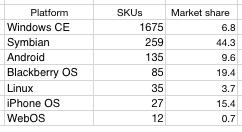
    The number of Android devices is rising steadily; it's already up to 135.  Android devotees should rightly rejoice.  However, Android is not the first mobile platform with an open licensing strategy. A quick visit to pdadb.net lets us count the number of devices that shipped for every mobile platform in history.  We can also see the current market shares as listed by Gartner for these platforms.

    The numbers of SKUs (stock keeping units) that have shipped historically vs. the market shares of the mobile phones running those platforms are (see Footnote below for some caveats):

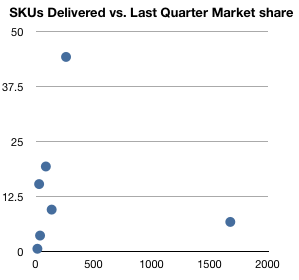
    The same data in a scatter plot:

    (SKUs on the x-axis and share on the y-axis)

    The thing that jumps out is how uncorrelated the two quantities are.  The Windows Mobile/CE number is such an outlier that it breaks any attempt to link the two variables.

    What's likely to happen is that since the licensing of Android is even less problematic than it was for WinCE (i.e. it's both free as in beer and free as in speech) the number of Android SKUs is likely to overtake WinCE.  In other words, we're very likely to see Android grow from hundreds to thousands SKUs.

    However, the real question for the Android platform isn't whether it will have licensees. WinCE proved that there is vast demand from many companies to build cloned and undifferentiated devices. The real challenge is whether Android can achieve significant volumes without fragmentation to keep the platform/network effect going.

    The WinCE platform was actually less fragmented through its life than Android is today. This is understandable since the source code was decidedly not open and thus not modifiable and new versions were released far less frequently. And even with a high price tag, it was wildly popular with licensees. Nevertheless, the volumes never came and Microsoft was forced to abandoned the whole strategy.  The next version of Windows Mobile (Windows Phone 7) will follow an "iPhone lite" model of highly restricted configurations and device and ecosystem specification.

    So will Android follow the fate of Windows Mobile with an even more fragmented, bazaar-like licensing model? Or will thousands of undifferentiated Android devices swamp their integrated competitors?

    Footnote: The total SKU number includes non-cellular devices whereas the market share number includes only cellular devices. Omitting non-cellular devices will not detract from the pattern or change the correlation meaningfully.  The argument can also be made that the "platform" value lies in both cellular and non-cellular devices (e.g. iPad) and they should both be counted.  Unfortunately there are no market share statistics that blend both device types into one market.

  3. Can Google buy consumer competitiveness? Can Apple be an ad giant?

    Research

    Daniel Eran Dilger in fine form after Apple became the world's largest technology company by market capitalization.

    These days, Apple’s primary competitors have all fallen down on their knees while clutching their gutted bellies...

    Who is left? Google, the paid search giant that backers hope will beat Apple in hardware and software platforms… despite Google being neither a hardware vendor (nor marketer nor retailer nor support provider) nor having any real experience in managing a software platform for consumers. Fans of Google suggest that the company will take on Apple by acquiring a competing version of everything Apple has built over the last decade: iTunes, a mobile platform, hardware expertise, user interface design savvy, development tools, and a user base.

    The problem is, they don’t also foresee that Apple could compete against Google in its own home territory of ads.

    via How Apple could slay Google at WWDC 2010 — RoughlyDrafted Magazine.

    The key assumption in the "Google can buy anything Apple already has" is that of the three things that make up a company (resources, processes and priorities) the only thing cash can buy is resources, and, in the tech world, even those are fragile things with legs that can walk out the front door.

    Google's "copy-paste" competitive approach vis-a-vis Apple falls down when you realize that Apple has been successful mostly because of its processes and priorities. It's well known that all of its vanquished competitors could (and did) recruit legions of Apple employees, elevating them to positions of responsibility, with naught to show for it. Grafting engineers and IP onto Google (or Nokia or Microsoft) cannot make it into an Apple.

    Conversely, through a risky, long and arduous path, Apple could become a Google. Success with ad-based search requires resources (mostly CapEx), algorithms and distribution. With the $42 billion (soon to be $100 billion) in the bank and eye-watering free cash flow, there are few no resources that Apple cannot buy.

    With iAd the world will witness an Apple that can make loads of money in Google's home turf, while Google burns cash and bridges with Android trying to defend its soft platform underbelly.  The irony is that Apple can knee-cap Google without even trying to do search. After all, Jobs said plainly enough: On a mobile device Search hasn't happened.

    Judging by the stock prices of the two companies, I suspect investors know this already.

  4. Does iPhone really have 72% of Japanese smartphone market?

    Research

    MM Research does not count Symbian as a smartphone platform. This makes them inconsistent with any other analyst for counting smartphones.  So shouldn't Symbian be included?

    In a comment to iPhone has 72% of Japanese smartphone market | Asymco it's been pointed out that 12 million Symbian sold in the same time frame as Apple sold 1.7 million phones in Japan.

    It would seem then that the correct market share for iPhone would be 12%, with Symbian having 83% and "others" having less than 5%.

    However...

    Symbian in Japan is not the same thing as Symbian elsewhere.  Symbian in Japan is used as a low level OS by Fujitsu, Sony Ericsson Japan, Mitsubishi, Sharp and others to provide devices running the MOAP(Symbian) software platform.  MOAP (Mobile Oriented Applications Platform) is the software platform for NTT DoCoMo's FOMA (Freedom of Mobile Multimedia Access) service.

    Unlike Series 60 and UIQ MOAP(Symbian) is not a open development platform.

    MOAP is also supported by Linux with Panasonic and NEC using it in something called MOAP(Linux).

    MOAP(Linux) is also not an open development platform.

    So the "72% share for iPhone" in Japan must be stated with this important caveat: that Symbian and Linux are not included because, due to not having exposed APIs, they are classified as feature phone platforms.

  5. The Next Billion Users

    Research

    Five weeks ago Apple forecast 100 million iPhone OS devices will be sold by summer. This was fairly easy to predict but the question comes up: when will the next 100 million be sold? And what about after that?

    The iPhone OS three-legged platform is now the fastest growing platform ever and enjoying network effects which naturally accrue to platforms under solid custodianship. However, I am observing signals from Apple that they intend this platform to become the global standard for mobile computing, which, in today's world, means targeting 1 billion users. Here are the signals that I'm noting:

    1. Geographic and cultural universality. What plays in Peoria should play in Beijing.  As it has shown by being big in Japan, the iPhone crosses over cultural idiosyncrasies. Not long ago it was taken for granted that "mobile tastes" differ and "one size does not fit all" in mobile phones hence the need for hundreds of phone models in every portfolio. Apple has completely destroyed this myth. (One could ask why should mobile computers be polymorphous when their slightly larger cousins the laptops are rigidly monotonic?) By broadening the platform with multiple screens and connectivity options, Apple is cleverly spanning the jobs that he platform can be hired for.
    2. Avoidance of a pricing umbrella.  Note that this does not mean being low prices, but rather, the protection of their franchise through pricing. Apple has developed a way to stretch a single product across multiple price bands, and carefully builds product to price and margin targets that have strategic placement.
    3. Product cycles and product ramps. Apple has imposed upon itself a yearly product cycle for the iPhone and the iPod.  This is a brilliant move because it keeps the product fresh without having it seem disposable.  It also keeps competitors within its turning radius. However, the challenge is that the distribution network has to be filled rapidly and drained rapidly to maximize availability. This gets harder and harder as the volume grows. Imagine having to manufacture and ship into the channel a billion devices in less than a quarter.

    I would point out that all these are marketing, not technical challenges. They are thinly disguised questions about product placement, portfolio, pricing, production and distribution--classic Marketing 101. (Promotion, which is what most people equate with marketing is not particularly challenging, especially for Apple who mostly does it through PR).

    It is comforting perhaps to know that Apple is the best marketing organization in the industry today. So to answer the question, 100 million is in the rear-view mirror, 200 million will come up in no more than 2 years and 1 billion will take 5 to 8 years.

  6. Will Apple rule the iPad market? (part II)

    Research · 12 comments

    Continuing from Will Apple rule the iPad market? | Asymco.

    The first claim is that

    it is unclear if [Apple] will end up dominating the market the way it has come to rule the digital music player market with the iPod.

    After hearing a thousand voices cry out that the iPad is nothing more than a bigger iPod touch (which, plainly, it is) it's amusing to read that its similarity with a sibling ends when it comes to market performance.

    Let me make one claim up-front: the iPad is more of an iPod than the iPod.

    The original iPod was successful because it had a significant integrated value chain bolted on. Apple disrupted music with a value chain, not a product. It changed the way music is bought, consumed and even how it is produced. It changed the economics from retail down to songwriting.

    This is why it came to dominate its market. Every competitor that took a run at it did so with a partial solution to the value chain. Often it was nothing more than a music player, and in some cases (e.g. Zune) it was bundled with some other pieces of technology, but poorly executed and too late.

    The iPad comes with an even bigger value chain bolted on: the App Store. Apple is flogging not just an "app player" but also a new way to develop and distribute software. If you cut "music" and paste "apps" you see the immediate parallel between iPod and iPad. The app ecosystem will quickly grow to be larger than the music ecosystem with the mobile software business already eclipsing the music business.

    A competitor launching a tablet device will have to somehow overcome the momentum of billions of downloads fed by hundreds of thousands of apps built by tens of thousands of developers for hundreds of millions of users.

    The iPod juggernaut pales in comparison to the iPad supernova. The iPod had no apps or dedicated developers. Its ecosystem consisted of a handful of music companies. The only thing that made it "sticky" was the tie-in with one type of content.

    The iPad on the other hand has a thousand other jobs to do for its users. It has a rich tapestry of functionality and a multi-dimensional (literally) user experience.  It's a platform. It's even powerful enough to impose new standards on the web itself and to suggest that search is a bygone activity.

    So to suggest that Asus or Dell will somehow build "iPad killers" sounds asinine. These competitors don't even grasp what the product is and what it's for.  Sony said they don't see a market for it. Microsoft, trapped in the innovator's dilemma and overshooting the market by miles, said they don't understand what the point is because users want full PCs.  Google asked what's the value of a big iPod. I could go on, but there was not a single company in the industry who recognized what they were looking at in January. Apple keeps a tight lid on new products so that competitors don't get a head-start on copying, but in the case of the iPad, advance knowledge would not have had any impact. Competitors look at the iPad and see nothing.  They'll only react once the market explodes and they start to feel belated pain.

    If, and it's a big if, they do recognize what an iPad is, their response cycle is going to be measured in years. On hardware, they were blown away with a product that had twice the power, half the bulk, twice the battery life with half the price of what they had on the shelf. They may catch up on hardware in a year or two and launch some sort of iPad-like assembly of components, but that is like making the first iPod killer in 2002.

    Then there is software. Their software supplier (Microsoft of Google) will have to build a platform that works. That will take years. Years during which the iPad will penetrate every geography, demographic and vertical market.

    Google might move more rapidly than Microsoft, but they will produce an open source poster child of a platform. Fragmented and rough around the edges to the point of looking like a hobby project. Their flea market store will also have the smell of fresh glue about it. Microsoft is so far behind the curve that I don't even think they will try to move the tiller.  Their view of the market was betrayed by the recently knifed Courier demoware. To suggest a challenge to the PC/Windows model inside Microsoft is a career-limiting move so don't expect their brightest to be lining up to propose new platforms to management.

    What about HP? Assuming they overcome the pitfall of NIH that kills 80% of integration efforts, they will still need to perform an enormous amount of heavy lifting to get WebOS to be a competitive experience on a tablet. Most opinions were that Palm came pretty close with a smartphone, but that was nowhere near enough to stay alive, never mind challenge iPhone.

    Then there is the ecosystem. Building it is just not something I can even begin to roadmap. What about developer tools, SDKs, frameworks and evangelism? With a Palm division, HP is the best positioned of the PC vendors but it has a chance at being a player as much as Creative did vs. the iPod, or needless to say, Palm vs. the iPhone.

    So the iPad challengers face five daunting obstacles:

    1. Recognition of a threat from a seemingly benign product
    2. Execution on hardware against the best integrator on the planet
    3. Execution on software against a new UI metaphor fortress surrounded by a patent moat
    4. Integration of hardware and software to a sublime whole
    5. Re-building a value chain for which they have no handle vs. a broad and deep existing universe of app/content creation distribution and consumption enjoying logarithmic network effect value.

    That does not even touch the logistics, sourcing, margin and pricing challenges of world-wide distribution of the whole value chain. Nor does it cover the lock-in of advertisers to new tools for creatives or the billions of daily views from a platform that is blindingly dazzling.

    To put it in the language of disruption, by the time the competitors launch symmetric attacks on the iPad, Apple will be the incumbent. And we all know that symmetric attacks never work against entrenched incumbents who have all the levers of power at hand to deploy in a withering counter-attack.

  7. iPhone OS download rate 10X Blackberry

    Research

    Today, Research in Motion co-CEO Jim Balsillie said his BlackBerry App World has 20 million registered users and nearly 1 million daily app downloads.

    via Apple Doing 10-20X As Many App Downloads A Day As BlackBerry.

    As previously stated, The App download rate increased to a record 10,753,000 per day during the last 90 days.  That makes the download rate for the iPhone platform 10x that of the Blackberry Platform.  The iPhone platform is nearing 100 million installed base.  Blackberry is citing 20 million registered users.  I think everyone is pretty clear on where this is going.

  8. The Progress of the Platform

    Research

    The Progress of the Platform.

    On why there is a ban on intermediate layers of software development on the iPhone OS.

    But the reason isn’t technical. It’s partly business (Apple doesn’t want another company to control any important part of the iPhone platform), but it’s also in no small part grounded in aesthetics and the progress of the platform. Apple wants developers to do things the iPhone and iPad Way because they believe it will result in a better user experience and better designed apps. That’s an aesthetic, design-centered argument about how touch apps should be done. Apple has created tools customized to the iPhone and iPad; hell, they built a whole new touch-based operating system. They created a whole set of user interface metaphors that are supposed to be standard and system-wide, and they want developers to do things the new way not because Apple just loves power, but because they believe it’s necessary to force developers to think about the new world of touch-based computing correctly. All of this in service of giving users who are taking their first steps into touch-based computing a great experience.

    Developers who want to write software for the iPhone have to write iPhone-like software. To do otherwise will hinder the progress of the platform.

  9. One Hundred Million (part II)

    Research · 3 comments

    My prediction is that sometime next year Apple will announce the 100 millionth iPhone OS device sold, making the iPhone the fastest selling platform in history. The iPhone will have been on the market for three years.

    One Hundred Million « Asymco. (five months ago)

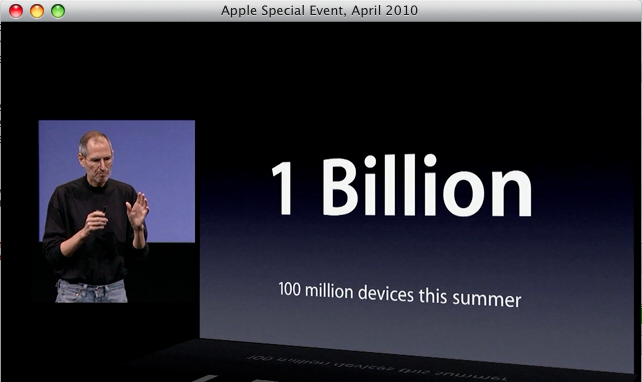
    Did anybody else see the line below the "1 Billion" header in the iPhone 4.0 Launch Event? The segment was about the 1 Billion impressions that iAd will be able to target.  Interestingly this is one of only two forward looking estimates that Apple has ever made on the iPhone.

    100 million

    The 100 million threshold in units is important in several contexts.

    First, on April 9th, 2007 Apple announced that the 100 millionth iPod had been sold, making the iPod the fastest selling music player in history. The first iPod was sold five and a half years earlier, in November 2001.  The iPhone will reach this in 3 years.

    Second, no other platform comes close.  On November 3, 2003, Microsoft announced that it intends to sell 100 million Windows Mobile devices by year 2007. Two years after that goal, in 2009, Microsoft sold 15 million units, down from 16.5 million in 2008.  It has not reached half the targeted installed base.

    Although there could be more than 100 million Symbian devices in use, they are not all running the same software, so they do not offer a targetable installed base.

  10. 7000 companies were created just to make apps

    Research

    An estimated one in five iPhone developers are companies founded specifically to create applications for the iPhone, according to the latest Flurry Smartphone Industry Pulse survey. That represents the second-largest category of developers behind only preexisting online companies, including giants like Google, Facebook and eBay. Those established brands take up 22 percent of the iPhone developer share.

    link: AppleInsider | Startup developers represent one in five on Apple's App Store

    Flurry argues that with 75 million units sold, the platform is reaching a critical mass where major brands being to take a dominant position in terms of position and sales rank.

    This argument is suggesting that the platform will be a sustaining technological improvement to existing industries such as traditional media, online media, retail and traditional gaming.

  11. App Store vs. Facebook as Platforms

    Research · 1 comment

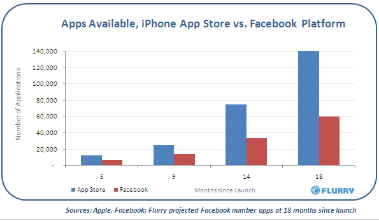
    Since the App Store launched in July 2008, 35,000 unique companies have released applications, which translates to 58 new companies launching apps each day. This appears to be the largest amassing of 3rd party developer support by any development platform in such a compressed timeframe. For example, comparing the number of applications created for the Facebook platform to the App Store over their respective first 9 months, Apple boasted 25,000 apps to Facebook's 14,000. Comparing respective growth in apps after 14 months, Apple had widened its gap to 85,000 apps over Facebook's 33,000. At the App Store's 18 month mark, reached this January, the number of iPhone apps was reported to have exceeded 140,000 compared to 60,000 we estimate Facebook had reached over the same number of months. Apple now leads Facebook with over twice as many available applications. We believe the difference in growth rates can be attributed to the App Store providing better monetization possibilities for application developers than Facebook. Developers, like all rational companies, pursue markets where the path to revenue generation is clear.

    link: Flurry Smartphone Industry Pulse, February 2010