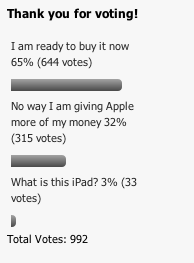
Apple’s official carrier in South Korea, KT, revealed yesterday that iPhone has now surpassed the half-million (500,000) sales mark. This makes South Korea, a nation with 47 million total mobile subscribers, number 8 globally in first year iPhone sales.
There have been several chauvinistic campaigns in Korea that attempted to undermine iPhone’s success. Yet, ironically, these well-funded initiatives may have backfired
Smart phones sold to retail customers totaled 408,000 units, down 15% from a year earlier and 29% sequentially
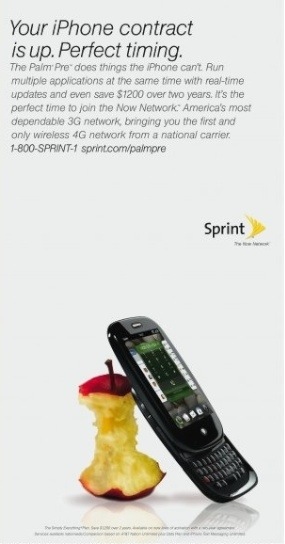
By some estimates, Apple pre-sold more iPads online in one week than Palm sold smartphones through Sprint and Verizon stores in 3 months. What's more remarkable is that year-on-year decline implies Palm sold more Windows Mobile devices than WebOS which was not on the market a year ago.
The company said there are over 2,000 apps in the Palm App Catalog.
ASP was $367, down from $375.
Almost all volume was from WebOS products (Windows Mobile devices are gone)
For Q4, the company expects revenue to be less than $150 million.
Q4 gross margin likely in the mid-teens.
Guidance for $150 million in revenue, down 57% sequentially.
After hours market cap for Palm is about $833 million down 13%. Expected revenue and ASP imply about 410k units will be sold into the channel in the following quarter.
Despite the fact that the Google Nexus One is the most advanced Android handset to date, and enjoyed substantial buzz leading up to its release, the launch has been overshadowed by lower than expected sales.
The problem will be in using some comparable as a measure of reference. This is a problem because first, there is no equivalent product in history, second, there are few similar products that are pre-ordered and sold without user samples being available, and third it's being sold through a very limited channel (on-line Apple Store). Lastly, the number includes only delivered units vs. reservation for pick-up.
Nevertheless, the figure is intriguing. One class of comparable products might be new smartphone products from companies that were launching on new platforms.
One example is the Android G1--the first Android device. It sold 663k units in the launch quarter. Another is the Nokia 5800, Nokia's first touch capable device. It sold 536k units in the first quarter (up to 1 million in the first 3 months). Sony Ericsson's first Windows Mobile device was the X1. It sold 237k units in the first quarter of sales. The first Sense UI HTC device (the Diamond) sold about 1 million units. The RIM Storm, RIM's first touch device sold 1.6 million units. Finally the iPhone which sold 1.1 million units in the first full quarter of sales (about 1.4 million if we include the weekend sales that fell outside the first quarter).
The iPad does seem to be doing rather well relative to these products. Again, their figures were for a full 90 days of sales and were sold through physical retail channels in a variety of geographic markets.
I will be surprised if the number of units sold in Apple's CQ2 don't exceed 1 million. (Apple will book all these sales only on delivery which means they won't appear in CQ1 sales figures). This will probably mean better performance with a new platform than Nokia, Google, Sony Ericsson or HTC and perhaps better than the iPhone.
On the eve of iPad sales start, and the soon-to-be classic quotes from iPad experts, it's time to play back some of the classic iPhone expert predictions from yesteryear:
"[iPhone] just doesn't matter anymore. There are now alternatives to the iPhone, which has been introduced everywhere else in the world. It's no longer a novelty." - Eamon Hoey, Hoey and Associates, April 30, 2008
"We are not at all worried. We think we've got the one mobile platform you'll use for the rest of your life. [Apple] are not going to catch up." - Scott Rockfeld, Microsoft Mobile Communications Group Product Manager, April 01, 2008
"Microsoft, with Windows Mobile/ActiveSync, Nokia with Intellisync, and Motorola with Good Technology have all fared poorly in the enterprise. We have no reason to expect otherwise from Apple." - Peter Misek, Canaccord Adams analyst, March 07, 2008
"[Apple should sell 7.9 million iPhones in 2008]... Apple's goal of selling 10 million iPhones this year is optimistic." - Toni Sacconaghi, Bernstein Research analyst, February 22, 2008
"What does the iPhone offer that other cell phones do not already offer, or will offer soon? The answer is not very much... Apple's stated goal of selling 10 million iPhones by the end of 2008 seems ambitious." - Laura Goldman, LSG Capital, May 21, 2007
Motorola's then-Chairman and then-CEO Ed Zander said his company was ready for competition from Apple's iPhone, due out the following month. "How do you deal with that?" Zander was asked at the Software 2007 conference. Zander quickly retorted, "How do they deal with us?" - Ed Zander, May 10, 2007
"The iPhone is going to be nothing more than a temporary novelty that will eventually wear off." - Gundeep Hora, CoolTechZone Editor-in-Chief, April 02, 2007
"Apple should pull the plug on the iPhone... What Apple risks here is its reputation as a hot company that can do no wrong. If it's smart it will call the iPhone a 'reference design' and pass it to some suckers to build with someone else's marketing budget. Then it can wash its hands of any marketplace failures... Otherwise I'd advise people to cover their eyes. You are not going to like what you'll see." - John C. Dvorak, March 28, 2007
Even if [the iPhone] is opened up to third parties, it is difficult to see how the installed base of iPhones can reach the level where it becomes a truly attractive service platform for operator and developer investment." - Tony Cripps, Ovum Service Manager for Mobile User Experience, March 14, 2007
"I'm more convinced than ever that, after an initial frenzy of publicity and sales to early adopters, iPhone sales will be unspectacular... iPhone may well become Apple's next Newton." - David Haskin, Computerworld, February 26, 2007
"Consumers are not used to paying another couple hundred bucks more just because Apple makes a cool product. Some fans will buy [iPhone], but for the rest of us it's a hard pill to swallow just to have the coolest thing." - Neil Strother, NPD Group analyst, January 22, 2007
"The iPhone's willful disregard of the global handset market will come back to haunt Apple." - Tero Kuittinen, RealMoney.com, January 18, 2007
"[Apple's iPhone] is the most expensive phone in the world and it doesn't appeal to business customers because it doesn't have a keyboard which makes it not a very good email machine... So, I, I kinda look at that and I say, well, I like our strategy. I like it a lot." - Steve Ballmer, Microsoft CEO, January 17, 2007
"The iPhone is nothing more than a luxury bauble that will appeal to a few gadget freaks. In terms of its impact on the industry, the iPhone is less relevant... Apple is unlikely to make much of an impact on this market... Apple will sell a few to its fans, but the iPhone won't make a long-term mark on the industry." - Matthew Lynn, Bloomberg, January 15, 2007
"iPhone which doesn't look, I mean to me, I'm looking at this thing and I think it's kind of trending against, you know, what's really going, what people are really liking on, in these phones nowadays, which are those little keypads. I mean, the Blackjack from Samsung, the Blackberry, obviously, you know kind of pushes this thing, the Palm, all these... And I guess some of these stocks went down on the Apple announcement, thinking that Apple could do no wrong, but I think Apple can do wrong and I think this is it." - John C. Dvorak, January 13, 2007
"I am pretty skeptical. I don't think [iPhone] will meet the fantastic predictions I have been reading. For starters, while Apple basically established the market for portable music players, the phone market is already established, with a number of major brands. Can Apple remake the phone market in its image? Success is far from guaranteed." - Jack Gold, founder and principal analyst at J. Gold Associates, January 11, 2007
"Apple will launch a mobile phone in January, and it will become available during 2007. It will be a lovely bit of kit, a pleasure to behold, and its limited functionality will be easy to access and use. The Apple phone will be exclusive to one of the major networks in each territory and some customers will switch networks just to get it, but not as many as had been hoped. As customers start to realise that the competition offers better functionality at a lower price, by negotiating a better subsidy, sales will stagnate. After a year a new version will be launched, but it will lack the innovation of the first and quickly vanish. The only question remaining isif, when the iPod phone fails, it will take the iPod with it." - Bill Ray, The Register, December 26, 2006
"The economics of something like [an Apple iPhone] aren't that compelling." - Rod Bare, Morningstar analyst, December 08, 2006
"Apple is slated to come out with a new phone... And it will largely fail.... Sales for the phone will skyrocket initially. However, things will calm down, and the Apple phone will take its place on the shelves with the random video cameras, cell phones, wireless routers and other would-be hits... When the iPod emerged in late 2001, it solved some major problems with MP3 players. Unfortunately for Apple, problems like that don't exist in the handset business. Cell phones aren't clunky, inadequate devices. Instead, they are pretty good. Really good." - Michael Kanellos, CNET, December 07, 2006
"We've learned and struggled for a few years here figuring out how to make a decent phone. PC guys are not going to just figure this out. They're not going to just walk in." - Ed Colligan, Palm CEO, November 16, 2006
As the Backflip will mark the first time U.S. customers under contract with AT&T will have the option to choose between Android and the iPhone, every Motorola Backflip that AT&T sells might potentially be at the expense of an iPhone.
That Backflip sold will not generate Google any ad revenue since it will offer Yahoo/Microsoft search exclusively. Nor will the Backflip generate any license revenue for Google, because Android is licensed without a fee.
If that buyer would instead have bought an iPhone, the search from mobile Safari would have some non-zero value.
It is therefore pretty obvious that, at least in this instance, Android is destroying value for Google.
Dave Whalen and I just returned from a very successful meeting with Verizon Wireless, where they acknowledged that their execution of our launch was below expectations and recommitted to working with us to improve sales. To accelerate sales, we initiated Project JumpStart nearly three weeks ago. Since then, nearly two hundred Palm Brand Ambassadors, supplemented by Palm employees from Sunnyvale, have been training Verizon sales reps across the U.S. on our products. Early results from the stores have already shown improvement on product knowledge and sales week over week. You may have also seen a growing number of Palm ads on billboards, bus shelters, buses, and subway stations-all getting the word out about Palm.
full-year revenue would be "well below" its previous target of $1.6 billion to $1.8 billion. Wall Street was expecting $1.6 billion
If we assume $1 billion/yr. revenues, that works out to about 3 million smartphones a year out of a market that Gartner just forecast to be 215 million this year. That gives Palm just 1.4% share of smartphones.
The WebOS is a fine piece of code, but one has to understand that success in this business is not just doing something right. You have to do everything right:
Nokia has great distribution and logistics, not so good software or platform story
Palm has great software, not so good distribution or platform
RIM has great distribution and service, not so great software
Android has good software but not great integration of solution
Apple's software and platform are great, but distribution is still weak
Microsoft has nothing good at all
The question of acquisition invariably comes up. The obvious answer would be to pair Palm with somebody who needs what they have and who has what they don't. Unfortunately no perfect fit arises.
Feb. 25 (Bloomberg) -- Palm Inc. said it expects that adjusted revenue for the third quarter of fiscal year 2010 will be in the range of $300 million to $320 million. The average estimate of analyts surveyed by Bloomberg was for adjusted third-quarter revenue of $409.3 million. The company said revenue for the quarter and full year are being affected by “slower than expected consumer adoption of the company’s products.”
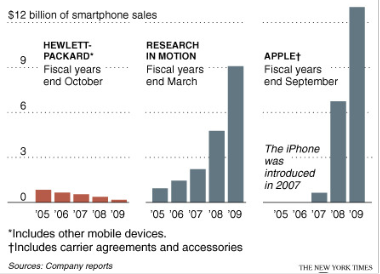
Sales of H.P.’s hand-held products, including its iPaq smartphone, dropped to $25 million in the quarter, down from $57 million in the same period last year. Apple, by contrast, had sales of $5.6 billion for iPhones and related products during its most recent quarter.
To put it in more perspective, $25 million at an ASP of $350 a phone means HP sold about 70k phones last quarter, or what Apple sold every 17 hours.
When I heard about Android being positioned against the iPhone, I thought about how that decision must have been justified internally at Google. I wondered how Andy Rubin added up the benefits of his product vs. the risks of losing whatever value Google derived from the iPhone.
On the benefits side, Android’s original business plan called for zero direct revenues with indirect revenues from search. The actual value would be somewhat dubious during the half decade it will take to get a significant installed base. Of course, with the Google-as-retailer model, Android can also be justified as earning some margin from devices, but as we’ve seen, these numbers don’t add up to much.
On the risk side there is the potential loss of the screen real estate on the iPhone (see photo above). Being the default search engine in mobile Safari might be worth hundreds of millions to Google.
Silicon Alley Insider reports a rumor that Apple's current deal with Google to provide default search functionality for the iPhone is currently worth over $100 million per year to Apple in revenue sharing.
So the iPhone may be a bigger money maker for Google than Android will, at least for a long time.
Which begs the question of whether by picking a fight with Apple, Android is biting the hand that feeds it.
If there is any logic to this Android adventure it might be that Google really feels it needs to have an option on the future mobile computing platform and that Android is worth the risk of losing placement on the iPhone.
I, for one, don’t think this is a risk worth taking.